
 100% FREE ACCESS
10th Standard CBSE Syllabus & Materials
10th Standard CBSE
CBSE 10th Social Science ECO - Globalisation and the Indian Economy - New Model Questions Papers Study Material - QB365 Set A
NEW10th Standard CBSE
CBSE 10th Social Science ECO - Money and Credit - New Model Questions Papers Study Material - QB365 Set A
NEW10th Standard CBSE
CBSE 10th Social Science ECO - Sectors of the Indian Economy - New Model Questions Papers Study Material - QB365 Set A
NEW10th Standard CBSE
CBSE 10th Social Science ECO - Development - New Model Questions Papers Study Material - QB365 Set A
NEW10th Standard CBSE
CBSE 10th Social Science PS - Outcomes of Democracy - New Model Questions Papers Study Material - QB365 Set A
NEW10th Standard CBSE
CBSE 10th Social Science PS - Gender, Religion and Caste - New Model Questions Papers Study Material - QB365 Set A

Published on: 20/10/2025
Download CBSE Class 10th Standard CBSE Maths question papers, sample papers, important questions, and previous year solved papers in PDF format. Get free study materials, NCERT solutions, and exam preparation resources for Class 10th Standard CBSE Maths
Questions + Answers key
Take MCQ Maths Test
1.
In the following figure, altitudes AD and CE of ΔABC intersect each other at the point P. Show that:
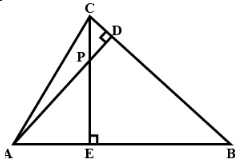
ΔPDC ∼ ΔBEC
2.
Find a relation between x and y such that the point (x , y) is equidistant from the points A (7, 1) and B (3, 5).
3.
ABCD is a trapezium in which AB || DC and its diagonals intersect each other at the point O. Show that \(\frac { AO }{ BO } =\frac { CO }{ DO } .\)
4.
If A(5,-1),B(3,-2) and C(-1,8) are the vertices of \(\triangle\)ABC, find the length of median through A.
5.
The ratio of the 5th and 3rd terms of an A.P. is 2 : 5. Find the ratio of the 15th and 7th terms.
6.
In an AP: given a3 = 15, S10 = 125, find d and a10.
7.
Which of the following are APs? If they form an AP, find the common difference d and write three more terms.
0.2, 0.22, 0.222, 0.2222,.......
8.
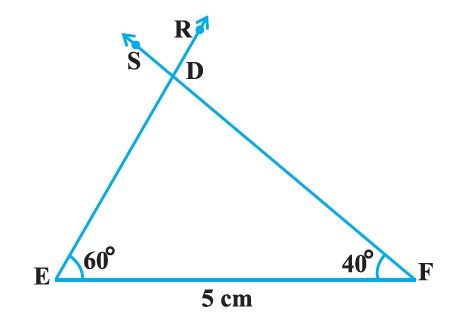
Draw two line segments BC and EF of two different lengths, say 3 cm and 5 cm respectively. Then, at the points B and C respectively, construct angles PBC and QCB of some measures, say, 60° and 40°. Also, at the points E and F, construct angles REF and SFE of 60° and 40° respectively.
9.
In the given figure, if LM II CB and LN II CD. Prove that \(\frac { AM }{ AB } =\frac { AN }{ AD } .\)
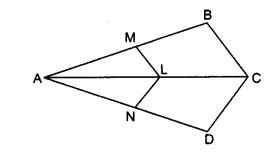
Use the basic proportionality theorem in both \(\Delta\)ABC and \(\Delta\)ACD
10.
If the co-ordinates of points A and B are (-2, -2) and (2, -4) respectively, find the co-ordinate of P such that \(AP=\frac{3}{7}AB\), where P lies on the line segment AB.
11.
ABCD is a parallelogram with vertices A (x1,y1), B(x2,y2) and C(x3y3). Find the coordinates of the fourth vertex D in terms of x1,x2,x3,y1,y2 and y3
12.
In an A.P. if Sn=3n2+5n and ak=164, find the value of k.
13.
In a flower bed, there are 23 rose plants in the first row, 21 in the second, 19 in the third, and so on. There are 5 rose plants in the last row. How many rows are there in the flower bed?
14.
Find the sum of all multiples of 5 lying between 101 and 999.
15.
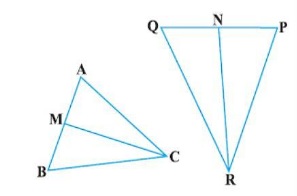
In figure CM and RN are respectively the medians of Δ ABC and Δ PQR. If Δ ABC ~ Δ PQR, prove that :
\(\frac{\mathrm{CM}}{\mathrm{RN}}=\frac{\mathrm{AB}}{\mathrm{PQ}}\)
16.
In a potato race, a bucket is placed at the starting point, which is 5 m from the first potato, and the other potatoes are placed 3 m apart in a straight line. There are ten potatoes in the line (see Fig)
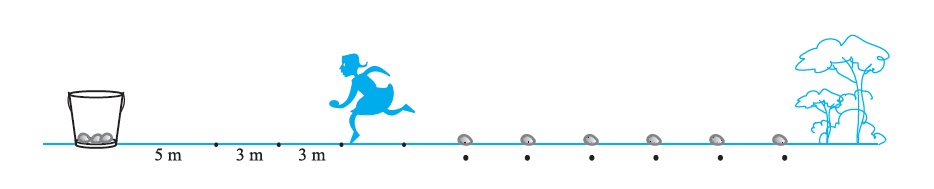
A competitor starts from the bucket, picks up the nearest potato, runs back with it, drops it in the bucket, runs back to pick up the next potato, runs to the bucket to drop it in, and she continues in the same way until all the potatoes are in the bucket. What is the total distance the competitor has to run?
[To pick up the first potato and the second potato, the total distance (in metres) run by a competitor is 2 x 5 + 2 x (5 + 3)]
17.
Diagonals AC and BD of a trapezium ABCD with \(AB\parallel DC\) intersect each other at the point O. Using a similarity criterion for two triangles, show that \(\frac { OA }{ OC } =\frac { OB }{ OD } \) .
18.
If two vertices of an equilateral triangle be (0, 0) (3, \(\sqrt { 3 } \) ). Find the third vertex.
19.
Find the coordinates of the points P,Q and R which divide the line segment joining A(5,4) and B(11,6) into four equal parts.
20.
A long a road lies a odd number of stones placed at intervals of 10 metres. These stones have to be assembled around the middle stone. A person can carry only one stone at a time. A man carried the job with one of the end stones by carrying them in succession. In carrying all the stones he covered a distance of 3 km. Find the number of stones.
21.
The value of k, if (6, k) lies on the line represented by x - 3y + 6 = 0, is
-4
12
-12
4
22.
The distance between the points \(P\left(-\frac{11}{3}, 5\right)\) and \(Q\left(-\frac{2}{3}, 5\right)\) is
6 units
2 units
4 units
3 units
23.
In a right angled \(\Delta\)ABC, \(\angle\)A = 90° and AB = AC. The value of sin C is
0
\(\frac{\sqrt{3}}{2}\)
\(\frac{1}{2}\)
\(\frac{1}{\sqrt{2}}\)
24.
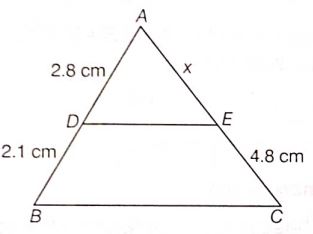
If in the given figure, DE || BC.
If AD = 2.8 cm, DB = 2.1 cm and EC = 4.8 cm, then the value of x is
3.6 cm
2.4 cm
6.4 cm
4.8 cm
25.
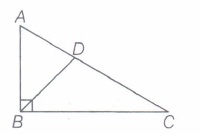
In the figure given below, ∠ABC = 90°, AD = 15 cm and DC = 20 cm, If BD is the bisector of ∠ABC, What is the perimeter of the triangle ABC?
74 cm
84 cm
91 cm
105 cm
26.
In Δ ABC and Δ DEF, ∠B = ∠E, ∠F = ∠C and AB = 3DE. Then, the two triangles are
congruent but not similar
similar but not congruent
neithercongruent nor similar
congruent as well as similar
27.
If the common difference of an AP is 5, then what is a18 - a13?
5
20
25
30
28.
11th term of the AP: – 3 ,\(-\frac{1}{2}\) ,2 , ..., is
28
22
- 38
\(-48 \frac{1}{2}\)
29.
30th term of the AP: 10, 7, 4, . . . , is
97
77
- 77
- 87
30.
The number of two digit numbers divisible by 5 is
17
16
19
18
31.
The weights of 11 students selected for a team are noted in ascending order and are in A. P. The lowest value is 45 Kg, and the middle value is 55 Kg. What is the difference between the two values placed consecutively ?
3
4
2
6
32.
Ramesh’s salary in February 2008 is Rs. 10,000. If he’s promised an increase of Rs. 1000 every year, what would be his salary in Feb 2011
Rs.14,000
Rs. 12,000
Rs. 13,000
Rs. 15,000
33.
In the given figure AD=2 cm, DB=5cm AC=21 cm and DE ll BC.Find AE =?
6
5
8
7
34.
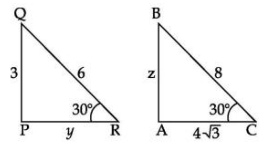
In figure, ΔABC ~ ΔPQR
2 + √3
4 + √3
3 + 4√3
4 + 3√3
35.
The sum of the first three terms of an AP is 33. If the product of the first and the third term exceeds the second term by 29, the AP is ?
2 ,21,11
1,10,19
-1 ,8,17
2 ,11,20
36.
The perimeter of the triangle formed by the points A(0,0), B(1,0) and C(0,1) is
√2 + 1
1 ± √2
2 + √2
3
37.
The ordinate of a point is twice its abscissa. If its distance from the point (4,3) is \(\sqrt { 10 } \) ,then the coordinates of the point are
(1,2) or (3,6)
(1,2) or (3,5)
(2,1) or (3,6)
(2,1) or (6,3)
38.
The coordinates of the centre of a circle passing through (1, 2), (3, – 4) and (5, – 6) is:
(11, – 2)
(-2, 11)
(11, 2)
(2, 11)
39.
Assertion (A) : \(-5, \frac{-5}{2}, 0, \frac{5}{2}, \ldots\) is an arithmetic progression.
Reason (R) : The terms of an arithmetic progression cannot have both positive and negative rational numbers.(a) Both Assertion and Reason are correct and Reason is the correct explanation of Assettion.
(b) Both Assertion and Reason are correct but Reason is not the correct explanation of Assertion.
(c) Assertion is correct but Reason is incorrect.
(d) Assertion is incorrect but Reason is correct.
40.
Assertion : PArea of the triangle whose vertices are \(A\left(\frac{-3}{2}, 3\right), B(6,-2) \text { and } C(-3,4)\) ) is 0.
Reason: The points A, Band Care collinear.
Codes :
(a) If both Assertion and Reason are correct and Reason is the correct explanation of Assertion. -
(b) If both Assertion and Reason are correct, but Reason is not the correct explanation of Assertion.
(c) If A~sertion is correct but Reason is incorrect.
(d) If Assertion is incorrect but Reason is correct.
41.
In an examination hall, students are seated at a distance of 2 m from each other, to maintain the social distance due to CORONA virus pandemic. Let three students sit at points A, Band C whose coordinates are (4, -3), (7,3) and (8, 5) respectively.
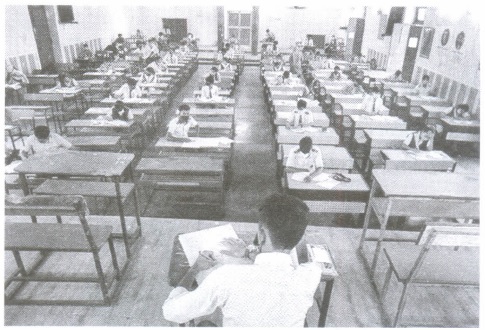
Based on the above information, answer the following questions.
(i) The distance between A and C is
| (a) \(\sqrt{5}\) units | (b) \(4\sqrt{5}\) units | (c) \(3\sqrt{5}\) units | (d) none of these |
(ii) If an invigilator at the point I, lying on the straight line joining Band C such that it divides the distance between them in the ratio of 1 : 2. Then coordinates of I are
| \((a) \left(\frac{22}{3}, \frac{11}{3}\right)\) | \((b) \left(\frac{23}{3}, \frac{13}{3}\right)\) | (c) (6,1) | (d) (9,1) |
(iii) The mid-point of the line segment joining A and C is
| (a) (1.6) | (b) (6.1) | \(\text { (c) }\left(\frac{11}{2}, 0\right)\) | (d) none of these |
(iv) The ratio in which B divides the line segment joining A and C is
| (a) 2:1 | (b) 3:1 | (c) 1:2 | (d) none of these |
(v) The points A, Band C lie on
| (a) a straight line | (b) an equilateral triangle |
| (c) a scalene triangle | (d) an isosceles triangle |
42.
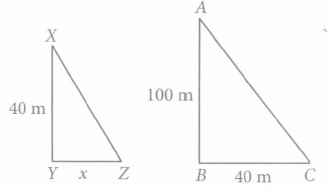
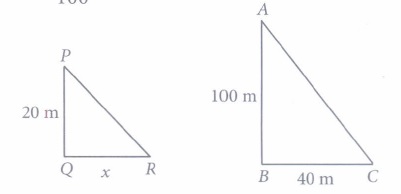
Meenal was trying to find the height of tower near his house. She is using the properties of similar triangles. The height of Meenal's house is 20 m. When Meenal's house casts a shadow of 10m long on the ground, at the same time, tower casts a shadow of 50 m long and Arun's house casts a shadow of 20 m long on the ground as shown below.
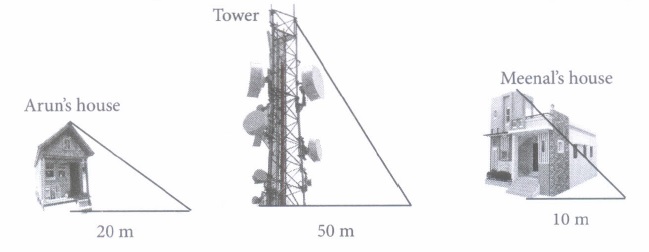
Based on the above information, answer the following questions.
(i) What is the height of tower?
| (a) 100 m | (b) 50 m | (c) 15 m | (d) 45 m |
(ii) What will be the length of shadow of tower when Meenal's house casts a shadow of 15 m?
| (a) 45 m | (b) 70 m | (c) 75 m | (d) 72 m |
(iii) Height of Aruns house is
| (a) 80 m | (b) 75 m | (c) 60 m | (d) 40 m |
(iv) If tower casts a shadow of 40 rn, then find the length of shadow of Arun's house
| (a) 18 m | (b) 17 m | (c) 16 m | (d) 14 m |
(v) If tower casts a shadow of 40 m, then what will be the length of shadow of Meenal's house?
| (a) 7 m | (b) 9 m | (c) 4 m | (d) 8 m |
43.
Meenas mother start a new shoe shop. To display the shoes, she put 3 pairs of shoes in 1st row,S pairs in 2nd row, 7 pairs in 3rd row and so on.
On the basis of above information, answer the following questions.
(i) If she puts a total of 120 pairs of shoes, then the number of rows required are
| (a) 5 | (b) 6 | (c) 7 | (d) 10 |
(ii) Difference of pairs of shoes in 17th row and 10th row is
| (a) 7 | (b) 14 | (c) 21 | (d) 28 |
(iii) On next day, she arranges x pairs of shoes in 15 rows, then x =
| (a) 21 | (b) 26 | (c) 31 | (d) 42 |
(iv) Find the pairs of shoes in 30th row.
| (a) 61 | (b) 67 | (c) 56 | (d) 59 |
(v) The total number of pairs of shoes in 5th and 8th row is
| (a) 7 | (b) 14 | (c) 28 | (d) 56 |
1.
Given, AD and CE are altitudes which intersect each other at the point P.
In ΔPDC and ΔBEC,
∠PDC = ∠BEC [each 90°]
and ∠PCD = ∠BCE [Common angle]
\(\therefore\) ΔPDC ∼ ΔBEC [by AA similarity criterion]
2.
Given point P(x, y) is equidistant from the points A(7, 1) and B(3, 5).
So, AP = BP
\(\Rightarrow\) AP2 = BP2
\(\Rightarrow\) (x - 7)2 + (y - 1)2 = (x - 3)2 + (y - 5)2
\(\left[\because \text { distance }=\sqrt{\left(x_2-x_1\right)^2+\left(y_2-y_1\right)^2}\right]\)
\(\Rightarrow\) x2 + 49 - 14x + y2 + 1 - 2y
= x2 + 9 - 6x + y2 + 25 - 10y
\(\Rightarrow\) -14x - 2y + 50 = -6x - 10y + 34
\(\Rightarrow\) -6x - 10y + 14x + 2y = 50 - 34
\(\Rightarrow\) 8x - 8y = 16
\(\Rightarrow\) x - y = 2
[dividing by 8 on both sides]
Hence, the relation between x and y is x - y = 2.
3.
In \(\triangle\)AOB and \(\triangle\)COD,
AB || CD
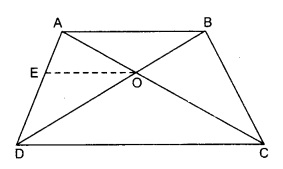
OAB = DCO and OBA = ODC (Alternate angles)
\(\triangle\)AOB ~\(\triangle\)COD (AA similarity)
\(\therefore \frac { AO }{ BO } =\frac { CO }{ DO } .\\ \) (Corresponding sides of similar triangles)
or \(\frac { AO }{ CO } =\frac { BO }{ DO } \)
4.
Mid-point of BC is D and coordinates of D are
\(D\left( \frac { 3-1 }{ 2 } ,\frac { -2+8 }{ 2 } \right) i.e.,D(1,3)\)
Now, \(|AD|=\sqrt { \left( 1-5 \right) ^{ 2 }+\left( 3+1 \right) ^{ 2 } } \)
\(=\sqrt { \left( -4 \right) ^{ 2 }+\left( 4 \right) ^{ 2 } } =\sqrt { 16+16 } \)
\(=4\sqrt { 2 } units\)
5.
20 : 23
6.
Here, a3 = 15 and S10 = 125
\(\because\) a3 = 15
\(\therefore\) a + 2d = 15 ....(i)
[\(\because\) an = a + (n - 1)d]
Also, S10 = 125
\(\begin{aligned} \therefore \quad \frac{10}{2}[2 a+(10-1) d] & =125 \\ \end{aligned}\)
\(\begin{aligned} {\left[\because S_n\right.} & \left.=\frac{n}{2}\{2 a+(n-1) d\}\right] \end{aligned}\)
\(\Rightarrow\) 2a + 9d = 25 [dividing by 5] .....(ii)
On multiplying Eq. (i) by 2 and then subtracting Eq. (ii) from it, we get
2(a + 2d) - (2a + 9d) = 2 \(\times\)15 - 25
\(\Rightarrow\) 4d - 9d = 30 - 25
\(\Rightarrow\) -5d = 5
\(\Rightarrow \quad d=-\frac{5}{5}=-1\)
Now, a10 = a + 9d
= (a + 2d) + 7d
= 15 + 7(-1) [from Eq. (i)]
= 15 - 7 = 8
Hence, d = -1 and a10 = 8.
7.
Here, we have a2 - a1 = 0.22 - 0.2 = 0.02
and a3 - a2 = 0.222 - 0.22 = 0.002
Since, a2 - a1 \(\neq\) a3 - a2, therefore the given list of numbers does not form an AP.
8.
Let rays BP and CQ intersect each other at A and rays ER and FS intersect each other at D. In the two triangles ABC and DEF, you can see that ∠ B = ∠ E, ∠ C = ∠ F and Ð A = ∠ D. That is, corresponding angles of these two
triangles are equal. What can you say about their corresponding sides. Note that \(\frac{\mathrm{BC}}{\mathrm{EF}}=\frac{3}{5}=0.6\) What about \(\frac{\mathrm{AB}}{\mathrm{DE}} \text { and } \frac{\mathrm{CA}}{\mathrm{FD}} \) On measuring AB, DE, CA and FD, you will find that \(\frac{\mathrm{AB}}{\mathrm{DE}} \text { and } \frac{\mathrm{CA}}{\mathrm{FD}}\) are also equal to 0.6 (or nearly equal to 0.6, if there is some error in the measurement). Thus, \(\frac{\mathrm{AB}}{\mathrm{DE}}=\frac{\mathrm{BC}}{\mathrm{EF}}=\frac{\mathrm{CA}}{\mathrm{FD}}\) You can repeat this activity by constructing several pairs of triangles having their corresponding angles equal. Every time, you will find that their corresponding sides are in the same ratio (or proportion). This activity leads us to the following criterion for similarity of two triangles.
9.
In \(\Delta\)ACB, LM || CB [given]
\(\Rightarrow \quad \frac{A M}{M B}=\frac{A L}{L C}\) ....(i)
[ by basic proportionality theorem]
In \(\Delta\)ACD, LN ||CD [given]
\(\Rightarrow \quad \frac{A N}{N D}=\frac{A L}{L C}\) ....(ii)
[by basic proportionality theorem]
From Eqs. (i) and (ii), we get
\(\frac{A M}{M B}=\frac{A N}{N D} \Rightarrow \frac{M B}{A M}=\frac{N D}{A N}\)
[on taking reciprocal of the terms]
\(\Rightarrow \quad \frac{M B}{A M}+1=\frac{N D}{A N}\) + 1 [adding 1 on both sides]
\(\begin{aligned} & \Rightarrow \quad \frac{M B+A M}{A M}=\frac{N D+A N}{A N} \\ \end{aligned}\)
\(\begin{aligned} \Rightarrow \quad \frac{A M}{A M+M B}=\frac{A N}{A N+N D} \end{aligned}\)
[on taking reciprocal of the terms]
\(\therefore \quad \frac{A M}{A B}=\frac{A N}{A D} \quad\left[\begin{array}{c} \because A D=A N+N D \\ \text { and } A B=A M+M B \end{array}\right]\)
Hence proved.
10.
\(AP=\frac { 3 }{ 7 } AB\Rightarrow AP:PB=3:4\)
\(x=\frac{6-8}{7}=-\frac{2}{7}\)
\(\therefore \ y=\frac{-12-8}{7}=-\frac{20}{7}\)
\(P=(-\frac{2}{7},-\frac{20}{7})\)
11.
Let the coordinates of the fourth vertex D be D(x, y). We know that diagonals of a parallelogram bisect each other.
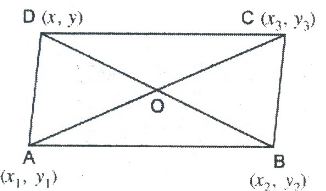
Therefore mid point of AC=midpoint of BD
\(\Rightarrow \) \(\left( \frac { { x }_{ 1 }+{ x }_{ 3 } }{ 2 } ,\frac { { y }_{ 1 }+y_{ 3 } }{ 2 } \right) =\left( \frac { { x }+{ x }_{ 2 } }{ 2 } ,\frac { { y }+y_{ 2 } }{ 2 } \right) \)
\(\Rightarrow \) \(\frac { { x }_{ 1 }+{ x }_{ 3 } }{ 2 } =\frac { { x }+{ x }_{ 2 } }{ 2 } \)
and \(\frac { y_{ 1 }+y_{ 3 } }{ 2 } =\frac { { y }+{ y }_{ 2 } }{ 2 } \)
\(\Rightarrow \) x1+x3=x+x2 and y1+y3=y+y2
\(\Rightarrow \) x=x1+x3 +x2 and y=y1+y3-y2
Hence,the coordinates of the fourth vertex in terms of x1,x2,x3,y1,y2 and y3 are
(x1+x3-x2,y1+y3-y2)
12.
Here, Sn = 3n2 + 5n ...(i)
Sn-1 = 3 ( n - 1 )2 + 5 ( n - 1 )
= 3 ( n2 + 1 - 2n ) + 5n - 5
= 3n2 + 3 - 6n + 5n - 5
= 3n2 - n - 2 ...(ii)
From (i), (ii), we obtain
Sn - Sn-1 = 3n2 + 5n - ( 3n2 - n - 2 )
an = 3n2 + 5n - 3n2 + n + 2
an = 6n + 2
Put n = k, we have
ak = 6k + 2
\(\Rightarrow\) 164 = 6k + 2
\(\Rightarrow\) 6k = 162
\(\Rightarrow\) k = 27
13.
The number of rose plants in the 1st, 2nd, 3rd, . . ., rows are :
23, 21, 19, . . ., 5
It forms an AP . Let the number of rows in the flower bed be n.
Then a = 23, d = 21 – 23 = – 2, an = 5
As, an = a + (n – 1) d
We have, 5 = 23 + (n – 1) (– 2)
i.e., – 18 = (n – 1) (– 2)
i.e., n = 10
So, there are 10 rows in the flower bed.
14.
Multiples of 5 lying between 101 and 999 are 105, 110, 115,......., 999 which are in AP.
Here a = 105 and d = 5.
an = a + (n - 1)d
995 = 105 + n(n -1)5
890 = 5n - 5
895 = 5n
n = 179
Sn = \(\frac{n}{2}\)[a + l] = \(\frac{179}{2}\)[105 + 995] = \(\frac{179}{2}\) x 1100 = 98450.
15.
From \(\frac{\mathrm{CM}}{\mathrm{RN}}=\frac{\mathrm{CA}}{\mathrm{RP}}\)
But, \(\frac{\mathrm{CA}}{\mathrm{RP}}=\frac{\mathrm{AB}}{\mathrm{PQ}}\) [From (1)]
Therefore, \(\frac{\mathrm{CM}}{\mathrm{RN}}=\frac{\mathrm{AB}}{\mathrm{PQ}}\) [From (6) and (7)]
16.
It can be observed that the numbers of logs in rows are in an A.P.
20, 19, 18…
For this A.P.,
a = 20
d = a2 − a1 = 19 − 20 = −1
Let a total of 200 logs be placed in n rows.
Sn = 200
\(S_{n}=\frac{n}{2}[2 a+(n-1) d]\)
\(200=\frac{n}{2}[2(20)+(n-1)(-1)]\)
400 = n (40 − n + 1)
400 = n (41 − n)
400 = 41n − n2
n2 − 41n + 400 = 0
n2 − 16n − 25n + 400 = 0
n (n − 16) −25 (n − 16) = 0
(n − 16) (n − 25) = 0
Either (n − 16) = 0 or n − 25 = 0
n = 16 or n = 25
an = a + (n − 1)d
a16 = 20 + (16 − 1) (−1)
a16 = 20 − 15
a16 = 5
Similarly,
a25 = 20 + (25 − 1) (−1)
a25 = 20 − 24
= −4
Clearly, the number of logs in 16th row is 5. However, the number of logs in 25th row is negative, which is not possible.
Therefore, 200 logs can be placed in 16 rows and the number of logs in the 16th row is 5.
17.
Consider a trapezium ABCD such that \(AB\parallel DC\) and draw its diagonals AC and BD which intersect at point O.
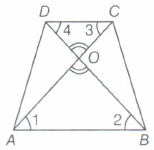
In \(\triangle OCD\) and \(\triangle OAB\),
\(AB\parallel DC\) [given]
\(\therefore \angle 1=\angle 3,\angle 2=\angle 4\) [alternate interior angles]
Also, \(\triangle DOC=\triangle BOA\) [vertically opposite angles]
\(\therefore \triangle OCD\sim \triangle OAB\) [by AAA similarity criterion]
\(\Rightarrow \frac { OC }{ OA } =\frac { OD }{ OB } \)
[since, ratios of the corresponding sides of the similar triangles are equal]
\(\therefore \frac { OA }{ OC } =\frac { OB }{ OD } \) [on taking reciprocal of the terms]
Hence proved.
18.
(0, \(2\sqrt { 3 } \)) or (3, -\(\sqrt { 3 } \))
19.
\(P({13\over 2},{9\over 2})\), Q(8,5), R\(({19\over 2}, {11\over2})\)
20.
-s.png)
Let there are ( 2n + 1 ) stones. Middle stone is at B. There are n stones on one side of the middle stone and n stones on other side of the middle stone.
Let the man starts from A.
He picks the stone and travels to B.|
\(\therefore\) Distance covered = 10n m
He comes back to pick the next stone and goes back to B.
Distance covered = 10 x ( n - 1) + 10 ( n - 1 )
= 2 x 10( n - 1)m
Simliarly, distance coverd to pick and place that stone at B.
= 2 X 10( n - 2) m and so on
Now total distance covered,
S1 = 10 x n + 2 x 10( n - 1 ) + 2 x 10( n - 2 ) + .. up to n terms
S1 = [ 2 x 10n + 2 x 10( n - 1 ) + 2 x 10 x ( n - 2 ) + .... up to n terms ] -10n
S1 = 20 [ n + ( n - 1) + ( n - 2 ) + ... up to n terms] - 10n
S1 = \(\left[ 20\times{n(n+1)\over2} -10n\right]m\)
Now to pick the stone at C, he will walk from B to C and then will come back to B, In order to pick all the stones, total distance covered will be S1 + distance covered from B to C.
= S1 + 10n
Total distance covered = 3 km
\(\Rightarrow\) S1 + S2 + 10n = 3000
\(\Rightarrow\) \(\left[ 20\times{n(n+1)\over2} -10n\right]+\left[ 20\times{n(n+1)\over2} *10n\right]+10n=3000\)
\(\Rightarrow\) 10( n2 + n ) - 10n + 10 ( n2 + n ) = 3000
\(\Rightarrow\) 20n2 + 10n - 3000 = 0
\(\Rightarrow\) 2n2 + n - 300 = 0
\(\Rightarrow\) 2n2 + 25n -24n - 300 = 0
\(\Rightarrow\) n( 2n + 25 ) - 12 ( 2n + 25 ) = 0
\(\Rightarrow\) ( 2n + 25 ) ( n - 12 ) = 0
\(\Rightarrow\) \(n={{-25}\over2}\) or n = 12
rejecting \(n={-25\over2}\)
\(\therefore\) n = 12
\(\therefore\) Total number of stones
= 2n + 1 = 2 x 12 + 1 = 25.
21.
(d)
4
22.
(d)
3 units
23.
(d)
\(\frac{1}{\sqrt{2}}\)
24.
(c)
6.4 cm
25.
(b)
84 cm
26.
(b)
similar but not congruent
27.
(c)
25
28.
(b)
22
29.
(c)
- 77
30.
(d)
18
31.
(c)
2
32.
(c)
Rs. 13,000
33.
(a)
6
34.
(d)
4 + 3√3
35.
(d)
2 ,11,20
36.
(c)
2 + √2
37.
(a)
(1,2) or (3,6)
38.
(c)
(11, 2)
39.
(c) Assertion is correct but Reason is incorrect.
40.
(a) Assertion Area of \(\triangle A B C\)
\(=\frac{1}{2}\left|\frac{-3}{2}(-2-4)+6(4-3)+(-3)(3+2)\right|\)
\(=\frac{1}{2}|9+6-15|=0\)
41.
(i) (b): The distance between A and C
\(=\sqrt{(8-4)^{2}+(5+3)^{2}}=\sqrt{4^{2}+8^{2}} \)
\(=\sqrt{16+64}=\sqrt{80}=4 \sqrt{5} \text { units }\)
(ii) (a): Let the coordinates of I be (x, y).
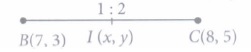
Then, by section formula
\(x =\frac{1 \times 8+2 \times 7}{1+2}=\frac{8+14}{3}=\frac{22}{3}\)
\(\text { and } y =\frac{1 \times 5+2 \times 3}{1+2}=\frac{5+6}{3}=\frac{11}{3}\)
Thus, the coordinates of I is \(\left(\frac{22}{3}, \frac{11}{3}\right)\)
(iii) (b): The mid -point of A and C
\(=\left(\frac{8+4}{2}, \frac{5-3}{2}\right)=(6,1)\)
(iv) (b): Let B divides the line segment joining A and C in the ratio k : 1. Then, the coordinates of B will be
\(\left(\frac{8 k+4}{k+1}, \frac{5 k-3}{k+1}\right)\)
\(\text { Thus, we have }\left(\frac{8 k+4}{k+1}, \frac{5 k-3}{k+1}\right)=(7,3)\)
\(\Rightarrow \frac{8 k+4}{k+1}=7 \text { and } \frac{5 k-3}{k+1}=3
\)
\(\text { Consider, } \frac{8 k+4}{k+1}=7 \Rightarrow 8 k+4=7 k+7 \Rightarrow k=3\)
Hence, the required ratio is 3 : 1
(v) (a):\(\because\) B divides AC in the ratio 3 : 4.
\(\therefore\) A, B, C lie on a straight line.
42.
(i) (a): Since \(\Delta\)ABC - \(\Delta\)PQR
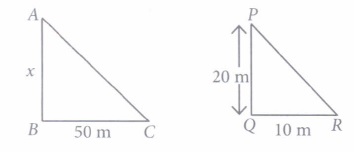
\(\therefore \quad \frac{A B}{P Q}=\frac{B C}{Q R} \Rightarrow \frac{x}{20}=\frac{50}{10} \Rightarrow x=100\)
Thus, height of tower is 100 m.
(ii) (c): Since \(\Delta\)ABC - \(\Delta\)PQR
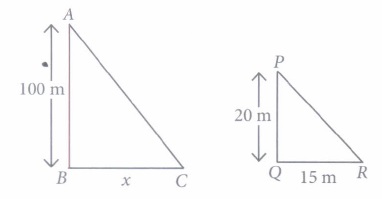
\(\therefore \quad \frac{100}{20}=\frac{x}{15} \Rightarrow x=\frac{1500}{20}=75 \mathrm{~m}\)
(iii) (d): Since, the shapes are similar
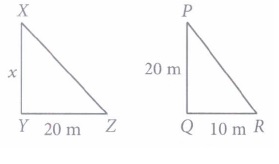
\(\therefore \quad \frac{x}{20}=\frac{20}{10} \)
\(\Rightarrow \quad x=\frac{20 \times 20}{10}=40 \mathrm{~m}\)
(iv) (b): Since, the shapes are similar, so, \(\frac{40}{100}=\frac{x}{40}\)
\(\Rightarrow\) x = 16m
(v) (d): Since, the shapes are similar, so \(\frac{20}{100}=\frac{x}{40}\)
\(\Rightarrow \quad x=\frac{20 \times 40}{100}=8 \mathrm{~m}\)
43.
Number of pairs of shoes in 1st, 2nd, 3rd row, ... are 3,5,7, ...
So, it forms an A.P. with first term a = 3, d = 5 - 3 = 2
(i) (d): Let n be the number of rows required.
\(\therefore S_{n}=120 \)
\(\Rightarrow \quad \frac{n}{2}[2(3)+(n-1) 2]=120 \)
\(\Rightarrow \quad n^{2}+2 n-120=0 \Rightarrow n^{2}+12 n-10 n-120=0\)
\(\Rightarrow \quad(n+12)(n-10)=0 \Rightarrow n=10\)
So, 10 rows required to put 120 pairs.
(ii) (b): No. of pairs in 1ih row = t17 = 3 + 16(2) = 35
No. of pairs in 10th row = t10 = 3 + 9(2) = 21
\(\therefore\) Required difference = 35 - 21 = 14
(iii) (c) : Here n = 15
\(\therefore\) t15 = 3 + 14(2) = 3 + 28 = 31
(iv) (a): No. of pairs in 30th row = t30 = 3 +29(2) = 61
(v) (c): No. of pairs in 5th row = t5 = 3 + 4(2) = 11
No. of pairs in 8th row = t8 = 3 + 7(2) = 17
\(\therefore\) Required sum = 11 + 17 = 28

10th Standard CBSE Syllabus & Materials
10th Standard CBSE
CBSE 10th Social Science PS - Federalism - New Model Questions Papers Study Material - QB365 Set A
NEW10th Standard CBSE
CBSE 10th Social Science PS - Power Sharing - New Model Questions Papers Study Material - QB365 Set A
NEW10th Standard CBSE
CBSE 10th Social Science GEO - Manufacturing Industries - New Model Questions Papers Study Material - QB365 Set A
NEW10th Standard CBSE
CBSE 10th Social Science GEO - Minerals and Energy Resources - New Model Questions Papers Study Material - QB365 Set A



NCERT Books

Syllabus

Exam Pattern

Sample Question Papers

Previous year Question Papers

Important Notes

MCQ Practice test

NCERT Exemplers

Case study Questions

Image Based Questions

Passage based Questions

HOT Questions

Value Based Questions

Model Questions Papers
NCERT ( Book Back ) Questions

Assertion and Reason
Important Questions And Answers

CBSE 10th Standard CBSE Subjects
CBSE Standards



