
 100% FREE ACCESS
10th Standard CBSE Syllabus & Materials
10th Standard CBSE
CBSE 10th Social Science ECO - Globalisation and the Indian Economy - New Model Questions Papers Study Material - QB365 Set A
NEW10th Standard CBSE
CBSE 10th Social Science ECO - Money and Credit - New Model Questions Papers Study Material - QB365 Set A
NEW10th Standard CBSE
CBSE 10th Social Science ECO - Sectors of the Indian Economy - New Model Questions Papers Study Material - QB365 Set A
NEW10th Standard CBSE
CBSE 10th Social Science ECO - Development - New Model Questions Papers Study Material - QB365 Set A
NEW10th Standard CBSE
CBSE 10th Social Science PS - Outcomes of Democracy - New Model Questions Papers Study Material - QB365 Set A
NEW10th Standard CBSE
CBSE 10th Social Science PS - Gender, Religion and Caste - New Model Questions Papers Study Material - QB365 Set A

Published on: 20/10/2025
Download CBSE Class 10th Standard CBSE Maths question papers, sample papers, important questions, and previous year solved papers in PDF format. Get free study materials, NCERT solutions, and exam preparation resources for Class 10th Standard CBSE Maths
Questions + Answers key
Take MCQ Maths Test
1.
If α and β are the zeroes of the quadratic polynomial p(x)=4x2-5x+1, then find the value of α2β+β2α.
2.
For what value of k, 3 is a zero of the polynomial 2x2+x+k?
3.
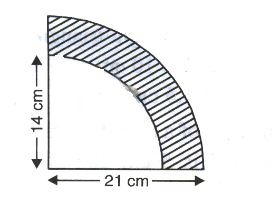
Find the area of shaded region in the given figure.
4.
The perimeter of a sector of a circle of radius 5.2 cm is 16.4 cm. Find the area of the sector.
5.
The length of the minute hand of a clock is 14 cm. Find the area swept by the minute hand in 5 minutes.
6.
Find the 12th term of the AP with first term 9 and common difference 10.
7.
Thro tankers contain 850 Land 680 L of petrol, respectively. Find the maximum capacity of a container which can measure the petrol of either tanker, in exact number of times.
8.
Find a quadratic polynomial, whose sum and product of the zeroes are \(-\frac { 8 }{ 3 } \) and \(\frac { 4 }{ 3 } \), respectively. Also, find the zeroes of this polynomial by factorisation.
9.
If α and β are zeroes of a quadratic polynomial x2 -5, then form a quadratic polynomial whose zeroes are 1+α and 1+β.
10.
A chord of a circle of radius 12cm subtends an angle of 1200 at the centre.Find the area of the corresponding segment of the circle.[Use \(\pi=3.14\ and\ \sqrt{3}=1.73\)]
11.
AB is a diameter of a circle. AH and BK are perpendicular from A and B respectively to the tangent at P.Prove that AH + BK = AB.
12.
In two concentric circles, a chord of length 24 cm of larger circle becomes a tangent to the smaller circle whose radius is 5 cm. Find the radius of the larger circle.
13.
How many terms of AP : 9, 17, 25,........ must be taken to give a sum of 636?
14.
If \(\alpha\) and \(\beta\) are zeroes of the polynomial p(x) = 6x2 - 5x + k such that \(\alpha-\beta=\frac{1}{6}\), find the value of k.
15.
In the adjoining figure, a circle touches all the four sides of a quadrilateral ABCD whose three sides are AB = 6 cm. BC = 7 cm and CD = 4 cm. Find the length of AD.
16.
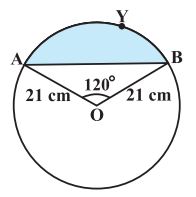
Find the area of the segment AYB shown in Figure, if radius of the circle is 21 cm and \(\angle \mathrm{AOB}=120^{\circ} .\left(\text { Use } \pi=\frac{22}{7}\right)\)
17.
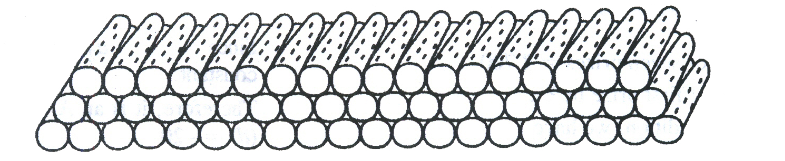
200 logs are stacked in the following manner: 20 logs in the bottom row, 19 in the next row, 18 in the row next to it and so on.
(i) In how many rows are the 200 logs placed and how many logs are in the top row?
(ii) Which value is depicted in the pattern of log?
18.
The sum of the first five terms of an AP and the first seven terms of the same AP is 167. If the sum of the first ten terms of this AP is 235, find the sum of its first twenty terms.
19.
The 8th term of an AP is 17 and its 14 th term is 29. The common difference of this AP is
3
2
5
-2
20.
HCF of two numbers is 27 and their LCM is 162 of the number is 54, then the other number is
36
35
9
81
21.
If HCF (72, 120)=24, then LCM ( 72, 120) is
72
120
360
9640
22.
A tangent PQ at a point P of a circle of radius 5 cm meets a line through the centre O at a point Q, so that OQ= 12 cm. Length of PQ is
12 cm
13 cm
8.5 cm
\(\sqrt119\) cm
23.
Two concentric circles are of radii 10 cm and 8 cm, then the length of the chord of the larger circle which touches the smaller circle is
6 cm
12 cm
18 cm
9 cm
24.
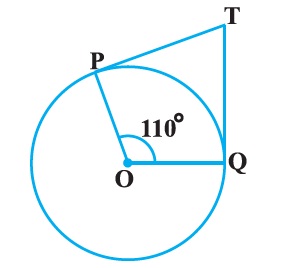
In the given figure, if TP and TQ are the two tangents to a circle with centre O so that \(\angle POQ\)= 110°, then \(\angle PTQ\) is equal to
60°
70°
80°
90°
25.
Tick the correct answer in the following:
Area of a sector of angle P (in degrees) of a circle with radius R is
\({P \over 180^o}\times 2\pi R\)
\({P \over 180^o}\times \pi R^2\)
\({P \over 360^o}\times 2\pi R\)
\({P \over 720^o}\times 2\pi R^2\)
26.
The first four terms of an AP whose first term is - 2 and the common difference is-2 are
- 2, 0,2, 4
- 2, 4, - 8, 16
- 2, - 4, - 6, - 8
- 2, - 4, - 8, - 16
27.
11th term of the AP: – 3 ,\(-\frac{1}{2}\) ,2 , ..., is
28
22
- 38
\(-48 \frac{1}{2}\)
28.
30th term of the AP: 10, 7, 4, . . . , is
97
77
- 77
- 87
29.
A circular field has a circumference of 360 km. TWo cyclists Sumeet and John start together and can cycle at speeds of 12 km!h and 15 km/h respectively, round the circular field. They will meet again at the starting point after
40 h
30 h
180 h
120 h
30.
The graph of y = p(x) is given below. The number of zeroes of p(x) are
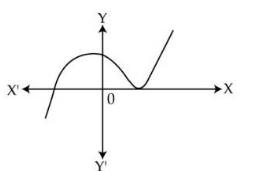
3
0
4
2
31.
The number of polynomials having zeroes -2 and 5 is:
1
3
2
more than 3
32.
If a prime number p divides a2 , then which one of the following is true?
p divides a
p = a
p > a
a divides p
33.
If O is the centre of the circle, and OA and OB are two radii, find the ratio of the area of the sector AOB to the area of the circle, if ㄥAOB = 60o
1:4
4:1
1:6
6:1
34.
The radii of two circles are 19 cm and 9 cm respectively. The radius of the circle which has its circumference equal to the sum of the circumferences of the two circles is:
30 cm
26 cm
32 cm
28 cm
35.
The shaded part of the circle in the given figure represents a
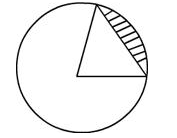
Segment
semi-circle
Sector
Chord
36.
In the given figure, PA and PB are tangents from P to a circle with centre O. If ∠AOB = 130°, then find ∠APB.
40o
55o
50o
60o
37.
Assertion : The number 5n cannot end with the digit 0. where n is a natural number.
Reason : Prime factorisation of 5 has only two factors 1 and 5.
(a) Both Assertion and Reason are correct and Reason is the correct explanation of Assertion.
(b) Both Assertion and Reason are correct but Reason is not the correct explanation of Assertion.
(c) Assertion is correct but Reason is incorrect.
(d) Assertion is incorrect but Reason is correct.
38.
Assertion In an Ap,Sn = n2 + n, then T20 = 40.
Reason In an Ap, an - an-1 = d.
Codes:
(a) If both Assertion and Reason are correct and Reason is the correct explanation of Assertion.
(b) If both Assertion and Reason are correct, but Reason is not the correct explanation of Assertion.
(c) If Assertion is correct but Reason is incorrect.
(d) If Assertion is incorrect but Reason is correct.
39.
A seminar is being conducted by an Educational Organisation, where the participants will be educators of different subjects. The number of participants in Hindi, English and Mathematics are 60, 84 and 108, respectively.
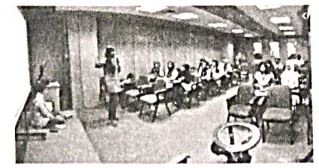
(i) In each room the same number of participants are to be seated and all of them being in the same subject, hence maximnum number participants that can accommodated in each room are
(a) 14 (b) 12 (c) 16 (d) 18
(ii) What is the minimum number of rooms required during the event?
(a) 11 (b) 31 (c) 41 (d) 21
(iii) The LCM of 60, 84 and 108 is
(a) 3780 (b) 3680 (c) 4780 (d) 4680
(iv) The product of HCF and LCM of 60, 84 and 108 is
(a) 55360 (b) 35360 (c) 45500 (d) 45360
(v) 108 can be expressed as a product of its primes as
(a) 23 \(\times\) 32 (b) 23\(\times\) 33 (c) 22 \(\times\)32 (d) 22\(\times\) 33
40.
Kritika bought a pendulum clock for her living room. The clock contains a small pendulum oflength 15 cm. The minute hand and hour hand of the clock are 9 cm and 6 cm long respectively.
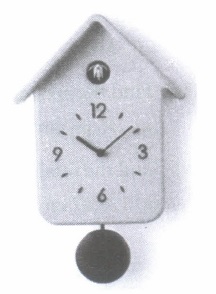
Based on the above information, answer the following questions.
(i) Find the area swept by the minute hand in 10 minutes.
| (a) 24.24 cm2 | (b) 42.42 cm2 |
| (c) 44 cm2 | (d) 44.42 cm2 |
(ii) If the pendulum covers a distance of 22 cm in one complete oscillation, then find the angle described by pendulum at the centre.
| (a) 40° | (b) 42° | (c) 45° | (d) 48° |
(iii) Find the angle described by hour hand in 10 minutes
| (a) 5° | (b) 10° | (c) 15° | (d) 20° |
(iv) Find the area swept by the hour hand in 1 hour
| (a) 7.68 cm2 | (b) 8.2 cm2 | (c) 8.86 cm2 | (d) 9.428 cm2 |
(v) Find the area swept by the hour hand between 11 a.m. and 5 p.m.
| (a) 56.568 cm2 | (b) 62 cm2 | (c) 70 cm2 | (d) 72cm2 |
41.
Amit was playing a number card game. In the game, some number cards (having both +ve or -ve numbers) are arranged in a row such that they are following an arithmetic progression. On his first turn, Amit picks up 6th and 14thcard and finds their sum to be -76. On the second turn he picks up 8th and 16thcard and finds their sum to be -96. Based on the above information, answer the following questions.
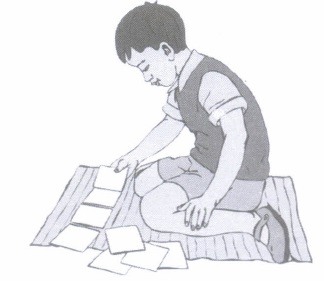
(i) What is the difference between the numbers on any two consecutive cards?
| (a) 7 | (b) -5 | (c) 11 | (d) -3 |
(ii) The number on first card is
| (a) 12 | (b) 3 | (c) 5 | (d) 7 |
(iii) What is the number on the 19th card?
| (a) -88 | (b) -82 | (c) -92 | (d) -102 |
(iv) What is the number on the 23rd card?
| (a) -103 | (b) -122 | (c) -108 | (d) -117 |
(v) The sum of numbers on the first 15 cards is
| (a) -840 | (b) -945 | (c) -427 | (d) -420 |
1.
\(\frac { 5 }{ 16 } \)
2.
2(3)2+3k=0⇒k=-21
3.
192.5 cm2
4.
-s.png)
Perimeter of a sector OAB = 16.4 cm
⇒ OA+ AB + 0B = 16.4cm
⇒ 5.2 cm + 5.2 cm + AB = 16.4 cm
⇒10.4 cm + AB = 16.4 cm
⇒ AB = (16.4 - 10.4) cm
Length of the arc = 6.0 cm
Area of the sector =\({lr\over 2}={6.0\times5.2\over 2}\)
= 6.0 x 2.6 cm2 = 15.6 cm2
5.
We know that in 1 hour (i.e., 60 minutes), the minute hand rotates 360°.
In 5 minutes, minute hand will rotate = 360^@/60xx5 = 30^@
Therefore, the area swept by the minute hand in 5 minutes will be the area of a sector of 30° in a circle of 14 cm radius.
Area of sector of angle θ = \(\frac{\theta}{360^{\circ}} \times \pi r^{2}\)
Area of sector of 30° \(=\frac{30^{\circ}}{360^{\circ}} \times \frac{22}{7} \times 14 \times 14\)
\(\begin{array}{l} =\frac{22}{12} \times 2 \times 14 \\ =\frac{11 \times 14}{3} \end{array}\)
=154/3 cm2
Therefore, the area swept by the minute hand in 5 minutes is 154/3 cm2
6.
a = 9, d = 10
a12= a + 11d
= 9 + 11 x 10 = 119
7.
Given capacities of two tankers are 850 Land 680 L.
Here, 850 > 680
Now, 850 = (680xl) +170
Here, remainder = 170 \( \neq\) 0.
So, new dividend is
680 and divisor is 170.
Now, 680 = (170 x 4)+0
[by Euclid's division lemma]
Here, remainder is zero and divisor is 170.
So, the HCF of 850 and 680 is 170.
Hence, the maximum capacity of the required container is 170 L
8.
3x2+8x+4;-2 and \(-\frac { 2 }{ 3 } \)
9.
Let P(x)=x2-5
For finding a zeroes of p(x), p(x)=0
x2-5=0
⇒ x=±5
Let α=5 and β=-5
Now, 1+a=1+5=6
and 1-a=1-5=4
Thus, 6 and -4 are the zeroes of new quadratic polynomial.
Therefore the new quadratic polynomial will be (x-6)(x+4) or x2-2x-24
10.
Here, OA = OB = r = 12cm, \(\angle \)AOB = 120°
In \(\triangle\)AOB, AO = BO = 12 cm, draw OD ⊥ AB
Since \(\triangle\)AOB is an isosceles and OD ⊥ AB
ஃ OD is the angle bisector as well as median
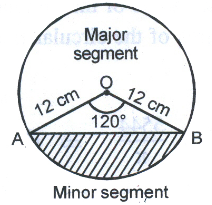
Now, in rt. \(\triangle\)ADO, \(\angle \)D = 90° , \(\angle \)AOD = 60°
∴ \(OD\over AO\) = cos 60°
= 12 x 1/2 =6 cm
and \(AD\over AO\) = sin 60°
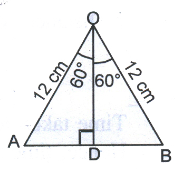
⇒ AD = AO, sin 60° = 12 x \(\sqrt3 \over2\) = 6\(\sqrt3\) cm
∴ AB = 2 AD = 2\(\sqrt3\) x = 12\(\sqrt3\) cm
Area of minor segment
= Area of sector AOB - Area of \(\triangle\)AOB
= \(\theta\over360°\) x \(\pi\)r2 - \(1\over2\) x AB x OD
= \(120° \over360°\) x 3.14 x 12 x 12 - \(1\over2\) x 12\(\sqrt3\) x 6
= 150.72 - 62.28 = 88.44 cm2.
11.
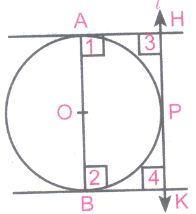
Given: A circle with centre O. AB is the diameter of this circle. I is tangent to the circle. AH and BK are perpendicular to I from A and B at H and K respectively.
To prove: AH + BK = AB
Proof: AH and HP are tangents from the external point H
ஃ AH = HP .....(i)
and BK, KP are tangent from the external point K
ஃ BK = KP ......(ii)
Adding (i) and (ii) we get
AH + BK = HP + PK = HK ......(iii)
AB ⊥ AH
AB ⊥ BK
[Tangent makes 90° angle with radius at the point of contact]
⇒ \(\angle \)1 = \(\angle \)2 = 90°
Given that AH ⊥ i ⇒ \(\angle \)3 = 90°
and BK ⊥ i ⇒ \(\angle \)4 = 90°
∵ \(\angle \)1 = \(\angle \)2 = \(\angle \)3 = \(\angle \)4 = 90°
⇒ AHKB is a rectangle
⇒ AB = HK ......(iv)
[Opposite sides of a rectangle are equal]
From (iii) and (iv) ⇒ PH + PK = AB
AH + BK = AB from (i) and (ii) Hence proved.
12.
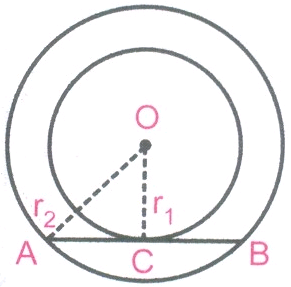
r1 = 5 cm, r2 = ?,
AB = 24 cm
∵ AB is tangent to circle
C(C, r1) at C
ஃ OC ⊥ AB
In circle C(O, r2), AB is a chord and OC ⊥ AB
ஃ AC = BC
[∵ Perpendicular from the centre bisects the chord]
In right \(\triangle\)OCA
OC2 + AC2 = AC2
⇒ 52 + (12)2 = (r2)2
⇒ 25 + 144 = (r2)2 ⇒ (r2)2 = 169
r2 = 13 cm
13.
Given, a = 9, d = 17 - 9 = 8,
Sn = 636
Sn = \(\frac{n}{2}[2a+(n-1)d]\)
\(\Rightarrow\) 636 = \(\frac{n}{2}[2\times9+(n-1)8]\Rightarrow636\times 2=n[18+8n-8]\)
\(\Rightarrow\) 636 X 2 = n ( 10 + 8n ) \(\Rightarrow\) 636 x 2 = 2n ( 5 + 4n )
\(\Rightarrow\) \(\frac{636\times2}{2}\) = 5n + 4n2 \(\Rightarrow\) 4n2 + 5n - 636 = 0
\(\Rightarrow\) 4n2 + 53n + 48n - 636 = 0 \(\Rightarrow\) 4n( n + 53 ) - 48 ( n + 53 ) = 0
\(\Rightarrow\) ( 4n - 48 ) ( n + 53 ) = 0 \(\Rightarrow\) Either 4n = 48 or n + 53 = 0
\(\Rightarrow\) n = \(\frac{48}{4}\) or n = -53 (rejected)
\(\Rightarrow\) n = 12
Hence n = 12
14.
According to the question, \(\alpha\) and \(\beta\) are zeroes of the polynomial p(x) = 6x2 - 5x + k
So, Sum of zeroes = \(\alpha +\beta =-\left( \frac { -5 }{ 6 } \right) =\frac { 5 }{ 6 } \) ... (i)
Product of zeroes = \(\alpha \beta =\frac { k }{ 6 } \)
\(\alpha-\beta=\frac{1}{6}\) (Given) ...... (ii)
Adding equations (i) and (ii), we get
\(2\alpha=2\)
\(\Rightarrow \quad \alpha=\frac{1}{2}\)
Putting the value of \(\alpha\) in equation (ii), we get
\(\frac{1}{2}-\beta=\frac{1}{6}\)
\(\Rightarrow \quad \frac{1}{2}-\frac{1}{6}=\beta\)
\(\Rightarrow \quad \frac{2}{6}=\frac{1}{3}=\beta\)
\(\therefore \quad \alpha\beta=\frac{k}{6}=\frac{1}{2}\times\frac{1}{3}\)
\(\therefore \quad k=1\)
15.
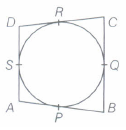
Let AB, BC, CD and AD touch the circle at points P, Q, R and S respectively, then AS = AP, BQ = BP, CQ = CR and DS = DR on adding,
AS + DS + BQ + CQ = AP + DR + BP + CR \(\Rightarrow\) AD + BC = AB + CD
\(\Rightarrow\) AD = (6 + 4 - 7) cm = 3 cm
16.
Now, area of the sector OAYB = \(=\frac{120}{360} \times \frac{22}{7} \times 21 \times 21 \mathrm{~cm}^2=462 \mathrm{~cm}^2\) (2)
For finding the area of \(\Delta\)OAB, draw OM \(\perp\) AB as shown in Figure.
Note that OA = OB. Therefore, by RHS congruence, \(\Delta\)AMO \(\cong\) BMO.
So, M is the mid-point of AB and \(\angle\)AOM = \(\angle\)BOM = \(\frac{1}{2} \times 120^{\circ}=60^{\circ}\)
Let OM = x cm
So, from \(\Delta\)OMA, \(\frac{\mathrm{OM}}{\mathrm{OA}}=\cos 60^{\circ}\)
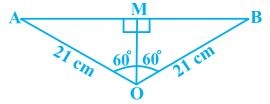
or, \(\begin{aligned} \frac{x}{21} & =\frac{1}{2} \quad\left(\cos 60^{\circ}=\frac{1}{2}\right) \\ \end{aligned}\)
or, \(\begin{aligned} x & =\frac{21}{2} \\ \end{aligned}\)
So, \(\begin{aligned} \mathrm{OM} & =\frac{21}{2} \mathrm{~cm} \\ \end{aligned}\)
Also,\(\begin{aligned} \frac{\mathrm{AM}}{\mathrm{OA}} & =\sin 60^{\circ}=\frac{\sqrt{3}}{2} \\ \end{aligned}\)
So, \(\begin{aligned} \mathrm{AM} & =\frac{21 \sqrt{3}}{2} \mathrm{~cm} \end{aligned}\)
Therefore, \(\mathrm{AB}=2 \mathrm{AM}=\frac{2 \times 21 \sqrt{3}}{2} \mathrm{~cm}=21 \sqrt{3} \mathrm{~cm}\)
So, area of \(\begin{aligned} \Delta \mathrm{OAB} & =\frac{1}{2} \mathrm{AB} \times \mathrm{OM}=\frac{1}{2} \times 21 \sqrt{3} \times \frac{21}{2} \mathrm{~cm}^2 \\ \end{aligned}\)
\(\begin{aligned} =\frac{441}{4} \sqrt{3} \mathrm{~cm}^2 \end{aligned}\) (3)
Therefore, are of the segment \(\mathrm{AYB}=\left(462-\frac{441}{4} \sqrt{3}\right) \mathrm{cm}^2\) [From (1), (2) and (3)]
\(=\frac{21}{4}(88-21 \sqrt{3}) \mathrm{cm}^2\)
17.
(i) Number of logs stacked in each row form a sequence 20, 19, 18, 17,...., which is an AP with first term, a= 20 and common difference, d = 19 - 20 = -1.
Suppose number of rows is n, then Sn= 200
\(\begin{aligned} \Rightarrow \frac{n}{2}[2 \times 20+(n-1)(-1)] & =200 \\ \end{aligned}\)
\(\begin{aligned} {\left[\because S_n\right.} & \left.=\frac{n}{2}\{2 a+(n-1) d\}\right] \end{aligned}\)
\(\begin{array}{lr} \Rightarrow & 400=40 n-n^2+n \\ \end{array}\)
\(\begin{array}{lr} \Rightarrow & n^2-41 n+400=0 \\ \end{array}\)
\(\begin{array}{lr} \Rightarrow & n^2-25 n-16 n+400=0 \\ \end{array}\)
\(\begin{array}{lr} \Rightarrow & n(n-25)-16(n-25)=0 \\ \end{array}\)
\(\begin{array}{lr} \Rightarrow & (n-25)(n-16)=0 \\ \end{array}\)
\(\begin{array}{lr} \Rightarrow & n=16 \text { or } n=25 \end{array}\)
Hence, the number of rows is either 25 or 16.
When, n = 16,
an= a + (n -1) d = 20 + (16 - 1) ( - 1)
= 20 - 15 = 5
When, n = 25,
an = a + (n - 1) d = 20 + (25-1) (-1)
= 20 - 24 = - 4
[\(\because\) number of logs cannot be negative]
Hence, the number of rows is 16 and number of logs in the top row is 5.
(ii) The pattern of logs show space saving creativity, reasoning and balancing.
18.
A.T.Q., S5 + S7 = 167
\(\Rightarrow\) \({5\over2}[2a+14d]+{7\over2}[2a+6d]=167\)
\(\Rightarrow\) 5 ( a + 2d ) + 7 ( a + 3d ) = 167
\(\Rightarrow\) 12a + 31d = 167 ...(i)
and S10 = 235
\(\Rightarrow\) \({10\over2}[2a+9d]=235\)
\(\Rightarrow\) 2a + 9d = \({235\over4}=47\) ...(ii)
Multiplying equation (ii) by 6 and then subtractigfrom (i), we have
12a + 31d = 167
12a + 54d = 282
- - -
-23d = -115
d= \({-115\over-23}=5\)
\(\therefore\) From (ii), 2a + 9d = 47
\(\Rightarrow\) 2a + 9 x 5 = 47
\(\Rightarrow\) 2a = 47 - 45
\(\Rightarrow\) 2a = 2 \(\Rightarrow\) a = 1
Hence, S20 = \({20\over2}[2a+19d]\)
= 10 [ 2 x 1 + 19x 5 ]
= 10 [ 2 + 95 ] = 10 x 97 = 970
19.
(b)
2
20.
(a)
36
21.
(c)
360
22.
(d)
\(\sqrt119\) cm
23.
(b)
12 cm
24.
(b)
70°
25.
(d)
\({P \over 720^o}\times 2\pi R^2\)
26.
(c)
- 2, - 4, - 6, - 8
27.
(b)
22
28.
(c)
- 77
29.
(d)
120 h
30.
(c)
4
31.
(d)
more than 3
32.
(a)
p divides a
33.
(c)
1:6
34.
(d)
28 cm
35.
(a)
Segment
36.
(c)
50o
37.
(a) Both Assertion and Reason are correct and Reason is the correct explanation of Assertion.
38.
(b) If both Assertion and Reason are correct, but Reason is not the correct explanation of Assertion.
39.
(i) (b) Given, number of students in each subject are Hindi =60, English = 84, Mathematics = 108.
The prime factors of each subject students are
60 =2\(\times\) 2 \(\times\)3 \(\times\)5= 22 \(\times\) 3 \(\times\) 5
84 = 2 \(\times\) 2 \(\times\)3 \(\times\)7 = 22 \(\times\)3 \(\times\)7
108 =2 \(\times\) 2 \(\times\)3 \(\times\)3 \(\times\)3= 22 \(\times\)33
The maximum number of participants that an accommodated in each room
=HCF (60, 84, 108)
= Product of the smallest power of each common prime factor involved in the numbers
=22 \(\times\)3 = 12
(ii) (d) The minimum number of rooms required during the event = \(\frac{Total \quad number \quad of \quad participants}{12}=\frac{252}{12}=21\)
(iii) (a) LCM of (60, 84, 108)
= Product of the greatest power of each prime factor involved in the numbers with highest power
= 22 \(\times\)33 \(\times\)5 \(\times\) 7
= 4 \(\times\)27 \(\times\)35
= 3780
(iv) (d) Now, HCF (60, 84, 108) \(\times\)LCM (60, 84, 108) = 12 \(\times\)3780 = 45360
(v) (d) Number 108 can be expressed as a product of its prime as 22\(\times\) 33.
40.
(i) (b): Angle made by minute hand in 60 minutes = 360°
\(\therefore\) Angle made by minute hand in 10 minutes
\(=\frac{360^{\circ}}{60} \times 10=60^{\circ}\)
Length of minute hand = 9 cm
Area swept by minute hand in 10 minutes = Area of sector having central angle 60°
\(=\pi r^{2}\left(\frac{60^{\circ}}{360^{\circ}}\right)=\frac{22}{7} \times 9 \times 9 \times \frac{1}{6}\)
\(=\frac{297}{7}=42.42 \mathrm{~cm}^{2}\)
(ii) (b): We have, r = 15 cm
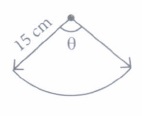
\(\text { and } l=\frac{1}{2}(22)=11 \mathrm{~cm}\)
\(\text { We known that } l=2 \pi r\left(\frac{\theta}{360^{\circ}}\right)\)
\(\Rightarrow \theta=\frac{11 \times 360^{\circ}}{2 \times \frac{22}{7} \times 15}=\frac{90^{\circ} \times 7}{15}=6^{\circ} \times 7=42^{\circ}\)
(iii) (a): Angle made by hour hand in 12 hours = 360°
\(\therefore\) Angle made by hour hand in 10 minutes
\(=\left(\frac{360^{\circ}}{12} \times \frac{1}{6}\right)=5^{\circ}\)
(iv) (d): Angle made by hour hand in 1 hour
\(=\frac{360^{\circ}}{12}=30^{\circ}\)
Also, r = 6 cm
Area swept by hour hand in 1 hour = Area of sector having central angle 30°
(v) (a): Number of hours from 11 a.m. to 5 p.m. = 6
Area swept by hour hand in 1 hour = 9.428 cm2
\(\therefore\) Area swept by hour hand in 6 hours = 9.428 x 6
= 56.568 cm2
41.
Let the numbers on the cards be a, a + d, a + Zd, ...
According to question, We have (a + 5d) + (a + 13d) = -76
\(\Rightarrow\) 2a+18d = -76\(\Rightarrow\)a + 9d= -38 ... (1)
And (a + 7d) + (a + 15d) = -96
\(\Rightarrow\) 2a + 22d = -96 \(\Rightarrow\) a + 11d = -48 ...(2)
From (1) and (2), we get
2d= -10 \(\Rightarrow\) d= -5
From (1), a + 9(-5) = -38 \(\Rightarrow\) a = 7
(i) (b): The difference between the numbers on any two consecutive cards = common difference of the A.P.=-5
(ii) (d): Number on first card = a = 7
(iii) (b): Number on 19th card = a + 18d = 7 + 18(-5) = -83
(iv) (a): Number on 23rd card = a + 22d = 7 + 22( -5) = -103
(v) (d): \(S_{15}=\frac{15}{2}[2(7)+14(-5)]=-420\)

10th Standard CBSE Syllabus & Materials
10th Standard CBSE
CBSE 10th Social Science PS - Federalism - New Model Questions Papers Study Material - QB365 Set A
NEW10th Standard CBSE
CBSE 10th Social Science PS - Power Sharing - New Model Questions Papers Study Material - QB365 Set A
NEW10th Standard CBSE
CBSE 10th Social Science GEO - Manufacturing Industries - New Model Questions Papers Study Material - QB365 Set A
NEW10th Standard CBSE
CBSE 10th Social Science GEO - Minerals and Energy Resources - New Model Questions Papers Study Material - QB365 Set A



NCERT Books

Syllabus

Exam Pattern

Sample Question Papers

Previous year Question Papers

Important Notes

MCQ Practice test

NCERT Exemplers

Case study Questions

Image Based Questions

Passage based Questions

HOT Questions

Value Based Questions

Model Questions Papers
NCERT ( Book Back ) Questions

Assertion and Reason
Important Questions And Answers

CBSE 10th Standard CBSE Subjects
CBSE Standards



