
 100% FREE ACCESS
10th Standard CBSE Syllabus & Materials
10th Standard CBSE
CBSE 10th Social Science ECO - Globalisation and the Indian Economy - New Model Questions Papers Study Material - QB365 Set A
NEW10th Standard CBSE
CBSE 10th Social Science ECO - Money and Credit - New Model Questions Papers Study Material - QB365 Set A
NEW10th Standard CBSE
CBSE 10th Social Science ECO - Sectors of the Indian Economy - New Model Questions Papers Study Material - QB365 Set A
NEW10th Standard CBSE
CBSE 10th Social Science ECO - Development - New Model Questions Papers Study Material - QB365 Set A
NEW10th Standard CBSE
CBSE 10th Social Science PS - Outcomes of Democracy - New Model Questions Papers Study Material - QB365 Set A
NEW10th Standard CBSE
CBSE 10th Social Science PS - Gender, Religion and Caste - New Model Questions Papers Study Material - QB365 Set A

Published on: 20/10/2025
Download CBSE Class 10th Standard CBSE Maths question papers, sample papers, important questions, and previous year solved papers in PDF format. Get free study materials, NCERT solutions, and exam preparation resources for Class 10th Standard CBSE Maths
Questions + Answers key
Take MCQ Maths Test
1.
Which of the following list of numbers form an AP? If they form an AP, write the next two term
4, 10, 16, 22, . . .
2.
A sum of Rs.1408 is to be used to give 16 cash prizes to cricket players of a school for their overall Test performance. If each prize is Rs.10 less than its preceding prize, find the value of each of the prizes.
3.
If an = 5 - 11n, then find the common difference.
4.
A contract on construction job specifies a penalty for delay of completion beyond a certain date as follows: Rs.200 for the first day, Rs.250 for the second day, Rs. 300 for the third day, etc. the penalty for each succeeding day being Rs.50 more than for the preceding day. How much money the contractor has to pay as penalty, if he has delayed the work by 30 days
5.
Which of the following are APs ? If they form an AP, find the common difference d and write three more terms.
\(-\frac{1}{2}\), \(-\frac{1}{2}\) , \(-\frac{1}{2}\), \(-\frac{1}{2}\).......
6.
In a potato race, a bucket is placed at the starting point, which is 5 m from the first potato, and the other potatoes are placed 3 m apart in a straight line. There are ten potatoes in the line. (see fig.)
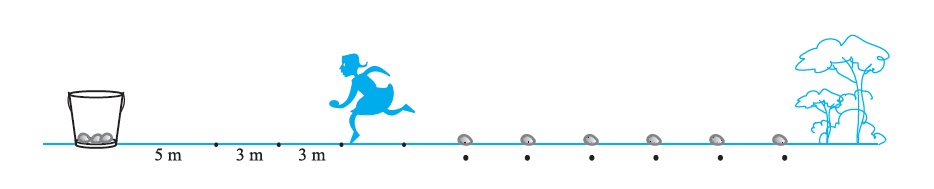
A competitor starts from the bucket, picks up the nearest potato, runs back with it, drops it in the bucket, runs back to pick up the next potato, runs to the bucket to drop it in, and she continues in the same way until all the potatoes are in the bucket. What is the total distance the competitor has to run?
[Hint : To pick up the first potato and the second potato, the total distance (in metres) run by a competitor is 2 \(\times\) 5 + 2 \(\times\) (5 + 3)]
7.
360 bricks are stacked in the following manner, 30 bricks in the bottom row, 29 bricks in the next row, 28 bricks in the next to it, and so on. In how many rows, 360 bricks are placed and how many bricks are there in there in the top row?
8.
If the sum of the first n terms of an AP is \(4n-{ n }^{ 2 }\), then what is the first term (i.e \(S_1\))? What is the sum of first two terms? What is the second term? Similarly, find the 3rd, 10th and the nth terms.
9.
If the sum of first 7 terms of an AP is 49 and that of first 17 terms is 289, find the sum of its first n terms.
10.
How many terms of the AP \(20, 19 \frac { 1 } { 3 }, 18 \frac { 2 } { 3 },...\) must be taken, so that their sum is 300?
11.
A sum of Rs 2000 is invested at 7% simple interest per year. Calculate at the end of each year. Do these interest form an AP? If so, then find the interest at the end of 20th year making use of this fact.
12.
The sum of the third and the seventh terms of an AP is 6 and their product is 8. Find the sum of first sixteen terms of the AP.
13.
A sum of Rs 1000 is invested at 8% simple interest per year. Calculate the interest at the end of each year. Do these interests form an AP? If so, find the interest at the end of 30 years making use of this fact.
14.
Which term of the AP : 21, 18, 15, . . . is – 81? Also, is any term 0? Give reason for your answer
15.
Find the sum: \(\frac{a - b}{a + b}+\frac{3a - 2b}{a + b}+\frac{5a - 3b}{a + b}+...\) to 11 terms.
16.
If the sum of first n terms of an AP is 3n2 + 4n and its common difference is 6, then its first term is
7
4
6
3
17.
The sum of the first 50 odd natural numbers is
5000
2500
2550
5050
18.
The 8th term of an AP is 17 and its 14 th term is 29. The common difference of this AP is
3
2
5
-2
19.
If -5, x, 3 are three consecutive terms of an AP then the value of x is
-2
2
-1
1
20.
A long a road line, an odd number of stones placed at intervals of 10 m. These stones have to be assembled around the middle stone. A person can carry only one stone at a time. A man carried the job with one of the end stone by carrying them in succession. In carrying, all the stones he covered a distance of 3 km. Then, the total number of stones is
10
15
12
25
21.
The sum of n terms of sequence \(\frac{1}{1 \times 2}, \frac{1}{2 \times 3}, \frac{1}{3 \times 4}, .\) is
\(\frac{1}{n+1}\)
\(\frac{1}{n}\)
\(\frac{n+1}{n}\)
\(\frac{n}{n+1}\)
22.
If the common difference of an AP is 5, then what is a18 - a13?
5
20
25
30
23.
In an Ap, if a = 3.5, d = 0 and n = 101,then an will be
0
3.5
103.5
104.5
24.
What is the common difference of the A.P. in which a18 – a14 = 32?
4
3
5
2
25.
The terms of an A.P. are governed by the rule tn = 2n – 3 for n ≥ 1. What will be the term in the 50th place?
103
95
105
97
26.
Ramesh’s salary in February 2008 is Rs. 10,000. If he’s promised an increase of Rs. 1000 every year, what would be his salary in Feb 2011?
Rs. 15,000
Rs.14,000
Rs. 13,000
Rs. 12,000
27.
If sum of n terms is given by Sn = 3n2 + 5n, then the common difference of this AP is
6
8
4
14
28.
The weights of 11 students selected for a team are noted in ascending order and are in A. P. The lowest value is 45 Kg, and the middle value is 55 Kg. What is the difference between the two values placed consecutively ?
3
4
2
6
29.
The first and last terms of an AP are 1 and 11. If the sum of all its terms is 36, then the number of terms will be
8
5
6
7
30.
What is the common difference of the A.P. in which a18 – a14 = 32?
8
-4
-8
4
31.
In an A.P. the two consecutive terms are (2n+3) and (2n+5). Find the common difference of the A.P
2
2n+2
2n+3
2n+1
32.
If a- b, 0 and a + b are consecutive terms of an AP then
a can take any real value and b = 0
a = 0 and b can take any real value
a = 1 and b= 0
a = 0 and b = 1
33.
Which term of the following A.P. would be 0? 36,33,30,27….
9
12
13
10
34.
The nth term of the AP 9, 13, 17, 21, 25, ………….. is:
3n+2
4n+5
5n+3
4n-5
35.
The first term of an A.P. is 12, the last term is -8, the common difference is -2. Find the sum of the A.P.
18
16
22
20
36.
Your friend Veer wants to participate in a 200 m race. He can currently run that distance in 51 s and with each day of practice it takes him 2s less. He wants to do in 31 s.

(i) Which of the following terms are in AP for the given situation?
(a) 51, 53, 55.... (b) 51, 49, 47 ....
(c) -51, -53, -55 .... (d) 51, 55, 59...
(ii) What is the minimum number of days he needs to practice till his goal is achieved?
(a) 10 (b) 12 (c) 11 (d) 9
(iii) Which of the following term is not in the AP of the above given situation?
(a) 41 (b) 30 (c) 37 (d) 39
(iv) If nth termn of an AP is given by an = 2n +3, then common difference of an AP is
(a) 2 (b) 3 (c) 5 (d) 1
(v) The value of x, for which 2x, x + 10, 3x + 2 are three consecutive terms of an AP
(a) 6 (b) -6 (c) 18 (d) -18
37.
In a school, students thought of planting trees in and around the school to reduce air pollution. It was decided that each section of each class would plant twice as many plants as the class standard. There were 3 sections of each standard from 1 to 12. So, if there are three sections in class 1 say 1A, 1B and 1C, then each section would plant 2 trees. Similarly, each section of class 2 would plant 4 trees and so on. Thus, the number of trees planted by classes 1 to 12 formed an AP given by 6, 12, 18,...

(a) What is the common difference of the AP formed
| (i) 6 | (ii) 5 | (iii) 3 | (iv) 2 |
(b) What will be the nth term of the AP formed?
| (i) 5n | (ii) 6n | (iii) 5n+6 | (iv) 6n+6 |
(c) How many trees will be planted by the students of all the sections of class 8?
| (i) 42 | (ii) 48 | (iii) 54 | (iv) 60 |
(d) Find the total number of trees planted by class 12 students.
| (i) 54 | (ii) 72 | (iii) 66 | (iv) None of these |
(e) What will be the third term from the end of the AP formed?
| (i) 72 | (ii) 66 | (iii) 60 | (iv) 54 |
38.
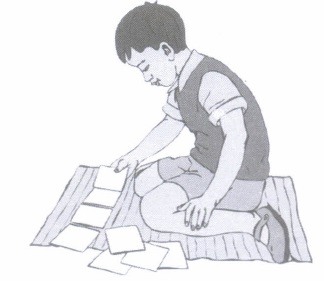
Amit was playing a number card game. In the game, some number cards (having both +ve or -ve numbers) are arranged in a row such that they are following an arithmetic progression. On his first turn, Amit picks up 6th and 14thcard and finds their sum to be -76. On the second turn he picks up 8th and 16thcard and finds their sum to be -96. Based on the above information, answer the following questions.
(i) What is the difference between the numbers on any two consecutive cards?
| (a) 7 | (b) -5 | (c) 11 | (d) -3 |
(ii) The number on first card is
| (a) 12 | (b) 3 | (c) 5 | (d) 7 |
(iii) What is the number on the 19th card?
| (a) -88 | (b) -82 | (c) -92 | (d) -102 |
(iv) What is the number on the 23rd card?
| (a) -103 | (b) -122 | (c) -108 | (d) -117 |
(v) The sum of numbers on the first 15 cards is
| (a) -840 | (b) -945 | (c) -427 | (d) -420 |
1.
(i) We have a2 – a1 = 10 – 4 = 6
a3 – a2 = 16 – 10 = 6
a4 – a3 = 22 – 16 = 6
i.e., ak + 1 – ak is the same every time.
So, the given list of numbers forms an AP with the common difference d = 6.
The next two terms are: 22 + 6 = 28 and 28 + 6 = 34.
2.
Rs.163, Rs.153, Rs.143, Rs.133,......
3.
Common difference, d = an+1 - an.
= 5 - 11(n + 1) - (5 - 11n)
= 5 - 11n - 11 - 5 + 11n = -11
4.
Given, the penalty for each succeeding day is Rs 50 more than the preceding day, therefore the penalties for the first day,the second day, the third day etc., will form an AP. Here, a= 200,d= 250 - 200 = 50 and n = 30. Clearly, the money required by the contractor to pay as penalty, if he delayed the work by 30 days, will be S30 We know that
\(\begin{aligned} S_n & =\frac{n}{2}[2 a+(n-1) d] \end{aligned}\)
\(\begin{aligned} \therefore \quad S_{30} & =\frac{30}{2}[2 \times 200+(30-1) 50] \\ \end{aligned}\)
= 15 (400 + 1450) = 15 \(\times\) 1850 = 27750
Hence, the contractor has to pay Rs 27750, if he delayed the work.
5.
Here, we have
\(a_{2}-a_{1}=-\frac{1}{2}-\left ( -\frac{1}{2} \right )=-\frac{1}{2}+\frac{1}{2}=0,\)
\(a_{3}-a_{2}=-\frac{1}{2}-\left (-\frac{1}{2} \right )=-\frac{1}{2}+\frac{1}{2}=0,\)
\(a_{4}-a_{3}=-\frac{1}{2}-\left ( -\frac{1}{2} \right )=-\frac{1}{2}+\frac{1}{2}=0\)
and so on.
Since, the difference of any two consecutive terms is same. Therefore, the given list of numbers forms an AP and its common difference (d) is 0.
Now, next three terms of this AP are
a5 = a4 + d = -\(\frac{1}{2}\) + 0 = - \(\frac{1}{2}\)
a6 = a5 + d = -\(\frac{1}{2}\) + 0 = - \(\frac{1}{2}\)
and a7 = a6 + d = -\(\frac{1}{2}\) + 0 = -\(\frac{1}{2}\)
6.
The distance run by the competitor to picks up the first potato, second potato, third potato, fourth potato, .... are respectively 2 \(\times\) 5, 2 \(\times\) (5 + 3), 2 \(\times\) (5 + 3 + 3), 2 \(\times\) (5 + 3 +3 + 3)... i.e. 10, 16, 22, 28, ...
Clearly, it is an AP with first term, a = 10 and common difference, d =16 - 10 = 6.
\(\because\) Sum of first n terms, \(\begin{aligned} & S_n=\frac{n}{2}[2 a+(n-1) d] \\ \end{aligned}\)
\(\therefore\) Sum of first 10 terms, \(\begin{aligned} & S_{10}=\frac{10}{2}[2 \times 10+(10-1) \times 6] \end{aligned}\)
[\(\because\) n = 10, given]
= 5 (20 + 54) = 5 \(\times\)74 = 370
Hence, the total distance the competitor has to run is 370 m.
7.
16 rows, 15 bricks.
8.
Given, the sum of first n terms,
\({ S }_{ n }=4n-{ n }^{ 2 }\) ...(i)
On putting n = 1 in Eq. (i), we get
\({ S }_{ 1 }=4\times 1-{ 1 }^{ 2 }=4-1=3\)
Thus, sum of first term = 3
On putting n = 2 in Eq. (i), we get
\({ S }_{ 2 }=4\times 2-{ 2 }^{ 2 }=8-4=4\)
Thus, sum of first two terms = 4
\(\because\) the n th term of an AP, an = Sn - Sn-1
\(\therefore\) Second term = S2 - S1 = 4 - 3 = 1
On putting n = 3 in Eq. (i), we get
S3 = 4 \(\times\) 3 - 32 = 12 - 9 = 3
\(\therefore\) third term = S3 - S2 = 3 - 4 = -1
On putting n = 9 in eq. (i), we get
S9 = 4 \(\times\) 9 - 92 = 36 - 81 = -45
Again, putting n = 10 in Eq. (i), we get
S10 = 4 \(\times\)10 - 102 = 40 - 100 = -60
\(\therefore\) 10th term = S10 - S9
= -60 - (-45) = -60 + 45 = -15
Now, on replacing n by n - 1 in Eq. (i), we get
\(\begin{aligned} S_{n-1} & =4(n-1)-(n-1)^2 \\ \end{aligned}\)
\(\begin{aligned} & =4 n-4-n^2+2 n-1=-n^2+6 n-5 \\ \end{aligned}\)
\(\begin{aligned} \therefore \quad n \text {th term } & =S_n-S_{n-1} \\ \end{aligned}\)
\(\begin{aligned} & =4 n-n^2-\left(-n^2+6 n-5\right) \end{aligned}\)
\(\begin{aligned} & =4 n-n^2+n^2-6 n+5=5-2 n \end{aligned}\)
9.
Given, S7 = 49 and S17 = 289.
Let a be the first term and d be the common difference of given AP. Then,
\(\begin{aligned} S_7=49 \Rightarrow \frac{7}{2}[2 a+6 d]=49 \Rightarrow a+3 d=7 \ldots \text { (i) } \\ \end{aligned}\)
and \(\begin{aligned} S_{17}=289 \Rightarrow \frac{17}{2}[2 a+16 d]=289 \end{aligned}\)
\(\Rightarrow\) a + 8d = 17 .....(ii)
On subtracting Eq. (i) from Eq. (i), we get
5d = 10 \(\Rightarrow\) d = 2
On substituting d = 2 in Eq. (i), we get
a + 6 = 7 \(\Rightarrow\) a = 1
Now, \(S_n=\frac{n}{2}[2 a+(n-1) d]=\frac{n}{2}[2+(n-1) 2]\)
= n[1 + n - 1] = n2
10.
Given AP is \(20, 19 \frac { 1 } { 3 }, 18 \frac { 2 } { 3 },...\)
Here, a = 20
and \(d=19\frac { 1 }{ 3 } -20=\frac { 58 }{ 3 } -20=\frac { 58-60 }{ 3 } =\frac { -2 }{ 3 } \)
Let n terms of given AP be required to get sum 300.
We know that,
\({ S }_{ n }=\frac { n }{ 2 } \left[ 2a+\left( n-1 \right) d \right] \)
\(\Rightarrow\) \(300=\frac { n }{ 2 } \left[ 2\left( 20 \right) +\left( n-1 \right) \left( \frac { -2 }{ 3 } \right) \right] \)
\(\Rightarrow\) \(600=n\left[ 40-\frac { 2 }{ n } n+\frac { 2 }{ 3 } \right] \)
\(\Rightarrow\) \(600=\frac { 1 }{ 3 } \left[ 120n-2{ n }^{ 2 }+2n \right] \)
\(\Rightarrow\) \(600\times 3+2{ n }^{ 2 }-122n=0\)
\(\Rightarrow\) \({ n }^{ 2 }-61n+900=0\) [dividing by 2]
\(\Rightarrow\) \({ n }^{ 2 }-36n-25n+900=0\)
\(\Rightarrow\) \({ n }^{ 2 }-36n-25n+900=0\)
\(\Rightarrow\) \(\left( n-36 \right) \left( n-25 \right) =0\)
\(\Rightarrow\) n = 36 or 25
Since, here a is positive and d is negative, so both values of n are possible. Hence, sum of 25 terms of given AP = Sum of 36 terms of given AP = 300.
11.
Given, initial money P = Rs2000
Rate of interest, R = 7% per yr; Time, T = 1,2,3,4,...
We know that, simple interest is given by the following formula
\(SI=\frac{PRT}{100}\)
\(\therefore\) SI at the end of 1st year \(= \frac{2000\times7\times1}{100}\) = 140
SI at the end of 2nd year \(= \frac{2000 \times 7 \times 2 } { 100 }\) = Rs 280
SI at the end of 3rd year \(=\frac {2000 \times 7 \times 3} {100 }\) = Rs 420
Thus, list of numbers is 140, 280, 420,...
Here, 280 - 140 = 420 - 280 = 140
So, above list of numbers is an AP, whose first term (a) = 140 and common difference (d) = 140.
Now, SI at the end of 20 yr will be equal to 20th term of the above AP.
\(\therefore\) \({a}_{20}=a+(20-1)d\)
\(=140+19\times 140=140+2660=2800\)
12.
Let the first term and the common difference of the given AP be a and d, respectively.
According to the question,
Third term + Seventh term = 6
\(\Rightarrow\) (a + 2d) + (a + 6d) = 6
\(\Rightarrow\) a + 4d = 3 ....(i)
and Third term x Seventh term = 8
\(\Rightarrow\) (a + 2d) (a + 6d) =8
\(\Rightarrow\) {(a + 4d) - 2d}{(a + 4d) + 2d} = 8
\(\Rightarrow\) (3- 2d)(3 + 2d) = 8 [using Eq. (i)]
\(\Rightarrow\) 9 - 4d2 = 8 [\(\because\)(a - b) (a + b) = a2 - b2]
\(\Rightarrow\) 4d2 = 9 - 8
\(\Rightarrow \quad d^2=\frac{1}{4}\)
\(\Rightarrow \quad d= \pm \frac{1}{2}\)
When, d = \(\frac{1}{2}\), then from Eq. (i), we get
\(\begin{aligned} a+4\left(\frac{1}{2}\right) & =3 \\ \end{aligned}\)
\(\begin{aligned} \Rightarrow & & a+2 & =3 \\ \end{aligned}\)
\(\begin{aligned} \Rightarrow & & a & =3-2 \Rightarrow a=1 \end{aligned}\)
Now, sum of first sixteen terms of the AP,
\(\begin{aligned} S_{16} & =\frac{16}{2}[2 a+(16-1) d] \quad\left[\because S_n=\frac{n}{2}\{2 a+(n-1) d\}\right] \\ \end{aligned}\)
\(\begin{aligned} =8[2 a+15 d]=8\left[2(1)+15\left(\frac{1}{2}\right)\right]\left[\because a=1, d=\frac{1}{2}\right] \\ \end{aligned}\)
\(\begin{aligned} =8\left(2+\frac{15}{2}\right)=8\left(\frac{19}{2}\right)=76 \end{aligned}\)
When, d = -\(\frac{1}{2}\), then from Eq. (i), we get
\(a+4\left(-\frac{1}{2}\right)=3 \Rightarrow a-2=3 \Rightarrow a=5\)
Now, sum of first sixteen terms of this AP,
\(\begin{aligned} S_{16} & =\frac{16}{2}[2 a+(16-1) d]\left[\because S_n=\frac{n}{2}\{2 a+(n-1) d\}\right] \\ \end{aligned}\)
\(\begin{aligned} =8(2 a+15 d) \\ \end{aligned}\)
\(\begin{aligned} =8\left[2(5)+15\left(-\frac{1}{2}\right)\right]=8\left(10-\frac{15}{2}\right)=8\left(\frac{5}{2}\right)=20 \end{aligned}\)
Hence, the sum of first sixteen terms, S16 = 20 or 76.
13.
We know that the formula to calculate simple interest is given by
Simple Interest \(=\frac{\mathrm{P} \times \mathrm{R} \times \mathrm{T}}{100}\)
So, the interest at the end of the 1st year = \(Rs \frac{1000 \times 8 \times 1}{100}=Rs 80\)
The interest at the end of the 2nd year = \(Rs \frac{1000 \times 8 \times 2}{100}=Rs 160\)
The interest at the end of the 3rd year = \(RS \frac{1000 \times 8 \times 3}{100}=Rs 240\)
Similarly, we can obtain the interest at the end of the 4th year, 5th year, and so on.
So, the interest (in Rs) at the end of the 1st, 2nd, 3rd, . . . years, respectively are 80, 160, 240, .
It is an AP as the difference between the consecutive terms in the list is 80, i.e., d = 80. Also, a = 80
So, to find the interest at the end of 30 years, we shall find a30
Now, a30 = a + (30 – 1) d = 80 + 29 x 80 = 2400
So, the interest at the end of 30 years will be Rs. 2400
14.
Here, a = 21, d = 18 – 21 = – 3 and an = – 81, and we have to find n.
As an = a + ( n – 1) d,
we have – 81 = 21 + (n – 1)(– 3)
– 81 = 24 – 3n
– 105 = – 3n
So, n = 35
Therefore, the 35th term of the given AP is – 81.
Next, we want to know if there is any n for which an = 0. If such an n is there, then
21 + (n – 1) (–3) = 0
i.e., 3 (n – 1) = 21
i.e., n = 8
So, the eighth term is 0.
15.
Here a = \(\frac{a-b}{a+b},d=\frac{3a-2b}{a+b}-\frac{a-b}{a+b}\)
\(={2a-b\over a+b}\) and n = 11.
Sn = \({n\over2}[2a+(n-1)d]\)
\(\Rightarrow\) S11 = \(\frac{11}{2}\left[ 2\left( a-b\over a+b \right)+(11-1)\left( 2a-b \over a+b \right)\right]\)
\(\Rightarrow\) S11 = \({11\over2}\times2\left[ {a-b\over a+b }+{5(2a-b)\over a+b} \right]\)
\(\Rightarrow\) S11 = \(11\left[ {a-b+10a-5b\over a+b} \right]\)
\(\Rightarrow\) S11 = \(11\left[ 11a-6b\over a+b \right]\)
16.
(a)
7
17.
(b)
2500
18.
(b)
2
19.
(d)
1
20.
(d)
25
21.
(d)
\(\frac{n}{n+1}\)
22.
(c)
25
23.
(b)
3.5
24.
(b)
3
25.
(d)
97
26.
(c)
Rs. 13,000
27.
(a)
6
28.
(c)
2
29.
(c)
6
30.
(a)
8
31.
(a)
2
32.
(b)
a = 0 and b can take any real value
33.
(c)
13
34.
(b)
4n+5
35.
(c)
22
36.
(i) (b) In first day, Veer takes 51 s to complete the 200 m race. But in each day he takes 2 s lesser than the previous days.
Thus, AP series will formed
51, 49, 47, ...
(ii) (c) Since, Veer wants to achieve the race in 31 s. Let Veer takes n days to achieve the target.
\(\therefore\) Tn = a + (n- 1)d
Here, a = 51, d = 49 - 51 = -2
\(\therefore\) 31 = 51 + (n - 1)(-2)
\(\Rightarrow\) (n - 1) 2 = 20
\(\therefore\) (n - 1) = 10
\(\therefore\) n = 11
Hence, he needs minimum 11 days to achieve the goal.
(iii) (b) In an AP series, we get the series of odd terms. Hence, term 30 is not an AP.
(iv) (a) Given, an = 2n + 3
\(\therefore\) Common difference = an +1 - an
= 2(n + 1) + 3 - (2n + 3)
= 2n + 2 + 3 - 2n - 3 = 2
(v) (a) Given, terms 2x, x + 10, 3x + 2 are in AP.
\(\therefore \quad x+10=\frac{2 x+(3 x+2)}{2}\)
\(\Rightarrow\) 2x + 20 = 5x + 2
\(\Rightarrow\) 3x = 18 \(\Rightarrow\) x = 6
37.
(a) (i)
The given AP is 6,12,18...,
The common difference = 12-6 =6.
(b) (ii)
In the given AP, we have:a=d=6
\(\therefore a_{n}=a+(n-1) d=6+(n-1) 6=6+6 n-6=6 n\)
(c) (ii)
The number of trees planted by the students of all the sections of class
= 8th term of the given AP
= 6n = 6X8=48
(d) (ii) T
otal number of trees planted by class 12 students
= 6 X 12 = 72
(e) (iii)
3rd term from the end = \((n-3+1) \text { th term }\)
= (12-3+1) th term = 10th term
= 6X10=60
38.
Let the numbers on the cards be a, a + d, a + Zd, ...
According to question, We have (a + 5d) + (a + 13d) = -76
\(\Rightarrow\) 2a+18d = -76\(\Rightarrow\)a + 9d= -38 ... (1)
And (a + 7d) + (a + 15d) = -96
\(\Rightarrow\) 2a + 22d = -96 \(\Rightarrow\) a + 11d = -48 ...(2)
From (1) and (2), we get
2d= -10 \(\Rightarrow\) d= -5
From (1), a + 9(-5) = -38 \(\Rightarrow\) a = 7
(i) (b): The difference between the numbers on any two consecutive cards = common difference of the A.P.=-5
(ii) (d): Number on first card = a = 7
(iii) (b): Number on 19th card = a + 18d = 7 + 18(-5) = -83
(iv) (a): Number on 23rd card = a + 22d = 7 + 22( -5) = -103
(v) (d): \(S_{15}=\frac{15}{2}[2(7)+14(-5)]=-420\)

10th Standard CBSE Syllabus & Materials
10th Standard CBSE
CBSE 10th Social Science PS - Federalism - New Model Questions Papers Study Material - QB365 Set A
NEW10th Standard CBSE
CBSE 10th Social Science PS - Power Sharing - New Model Questions Papers Study Material - QB365 Set A
NEW10th Standard CBSE
CBSE 10th Social Science GEO - Manufacturing Industries - New Model Questions Papers Study Material - QB365 Set A
NEW10th Standard CBSE
CBSE 10th Social Science GEO - Minerals and Energy Resources - New Model Questions Papers Study Material - QB365 Set A



NCERT Books

Syllabus

Exam Pattern

Sample Question Papers

Previous year Question Papers

Important Notes

MCQ Practice test

NCERT Exemplers

Case study Questions

Image Based Questions

Passage based Questions

HOT Questions

Value Based Questions

Model Questions Papers
NCERT ( Book Back ) Questions

Assertion and Reason
Important Questions And Answers

CBSE 10th Standard CBSE Subjects
CBSE Standards



