
 100% FREE ACCESS
10th Standard CBSE Syllabus & Materials
10th Standard CBSE
CBSE 10th Social Science ECO - Globalisation and the Indian Economy - New Model Questions Papers Study Material - QB365 Set A
NEW10th Standard CBSE
CBSE 10th Social Science ECO - Money and Credit - New Model Questions Papers Study Material - QB365 Set A
NEW10th Standard CBSE
CBSE 10th Social Science ECO - Sectors of the Indian Economy - New Model Questions Papers Study Material - QB365 Set A
NEW10th Standard CBSE
CBSE 10th Social Science ECO - Development - New Model Questions Papers Study Material - QB365 Set A
NEW10th Standard CBSE
CBSE 10th Social Science PS - Outcomes of Democracy - New Model Questions Papers Study Material - QB365 Set A
NEW10th Standard CBSE
CBSE 10th Social Science PS - Gender, Religion and Caste - New Model Questions Papers Study Material - QB365 Set A

Published on: 20/10/2025
Download CBSE Class 10th Standard CBSE Maths question papers, sample papers, important questions, and previous year solved papers in PDF format. Get free study materials, NCERT solutions, and exam preparation resources for Class 10th Standard CBSE Maths
Questions + Answers key
Take MCQ Maths Test
1.
Obtain all zeroes of the following polynomial, when two of its zeroes are given p(x) = 15x4 - 41x2 + 28, having two of its zeroes as \(\frac{2}{\sqrt{3}} \text { and }-\frac{2}{\sqrt{3}}\)
2.
In the following frequency distribution, find the median class.
| Height (in cm) | 140-145 | 145-150 | 150-155 | 155-160 | 160-165 | 165-170 |
| Frequency | 5 | 15 | 25 | 30 | 15 | 10 |
3.
Complete the following factor tree and find the composite number x :
4.
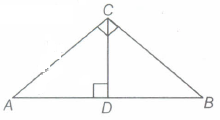
In the given figure, \(\triangle ACB\) = 90° and \(CD\bot AB\) . Prove that \(\frac { { { BC }^{ 2 } } }{ { AC }^{ 2 } } =\frac { BD }{ AD } \) .
5.
For what value of k, the pair of linear equations x+2y=3, 5x+ky+7=0 represents
(i) Intersecting lines
(ii) Parallel lines
Is there any value of k for which the given equations represents coincident lines?
6.
If P(E)=0.15, then find P(not E).
7.
Find the area of a triangle with vertices A(2,0), B(6,0), C(4,2)
8.
If one root of the quadratic equation 2x2-8x-m=0 is 5/2. Find the other root and the value of m.
9.
Find the number of two-digit numbers which are divisible by 6.
10.
Solve the following pair of linear equations by elimination method.
5ax + 6by = 28; 3ax + 4by = 18
11.
Find the values of p and q for which the following system of equations has infinitely many solutions
2x+3y =7, (p+q)x+(2p-q)y =21
12.
Find the value of k for which the following system of equations has infinitely many solutions
2x + 3y = 2; (k + 2)x + (2k + 1)y = 2 (k -1)
13.
If three times the larger of tire two numbers is divided by the smaller one, we get 4 as quotient and 3 as remainder. Also, if seven times the smaller number is divided by the larger one we get 5 as quotient and 1 as remainder Find the numbers.
14.
A box contains 20 cards from 1 to 20. A card is drawn at random from the box. Find the probability that the number on the drawn card is:
(i) divisible by 2 or 3.
(ii) a prime number
15.
Susan invested certain amount of money in two schemes A and B, which offer interest at the rate of 8% per annum and 9% per annum, respectively. She received Rs.1860 as annual interest. However, had she interchanged the amount of investments in the two schemes, she would received Rs.20 more as annual interest. How much money did she invest in each scheme?
16.
Factorise 612 and 1314 by using tree method and find HCF and LCM.
17.
The mid-point P of the line segment joining the points A(-10,4) and B(-2,0) lies on the line segment joining the points C(-9,-4) and D(-4,y). Find the ratio in which P divides CD. Also find the value of y.
18.
If x=-2 is a root of the equation 3x2+7x+p=0, find the values of k so that the roots of the equation \(x^2+k(4x+k-1)+p=0\) are equal.
19.
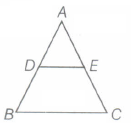
Using theorem (converse of basic proportionality theorem), prove that the line joining the mid-points of any two sides of a triangle, is parallel to the third side. (Recall that you have done it in Class IX.)
20.
Check whether 6n can end with the digit 0 for any natural number n.
21.
Find the roots of the quadratic equation: \(3x^{2}-2\sqrt {6} \ x +2 = 0\)
22.
A game consists of tossing a one rupee coin 3 times and noting its outcome each time. Hanif wins if all the tosses give the same result i.e., three heads or three tails, and loses otherwise. Calculate the probability that Hanif will lose the game.
23.
The distance between the points \(P\left(-\frac{11}{3}, 5\right)\) and \(Q\left(-\frac{2}{3}, 5\right)\) is
6 units
2 units
4 units
3 units
24.
In an AP,if d = - 4,n = 7 and an = 4,thena is equal to
6
7
20
28
25.
Which of the following pair of equations are inconsistent?
3x - y = 9, x - \(\frac{y}{3}\)=3
4x.+ 3y = 24, - 2x+ 3y = 6
5x - y = 10,10x-2y = 20
2x+ y=3,-4x+2y=10
26.
For an A.P the sum of first 30 terms is -1155,the common difference is -3and the thirtieth term is -82. What is the first term?
5
10
12
8
27.
For what value of k will 7/3 be a root of : 3x2 – 13x – k = 0.
-7/2
-14
14
3/7
28.
The perfect square binomial obtained by adding a constant to the expression : x2 – 18x is
(x + 3)2
(x – 9) 2
(x +9) 2
(x – 3)2
29.
What is the empirical relationship between the three measures of central tendency?
3 Mean = Mode + 2 Median
3 Median = Mode + 2 Mean
3 Median = 2Mode + Mean
3 Mean = 2Mode + Median
30.
The value of the observation having greatest frequency is called____
Mean
Median
Mode
All of above
31.
In figure, ΔABC ~ ΔPQR
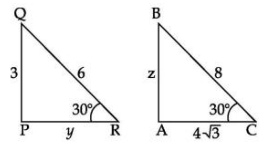
2 + √3
4 + √3
3 + 4√3
4 + 3√3
32.
Three squares are based on the sides of a right angled triangle. The area of the two smaller ones are 144 sq. cm and 256 sq. cm. What is the area of the third one?
625 sq. cm
361 sq. cm
400 sq. cm
900sq. cm
33.
If one zero of 2x2 – 3x + k is reciprocal to the other, then the value of k is :
-3
2
-3/2
-2/3
34.
Given that HCF (26 , 91) = 13, then LCM of (26 , 91) is :
182
91
364
2366
35.
15 defective pens are accidentally mixed with 135 good ones. It is not possible to just look at a pen and tell whether it is defective or not. One pen is taken out at random from this lot. The probability that the pen taken out is good will be
9/10
11/12
6/15
1/10
36.
Assertion When two coins are tossed together, the probability of getting no tail is \(\frac{1}{4}\).
Reason The probability P(E) of an event Esatisfies \(0 \leq P(E) \leq 1\).
(a) Both Assertion and Reason are correct and Reason is the correct explanation of Assertion.
(b) Both Assertion and Reason are correct but Reason is not the correct explanation of Assertion.
(c) Assertion is correct but Reason is incorrect.
(d) Assertion is incorrect but Reason is correct.
37.
Assertion: If the equation
y2 + 4my + n = 0 has real roots, then \(m^{2}=\frac{n}{4}\)
Reason: If the quadratic equation
ax2 + bx + c = 0, a ≠ 0 has b2 - 4ac = 0, then x = \(\frac{-b}{2 a}, \frac{-b}{2 a}\)
Codes:
(a) If both Assertion and Reason are correct and Reason is the correct explanation of Assertion.
(b) If both Assertion and Reason are correct, but Reason is not the correct explanation of Assertion.
(c) If Assertion is correct but Reason is incorrect.
(d) If Assertion is incorrect but Reason is correct.
38.
Two hotels are at the ground level on either side of a mountain. On moving a certain distance towards the top of the mountain two huts are situated as shown in the figure. The ratio between the distance from hotel B to hut-2 and that ofhut-2 to mountain top is 3: 7.
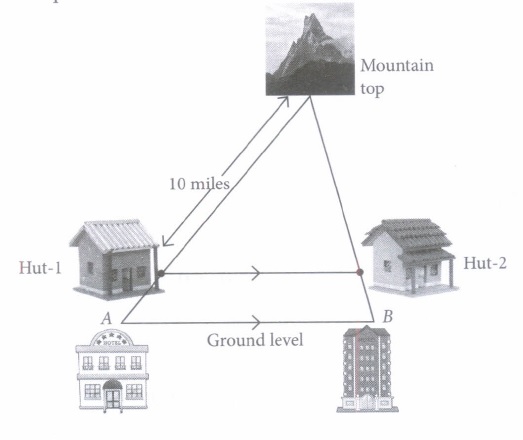
Based on the above information, answer the following questions.
(i) What is the ratio of the perimeters of the triangle formed by both hotels and mountain top to the triangle formed by both huts and mountain top?
| (a) 5: 2 | (b) 10: 7 | (c) 7: 3 | (d) 3: 10 |
(ii) The distance between the hotel A and hut-I is
| (a) 2.5 miles | (b) 29 miles | (c) 4.29 miles | (d) 1.5 miles |
(iii) If the horizontal distance between the hut -1 and hut -2 is 8 miles, then the distance between the two hotels is
| (a) 2.4 miles | (b) 11.43 miles | (c) 9 miles | (d) 7 miles |
(iv) If the distance from mountain top to hut-1 is 5 miles more than that of distance from hotel B to mountain top, then what is the distance between hut-2 and mountain top?
| (a) 3.5 miles | (b) 6 miles | (c) 5.5 miles | (d) 4 miles |
(v) What is the ratio of areas of two parts formed in the complete figure?
| (a) 53: 21 | (b) 10: 41 | (c) 51: 33 | (d) 49:51 |
39.
While playing a treasure hunt game, some clues (numbers) are hidden in various spots collectively forms an A.P. If the number on the nth spot is 20 + 4n, then answer the following questions to help the player in spotting the clues.
(i) Which number is on the first spot?
| (a) 20 | (b) 24 | (c) 16 | (d) 28 |
(ii) Which number is on the (n - 2)th spot?
| (a) 16+4n | (b) 24+4n | (c) 12+4n | (d) 28+4n |
(iii) Which number is on the 34th spot?
| (a) 156 | (b) 116 | (c) 120 | (d) 160 |
(iv) What is the sum of all the numbers on the first 10 spots?
| (a) 410 | (b) 420 | (c) 480 | (d) 410 |
(v) Which spot is numbered as 116?
| (a) 5th | (b) 8th | (c) 9th | (d) 24th |
40.
Real numbers are extremely useful in everyday life. That is probably one of the main reasons we all learn how to count and add and subtract from a very young age. Real numbers help us to count and to measure out quantities of different items in various fields like retail, buying, catering, publishing etc. Every normal person uses real numbers in his daily life. After knowing the importance of real numbers, try and improve your knowledge about them by answering the following questions on real life based situations.
(i) Three people go for a morning walk together from the same place. Their steps measure 80 cm, 85 cm, and 90 cm respectively. What is the minimum distance travelled when they meet at first time after starting the walk assuming that their walking speed is same?
| (a) 6120 cm | (b) 12240 cm | (c) 4080 cm | (d) None of these |
(ii) In a school Independence Day parade, a group of 594 students need to march behind a band of 189 members. The two groups have to march in the same number of columns. What is the maximum number of columns in which they can march?
| (a) 9 | (b) 6 | (c) 27 | (d) 29 |
(iii) Two tankers contain 768litres and 420 litres of fuel respectively. Find the maximum capacity of the container which can measure the fuel of either tanker exactly.
| (a) 4litres | (b) 7litres | (c) 12litres | (d) 18litres |
(iv) The dimensions of a room are 8 m 25 cm, 6 m 75 crn and 4 m 50 cm. Find the length of the largest measuring rod which can measure the dimensions of room exactly.
| (a) 1 m 25cm | (b) 75cm | (c) 90cm | (d) 1 m 35cm |
(v) Pens are sold in pack of 8 and notepads are sold in pack of 12. Find the least number of pack of each type that one should buy so that there are equal number of pens and notepads
| (a) 3 and 2 | (b) 2 and 5 | (c) 3 and 4 | (d) 4 and 5 |
1.
\(\pm \sqrt{\frac{7}{5}}, \pm \frac{2}{\sqrt{3}}\)
2.
| Height | Frequency | c.f |
| 140-145 | 5 | 5 |
| 145-150 | 15 | 20 |
| 150-155 | 25 | 45 |
| 155-160 | 30 | 75 |
| 160-165 | 15 | 90 |
| 165-170 | 10 | 100 |
| \(\Sigma f\)= |
N=100
\(\frac { N }{ 2 } =\frac { 100 }{ 2 } =50\)
Hence Median Class is 155 - 160
3.
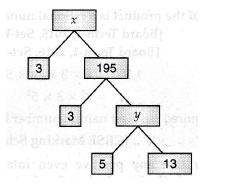
∴ Composite number, x = 6762
4.
In \(\triangle ADC\) and \(\triangle ACB\),
\(\angle ADC=\angle ACB\) [each angle 90°]
\(\angle DAC= \angle CAB\) [common angle]
So, \(\triangle ADC\sim \triangle ACB\)
[by AAA similarity criterion]
Then, \(\frac{AD}{AC}=\frac{AC}{BA}\)
[since, corresponding sides of similar triangles are proportional]
\(\Rightarrow\) AC2 = AB x AD ... (i)
Similarly, \(\triangle BDC\sim \triangle BCA\)
\(\frac{BD}{BC}=\frac{BC}{AB}\)
[since, corresponding sides of similar triangles are proportional]
\(\Rightarrow\) BC2 = AB x AD ... (ii)
On dividing Eq.(i) by Eq.(ii), we get
\(\frac { { { BC }^{ 2 } } }{ { AC }^{ 2 } } =\frac { BD }{ AD } \)
5.
(i) k\(\neq\)10
(ii) k=10.
There is no value of k for which given system has infinitely many solutions. i.e, represent coincident lines.
6.
0.95
7.
Area of the required \(\Delta ABC\)
=\({1\over2}|2(0-2)+6(2-0)+4(0-0)|\)
=\({1\over2}|12-4|=4\) sq.units
8.
Let the other root be \(\alpha \)
\(\therefore \) Sum of the roots = \(\alpha +3=\frac { 3 }{ 2 } \)
\(\therefore \quad \alpha =\frac { 3 }{ 2 } -3\)
\(\therefore \quad \alpha =\frac { 3-6 }{ 2 } =-\frac { 3 }{ 2 } \)
\(\therefore \) The other root be \(\alpha =-\frac { 3 }{ 2 } \)
When 3 be a root of the given equation, then put x=3 in the given equation,we get
2.32-3.3+p=0
\(\Rightarrow 18-9+p=0\Rightarrow p=-9\)
\(\therefore \) The other root be \(-\frac { 3 }{ 2 } \) and the value of p=-9
9.
Two digit numbers, divisible by 6 are 12,
18, 24,..., 96
Here a = 12 and d = 18 - 12 = 6
\(\because\) an = 96
From formula, a + ( n - 1 ) d = an, we get
12 + ( n - 1 ) 6 = 96
\(\Rightarrow\) ( n - 1 )6 = 96 - 12 = 84
\(\Rightarrow\) n - 1 = \(\frac{84}{6}\)
\(\Rightarrow\) n - 1 = 14
\(\Rightarrow\) n = 14 + 1 = 15
10.
\(x=\frac{2}{a}, y=\frac{3}{b}\)
11.
p = 5, q = 1
12.
k = 4
13.
Let larger number = x and smaller number =y
A.T.Q 3x=4y + 3
⇒ x=\(\frac{4y+3}{3}\)...(i)
and 7y=5x+1
Using (i) in (ii), we get 7y=5\(\left(\frac{4y+3}{3}\right)+1\)
7y=\(\frac{20y+15+3}{3}\)
21y=20y+18⇒ y=18
when y=18, eq.(i) becomes x=\(\frac{4\times{18}+3}{3}\)=25
Numbers are 25 and 18
14.
No. of possible outcomes = 20 1
(i) Total no. divisible by 2 or 3 = 6, 12, 18 =3
P(divisible by 2 or 3) = \(\frac{3}{20}\)
(ii) Prime numbers = 2, 3, 5, 7, 11, 13, 17, 19 = 8
P(a prime. no.) =\(\frac{8}{20}\)= \(\frac{2}{5}\)
15.
Rs.12000 in scheme A and Rs.10000 in scheme B
16.
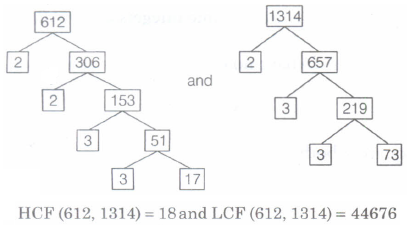
17.
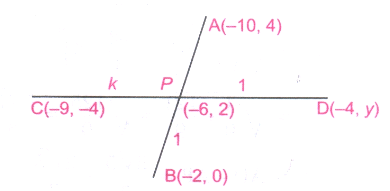
Since P is the mid-point Of the line segment joining A(-10,4) and B-2,0).
\(\therefore \) The coordinates of P are
\(\left( \frac { -10-2 }{ 2 } ,\frac { 4+0 }{ 2 } \right) \) i.e P(-6,2)
Let P(-6, 2) divides the joining of C(-9, -4) and D(-4,y) in ratio k:1
\(\therefore \) The coordinates of P = \(\left( \frac { -4k-9 }{ k+1 } ,\frac { ky-4 }{ k+1 } \right) \)
=(-6,2)
\(\Rightarrow \) \(\frac { -4k-9 }{ k+1 } \)=-6 and \(\frac { ky-4 }{ k+1 } \) =2 ...(i)
Consider \(\frac { -4k-9 }{ k+1 } \)=-6
\(\Rightarrow \) -4k-9=-6k-6 2k=3
\(\Rightarrow \) k= \(\frac { 3 }{ 2 } \)
\(\Rightarrow \) Ratio is\(\frac { 3 }{ 2 } \) :1 or 3:2
From (i) \(\frac { \frac { 3 }{ 2 } y-4 }{ \frac { 3 }{ 2 } +1 } =2\)
\(\Rightarrow \) \(\frac { 3y-8 }{ 3+2 } \) =2 \(\Rightarrow \) 3y-8=10
\(\Rightarrow \) 3y=18 y=6
18.
\(\therefore \) x = -2 is a root of 3x2 +7x+p=0
\(\Rightarrow 3(-2)^{ 2 }+7\times (-2)+p=0\)
\(\Rightarrow p=2\)
\(\therefore \quad x^{ 2 }+k(4x+k-1)+p=0\) becomes
\(x^{ 2 }+4kx+k^{ 2 }-k+2=0\)
D = (4k)2-4X 1(k2-k+2)
=16k2-4k2+4k-8
= 12k2+4k-8
\(\therefore \) Roots are equal
\(\therefore \) 12k2+4k-8=0
\(\Rightarrow 3k^{ 2 }+k-2=0\)
\(\Rightarrow 3k^{ 2 }+3k-2k-2=0\)
\(\Rightarrow 3k(k+1)-2(k+1)=0\)
\((k+1)(3k-2)=0\)
\(k=-1,k=\frac { 2 }{ 3 } \)
19.
Consider \(\triangle ABC\), in which D and E are the mid-points of sides AB and AC, respectively.
\(\because \frac { AD }{ DB } =1\quad and\quad \frac { AE }{ EC } =1\Rightarrow \quad \frac { AD }{ DB } =\frac { AE }{ EC } \)
\(\therefore DE\parallel BC\)
[by converse of basic proportionality theorem]
Hence, the line joining the mid-points of any two sides of a triangle, is parallel to the third side.
Hence proved.
20.
Here, n is a natural number and let 6n ends with 0.
Hence, 6n is divisible by 5.
But the prime factors of 6 are 2 and 3, so 5 is not a factor.
\(\Rightarrow \) 6n = (2 x 3)n
In the prime factorisation of 6n , 5 is not a factor.
By using the fundamental theorem of arithmetic, every composite number can be expressed as a product of primes and this factorisation is unique apart from the order, in which the prime factors occur.
So, our assumption, 6n ends with 0, is wrong.
Thus, there does not exist any natural number n, for which 6n ends with zero.
21.
\(3 x^{2}-2 \sqrt{6} x+2=3 x^{2}-\sqrt{6} x-\sqrt{6} x+2\)
\(=\sqrt{3} x(\sqrt{3} x-\sqrt{2})-\sqrt{2}(\sqrt{3} x-\sqrt{2})\)
\(=(\sqrt{3} x-\sqrt{2})(\sqrt{3} x-\sqrt{2})\)
So, the roots of the equation are the values of x for which
\((\sqrt{3} x-\sqrt{2})(\sqrt{3} x-\sqrt{2})=0\)
Now, \(\sqrt{3} x-\sqrt{2}=0 \text { for } x=\sqrt{\frac{2}{3}}\)
So, this root is repeated twice, one for each repeated factor \(\sqrt{3} x-\sqrt{2}\)
Therefore, the roots of 3x2 - 2\(\sqrt6\)x + 2 = 0 are \(\sqrt{\frac{2}{3}}, \sqrt{\frac{2}{3}}\)
22.
The total possible outcomes on tossing a coin three times are (HHH, (HHT), (HTH), (THH), (HTT), (THT), (TTH) and (TTT).
\(\therefore\) Number of all possible outcomes = 8
Let E be the event that Hanif will lose the game.
Hanif will lose the game, if all tosses do not have same result.
i.e. if outcomes are
(HHT), (HTH), (THH), (HTT), (THT) or (TTH).
\(\therefore\) Number of outcomes favourable to E = 6
Hence, required probability = \(P(E)=\frac{6}{8}=\frac{3}{4}\)
23.
(d)
3 units
24.
(d)
28
25.
(d)
2x+ y=3,-4x+2y=10
26.
(a)
5
27.
(b)
-14
28.
(b)
(x – 9) 2
29.
(b)
3 Median = Mode + 2 Mean
30.
(c)
Mode
31.
(d)
4 + 3√3
32.
(c)
400 sq. cm
33.
(b)
2
34.
(a)
182
35.
(a)
9/10
36.
(b) S = {HH, HT, TH, TT}
Favourable outcomes = {HH}
Total number of outcomes = 4
\(\therefore \text { Probability }=\frac{\text { Number of favourable outcomes }}{\text { Total number of outcomes }}=\frac{1}{4}\)
Reason is true but not correct explanation of Assertion.
37.
(a) If both Assertion and Reason are correct and Reason is the correct explanation of Assertion.
38.
(i) (b): Let \(\Delta\)ABC is the triangle formed by both hotels and mountain top. \(\Delta\)CDE is the triangle formed by both huts and mountain top. Clearly, DE || AB and so
\(\triangle A B C \sim \triangle D E C\) [By AA-similarity criterion]
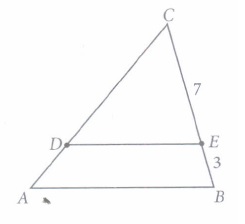
Now, required ratio = Ratio of their corresponding sides \(=\frac{B C}{E C}=\frac{10}{7}\) i.e., 10:7.
(ii) (c): Since, DE || AB, therefore
\(\frac{C D}{A D}=\frac{C E}{E B} \Rightarrow \frac{10}{A D}=\frac{7}{3} \Rightarrow A D=\frac{10 \times 3}{7}=4.29 \text { miles }\)
(iii) (b) : Since, \(\triangle A B C \sim \triangle D E C\)
\(\therefore \quad \frac{B C}{E C}=\frac{A B}{D E}\) [ \(\because\) Corresponding sides of similar triangles are proportional]
\(\Rightarrow \frac{10}{7}=\frac{A B}{8} \Rightarrow A B=\frac{80}{7}=11.43 \text { miles }\)
(iv) (a) Given, DC= 5+ BC.
Clearly, BC = 10-5 = 5 miles
Now, CE = \(\frac{7}{10}\)x BC = \(\frac{7}{10}\) x 5 = 3.5 miles
(v) (d) :Clearly the radio of areas of two angles (i,e \(\triangle A B C \sim \triangle D E C\))
\(\begin{array}{l}
=\left(\frac{B C}{E C}\right)^{2}=\left(\frac{10}{7}\right)^{2}=\frac{100}{49} \\
\therefore \quad \text { Required ratio }=\frac{\operatorname{ar}(\Delta C D E)}{a r(E B A D)}=\frac{49}{100-49}=\frac{49}{51}
\end{array}\)
39.
Number on nth spot = 20 + 4n i.e., tn = 20 + 4n
(i) (b): Number on 1st spot = t1 = 20 + 4(1) = 24
(ii) (c): Number on (n - 2)th spot = tn - 2
= 20 + 4 (n - 2)
= 20 + 4n - 8 = 12 + 4n
(iii) (a): Number on 34th spot = t34 = 20 + 4(34) = 156
(iv) (b): Here a = t1 = 24
Now, t2 = 20 + 4 (2) = 20 + 8 = 28
\(\therefore\) d = t2 - t1 = 4
So, required sum \(=S_{10}=\frac{10}{2}[2(24)+9(4)]=420\)
(v) (d): Let nth spot is numbered as 116.
\(\therefore\) tn = 116
\(\Rightarrow 20+4 n=116 \Rightarrow 4 n=96 \Rightarrow n=24\)
40.
(i) (b): Here 80 = 24 x 5, 85 = 17 x 5
and 90 = 2 x 32 x 5
L.C.M of 80, 85 and 90 = 24 x 3 x 3 x 5 x 17 = 12240
Hence, the minimum distance each should walk when they at first time is 12240 cm.
(ii) (c): Here 594 = 2 x 33 x 11 and 189 = 33 x 7
HCF of 594 and 189 = 33= 27
Hence, the maximum number of columns in which they can march is 27.
(iii) (c) : Here 768 = 28 x 3 and 420 = 22 x 3 x 5 x 7
HCF of 768 and 420 = 22 x 3 = 12
So, the container which can measure fuel of either tanker exactly must be of 12litres.
(iv) (b): Here, Length = 825 ern, Breadth = 675 cm and Height = 450 cm
Also, 825 = 5 x 5 x 3 x 11 , 675 = 5 x 5 x 3 x 3 x 3 and 450 = 2 x 3 x 3 x 5 x 5
HCF = 5 x 5 x 3 = 75
Therefore, the length of the longest rod which can measure the three dimensions of the room exactly is 75cm.
(v) (a): LCM of 8 and 12 is 24.
\(\therefore \)The least number of pack of pens = 24/8 = 3
\(\therefore \)The least number of pack of note pads = 24/12 = 2

10th Standard CBSE Syllabus & Materials
10th Standard CBSE
CBSE 10th Social Science PS - Federalism - New Model Questions Papers Study Material - QB365 Set A
NEW10th Standard CBSE
CBSE 10th Social Science PS - Power Sharing - New Model Questions Papers Study Material - QB365 Set A
NEW10th Standard CBSE
CBSE 10th Social Science GEO - Manufacturing Industries - New Model Questions Papers Study Material - QB365 Set A
NEW10th Standard CBSE
CBSE 10th Social Science GEO - Minerals and Energy Resources - New Model Questions Papers Study Material - QB365 Set A



NCERT Books

Syllabus

Exam Pattern

Sample Question Papers

Previous year Question Papers

Important Notes

MCQ Practice test

NCERT Exemplers

Case study Questions

Image Based Questions

Passage based Questions

HOT Questions

Value Based Questions

Model Questions Papers
NCERT ( Book Back ) Questions

Assertion and Reason
Important Questions And Answers

CBSE 10th Standard CBSE Subjects
CBSE Standards



