
 100% FREE ACCESS
10th Standard CBSE Syllabus & Materials
10th Standard CBSE
CBSE 10th Social Science ECO - Globalisation and the Indian Economy - New Model Questions Papers Study Material - QB365 Set A
NEW10th Standard CBSE
CBSE 10th Social Science ECO - Money and Credit - New Model Questions Papers Study Material - QB365 Set A
NEW10th Standard CBSE
CBSE 10th Social Science ECO - Sectors of the Indian Economy - New Model Questions Papers Study Material - QB365 Set A
NEW10th Standard CBSE
CBSE 10th Social Science ECO - Development - New Model Questions Papers Study Material - QB365 Set A
NEW10th Standard CBSE
CBSE 10th Social Science PS - Outcomes of Democracy - New Model Questions Papers Study Material - QB365 Set A
NEW10th Standard CBSE
CBSE 10th Social Science PS - Gender, Religion and Caste - New Model Questions Papers Study Material - QB365 Set A

Published on: 21/10/2025
Download CBSE Class 10th Standard CBSE Maths question papers, sample papers, important questions, and previous year solved papers in PDF format. Get free study materials, NCERT solutions, and exam preparation resources for Class 10th Standard CBSE Maths
Questions + Answers key
Take MCQ Maths Test
1.
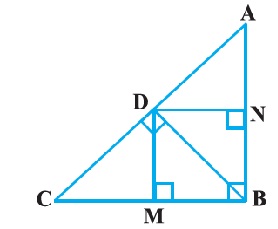
In the given figure, D is a point on hypotenuse AC of ΔABC, DM ⊥ BC and DN ⊥ AB, Prove that:
DM2 = DN.MC
2.
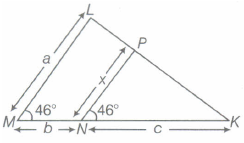
In the given figure, \(\angle M=\angle N=\) 46°. Express x in terms of a, b and c, where a, b and c are the lengths of LM, MN and NK respectively.
3.
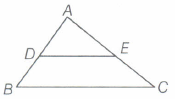
In the given figure, \(DE\parallel BC\) . If AD = 3 cm, DB = 4 cm and AE = 6 cm, find EC.
4.
Find three numbers in A.P. whose sum is 15 and the product is 80.
5.
The sum of first q terms of an A.P. is 63q - 3q2. If its pth term is -60, find the value of p. Also, find the 11th term of this A.P.
6.
Determine the AP whose fourth term is 18 and the difference of the ninth term from the fifteenth term is 30.
7.
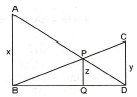
In figure AB || PO || CD, AB = x units, CD = y units and PQ = z units, prove that \({1\over x}+{1\over y}={1\over z}\)
8.
Prove that the ratio of the areas of two similaoswall triangles is equal to the square of the ratio of their corresponding meidans.
9.
Deepak repays his total loan of Rs.1,18,000 by paying every month starting with the first instalment of Rs.1000. If he increase the instalment by Rs.100 every month, what amount will be paid as the last instalment of loan? What amount of loan he still have to pay after the 30th instalment?
10.
Kanoka was given her pocket money on Jan 1st, 2008. She puts Rs.1 on day 1, Rs.2 on day 2, Rs.3 on day 3, and continued doing so til the end of the month, from this money into her piggy bank. She also spent Rs.204 of her pocket money, and found that at the end of the month she still had Rs.100 with her. How much was her pocket money for the month?
11.
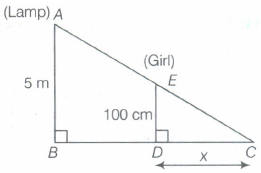
A girl of height 100 cm is walking away from the base of a lamppost at a speed of 1.9 m/s. If the lamp is 5 m above the ground, find the length of her shadow after 4s.
12.
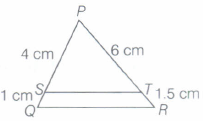
In the given figure, PS, SQ, PT and TR are 4 cm, 1 cm, 6 cm and 1.5 cm respectively.
Prove that \(ST\parallel QR\) . Also, find \(\frac { ar\left( \triangle PST \right) }{ ar\left( trapezium\quad QRTS \right) } \)
13.
A vertical stick 1 m long casts a shadow 80 cm long. At the same time a tower casts a shadow 30 m long. Determine the height of the tower.
14.
The amount of money in the account every year, when Rs.10000 is deposited at compound interest at 8% per annum. Do these amounts from an A.P.?
15.
Three numbers in A.P. have sum 24, find the middle term.
16.
If one angle of a triangle is equal to one angle of the other triangle and any two sides are proportional, then the two triangles are similar.
17.
If 7th term of A.P. is 34 and 13th term is 64, then its 18th term is 89.
18.
Radhika wants to visit her friend who recently moved to a new house. The road map between Radhika's home and her friend's as well as the distance known to Radhika are as shown in the figure given below:
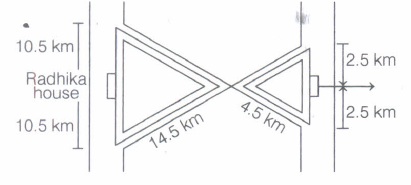
To reach the friend's house, the shortest distance which Radhika has to travel, is
30.95 km
32.5 km
28.5 km
35.35 km
19.
Sides of two similar triangles are in the ratio 4 : 9. Areas of these triangles are in the ratio
2 : 3
4 : 9
81 : 16
16 : 81
20.
Take a point A(3, 4) on the graph and draw two lines from it, one is parallel to X-axis and another parallel to Y-axis. Again, take four points on both line on both sides of A, such that their x-coordinates and y-coordinates form an AP with common difference 2. Then, the area of circle, passing through these four points is
12 sq units
13 sq units
12.56 sq units
13.56 sq units
21.
The sum of the series 452 - 432 + 442 - 422 + 432 - 412+ 422 - 402 + ... upto 30 terms.
1110
2220
3330
4440
22.
Find the sum of the series 1 + (1+ 2) + (1+ 2 + 3) +(1 + 2 + 3 + 4) + ... + (1+ 2 + 3 + ... + 20)
1470
1540
1610
1370
23.
Let a be a sequence defined by a1 = 1, a2 = 1 and an = an - 1 + an - 2 for all n > 2, then the value of \(\frac{a_{4}}{a_{3}}\) is
\(\frac{2}{3}\)
\(\frac{5}{4}\)
\(\frac{4}{5}\)
\(\frac{3}{2}\)
24.
The number of two digit numbers divisible by 5 is
17
16
19
18
25.
Ramesh’s salary in February 2008 is Rs. 10,000. If he’s promised an increase of Rs. 1000 every year, what would be his salary in Feb 2011
Rs.14,000
Rs. 12,000
Rs. 13,000
Rs. 15,000
26.
In an A.P. the two consecutive terms are (2n+3) and (2n+5). Find the common difference of the A.P
2
2n+2
2n+3
2n+1
27.
Which term of the following A.P. would be 0? 36,33,30,27….
9
12
13
10
28.
An AP has first term -3 and a common difference -1. Find the 3rd term of the A.
5
-7
-1
-5
29.
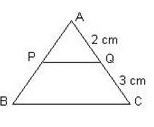
In the adjoining figure, PQ || BC, then what could be the values of AP & PB respectively
1 cm and 3 cm
3 cm and 6 cm
2 cm and 4 cm
4 cm and 6 cm
30.
ΔABC ~ ΔPQR, ∠B = 50° and ∠C = 70° then ∠P is equal to
50°
60°
40o
70o
31.
In figure, ΔABC ~ ΔPQR
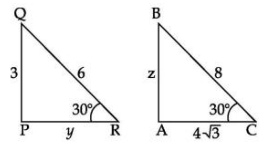
2 + √3
4 + √3
3 + 4√3
4 + 3√3
32.
Two friends A and B start from the same point in the Eastern and Northern directions at the same time. How far are they from each other when A has travelled 5 km and B has travelled 12 km. distance?
8 km
17 km
10 km
13 km
33.
A boy is trying to catch fish sitting at a height of 12 m from the surface of the water.A big fish is at a horizontal distance of 5 m from him. What should be the length of his string to get the fish?
10
13
7
15
34.
What is the diagonal length of a TV screen whose dimensions are 80 x 60 cm?
10
100
20
100
35.
From the given figure, find the unknown x.
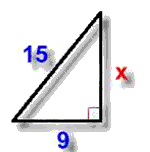
12
225
10
144
36.
Vijay is trying to find the average height of a tower near his house. He is using the properties of similar triangles. The height of Vijay's house, if 20 m when Vijay's house casts a shadow 10m long on the ground.
At the same time, the tower casts a shadow 50 m long on the ground and the house of Aiay casts 20 m shadow on the ground.
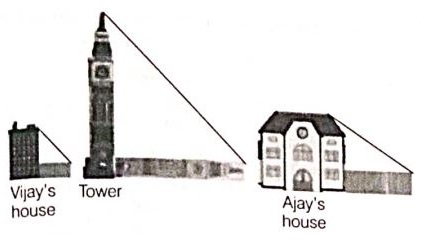
(i) What is the height of the tower?
(a) 20 m (b) 50 m (c) 100 m (d) 200 m
(ii) What will be the length of the shadow of the tower when Vijay's house casts a shadow of 12 m?
(a) 75 m (b) 50 m (c) 45 m (d) 60 m
(iii) What is the height of Ajay's house?
(a) 30 m (b) 40 m (c) 50 m (d) 20 m
(iv) When the tower casts a shadow of 40 m, same time what will be the length of the shadow of Ajay's house?
(a) 16 m (b) 32 m (c) 20 m (d) 8 m
(v) When the tower casts a shadow of 40 m, same time what will be the length of the shadow of Vijay's house?
(a) 15 m (b) 32 m (c) 16 m (d) 8 m
37.
A sequence is an ordered list of numbers. A sequence of numbers such that the difference between the consecutive terms is constant is said to be an arithmetic progression (A.P.).
On the basis of above information, answer the following questions.
(i) Which of the following sequence is an A.P.?
| (a) 10,24,39,52,.... | (b) 11,24,39,52, ... | (c) 10,24,38,52, ... | (d) 10, 38, 52, 66, .... |
(ii) If x, y and z are in A.P., then
| (a) x + z = y | (b) x - z = y | (c) x + z = 2y | (d) None of these |
(iii) If a1 a2, a3 ..... , an are in A.P., then which of the following is true?
| (a) a1 + k, a2 + k, a3 + k, , an + k are in A.P., where k is a constant. |
| (b) k - a1 k - a2, k - a3, , k - an are in A.P., where k is a constant. |
| (c) ka1, ka2, ka3 ..... , kan are in A.P., where k is a constant. |
| (d) All of these |
(iv) If the nth term (n > 1) of an A.P. is smaller than the first term, then nature of its common difference (d) is
| (a) d > 0 | (b) d < 0 |
| (c) d = 0 | (d) Can't be determined |
(v) Which of the following is incorrect about A.P.?
| (a) All the terms of constant A.P. are same. |
| (b) Some terms of an A.P. can be negative. |
| (c) All the terms of an A.P. can never be negative. |
| (d) None of these |
38.
Anuj gets pocket money from his father everyday. Out of the pocket money, he saves Rs 2.75 on first day, Rs 3 on second day, Rs 3.25 on third day and so on.
On the basis of above information, answer the following questions .

(i) What is the amount saved by Anuj on 14th day?
| (a) Rs 6.25 | (b) Rs 6 | (c) Rs 6.50 | (d) Rs 6.75 |
(ii) What is the total amount saved by Anuj in 8 days?
| (a) Rs 18 | (b) Rs 33 | (c) Rs 24 | (d) Rs 29 |
(iii) What is the amount saved by Anuj on 30th day?
| (a) Rs 10 | (b) Rs 12.75 | (c) Rs 10.25 | (d) Rs 9.75 |
(iv) What is the total amount saved by him in the month of June, if he starts savings from 1st June?
| (a) Rs 191 | (b) Rs 191.25 | (c) Rs 192 | (d) Rs 192.5 |
(v) On which day, he save tens times as much as he saved on day-I?
| (a) 9th | (b) 99th | (c) 10th | (d) 100th |
1.
Let us join DB.
We have, DN || CB, DM || AB, and ∠B = 90°
∴ DMBN is a rectangle.
∴ DN = MB and DM = NB
The condition to be proved is the case when D is the foot of the perpendicular drawn from B to AC.
∴ ∠CDB = 90°
⇒ ∠2 + ∠3 = 90° … (1)
In ΔCDM,
∠1 + ∠2 + ∠DMC = 180°
⇒ ∠1 + ∠2 = 90° … (2)
In ΔDMB,
∠3 + ∠DMB + ∠4 = 180°
⇒ ∠3 + ∠4 = 90° … (3)
From equation (1) and (2), we obtain
∠1 = ∠3
From equation (1) and (3), we obtain
∠2 = ∠4
In ΔDCM and ΔBDM,
∠1 = ∠3 (Proved above)
∠2 = ∠4 (Proved above)
∴ ΔDCM ∼ ΔBDM (AA similarity criterion)
=> (BM)/(DM) = (DM)/(MC)
=> (DN)/(DM) = (DM)/(MC) (BM = DN)
⇒ DM2 = DN x MC
2.
Prove \(\triangle PNK\) and \(\triangle LMK\), similar then, \(\frac { NK }{ MK } =\frac { PN }{ LM } \)
\(\frac { c }{ b+c } =\frac { x }{ a } \Rightarrow x=\frac { ac }{ b+c } \)
3.
In \(\triangle ABC, DE\parallel BC\)
Let EC = x cm
\(\Rightarrow \frac { AD }{ DB } =\frac { AE }{ EC } \)
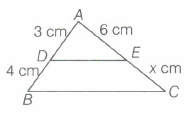
[by basic proportionality theorem]
\(\Rightarrow \frac { 3 }{ 4 } =\frac { 6 }{ x } \Rightarrow \) x = 8 cm
\(\therefore \) EC = 8 cm
4.
Let the three numbers in A.P. be a - d, a, a + d
\(\therefore\) Sum is a - d + a + a + d =15
\(\Rightarrow\) 3a = 15
\(\Rightarrow\) a = 5
Also, product is ( a - d ) (a) ( a + d ) = 80
( 5 - d ) (5) ( 5 + d ) = 80
5 ( 25 - d2 ) = 8
\(\Rightarrow\) 25 - d2 = \({80 \over 5}\)
\(\Rightarrow\) 25 - d2 = 16
\(\Rightarrow\) d2 = 9
\(\Rightarrow\) d = \(\pm\) 3
\(\therefore\) Three numbes in A.P. are 5, -3, 5, 5 + 3
i.e., 2, 5, 8
or 5 + 3, 5, 5 - 3
i.e., 8, 5, 2
5.
Here, Sq = 63q - 3q2 ....(i)
Also, Sq-1 = 63 ( q - 1 ) - 3 ( q - 1 )2
= 63q - 63 - 3 ( q2 + 1 - 2q )
\(\Rightarrow\) 500 + 100d + 50 + 50 - d = 500 - 100d + 50 + 5 + d - 594
\(\Rightarrow\) 198d = - 594
\(\Rightarrow\) d = - 3
Thus, the three digits are 5 - ( - 3 ), 5 and 5 - 3, (i.e., 8, 5 and 2 )
Hence, the required number is 852.
6.
Given; a4 = 18
\(\Rightarrow\) a + 3d = 18 ...... (i)
and a15 - a9 = 30
\(\Rightarrow\) (15 - 9)d = 30
\(\Rightarrow\) 6d = 30
\(\Rightarrow\) d = 5
Putting the value of d in (i), we have
a + 3d = 18
\(\Rightarrow\) a + 3 x 5 = 18
\(\Rightarrow\) a + 15 = 18
\(\Rightarrow\) a = 3
Required AP is 3, 8, 13,......
7.
Let BQ =aunits, DQ = b units
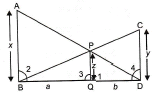
∵ PQ || AB ∴ ㄥ1 = ㄥ2
and ㄥADB = ㄥPDQ
∴ ΔADB ~ ΔPDQ
Similarily ΔADB ~ΔPDQ
∴ \({AB\over PQ}={BD\over DQ}\)
\({x\over z}={a+b\over b}\)
\({x\over z}={a\over b}+1⇒{x\over z}-1={a\over b}\ \ \ ...(i)\)
Also ΔBCD ~ ΔBPQ
∴ \({BD\over BQ}={CD\over PQ}⇒{a+b\over a}={y\over z}\)
\(1+{b\over a}={y\over z}⇒{a\over b}={y\over z}-1\)
⇒ \({b\over a}={y-z\over z}⇒{a\over b}={z\over y-z}\ \ \ (ii)\)
From (i) and (ii)
\({x\over z}-1={z\over y-z}⇒{x\over z}={z\over y-z}+1\)
\({x\over z}={z+y-z\over y-z}\)
\({z\over z}={y\over y-z}⇒{z\over x}={y-z\over y}\)
\({z\over x}=1-{z\over y}\)
\(z\left(1\over x\right)=z\left({1\over z}-{1\over y}\right)⇒{1\over x}={1\over z}-{1\over y}\)
\(⇒{1\over x}+{1\over y}={1\over z}\)
8.
Given: \(\triangle\)ABC~ \(\triangle\)PQR
To Prove: \(\frac { ar(\triangle ABC) }{ ar(\triangle PQR) } ={ \left( \frac { AB }{ PQ } \right) }^{ 2 }\)
\(={ \left( \frac { BC }{ QR } \right) }^{ 2 }={ \left( \frac { AC }{ PR } \right) }^{ 2 }\)
Construction: Draw AD\(\bot\)BC and PE\(\bot\)QR.
Proof: \(\triangle\)ABC ~ \(\triangle\)PQR
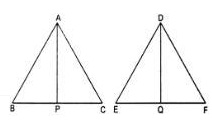
\(\frac { AB }{ PQ } =\frac { BC }{ QR } =\frac { AC }{ PR } \)
(Corresponding sides of similar triangles) ...(i)
\(\angle\)B = \(\angle\)Q
In \(\triangle\)ADB and \(\triangle\)PEQ
\(\angle\)B=\(\angle\)Q
\(\angle\)ADB=\(\angle\)PEQ [each 900]
\(\triangle\)ADB ~ \(\triangle\)PEQ (AA similarity)
\(\Rightarrow \quad \frac { AD }{ PE } =\frac { AB }{ QQ } \)
(corresponding sides of similar triangles) ...(ii)
From eq.(i) and eq.(ii),
\(\Rightarrow \frac { AB }{ PQ } =\frac { BC }{ QR } =\frac { AC }{ PR } =\frac { AD }{ PE } ...(iii)\)
Now \(\frac { ar(\triangle ABC) }{ ar(\triangle PQR) } =\frac { \frac { 1 }{ 2 } \times BC\times AD }{ \frac { 1 }{ 2 } \times QR\times PE } \)
\(=\left( \frac { BC }{ QR } \right) \times \left( \frac { AD }{ PE } \right) \)
\(\frac { ar(\triangle ABC) }{ ar(\triangle PQR) } ={ \left( \frac { BC }{ QR } \right) }^{ 2 }...(iv)\)
From eq (iii) and eq (iv),
\(\frac { ar(\triangle ABC) }{ ar(\triangle PQR) } ={ \left( \frac { AB }{ PQ } \right) }^{ 2 }\)
\(={ \left( \frac { BC }{ QR } \right) }^{ 2 }={ \left( \frac { AC }{ PR } \right) }^{ 2 }\)
9.
Ist instalment = Rs 1000
IInd instalment = Rs 1000 + Rs 100 = IIIrd instalment = Rs 1100 + Rs 100 = Rs 1200 and so on
Let number of instalments = n
\(\therefore\) 1000 + 1100 + 1200 + .... up to n terms = 118000
\(\Rightarrow\) \({n\over2}[2\times1000+(n-1)100]=118000\)
\(\Rightarrow\) n( 100n + 1900 ) = 236000
\(\Rightarrow\) 100n2 + 1900n - 2360 = 0
\(\Rightarrow\) n2 + 19n - 2360 = 0
\(\Rightarrow\) ( n + 59 ) ( n - 40 ) = 0.
\(\Rightarrow\) n = - 59 ( rejected ) or n = 40
\(\therefore\) Total no. of instalment = 40th instalment
\(\therefore\) a40 = a + 39d
= 1000 + 39 x 100
= Rs 4900
Loan repaid i 30 instalments = \({30\over2}[2\times1000+(30-1)\times100]\)
\(={30\over2}(2000+2900)\)
= 15 x 4900 = Rs 73500
\(\therefore\) Amount to be repaid after 30th instalment = 118000 - 73500 = Rs 44500
10.
Here a = 1, d = 1 and n = 31
Sn = \({n\over2}[2a+(n-1)d]\)
\(={31\over2}[2\times1+(31-1)]\)
\(={31\over2}[2+30]={31\over2}\times 32\)
= 496
\(\therefore\) Piggy bank amount = Rs 496
Amount spent = Rs 204
Amount left = Rs 100
Total pocket money = Rs 800
11.
Let AB be the lamp-post and ED be the position of girl after 4s.
Given, height of the girl, ED = 100 cm
and height of the lamp-post, AB = 5 m = 500 cm
Distance of the girl from lamp-post after 4 s
= 1.9 x 4 = 7.6 m = 760 cm
[\(\because\) distance = speed x time]
i.e. BD = 760 cm
Let DC = x cm
In \(\triangle CDE\) and \(\triangle CBA\),
\(\angle DCE=\angle BCA\) [common angle]
\(\angle CDE=\angle CBA\) [each 90°]
\(\therefore \triangle CDE\sim \triangle CBA\) [by AA similarity criterion]
So, \(\frac { CD }{ CB } =\frac { DE }{ BA } \Rightarrow \frac { x }{ x+760 } =\frac { 100 }{ 500 } \)
\(\Rightarrow\) 5x = x + 760
\(\Rightarrow\) 4x = 760
\(\Rightarrow\) x = 190 cm
Hence, the length of her shadow 4s is 190 cm.
12.
\(\frac{16}{9}\)
13.
Let h be the height of the tower.
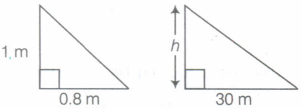
[\(\because\) 80 cm = 0.8 m]
Since, it is clear that both the triangles will be similar.
\(\therefore \frac{1}{0.8}=\frac{h}{30} \quad \Rightarrow h = \frac{30}{0.8}\) = 37.5 m
14.
Principal = Rs 10000
Rate of interest = 85 per annum
Since the interest is compounded yearly.
Therefore, Amount(A) = \(10000\left(1+\frac{8}{100}\right)\)
Now, the sequence becomes \(10000\left( 1+\frac{8}{100} \right),\)
\(10000\left( 1+\frac{8}{100} \right)^{2},10000\left( 1+\frac{8}{100} \right)^{3}\) , ...
Here, a2 - a1 \(\neq\) a3 - a2
Therefore, the given amount of money in the account every year does not form an A.P.
15.
8
16.
(b)
17.
(a)
18.
(a)
30.95 km
19.
(d)
16 : 81
20.
(c)
12.56 sq units
21.
(b)
2220
22.
(b)
1540
23.
(d)
\(\frac{3}{2}\)
24.
(d)
18
25.
(c)
Rs. 13,000
26.
(a)
2
27.
(c)
13
28.
(d)
-5
29.
(d)
4 cm and 6 cm
30.
(b)
60°
31.
(d)
4 + 3√3
32.
(d)
13 km
33.
(b)
13
34.
(b)
100
35.
(a)
12
36.
(i) (c) Let CD = h m be the height of the tower BE = 20 m be the height of Vijay's house and GF be the height of Ajay's house.
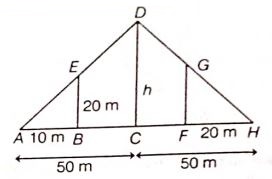
\(\begin{array}{rlrl} \triangle A C D & \sim\triangle A B E \\ \end{array}\)
\(\therefore\) \(\begin{array}{rlrl} \frac{A C}{A B} & =\frac{C D}{E B} \\ \end{array}\)
\(\begin{array}{rlrl} \Rightarrow & \frac{50}{10} & =\frac{h}{20} \\ \end{array}\)
\(\begin{array}{rlrl} \Rightarrow & h & =100 \mathrm{~m} \end{array}\)
(ii) (d) Given, AB = 12 m, let AC = h
In similar \(\Delta\) ABE and \(\Delta\)ACD,
\(\begin{aligned} \frac{A B}{A C} =\frac{B E}{C D} \\ \end{aligned}\)
\(\begin{aligned} \Rightarrow \quad \frac{12}{h} & =\frac{20}{100} \\ \end{aligned}\)
\(\begin{aligned} \Rightarrow & h =\frac{12 \times 100}{20}=12 \times 5=60 \mathrm{~m} \end{aligned}\)
(iii) (b) Let height of Ajay's house be GF = h1
Since, \(\Delta\)HFG - \(\Delta\)HCD
\(\begin{array}{ll} \therefore & \frac{H F}{H C}=\frac{F G}{C D} \\ \end{array}\)
\(\begin{array}{ll} \Rightarrow & \frac{20}{50}=\frac{h_1}{100} \\ \end{array}\)
\(\begin{array}{ll} \Rightarrow & h_1=\frac{20 \times 100}{50}=40 \mathrm{~m} \end{array}\)
(a) Given, HC = 40 m
Let length of the shadow of Ajay's house be HF = l m
Since, \(\Delta\)HFG \(\sim\) \(\Delta\)HCD
\(\begin{aligned} & \therefore & \frac{H F}{H C} & =\frac{F G}{C D} \\ \end{aligned}\)
\(\begin{aligned} & \Rightarrow & \frac{l}{40} & =\frac{40}{100} \\ \end{aligned}\)
\(\begin{aligned} \Rightarrow & & l & =\frac{40 \times 40}{100}=16 \mathrm{~m} \end{aligned}\)
(v) (d) Given, AC = 40 m
Let length of the shadow of Vijay's house be AB = l m
Since, \(\triangle A B E \sim \triangle A C D\)
\(\begin{array}{rlrl} \therefore & & \frac{A B}{A C} & =\frac{E B}{C D} \\ \end{array}\)
\(\begin{array}{rlrl} \Rightarrow & \frac{l}{40} & =\frac{20}{100} \\ \end{array}\)
\(\begin{array}{rlrl} \Rightarrow & l l & =\frac{20 \times 40}{100}=8 \mathrm{~m} \end{array}\)
37.
(i) (c)
(ii) (c)
(iii) (d)
(iv) (b)
(v) (c)
38.
Here the savings form an A.P. i.e., Rs 2.75, Rs 3, Rs 3.25, ...
So, a = 2.75, d = 3 - 2.75 = 0.25
(i) (b): Amount saved by Anuj on 14th day
= t14 = a + 13d = 2.75 + 13(0.25) = ₹ 6
(ii) (d): Total amount saved by Anuj in 8 days
\(=S_{8}=\frac{8}{2}[2(2.75)+7(0.25)]=₹ 29\)
(iii) (a): Amount saved by Anuj on 30th day
= t30 = a + 29d = 2.75 + 29(0.25) = ₹ 10
(iv) (b): Number of days in June = 30
\(\therefore S_{30}=\frac{30}{2}[2(2.75)+29(0.25)]=₹ 191.25\)
(v) (d): Let on nth day, he saves 10 times as he saves on 1st day.
tn = 10(2.75) \(\Rightarrow\) a + (n - 1)d = 27.5 \(\Rightarrow\) n = 100.

10th Standard CBSE Syllabus & Materials
10th Standard CBSE
CBSE 10th Social Science PS - Federalism - New Model Questions Papers Study Material - QB365 Set A
NEW10th Standard CBSE
CBSE 10th Social Science PS - Power Sharing - New Model Questions Papers Study Material - QB365 Set A
NEW10th Standard CBSE
CBSE 10th Social Science GEO - Manufacturing Industries - New Model Questions Papers Study Material - QB365 Set A
NEW10th Standard CBSE
CBSE 10th Social Science GEO - Minerals and Energy Resources - New Model Questions Papers Study Material - QB365 Set A



NCERT Books

Syllabus

Exam Pattern

Sample Question Papers

Previous year Question Papers

Important Notes

MCQ Practice test

NCERT Exemplers

Case study Questions

Image Based Questions

Passage based Questions

HOT Questions

Value Based Questions

Model Questions Papers
NCERT ( Book Back ) Questions

Assertion and Reason
Important Questions And Answers

CBSE 10th Standard CBSE Subjects
CBSE Standards



