
 100% FREE ACCESS
10th Standard CBSE Syllabus & Materials
10th Standard CBSE
CBSE 10th Social Science ECO - Globalisation and the Indian Economy - New Model Questions Papers Study Material - QB365 Set A
NEW10th Standard CBSE
CBSE 10th Social Science ECO - Money and Credit - New Model Questions Papers Study Material - QB365 Set A
NEW10th Standard CBSE
CBSE 10th Social Science ECO - Sectors of the Indian Economy - New Model Questions Papers Study Material - QB365 Set A
NEW10th Standard CBSE
CBSE 10th Social Science ECO - Development - New Model Questions Papers Study Material - QB365 Set A
NEW10th Standard CBSE
CBSE 10th Social Science PS - Outcomes of Democracy - New Model Questions Papers Study Material - QB365 Set A
NEW10th Standard CBSE
CBSE 10th Social Science PS - Gender, Religion and Caste - New Model Questions Papers Study Material - QB365 Set A

Published on: 22/10/2025
Download CBSE Class 10th Standard CBSE Maths question papers, sample papers, important questions, and previous year solved papers in PDF format. Get free study materials, NCERT solutions, and exam preparation resources for Class 10th Standard CBSE Maths
Questions + Answers key
Take MCQ Maths Test
1.
The angles of elevation of the top of a rock from the top and foot of a 60 m high tower are \({ 45 }^{ ° }\)and \({ 60 }^{ ° }\), respectively. Find the height of the rock.
2.
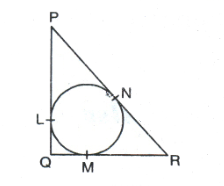
In figure, a circle is inscribed in a triangle PQR with PQ = 10cm, QR = 8 cm and PR = 12 cm. Find the lengths QM, RN and PL.
3.
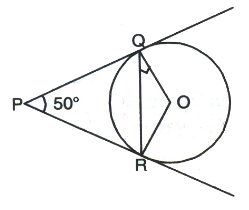
In figure, PQ and PR are the tangents to the circle with centre O such that \(\angle QPR={ 50 }^{ \circ }\). Then find the degree measure of \(\angle OQR\).
4.
A portion of 60 m long tree is broken by tornado and the top struck up the ground making an angle of 30o with the ground level. Find the height of the point where the tree is broken.
5.
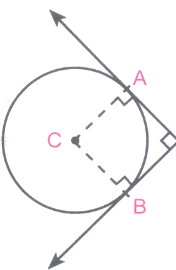
In the figure, PA and PB are two tangents drawn from an external point P to a circle with centre C and radius 4cm.If PA\(\bot \)PB, find the length of each tangent.
6.
In the given figure, O is the centre of a circle, BOA is its diameter and the tangent at the point P meets BA extended at T. If ∠PBO=30°, then find ∠PTA.

7.
Two trees are 2d m apart. Ajay stood at a point midway between them and started walking in a direction perpendicular to the line connecting the tWo trees. After walkingd metres, he observed the angle of elevations to the tops of the two trees and found them to be complementary.
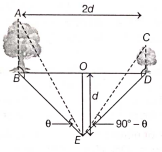
(Note The figure is not to scale.)
If one of the trees is thrice as tallas the other, find the height of the shorter tree, in terms of d. Show your work
8.
An aeroplane, when 3000 m high, passes vertically above another aeroplane at an instant, when the angles of elevation of the two aeroplanes from the same point on the ground are \({ 60 }^{ ° }\)and \({ 45 }^{ ° }\), respectively, Find the vertical distance between the two aeroplanes.
9.
An Aeroplane at an altitude of 200 m observes the angle of depression of opposite points on the two banks of a river to be \({ 45 }^{ \circ }\) and \({ 60 }^{ \circ }\) .Find width of the river.
10.
In a right triangle ΔABC, right angled at B, BC = 15 cm and AB = 8 cm. A circle is inscribed in triangle ABC. Find the radius of the circle.
11.
AB is a diameter of a circle. AH and BK are perpendicular from A and B respectively to the tangent at P.Prove that AH + BK = AB.
12.
Prove that the parallelogram circumscribing a circle is a rhombus. Also, find area of the rhombus, if radius of circle is 3cm and length of one side of the rhombus is 10 cm.
13.
A man on the top of a vertical observation tower observes a car moving at a uniform speed coming directly towards it.If it takes 12minutes for the angle of elevation to change from 300 to 450, how soon after this will the car reaches the observation tower?
14.
From the top of a hill, the angles of depression of two consecutive kilometre stones due east are found to be 300 and 450.Find the height of the hill.
15.
Two circles with centres O and O' of radii 3cm and 4cm, respectively intersect at two points P and Q such that OP and O'P are tangents to the two circles.Find the length of the common chord PQ.
16.
Two posts are 120m apart and the height of one is double that of the other.If from the middle point of the line joining their feet, an observer finds that the angular elevations of their tops to be complementary, then the height of the poles are \(30\sqrt{2}m\) and \(60\sqrt{2}m\)
17.
The length of the tangent is the length of the segment from an external point to the point of contact.
18.
In the given figure, PA and PB are tangents from external point P to a circle with centre C and Q is any point on the circle. Then, the measure of \(\angle\)AQB is
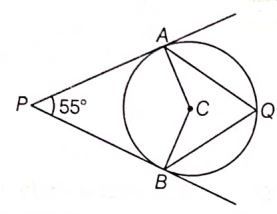
62.5°
125°
55°
90°
19.
PQ is tangent to a circle centered at O. If the radius of the circle is 5 cm, then the length of the tangent PQ is
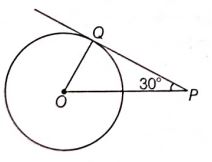
\(5 \sqrt{3} \mathrm{~cm}\)
\(\frac{10}{\sqrt{3}} \mathrm{~cm}\)
10 cm
\(\frac{5}{\sqrt{3}} \mathrm{~cm}\)
20.
A is a point at a distance 13 cm from the centre O of a circle of radius 5 cm. AP and AQ are the tangents to the circle at P and Q. If a tangent BC is drawn at a point R lying on the minor arc PQ to intersect AP at Band AQ at C, then the perimeter of the MBC is
12 cm
24 cm
36 cm
48 cm
21.
In figure, if O is the centre of a circle, PQ is a chord and the tangent PR at P makes an angle of 50° with PQ, then \(\angle\)POQ is equal to
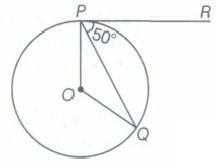
100°
80o
90°
75°
22.
In the following figure, from the top of a building AB, 60 m high, the angles of depression of the top and the bottom of a vertical lamp post CD are observed to be 30° and 60°, respectively.
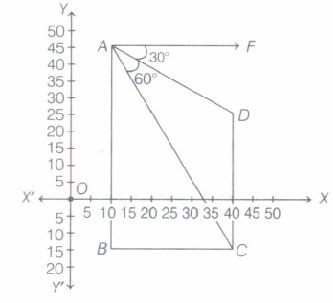
Find the height of the lamp post CD.
60 m
40 m
20 m
10 m
23.
In the following figure, from the top of a building AB, 60 m high, the angles of depression of the top and the bottom of a vertical lamp post CD are observed to be 30° and 60°, respectively.
Find the horizontal distance between BA and CO.
60\(\sqrt3\)m
40\(\sqrt3\)m
20\(\sqrt3\)m
10\(\sqrt3\)m
24.
A circle artist is climbing a 20 m long rope, which is tightly stretched and tied from the top of a vertical pole to the ground, then the height of pole, if the angle made by the rope with the ground level is 30°, is
5 m
10 m
15 m
20 m
25.
In the given figure, two tangents AB andAC are drawn to a circle with centre O such that \(\angle B A C=120^{\circ}\) , then OA is equal to
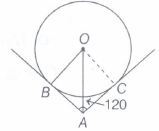
2 AB
3 AB
4 AB
5 AB
26.
In the given figure, the respective values of y and x are
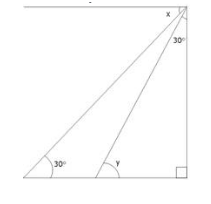
60° and 30°
45° and 60°
60° and 45°
30° and 45°
27.
Consider a ship with a right triangular mast. If the base of the mast is 10 m long, and the angle that the mast makes with the base is 60°, then what area of cloth is used to make the mast?
50 (√3 + 1) m2
50 √3 m2
50 m2
100 m2
28.
The ——– is the line drawn from the eye of an observer to the point in the object viewed by the observer
Line of sight
Line of sight propagation
Line of symmetry
Line of incidence
29.
The shadow of a tower standing on a level ground is found to be 40 m longer when the Sun’s altitude is 30° than when it is 60°. Find the height of the tower.
20
40√3
20√3
40
30.
An electrician has to repair an electric fault on a pole of height 4 m. He needs to reach a point 1.3 m below the top of the pole to undertake the repair work. The length of the ladder he should use which when inclined at an angle of 60° to the horizontal would enable him to reach the required position is:
\(\frac { 9\sqrt { 3 } }{ 5 } \)m
\(\frac { 5 }{ 9 } \)m
\(\frac { \sqrt { 3 } }{ 5 } \)m
\(\frac { 9 }{ 5 } \)m
31.
From the given figure, find h
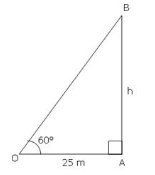
√3 m
25√3m
50√3 m
2 √3 m
32.
A tangent to a circle is a line that intersects the circle in
Exactly one point
2 points
3 points
4 points
33.
PQ is a tangent drawn from a point P to a circle with centre O and QOR is a diameter of the circle such that ∠POR=120°, then ∠OPQ is
60o
30o
90o
45o
34.
If radii of two concentric circles are 4 cm and 5 cm, then length of each chord of one circle which is tangent to the other circle, is
3 cm
6 cm
9 cm
1 cm
35.
In the given figure, PT is a tangent to a circle whose centre is O. If PT = 12 cm and PO = 13 cm then find teh radius of the circle.
5 cm
4 cm
6 cm
4.5 cm
36.
A backyard is in the shape of a triangle with right angle at B, AB = 6 m and BC = 8 m. A pit was dig inside it such that it touches the walls AC, BC and AB at P, Q and R respectively such that AP = x m.
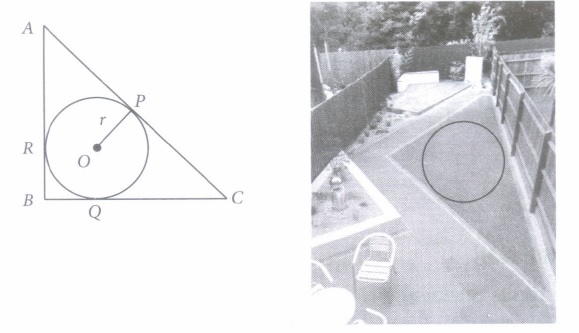
Based on the above information, answer the following questions.
(i) The value of AR =
| (a) 2x m | (b) x/2 m | (c) x m | (d) 3x m |
(ii) The value of BQ =
| (a) 2x m | (b) (6-x) m | (c) (2 - x) cm | (d) 4x m |
(iii) The value of CQ =
| (a) (4+x)m | (b) (10 - x) m | (c) (2+x)m | (d) both (b) and (c) |
(iv) Which of the following is correct?
| (a) Quadrilateral AROP is a square. | (b) Quadrilateral BROQ is a square. |
| (c) Quadrilateral CQOP is a square. | (d) None of these |
(v) Radius of the pit is
| (a) 2 cm | (b) 3 cm | (c) 4 cm | (d) 5 cm |
37.
In a park, four poles are standing at positions A, B, C and D around the fountain such that the cloth joining the poles AB, BC, CD and DA touches the fountain at P, Q, Rand S respectively as shown in the figure.
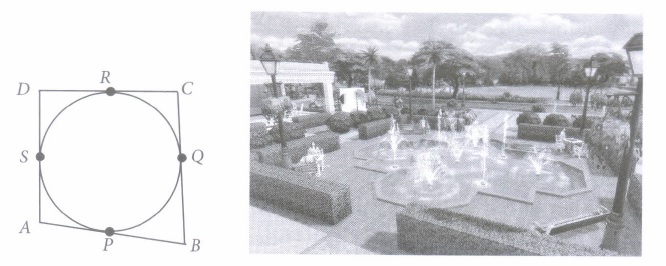
Based on the above information, answer the following questions.
(i) If 0 is the centre of the circular fountain, then \(\angle\)OSA =
| (a) 60° | (b) 90° |
| (c) 45° | (d) None of these |
(ii) Which of the following is correct?
| (a) AS = AP | (b) BP= BQ | (c) CQ = CR | (d) All of these |
(iii) If DR = 7 cm and AD = 11 ern, then AP =
| (a) 4 cm | (b) 18 cm | (c) 7 cm | (d) 11 cm |
(iv) If O is the centre of the fountain, with \(\angle\)QCR = 60°, then \(\angle\)QOR
| (a) 60° | (b) 120° | (c) 90° | (d) 30° |
(v) Which of the following is correct?
| (a) AB + BC = CD + DA | (b) AB + AD = BC + CD |
| (c) AB + CD = AD + BC | (d) All of these |
38.
Two hoardings are put on two poles of equal heights standing on either side of the road. From a point between them on the road the angle of elevation of the top of poles are 60° and 30° respectively. Height of the each pole is 20 m.
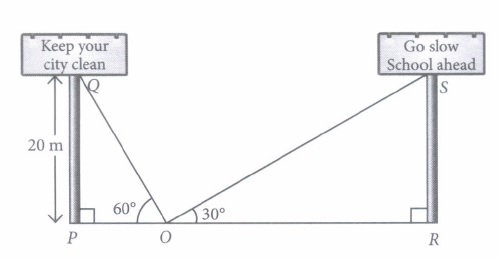
Based on the above information, answer the following questions. (Take \(\sqrt{3}\) = 1.73).
(i) Find the length of PO.
| (a) 20 m | \((b) 20 \sqrt{3} \mathrm{~m}\) | \((c) \frac{20}{\sqrt{3}} \mathrm{~m}\) | (d) None of these |
(ii) Find the length of RO.
| (a) 20 m | \((b) 20 \sqrt{3} \mathrm{~m}\) | \((c) \frac{20}{\sqrt{3}} \mathrm{~m}\) | (d) None of these |
(iii) The width of the road is
| (a) 31.23m | (b) 35.68 m | (c) 39.73 m | (d) 46.24 m |
(iv) If the angle of elevation made by pole PQ is 45°, then the length of PO =
| (a) 20 m | \((b) 20 \sqrt{3} \mathrm{~m}\) | \((c) \frac{20}{\sqrt{3}} \mathrm{~m}\) | (d) None of these |
(v) Angle formed by the line of sight with the horizontal when the point being viewed is above the horizontal level is known as
| (a) angle of depression | (b) angle of elevation | (c) right Angle | (d) reflex angle |
1.
141.96 m
2.
QM = 3cm, RN = 5cm and PL = 7cm
3.
25∘
4.
20 m
5.
CA ⊥ AP
CB ⊥ BP
PA ⊥ PB
Also AP = PB
ஃ BPAC is a square.
⇒ AP = PB = BC = 4 cm
6.

∠BPA = 90° (Angle in semicircle)
In BPA
∠ABP + ∠BPA + ∠PAB = 180°
⇒ 30° + 90 + PAB = 180°
⇒ ∠PAB = 60°
Also ∠POA = 2 ∠PBA
⇒ ∠POA = 2 x 30° = 60°
⇒ OP = AP
(sides opposite to equal angles) .....(i)
In △OPT, △OPT = 90°
∠POT = 60° and ∠PTO = 30° [angle sum property of a ]
Also ∠APT + ∠ATP = PAO (exterior angle property)
ஃ APT + 30 = 60
⇒ APT = 30
7.
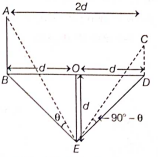
Since, Ajay stands midway between two trees
\(\therefore B O=O D=d \mathrm{~m} \text {. }\)
Now, in \(\triangle B O E\) right angle at O
\(B E^2 =B O^2+O E^2 \)
\(B E^2 =d^2+d^2=2 d^2\)
\(B E =\sqrt{2} d\) [by Pythagoras theorem]
Similarly, \(D E=\sqrt{2} d\)
Let \(D C=h \mathrm{~m}\),
then \(A B=3 h \mathrm{~m}\)
In \(\triangle E B A, \tan \theta=\frac{A B}{B E}\)
\(\tan \theta=\frac{3 h}{\sqrt{2} d}\) [from Eq. (i) and (iv)]
Similarly, in right \(\triangle E D C\),
\(\tan \left(90^{\circ}-\theta\right) =\frac{C D}{E D} \ {\left[\because \cdot \tan \left(90^{\circ}-\theta\right)=\cot \theta\right]} \)
\(\Rightarrow \quad \cot \theta =\frac{h}{\sqrt{2} d} \ {[\text { from Eqs. (ii) and (iii) }]}\)
On multiplying $\tan \theta$ and $\cot \theta$, we get
\(\tan \theta \times \cot \theta =\frac{3 h}{\sqrt{2} d} \times \frac{h}{\sqrt{2} d} \)
\(1 =\frac{3 h^2}{2 d^2}\)
\(\Rightarrow \quad \frac{2}{3} d^2 =h^2\) \([\because \tan \theta \times \cot \theta=1]\)
Thus, \(h=d \times \sqrt{\frac{2}{3}}\)
8.
1268 m
9.
Let P be the position of the aeroplane. Then, PM=200m and let A and B be two points on the two banks of a river such that the angles of depression at A and B are \({ 60 }^{ \circ }\)and \({ 45 }^{ \circ }\) , respectively.
Let Am=x m and BM= y m.
Then, \(\angle XPB=\angle MBP={ 45 }^{ \circ }\) [altenatives angles]
and \(\angle XPB=\angle MBP={ 60 }^{ \circ }\) [altenatives angles]
In right angled \(\Delta AMP,\) \(\tan { { 60 }^{ \circ } } =\frac { PM }{ AM } \)
\(\Rightarrow \sqrt { 3 } =\frac { 200 }{ x } \Rightarrow 200=\sqrt { 3x } \)
\(\Rightarrow x=\frac { 200 }{ \sqrt { 3 } } m \)
In right angled \(\Delta BMP,\)
\(\tan { { 45 }^{ \circ } } =\frac { PM }{ BM } \Rightarrow 1=\frac { 200 }{ y }\)
\(\Rightarrow y=200m \)
Now, width of the river, AB=BM+MA
\(\Rightarrow AB=x+y=\frac { 200 }{ \sqrt { 3 } } +200\)
\( =200\left( \frac { 1 }{ \sqrt { 3 } } +1 \right)\)
\(=200(1.5773)=315.46m. [\because \sqrt { 3 } =1.732]\)
Hence, the width of the river is 315.46m.
10.
Here, AC = \(\sqrt { { AB }^{ 2 }+{ BC }^{ 2 } } =\sqrt { { 8 }^{ 2 }+{ 15 }^{ 2 } } \)
= \(\sqrt { 64+225 } =\sqrt { 289 } \)
= 17 cm
Clearly, OPBQ is a square
ஃ BP = BQ = OP = OQ = r cm
AR = AP = AB - BP = (8 - r) cm
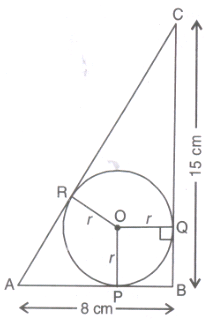
Also, Cr = CQ = CB - BQ = 15 - r
⇒ CR + AR = AC
⇒ 15 - r + 8 - r = 17
⇒ 23 - 2r = 17
⇒ -2r = -6
⇒ r = 3 cm
11.
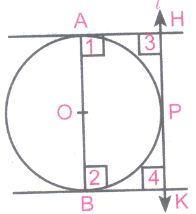
Given: A circle with centre O. AB is the diameter of this circle. I is tangent to the circle. AH and BK are perpendicular to I from A and B at H and K respectively.
To prove: AH + BK = AB
Proof: AH and HP are tangents from the external point H
ஃ AH = HP .....(i)
and BK, KP are tangent from the external point K
ஃ BK = KP ......(ii)
Adding (i) and (ii) we get
AH + BK = HP + PK = HK ......(iii)
AB ⊥ AH
AB ⊥ BK
[Tangent makes 90° angle with radius at the point of contact]
⇒ \(\angle \)1 = \(\angle \)2 = 90°
Given that AH ⊥ i ⇒ \(\angle \)3 = 90°
and BK ⊥ i ⇒ \(\angle \)4 = 90°
∵ \(\angle \)1 = \(\angle \)2 = \(\angle \)3 = \(\angle \)4 = 90°
⇒ AHKB is a rectangle
⇒ AB = HK ......(iv)
[Opposite sides of a rectangle are equal]
From (iii) and (iv) ⇒ PH + PK = AB
AH + BK = AB from (i) and (ii) Hence proved.
12.
Given ABCD be a parallelogram circumscribing a circle with centre O.
To prove ABCD is a rhombus.
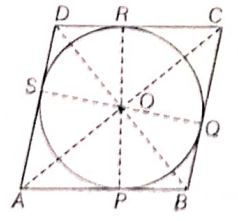
Proof We know that the tangents drawn to a circle from an exterior point are of equal lengh.
\(\therefore\) AP = AS, BP = BQ, CR = CQ and DR = DS
Adding the above four equations
AP + BP + CR + DR = AS + BQ + CQ + DS
(AP + BP) + (CR + DR) = (AS + DS) + (BQ + CQ)
\(\therefore\) AB + CD = AD + BC
or AB = BC = DC = AD
Therefore, ABCD is a rhombus.
Join OC, OP, OQ, OR, OD, OS, OB and OA
Now, area of rhombus = Area of \(\Delta\)BOC + Area of \(\Delta\)AOB + Area of \(\Delta\)AOD + Area of \(\Delta\)COD
Area of \(\Delta\)BOC \(=\frac{1}{2} \times B C \times O Q\)
\(\left[\because \text { Area of triangle }=\frac{1}{2} \times \text { Base } \times \text { Height }\right]\)
\(=\frac{1}{2} \times 10 \times 3=15 \mathrm{~cm}^2\)
\(\therefore\) Area of \(\Delta\)BOC = Area of \(\Delta\)AOB
= Area of \(\Delta\)AOD
= Area of \(\Delta\)COD
= 15 cm2
Area of rhombus=4 \(\times\) Area of \(\Delta\)BOC
= 4 \(\times\) 15 cm2 = 60 cm2
Therefore, area of rhombus is 60 cm2.
13.
16 minutes 24 seconds
14.
Let AB = h km be the height of the hill and C, D be two consecutive stones such that CD = 1 km.
Let BC be x km , then BD = BC + CD = (x + 1) km
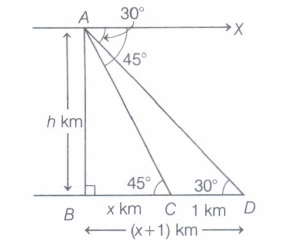
Now, ∠ADB = ∠XAD = 30° [alternate angles]
and ∠ACB = ∠XAC = 45° [alternate angles]
In right angled ΔABC,
\(\tan 45^{\circ}=\frac{P}{B}=\frac{A B}{B C} \Rightarrow 1=\frac{h}{x} \Rightarrow x=h\)
Now, in right angled ΔABD, tan\(30^{\circ}=\frac{A B}{B D}\)
\(\Rightarrow \frac{1}{\sqrt{3}}=\frac{h}{x+1} \left[\because \tan 30^{\circ}=\frac{1}{\sqrt{3}}\right]\)
\(\left(\frac{\sqrt{3+1}}{2}\right) \mathrm{km}\)
15.
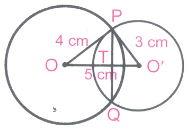
OP is tangent of the circle having centre O'
So \(\angle \)OPO' = 90°
[ ∵ Radius and tangent are to ⊥ each other at the point of contact]
In right-angled OPO'
OP = 4 cm
O'P = 3 cm [Given]
In right-angled \(\triangle\)OPO'
OP = 4 cm
O'P = 3 cm [Given]
OO'2 = OP2 + O'P2
= 42 + 32 = 16 + 9 = 25
OO' = 5 cm
If two circles intersect each other then line joining the two centre always ⊥ bisector of the common chord.
OO' ⊥ PQ and PT = TQ
Area of \(\triangle\) OO'P = \(1\over2\) x base x altitude
Here, base = 4 cm, attitude = 3 cm.
Area = \(1\over2\) x 4 x 3 = 6 cm2 ...(i)
But if base OO' = 5 cm altitude = PT
Area \(\triangle\)POO' = \(1\over2\) x 5 x altitude .....(ii)
6 cm2 = \(1\over2\)x 5 x altitude .....(ii)
Comparing (i) and (ii)
6 cm2 = \(1\over2\) x 5 x altitude
⇒ \(\frac { 2\times 6 }{ 5 } \) = Altitude
⇒ \(\frac { 12 }{ 5 } \) = PT
⇒ PQ = 2PT = \(\frac { 2\times 12 }{ 5 } =\frac { 24 }{ 5 } \)cm
So, length of common chord = \(24\over5\) cm
= 4.8 cm
16.
(a)
17.
(a)
18.
(a)
62.5°
19.
(a)
\(5 \sqrt{3} \mathrm{~cm}\)
20.
(b)
24 cm
21.
(a)
100°
22.
(b)
40 m
23.
(c)
20\(\sqrt3\)m
24.
(b)
10 m
25.
(a)
2 AB
26.
(a)
60° and 30°
27.
(b)
50 √3 m2
28.
(a)
Line of sight
29.
(c)
20√3
30.
(a)
\(\frac { 9\sqrt { 3 } }{ 5 } \)m
31.
(b)
25√3m
32.
(a)
Exactly one point
33.
(b)
30o
34.
Let C1 and C2 be the two concentric circles, with centre at O and respective radii being r1 = 4cm and r2 = 5cm.
Draw a chord AC of circle C2, to touch circle C1 at B.
Join OB.
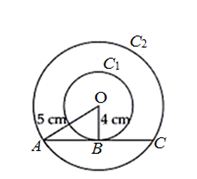
Here OB 丄 AC [As, tangent at any point of circle is perpendicular to radius through the point of contact]
Thus, in right angled OAB ,we have:
OA2 = AB2 + OB2 [By using phythagoras theorem]
⇒ 52 = AB2 + 42
⇒ AB2 = 25 - 16 = 9
∴ Length of chord AC = 2 AB = 2 x 3 = 6 cm
35.
(b)
4 cm
36.
Here in right angled triangle ABC, AB = 6 m and BC= 8 cm.
\(\therefore\) By Pythagoras theorem \(A C=\sqrt{(A B)^{2}+(B C)^{2}}\)
\(=\sqrt{(8)^{2}+(6)^{2}}=\sqrt{100}=10 \mathrm{~m}\)
Also, AP = x m.
(i) (c):AR=AP = xm ..(1)
[Since, length of tangents drawn from an external point are equal]
(ii) (b): BQ = BR = AB - AR = (6 - x) m (Using (1))
(iii) (d): CQ = CP = AC - AP = (10 - x) m
Also, CQ = BC - BQ = BC - BR = 8 - (6 - x) = 2 + x
(iv) (b): Since, CQ = 10 - x = 2 + x
\(\Rightarrow\) 8 = 2x \(\Rightarrow\) x = 4
\(\therefore\) AR = AP = 4 m, BR = BQ = 2 m
and CP = CQ = 6 m
Also, OQ.\(\perp\)BQ and OR.l BR
\(\therefore\) BROQ is a square.
(v) (a): Radius of the circle, OR = BR = 2 cm
37.
(i) (b):
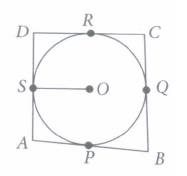
Here, OS the is radius of circle.
Since radius at the point of contact is perpendicularto tangent.
So, \(\angle\)OSA = 90°
(ii) (d): Since, length of tangents drawn from an external point to a circle are equal.
\(\therefore\) AS=AP,BP=BQ,
CQ = CR and DR = DS
(iii) (a): AP = AS = AD _ DS = AD _ DR (Using (1)
= 11 - 7 = 4 cm
(iv) (b): In quadrilateral OQCR,
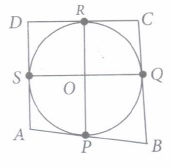
\(\angle\)QCR = 60° (Given)
And \(\angle\)OQC = \(\angle\)ORC = 90° [Since, radius at the point of contact is perpendicular to tangent.]
\(\therefore\) \(\angle\)QOR = 360° - 90° - 90° - 60° = 120°
(v) (c): From (1), we have AS = AP, DS = DR,
BQ = BP and CQ = CR
Adding all above equations, we get
AS + DS + BQ + CQ = AP + DR + BP + CR
\(\Rightarrow\) AD + BC = AB + CD
38.
(i) (c): \(\text { In } \Delta O P Q\), we have
\(\tan 60^{\circ}=\frac{P Q}{P O} \)
\(\Rightarrow \sqrt{3}=\frac{20}{P O} \)
\(\Rightarrow P O=\frac{20}{\sqrt{3}} \mathrm{~m}\)
(ii) (b): In \(\Delta\)ORS, we have
\(\tan 30^{\circ}=\frac{R S}{O R} \Rightarrow \frac{1}{\sqrt{3}}=\frac{20}{O R} \Rightarrow O R=20 \sqrt{3} \mathrm{~m}\)
(iii) (d): Clearly, width of the road = PR
\(\begin{array}{l}
=P O+O R=\left(\frac{20}{\sqrt{3}}+20 \sqrt{3}\right) \mathrm{m} \\
=20\left(\frac{4}{\sqrt{3}}\right) \mathrm{m}=\frac{80}{\sqrt{3}} \mathrm{~m}=46.24 \mathrm{~m}
\end{array}\)
(iv) (a): \(\text { In } \Delta O P Q \text { , if } \angle P O Q=45^{\circ} \text { , then }\)
\(\tan 45^{\circ}=\frac{P Q}{P O} \Rightarrow 1=\frac{20}{P O} \Rightarrow P O=20 \mathrm{~m}\)
(v) (b)

10th Standard CBSE Syllabus & Materials
10th Standard CBSE
CBSE 10th Social Science PS - Federalism - New Model Questions Papers Study Material - QB365 Set A
NEW10th Standard CBSE
CBSE 10th Social Science PS - Power Sharing - New Model Questions Papers Study Material - QB365 Set A
NEW10th Standard CBSE
CBSE 10th Social Science GEO - Manufacturing Industries - New Model Questions Papers Study Material - QB365 Set A
NEW10th Standard CBSE
CBSE 10th Social Science GEO - Minerals and Energy Resources - New Model Questions Papers Study Material - QB365 Set A



NCERT Books

Syllabus

Exam Pattern

Sample Question Papers

Previous year Question Papers

Important Notes

MCQ Practice test

NCERT Exemplers

Case study Questions

Image Based Questions

Passage based Questions

HOT Questions

Value Based Questions

Model Questions Papers
NCERT ( Book Back ) Questions

Assertion and Reason
Important Questions And Answers

CBSE 10th Standard CBSE Subjects
CBSE Standards



