
 100% FREE ACCESS
10th Standard CBSE Syllabus & Materials
10th Standard CBSE
CBSE 10th Social Science ECO - Globalisation and the Indian Economy - New Model Questions Papers Study Material - QB365 Set A
NEW10th Standard CBSE
CBSE 10th Social Science ECO - Money and Credit - New Model Questions Papers Study Material - QB365 Set A
NEW10th Standard CBSE
CBSE 10th Social Science ECO - Sectors of the Indian Economy - New Model Questions Papers Study Material - QB365 Set A
NEW10th Standard CBSE
CBSE 10th Social Science ECO - Development - New Model Questions Papers Study Material - QB365 Set A
NEW10th Standard CBSE
CBSE 10th Social Science PS - Outcomes of Democracy - New Model Questions Papers Study Material - QB365 Set A
NEW10th Standard CBSE
CBSE 10th Social Science PS - Gender, Religion and Caste - New Model Questions Papers Study Material - QB365 Set A

Published on: 22/10/2025
Download CBSE Class 10th Standard CBSE Maths question papers, sample papers, important questions, and previous year solved papers in PDF format. Get free study materials, NCERT solutions, and exam preparation resources for Class 10th Standard CBSE Maths
Questions + Answers key
Take MCQ Maths Test
1.
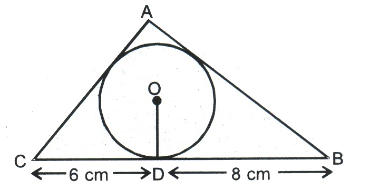
A triangle ABC is drawn to circumscribe a circle of radius 4 cm such that the segments BD and DC into which BC is divided by the point of contact D are of lengths 8 cm and 6 cm respectively (see Fig). Find the sides AB and AC.
2.
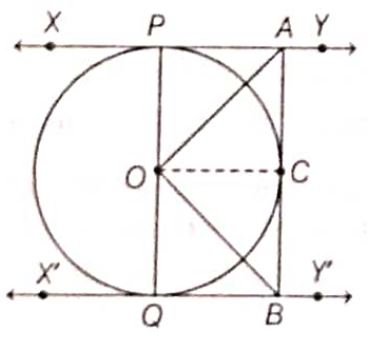
In the given figure, XY and X'Y' are two parallel tangents to a circle with centre O and another tangent AB with point of contact C intersecting XY at A and X'Y' at B.Prove that \(\angle AOB=90^0\)
3.
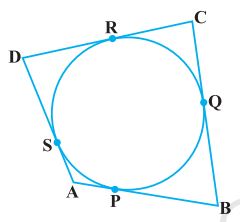
A quadrilateral ABCD is drawn to circumscribe a circle (see figure). Prove that AB+CD=AD+BC.
4.
A tangent PQ at a point P of a circle of radius 5 cm meets a line through the centre O at a point Q, so that OQ= 12 cm. Length of PQ is
12 cm
13 cm
8.5 cm
\(\sqrt119\) cm
5.
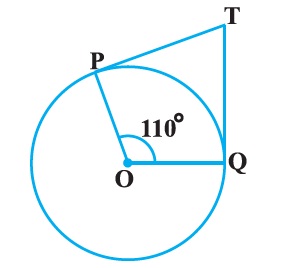
In the given figure, if TP and TQ are the two tangents to a circle with centre O so that \(\angle POQ\)= 110°, then \(\angle PTQ\) is equal to
60°
70°
80°
90°
6.
From a point Q, the length of the tangent to a circle is 24 cm and the distance of Q from the centre is 25 cm. The radius of the circle is
7 cm
12 cm
15 cm
24.5 cm
7.
A line that intersects a circle in exactly one point is called a
Diameter
Tangent
Radius
Secant
8.
Number of tangents, that can be drawn to a circle, parallel to a given chord is
3
zero
Infinite
2
9.
From a point P which is at a distance of 13 cm from the centre O of a circle of radius 5 cm, the pair of tangents PQ and PR to the circle is drawn. Then, the area of the quadrilateral PQOR is
60 cm2
65 cm2
30 cm2
32.5 cm2
10.
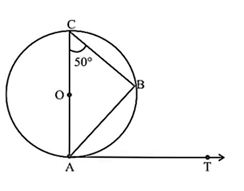
In figure, AB is a chord of the circle and AOC is its diameter such that ∠ACB = 50°. If AT is the tangent to the circle at the point A, then ∠BAT is equal to
45o
60o
50o
55o
11.
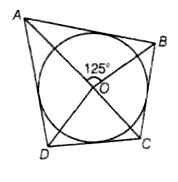
in figure , if ㄥAOB = 125o, then ㄥCOD is equal to
62o
45o
35o
55o
12.
If radii of two concentric circles are 4 cm and 5 cm, then length of each chord of one circle which is tangent to the other circle, is
3 cm
6 cm
9 cm
1 cm
13.
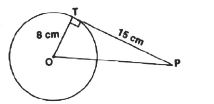
In the figure, Ab is a chord of length 16 cm, of a circle of radius 10 cm. The tangents at A and B intersect at a point P. Find the length of PA.
\(\frac { 20 }{ 5 } \)cm
\(\frac { 40 }{ 5 } \)cm
\(\frac { 20 }{ 3 } \)cm
\(\frac { 40 }{ 3 } \)cm
14.
In an online test, Ishita comes across the statement - If a tangent is drawn to a circle from an external point, then the square of length of tangent drawn is equal to difference of squares of distance of the tangent from the centre of circle and radius of the circle.

Help Ishita, in answering the following questions based on the above statement.
(i) If AB is a tangent to a circle with centre O at B such that AB = 10 cm and OB = 5 cm, then OA =
| \((a) 3 \sqrt{5} \mathrm{~cm}\) | \((b) 5 \sqrt{5} \mathrm{~cm}\) | \((c) 4 \sqrt{5} \mathrm{~cm}\) | \((d) 6 \sqrt{5} \mathrm{~cm}\) |
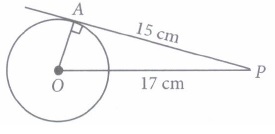
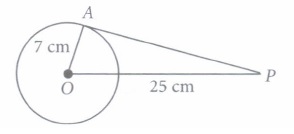
(ii) In the adjoining figure, radius of the circle is
| (a) 8 cm | (b) 7 cm | (c) 9 cm | (d) 10 cm |
(iii) In the adjoining figure, length of tangent AP is
| (a) 12 cm | (b) 24 cm | (c) 30 cm | (d) None of these |
(iv) PT is a tangent to a circle with centre 0 and diameter = 40 cm. If PT = 21 cm, then OP =
| (a) 33 cm | (b) 29 cm | (c) 37 cm | (d) None of these |
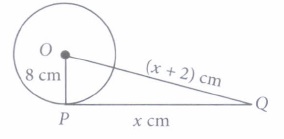
(v) In the adjoining figure, the length of the tangent is
| (a) 15 cm | (b) 9 cm | (c) 8 cm | (d) 10 cm |
15.
A backyard is in the shape of a triangle with right angle at B, AB = 6 m and BC = 8 m. A pit was dig inside it such that it touches the walls AC, BC and AB at P, Q and R respectively such that AP = x m.
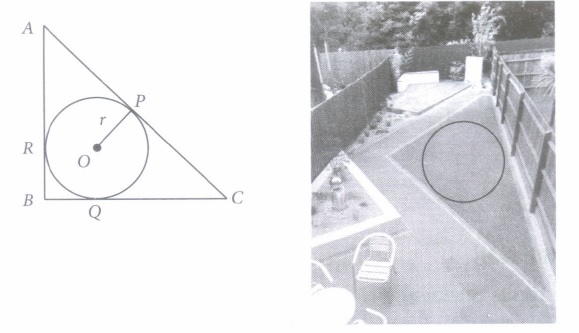
Based on the above information, answer the following questions.
(i) The value of AR =
| (a) 2x m | (b) x/2 m | (c) x m | (d) 3x m |
(ii) The value of BQ =
| (a) 2x m | (b) (6-x) m | (c) (2 - x) cm | (d) 4x m |
(iii) The value of CQ =
| (a) (4+x)m | (b) (10 - x) m | (c) (2+x)m | (d) both (b) and (c) |
(iv) Which of the following is correct?
| (a) Quadrilateral AROP is a square. | (b) Quadrilateral BROQ is a square. |
| (c) Quadrilateral CQOP is a square. | (d) None of these |
(v) Radius of the pit is
| (a) 2 cm | (b) 3 cm | (c) 4 cm | (d) 5 cm |
16.
Smita always finds it confusing with the concepts of tangent and secant of a circle. But this time she has determined herself to get concepts easier. So, she started listing down the differences between tangent and secant of a circle along with their relation. Here, some points in question form are listed by Smita in her notes. Try answering them to clear your concepts also.

(i) A line that intersects a circle exactly at two points is called
| (a) Secant | (b) Tangent | (c) Chord | (d) Both (a) and (b) |
(ii) Number of tangents that can be drawn on a circle is
| (a) 1 | (b) 0 | (c) 2 | (d) Infinite |
(iii) Number of tangents that can be drawn to a circle from a point not on it, is
| (a) 1 | (b) 2 | (c) 0 | (d) Infinite |
(iv) Number of secants that can be drawn to a circle from a point on it is
| (a) Infinite | (b) 1 | (c) 2 | (d) 0 |
(v) A line that touches a circle at only one point is called
| (a) Secant | (b) Chord | (c) Tangent | (d) Diameter |
1.
Given, CD = 6 cm, BD = 8 cm and radius = 4 cm
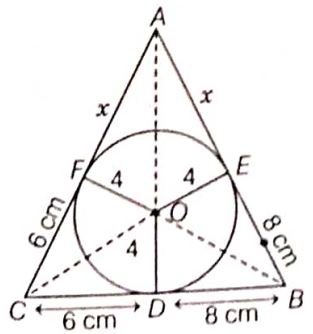
Join OC, OA and OB.
Let the circle touches the other sides AB and AC at points E and F, respectively.
We know that tangents drawn from an external point to the circle are equal in length.
\(\therefore\) CD = CF = 6 cm [\(\because\) C is an external point]
BD = BE = 8 cm [\(\because\) B is an external point]
and AF = AE = x cm (say [\(\because\) A is an external point]
Area of \(\Delta\)OCB, \(A_1=\frac{1}{2} \times \text { Base } \times \text { Height }\)
\(\begin{aligned} & =\frac{1}{2} \times C B \times O D \\ \end{aligned}\)
\(\begin{aligned} & =\frac{1}{2} \times 14 \times 4=28 \mathrm{~cm}^2 \\ \end{aligned}\)
\(\begin{aligned} & \quad[\because C B=C D+B D=6+8=14] \end{aligned}\)
Area of \(\Delta\)OCA,
\(\begin{aligned} A_2 & =\frac{1}{2} \times A C \times O F \end{aligned}\)
\(\begin{aligned} =\frac{1}{2}(6+x) \times 4=(12+2 x) \mathrm{cm}^2 \end{aligned}\)
and area of \(\Delta\)OBA,
\(A_3=\frac{1}{2} \times A B \times O E=\frac{1}{2}(8+x) \times 4=(16+2 x) \mathrm{cm}^2\)
Thus, area of \(\Delta\)ABC
= A1 + A2 + A3 = [28 + (12 + 2x) + (16+ 2x)]
= (56 + 4x) cm2 ...(i)
Now, semi-perimeter of \(\Delta\)ABC=\(\frac{1}{2}\)(AB + BC + CA)
\(\Rightarrow \quad s=\frac{1}{2}(x+8+14+6+x)\)
\(\Rightarrow\) s = (14 + x) cm
Using Heron's formula,
area of \(\Delta\)ABC = \(\begin{aligned} & =\sqrt{s(s-a)(s-b)(s-c)} \end{aligned}\)
\(\begin{aligned} =\sqrt{(14+x)(14+x-14)(14+x-x-6)(14+x-x-8)} \end{aligned}\)
\(\begin{aligned} & =\sqrt{(14+x) \times x \times 8 \times 6} \end{aligned}\)
\(\begin{aligned} =\sqrt{(14+x) 48 x} \end{aligned}\) ...(ii)
From Eqs. (i) and (ii), we get
\(\sqrt{(14+x) 48 x}=56+4 x=4(14+x)\)
On squaring both sides, we get
(14 + x) 48 x = 42 (14 + x)2
\(\Rightarrow\) 3x = 14 + x
\(\Rightarrow\) 2x = 14
\(\Rightarrow\) x = 7
\(\therefore\) Length of AC = 6 + x = 6 + 7 = 13 cm
and length of AB = 8 + x = 8 + 7 = 15 cm
2.
Given XY and X'Y' are two parallel tangents. Another tangent AB touches the circle at C and intersect XY at A and X'Y'at B.
To prove \(\angle\)AOB = 90°
Proof We know that, tangents drawn from an external point to a circle are equal in length.
\(\therefore\) AP = AC [\(\because\) A is an external point] ...(i)
Thus, in \(\Delta\)APO and \(\Delta\)ACO, AP = AC [from Eq. (i)]
AO = AO [common sides]
OP = OC [radii of circle]
\(\Delta\)APO \(\cong\)\(\Delta\)ACO [by SSS congruence rule]
Then, \(\angle\)OAP = \(\angle\)OAC [by CPCT] ...(ii)
\(\Rightarrow\) \(\angle\)PAC = 2 \(\angle\)CAO ....(iii)
Similarly, we can prove that \(\angle\)CBO = \(\angle\)OBQ
\(\Rightarrow\) \(\angle\)CBQ = 2 \(\angle\)CBO ...(iv)
since, XY || X'Y' [given]
\(\therefore\) \(\angle\)PAC + \(\angle\)QBC = 180°
[\(\because\) sum of interior angles on the same side of transversal is 180°]
\(\Rightarrow\) 2 \(\angle\)CAO + 2 \(\angle\)CBO = 180° [from Eqs. (iii) and (iv)]
\(\Rightarrow\) \(\angle\)CAO + \(\angle\)CBO = 90° ...(v)
Now, in \(\Delta\)AOB, \(\angle\)CAO + \(\angle\) CBO + \(\angle\)AOB = 180°
[by angle sum property of triangle]
\(\Rightarrow\) \(\angle\)CAO + \(\angle\)CBO = 180° - \(\angle\)AOB ...(vi)
From Eqs. (v) and (vi), we get
180° - \(\angle\)AOB = 90° \(\Rightarrow\) \(\angle\)AOB = 90° Hence proved.
3.
Given A quadrilateral ABCD, circumscribing a circde.
To prove AB + CD = AD + BC
Proof We know that the lengths of tangents drawn from an external point to a circde are equal.
\(\therefore\) AP = AS ...(i)
[\(\because\) both are tangents to a circle from point A]
Similarly, BP = BQ, ...(ii)
CR = CQ ....(iii)
and DR = DS .....(iv)
On adding Eqs. (i), (ii), (ii) and (iv), we get
(AP + BP) + (CR + DR) = (AS + BQ) + (CQ + DS)
\(\Rightarrow\) AB + CD = (AS + DS) + (BQ + CQ)
\(\Rightarrow\) AB + CD = AD + BC
Hence Proved.
4.
(d)
\(\sqrt119\) cm
5.
(b)
70°
6.
(a)
7 cm
7.
(b)
Tangent
8.
(d)
2
9.
Given conditions are described in the diagram given below:
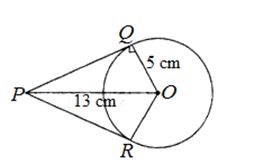
We are to find the area of the quadrilateral PQRL
Here OQ⊥QP [As, tangent at any point of circle is perpendicular to radius through the point of contact]
Similarly, OR⊥PR
Now in ΔOPQ and ΔOPR
OP = OP [Common Side]
ㄥQ = ㄥR = 90o
And, ΔOPQ ≌ ΔOPR
Area of quadrilateral PQOR = 2 X area of ΔOQP
In right angled OQP,
OP2 = OQ2 + PQ2
⇒ 132 = 52 + PQ2
⇒ PQ2 = 169 - 25 =144
⇒ PQ = 12 cm
Now, area of OQP = \(\frac { 1 }{ 2 } \times PQ\times OQ\)
= \(\frac { 1 }{ 2 } \times 12\times 5\) = 30 cm2
∴ Area of quadrilateral QORP = 2 x area of ΔOQP
= 2 x 30 = 60cm2
10.
Here AC is the diameter of the circle.
∴ ∠ABC = 90° [ Angle in a semi-circle]
Now, in ΔACB, ∠A + ∠B + ∠C = 180° [Sum of all interior angles of a triangle is 180°]
⟹ ∠A + 90° + 50° = 180°
⟹ ∠A + 140 = 180
⟹ ∠A = 180o - 140° = 40°
Or ∠OAB = 40° …(i)
Here, OA ⏊ AT
⟹ ∠OAT = 90°
⟹ ∠OAB + ∠BAT = 90°
⟹ ∠BAT = 90° - 40° = 50° [Using (i)]
Hence, the value of ∠BAT is 50°.
11.
Since, the opposite sides of a quadrilateral circumscribing a circle subtend supplementary angles at the centre of the circle.
i.e ㄥAOB + ㄥCOD = 180o
⇒ ㄥCOD =180o - ㄥAOB
⇒ ㄥCOD = = 180o - 125o = 55o
12.
Let C1 and C2 be the two concentric circles, with centre at O and respective radii being r1 = 4cm and r2 = 5cm.
Draw a chord AC of circle C2, to touch circle C1 at B.
Join OB.
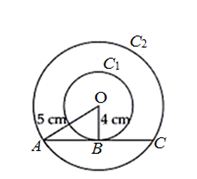
Here OB 丄 AC [As, tangent at any point of circle is perpendicular to radius through the point of contact]
Thus, in right angled OAB ,we have:
OA2 = AB2 + OB2 [By using phythagoras theorem]
⇒ 52 = AB2 + 42
⇒ AB2 = 25 - 16 = 9
∴ Length of chord AC = 2 AB = 2 x 3 = 6 cm
13.
(d)
\(\frac { 40 }{ 3 } \)cm
14.
(i) (b): OA2=AB2+OB2
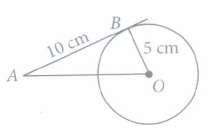
\(\Rightarrow \quad O A=\sqrt{10^{2}+5^{2}}=5 \sqrt{5} \mathrm{~cm}\)
(ii) (a) : \(O A=\sqrt{O P^{2}-A P^{2}} \text { (Given) }\)
\(=\sqrt{17^{2}-15^{2}}=\sqrt{64}=8 \mathrm{~cm}\)
(iii) (b): Length of tangent \(A P=\sqrt{O P^{2}-O A^{2}} \text { (Given) }\)
\(=\sqrt{25^{2}-7^{2}}=\sqrt{576}=24 \mathrm{~cm}\)
(iv) (b):
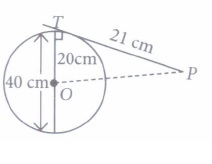
\(\text { Since, } O P=\sqrt{(P T)^{2}+(O T)^{2}}=\sqrt{21^{2}+20^{2}}=29 \mathrm{~cm}\)
(v) (a): Since, OP2 + PQ2 = OQ2
\(\Rightarrow\) 82 + x2 = (x + 2)2\(\Rightarrow\) 64 = 4x + 4\(\Rightarrow\) x = 15 cm
So, length of tangent, PQ = 15 cm.
15.
Here in right angled triangle ABC, AB = 6 m and BC= 8 cm.
\(\therefore\) By Pythagoras theorem \(A C=\sqrt{(A B)^{2}+(B C)^{2}}\)
\(=\sqrt{(8)^{2}+(6)^{2}}=\sqrt{100}=10 \mathrm{~m}\)
Also, AP = x m.
(i) (c):AR=AP = xm ..(1)
[Since, length of tangents drawn from an external point are equal]
(ii) (b): BQ = BR = AB - AR = (6 - x) m (Using (1))
(iii) (d): CQ = CP = AC - AP = (10 - x) m
Also, CQ = BC - BQ = BC - BR = 8 - (6 - x) = 2 + x
(iv) (b): Since, CQ = 10 - x = 2 + x
\(\Rightarrow\) 8 = 2x \(\Rightarrow\) x = 4
\(\therefore\) AR = AP = 4 m, BR = BQ = 2 m
and CP = CQ = 6 m
Also, OQ.\(\perp\)BQ and OR.l BR
\(\therefore\) BROQ is a square.
(v) (a): Radius of the circle, OR = BR = 2 cm
16.
(i) (a)
(ii) (d)
(iii) (b)
(iv) (a)
(v) (c)

10th Standard CBSE Syllabus & Materials
10th Standard CBSE
CBSE 10th Social Science PS - Federalism - New Model Questions Papers Study Material - QB365 Set A
NEW10th Standard CBSE
CBSE 10th Social Science PS - Power Sharing - New Model Questions Papers Study Material - QB365 Set A
NEW10th Standard CBSE
CBSE 10th Social Science GEO - Manufacturing Industries - New Model Questions Papers Study Material - QB365 Set A
NEW10th Standard CBSE
CBSE 10th Social Science GEO - Minerals and Energy Resources - New Model Questions Papers Study Material - QB365 Set A



NCERT Books

Syllabus

Exam Pattern

Sample Question Papers

Previous year Question Papers

Important Notes

MCQ Practice test

NCERT Exemplers

Case study Questions

Image Based Questions

Passage based Questions

HOT Questions

Value Based Questions

Model Questions Papers
NCERT ( Book Back ) Questions

Assertion and Reason
Important Questions And Answers

CBSE 10th Standard CBSE Subjects
CBSE Standards



