
 100% FREE ACCESS
10th Standard CBSE Syllabus & Materials
10th Standard CBSE
CBSE 10th Social Science ECO - Globalisation and the Indian Economy - New Model Questions Papers Study Material - QB365 Set A
NEW10th Standard CBSE
CBSE 10th Social Science ECO - Money and Credit - New Model Questions Papers Study Material - QB365 Set A
NEW10th Standard CBSE
CBSE 10th Social Science ECO - Sectors of the Indian Economy - New Model Questions Papers Study Material - QB365 Set A
NEW10th Standard CBSE
CBSE 10th Social Science ECO - Development - New Model Questions Papers Study Material - QB365 Set A
NEW10th Standard CBSE
CBSE 10th Social Science PS - Outcomes of Democracy - New Model Questions Papers Study Material - QB365 Set A
NEW10th Standard CBSE
CBSE 10th Social Science PS - Gender, Religion and Caste - New Model Questions Papers Study Material - QB365 Set A

Published on: 22/10/2025
Download CBSE Class 10th Standard CBSE Maths question papers, sample papers, important questions, and previous year solved papers in PDF format. Get free study materials, NCERT solutions, and exam preparation resources for Class 10th Standard CBSE Maths
Questions + Answers key
Take MCQ Maths Test
1.
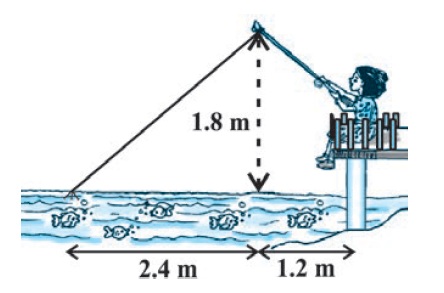
Nazima is fly fishing in a stream. The tip of her fishing rod is 1.8 m above the surface of the water and the fly at the end of the string rests on the water 3.6 m away and 2.4 m from a point directly under the tip of the rod. Assuming that her string (from the tip of her rod to the fly) is taut, how much string does she have out see Figure? If she pulls in the string at the rate of 5 cm per second, what will be the horizontal distance of the fly from her after 12 seconds?
2.
Evaluate cot 120 cot 380 cot 520 cot 600 cot 780 .
3.
Evaluate \({ \left( \frac { \sin { { 25 }^{ 0 } } }{ \cos { { 65 }^{ 0 } } } \right) }^{ 2 }+{ \left( \frac { \tan { { 65 }^{ 0 } } }{ \cot { { 25 }^{ 0 } } } \right) }^{ 2 }-2\cos ^{ 2 }{ { 45 }^{ 0 } } .\)
4.
In an acute \(\triangle ABC,\) if tan (A + B - C) = 1 and sec (B + C - A) = 2, find the angles A, B and C.
5.
If sin (A + B) = 1 and sin (A - B)\(=\frac { 1 }{ 2 } ;0\le A+B\le { 90 }^{ 0 }\) and A > B, find the value of A and B.
6.
In \(\triangle ABC\), right angles at B, AC + BC = 49 cm, AB = 7 cm. Determine the values of sin A, cos A, tan C and sec C.
7.
At a fete cards bearing numbers 1 to 500, one on each card, are put in a box. Each player selects one card at random and that card is not replaced. If the selected card bears a number which is a perfect square of an even number the player wins prize.
(i) What is the probability that the first player wins a prize?
(ii) The second player wins prize, if the first has not won.
8.
20 cards numbered 1, 2, 3, ...., 20 are put in a box and mixed thoroughly. Shashi draws a cards from the box. Find the probability that the number on the card is
(i) odd (ii) even (iii) a prime
(iv) divisible by 3 (v) divisible by 3 and 2 both.
9.
A coin is tossed. If it results in a head a coin is tossed, otherwise a die is thrown. Describe the following events:
(i) A = getting atleast one head
(ii) B = getting an even number
(iii) C = getting a tail
(iv) D = getting a tail and an odd number
10.
The first and the last terms of an AP are 8 and 350 respectively. If its common difference is 9, how many terms are there and what is their sum?
11.
Find the common difference of the following AP is:
\(\text { (iv) } \sqrt{3}, \sqrt{12}, \sqrt{27}, \sqrt{48}, \ldots\)
12.
If \(\alpha\) and \(\beta\) are the zeroes of the polynomial x2 + 8x + 6 from a quadratic polynomial whose zeroes are \(\frac{1}{\alpha}\) and \(\frac{1}{\beta}\)
13.
If \(\alpha\) and \(\beta\) are zeroes of the polynomial p(x) = 3x2 - 4x - 7 then form a quadratic polynomial whose zeroes are \(\frac{1}{\alpha}\) and \(\frac{1}{\beta}\).
14.
If the sum and product of the zeroes of the polynomial ax2 - 5x + c is equal to 10 each, find the value of 'a' and 'c'.
15.
Verify whether 2, 3 and \(\frac{1}{2}\) are the zeroes of the polynomial p(x) = 2x3 - 11x2 + 17x - 6.
16.
Express the number \(0.\overline { 3178 } \) in the form of rational number a/b.
17.
Express \(\left( \frac { 15 }{ 4 } +\frac { 5 }{ 40 } \right) \) as a decimal without actual division.
18.
Without actually performing the long division, state whether the following rational number will have a terminating decimal expansion or not. Also, write the terminating decimal expansion, if exist.
\(\frac{3}{8}\)
19.
Find the vertices of a triangle, the mid-points of whose sides are (3,1), (5,6) and (-3,2).
20.
If the point (x,y) be equidistant from the points (a+b,b-a) and (a-b,a+b) prove that bx=ay.
21.
If two vertices of an equilateral triangle are (0,0), \((3,\sqrt3)\) find the area of the triangle.
22.
The first and last terms of an AP are 1 and 11. If the sum of all its terms is 36, then the number of terms will be
8
5
6
7
23.
The 9th term of an AP is 449 and 449th term is 9. The term which is equal to zero is:
502th
459th
501th
458th
24.
What is the sum of the first 20 whole numbers
190
200
100
140
25.
If in ΔABC and ΔDEF, \(\frac { AB }{ DF } =\frac { AC }{ DE } \)then they will be similar , when
ㄥB =ㄥE
ㄥA = ㄥD
ㄥB = ㄥD
ㄥA = ㄥF
26.
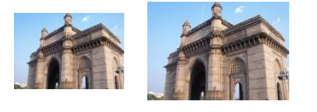
The above two pictures of Gateway of India are:
neither similar nor congruent
similar
dissimilar
congruent
27.
A boy is trying to catch fish sitting at a height of 12 m from the surface of the water.A big fish is at a horizontal distance of 5 m from him. What should be the length of his string to get the fish?
10
13
7
15
28.
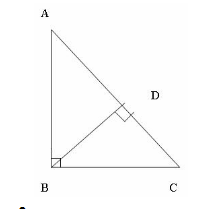
In the above figure, AB = c, BC = a, AC = b, AD = y, DB = p. Check which of the following options is correct?
cy=ap
ac=by
ay=cp
cy=ab
29.
From a well-shuffled pack of 52 cards, a card is drawn at random. The probability that it is a face card is:
4/13
2/13
1/13
3/13
30.
The probability that a prime number selected at random from the numbers (1,2,3, ..........35) is
12/35
11/35
13/35
none of these
31.
What is the probability that a number selected from the numbers (1, 2, 3,..........,15) is a multiple of 4?
1/5
4/5
2/15
1/3
32.
The length of the tangent drawn from a point 8 cm away from the centre of a circle, of radius 6 cm, is :
10 cm
5 cm
√7 cm
2√7 cm
33.
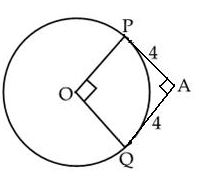
In the figure, the pair of tangents AP and AQ, drawn from an external point A to a circle with centre O, are perpendicular to each other and length of each tangent is 4 cm, then the radius of the circle is
10 cm
4 cm
7.5 cm
2.5 cm
1.
Let AB be the height of the tip of the fishing rod from the water surface. Let BC be the horizontal distance of the fly from the tip of the fishing rod.
Then, AC is the length of the string.
AC can be found by applying Pythagoras theorem in ΔABC.
AC2 = AB2 + BC2
AB2 = (1.8 m)2 + (2.4 m)2
AB2 = (3.24 + 5.76) m2
AB2 = 9.00 m2
\(\Rightarrow A B=\sqrt{9} m=3 m\)
Thus, the length of the string out is 3 m.
She pulls the string at the rate of 5 cm per second.
Therefore, string pulled in 12 seconds = 12 x 5 = 60 cm = 0.6 m
Let the fly be at point D after 12 seconds.
Length of string out after 12 seconds is AD.
AD = AC - String pulled by Nazima in 12 seconds
= (3.00 - 0.6) m
= 2.4 m
In ΔADB,
AB2 + BD2 = AD2
(1.8 m)2 + BD2 = (2.4 m)2
BD2 = (5.76 − 3.24) m2 = 2.52 m2
BD = 1.587 m
Horizontal distance of fly = BD + 1.2 m
= (1.587 + 1.2) m
= 2.787 m
= 2.79 m
2.
\(\frac { 1 }{ \sqrt { 3 } } \)
3.
0
4.
A + B - C = 450, B + C - A = 600, A + B + C = 1800.
\(A={ 60 }^{ 0 },\quad B=\frac { { 105 }^{ 0 } }{ 2 } ,C=\frac { { 135 }^{ 0 } }{ 2 } \)
5.
A = 600, B = 300
6.
\(\sin { A } =\frac { 24 }{ 25 } \)
\(\tan { C } =\frac { 7 }{ 24 } ;\cos { A } =\frac { 7 }{ 25 } \)
\(\sec { C } =\frac { 25 }{ 24 } \)
7.
(i)There are 500 possible ways to draw a card.Perfect squares of even numbers are 4, 16, 36, 64, 64, 100, 144,196, 256, 324, 400, 484.
Number of ways to draw a no. of which is a perfect square of even number =11
Probability of first player winning a prize = \(11\over 500\)
(ii)For second players No. of cards left = 500-1=499
[∵ One card has been drawn by 1st players and it has not been replaced]
Also No. of cards bearing perfect square of even number = 11
[∵ 1st players has not won ∴ Card drawn by him does not bear a perfect square even numbert]
∴ Probability of IInd player winning a prize = \(11\over 499\)
8.
Total cards=20
(i)Probability of drawing a card bearing an odd number = \({10\over 20}={1\over 2}\)
(ii)Probability of drawing a card bearing an even number = \({10\over 20}={1\over 2}\)
(iii)Probability of drawing a prime number {2, 3, 5, 7, 11, 13, 17, 19}= \({8\over 20}={2\over 5}\)
(iv)Probability of drawing a number divisible by 3, {3, 6, 9, 12, 15, 18} = \({6\over 20}={3\over 10}\)
(v)Probability of drawing a number divisible 2 and 3 both (6, 12, 18) = \(3\over 20\)
9.
Total outcomes
(H, H), (H, T), (T, 1), (T, 3), (T, 4), (T, 5), (T, 6)
A=(H, H), (H, T)
B=(T, 2), (T, 4), (T, 6)
C=(H, T), (T, 1), (T, 2), (T, 3), (T, 4), (T, 5), (T, 6)
D=(T, 1), (T, 3), (T, 5)
10.
Here, a = 8, l = 350, d = 9.
Using formula, l = a + ( n - 1 )d, we get
a + ( n - 1 )d = 350
\(\Rightarrow\) 8 + ( n - 1 )9 = 350 \(\Rightarrow\) ( n - 1 )9 = 350 - 8
\(\Rightarrow\) ( n - 1 )9 = 342 \(\Rightarrow\) n - 1 = \({342 \over 9}\)
\(\Rightarrow\) n - 1 = 38 \(\Rightarrow\) n = 38 + 1 = 39
From formula, Sn = \({n\over 2}\) ( a + l ), we get
S39 = \({39\over2}\) ( 8 + 350 ) = \({39 \over 2}\) X = 358 = 6981
11.
Given, AP is \(\sqrt{3}, \sqrt{12}, \sqrt{27}, \sqrt{48} \ldots\)
Here, a1 \(=\sqrt{3}, a_{2}=\sqrt{12}=2 \sqrt{3}, a_{3}=\sqrt{27}=3 \sqrt{3}\)
and a4 \(=\sqrt{48}=4 \sqrt{3} \) and so on.
\(\therefore\) Common difference (d) = a2 - a1
\(=2 \sqrt{3}-\sqrt{3}=\sqrt{3}\)
12.
From the given polynomial we will find the value, the sum of the zeroes, and the multiple of the zeroes.
\(\alpha+\beta=\frac{-b}{a}=\frac{-8}{1}=-8\)
\(\alpha\times\beta=\frac{c}{a}=\frac{6}{1}=6\)
Sum of zeroes = \(\frac { 1 }{ \alpha } +\frac { 1 }{ \beta } =\frac { \alpha +\beta }{ \alpha \beta } =\frac { -8 }{ 6 } =\frac { -4 }{ 3 } \)
Product of zeroes = \(\frac { 1 }{ \alpha } \times \frac { 1 }{ \beta } =\frac { 1 }{ \alpha \beta } =\frac { 1 }{ 6 } \)
Now for making a polynomial
p(x) = x2 - \((\alpha+\beta)x+\alpha\beta\)
\(\therefore\) The polynomial is : \(p(x)=\frac { 1 }{ 6 } \left( 6{ x }^{ 2 }+8x+1 \right) \)
13.
Given, p(x) = 3x2 - 4x - 7 and \(\alpha\) and \(\beta\) are zeroes.
Sum of zeroes = \(\alpha +\beta =-\frac { Coefficient \ of \ x }{ Coefficient \ of \ { x }^{ 2 } } \)
\(=\left( -\frac { 4 }{ 3 } \right) =\frac { 4 }{ 3 } \)
Product of zeroes = \(\alpha \beta =\frac { Constant \ term }{ Coefficient \ of \ { x }^{ 2 } } \)
\(=\left( \frac { -7 }{ 3 } \right) =\frac { 7 }{ 3 } \)
For the new polynomial,
Sum of zeroes = \(\frac { 1 }{ \alpha } +\frac { 1 }{ \beta } =\frac { \alpha +\beta }{ \alpha \beta } =\frac { \frac { 4 }{ 3 } }{ -\frac { 7 }{ 3 } } =\frac { -4 }{ 7 } \)
Product of zeroes = \(\frac { 1 }{ \alpha } \times \frac { 1 }{ \beta } =\frac { 1 }{ \alpha \beta } =\frac { 1 }{ -\frac { 7 }{ 3 } } =\frac { -3 }{ 7 } \)
\(\therefore\) Required quadratic polynomial = x2 - (Sum of zeroes)x + Product of zeroes
\({ x }^{ 2 }-\left( \frac { -4 }{ 7 } \right) x+\left( \frac { -3 }{ 7 } \right) \)
\(=\frac { 1 }{ 7 } \left( 7{ x }^{ 2 }+4x-3 \right) \)
\( =\left( 7{ x }^{ 2 }+4x-3 \right) \frac { 1 }{ 7 }\)
14.
Given, polynomial, f(x) = ax2 - 5x + c
Let the zeroes of f(x) are \(\alpha\) and \(\beta\), then according to the question
Sum of zeroes, \((\alpha+\beta)\) = Product of zeroes, \((\alpha\beta)\) = 10
Now \(\alpha +\beta =-\frac { Coeff.of \ x }{ Coeff \ of \ { x }^{ 2 } } =\frac { -5 }{ a } \)
\(\Rightarrow \quad 10=\frac{+5}{a}\)
\(\therefore \quad a=\frac{1}{2}\)
and \(\alpha \beta =\frac { Constant \ term }{ Coeff \ of \ { x }^{ 2 } } \)
\(\Rightarrow \quad 10 = 2c\)
\(\therefore \quad c=5\)
Hence \(a=\frac{1}{2}\) and c = 5
15.
(i) Now p(x) = 2x3 - 11x2 + 17x - 6
p(2) = 2(2)3 - 11(2)2 + 17(2) - 6
= 16 - 44 + 34 - 6
= 50 - 50
= 0
Hence 2 is the zero of p(x)
(ii) Again p(3) = 2(3)3 - 11(3)2 + 17(3) - 6
= 54 - 99 + 51 - 6
= 105 - 105 = 0
Hence, 3 is zero of p(x)
(iii) Again \(p\left( \frac { 1 }{ 2 } \right) =2\left( \frac { 1 }{ 2 } \right) ^{ 3 }-11\left( \frac { 1 }{ 2 } \right) ^{ 2 }+17\left( \frac { 1 }{ 2 } \right) -6\)
\(=\frac { 1 }{ 4 } -\frac { 11 }{ 4 } +\frac { 17 }{ 2 } -6\)
= 0
Hence, \(\frac{1}{2}\) is also the zero of p(x).
16.
Let x=\(0.\overline { 3178 } \)
⇒ x =.3178178178...
⇒ 10,000 x = 3178.178178
⇒ 10 x =3.178178...
substracting, 9990 x = 3175
⇒ \(x=\frac { 3175 }{ 9990 } =\frac { 635 }{ 1998 } \)
17.
\(\frac { 15 }{ 4 } +\frac { 5 }{ 40 } =\frac { 15 }{ 4 } \times \frac { 25 }{ 25 } +\frac { 5 }{ 40 } \times \frac { 25 }{ 25 } \)
\(=\frac { 375 }{ 100 } +\frac { 125 }{ 1000 } \)
= 3.75 + 0.125 = 3.875
18.
We have, \(\frac{3}{8}\)
The factors of the denominator 8 is 23 x 50.
So, \(\frac{3}{8}\) has a terminating decimal expansion.
Now, \(\frac { 3 }{ 8 } =\frac { 3 }{ { 2 }^{ 3 } } \times \frac { { 5 }^{ 3 } }{ { 5 }^{ 3 } } =\frac { 375 }{ { 10 }^{ 3 } } =0.375\)
which is the required decimal expansion.
19.
Let the vertices of △ABC be A(x1,y1), B(x2,y2) and C(x3, y3). Let D(3, 1), F.(5, 6) and F(- 3, 2) be the mid-points of BC, CA and AB respectively.
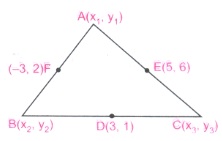
then \(\frac { { x }_{ 2 }+{ x }_{ 3 } }{ 2 } =3\ \Rightarrow \ { x }_{ 2 }+{ x }_{ 3 }=6\) ---- (i)
\(\frac { y_{ 2 }+{ y }_{ 3 } }{ 2 } =3\ \Rightarrow \ { y }_{ 2 }+{ y }_{ 3 }=2\) --- (ii)
\(\frac { { x }_{ 2 }+{ x }_{ 3 } }{ 2 } =5\ \Rightarrow \ { x }_{ 3 }+{ x }_{ 1 }=10\) --- (iii) and \(\frac { y_{ 3 }+{ y }_{ 1 } }{ 2 } =6\ \Rightarrow \ { y }_{ 1 }+{ y }_{ 3 }=12\) --- (iv)
\(\frac { { x }_{ 1 }+{ x }_{ 2 } }{ 2 } =-3\ \Rightarrow \ { x }_{ 1 }+{ x }_{ 2 }=-6\) --- (v) and \(\frac { y_{ 1 }+{ y }_{ 2 } }{ 2 } =2\ \Rightarrow \ { y }_{ 1 }+{ y }_{ 2 }=4\) --- (vi)
Adding (i), (iii) and (v), we get
2(x1+x2+x3) = 10 ⇒ x1+x2+x3=5 --- (vii)
Subtrcting (i), (iii), (v) separtely from (vii), we get x1=-1 , x2=-5, x3=11
Adding (ii), (iv) and (vi), we get
2(y1+y2+y3) = 18 ⇒ y1+y2+y3=9 --- (viii)
Subtracting (ii), (iv) and (vi) separetely from (viii), we get y1=7, y2=-3, y3=5.
Hence, the vertices of the triangle ABC are A(-1,7), B(-5,-3) and C(11,5).
20.
Let P(x,y), A(a+b, a-b) and B(a-b, a+b) be the given points.
Since AP = BP,
ஃ AP2 = BP2
⇒ (x-a-b)2+(y-b+a)2 = (x-a+b)2+(y-a-b)2
⇒ (x-a-b)2- (x-a+b)2 = (y-a-b)2-(y-b+a)2
⇒ (x-a-b+x-a+b)(x-a-b-x+a-b) = (y-a-b+y-b+a) (y-a-b-y+b-a)
⇒ (2x-2a)(-2b) = (2y-2b)(-2a) ⇒ -4bx+4ab = -4ay+4ab
⇒ -4bx = -4ay ⇒ bx = ay. Hence proved
21.
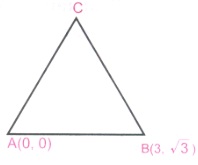
AB = \(\sqrt { { (3-0 })^{ 2 }+(\sqrt { 3 } -0)^{ 2 } } \) = \(\sqrt{9+3}\) =\(\sqrt {12}\) = 2\(\sqrt{3}\)
∴ Side of equilateral △ = 2\(\sqrt{3}\) units
Area of equilateral △ = \(\frac{\sqrt 3} {4}\) (Sides)2
=\(\frac {\sqrt {3}} {4} \times (2\sqrt {3})^{2} = 3{\sqrt{3}}\) sq.units
22.
(c)
6
23.
(d)
458th
24.
(a)
190
25.
(c)
ㄥB = ㄥD
26.
(b)
similar
27.
(b)
13
28.
(c)
ay=cp
29.
(d)
3/13
30.
(b)
11/35
31.
(a)
1/5
32.
33.
(b)
4 cm

10th Standard CBSE Syllabus & Materials
10th Standard CBSE
CBSE 10th Social Science PS - Federalism - New Model Questions Papers Study Material - QB365 Set A
NEW10th Standard CBSE
CBSE 10th Social Science PS - Power Sharing - New Model Questions Papers Study Material - QB365 Set A
NEW10th Standard CBSE
CBSE 10th Social Science GEO - Manufacturing Industries - New Model Questions Papers Study Material - QB365 Set A
NEW10th Standard CBSE
CBSE 10th Social Science GEO - Minerals and Energy Resources - New Model Questions Papers Study Material - QB365 Set A



NCERT Books

Syllabus

Exam Pattern

Sample Question Papers

Previous year Question Papers

Important Notes

MCQ Practice test

NCERT Exemplers

Case study Questions

Image Based Questions

Passage based Questions

HOT Questions

Value Based Questions

Model Questions Papers
NCERT ( Book Back ) Questions

Assertion and Reason
Important Questions And Answers

CBSE 10th Standard CBSE Subjects
CBSE Standards



