
 100% FREE ACCESS
10th Standard CBSE Syllabus & Materials
10th Standard CBSE
CBSE 10th Social Science ECO - Globalisation and the Indian Economy - New Model Questions Papers Study Material - QB365 Set A
NEW10th Standard CBSE
CBSE 10th Social Science ECO - Money and Credit - New Model Questions Papers Study Material - QB365 Set A
NEW10th Standard CBSE
CBSE 10th Social Science ECO - Sectors of the Indian Economy - New Model Questions Papers Study Material - QB365 Set A
NEW10th Standard CBSE
CBSE 10th Social Science ECO - Development - New Model Questions Papers Study Material - QB365 Set A
NEW10th Standard CBSE
CBSE 10th Social Science PS - Outcomes of Democracy - New Model Questions Papers Study Material - QB365 Set A
NEW10th Standard CBSE
CBSE 10th Social Science PS - Gender, Religion and Caste - New Model Questions Papers Study Material - QB365 Set A

Published on: 26/10/2025
Download CBSE Class 10th Standard CBSE Maths question papers, sample papers, important questions, and previous year solved papers in PDF format. Get free study materials, NCERT solutions, and exam preparation resources for Class 10th Standard CBSE Maths
Questions + Answers key
Take MCQ Maths Test
1.
The lengths of tangents drawn from an external point to a circle are equal.
2.
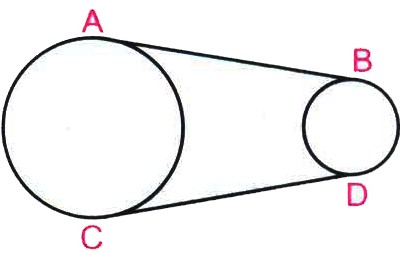
In figure, AB and CD are common tangents to two circles of unequal radii.Prove that AB=CD.
3.
In figure, a triangle ABC is drawn to circumscribe a circle of radius 2cm such that the segments BD and DC into which BC is divided by the point of contact D are the lengths 4cm and 3cm respectively.If area of \(\Delta ABC=cm^2\), then find the lengths of sides AB and AC.
-S.jpg)
4.
Prove that opposite sides of a quadrilateral circumscribing a circle subtend supplementary angles at the centre of the circle.
5.
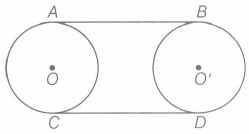
In figure, AB and CD are common tangents to two circles of equal radii. Prove that AB = CD. Further prove that ∆OAB = ∆OCD.
6.
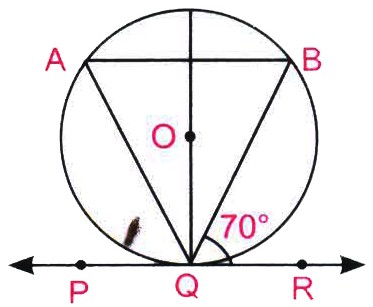
In the given figure PQR is the tangent to a circle at Q whose centre is O, AB is a chord parallel to PR and \(\angle BQR=70^0\).FInd \(\angle AQB.\)
7.
PQ is a tangent drawn from a point P to a circle with centre O and QOR is a diameter of the circle such that \(\angle POR=110^0\)Find \(\angle OPQ.\)
8.
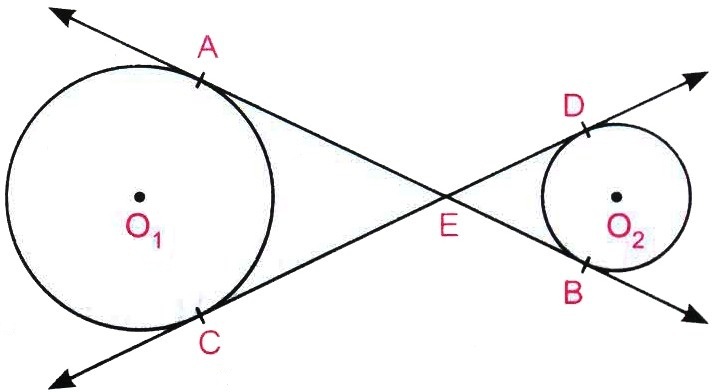
In figure common tangents AB and CD to the two circles with centres O1 and O2 intersect at E. Prove that AB = CD.
9.
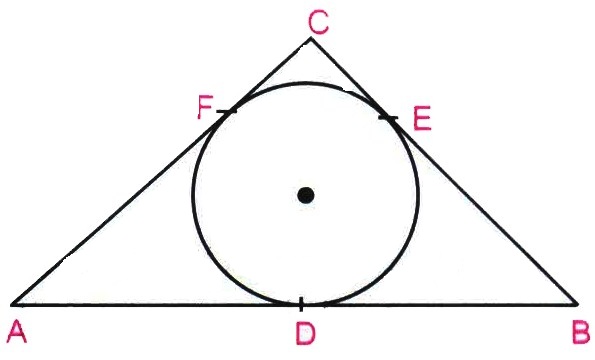
In figure, a circle inscribed in triangle ABC touches its sides AB, BC and AC at points D, E and F respectively. If AB=12cm, BC=8cm, and AC=10cm, then find the lengths of AD, BE, and CF.
10.
If d1, d2 (d2>d1) be the diameters of two concentric circles and c be the length of a chord of a circle which is tangent to the other circle, prove that \(d^{2}_{2}=c^2+d^{2}_{1}\)
11.
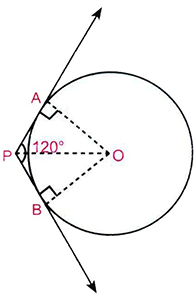
Two tangents PA and PB are drawn to the circle with centre O, such that \(\angle =120^0.\)Prove that OP = 2AP.
12.
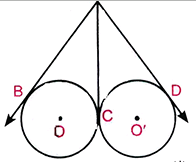
In the figure, AB, AC and AD are tangents. If AB - 5 cm, find AD.
13.
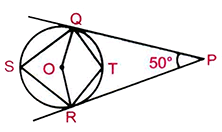
In the figure given below, find \(\angle QSR.\)
14.
What is the distance between two parallel tangents of a circle of radius 7cm?
15.
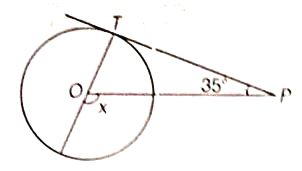
In the given figure, if PT is a tangent to a circle with centre O and \(\angle\)TPO = 35°, then the measure of \(\angle\)x is
110°
115°
120°
125°
16.
In the given figure, tangents PA and PB drawn from P to circle are inclined to each other at an angle of 80°.The measure of \(\angle\)PAB is
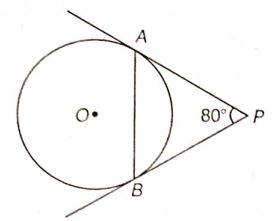
80°
60°
50°
40°
17.
In the following figure, diameters of two wheels have measures 4 cm and 2 cm. Determine the length of the belts AP and BC that pass around the wheels, if it is given that belts cross each other at right angles.
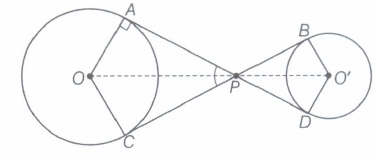
4 cm
3 cm
2 cm
1 cm
18.
In the given figure, a circle touches all the four sides of quadrilateral ABCD with AB = 6 cm, BC = 7 cm and CD = 4 cm, then length of AD is
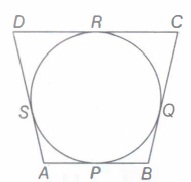
3 cm
4 cm
5 cm
6 cm
19.
A tangent PO at a point P of a circle of radius 6 cm meets a line through the centre o at a point Q, so that OQ = 14 cm, then length of PO is
\(4 \sqrt{10} \mathrm{~cm}\)
\(6 \sqrt{10} \mathrm{~cm}\)
\(5 \sqrt{10} \mathrm{~cm}\)
\(7 \sqrt{10} \mathrm{~cm}\)
20.
A circle can pass through
3 non- collinear points
3 collinear points
4 collinear points
2 collinear points
21.
The tangents drawn at the ends of a diameter of a circle are:
intersecting at a point inside the circle
perpendicular
intersecting at the centre of the circle
parallel
22.
In the figure, the pair of tangents AP and AQ, drawn from an external point A to a circle with centre O, are perpendicular to each other and length of each tangent is 4 cm, then the radius of the circle is
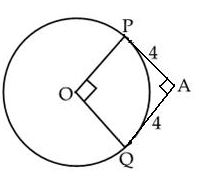
10 cm
4 cm
7.5 cm
2.5 cm
23.
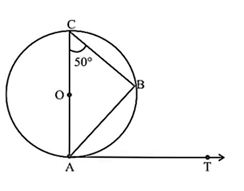
In figure, AB is a chord of the circle and AOC is its diameter such that ∠ACB = 50°. If AT is the tangent to the circle at the point A, then ∠BAT is equal to
45o
60o
50o
55o
24.
In the given figure, PT is a tangent to a circle whose centre is O. If PT = 12 cm and PO = 13 cm then find teh radius of the circle.
5 cm
4 cm
6 cm
4.5 cm
25.
Prem did an activity on tangents drawn to a circle from an external point using 2 straws and a nail for maths project as shown in figure.
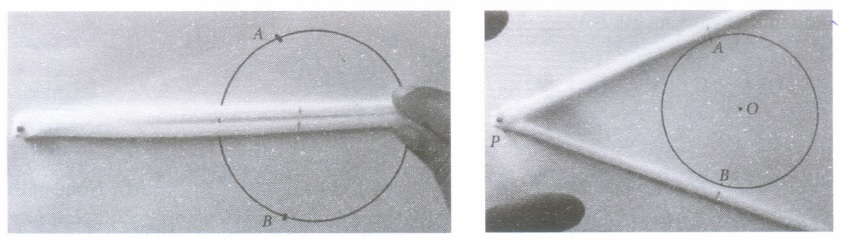
Based on the above information, answer the following questions.
(i) Number of tangents that can be drawn to a circle from an external point is
| (a) 1 | (b) 2 | (c) infinite | (d) any number depending on radius of circle |
(ii) On the basis of which of the following congruency criterion,\(\Delta \mathrm{OAP} \cong \Delta \mathrm{OBP} ?\)
| (a) ASA | (b) SAS | (c) RHS | (d) SSS |
(iii) If \(\angle\)AOB = 150°, then \(\angle\)APB =
| (a) 75° | (b) 30° | (c) 60° | (d) 100° |
(iv) If \(\angle\)APB = 40°, then \(\angle\)BAO =
| (a) 40° | (b) 30° | (c) 50° | (d) 20° |
(v) If \(\angle\)ABO = 45°, then which of the following is correct option?
| (a) \(A P \perp B P\) | (b) PAOB is square | (c) \(\angle\)AOB = 90° | (d) All of these |
26.
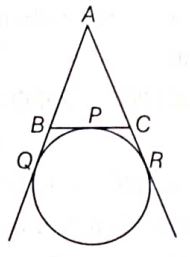
A circle touches the side BC of a \(\Delta\)ABC at a point P and touches AB and AC when produced at Q and R respectively. Show that \(A Q=\frac{1}{2}\)(Perimeter of \(\Delta\)ABC).
1.
We are given a circle with centre O, a point P lying outside the circle and two tangents PQ, PR on the circle from P see fig. We are required to prove that PQ = PR.
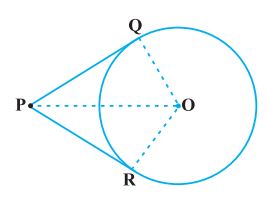
For this, we join OP, OQ and OR. Then \(\angle\)OQP and \(\angle\)ORP are right angles, because these are angles between the radii and tangents, and according to Theorem 10.1 they are right angles. Now in right triangles OQP and ORP,
OQ = OR (Radii of the same circle)
OP = OP (Common)
Therefore, \(\Delta\)OQP \(\cong\)\(\Delta\) ORP (RHS)
This gives PQ = PR (CPCT)
2.
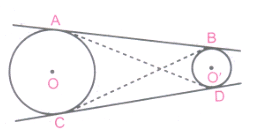
Construction: Join AD and BC
Proof: The tangent drawn from an internal point to a circle are equal in length.
If A is external point for circle hving centre O.
AB = AD .....(i)
If C is external point then
BC = CD .....(ii)
Now, B is external point for circle having centre O
AB = BC .....(iii)
So, from (i), (ii) and (iii), we get
AB = BC = CD
So, AB = CD Hence proved.
3.
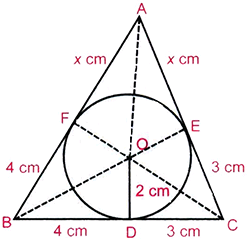
Let AE = AF = x
Length of tangents from an external point are equal
ar \(\triangle\)BOC = \(1\over2\) x 7 x 2 = 7 cm2
ar \(\triangle\)BOC = \(1\over2\)x (4 + x) x2=(4 + x) cm2
ar \(\triangle\)AOC = \(1\over2\) x (3 + x) x 2=(3 + x) cm2
ar \(\triangle\)ABC = \(1\over2\) AOB +ar \(\triangle\)BOC + a r\(\triangle\)AOC
S=\(a+b+c \over2\)
\(=\frac { 4+x+7+3+x }{ 2 } =\frac { 14+2x }{ 2 } =7+x\)
\(ar\Delta ABC=\sqrt { s(s-a)(s-b)(s-c) } \)
\(=\sqrt { (7+x)(7+x-4-x)[7+x-7][7+x-3-x] } \)
\(=\sqrt { (7+x)\times 3\times x\times 4 } =2\sqrt { 3x(7+x) } \)
\(2\sqrt { 3x(7+x) } =4+x+7+3+x\Rightarrow 2\sqrt { 3x(7+x) } \) = 14 + 2x
\(\sqrt { 3x(7+x) } =7+x\Rightarrow 3x(7+x)={ (7+x) }^{ 2 }\)
⇒ 21x+3x2 = 49 +x2 + 14x ⇒ 2x2 + 7x - 49 = 0
⇒ 2x2 + 14x - 7x - 49 = 0 ⇒ 2x(x+7)-7(x+7) = 0
⇒ (2x - 7)(x + 7) = 0 ⇒ x = \(7\over2\), x = -7 [Rejected]
The length of side AB = 4 + 3.5 = 7.5 cm and AC = 3 + 3.5 = 6.5 cm
4.
Let ABCD is a quadrilateral circumscribing a circle with centre O. Let circle touches the sides of a quadrilatcral at points E, F, G and H.
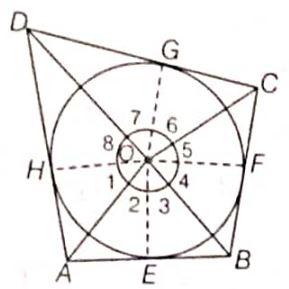
To prove \(\angle\)AOB + \(\angle\)COD = 180°
and \(\angle\) AOD + \(\angle\)BOC = 180°
Construction Join OE, OF, OG and OH.
Proof We know that two tangents drawn from an external point to a circle subtend equal angles at the centre.
and 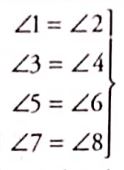 ....(i)
Also, we know that the sum of all angles subtended at a point is 360°.
\(\begin{array}{rlrl} \therefore \angle 1+\angle 2+\angle 3+\angle 4+\angle 5+\angle 6+\angle 7+\angle 8 & =360^{\circ} \\ \end{array}\) ...(ii)
\(\begin{array}{rlrl} \Rightarrow 2(\angle 2+\angle 3+\angle 6+\angle 7) & =360^{\circ} \\ \end{array}\)
\(\begin{array}{rlrl} \Rightarrow & (\angle 2+\angle 3)+(\angle 6+\angle 7)=180^{\circ} \\ \end{array}\)
\(\begin{array}{rlrl} \Rightarrow & \angle A O B+\angle C O D=180^{\circ} \end{array}\)
Similarly, we have
\(\begin{aligned} 2(\angle 1+\angle 8+\angle 4+\angle 5) & =360^{\circ} \\ \end{aligned}\) [from Eq. (i) and (ii)]
\(\begin{aligned} & \Rightarrow(\angle 1+\angle 8)+(\angle 4+\angle 5)=180^{\circ} \\ \end{aligned}\)
\(\begin{aligned} \Rightarrow \quad \angle A O D+\angle B O C=180^{\circ} \end{aligned}\) Hence proved.
5.
Join OB and OD, then OB = OD.
6.
AB II PR
\(\angle \)B = \(\angle \)Q [Alternate interior angles]
⇒ \(\angle \)B = 70°
AQB is an Isosceles triangle,
AB = AQ
So, \(\angle \)BQR = \(\angle \)BAQ
⇒ \(\angle \)A = 70
⇒ AQB
\(\angle \)A + \(\angle \)B + \(\angle \)Q = 180°
⇒ 70° + 70° + \(\angle \)Q = 180°
⇒ Q = 180° - \(\angle \)140° = 40°
7.
Given: PQ is a tangent to the circle with centre O from a point P. QCR is a diameter of the circle
and \(\angle \)POR = 110°.
To find: \(\angle \)OPQ
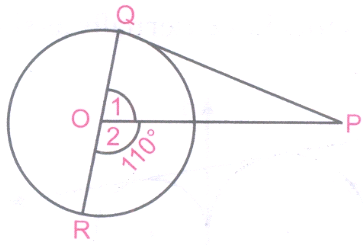
Sol. POR = 110°
QR is the diameter of the circle.
⇒ \(\angle \)1 + \(\angle \)2 = 180° [Linear pair axiom]
⇒ \(\angle \)1 + 110° = 180° ⇒ \(\angle \)1 = 70°
\(\angle \)OQP = 90°
(Tangent makes 90° angle with the radius at the point of contact).
In \(\triangle\)OPQ
\(\angle \)1 + \(\angle \)OQP + \(\angle \)QPO = 180° [Angle sum properety]
⇒ 70° + 90° + \(\angle \)QOP = 180°
⇒ \(\angle \)OPQ = 180° - 160°
⇒ \(\angle \)OPQ = 20°
8.
AB and CD are common tangents to the two given circles with centres O1 and O2. We know that lengths of the tangents drawn from a point outside the circle to the circle are equal in length.
\(\therefore\) AE = EC and EB = ED
\(\Rightarrow\) AE + EB = CE + ED
\(\Rightarrow\) AB = CD.
9.
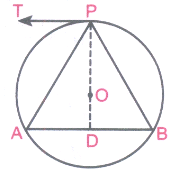
Let AD = x cm; BD = AB - AD
= (12 - x)cm; AD = AF [tangents from point A]
ஃ AF = x cm
Now, CF = AC - AF = (10-x) cm
and BD = BE ⇒ BE = (10 - x) c
Now, BC = CE + BE
⇒ 8 = (10 -x) + (12 - x)
⇒ 8 = 22 - 2x ⇒ 2x = 14
⇒ x = 7 cm
⇒ AD = 7 cm; BE = 12 - x
= 12 - 7 = 5 cm;
CF = 10 - x = 10 - 7 = 3 cm
10.
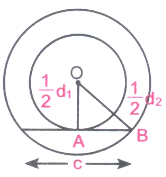
Radius of bigger circle = \(1\over2\)d2 and Radius of smaller circle = \(1\over2\)d2
In right angled \(\triangle\)OAB
OB2 = AB2 + OA2
⇒ \({ \left( \frac { 1 }{ 2 } { d }_{ 2 } \right) }^{ 2 }={ \left( \frac { 1 }{ 2 } c \right) }^{ 2 }{ \left( \frac { 1 }{ 2 } { d }_{ 1 } \right) }^{ 2 }\) [OA=\(1\over2\)d1 and OB=\(1\over2\)d2]
⇒ \(\frac { 1 }{ 4 } { d }_{ 2 }^{ 2 }=\frac { 1 }{ 4 } { c }^{ 2 }+\frac { 1 }{ 4 } { d }_{ 1 }^{ 2 }\)
⇒ \({ d }_{ 2 }^{ 2 }={ c }^{ 2 }+{ d }_{ 1 }^{ 2 }\)
11.
Given. A circle C(O, r). PA and PB are tangent to the circle from point P, outside the circle such that \(\angle \)APB = 120o. OP is joined.
To Prove. OP = 2AP.
Construction. Join OA and OB.
Proof. Consider s PAO and PBO
PA = PB [Tangent to a circle, from a point outside it, are equal.]
OP = OP [Common]
\(\angle \)OAP = \(\angle \)OBP = 90o
ஃ OAP OBP
ஃ \(\angle \)OPA = \(\angle \)OPB = \(1\over2\) \(\angle \)APB = \(1\over2\) x 120o = 60o.
In right angled OAP, \(AP\over OP\) = cos60o = \(1\over2\)⇒ OP = 2AP.
12.
Given: AB, AC and AD are tangents. AB = 5 cm.
TO find: AD
Sol. AB and AC are tangents from the same point to the circle with centre O.
⇒ AB = AC .......(i)
(Length of the tangents from the same external point are equal).
AC and AD are tangents from the same point to the circle with centre O.
⇒ AC = AD .....(ii)
(Length of the tangents from the same external point are equal)
From (i) and (ii)
∵ AB = AD = 5 cm
13.
In the figure given below, find \(\angle \)QSR.
Given: PQ and PR are tangents to a circle with centre O and
\(\angle \)QPR = 50
To find: QSR
sol. \(\angle \)QOR + \(\angle \)QPR = 180°
⇒ \(\angle \)QOR + 50° = 180°
⇒ \(\angle \)QOR = 130QOR
⇒ \(\angle \)QOR = \(1\over2\) \(\angle \)QSR [Degree measure theorem]
⇒ \(\angle \)QSR = \(1\over2\) x 130° = 65°
14.
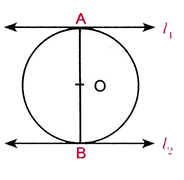
parallel tangents of a circle can be drawn only at the end points of the diameter
⇒ I1 || I2
⇒ Distance between I1 and I2 = AB = Diameter of the circle
= 2 x r = 2 x 7 cm = 14 cm
15.
(d)
125°
16.
(c)
50°
17.
(b)
3 cm
18.
(a)
3 cm
19.
(a)
\(4 \sqrt{10} \mathrm{~cm}\)
20.
(a)
3 non- collinear points
21.
(d)
parallel
22.
(b)
4 cm
23.
Here AC is the diameter of the circle.
∴ ∠ABC = 90° [ Angle in a semi-circle]
Now, in ΔACB, ∠A + ∠B + ∠C = 180° [Sum of all interior angles of a triangle is 180°]
⟹ ∠A + 90° + 50° = 180°
⟹ ∠A + 140 = 180
⟹ ∠A = 180o - 140° = 40°
Or ∠OAB = 40° …(i)
Here, OA ⏊ AT
⟹ ∠OAT = 90°
⟹ ∠OAB + ∠BAT = 90°
⟹ ∠BAT = 90° - 40° = 50° [Using (i)]
Hence, the value of ∠BAT is 50°.
24.
(b)
4 cm
25.
(i) (b)
(ii) (c): In \(\Delta\)OAP and \(\Delta\)OBP,
\(\angle\)OAP = \(\angle\)OBP = 90°
[Since, radius at the point of contact is perpendicular to tangent]
OP = OP (Common)
OA = OB (Radii of circle)
So, \(\angle\)OAP == \(\angle\)OBP (By RHS congruency criterion)
(iii) (b): In quadrilateral OAPB, \(\angle\)AOB = 150° [Given]
\(\angle\)OAP = \(\angle\)OBP = 90°
\(\therefore\) \(\angle\)APB = 360° - 90° - 90° - 150° = 30°
(iv) (d): We have, \(\angle\)APB = 40°
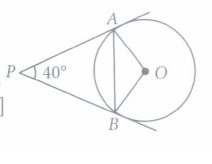
Now,PA =PB [Since, length of tangents drawn from an external point are equal]
In \(\Delta\)PAB, \(\angle\)PAB = \(\angle\)PBA = 70° [Angles opposite to equal sides are equal]
Also, \(\angle\)PAB + \(\angle\)BAO = 90°
[Since, radius at the point of contact is perpendicular to tangent]
\(\Rightarrow\) \(\angle\)BAO = 90° - 70° = 20°
(v) (d): We have, \(\angle\)ABO = 45°
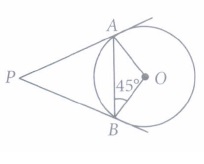
\(\because\) AO = OB (Radii of circle)
\(\therefore\) \(\angle\)BAO = \(\angle\)ABO = 45° [Angles opposite to equal sides are equal]
Now, in \(\Delta\)OAB,
\(\angle\)AOB = 180° - 45° - 45° = 90°
Since, \(\angle\)APB = 360° - 90° - 90° - 90° = 90° i.e., AP\(\perp\) BP
So, OAPB is a square.
26.
BQ = BP (length of tangents drawn from an external point to a circle are equal) ...(i)
CP = CR ...(ii)
and AQ = AR
\(\therefore\) 2AQ = AQ + AR
= (AB + BQ) + (AC + CR)
= (AB + BP) + (AC + CP)
[using Eqs. (i) and (ii)]
\(\Rightarrow\) 2AQ = AB + AC + (BP + CP)
\(\Rightarrow\) 2AQ = AB + AC + BC
\(\begin{array}{ll} \Rightarrow & A Q=\frac{1}{2}(A B+B C+A C) \end{array}\)
\(\begin{array}{ll} \Rightarrow & A Q=\frac{1}{2} \text { Perimeter of } \triangle A B C \end{array}\)

10th Standard CBSE Syllabus & Materials
10th Standard CBSE
CBSE 10th Social Science PS - Federalism - New Model Questions Papers Study Material - QB365 Set A
NEW10th Standard CBSE
CBSE 10th Social Science PS - Power Sharing - New Model Questions Papers Study Material - QB365 Set A
NEW10th Standard CBSE
CBSE 10th Social Science GEO - Manufacturing Industries - New Model Questions Papers Study Material - QB365 Set A
NEW10th Standard CBSE
CBSE 10th Social Science GEO - Minerals and Energy Resources - New Model Questions Papers Study Material - QB365 Set A



NCERT Books

Syllabus

Exam Pattern

Sample Question Papers

Previous year Question Papers

Important Notes

MCQ Practice test

NCERT Exemplers

Case study Questions

Image Based Questions

Passage based Questions

HOT Questions

Value Based Questions

Model Questions Papers
NCERT ( Book Back ) Questions

Assertion and Reason
Important Questions And Answers

CBSE 10th Standard CBSE Subjects
CBSE Standards



