
 100% FREE ACCESS
10th Standard CBSE Syllabus & Materials
10th Standard CBSE
CBSE 10th Social Science ECO - Globalisation and the Indian Economy - New Model Questions Papers Study Material - QB365 Set A
NEW10th Standard CBSE
CBSE 10th Social Science ECO - Money and Credit - New Model Questions Papers Study Material - QB365 Set A
NEW10th Standard CBSE
CBSE 10th Social Science ECO - Sectors of the Indian Economy - New Model Questions Papers Study Material - QB365 Set A
NEW10th Standard CBSE
CBSE 10th Social Science ECO - Development - New Model Questions Papers Study Material - QB365 Set A
NEW10th Standard CBSE
CBSE 10th Social Science PS - Outcomes of Democracy - New Model Questions Papers Study Material - QB365 Set A
NEW10th Standard CBSE
CBSE 10th Social Science PS - Gender, Religion and Caste - New Model Questions Papers Study Material - QB365 Set A

Published on: 26/10/2025
Download CBSE Class 10th Standard CBSE Maths question papers, sample papers, important questions, and previous year solved papers in PDF format. Get free study materials, NCERT solutions, and exam preparation resources for Class 10th Standard CBSE Maths
Questions + Answers key
Take MCQ Maths Test
1.
The mean and median of 100 observations are 50 and 52 respectively. The value of the largest observation is 100. It was later found that it is 110 not 100. Find the true mean and median.
2.
The sides AB and AC and the perimeter P1 of ABC are respectively three times the corresponding sides DE and DF and the perimeter P2 of DEF, Are the two triangles similar? If yes, find \(\frac { ar(\triangle ABC) }{ ar(\triangle DEF) } \)
3.
Find the next term of the series \(\sqrt { 2 } ,\sqrt { 8 } ,\sqrt { 18 } ,\sqrt { 32 } ....\)
4.
The weight (in kg) of 50 wrestlers are recorded in the following table:
| Weight (in kg) | 100-110 | 110-120 | 120-130 | 130-140 | 140-150 |
|---|---|---|---|---|---|
| Number of wrestlers | 4 | 14 | 21 | 8 | 3 |
Find the mean weight of the wrestlers.
5.
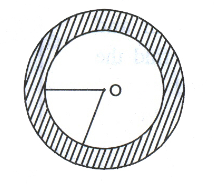
Area enclosed between two circumferences of two concentric circles is 346.5 cm2 , if circumference of inner circle is 88 cm, find the radius of outer circle.
6.
Find the area of a sector of a circle with radius 6 cm, if angle of the sector is \(60^o\)
7.
An AP consists of 50 terms of which 3rd term is 12 and the last term is 106. Find the 29th term.
8.
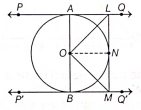
In the given figure, PQ and P'O' are two parallel tangents to a circle with centre O and another tangent LM with point of contact N intersecting PQ at L and P at M. Find ∠LOM.
9.
504 cones, each of diameter 3.5 cm and height 3 cm, are melted and recast into a metallic sphere. Find the diameter of the sphere and hence find its surface area.\(\left[ Use\quad \pi =\frac { 22 }{ 7 } \right] \)
10.
Find the mean and mode of the following frequency distribution
| Classes | 0-10 | 10-20 | 20-30 | 30-40 | 40-50 | 50-60 | 60-70 |
| Frequency | 3 | 8 | 10 | 15 | 7 | 4 | 3 |
11.
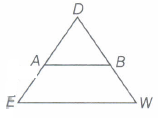
In \(\triangle DEW, AB\parallel EW\). If AD = 4 cm, DE = 12 cm and DW = 24 cm, find the value of DB.
12.
The radii of two concentric circles are 13 cm and 8 cm. AB is a diameter of the bigger circle. BD is a tangent to the smaller circle touching it at D.Find the length of AD.
13.
Find the diameter of a circle whose circumference is equal to the sum of the circumference of the two circles of diameters 36 cm and 20 cm.
14.
A rectangular container, whose base is a square of side 5 cm stands on a horizontal table and holds water up to 1 cm from the top. When a cube is placed in the water it is completely submerged. The water rises to the top and 2 cubic cm of water overflows. Calculate the volume of the cube and also the length of its edge.
15.
Find the number of terms in A.P.: 3, 6, 9, 12,.....,111.
16.
Two tangents TP and TQ are drawn to a circle with centre O from an external point T. Prove that \(\angle \mathrm{PTQ}=2 \angle \mathrm{OPQ}\).
17.
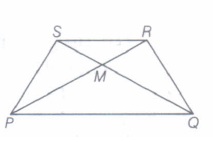
PQRS is a trapezium with PQ II SR. Diagonals PR and SQ intersect at M and ΔPMS - ΔQMR. Prove that PS = QR.
18.
Following data was obtained regarding concentration of sulphur dioxide (SO2) in the air (in parts per million, i.e. ppm) in 24 for a awareness programme related to environment locations of a city:
| Concentration of SO2 (in ppm) | Frequecy |
|---|---|
| 0.00-0.02 | 2 |
| 0.02-0.04 | 5 |
| 0.04-0.06 | 4 |
| 0.06-0.08 | 3 |
| 0.08-0.10 | 4 |
| 0.10-0.12 | 6 |
Find the mean and median concentration of SO2 in the air. What value is indicated from this action?
19.
A building in the form of a cylinder surmounted by a hemispherical valuated dome and contains \(41\frac { 19 }{ 21 } \)m3 of air. If the internal diameter of dome is equal to its total height above the floor. Find the height of the building.
20.
Find the area of the sector of a circle with radius 4 cm and of angle 30°. Also find the area of the corresponding major sector. (Use \(\pi\) = 3.14).
21.
Jaspal Singh repays his total loan of Rs.118000 by paying every month starting with the first instalment of Rs.1000. If he increases the instalment by Rs.100 every month,
(i) What will be paid by him in the 30th instalment?
(ii) What amount of loan does he still have to pay after the 30th instalment?
22.
The median of first seven prime numbers is
5
7
11
13
23.
If the sum of first n terms of an AP is 3n2 + 4n and its common difference is 6, then its first term is
7
4
6
3
24.
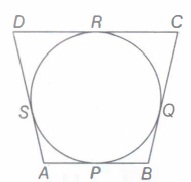
In the given figure, a circle touches all the four sides of quadrilateral ABCD with AB = 6 cm, BC = 7 cm and CD = 4 cm, then length of AD is
3 cm
4 cm
5 cm
6 cm
25.
If tangents PA and PB from a point P to a circle with centre O are inclined to each other at angle of 80°, then \(\angle POA \) is equal to
50°
60°
70°
80°
26.
Diagonal AC of a rectangle ABCD is produced to the point E such that AC : CE = 2 : 1, AB = 8 cm and BC = 6 m. The length of DE is
\(2 \sqrt{19}\)cm
15 cm
\(3 \sqrt{17}\)cm
13 cm
27.
Tick the correct answer in the following:
Area of a sector of angle P (in degrees) of a circle with radius R is
\({P \over 180^o}\times 2\pi R\)
\({P \over 180^o}\times \pi R^2\)
\({P \over 360^o}\times 2\pi R\)
\({P \over 720^o}\times 2\pi R^2\)
28.
Sides of two similar triangles are in the ratio 4 : 9. Areas of these triangles are in the ratio
2 : 3
4 : 9
81 : 16
16 : 81
29.
How many terms of AP 54, 51, 48… are required to give a sum of 513
21 or 25
23 or 24
18 or 19
22 or 23
30.
An AP has first term 1 with a common difference also 1 and has 49 as its last term. Find its sum. 1,2,3,4 ……..49
1221
1242
1225
1232
31.
If the point of intersection of a less than and more than ogive is (15,20), then the value of median is
5
20
15
35
32.
Frequency table of the marks of 50 students as given below:
| Marks Obtained | 0-10 | 10-20 | 20-30 | 30-40 | 40-50 | 50-60 |
| No of students | 3 | f1 | 20 | 10 | 5 | f2 |
Given that the median marks are 28.5, the missing frequencies will be
f1 = 7, f2 = 9
f1 = 5, f2 = 7
f1 = 8, f2 = 7
f1= 7, f2 = 5
33.
In the adjoining figure, PQ || BC, then what could be the values of AP & PB respectively
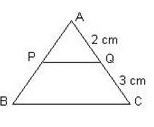
1 cm and 3 cm
3 cm and 6 cm
2 cm and 4 cm
4 cm and 6 cm
34.
If the surface area of a sphere is 144 π cm2, then its radius is
8 cm
10 cm
12 cm
6 cm
35.
rocket is in the form of a circular cylinder closed at the lower end and a cone of the same radius is attached to the top. The radius of the cylinder is 2.5 m and its height is 21 m. Also, the slant height of the cone is 8 m. The total surface area of the rocket is
200 m2
412.5 m2
500 m2
313.5 m2
36.
If a right angled triangle is revolved about one of the sides containing the right angle it forms a
Right circular cone
Right triangle
Prism
Pyramid
37.
If the circumference of a circle increases from 2π to 4π then its area is
Tripled
Doubled
Four times
Halved
38.
How many tangents can be drawn to a circle from a point in its interior?
One
Infinite
None
Two
39.
In the given figure, PT is a tangent to a circle whose centre is O. If PT = 12 cm and PO = 13 cm then find teh radius of the circle.
5 cm
4 cm
6 cm
4.5 cm
40.
Assertion: In ΔABC, ∠B = 90° and BD ⊥ AC. If AD = 4 cm and CD = 5 cm then BD is 2\(\sqrt5\) cm.
Reason: The ratio of the areas of two similar triangles are equal to the ratio of squares of any two corresponding sides.
Codes:
(a) If both Assertion and Reason are correct and Reason is the correct explanation of Assertion.
(b) If both Assertion and Reason are correct, but Reason is not the correct explanation of Assertion.
(c) If Assertion is correct but Reason is incorrect.
(d) If Assertion is incorrect but Reason is correct.
41.
Assertion In an Ap,Sn = n2 + n, then T20 = 40.
Reason In an Ap, an - an-1 = d.
Codes:
(a) If both Assertion and Reason are correct and Reason is the correct explanation of Assertion.
(b) If both Assertion and Reason are correct, but Reason is not the correct explanation of Assertion.
(c) If Assertion is correct but Reason is incorrect.
(d) If Assertion is incorrect but Reason is correct.
42.
India is competitive manufacturing location due to the low Cost of manpower and strong technical and engineering capabilities contributing to higher quality production runs. The production of TV sets in a factory increases uniformly by a fixed number every year. It produced 16000 sets in 6th year and 22600 in 9th year.


Based on the above information,answer the following questions:
(i) Find the production during first year.
(ii) Find the production during 8th year.
(iii) Find the production during first 3 yr.
(iv) In which year, the production is 29200.
(v) Find the difference of the production during 7th year and 4th year.
43.
A scale drawing of an object is the same shape at the object but a different size. The scale of a drawing Is a comparison of the length used on a drawing to the length it represents. The scale is written as a ratio. The ratio of two corresponding sides in similar figures is called the scale factor.
\(\text { Scale factor }=\frac{\text { length in image }}{\text { corresponding length in object }}\)
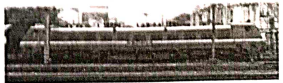
If one shape can become another using revising,then the shapes are sinilar. Hence,two shapes are similar when one can become the other after a resize, flip, slide or turn. In the photograph below showing the side view of a train engine. Scale factor is 1:200.
This means that a length of 1 cm on the photograph above corresponds to a length of 200 cm, or 2 metres, on the actual engine. The scale can also be written as the ratio of two lengths.
(a) If the length of the modelis 11cm, then the overall length of the engine in the photograph above, including the couplings(mechanism used to Connect) is
| (i) 22 cm | (ii) 220 cm | (iii) 220 m | (iv) 22 m |
(b) What will affect the similarity of any two polygons?
| (i) They are flipped horizontally | (ii) They are dilated by a scale factor. |
| (iii) They are translated down | (iv) They are not the mirror image of one another |
(c) What is the actual width of the door if the width of the door in photograph is 0.35 cm?
| (i) 0.7 m | (ii) 0.7 cm | (iii) 0.07 cm | (iv) 0.07 m |
(d) If two similar triangles have a scale factor of 5 : 3, which statement regarding the two triangles is true
| (i) The ratio of their perimeters is 15 : 1 | (ii) Their altitudes have a ratio 25 : 15 |
| (iii) Their medians have a ratio 10 : 4 | (iv) Their medians have a ratio 10 : 4 |
(e) The length of AB in the given figure is
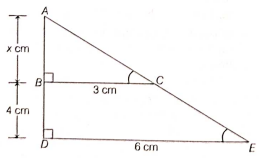
| (i) 8 cm | (ii) 6 cm | (iii) 4 cm | (iv) 0.07m |
44.
In a park, four poles are standing at positions A, B, C and D around the fountain such that the cloth joining the poles AB, BC, CD and DA touches the fountain at P, Q, Rand S respectively as shown in the figure.
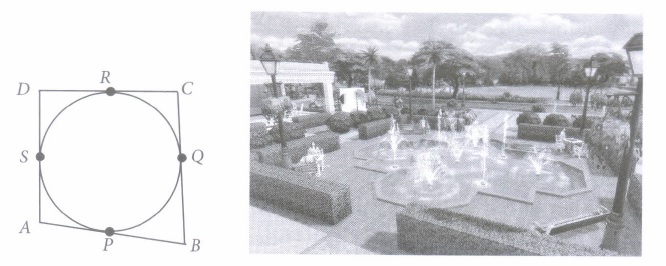
Based on the above information, answer the following questions.
(i) If 0 is the centre of the circular fountain, then \(\angle\)OSA =
| (a) 60° | (b) 90° |
| (c) 45° | (d) None of these |
(ii) Which of the following is correct?
| (a) AS = AP | (b) BP= BQ | (c) CQ = CR | (d) All of these |
(iii) If DR = 7 cm and AD = 11 ern, then AP =
| (a) 4 cm | (b) 18 cm | (c) 7 cm | (d) 11 cm |
(iv) If O is the centre of the fountain, with \(\angle\)QCR = 60°, then \(\angle\)QOR
| (a) 60° | (b) 120° | (c) 90° | (d) 30° |
(v) Which of the following is correct?
| (a) AB + BC = CD + DA | (b) AB + AD = BC + CD |
| (c) AB + CD = AD + BC | (d) All of these |
1.
Mean \(= \frac { \Sigma fx }{ \Sigma f } \)
\(50=\frac { \Sigma fx }{ 100 } \)
\(\Sigma fx=5000\)
Correct \(\Sigma fx^{ ' }=5000-100+110\)
=5010
Correct Mean \(= \frac { 5010 }{ 100 } \)
= 50.1
Median Will remain same median = 52
2.
In \(\triangle\)ABC and \(\triangle\)DEF,
AB = 3DE and AB = 3DF
\(\Rightarrow \frac { AB }{ DE } =3; \frac { AC }{ DF } =3;\)
P1 = 3P2
BC = 3EF
\(\Rightarrow \frac { AB }{ DE } =\frac { AC }{ DF } =\frac { BC }{ EF } =3\)
\(\triangle\)ABC~\(\triangle\)DEF
\(\Rightarrow\frac { ar(\triangle ABC) }{ ar(\triangle DEF) } ={ \left( \frac { AB }{ DE } \right) }^{ 2 }={ (3) }^{ 2 }=9.\)
3.
Here, \(a=\sqrt { 2 } ,a+d=\sqrt { 8 } =2\sqrt { 2 } \)
\(d=2\sqrt { 2 } -\sqrt { 2 } =\sqrt { 2 } \\ \therefore Next\quad term=\sqrt { 32 } +\sqrt { 2 } \\ =4\sqrt { 2 } +\sqrt { 2 } \\ =5\sqrt { 2 } \\ =\sqrt { 50 } \)
4.
123.4 kg
5.
17.5 cm
6.
We know that area of sector of a circle =\(\frac{\theta}{360^{\circ}} \times \pi r^2\)
Given, radius of circle, r = 6 cm
and angle of sector, \(\theta\)= 60°
\(\therefore\) Area of sector of a circle \(=\frac{60^{\circ}}{360^{\circ}} \times \frac{22}{7} \times(6)^2=\frac{132}{7} \mathrm{~cm}^2\)
7.
Let a be the first term and d be the common difference of given AP.
Now, as the nth term of an AP is an = a + (n-1) d
\(\therefore\) a3= a + 2d = 12 [\(\because\) a3 = 12, given] ...(i)
and a50 = a + 49 d =106 ...(ii)
[\(\because\) a50 = 106, given]
On subtracting Eq. (i) from Eq. (ii), we get
47 d = 94 \( \Rightarrow d=\frac{94}{47}=2\)
On putting the value of d in Eq. (i), we get
a + 2 \(\times\) 2 = 12 \(\Rightarrow\) a = 12 - 4 = 8
Now, 29th term, a29 = a + (29 - 1) d
= 8 + 28 \(\times\) 2 = 8 + 56 = 64
8.
∠LOM= 90o
9.
Volume of cone = \(\frac { 1 }{ 3 } \pi { r }^{ 2 }h\)
Volume of metal in 504 cones
\(=504\times \frac { 1 }{ 3 } \times \frac { 22 }{ 7 } \times \frac { 3.5 }{ 2 } \times \frac { 3.5 }{ 2 } \times 3\)
Volume of Sphere = \(\frac { 4 }{ 3 } \pi { r }^{ 3 }\)
\(= \frac { 4 }{ 3 } \times \frac { 22 }{ 7 } \times { r }^{ 3 }\)
Volume of sphere= Volume of 504 cones
\(\frac { 4 }{ 3 } \times \frac { 22 }{ 7 } \times { r }^{ 3 }=504\times \frac { 4 }{ 3 } \times \frac { 22 }{ 7 } \times \frac { 3.5 }{ 2 } \times \frac { 3.5 }{ 2 } \times 3\)
\(\Rightarrow { r }^{ 3 }={ \left( \frac { 21 }{ 2 } \right) }^{ 3 }\)
\(\Rightarrow\) r = 10.5 cm
\(\therefore\) Diameter = 21 cm
Surface area = 4\(\pi { r }^{ 2 }\)
= 4 x \(\frac {22}{7}\) x 10.5 x 10.5
= 1386 cm2.
10.
| Class Interval | Xi | fi | fixi |
| 010 | 5 | 3 | 15 |
| 10-20 | 15 | 8 | 120 |
| 20-30 | 25 | 10 | 250 |
| 30-40 | 35 | 15 | 525 |
| 40-50 | 45 | 7 | 315 |
| 50-60 | 55 | 4 | 220 |
| 60-70 | 65 | 3 | 1954 |
| \(\Sigma f_{ i }=50\) | \(\Sigma f_{ i }x_{ i }=1640\) |
Mean = \(\frac { \Sigma f_{ i }x_{ i } }{ \Sigma f_{ i } } =\frac { 1640 }{ 50 } \times 32.8\)
Modal class = 30-40
l=30, f1=15 , f2=7, f0=10 , h=10
Mode = \(l+\frac { f_{ 1 }-f_{ 0 } }{ 2f_{ 1 }f_{ 0 }-f_{ 2 } } \times h\)
\(30+\frac { 15+10 }{ 30-10-7 } \times 10\)
30+3.85
=33.85
11.
\(\because AB\parallel EW\) [given]
\(\therefore \frac { DA }{ AE } =\frac { DB }{ BW } \) [by basic proportionality theorem]
\(\Rightarrow \frac { DA }{ DE-DA } =\frac { DB }{ DW-DB } \)
\(\Rightarrow \frac { 4 }{ 12-4 } =\frac { DB }{ 24-DB } \Rightarrow \frac { 4 }{ 8 } =\frac { DB }{ 24-DB } \)
\(\Rightarrow 24-DB=2DB\Rightarrow 24=3DB\Rightarrow DB=\frac { 24 }{ 3 } =\) 8 cm
12.
Given, radii of two concentric circles are 13 cm and 8 cm.
Produced BD to meet the bigger circle at E. Join AE.
Then, ㄥAEB = 90°
OD丄BE
and BD = DE
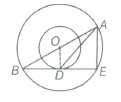
OD || AE
In Δ AEB, O and D are the mid-points of AB and BE, respectively
Therefore, by mid-point theorem, we have
\(OD={1\over2}AE\Rightarrow\ AE=2\times8=16\)
In right angled ∆ODB,
OB2 = OD2 + BD2 [by Pythagoras theorem)
132 = 82 + BD2
BD2 = 169 - 64 = 105
BD = \(\sqrt{105}cm\)
DE= \(\sqrt{105}cm\)
Now, in right angled ∆AED,
AD2 = AE2 + ED2
AD2 = (16)2 + (\(\sqrt{105}\))2 = 256 + 105
AD2 = 361 ⇒ AD =\(\sqrt{361}\)
AD = 19cm
Hence, the length of AD is 19 cm
13.
56 cm
14.
Volume of the cube = (5 x 5 x 1 + 2) cm3 = 27 cm3
Length of edge of the cube = \(\sqrt [ 3 ]{volume}=\sqrt [ 3 ]{ 27} \)= 3 cm
15.
37
16.
We are given a circle with centre O, an external point T and two tangents TP and TQ to the circle, where P, Q are the points of contact Fig. We need to prove that
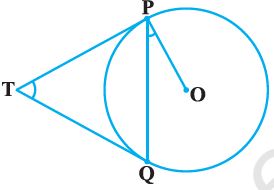
\(\angle \mathrm{PTQ}=2 \angle \mathrm{OPQ}\)
Let \(\angle \mathrm{PTQ}=\theta\)
Now, TP = TQ. So, TPQ is an isosceles triangle.
Therefore, \(\angle \mathrm{TPQ}=\angle \mathrm{TQP}=\frac{1}{2}\left(180^{\circ}-\theta\right)=90^{\circ}-\frac{1}{2} \theta\)
Also, \(\angle \mathrm{OPT}=90^{\circ}\)
So, \(\angle \mathrm{OPQ}=\angle \mathrm{OPT}-\angle \mathrm{TPQ}=90^{\circ}-\left(90^{\circ}-\frac{1}{2} \theta\right)\)
\(=\frac{1}{2} \theta=\frac{1}{2} \angle \mathrm{PTQ}\)
This gives \(\angle \mathrm{PTQ}=2 \angle \mathrm{OPQ}\)
17.
Given \(\Delta P M S \sim \Delta Q M R\) andPQ II SR.
To show PS = QR
\(
\because \Delta P M S \sim \Delta Q M R
\)
\(\therefore \frac{P S}{Q R}=\frac{P M}{Q M}=\frac{M S}{M R}
\) ........(i)
[∴ corresponding sides of similar triangles are proportional]
Now, consider ΔPMQ and ΔRMS. In these triangles, we have
\(\angle P M Q=\angle R M S \text { [vertically opposite angles] }\)and \(\angle M P Q=\angle M R S \text { [alternate angles] }\)
\(\therefore \Delta P M Q \sim \Delta R M S\) [by AA similarity criterion]
\(\Rightarrow \frac{P M}{R M}=\frac{M Q}{M S}\) [∴ corresponding sides of similar triangles are proportional]
\(\Rightarrow \frac{P M}{Q M}=\frac{M R}{M S}\) .........(ii)
From Eqs. (i) and (ii), we get
\(\frac{M S}{M R}=\frac{M R}{M S} \Rightarrow M S^{2}=M R^{2} \Rightarrow M S=M R\)
From Eq. (i), we get
\(\frac{P S}{Q R}=1 \Rightarrow P S=Q R\) Hence proved.
18.
The table for given distribution is
| Concentration of SO2 (in ppm) | Frequency (fi) | Class marks (xi) | fixi | Cumulative frequency |
|---|---|---|---|---|
| 0.00-0.02 | 2 | 0.01 | 0.02 | 2 |
| 0.02-0.04 | 5 | 0.03 | 0.15 | 7 |
| 0.04-0.06 | 4 | 0.05 | 0.20 | 11=cf |
| 0.06-0.08 | 3 | 0.07 | 0.21 | 14 |
| 0.08-0.10 | 4 | 0.09 | 0.36 | 18 |
| 0.10-0.12 | 6 | 0.11 | 0.66 | 24 |
| Total | \(\sum { f_{ i } } =24\) | \(\sum { f_{ i }x_{ i } } =1.60\) |
Here, \(\sum { f_{ i }x_{ i } } =1.60\) and \(\sum { f_{ i } } =24\)
Mean concentration of SO2\(=\frac { \sum { f_{ i }x_{ i } } }{ \sum { f_{ i } } } =\frac { 1.60 }{ 24 } \)
=0.066 (approx.)
Here, n=24 ⇒\(\frac { n }{ 2 } =12\)
The cumulative frequency just greater than 12 is 14 and corresponding class interval is 0.06-0.08.Here, l=0.06, cf=11, f=3 and h=0.02
Median\(=l+\left\{ \frac { \frac { n }{ 2 } -cf }{ f } \right\} \times h\)
\(=0.06+\left\{ \frac { \frac { 24 }{ 2 } -11 }{ 3 } \right\} \times 0.02=0.06+\left\{ \frac { 12-11 }{ 3 } \right\} \times 0.02\\ =0.06+\frac { 0.02 }{ 3 } =0.06+0.007=0.067(approx).\)
Promoting awarness regarding protection of environment and taking suggestive measures to make it pollution free.
19.
Given, Diameter of hemisphere=Diameter of a cylinder=Height of building (H) let
Radius of hemisphere=Radius of cylinder=\(\frac { H }{ 2 } \) and height of cylinder\(=H-\frac { H }{ 2 } =\frac { H }{ 2 } \)
Now, Volume of building =Volume of hemisphere+Volume of cylinder
4 m
20.
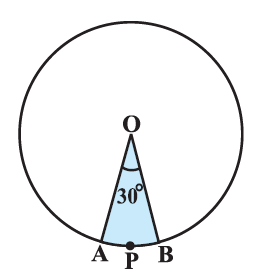
Given sector is OAPB
Area of the sector \(=\frac{\theta}{360} \times \pi r^{2}\)
\(=\frac{30}{360} \times 3.14 \times 4 \times 4 \mathrm{~cm}^{2}\)
\(=\frac{12.56}{3} \mathrm{~cm}^{2}=4.19 \mathrm{~cm}^{2}(\text { approx. })\)
Area of the corresponding major sector
\(\begin{aligned} &=\pi r^{2}-\text { area of sector } \mathrm{OAPB}\\ &=(3.14 \times 16-4.19) \mathrm{cm}^{2}\\ &=46.05 \mathrm{~cm}^{2}=46.1 \mathrm{~cm}^{2}(\text { approx. }) \end{aligned}\)
Alternatively, area of the major sector \(=\frac{(360-\theta)}{360} \times \pi r^{2}\)
\(\begin{array}{l} =\left(\frac{360-30}{360}\right) \times 3.14 \times 16 \mathrm{~cm}^{2} \\ =\frac{330}{360} \times 3.14 \times 16 \mathrm{~cm}^{2}=46.05 \mathrm{~cm}^{2} \\ =46.1 \mathrm{~cm}^{2}(\text { approx. }) \end{array}\)
21.
Since, Jaspal Singh repays his loan of Rs.118000, with first instalment of Rs 1000 and increases each instalment by Rs 100.
\(\therefore \) His instalments are Rs 1000, Rs 1100, Rs 1200, Rs 1300, ... which forms an A.P.
Here, first term is Rs 1000 and common difference is Rs 100.
\(\therefore \) 30th instalment = a30 = a + 29d
= Rs (1000 + 29 \(\times \) 100)
= Rs (1000 + 2900) = Rs 3900
Amount paid in 30 instalments = S30
\(\Rightarrow \) S30 = Rs \(\quad \frac { 30 }{ 2 } (2\times 1000+29\times 100)\)
\(=\ Rs\ 15 (2000+2900)\\ =\ Rs\ 15(4900)\ =\ Rs\ 73500\)
Amount of loan still have to pay
= Rs (118000 - 73500)
= Rs 44500
22.
(b)
7
23.
(a)
7
24.
(a)
3 cm
25.
(a)
50°
26.
(c)
\(3 \sqrt{17}\)cm
27.
(d)
\({P \over 720^o}\times 2\pi R^2\)
28.
(d)
16 : 81
29.
(c)
18 or 19
30.
(c)
1225
31.
(c)
15
32.
(b)
f1 = 5, f2 = 7
33.
(d)
4 cm and 6 cm
34.
(d)
6 cm
35.
(b)
412.5 m2
36.
(a)
Right circular cone
37.
(c)
Four times
38.
(c)
None
39.
(b)
4 cm
40.
(c) If Assertion is correct but Reason is incorrect.
41.
(b) If both Assertion and Reason are correct, but Reason is not the correct explanation of Assertion.
42.
(i) Let the production of TV sets in first year be a units.Then, production in the next consecutive years are a + d, a + 2d, ......
Thus, we get the sequence,
a, a + d, a + 2d, ...
This is an AP sequence, whose first term = a and common difference = d.
Given, T6 = 16000 and T9 = 22600
\(\therefore\) a + (6 - 1)d = 16000
and a + (9 - 1)d = 22600
[\(\because\) Tn = a + (n - 1)d]
\(\Rightarrow\) a + 5d = 16000 ....(i)
and a + 8 d = 22600 ...(ii)
On subtracting Eq. (i) from Eq. (ii), we get
3d = 22600 - 16000
\(\Rightarrow\) 3d = 6600
\(\Rightarrow\) d = 2200
Putting d = 2200 in Eq. (i), we get
a + 5 \(\times\) 2200 = 16000
\(\Rightarrow\) a = 16000 - 11000 = 5000
Hence, the production during first year is 5000 sets.
(ii) The production during 8th yr is
T8 = a + (8 - 1) d
= 5000 + 7 \(\times\) 2200
= 5000 + 15400 = 20400
Hence, the production during 8th yr is 20400 sets.
(iii) The production during first 3 yrs,
\(\begin{aligned} S_3 & =\frac{3}{2}[2 a+(3-1) d] \\ \end{aligned}\)
\(\begin{aligned} & =\frac{3}{2}[2 \times 5000+2 \times 2200] \end{aligned}\)
= 3(5000 + 2200]
= 3 \(\times\) 7200 = 21600
(iv) Let in n th year, the production is 29200.
\(\because\) Tn = a + (n - 1)d
\(\therefore\) 29200 = 5000 + (n - 1) 2200
\(\Rightarrow\)(n - 1)2200 = 24200
\(\Rightarrow \quad(n-1)=\frac{24200}{2200}\)
\(\Rightarrow\) n - 1 = 1
\(\Rightarrow\) n = 12
(v) The difference of the production during 7th yr and 4th yr
= T7 - T4
= a + (7 - 1) d - [a + (4 - 1)d]
= 6d - 3d = 3d
=3 \(\times\) 2200 = 6600
43.
(a) (i) Length of the engine = 11 x 200 = 2200 cm
= 22 m
(b) (iv) They are not the mirror image of one another.
(c) (iv) Actual width of the door = 0.35 x 200 = 70 cm
= 0.7m
(d) (ii) Their altitudes have a ratio 25 : 15.
(e) (iii) \(\triangle A B C \sim \triangle A D E\) ( AA Similarity)
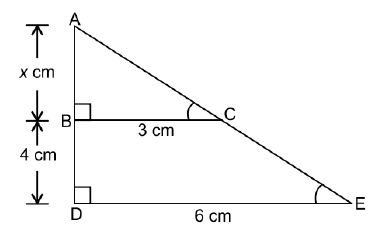
\(\frac{A B}{A D}=\frac{B C}{D E}\)
\(\rightarrow \frac{x}{x+4}-\frac{3}{6}-\frac{1}{2}\)
\(\Rightarrow 2 x=x+4 \Rightarrow x=4\)
44.
(i) (b):
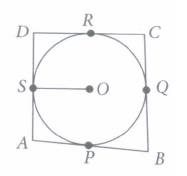
Here, OS the is radius of circle.
Since radius at the point of contact is perpendicularto tangent.
So, \(\angle\)OSA = 90°
(ii) (d): Since, length of tangents drawn from an external point to a circle are equal.
\(\therefore\) AS=AP,BP=BQ,
CQ = CR and DR = DS
(iii) (a): AP = AS = AD _ DS = AD _ DR (Using (1)
= 11 - 7 = 4 cm
(iv) (b): In quadrilateral OQCR,
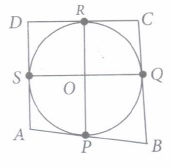
\(\angle\)QCR = 60° (Given)
And \(\angle\)OQC = \(\angle\)ORC = 90° [Since, radius at the point of contact is perpendicular to tangent.]
\(\therefore\) \(\angle\)QOR = 360° - 90° - 90° - 60° = 120°
(v) (c): From (1), we have AS = AP, DS = DR,
BQ = BP and CQ = CR
Adding all above equations, we get
AS + DS + BQ + CQ = AP + DR + BP + CR
\(\Rightarrow\) AD + BC = AB + CD

10th Standard CBSE Syllabus & Materials
10th Standard CBSE
CBSE 10th Social Science PS - Federalism - New Model Questions Papers Study Material - QB365 Set A
NEW10th Standard CBSE
CBSE 10th Social Science PS - Power Sharing - New Model Questions Papers Study Material - QB365 Set A
NEW10th Standard CBSE
CBSE 10th Social Science GEO - Manufacturing Industries - New Model Questions Papers Study Material - QB365 Set A
NEW10th Standard CBSE
CBSE 10th Social Science GEO - Minerals and Energy Resources - New Model Questions Papers Study Material - QB365 Set A



NCERT Books

Syllabus

Exam Pattern

Sample Question Papers

Previous year Question Papers

Important Notes

MCQ Practice test

NCERT Exemplers

Case study Questions

Image Based Questions

Passage based Questions

HOT Questions

Value Based Questions

Model Questions Papers
NCERT ( Book Back ) Questions

Assertion and Reason
Important Questions And Answers

CBSE 10th Standard CBSE Subjects
CBSE Standards



