
 100% FREE ACCESS
10th Standard CBSE Syllabus & Materials
10th Standard CBSE
CBSE 10th Social Science ECO - Globalisation and the Indian Economy - New Model Questions Papers Study Material - QB365 Set A
NEW10th Standard CBSE
CBSE 10th Social Science ECO - Money and Credit - New Model Questions Papers Study Material - QB365 Set A
NEW10th Standard CBSE
CBSE 10th Social Science ECO - Sectors of the Indian Economy - New Model Questions Papers Study Material - QB365 Set A
NEW10th Standard CBSE
CBSE 10th Social Science ECO - Development - New Model Questions Papers Study Material - QB365 Set A
NEW10th Standard CBSE
CBSE 10th Social Science PS - Outcomes of Democracy - New Model Questions Papers Study Material - QB365 Set A
NEW10th Standard CBSE
CBSE 10th Social Science PS - Gender, Religion and Caste - New Model Questions Papers Study Material - QB365 Set A

Published on: 20/10/2025
Download CBSE Class 10th Standard CBSE Maths question papers, sample papers, important questions, and previous year solved papers in PDF format. Get free study materials, NCERT solutions, and exam preparation resources for Class 10th Standard CBSE Maths
Questions + Answers key
Take MCQ Maths Test
1.
Water is flowering at the rate of 2.52 km/h through a cylindrical pipe into a cylindrical tank, the radius of whose base is 40 cm, If the increase in the level of water in the tank, in half an hour is 3.15 m, find the internal diameter of the pipe.
2.
A tent is in the shape of a cylinder surmounted by a conical top.If the height and diameter of the cylindrical part are 2.1m and 4m respectively, and the slant height of the top is 2.8m, find the area of the canvas used for making the tent.Find the cost of the canvas of the tent at the rate of Rs.500 per m2.Also find the volume air enclosed in the tent.
3.
A solid consisting of a right circular cone of height 120cm and radius 60cm standing on a hemisphere of radius 60cm is placed upright in a right circular cylinder full of water such that it touches the bottom.Find the volume of water left in the cylinder, if the radius of the cylinder is 60cm and its height is 180cm.
4.
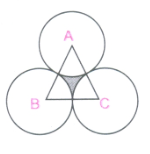
The area of an equilateral triangle ABC is 17320.5 \(cm^2.\) With each vertex of the triangle as centre, a circle is drawn with radius equal to half the length of the side of the triangle (see figure). Find the area of the shaded region. \((Use\ \pi=3.14\ and\ \sqrt3=1.73205)\)
5.
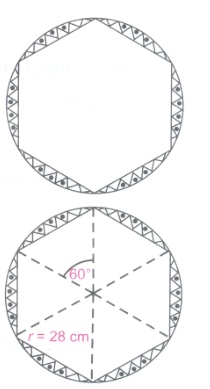
A round table cover has six equal designs as shown in the figure. If the radius of the cover is 28 cm, find the cost of making the designs at the rate of Rs. 0.35 per \(cm^2\). \((Use\ \sqrt3=1.7)\)
6.
A horse is tied to a peg at one corner of a square shaped grass field of side 15 m by means of a 5 m long rope (see figure). Find
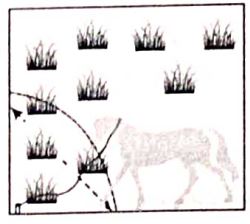
(i) the area of the part of the field in which the horse can graze.
(ii) the increase in the grazing area if the rope were 10 m long instead of 5 m. \((take, \pi\ =3.14)\)
7.
Prove that the parallelogram circumscribing a circle is a rhombus.
8.
Two concentric circles are of radii 5 cm and 3 cm. Find the length of the chord of the larger circle which touches the smaller circle.
9.
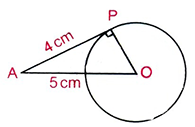
The length of a tangent from a point A at distance 5cm from the centre of the circle is 4cm.Find the radius of the circle.
10.
There is a race competition between all students of a sports academy, so that the sports committee can choose better students for a marathon. The race track in the academy is in the form of a ring whose inner most circumference is 264 m and the outer most circumference is 308 m.
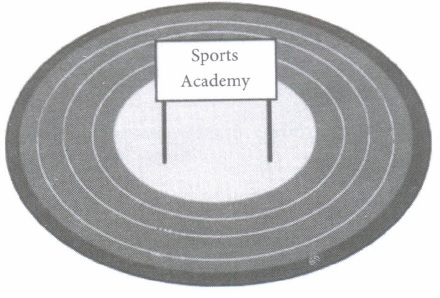
Based on the above information, answer the following questions.
(i) Find the radius of the outer most circle.
| (a) 48 m | (b) 49 m | (c) 50 m | (d) 51 m |
(ii) Find the radius of the inner most circle.
| (a) 38 m | (b) 40 m | (c) 42 m | (d) 44 m |
(iii) Find the width of the track
| (a) 7 m | (b) 8 m | (c) 9 m | (d) 10 m |
(iv) Find the area of the race track
| (a) 2010 m2 | (b) 2006 m2 | (c) 2000 m2 | (d) 2002 m2 |
(v) If the cost of painting on the race track is Rs 6 per m2, then find the total cost for painting the whole race track.
| (a) Rs 12000 | (b) Rs 12012 | (c) Rs 12550 | (d) Rs 12850 |
1.
Let internal radius of the pipe = x cm
Speed of water = 2.52 km/h = 2520 m/h
\(\therefore \) Volume of water that flows in half an hour = \(\frac { 1 }{ 2 } \pi r^{ h }h\)
\(=\frac { 1 }{ 2 } \pi \times \frac { x }{ 100 } \times \frac { x }{ 100 } \times 2520=\frac { 126\pi x^{ 2 } }{ 1000 } m^{ 3 }\)
Volume of water cylindrical tank
= \(\pi \times \frac { 40 }{ 100 } \times \frac { 40 }{ 100 } \times 3.15\quad m^{ 3 }\)
\(\Rightarrow \frac { 126\pi x^{ 2 } }{ 1000 } =\pi \times \frac { 40 }{ 100 } \times \frac { 40 }{ 100 } \times 3.15\)
\(x^{ 2 }=\frac { 40 }{ 100 } \times \frac { 40 }{ 100 } \times 3.15\times \frac { 1000 }{ 126 } \)
\(x^{ 2 }=4\Rightarrow x=2cm\)
\(\therefore \) Internal diameter = 4cm
2.
Diameter of cylinder = 4m \(\Rightarrow \) Radius of cylinder = 2m
Height of cylinder = 2.1 m
Slant height of cone = 2.8 m
Area of canvas used = C.S.A of cylinder + C.S.A of cone
\(=2\pi rh+\pi rl=\pi r\left[ 2h+l \right] \)
\(=\frac { 22 }{ 7 } \times 2\left[ 2\times 2.1+2.8 \right] =\frac { 22 }{ 7 } \times 2\left[ 4.2+2.8 \right] \)
\(=\frac { 22 }{ 7 } \times 2\times 7=44m^{ 2 }\)
Cost of 1 m2 of canvas = Rs 500
\(\therefore \) Total cost = Rs 500 X 44 = Rs 22000
Volume of air = volume of cone + volume of cylinder
= \(\frac { 1 }{ 3 } \pi r^{ 2 }H+\pi r^{ 2 }h\left[ \frac { 1 }{ 3 } H+h \right] \)
Height of cone = \(\sqrt { l^{ 2 }-r^{ 2 } } =\sqrt { (2.8)^{ 2 }-2^{ 2 } } =\sqrt { 7.84-4 } =\sqrt { 3.84 } =1.95\)
\(=\frac { 22 }{ 7 } \times 4\times 2.75=34.57m^{ 2 }\)
3.
Given, solid is a combination of a cone and a hemisphere and it is placed into a right circular cylinder.
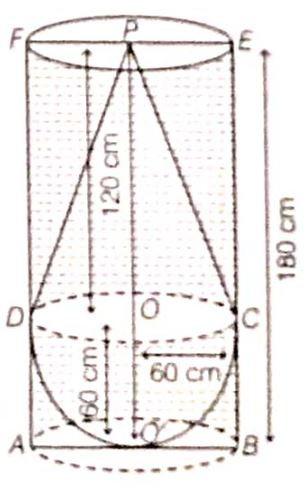
Height of the cylinder, h = 180 cm = 1.8 m
\(\left[\because 1 \mathrm{~cm}=\frac{1}{100} \mathrm{~m}\right]\)
Radius of the cylinder, r = 60 cm = 0.6 m
\(\therefore\) Volume of water filled in a right circular cylinder = \(\pi\) r2 h
\(\begin{aligned} & =\frac{22}{7} \times 0.6 \times 0.6 \times 1.8 \\ \end{aligned}\)
\(\begin{aligned} & =\frac{14.256}{7} \mathrm{~m}^3 \end{aligned}\)
For conical portion,
Height, h1 = 120 cm = 1.2 m
Radius, r1 = 60 cm = 0.6 m
For hemispherical portion,
Radius, r2 = 60 cm = 0.6 m
\(\therefore\) Volume of the solid = Volume of the cone + Volume of the hemisphere
\( =\frac{1}{3}\times \pi r_{1}^{2}k_{1}+\frac{2}{3}\pi r_{2}^{1}\)
\(\begin{aligned} & =\frac{1}{3} \times \frac{22}{7} \times(0.6)^2 \times(1.2)+\frac{2}{3} \times \frac{22}{7} \times(0.6)^3 \\ \end{aligned}\)
\(\begin{aligned} & =\frac{22}{21} \times(0.6)^2[1.2+2 \times 0.6)=\frac{22}{21} \times 0.36(1.2+1.2) \\ \end{aligned}\)
\(\begin{aligned} & =\frac{22}{21} \times 0.36 \times 2.4=\frac{19.008}{21}=\frac{6.336}{7} \mathrm{~m}^3 \end{aligned}\)
Clearly, volume of water left in the cylinder = volume of water filled in a right circular cylinder - volume of the solid
\(=\frac{14.256}{7}-\frac{6.336}{7}=\frac{7.92}{7}=\)1.131429 m3 = 1.131 m3
4.
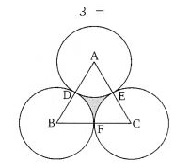
Let the side of the equilateral triangle be a.
Area of equilateral triangle = 17320.5 cm2
\(\sqrt3/4(s)^2= 17320.5\)
\(1.7320/4a^2 = 17320.5\)
a2 = 4 x 10000
a = 200 cm
Each sector is of measure 60°
Area of sector ADEF \(=\frac{60^{\circ}}{360^{\circ}} \times \pi \times r^{2}\)
\(\begin{array}{l} =\frac{1}{6} \times \pi \times(100)^{2} \\ =\frac{3.14 \times 10000}{6} \\ =\frac{15700}{3} \mathrm{~cm}^{2} \end{array}\)
Area of shaded region = Area of equilateral triangle − 3 × Area of each sector
\(=17320.5-3 \times \frac{15700}{3}\)
= 17320.5-15700 = 1620.5 cm2
5.
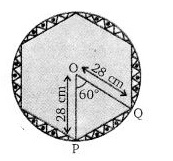
It can be observed that these designs are segments of the circle.
Consider segment APB. Chord AB is a side of the hexagon. Each chord will substitute 360º/6 = 60º at the centre of the circle.
In ΔOAB,
∠OAB = ∠OBA (As OA = OB)
∠AOB = 60°
∠OAB + ∠OBA + ∠AOB = 180°
2∠OAB = 180° − 60° = 120°
∠OAB = 60°
Therefore, ΔOAB is an equilateral triangle.
Area of ΔOAB \(=\frac{\sqrt{3}}{4} \times(\text { side })^{2}\)
\(=\frac{\sqrt{3}}{4} \times(28)^{2}=196 \sqrt{3}=196 \times 1.7=333.2 \mathrm{~cm}^{2}\)
Area of sector OAPB \(=\frac{60^{\circ}}{360^{\circ}} \times \pi r^{2}\)
\(=\frac{1}{6} \times \frac{22}{7} \times 28 \times 28 \)
\(=\frac{1232}{3} \mathrm{~cm}^{2}\)
Area of segment APB = Area of sector OAPB − Area of ΔOAB
\(=\left(\frac{1232}{3}-333.2\right) \mathrm{cm}^{2}\)
Therefore are of designs \(=6 \times\left(\frac{1232}{3}-333.2\right) \mathrm{cm}^{2}\)
\(=(2464-1999.2) c m^{2}\)
= 464.8 cm2
Cost of making 1 cm2 designs = Rs 0.35
Cost of making 464.76 cm2 designs = 464.8 x 0.35 = Rs 162.68
Therefore, the cost of making such designs is Rs 162.68.
6.
Given, side of a square = 15 m
\(\therefore\) Area of square = (15)2 = 225 m2 [\(\because\)area of square = (side)2]
also given, length of rope = 5 m
\(\therefore\) Radius of arc = 5 m
(i) Area of the field graze by the horse,
\(A_1=\frac{\theta}{360^{\circ}} \times \pi r^2=\frac{90^{\circ}}{360^{\circ}} \times 3.14 \times(5)^2\)
[\(\because\) each angle of a square is 90°]
\(=\frac{3.14 \times 25}{4}=\frac{78.5}{4}=19.625 \mathrm{~cm}^2\)
(ii) If length of rope = 10 m = r1 (say)
then, area of the field graze by the horse,
\(\begin{aligned} A_2 & =\frac{\theta}{360^{\circ}} \times \pi r_1^2=\frac{90^{\circ}}{360^{\circ}} \times 3.14 \times(10)^2 \\ \end{aligned}\)
\(\begin{aligned} =\frac{3.14 \times 100}{4}=\frac{314}{4}=78.5 \mathrm{~cm}^2 \end{aligned}\)
\(\therefore\) Required increase in the grazing area
= A2 - A1
= 78.5 - 19.625 = 58.875 cm2
7.
Let ABCD be a parallelogram circumscribing a circle.
To prove ABCD is a rhombus.
i.e. to prove AB = BC = CD= DA
Proof We know that the tangents to circle from an external point are equal in length.
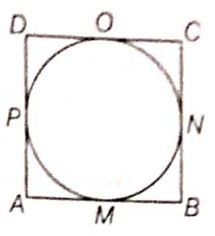
\(\therefore\) AM = AP, BM = BN, CO = CN and DO = DP
On adding all above equations, we get
(AM + BM) + (CO + DO) = AP + BN + CN + DP
\(\Rightarrow\) AB + CD = (AP + PD) + (BN + NC)
= AD + BC ....(i)
Given, ABCD is a parallelogram.
\(\therefore\) AB = CD and BC = AD ....(ii)
[\(\because\) opposite sides of a parallelogram are equal]
Then, from Eq. (i), we get
2 AB = 2BC
\(\Rightarrow\) AB = BC ...(iii)
From Eqs. (ii) and (iii), we get
AB = BC = CD = DA
\(\Rightarrow\) ABCD is a rhombus.
Hence, the parallelogram circumscribing a circle is a rhombus.
Hence proved.
8.
Let C1 and C2 be rwo circles of radii, r1=3 cm and r2 = 5 cm and having common centre O.
Now, let AB be the chord of circle C2 such that it touches the circle C1 at point D. Clearly, AB be the tangent to the circle C1, at point D.
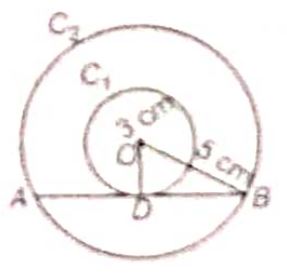
\(\therefore\) OD \(\perp\)AB [\(\because\) radius is perpendicular to the tangent at the point of contact]
\(\Rightarrow\) AD = BD [ \(\because\) perpendicular from centre to the chord bisect the chord]
Now, in right angled \(\Delta\)ODB,
OB2 = OD2 + DB2 [by Pythagoras theorem]
\(\Rightarrow\) 52 = 32 + DB2 \(\Rightarrow\) DB2 = 25 - 9 = 16
\(\Rightarrow\) DB = 4 cm [ taking positive square root]
\(\therefore\) Length of chord = AB = 2 AD = 2 \(\times\)4 = 8 cm
9.
OP = Radius of the circle OA = 5 cm; AP = 4 cm
OA2 = AP2 + OP2 [By pythagoras theorem]
52 = 42 + OP2
⇒ 25 = 16 + OP2 ⇒ 25 - 16 = OP2 ⇒ 9 = OP2 ⇒ OP = \(\sqrt9\) = 3
Radius = 3 cm
10.
(i) (b): Let the radius of outer most circle be R.
Outer most circumference = 308 m [Given]
\(\Rightarrow 2 \pi R=308 \Rightarrow 2 \times \frac{22}{7} \times R=308\)
\(\Rightarrow \quad R=\frac{308 \times 7}{2 \times 22}=49 \mathrm{~m}\)
(ii) (c): Let the radius of inner most circle be r
Inner most circumference = 264 m [Given]
\(\Rightarrow 2 \pi r=264 \)
\(\Rightarrow \quad 2 \times \frac{22}{7} \times r=264 \Rightarrow r=\frac{264 \times 7}{2 \times 22}=42 \mathrm{~m}\)
(iii) (a): Width of the track = Radius of outer most track - Radius of inner most track = 49 - 42 = 7 m
(iv) (d): Area of the race track = Area of outer circle - Area of inner circle
\(=\pi\left(R^{2}-r^{2}\right)=\pi\left[(49)^{2}-(42)^{2}\right] \)
\(v=\frac{22}{7}[2401-1764]=2002 \mathrm{~m}^{2}\)
(v) (b): Cost of painting the whole race track
= Rs (6 x 2002) = Rs 12012.

10th Standard CBSE Syllabus & Materials
10th Standard CBSE
CBSE 10th Social Science PS - Federalism - New Model Questions Papers Study Material - QB365 Set A
NEW10th Standard CBSE
CBSE 10th Social Science PS - Power Sharing - New Model Questions Papers Study Material - QB365 Set A
NEW10th Standard CBSE
CBSE 10th Social Science GEO - Manufacturing Industries - New Model Questions Papers Study Material - QB365 Set A
NEW10th Standard CBSE
CBSE 10th Social Science GEO - Minerals and Energy Resources - New Model Questions Papers Study Material - QB365 Set A



NCERT Books

Syllabus

Exam Pattern

Sample Question Papers

Previous year Question Papers

Important Notes

MCQ Practice test

NCERT Exemplers

Case study Questions

Image Based Questions

Passage based Questions

HOT Questions

Value Based Questions

Model Questions Papers
NCERT ( Book Back ) Questions

Assertion and Reason
Important Questions And Answers

CBSE 10th Standard CBSE Subjects
CBSE Standards



