
 100% FREE ACCESS
10th Standard CBSE Syllabus & Materials
10th Standard CBSE
CBSE 10th Social Science ECO - Globalisation and the Indian Economy - New Model Questions Papers Study Material - QB365 Set A
NEW10th Standard CBSE
CBSE 10th Social Science ECO - Money and Credit - New Model Questions Papers Study Material - QB365 Set A
NEW10th Standard CBSE
CBSE 10th Social Science ECO - Sectors of the Indian Economy - New Model Questions Papers Study Material - QB365 Set A
NEW10th Standard CBSE
CBSE 10th Social Science ECO - Development - New Model Questions Papers Study Material - QB365 Set A
NEW10th Standard CBSE
CBSE 10th Social Science PS - Outcomes of Democracy - New Model Questions Papers Study Material - QB365 Set A
NEW10th Standard CBSE
CBSE 10th Social Science PS - Gender, Religion and Caste - New Model Questions Papers Study Material - QB365 Set A

Published on: 20/10/2025
Download CBSE Class 10th Standard CBSE Maths question papers, sample papers, important questions, and previous year solved papers in PDF format. Get free study materials, NCERT solutions, and exam preparation resources for Class 10th Standard CBSE Maths
Questions + Answers key
Take MCQ Maths Test
1.
One evening, Kaushik was in a park. Children were playing cricket. Birds were singing on a nearby tree of height 80m. He observed a bird on the tree at an angle of elevation of 45°,
When a sixer was hit, a ball flew through the tree frightening the bird to fly away. In 2 s, he observed the bird flying at the same height at an angle of elevation of 30° and the ball flying tovwards him at the same height at an angle of elevation of 60°
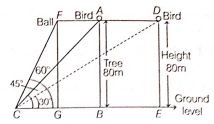
(i) At what distance from the foot of the tree was he observing the bird sitting on the tree?
(ii) How far did the bird fly in the mentioned tirne?
Or After hitting the tree, how far did the ball travel in the sky when Kaushik saw the ballI?
(ii) What is the speed of the bird in m/min, if it had flown 2(√3 + 1) m?
2.
A stable owner has four horses. He usually tie these horses with 7 m long rope to pegs at each corner of a square shaped grass field of 20 m length, to graze in his farm. But tying with rope Sometimes results in injuries to his horses, so he decided to build fence around the area, so that each horse can graze.
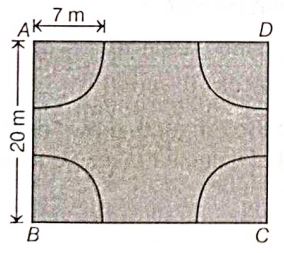
Based on the above, answer the following questions
(a) Find the area of the square shaped grass field.
(b) (i) Find the area of the total field in which these horses can graze.
Or
(ii) If the length of the rope of each horse is increased from 7m to 10m, find the area grazed by one horse. (use \(\pi\) = 3.14)
(c) What is area of the field that is left ungrazed, if the length of the rope of each horse is 7 cm?
3.
A Ferris wheel (or a big wheel in the United Kingdom) is an amusement ride consisting of a rotating upright wheel with multiple passenger-carrying components (commonly referred to as passenger cars, cabins, tubs, capsules, gondolas, or pods) attached to the rim in such a way that as the wheel turns, they are kept upright, usually by gravity.
After taking a ride in Ferris wheel, Aarti came out from the crowd and was observing her friends who were enjoying the ride . She was curious about the different angles and measures that the wheel will form. She forms the figure as given below.
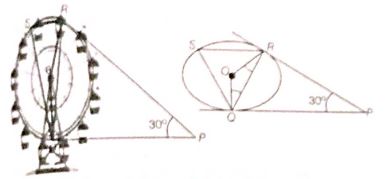
(i) In the given figure, find \(\angle\)ROQ
(a) 60° (b) 100° (c) 150° (d) 90°
(ii) Find \(\angle\)RQP.
(a) 75° (b) 60° (c) 30° (d) 90°
(iii) Find \(\angle\)RSQ
(a) 60° (b) 75° (c) 100° (d) 30°
(iv) Find \(\angle\)ORP.
(a) 90° (b) 70° (c) 100° (d) 60°
4.
A group of students of class X visited India Gate on an education trip. The teacher and students had interest in history as well.The teacher narrated that India Gate, official name Delhi Memorial, originally called All India War Memorial, monumental sandstone arch in New Delhi, dedicated to the troops of British India who died in wars fought between 1914 and 1919.The teacher also said that India Gate, which is located at the eastern end of the Rajpath (formerly called the Kingsway), is about 138 ft (42 m) in height.

(i) What is the angle of elevation if they are standing at a distance of 42 m away from the monument?
(a) 30° (b) 45° (c) 60° (d) 0°
(ii) They want to see the tower at an angle of 60°. So, they want to know the distance where they should stand and hence find the distance.
(a) 24.25 m (b) 20.12 m (c) 42 m (d) 24.64 m
(iii) If the altitude of the Sun is at 60°, then the height of the vertical tower that will cast a shadow of length 20 m is
(a) 20\(\sqrt3\)m (b) \(\frac{20}{\sqrt3}m\) (c) \(\frac{15}{\sqrt3}m\) (d) 15\(\sqrt3\)m
(iv) The ratio of the length of a rod and its shadow is 1:1. The angle of elevation of the Sun is
(a) 30° (b) 45° (c) 60° (d) 90°
(v) The angle formed by the line of sight with the horizontal when the object viewed is below the horizontal level is
(a) corresponding angle (b) angle of elevation (c) angle of depression (d) complete angle
5.
In an international school in Hyderabad organised an Interschool Throwball Tournament for girls just after the pre-board exam. The throw ball team was very excited. The team captain Anjali directed the team to assemble in the ground for practices. Only three girls Priyanshi, Swetha and Aditi showed up. The rest did not come on the pretext of preparing for pre-board exam. Anjali drew a circle of radius 5 m on the ground. The centre A was the position of Priyanshi. Anjali marked a point N, 13 m away from centre A as her own position. From the point N, she drew two tangential lines NS and NR and gave positions S and R to Swetha and Aditi. Anjali throws the ball to Priyanshi, Priyanshi throws it to Swetha, Swetha throws it to Anjali, Anjali throws it to Aditi, Aditi throws it to Priyanshi, Priyanshi throws it to Swetha and so on.
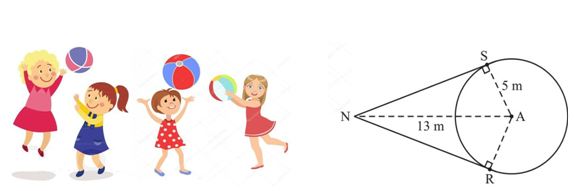
(a) What is the measure of \(\angle \mathrm{NSA} ?\)
| (i) 30o | (ii) 45o | (iii) 60o | (iv) 90o |
(b) Find the distance between Swetha and Anjali
| (i) 8m | (ii) ) 12 m | (iii) 15m | (iv) 18m |
(c) How far does Anjali have to throw the ball towards Aditi
| (i) 18m | (ii) 15m | (iii) 12m | (iv) 8m |
(d) If \(\angle \mathrm{SNR}\) is equal to θ, then which of the following is true?
| (i) \(\angle \mathrm{ANS}=90^{\circ}-\theta\) | (ii) \(\angle \mathrm{SAN}=90^{\circ}-\theta\) | (iii) \(\angle \operatorname{RAN}=\theta\) | (iv) \(\angle \operatorname{RAS}=180^{\circ}-\theta\) |
(e) If \(\angle \mathrm{SNR}\) SNR is equal to \(\theta\) ,then \(\angle \mathrm{NAS}\) is equal
| (i) \(90^{\circ}-(\theta / 2)\) | (ii) \(1180^{\circ}-2 \theta\) | (iii) \(90^{\circ}-\theta\) | (iv) \(90^{\circ}+\theta\) |
6.
In a village, group of people complained for an electric fault in their area. On their complained, an electrician reached village to repair an electric fault on a pole of height 5 m. She needs to reach a point 1.3m below the top of the pole to undertake the repair work (see the adjoining figure). She used ladder, inclined at an angle of \(\theta\) to the horizontal such that cos \(\theta\) = 0.5, to reach the required position
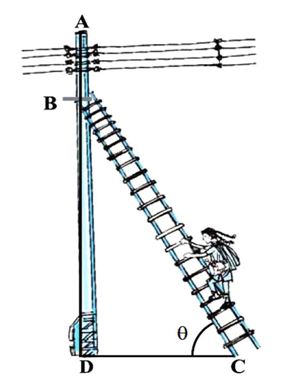
(i) Find the angle of elevation \(\theta\)
| (a) 600 | (b) 300 | (c) 450 | (d) 900 |
(ii) Find the length BD
| (a) 3 m | (b) 3.5 m | (c) 3.7 m | (d) 4 m |
(iii) Find the length of the ladder (take = \(\sqrt{3}=1.73\))
| (a) 4 m | (b) 4.3 | (c) 4.2 m | (d) 4.28 m |
(iv) How far from the foot of the pole should she place the foot of the ladder?
| (a) 2 m | (b) 2.14 m | (c) 2.2 m | (d) 2.28 m |
(v) If the height of pole and distance BD is doubled, then what will be the length of the ladder
| (a) 8 m | (b) 8.6 m | (c) 8.56 m | (d) 8.28m |
7.
Sara hold a japanese folding fan in her hand as shown in the figure. It is shaped like a sector of a circle and made of a thin material such as paper or feather. The inner and outer radii are 3 em and 5 ern respectively. The fan has three colours i.e., red, blue and green.
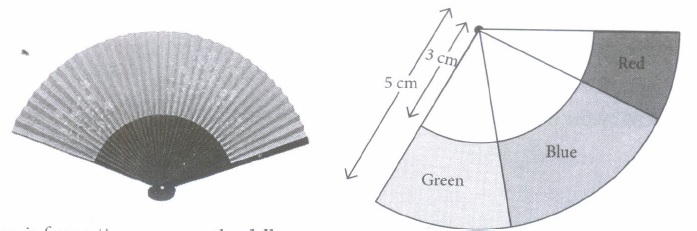
Based on the above information, answer the following questions.
(i) If the region containing blue colour makes an angle of 80° at the centre, then find the area of the region having blue colour.
| (a) 9.17 cm2 | (b) 10.1 cm2 | (c) 11.17 cm2 | (d) 13.17 cm2 |
(ii) If the region containing green colour makes an angle of 60° at the centre, then find the area of the region having green colour
| (a) 6.2 cm2 | (b) 8.38 cm2 | (c) 9.9 cm2 | (d) 11.12 cm2 |
(iii) If the region containing red colour makes an angle oflOo at the centre, then find the perimeter of the region containing red colour.
| (a) 2.9 cm | (b) 4.2 cm | (c) 5.4 cm | (d) 6.79 cm |
(iv) Find the area of the region having radius 3 cm.
| (a) 12.57 cm2 | (b) 14.8 cm2 | (c) 20 cm2 | (d) 26.57 cm2 |
(v) The region given in the figure represents
| (a) minor sector | (b) major sector | (c) minor segment | (d) major segment |
8.
Director of a company select a round glass trophy for awarding their employees on annual function. Design of each trophy is made as shown in the figure, where its base ABCD is golden plated from the front side at the rate of Rs 6 per cm2
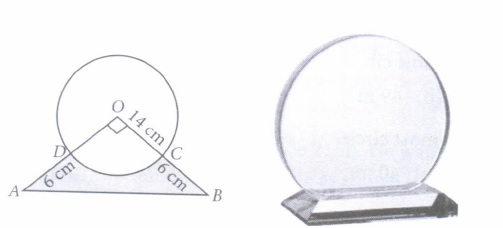
(i) Find the area of sector ODCO.
| (a) 154 cm2 | (b) 155 cm2 | (c) 156 cm2 | (d) 157cm2 |
(ii) Find the area of \(\Delta\)AOB=
| (a) 150 cm2 | (b) 200 cm2 | (c) 250 cm2 | (d) 300 cm2 |
(iii) Find the total cost of golden plating.
| (a) Rs 276 | (b) Rs 280 | (c) Rs 284 | (d) Rs 200 |
(iv) Find the area of major sector formed in the given figure.
| (a) 400 cm2 | (b) 450 cm2 | (c) 462 cm2 | (d) 472 cm2 |
(v) Find the length of arc DC.
| (a) 16 cm | (b) 18 cm | (c) 20 cm | (d) 22 cm |
9.
Kartik has his home located at A and his college located at E. Kartik drives his motorbike three days in a week and rides his bicycle in the remaining 3 days, to go to his college and back to home. AOB is a sector of a circle with centre O, central angle 60° and radius 4.2 km. Path AOB is the route for driving by motorbike and path ACB is for bicycle only.
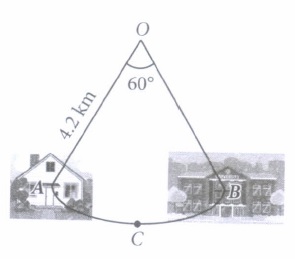
(i) Find the total distance travelled by Kartik through the motorbike in a week to go to college.
| (a) 50.4 km | (b) 55 km | (c) 56.4 km | (d) 58 km |
(ii) Find the total distance travelled by Kartik through the bicycle in a week to go to college.
| (a) 24.4 km | (b) 26.4 km | (c) 28 km | (d) 29.4 km |
(iii) Find the area of sector AOB.
| (a) 7.88 km2 | (b) 8.24 km2 | (c) 9.24 km2 | (d) 10.14 km2 |
(iv) If the cost of fuel for the motorbike is Rs 20 per km, then find the total cost of fuel used in a week in going college.
| (a) Rs 1008 | (b) Rs 1120 | (c) Rs 1200 | (d) Rs 1240 |
(v) If the angle of sector changed from 60° to 90°, then find the total length of the available paths.
| (a) 12 km | (b) 13 km | (c) 14 km | (d) 15 km |
10.
There is a race competition between all students of a sports academy, so that the sports committee can choose better students for a marathon. The race track in the academy is in the form of a ring whose inner most circumference is 264 m and the outer most circumference is 308 m.
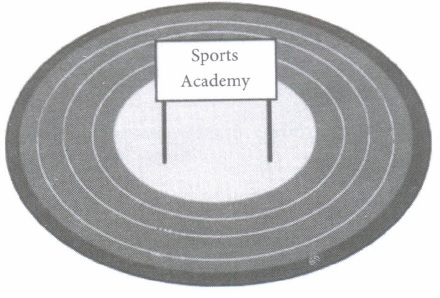
Based on the above information, answer the following questions.
(i) Find the radius of the outer most circle.
| (a) 48 m | (b) 49 m | (c) 50 m | (d) 51 m |
(ii) Find the radius of the inner most circle.
| (a) 38 m | (b) 40 m | (c) 42 m | (d) 44 m |
(iii) Find the width of the track
| (a) 7 m | (b) 8 m | (c) 9 m | (d) 10 m |
(iv) Find the area of the race track
| (a) 2010 m2 | (b) 2006 m2 | (c) 2000 m2 | (d) 2002 m2 |
(v) If the cost of painting on the race track is Rs 6 per m2, then find the total cost for painting the whole race track.
| (a) Rs 12000 | (b) Rs 12012 | (c) Rs 12550 | (d) Rs 12850 |
11.
Gayatri have a triangular shaped grass field. At the three corners of the field, a cow, a buffalo and a horse are tied separately to the pegs by means of ropes of3.5 m each to graze in the field, as shown in the figure. Sides of the triangular field are 25 m, 24 m and 7 m. Based on the above information, answer the following questions.
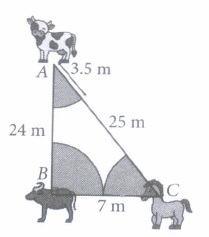
(i) Area of triangular field is
| (a) 82 m2 | (b) 84 m2 | (c) 86 m2 | (d) 88 m2 |
(ii) Area of the region grazed by the cow is
| \((a) \frac{\angle A}{360^{\circ}} \times \pi \times(3.5)^{2}\) | \((b) \frac{\angle B}{360^{\circ}} \times \pi \times(24)^{2}\) | \((c) \frac{\angle C}{360^{\circ}} \times \pi \times(3.5)^{2}\) | (d) None of these |
(iii) Area of region grazed by the buffalo and the horse is
| \((a) \frac{(\angle A+\angle C)}{360^{\circ}} \times \pi \times(5.5)^{2}\) | \((b) \frac{(\angle B+\angle C)}{360^{\circ}} \times \pi \times(5.6)^{2}\) |
| \((c) \frac{(\angle A+\angle C)}{360^{\circ}} \times \pi \times(3.5)^{2}\) | \((d) \frac{(\angle B+\angle C)}{360^{\circ}} \times \pi \times(3.5)^{2}\) |
(iv) Total area grazed by the cow, the buffalo and the horse is
| (a) 16.25 m2 | (b) 17.3 m2 | (c) 18.25 m2 | (d) 19.25 m2 |
(v) Find the area of the field that cannot be grazed.
| (a) 60.75 m2 | (b) 64.75 m2 | (c) 68 m2 | (d) 69.75 m2 |
12.
While doing dusting a maid found a button whose upper face is of black colour, as shown in the figure. The diameter of each of the smaller identical circles is 1/4 of the diameter of the larger circle whose radius is 16 cm.
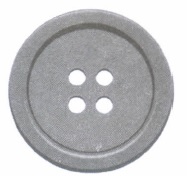
Based on the above information, answer the following questions.
(i) The area of each of the smaller circle is
| (a) 40.28 cm2 | (b) 46.39 cm2 | (c) 50.28 cm2 | (d) 52.3 cm2 |
(ii) The area of the larger circle is
| (a) 804.57 cm2 | (b) 704.57 cm2 | (c) 855.57 cm2 | (d) 990.57 cm2 |
(iii) The area of the black colour region is
| (a) 600.45 cm2 | (b) 603.45 cm2 | (c) 610.45 cm2 | (d) 623.45 cm2 |
(iv) The area of quadrant of a smaller circle is
| (a) 11.57 cm2 | (b) 13.68 cm2 | (c) 12 cm2 | (d) 12.57 cm2 |
(v) If two concentric circles are of radii 2 cm and 5 cm, then the area between them is
| (a) 60 cm2 | (b) 63 cm2 | (c) 66 cm2 | (d) 68 cm2 |
13.
A boy is standing on the top of light house. He observed that boat P and boat Q are approaching to light house from opposite directions. He finds that angle of depression of boat P is 45° and angle of depression of boat Q is 30°. He also knows that height of the light house is 100 m.
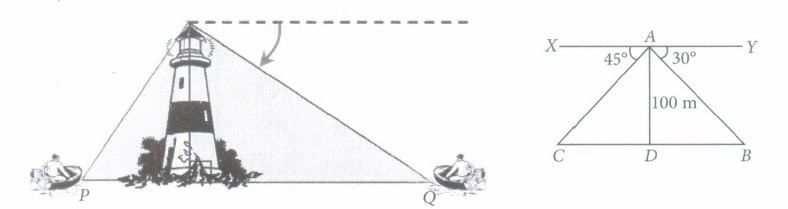
Based on the above information, answer the following questions.
(i) Measure of \(\angle\)ACD is equal to
| (a) 30° | (b) 45° | (c) 60° | (d) 90° |
(ii) If \(\angle\)YAB = 30°, then \(\angle\)ABD is also 30°, Why?
| (a) vertically opposite angles | (b) alternate interior angles |
| (c) alternate exterior angles | (d) corresponding angles |
(iii) Length of CD is equal to
| (a) 90 m | (b) 60 m | (c) 100 m | (d) 80 m |
(iv) Length of BD is equal to
| (a) 50 m | (b) 100 m | (c) 100\(\sqrt{2}\) m | (d) 100\(\sqrt{3}\) m |
(v) Length of AC is equal to
| (a)100\(\sqrt{2}\) m | (b) 100\(\sqrt{3}\) m | (c) 50 m | (d) 100 m |
14.
An electrician has to repair an electric fault on the pole of height of8 m. He needs to reach a point 2 m below the top of the pole to undertake the repair work.
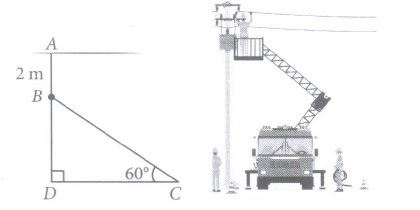
Based on the above information, answer the following questions.
(i) Length of BD is
| (a) 10 m | (b) 6 m | (c) 4 m | (d) 4 m |
(ii) What should be the length of ladder, so that it makes an angle of 60° with the ground?
| \((a) 4\sqrt{3} {~m}\) | \((b) 2\sqrt{3} {~m}\) | \((c) 3\sqrt{3} {~m}\) | \((d) 5\sqrt{3} {~m}\) |
(iii) The distance between the foot ofladder and pole is
| \((a) 6\sqrt{3} {~m}\) | \((b) 4\sqrt{3} {~m}\) | \((c) 3\sqrt{3} {~m}\) | \((d) 2\sqrt{3} {~m}\) |
(iv) What will be the measure of \(\angle\)BCD when BD and CD are equal?
| (a) 30° | (b) 45° | (c) 60° | (d) 75° |
(v) Find the measure of \(\angle\)DBC.
| (a) 15° | (b) 60° | (c) 30° | (d) 45° |
15.
There is fire incident in the house. The house door is locked so, the fireman is trying to enter the house from the window. He places the ladder against the wall such that its top reaches the window as shown in the figure .
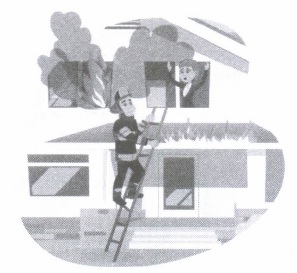
Based on. the above information, answer the following questions.
(i) If window is 6 m above the ground and angle made by the foot ofladder to the ground is 30°, then length of the ladder is
| (a) 8m | (b) 10m | (c) 12m | (d) 14m |
(ii) If fireman place the ladder 5 m away from the wall and angle of elevation is observed to be 30°, then length of the ladder is
| (a) 5 m | \((b) \frac{10}{\sqrt{3}} \mathrm{~m}\) | \((c) \frac{15}{\sqrt{2}} \mathrm{~m}\) | (d) 20 m |
(iii) If fireman places the ladder 2.5 m away from the wall and angle of elevation is observed to be 60°, then find the height of the window. (Take \(\sqrt{3}\) = 1.73)
| (a) 4.325 m | (b) 5.5 m | (c) 6.3 m | (d) 2.5 m |
(iv) If the height of the window is 8 m above the ground and angle of elevation is observed to be 45°, then horizontal distance between the foot of ladder and wall is
| (a) 2 m | (b) 4 m | (c) 6 m | (d) 8 m |
(v) If the fireman gets a 9 m long ladder and window is at 6 m height, then how far should the ladder be placed?
| (a) 5 m | (b) 3\(\sqrt{5}\)m | (c) 3 m | (d) 4 m |
16.
A circus artist is climbing through a 15 m long rope which is highly stretched and tied from the top of a vertical pole to the ground as shown below. Based on the above information, answer the following questions.
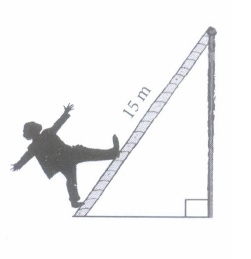
(i) Find the height of the pole, if angle made by rope to the ground level is 45°.
| \((a) 15 \mathrm{~m}\) | \((b) 15 \sqrt{2} \mathrm{~m}\) |
| \((c) \frac{15}{\sqrt{3}} \mathrm{~m}\) | \((d) \frac{15}{\sqrt{2}} \mathrm{~m}\) |
(ii) If the angle made by the rope to the ground level is 45°, then find the distance between artist and pole at ground level.
| \((a) \frac{15}{\sqrt{2}} \mathrm{~m}\) | \((b) 15 \sqrt{2} \mathrm{~m}\) | \((c) 15 \mathrm{~m}\) | \((d) {15}{\sqrt{3}} \mathrm{~m}\) |
(iii) Find the height of the pole if the angle made by the rope to the ground level is 30°.
| (a) 2.5 m | (b) 5 m | (c) 7.5 m | (d) 10 m |
(iv) If the angle made by the rope to the ground level is 30° and 3 m rope is broken, then find the height of the pole
| (a) 2m | (b) 4m | (c) 5m | (d) 6m |
(v) Which mathematical concept is used here?
| (a) Similar Triangles | (b) Pythagoras Theorem |
| (c) Application of Trigonometry | (d) None of these |
17.
There are two windows in a house. First window is at the height of 2 m above the ground and other window is 4 m vertically above the lower window. Ankit and Radha are sitting inside the two windows at points G and F respectively. At an instant, the angles of elevation of a balloon from these windows are observed to be 60° and 30° as shown below
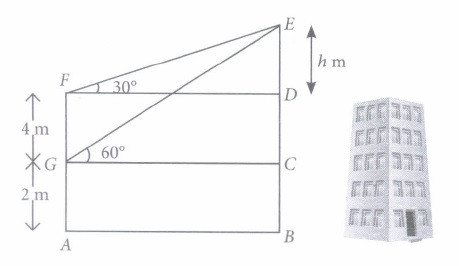
Based on the above information, answer the following questions.
(i) Who is more closer to the balloon?
| (a) Ankit | (b) Radha |
| (c) Both are at equal distance | (d) Can't be determined |
(ii) Value of DF is equal to
| \((a) \frac{h}{\sqrt{3}} \mathrm{~m}\) | \((b) h \sqrt{3} \mathrm{~m}\) | \((c) \frac{h}{2} \mathrm{~m}\) | \((d) 2 h \mathrm{~m}\) |
(iii) Value of h is
| (a) 2 | (b) 3 | (c) 4 | (d) 5 |
(iv) Height of the balloon from the ground is
| (a) 4 m | (b) 6 m | (c) 8 m | (d) 10 m |
(v) If the balloon is moving towards the building, then both angle of elevation will
| (a) remain same | (b) increases | (c) decreases | (d) can't be determined |
18.
There are two temples on each bank of a river. One temple is 50 m high. A man, who is standing on the top of 50 m high temple, observed from the top that angle of depression of the top and foot of other temple are 30° and 60° respectively. (Take \(\sqrt{3}\) = 1.73)
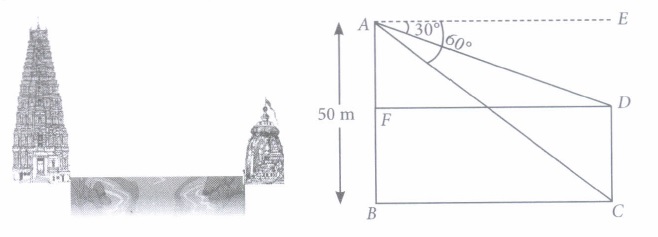
Based on the above information, answer the following questions.
(i) Measure of \(\angle\)ADF is equal to
| (a) 45° | (b) 60° | (c) 30° | (d) 90° |
(ii) Measure of \(\angle\)ACB is equal to
| (a) 45° | (b) 60° | (c) 30° | (d) 90° |
(iii) Width of the river is
| (a) 28.90 m | (b) 26.75 m | (c) 25 m | (d) 27 m |
(iv) Height of the other temple is
| (a) 32.5 m | (b) 35 m | (c) 33.33 m | (d) 40 m |
(v) Angle of depression is always
| (a) reflex angle | (b) straight |
| (c) an obtuse angle | (d) an acute angle |
19.
Aanya and her father go to meet her friend Juhi for a party. When they reached to [uhi's place, Aanya saw the roof of the house, which is triangular in shape. If she imagined the dimensions of the roof as given in the figure, then answer the following questions.
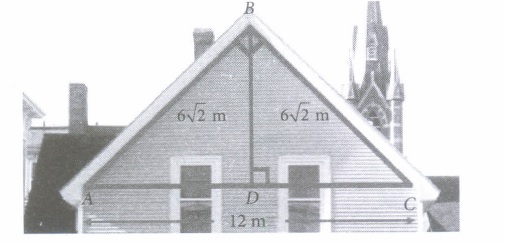
(i) If D is the mid point of AC, then BD =
| (a) 2m | (b) 3m | (c) 4m | (d) 6m |
(ii) Measure of \(\angle\)A =
| (a) 30° | (b) 60° | (c) 45° | (d) None of these |
(iii) Measure of \(\angle\)C =
| (a) 30° | (b) 60° | (c) 45° | (d) None of these |
(iv) Find the value of sinA + cosC.
| (a) 0 | (b) 1 | (c) \(\frac{1}{2}\) | (d) \(\sqrt{2}\) |
(v) Find the value of tan2C + tan2 A.
| (a) 0 | (b) 1 | (c) 2 | (d) \(\frac{1}{2}\) |
20.
Ritu's daughter is feeling so hungry and so thought to eat something. She looked into the fridge and found some bread pieces. She decided to make a sandwich. She cut the piece of bread diagonally and found that it forms a
righ.t angled triangle with sides 4 cm, 4\(\sqrt{3}\) cm and 8 cm.
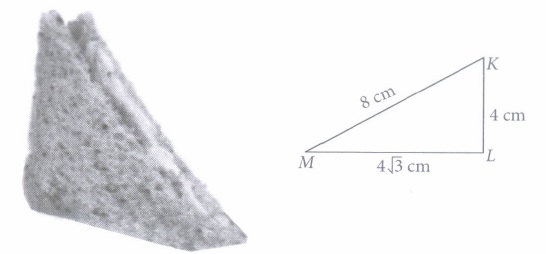
On the basis of above information, answer the following questions.
(i) The value of \(\angle\)M =
| (a) 30° | (b) 60° | (c) 45° | (d) None of these |
(ii) The value of \(\angle\)K =
| (a) 45° | (b) 30 ° | (c) 60° | (d) None of these |
(iii) Find the value of tanM.
| \((a) \sqrt{3}\) | \((b) \frac{1}{\sqrt{3}}\) | (c) 1 | (d) None of these |
(iv) sec2M - 1 =
| (a) tanM | (b) tan2M | (c) tan2M | (d) None of these |
(v) The value of \(\frac{\tan ^{2} 45^{\circ}-1}{\tan ^{2} 45^{\circ}+1}\) is
| (a) 0 | (b) 1 | (c) 2 | (d) -1 |
21.
Anita, a student of class 10th, has to made a project on 'Introduction to Trigonometry' She decides to make a bird house which is triangular in shape. She uses cardboard to make the bird house as shown in the figure. Considering the front side of bird house as right angled triangle PQR, right angled at R, answer the following questions.
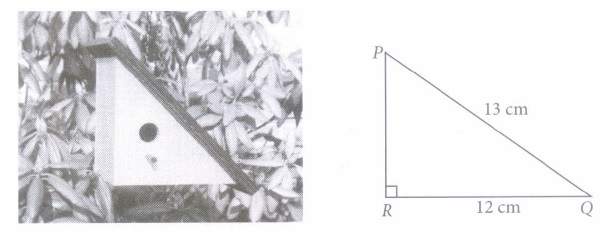
(i) If \(\angle P Q R=\theta, \text { then } \cos \theta=\)
| \((a) \frac{12}{5}\) | \((b) \frac{5}{12}\) | \((c) \frac{12}{13}\) | \((d) \frac{13}{12}\) |
(ii) The value of sec \(\theta\) =
| \((a) \frac{5}{12}\) | \((b) \frac{12}{5}\) | \((c) \frac{13}{12}\) | \((d) \frac{12}{13}\) |
(iii) The value of \(\frac{\tan \theta}{1+\tan ^{2} \theta}=\)
| \((a) \frac{5}{12}\) | \((b) \frac{12}{5}\) | \((c) \frac{60}{169}\) | \((d) \frac{169}{60}\) |
(iv) The value of \(\cot ^{2} \theta-\operatorname{cosec}^{2} \theta=\)
| (a) -1 | (b) 0 | (c) 1 | (d) 2 |
(v) The value of \(\sin ^{2} \theta+\cos ^{2} \theta=\)
| (a) 0 | (b) 1 | (c) -1 | (d) 2 |
22.
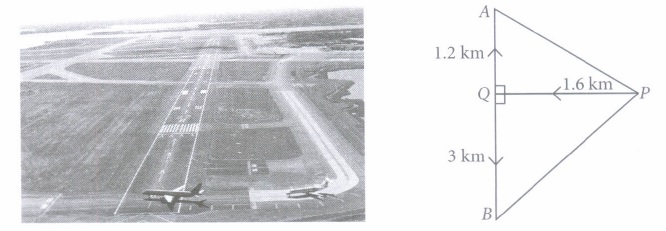
Two aeroplanes leave an airport, one after the other. After moving on runway, one flies due North and other flies due South. The speed of two aeroplanes is 400 km/hr and 500 km/hr respectively. Considering PQ as runway and A and B are any two points in the path followed by two planes, then answer the following questions.
(i) Find \(\tan \theta ; \text { if } \angle A P Q=\theta\)
| \((a) \frac{1}{2}\) | \((b) \frac{1}{\sqrt{2}}\) | \((c) \frac{\sqrt{3}}{2}\) | \((d) \frac{3}{4}\) |
(ii) Find cot B
| \((a) \frac{3}{4}\) | \((b) \frac{15}{4}\) | \((c) \frac{3}{8}\) | \((d) \frac{15}{8}\) |
(iii) Find tanA.
| \((a) 2\) | \((b) \sqrt{2}\) | \((c) \frac{4}{3}\) | \((d) \frac{2}{\sqrt{3}}\) |
(iv) Find secA.
| \((a) 1\) | \((b) \frac{2}{3}\) | \((c) \frac{4}{3}\) | \((d) \frac{5}{3}\) |
(v) Find cosecB.
| \((a) \frac{17}{8}\) | \((b) \frac{12}{5}\) | \((c) \frac{5}{12}\) | \((d) \frac{8}{17}\) |
23.
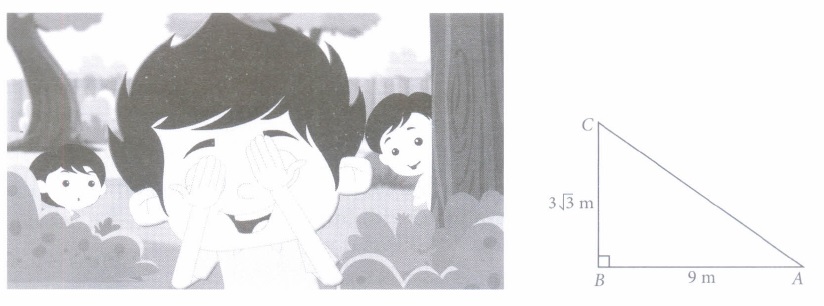
Three friends - Anshu, Vijay and Vishal are playing hide and seek in a park. Anshu and Vijay hide in the shrubs and Vishal have to find both of them. If the positions of three friends are at A, Band C respectively as shown in the figure and forms a right angled triangle such that AB = 9 m, BC = 3\(\sqrt{3}\) m and \(\angle\)B = 90°, then answer the following questions.
(i) The measure of \(\angle\)A is
| (a) 30° | (b) 45° | (c) 60° | (d) None of these |
(ii) The measure of \(\angle\)C is
| (a) 30° | (b) 45° | (c) 60° | (d) None of these |
(iii) The length of AC is
| \((a) 2 \sqrt{3} \mathrm{~m}\) | \((b) \sqrt{3} \mathrm{~m}\) | \((c) 4 \sqrt{3} \mathrm{~m}\) | \((d) 6 \sqrt{3} \mathrm{~m}\) |
(iv) cos2A =
| (a) 0 | \((b) \frac{1}{2}\) | \((c) \frac{1}{\sqrt{2}}\) | \((d) \frac{\sqrt{3}}{2}\) |
(v) sin \(\left(\frac{C}{2}\right)\) =
| (a) 0 | \((b) \frac{1}{2}\) | \((c) \frac{1}{\sqrt{2}}\) | \((d) \frac{\sqrt{3}}{2}\) |
1.
(i) In right angled \(\triangle A B C\),
\(\tan 45^{\circ} =\frac{A B}{B C}\)
\(\Rightarrow B C =A B=80 \mathrm{~m}\)
\( {\left[\because A B=80 \mathrm{~m} \text { and } \tan 45^{\circ}=1\right] }\)
Therefore Required distance \(=80 \mathrm{~m}\)
(ii) In right angled \(\triangle D E C\),
\(\tan 30^{\circ} =\frac{D E}{E C}\)
\(\Rightarrow \frac{1}{\sqrt{3}} =\frac{80}{E C} \)
\(\Rightarrow \left[\because D E=80 \mathrm{~m} \text { and } \tan 30^{\circ}=\frac{1}{\sqrt{3}}\right]\)
\(\Rightarrow \quad E C =80 \sqrt{3} \mathrm{~m}\)
\(\therefore \quad B E =E C-B C\)
\(=80 \sqrt{3}-80 \quad \text { [using Eq. (i)] }\)
\(=80(\sqrt{3}-1) \mathrm{m} \)
Hence, distance the bird flew
\(=A D=B E =80(\sqrt{3}-1) \mathrm{m}\)
Or
In right angled \(\triangle C G F\),
\( \tan 60^{\circ} =\frac{G F}{G C} \)
\(\Rightarrow \sqrt{3} =\frac{80}{G C}\)
\( {\left[\because G F=E D=80 \mathrm{~m} \text { and } \tan 60^{\circ}=\sqrt{3}\right]} \)
\(\Rightarrow G C =\frac{80 \sqrt{3}}{3} \mathrm{~m}\)
Distance travelled by the ball after hitting the tree =AF = BG
and BG =BC-GC
\(=\left(80-\frac{80 \sqrt{3}}{3}\right)\)
\(=80\left(\frac{3-\sqrt{3}}{3}\right) \mathrm{m}\) [using Eqs. (i) and (ii)]
(iii) \( \text { Speed of the bird }=\frac{\text { Distance }}{\text { Time }} \)
\(=\frac{20(\sqrt{3}+1)}{2} \mathrm{~m} / \mathrm{s}\)
\(=10(\sqrt{3}+1) \mathrm{m} / \mathrm{s}\)
\(=600(\sqrt{3}+1) \mathrm{m} / \mathrm{min} \)
\(\left[\because 1 \mathrm{~s}=\frac{1}{60} \mathrm{~min}\right]\)
2.
(a) Length of the square shaped grass field = 20 m
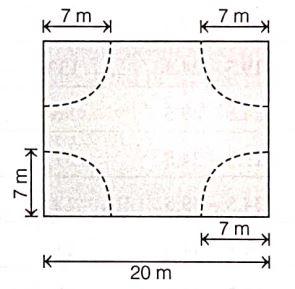
Area of the square shaped grass field = 20 \(\times\) 20 = 400 m2
(b) (i) Length of the rope = 7 m
Thus, each horse can graze upto 7 m of distance along the side.
The grazed area is making a complete circle by taking all the four grazed parts.
So, area of grazed part = \(\pi\)r2
\(=\frac{22}{7} \times 7^2=22 \times 7=154 \mathrm{~m}^2\)
Therefore, area of the total field in which these horses can graze is 154 m2.
(ii) New length of the rope of each horse = 10 m
Area grazed by one horse \(=\frac{1}{4} \pi r^2\)
\(\begin{aligned} & =\frac{1}{4} \times 3.14 \times 10^2 \\ \end{aligned}\)
\(\begin{aligned} & =\frac{314}{4}=78.5 \mathrm{~m}^2 \end{aligned}\)
Therefore, the required area grazed by one horse is 78.5 m2.
(c) Length of rope of each horse = 7 m
Area of square shaped grass field = 400 m2
[from part (a)]
Area of total field grazed by horses = 154 m2
[from Eq. (ii) (a)]
Area of field left ungrazed = Area of square field - Area of grazed field by horses
= 400 - 154 = 246
Therefore, area of field left ungrazed is 246m2.
3.
(i) (c) In quadrilateral PQOR, we have
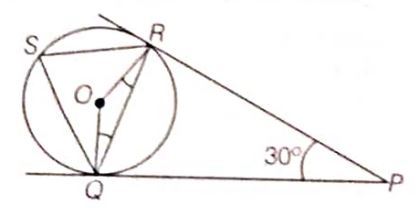
\(\begin{array}{r} \angle Q P R+\angle P R O+\angle P Q O+\angle R O Q=360^{\circ} \\ \end{array}\)
\(\Rightarrow \begin{array}{r} 30^{\circ}+90^{\circ}+90^{\circ}+\angle R O Q=360^{\circ} \end{array}\)
[\(\because\) radius is always perpendicular to the tangent at point of contact]
\(\Rightarrow \quad \angle R O Q=360^{\circ}-210^{\circ}=150^{\circ} \)
\((ii) (a) In \quad \triangle Q O R, O Q=O R\) [radii]
\(\begin{array}{ll} \therefore & \angle O R Q=\angle O Q R \\ \end{array}\)
\(\begin{array}{ll} \text { Now, } & \angle R O Q+\angle O R Q+\angle O Q R=180^{\circ} \\ \end{array}\)
\(\begin{array}{ll} \Rightarrow & 2 \angle O Q R=180^{\circ}-150^{\circ} \\ \end{array}\)
\(\begin{array}{ll} \Rightarrow & 2 \angle O Q R=30^{\circ} \\ \end{array}\)
\(\begin{array}{ll} \Rightarrow & \angle O Q R=15^{\circ} \end{array}\)
Again, \(\begin{array}{ll} \angle O Q R=90^{\circ} \end{array}\) \([\because O Q \perp Q P]\)
\(\begin{aligned} \Rightarrow \angle O Q R+\angle R Q P=90 \\ \end{aligned}\)\({\circ}\)
\(\Rightarrow \quad \angle R Q P=90^{\circ}-15^{\circ}=75^{\circ}\)
(iii) (b) We know that angle subtended by an are at centre is double the angle subtended by it at any other part of the circle.
\(\begin{aligned} 2 \angle R S Q & =\angle R O Q \\ \end{aligned}\)
\(\begin{aligned} \angle R S Q & =\frac{1}{2} \times 150^{\circ}=75^{\circ} \end{aligned}\)
(iv) (a) \(\angle\)ORP = 90\(\circ\) as radius is always perpendicular to the tangent at the point of contact.
4.
(i) (b) Let AB be the monument of height 42 m and C is the point where they are standing such that BC = 42 m.

Now, in \(\Delta\)ABC,
\(\begin{aligned}
& \tan \theta=\frac{A B}{B C} \Rightarrow \tan \theta=\frac{42}{42}=1 \\
\end{aligned}\)
\(\begin{aligned}
\Rightarrow \quad \tan \theta & =1 \quad \Rightarrow \quad \theta=45^{\circ}
\end{aligned}\)
(ii) (a) In \(\Delta\)ABC,

\(\begin{aligned}
\tan 60^{\circ} & =\frac{A B}{B C} \\
\end{aligned}\)
\(\begin{aligned}
\Rightarrow \quad \sqrt{3} & =\frac{42}{B C} \\
\end{aligned}\)
\(\begin{aligned}
\Rightarrow \quad B C & =\frac{42}{\sqrt{3}}=\frac{42 \sqrt{3}}{3}=14 \sqrt{3} \\
\end{aligned}\)
\(\begin{aligned}
=14 \times 1.732=24.248=24.25 \mathrm{~m}
\end{aligned}\)
(iii) (a) Let AB be the height of the tower.

Then, in \(\Delta\)ABC, tan 60°\(=\frac{A B}{B C} \Rightarrow \sqrt{3}=\frac{h}{20}\)
\(\Rightarrow\) h = 20\(\sqrt3\) m
(b) Let h and x be the height and length of shadow of the vertical tower.

Then, in \(\Delta\)ABC,
\(\begin{array}{rlrl}
\tan \theta & =\frac{A B}{B C} \Rightarrow \tan \theta=\frac{h}{x} \\
\end{array}\)
\(\begin{array}{rlrl}
\Rightarrow & & \tan \theta & =1 \\
\end{array}\)
\(\begin{array}{rlrl}
\Rightarrow & \theta & =45^{\circ} & {[\because h: x=1: 1]}
\end{array}\)
(v) (c) The angle of depression of an object viewed, is the angle formed by the line of sight with the horizontal, when it is below the horizontal level.

5.
(a) (iv) NS and NR are both tangent to the circle
So, \(N S \perp S A\) and \(N R \perp R A\)
[ \(\therefore\) Tangent to a circle is perpendicular to the radius through the point of contact ]
\(\therefore \angle N S A=90^{\circ}\)
(b) (ii)
\(\angle N S A=90^{\circ} \quad \Rightarrow N A^{2}=N S^{2}+S A^{2}\) [ By Pythagora's Theorem]
\(\Rightarrow N S=\sqrt{N A^{2}-S A^{2}}=\sqrt{13^{2}-5^{2}}=\sqrt{169-25}\)
\(=\sqrt{144}=12 \mathrm{~m}\)
(c) (iiii)
NR = NS = 12m
Tangents drawn from an external point are equal
\(\therefore N R=12 \mathrm{~m}\)
(d) (iv)
\(\angle S N R+\angle R A S=180^{\circ} \Rightarrow \angle R A S=180^{\circ}-\angle S N R\)
[\(\because\) The angle between the two tangents drawn from an external point to a circle is supplementary to the angle subtended by the line segments joining the points of contact to the centre]
\(\Rightarrow \angle R A S=180^{\circ}-\theta\)
(e) (i)
\(\angle R A S=180^{\circ}-\theta\) [ Calulated bove]
Now, \(\angle N A S=\angle N A R=\frac{1}{2} \angle R A S\)
[\(\because\) If two tangents are drawn from an external point, then they extend equal angles at the centre]
\(\Rightarrow \angle N A S=\frac{1}{2}\left(180^{\circ}-\theta\right)=90^{\circ}-\frac{\theta}{2}\)
6.
(i) (a) \(\cos \theta=0.5=\cos 60^{0}\)
\(\Rightarrow \theta=60^{\circ}\)
(ii) (c) BD = AD - AB
= (5-1.3)m
= 3.7m
(iii) (d) \(\frac{\mathrm{BD}}{\mathrm{BC}}=\sin 60^{\circ}\) or \(\frac{3.7}{\mathrm{BC}}=\frac{\sqrt{3}}{2}\)
\(\mathrm{BC}=\frac{3.7 \times 2}{\sqrt{3}}=4.28 \mathrm{~m}(\text { approx. })\)
(iv) (b) \(\frac{\mathrm{DC}}{\mathrm{BD}}=\cot 60^{\circ}=\frac{1}{\sqrt{3}}\)
\(\mathrm{DC}=\frac{3.7}{\sqrt{3}}=2.14 \mathrm{~m}(\text { approx. })\)
(v) (c) \(\frac{\mathrm{BD}}{\mathrm{BC}}=\sin 60^{\circ}\) or \(\frac{7.4}{\mathrm{BC}}=\frac{\sqrt{3}}{2}\)
\(\mathrm{BC}=\frac{7.4 \times 2}{\sqrt{3}}=8.56 \mathrm{~m}(\text { approx. })\)
7.
(i) (c): Area of the region containing blue colour
\(=\frac{22}{7} \times 5 \times 5 \times \frac{80^{\circ}}{360^{\circ}}-\frac{22}{7} \times 3 \times 3 \times \frac{80^{\circ}}{360^{\circ}}\)
\(=\frac{22}{7} \times \frac{2}{9} \times[25-9]=\frac{44}{63}(16)=11.17 \mathrm{~cm}^{2}\)
(ii) (b) : Area of the region containing green colour
\(=\frac{22}{7} \times \frac{60^{\circ}}{360^{\circ}}[5 \times 5-3 \times 3]=\frac{22}{7} \times \frac{1}{6} \times 16=8.38 \mathrm{~cm}^{2}\)
(iii) (d): Perimeter of the region containing red colour
= 2 + 2 + length of arc of sector having radius 3 cm + length of arc of sector having radius 5 cm.
\(=4+2 \times \frac{22}{7} \times 3 \times \frac{20^{\circ}}{360^{\circ}}+2 \times \frac{22}{7} \times 5 \times \frac{20^{\circ}}{360^{\circ}}\)
\(=4+\frac{44}{7} \times \frac{1}{18} \times 8=4+\frac{176}{63}=4+2.79=6.79 \mathrm{~cm}\)
(iv) (a): Required area \(=\frac{22}{7} \times 3 \times 3 \times \frac{160^{\circ}}{360^{\circ}}\)
\(=\frac{88}{7}=12.57 \mathrm{~cm}^{2}\)
(v) (a): Angle of given sector = 800 + 600 + 200 = 1600
Thus, the given region represents minor sector of a circle.
8.
(i) (a): Area of sector ODCO \(=\frac{1}{4} \pi r^{2}\)
\(=\frac{1}{4} \times \frac{22}{7} \times 14 \times 14=154 \mathrm{~cm}^{2}\)
(ii) (b): Area of \(\triangle A O B=\frac{1}{2} \times O A \times O B=\frac{1}{2}(20 \times 20)\)
= 200 cm2
(iii) (a) : Area of region which is golden plated
= area of \(\Delta\)OAB - area of sector ODCO.
= 200 - 154 = 46 cm2
\(\therefore\) Total cost of golden plating = Rs (6 x 46) = Rs 276
(iv) (c): Area of major sector = area of circle - area of minor sector
\(=\pi r^{2}-\frac{1}{4} \pi r^{2}=\frac{3 \pi r^{2}}{4}=\frac{3}{4} \times \frac{22}{7} \times 14 \times 14=462 \mathrm{~cm}^{2}\)
(v) (d): Length of arc DC \(=\frac{90^{\circ}}{360^{\circ}} \times 2 \times \frac{22}{7} \times 14\)
= 22cm
9.
(i) (a): In a week, Kartik drives his motorbike 3 days to go to college
\(\therefore\)Total distance travelled by Kartik through
motorbike = 2 x 4.2 x 6 = 50.4 km
(ii) (b): In a week Kartik rides his bicycle 3 days to go to college.
\(\therefore\) Total distance travelled by Kartik through bicycle
= Length of arc \(\widehat{A C B} \times 6\)
\(=\frac{\theta}{360^{\circ}} \times 2 \pi r \times 6 \Rightarrow \frac{60^{\circ}}{360^{\circ}} \times 2 \times \frac{22}{7} \times 4.2 \times 6=26.4 \mathrm{~km}\)
(iii) (c) : Area of sector \(A O B=\frac{\theta}{360^{\circ}} \times \pi r^{2}\)
\(=\frac{60^{\circ}}{360^{\circ}} \times \frac{22}{7} \times(4.2)^{2}=9.24 \mathrm{~km}^{2}\)
(iv) (a): Total cost of fuel used for a week = Rs (20 x 50.4) = Rs 1008
(v) (d): Total length of available paths
\(=4.2+4.2+\frac{\theta}{360^{\circ}} \times 2 \pi r \)
\(=8.4+\frac{90^{\circ}}{360^{\circ}} \times 2 \times \frac{22}{7} \times 4.2=8.4+6.6=15 \mathrm{~km}\)
10.
(i) (b): Let the radius of outer most circle be R.
Outer most circumference = 308 m [Given]
\(\Rightarrow 2 \pi R=308 \Rightarrow 2 \times \frac{22}{7} \times R=308\)
\(\Rightarrow \quad R=\frac{308 \times 7}{2 \times 22}=49 \mathrm{~m}\)
(ii) (c): Let the radius of inner most circle be r
Inner most circumference = 264 m [Given]
\(\Rightarrow 2 \pi r=264 \)
\(\Rightarrow \quad 2 \times \frac{22}{7} \times r=264 \Rightarrow r=\frac{264 \times 7}{2 \times 22}=42 \mathrm{~m}\)
(iii) (a): Width of the track = Radius of outer most track - Radius of inner most track = 49 - 42 = 7 m
(iv) (d): Area of the race track = Area of outer circle - Area of inner circle
\(=\pi\left(R^{2}-r^{2}\right)=\pi\left[(49)^{2}-(42)^{2}\right] \)
\(v=\frac{22}{7}[2401-1764]=2002 \mathrm{~m}^{2}\)
(v) (b): Cost of painting the whole race track
= Rs (6 x 2002) = Rs 12012.
11.
(i) (b): Since \(\Delta\)ABC is a right angled triangle
\(\therefore\) Area of triangle ABC \(=\frac{1}{2} \times 7 \times 24=84 \mathrm{~m}^{2}\)
(ii) (a): Area of region grazed by the cow
\(=\frac{\angle A}{360^{\circ}} \times \pi \times(3.5)^{2}\)
(iii) (d): Area of the region grazed by the buffalo and the horse
\(=\frac{\angle B}{360^{\circ}} \times \pi \times(3.5)^{2}+\frac{\angle C}{360^{\circ}} \times \pi \times(3.5)^{2} \)
\(=\frac{(\angle B+\angle C)}{360^{\circ}} \times \pi \times(3.5)^{2}\)
(iv) (d): Total area grazed by the cow, the horse and the buffalo
\(=\frac{\angle A}{360^{\circ}} \times \pi \times(3.5)^{2}+\frac{(\angle B+\angle C)}{360^{\circ}} \times \pi \times(3.5)^{2}\)
\(=\frac{(\angle A+\angle B+\angle C)}{360^{\circ}} \times \pi \times(3.5)^{2} \)
\(=\frac{22}{7} \times \frac{180^{\circ}}{360^{\circ}} \times 3.5 \times 3.5\)
\(\left(\because\right. sum of interior angles of a triangle is 180^{\circ} )\)
\(=\frac{77}{4}=19.25 \mathrm{~m}^{2}\)
(v) (b): Area of the field that cannot be grazed
= Area of MBC - Area of region grazed by all the three animals
= 84 - 19.25 = 64.75 m2
12.
Let r and R be the radii of each smaller circle and larger circle respectively.
We have, \(d=\frac{1}{4} D\)
\(\Rightarrow r=\frac{1}{4} R \Rightarrow r=\frac{1}{4} \times 16 \Rightarrow r=4 \mathrm{~cm}\)
(i) (c): Area of smaller circle = \(\pi r^{2}\)
\(=\frac{22}{7} \dot{\times} 4 \times 4=50.28 \mathrm{~cm}^{2}\)
(ii) (a): Area oflarger circle = \(\pi R^{2}\)
\(=\frac{22}{7} \times 16 \times 16=\frac{5632}{7}=804.57 \mathrm{~cm}^{2}\)
(iii) (b): Area of the black colour region = Area of larger circle - Area of 4 smaller circles
= 804.57 - 4 x 50.28 = 603.45 cm2
(iv) (d): Area of quadrant of a smaller circle
\(=\frac{1}{4} \times 50.28=12.57 \mathrm{~cm}^{2}\)
(v) (c): Area between two concentric circles
\(=\pi\left(R^{2}-r^{2}\right)=\frac{22}{7}\left(5^{2}-2^{2}\right) \)
\(=\frac{22}{7}(25-4)=\frac{22}{7} \times 21=66 \mathrm{~cm}^{2}\)
13.
(i) (b): \(\angle X A C=45^{\circ}\)
\(\therefore \quad \angle A C D=45^{\circ}\) [Alternate interior angles]
(ii) (b)
(iii) (c) : \(\text { In } \Delta A C D\)
\(\frac{A D}{D C}=\tan 45^{\circ} \)
\(\Rightarrow \frac{100}{D C}=1 \Rightarrow D C=100 \mathrm{~m}\)
(iv) (d): \(\text { In } \Delta A B D, \frac{A D}{B D}=\tan 30^{\circ}\)
\(\Rightarrow \quad \frac{100}{B D}=\frac{1}{\sqrt{3}} \)
\(\Rightarrow \quad B D=100 \sqrt{3} \mathrm{~m}\)
(v) (a): \(\text { In } \Delta A D C\)
\(\frac{A D}{A C}=\sin 45^{\circ} \Rightarrow \frac{100}{A C}=\frac{1}{\sqrt{2}} \Rightarrow A C=100 \sqrt{2} \mathrm{~m}\)
14.
(i) (b): Total height of pole = 8 m
\(\therefore\) BD = AD - AB = (8 - 2)m = 6 m
(ii) (a): \(\text { In } \Delta B D C, \frac{B D}{B C}=\sin 60^{\circ}\)
\(\Rightarrow \quad \frac{6}{B C}=\frac{\sqrt{3}}{2} \)
\(\Rightarrow \quad B C=\frac{12}{\sqrt{3}} \times \frac{\sqrt{3}}{\sqrt{3}}=4 \sqrt{3} \mathrm{~m}\)
(iii) (d): \(\text { In } \triangle B D C\)
\(\frac{B D}{C D}=\tan 60^{\circ} \Rightarrow \frac{6}{C D}=\sqrt{3} \Rightarrow C D=\frac{6}{\sqrt{3}} \times \frac{\sqrt{3}}{\sqrt{3}}=2 \sqrt{3} \mathrm{~m}\)
(iv) (b) : \(\text { If } \Delta B C D\)
\(\frac{B D}{C D}=\tan \theta \Rightarrow 1=\tan \theta \quad[\because B D=C D] \)
\(\Rightarrow \quad \theta=45^{\circ}\)
(v) (c) : \(\operatorname{In} \Delta B D C, \angle B+\angle D+\angle C=180^{\circ}\)
\(\therefore \quad \angle B=180^{\circ}-60^{\circ}-90^{\circ}=30^{\circ}\)
15.
(i) (c) : Let AC be the length of the ladder.
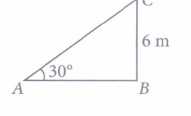
\(\text { In } \Delta A B C, \frac{B C}{A C}=\sin 30^{\circ} \)
\(\Rightarrow \frac{6}{A C}=\frac{1}{2} \Rightarrow A C=12 \mathrm{~m}\)
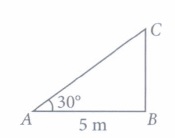
(ii) (b): \(\text { In } \Delta A B C, \frac{A B}{A C}=\cos 30^{\circ}\)
\(\Rightarrow \frac{5}{A C}=\frac{\sqrt{3}}{2} \Rightarrow A C=\frac{10}{\sqrt{3}} \mathrm{~m}\)
(iii) (a) : Let BC be the height of window from ground.
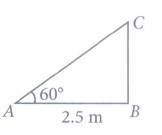
\(\text { In } \Delta A B C, \frac{B C}{A B}=\tan 60^{\circ} \)
\(\Rightarrow \frac{B C}{2.5}=\sqrt{3} \)
\(\Rightarrow B C=2.5 \times 1.73=4.325 \mathrm{~m}\)
(iv) (d): Let AB be the horizontal distance between the foot of ladder and wall.
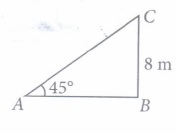
\(\text { In } \Delta A B C, \frac{B C}{A B}=\tan 45^{\circ} \)
\(\Rightarrow \quad \frac{8}{A B}=1 \Rightarrow A B=8 \mathrm{~m}\)
(v) (b): Let the required distance be x.
\(\text { In } \Delta A B C,(9)^{2}=x^{2}+(6)^{2}\)
[By Pythagoras theorem]
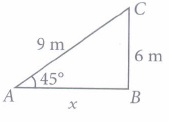
\(\Rightarrow 81-36=x^{2} \Rightarrow 45=x^{2} \)
\(\Rightarrow \quad x=3 \sqrt{5} \mathrm{~m}\)
16.
(i) (d): Let h be the height of the pole.
In \(\Delta\)ABC,
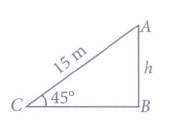
\( \frac{h}{15}=\sin 45^{\circ} \Rightarrow \frac{h}{15}=\frac{1}{\sqrt{2}}\)
\(\Rightarrow \quad h =\frac{15}{\sqrt{2}} \mathrm{~m}\)
(ii) (a): Let x be the required distance.
In \(\Delta\)ABC,
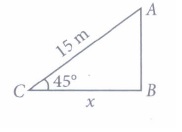
\(\frac{x}{15}=\cos 45^{\circ}=\frac{1}{\sqrt{2}}\)
\(\Rightarrow \quad x=\frac{15}{\sqrt{2}} \mathrm{~m}\)
(iii) (c) : Let h be the height of the pole.
In right triangle ABC,
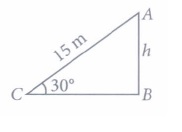
\(\frac{h}{15}=\sin 30^{\circ}=\frac{1}{2}\)
\(\Rightarrow \quad h=\frac{15}{2}=7.5 \mathrm{~m}\)
(iv) (d): If 3 m rope is broken, then the length of the rope is 12 m.
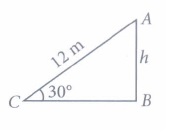
\(\text { In } \Delta A B C, \frac{h}{12}=\sin 30^{\circ}=\frac{1}{2} \)
\(\Rightarrow \quad h=\frac{12}{2}=6 \mathrm{~m}\)
(v) (c)
17.
(i) (b): The person who makes small angle of elevation is more closer to the balloon.
\(\therefore\) Radlra is more closer to the balloon.
(ii) (b): \(\text { In } \Delta E F D, \tan 30^{\circ}=\frac{E D}{D F}\)
\(\Rightarrow \quad \frac{1}{\sqrt{3}}=\frac{h}{D F} \)
\(\Rightarrow \quad D F=h \sqrt{3} \mathrm{~m}\)
(iii) (a): In \(\Delta\)GCE,
\(\begin{array}{l}
\tan 60^{\circ}=\frac{E C}{G C}=\frac{h+4}{D F} \\
\Rightarrow \quad \sqrt{3}=\frac{h+4}{\sqrt{3} h} \Rightarrow 3 h=h+4 \Rightarrow h=2
\end{array}\)
(iv) (c): Height of the balloon from the ground = BE = BC + CD + DE = 2 + 4 + 2 = 8 m
(v) (b)
18.
(i) (c) : Since AE || FD
\(\therefore\) \(\angle\)EAD = \(\angle\)ADF = 30° [Alternate interior angles]
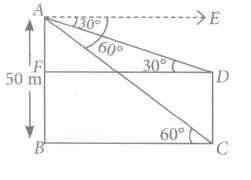
(ii) (b): Since, AE || BC
\(\therefore\) \(\angle\)EAC = \(\angle\)ACB = 60° [Alternate interior angles]
(iii) (a) : In \(\Delta\)ABC,
\(\begin{array}{l}
\tan 60^{\circ}=\frac{A B}{B C} \Rightarrow \sqrt{3}=\frac{50}{B C} \\
\Rightarrow \quad B C=\frac{50}{\sqrt{3}}=28.90 \mathrm{~m}
\end{array}\)
(iv) (c): In \(\Delta\)ADF, \(\tan 30^{\circ}=\frac{A F}{F D}\)
\(\Rightarrow \frac{1}{\sqrt{3}}=\frac{A B-B F}{F D} \Rightarrow \frac{1}{\sqrt{3}}=\frac{50-C D}{\frac{50}{\sqrt{3}}}\)
\(\left[\because F D=B C=\frac{50}{\sqrt{3}}\right] \)
\(\Rightarrow \frac{50}{3}=50-C D \Rightarrow C D=50-\frac{50}{3}=\frac{100}{3}=33.33 \mathrm{~m}\)
(v) (d)
19.
We have, AB = BC = 6\(\sqrt{2}\) m and AC=12m .
(i) (d):\(\because\) Dis mid point of AC.
\(\therefore\) AD=DC=6m
Now, AB2 = BD2 + AD2 (\(\therefore\) \(\Delta\)ABD is a right triangle)
\(\Rightarrow B D^{2}=(6 \sqrt{2})^{2}-6^{2}=72-36=36 \)
\(\Rightarrow B D=6 \mathrm{~m}\)
(ii) (c) : \(\operatorname{In} \Delta A B D, \sin A=\frac{B D}{A B}=\frac{6}{6 \sqrt{2}}=\frac{1}{\sqrt{2}}\)
\(\Rightarrow \sin A=\sin 45^{\circ} \Rightarrow \angle A=45^{\circ}\)
(iii) (c) : \(\operatorname{In} \Delta B D C, \tan C=\frac{B D}{D C}=\frac{6}{6}\)
\(\Rightarrow \tan C=1=\tan 45^{\circ} \Rightarrow \angle C=45^{\circ}\)
(iv) (d) : \(\sin A=\frac{1}{\sqrt{2}}, \cos C=\cos 45^{\circ}=\frac{1}{\sqrt{2}}\)
\(\therefore \quad \sin A+\cos C=\frac{1}{\sqrt{2}}+\frac{1}{\sqrt{2}}=\frac{2}{\sqrt{2}}=\sqrt{2}\)
(v) (c): \((v) \quad(c): \tan C=1, \tan A=\tan 45^{\circ}=1\)
\(\Rightarrow \tan ^{2} C+\tan ^{2} A=1+1=2\)
20.
We have, KL = 4 cm, ML = 4\(\sqrt{3}\)m, KM = 8 cm
(i) (a): \(\tan M=\frac{K L}{L M}=\frac{4}{4 \sqrt{3}}=\frac{1}{\sqrt{3}}\)
\(\Rightarrow \tan M=\tan 30^{\circ} \Rightarrow \angle M=30^{\circ}\)
(ii) (c) : \(\tan K=\frac{M L}{K L}=\frac{4 \sqrt{3}}{4}=\sqrt{3}=\tan 60^{\circ}\)
\(\Rightarrow \angle K=60^{\circ}\)
(iii) (b)
(iv) (c)
(v) (a) : \(\frac{\tan ^{2} 45^{\circ}-1}{\tan ^{2} 45^{\circ}+1}=\frac{(1)^{2}-1}{1^{2}+1}=\frac{0}{2}=0\)
21.
\(\because \Delta\)PQR is a right angled triangle.
\(\therefore\) PR2 + RQ2 = PQ2
\(\Rightarrow P R^{2}=(13)^{2}-(12)^{2}=25 \Rightarrow P R=5 \mathrm{~cm}\)
(i) (c) : \(\cos \theta=\frac{Q R}{P Q}=\frac{12}{13} \)
(ii) (c) : \(\sec \theta=\frac{1}{\cos \theta}=\frac{13}{12} \)
(iii) (c) : \(\tan \theta=\frac{P R}{R Q}=\frac{5}{12}\)
\(\therefore \frac{\tan \theta}{1+\tan ^{2} \theta}=\frac{\frac{5}{12}}{1+\frac{25}{144}}=\frac{\frac{5}{12}}{\frac{169}{144}}=\frac{60}{169}\)
(iv) (a): \(\cot \theta=\frac{1}{\tan \theta}=\frac{12}{5}\) [Using (1)]
\(\operatorname{cosec} \theta=\frac{P Q}{P R}=\frac{13}{5} \)
\(\therefore \quad \cot ^{2} \theta-\operatorname{cosec}^{2} \theta=\frac{144}{25}-\frac{169}{25}=-1\)
(v) (b): \(\sin ^{2} \theta+\cos ^{2} \theta=1\) (Using identity)
22.
(i) (d) : \(\text { In } \Delta A P Q, \tan \theta=\frac{A Q}{P Q}=\frac{1.2}{1.6}=\frac{3}{4}\)
(ii) (d) : \(\text { In } \Delta P B Q, \cot B=\frac{Q B}{P Q}=\frac{3}{1.6}=\frac{15}{8}\) ...(i)
(iii) (c): \(\text { In } \Delta A P Q, \tan A=\frac{P Q}{A Q}=\frac{1.6}{1.2}=\frac{4}{3}\) ...(ii)
(iv) (d): We have, tan2A + 1 = sec2A
\(\Rightarrow \sec A =\sqrt{\left(\frac{4}{3}\right)^{2}+1}
\)
\(=\sqrt{\frac{16}{9}+1}=\sqrt{\frac{25}{9}}=\frac{5}{3}\)
(v) (a): Since \(\operatorname{cosec} B=\sqrt{\cot ^{2} B+1}\)
\(\begin{array}{l}
=\sqrt{\left(\frac{15}{8}\right)^{2}+1} \\
=\frac{17}{8}
\end{array}\)
23.
(i) (a): We have, AB = 9 m, BC = 3\(\sqrt{3}\) m
In \(\Delta\)ABC, we have
\(\tan A=\frac{B C}{A B}=\frac{3 \sqrt{3}}{9}=\frac{1}{\sqrt{3}} \)
\(\Rightarrow \tan A=\tan 30^{\circ} \Rightarrow \angle A=30^{\circ}\)
(ii) (c): Similarly, \(\tan C=\frac{A B}{B C}=\frac{9}{3 \sqrt{3}}=\sqrt{3}\)
\(\Rightarrow \tan C=\tan 60^{\circ} \Rightarrow \angle C=60^{\circ}\)
(iii) (d): Since \(\sin A=\frac{B C}{A C} \Rightarrow \sin 30^{\circ}=\frac{B C}{A C}\)
\(\Rightarrow \frac{1}{2}=\frac{3 \sqrt{3}}{A C} \Rightarrow A C=6 \sqrt{3} \mathrm{~m}\)
(iv) (b) : \(\because \angle A=30^{\circ}\) [From (1)]
\(\therefore \quad \cos 2 A=\cos \left(2 \times 30^{\circ}\right)=\cos 60^{\circ}=\frac{1}{2}\)
(v) (b): \(\because \angle C=60^{\circ}\) [Using (2)]
\(\therefore \quad \sin \left(\frac{C}{2}\right)=\sin \left(\frac{60^{\circ}}{2}\right)=\sin 30^{\circ}=\frac{1}{2}\)

10th Standard CBSE Syllabus & Materials
10th Standard CBSE
CBSE 10th Social Science PS - Federalism - New Model Questions Papers Study Material - QB365 Set A
NEW10th Standard CBSE
CBSE 10th Social Science PS - Power Sharing - New Model Questions Papers Study Material - QB365 Set A
NEW10th Standard CBSE
CBSE 10th Social Science GEO - Manufacturing Industries - New Model Questions Papers Study Material - QB365 Set A
NEW10th Standard CBSE
CBSE 10th Social Science GEO - Minerals and Energy Resources - New Model Questions Papers Study Material - QB365 Set A



NCERT Books

Syllabus

Exam Pattern

Sample Question Papers

Previous year Question Papers

Important Notes

MCQ Practice test

NCERT Exemplers

Case study Questions

Image Based Questions

Passage based Questions

HOT Questions

Value Based Questions

Model Questions Papers
NCERT ( Book Back ) Questions

Assertion and Reason
Important Questions And Answers

CBSE 10th Standard CBSE Subjects
CBSE Standards



