
 100% FREE ACCESS
10th Standard CBSE Syllabus & Materials
10th Standard CBSE
CBSE 10th Social Science ECO - Globalisation and the Indian Economy - New Model Questions Papers Study Material - QB365 Set A
NEW10th Standard CBSE
CBSE 10th Social Science ECO - Money and Credit - New Model Questions Papers Study Material - QB365 Set A
NEW10th Standard CBSE
CBSE 10th Social Science ECO - Sectors of the Indian Economy - New Model Questions Papers Study Material - QB365 Set A
NEW10th Standard CBSE
CBSE 10th Social Science ECO - Development - New Model Questions Papers Study Material - QB365 Set A
NEW10th Standard CBSE
CBSE 10th Social Science PS - Outcomes of Democracy - New Model Questions Papers Study Material - QB365 Set A
NEW10th Standard CBSE
CBSE 10th Social Science PS - Gender, Religion and Caste - New Model Questions Papers Study Material - QB365 Set A

Published on: 20/10/2025
Download CBSE Class 10th Standard CBSE Maths question papers, sample papers, important questions, and previous year solved papers in PDF format. Get free study materials, NCERT solutions, and exam preparation resources for Class 10th Standard CBSE Maths
Questions + Answers key
Take MCQ Maths Test
1.
The tangent at any point of a circle is perpendicular to the radius through the point of contact.
2.
Find the value of sin2 30o + cos2 45o + cos2 30o.
3.
If \(\sin { \alpha =\frac { 1 }{ 2 } } \) then find the value of \(3\sin { \alpha } -4\sin ^{ 3 }{ \alpha } \)
4.
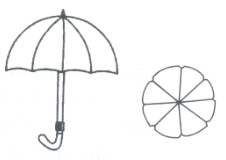
An umbrella has 8 ribs which are equally spaced (see the figure). Assuming umbrella to be a flat circle of radius 45 cm, find the area between the two consecutive ribs of the umbrella.
5.
The length of the minute hand of a clock is 14 cm. Find the area swept by the minute hand in 5 minutes.
6.
Find the area of a sector of a circle with radius 6 cm, if angle of the sector is \(60^o\)
7.
Prove that the tangents drawn at the ends of a diameter of a circle are parallel.
8.
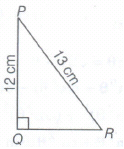
In the following figure, find tan P - cot R.
9.
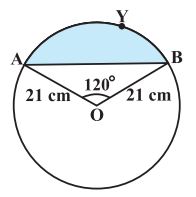
Find the area of the segment AYB shown in Figure, if radius of the circle is 21 cm and \(\angle \mathrm{AOB}=120^{\circ} .\left(\text { Use } \pi=\frac{22}{7}\right)\)
10.
From the top of a 7 m high building, the angle of elevation of the top of a cable tower is 60o and the angle of depression of its foot is 45o. Determine the height of the tower.
11.
From a point on the ground, the angles of elevation of the bottom and the top of a transmission tower fixed at the top of a 20 m high building are 45° and 60°. Find the height of the tower.
12.
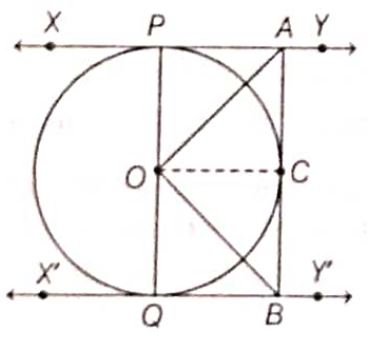
In the given figure, XY and X'Y' are two parallel tangents to a circle with centre O and another tangent AB with point of contact C intersecting XY at A and X'Y' at B.Prove that \(\angle AOB=90^0\)
13.
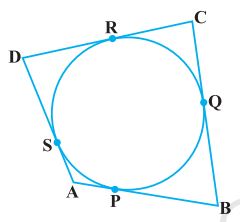
A quadrilateral ABCD is drawn to circumscribe a circle (see figure). Prove that AB+CD=AD+BC.
14.
Evaluate the following : sin 60° cos 30° + sin 30° cos 60°
15.
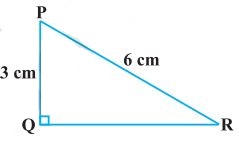
In \(\triangle PQR\), right-angles at Q, PQ = 3 cm and PR = 6 cm. Determine \(\angle QPR\) and \(\angle PRQ\).
16.
Given \(\tan\ A=\frac { 4 }{ 3 } \), find the other trigonometric ratios of the angle A.
17.
If sin (A – B) = \(\frac{1}{2}\) cos (A + B) = \(\frac{1}{2}\) 0° < A + B \(\leq\) 90°, A > B, find A and B.
18.
In the given figure, O is the centre of the circle with radius equal to 14 cm. The length of the arc AB=13.2 cm. Find the area of the shaded sector of the circle.

19.
A chord of a circle of radius 30 cm subtends an angle of \(60°\) at the centre. Find the area of the corresponding minor and major segments of the circle.
20.
The lengths of tangents drawn from an external point to a circle are equal.
21.
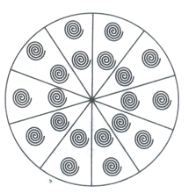
A brooch is made with silver wire in the form of a circle with diameter 35 mm. The wire is also used in making 5 diameters which divide the circle into 10 equal sectors as shown in figure.
Find:
(i) the total length of the silver wire required.
(ii) the area of each sector of the brooch.
22.
Maximum number of common tangents that can be drawn to two circles intersecting at two distinct points is
4
3
2
1
23.
A tangent PQ at a point P of a circle of radius 5 cm meets a line through the centre O at a point Q, so that OQ= 12 cm. Length of PQ is
12 cm
13 cm
8.5 cm
\(\sqrt119\) cm
24.
If tangents PA and PB from a point P to a circle with centre O are inclined to each other at angle of 80°, then \(\angle POA \) is equal to
50°
60°
70°
80°
25.
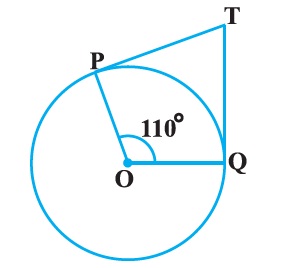
In the given figure, if TP and TQ are the two tangents to a circle with centre O so that \(\angle POQ\)= 110°, then \(\angle PTQ\) is equal to
60°
70°
80°
90°
26.
From a point Q, the length of the tangent to a circle is 24 cm and the distance of Q from the centre is 25 cm. The radius of the circle is
7 cm
12 cm
15 cm
24.5 cm
27.
Tick the correct answer in the following:
Area of a sector of angle P (in degrees) of a circle with radius R is
\({P \over 180^o}\times 2\pi R\)
\({P \over 180^o}\times \pi R^2\)
\({P \over 360^o}\times 2\pi R\)
\({P \over 720^o}\times 2\pi R^2\)
28.
\(\frac{1+\tan ^{2} A}{1+\cot ^{2} A}=\)
sec2 A
–1
cot2 A
tan2 A
29.
(sec A + tan A) (1 – sin A) =
sec A
sin A
cosec A
cos A
30.
(1 + tan \(\theta\) + sec \(\theta\)) (1 + cot \(\theta\) – cosec \(\theta\)) =
0
1
2
-1
31.
9 sec2 A – 9 tan2 A =
1
9
8
0
32.
\(\frac{2 \tan 30^{\circ}}{1-\tan ^{2} 30^{\circ}}\) =
cos 60°
sin 60°
tan 60°
sin 30°
33.
sin 2A = 2 sin A is true, when A =
0°
30o
45°
60°
34.
\(\frac{1-\tan ^{2} 45^{\circ}}{1+\tan ^{2} 45^{\circ}}\) =
tan 90°
1
sin 45°
0
35.
\(\frac{2 \tan 30^{\circ}}{1+\tan ^{2} 30^{\circ}}\)=
sin 60°
cos 60°
tan 60°
sin 30°
36.
The area swept by the minute hand of a circular clock in 5 minutes forms a
Circle
Segment
Cone
Sector
37.
If altitude of the sun is 60°, the height of a tower which casts a shadow of length 30 m is:
30√3 cm
30/√3 m
15 m
15√2 m
38.
An observer 1.5 m tall is 28.5 m away from a tower. The angle of elevation of the top of the tower from his eyes is 45°. The height of the tower is
30 m
20 m
40 m
10 m
39.
The distance between two parallel tangents to a circle of radius 5 cm is
5cm
8cm
10cm
9cm
40.
Assertion : A tangent PA at point A of a circle of radius 6 cm meets a line through the centre O at a point P so that OP = 10 cm, then PA = 9 cm.
Reason : The tangents drawn at the ends of a diameter of a circle are parallel.
Codes :
(a) If both Assertion and Reason are correct and Reason is the correct explanation of Assertion.
(b) If both Assertion and Reason are correct, but Reason is not the correct explanation of Assertion.
(c) If Assertion is correct but Reason is incorrect
(d) If Assertion is incorrect but Reason is correct.
41.
Assertion cos2 A - sin 2 A = 1 is a trigonometric identity.
Reason An equation involving trigonometric ratios of an angle is called trigonometric identity, if it is true for all values of the angles involved.
Codes:
(a) If both Assertion and Reason are correct and Reason is the correct explanation of Assertion.
(b) If both Assertion and Reason are correct, but Reason is not the correct explanation of Assertion.
(c) If Assertion is correct but Reason is Incorrect.
(d) If Assertion is incorrect but Reason is correct
42.
A Ferris wheel (or a big wheel in the United Kingdom) is an amusement ride consisting of a rotating upright wheel with multiple passenger-carrying components (commonly referred to as passenger cars, cabins, tubs, capsules, gondolas, or pods) attached to the rim in such a way that as the wheel turns, they are kept upright, usually by gravity.
After taking a ride in Ferris wheel, Aarti came out from the crowd and was observing her friends who were enjoying the ride . She was curious about the different angles and measures that the wheel will form. She forms the figure as given below.
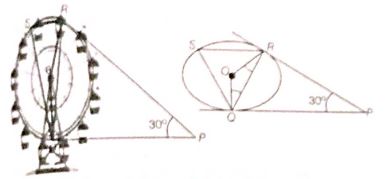
(i) In the given figure, find \(\angle\)ROQ
(a) 60° (b) 100° (c) 150° (d) 90°
(ii) Find \(\angle\)RQP.
(a) 75° (b) 60° (c) 30° (d) 90°
(iii) Find \(\angle\)RSQ
(a) 60° (b) 75° (c) 100° (d) 30°
(iv) Find \(\angle\)ORP.
(a) 90° (b) 70° (c) 100° (d) 60°
43.
A boy is standing on the top of light house. He observed that boat P and boat Q are approaching to light house from opposite directions. He finds that angle of depression of boat P is 45° and angle of depression of boat Q is 30°. He also knows that height of the light house is 100 m.
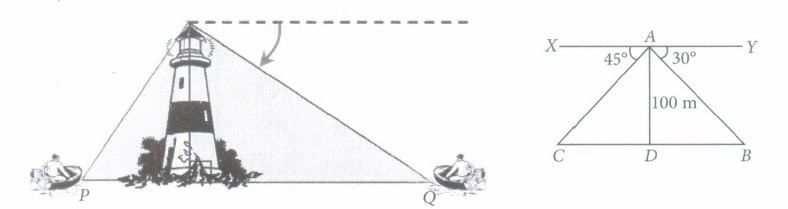
Based on the above information, answer the following questions.
(i) Measure of \(\angle\)ACD is equal to
| (a) 30° | (b) 45° | (c) 60° | (d) 90° |
(ii) If \(\angle\)YAB = 30°, then \(\angle\)ABD is also 30°, Why?
| (a) vertically opposite angles | (b) alternate interior angles |
| (c) alternate exterior angles | (d) corresponding angles |
(iii) Length of CD is equal to
| (a) 90 m | (b) 60 m | (c) 100 m | (d) 80 m |
(iv) Length of BD is equal to
| (a) 50 m | (b) 100 m | (c) 100\(\sqrt{2}\) m | (d) 100\(\sqrt{3}\) m |
(v) Length of AC is equal to
| (a)100\(\sqrt{2}\) m | (b) 100\(\sqrt{3}\) m | (c) 50 m | (d) 100 m |
44.
Three friends - Anshu, Vijay and Vishal are playing hide and seek in a park. Anshu and Vijay hide in the shrubs and Vishal have to find both of them. If the positions of three friends are at A, Band C respectively as shown in the figure and forms a right angled triangle such that AB = 9 m, BC = 3\(\sqrt{3}\) m and \(\angle\)B = 90°, then answer the following questions.
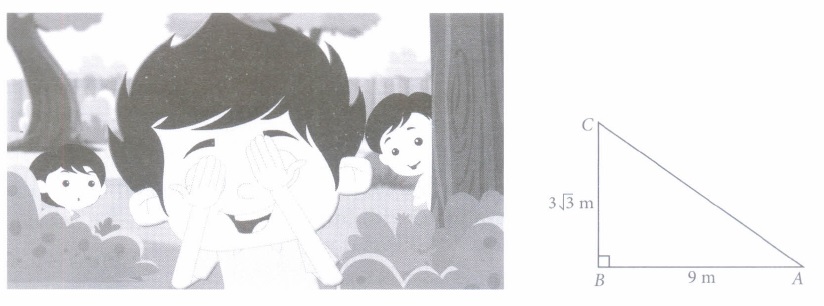
(i) The measure of \(\angle\)A is
| (a) 30° | (b) 45° | (c) 60° | (d) None of these |
(ii) The measure of \(\angle\)C is
| (a) 30° | (b) 45° | (c) 60° | (d) None of these |
(iii) The length of AC is
| \((a) 2 \sqrt{3} \mathrm{~m}\) | \((b) \sqrt{3} \mathrm{~m}\) | \((c) 4 \sqrt{3} \mathrm{~m}\) | \((d) 6 \sqrt{3} \mathrm{~m}\) |
(iv) cos2A =
| (a) 0 | \((b) \frac{1}{2}\) | \((c) \frac{1}{\sqrt{2}}\) | \((d) \frac{\sqrt{3}}{2}\) |
(v) sin \(\left(\frac{C}{2}\right)\) =
| (a) 0 | \((b) \frac{1}{2}\) | \((c) \frac{1}{\sqrt{2}}\) | \((d) \frac{\sqrt{3}}{2}\) |
1.
We are given a circle with centre O and a tangent XY to the circle at a point P. We need to prove that OP is perpendicular to XY.
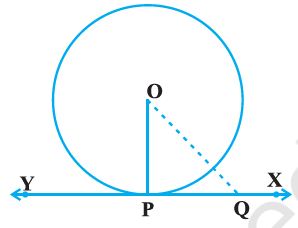
Take a point Q on XY other than P and join OQ see Fig.The point Q must lie outside the circle. (Why? Note that if Q lies inside the circle, XY will become a secant and not a tangent to the circle). Therefore, OQ is longer than the radius OP of the circle. That is, OQ > OP.
Since this happens for every point on the line XY except the point P, OP is the shortest of all the distances of the point O to the points of XY. So OP is perpendicular to XY.
2.
\( \frac{3}{2}\)
3.
Given, \(\sin { \alpha =\frac { 1 }{ 2 } } \)
then \(3\sin { \alpha } -4\sin ^{ 3 }{ \alpha } =3\times \frac { 1 }{ 2 } -4\times { \left( \frac { 1 }{ 2 } \right) }^{ 3 }\)
\(=\frac { 3 }{ 2 } -\frac { 4 }{ 8 } =1\)
4.
Given, umbrella to be a flat circle. So, the central angle of an umbrella is 360°.
Since, umbrella has 8 ribs.
\(\therefore\) Angle between two ribs.
\(=\frac{360^{\circ}}{8}=45^{\circ}\)
Area between two ribs = Area of one sector of the umbrella
\(=\frac{\theta}{360^{\circ}} \times \pi r^2=\frac{45^{\circ}}{360^{\circ}} \times \frac{22}{7} \times(45)^2[\because r=45, \text { given }]\)
\(\begin{aligned} & =\frac{22}{7 \times 8}(45)^2 \\ \end{aligned}\)
\(\begin{aligned} & =\frac{22275}{28} \mathrm{~cm}^2 \end{aligned}\)
5.
We know that in 1 hour (i.e., 60 minutes), the minute hand rotates 360°.
In 5 minutes, minute hand will rotate = 360^@/60xx5 = 30^@
Therefore, the area swept by the minute hand in 5 minutes will be the area of a sector of 30° in a circle of 14 cm radius.
Area of sector of angle θ = \(\frac{\theta}{360^{\circ}} \times \pi r^{2}\)
Area of sector of 30° \(=\frac{30^{\circ}}{360^{\circ}} \times \frac{22}{7} \times 14 \times 14\)
\(\begin{array}{l} =\frac{22}{12} \times 2 \times 14 \\ =\frac{11 \times 14}{3} \end{array}\)
=154/3 cm2
Therefore, the area swept by the minute hand in 5 minutes is 154/3 cm2
6.
We know that area of sector of a circle =\(\frac{\theta}{360^{\circ}} \times \pi r^2\)
Given, radius of circle, r = 6 cm
and angle of sector, \(\theta\)= 60°
\(\therefore\) Area of sector of a circle \(=\frac{60^{\circ}}{360^{\circ}} \times \frac{22}{7} \times(6)^2=\frac{132}{7} \mathrm{~cm}^2\)
7.
Let AB be a diameter of a given circle and LM and PQ be the tangent lines drawn to the circle at points A and B, respectively.
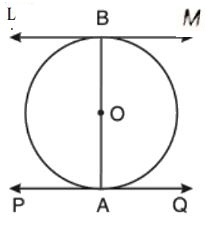
To prove LM || PQ
Proof We know that the tangent at any point of a circle is perpendicular to the radius through the point of contact.
\(\therefore\) OA \(\perp\) PQ and OB \(\perp\) LM
\(\Rightarrow\) AB \(\perp\) PQ
and AB \(\perp\) LM
\(\Rightarrow\) \(\angle\)PAB = 90°
and \(\angle\)ABM = 90°
\(\Rightarrow\) \(\angle\)PAB = \(\angle\)ABM
[each = 90°]
But these are alternate angles.
\(\therefore\) PQ || LM
Hence, the tangents drawn at the ends of a diameter of a circle are parallel.
Hence proved.
8.
In right angled \(\triangle PQR,\)
PQ = 12 cm, PR = 13 cm [given]
Then, PQ2 + QR2 = PR2 [by using Pythagoras theorem]
\(\Rightarrow\) (12)2 + QR2 = (13)2
\(\Rightarrow\) 144 + QR2 = 169
\(\Rightarrow\) QR2 = 169 - 144 = 25
\(\Rightarrow\) QR = 5 [taking positive square root since, side cannot be negative]
Now, \(tanP=\frac { P }{ B } =\frac { QR }{ PQ } =\frac { 5 }{ 12 } \)
\(and\quad cot \quad R=\frac { B }{ P } =\frac { QR }{ PQ } =\frac { 5 }{ 12 } \)
\(\therefore \quad tanP-cosR=\frac { 5 }{ 12 } - \frac { 5 }{ 12 } =0\)
9.
Now, area of the sector OAYB = \(=\frac{120}{360} \times \frac{22}{7} \times 21 \times 21 \mathrm{~cm}^2=462 \mathrm{~cm}^2\) (2)
For finding the area of \(\Delta\)OAB, draw OM \(\perp\) AB as shown in Figure.
Note that OA = OB. Therefore, by RHS congruence, \(\Delta\)AMO \(\cong\) BMO.
So, M is the mid-point of AB and \(\angle\)AOM = \(\angle\)BOM = \(\frac{1}{2} \times 120^{\circ}=60^{\circ}\)
Let OM = x cm
So, from \(\Delta\)OMA, \(\frac{\mathrm{OM}}{\mathrm{OA}}=\cos 60^{\circ}\)
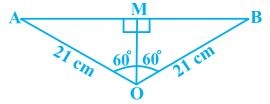
or, \(\begin{aligned} \frac{x}{21} & =\frac{1}{2} \quad\left(\cos 60^{\circ}=\frac{1}{2}\right) \\ \end{aligned}\)
or, \(\begin{aligned} x & =\frac{21}{2} \\ \end{aligned}\)
So, \(\begin{aligned} \mathrm{OM} & =\frac{21}{2} \mathrm{~cm} \\ \end{aligned}\)
Also,\(\begin{aligned} \frac{\mathrm{AM}}{\mathrm{OA}} & =\sin 60^{\circ}=\frac{\sqrt{3}}{2} \\ \end{aligned}\)
So, \(\begin{aligned} \mathrm{AM} & =\frac{21 \sqrt{3}}{2} \mathrm{~cm} \end{aligned}\)
Therefore, \(\mathrm{AB}=2 \mathrm{AM}=\frac{2 \times 21 \sqrt{3}}{2} \mathrm{~cm}=21 \sqrt{3} \mathrm{~cm}\)
So, area of \(\begin{aligned} \Delta \mathrm{OAB} & =\frac{1}{2} \mathrm{AB} \times \mathrm{OM}=\frac{1}{2} \times 21 \sqrt{3} \times \frac{21}{2} \mathrm{~cm}^2 \\ \end{aligned}\)
\(\begin{aligned} =\frac{441}{4} \sqrt{3} \mathrm{~cm}^2 \end{aligned}\) (3)
Therefore, are of the segment \(\mathrm{AYB}=\left(462-\frac{441}{4} \sqrt{3}\right) \mathrm{cm}^2\) [From (1), (2) and (3)]
\(=\frac{21}{4}(88-21 \sqrt{3}) \mathrm{cm}^2\)
10.
Let AD = 7 m be the height of the building and BC = h m be the height of the cable tower. From the top of the building D, the angles of elevation and depression are \(\angle\)CDE = 60o and \(\angle\)EDB = 45o
From the point D, draw a line DE || AB.
Then, \(\angle\)EDB = \(\angle\)ABD = 45o [alternate angles]

Also, let AB = DE = x m be the distance between building and tower.
In right angled \(\Delta\)BAD,
\(\begin{array}{rlrl} \tan 45^{\circ} & =\frac{P}{B}=\frac{A D}{A B} \\ \end{array}\)
\(\begin{array}{rlrl} \Rightarrow \quad 1 & =\frac{7}{x} & {\left[\because \tan 45^{\circ}=1\right]} \end{array}\)
\(\Rightarrow\) x = 7 m ....(i)
and in right angled \(\Delta\)CED,
\(\begin{aligned} & \tan 60^{\circ}=\frac{C E}{D E}=\frac{C B-B E}{A B}[\because C E=C B-B E] \\ \end{aligned}\)
\(\begin{aligned} & \Rightarrow \quad \sqrt{3}=\frac{b-7}{x} \quad\left[\because \tan 60^{\circ}=\sqrt{3}\right\} \\ \end{aligned}\)
\(\begin{aligned} & \Rightarrow \quad b-7=x \sqrt{3} \\ \end{aligned}\)
\(\begin{aligned} & \Rightarrow \quad h=x \sqrt{3}+7 \\ \end{aligned}\)
\(\begin{aligned} & \Rightarrow \quad h=7 \sqrt{3}+7 \quad \text { [from Eq. (i)] } \\ \end{aligned}\)
\(\begin{aligned} & \Rightarrow \quad h=7(\sqrt{3}+1) \mathrm{m} \\ \end{aligned}\)
Hence, the height of the tower is \(7(\sqrt{3}+1) \mathrm{m} .\)
11.
Let BC be the building, AB be the transmission tower and D be the point on the ground from where the angles of elevations are to be measured.
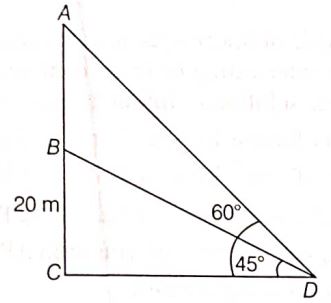
\(\begin{array}{rlrl}
\text { In } \triangle B C D, & \tan 45^{\circ} =\frac{B C}{C D} \\
\end{array}\)
\(\begin{array}{rlrl}
\Rightarrow 1 =\frac{20}{C D} \Rightarrow C D=20 \mathrm{~m}
\end{array}\)
\(\begin{array}{llrl}
\text { In } \triangle A C D, & \tan 60^{\circ} =\frac{A C}{C D}
\end{array}\)
\(\begin{array}{llrl}
\Rightarrow \sqrt{3} =\frac{A B+B C}{C D} \\
\end{array}\)
\(\begin{array}{llrl}
\Rightarrow \sqrt{3} =\frac{A B+20}{20} \\
\end{array}\)
\(\Rightarrow A B =20 \sqrt{3}-20=20(\sqrt{3}-1) \mathrm{m}\)
Thus, the height of the tower is \(20(\sqrt{3}-1) \mathrm{m}\).
12.
Given XY and X'Y' are two parallel tangents. Another tangent AB touches the circle at C and intersect XY at A and X'Y'at B.
To prove \(\angle\)AOB = 90°
Proof We know that, tangents drawn from an external point to a circle are equal in length.
\(\therefore\) AP = AC [\(\because\) A is an external point] ...(i)
Thus, in \(\Delta\)APO and \(\Delta\)ACO, AP = AC [from Eq. (i)]
AO = AO [common sides]
OP = OC [radii of circle]
\(\Delta\)APO \(\cong\)\(\Delta\)ACO [by SSS congruence rule]
Then, \(\angle\)OAP = \(\angle\)OAC [by CPCT] ...(ii)
\(\Rightarrow\) \(\angle\)PAC = 2 \(\angle\)CAO ....(iii)
Similarly, we can prove that \(\angle\)CBO = \(\angle\)OBQ
\(\Rightarrow\) \(\angle\)CBQ = 2 \(\angle\)CBO ...(iv)
since, XY || X'Y' [given]
\(\therefore\) \(\angle\)PAC + \(\angle\)QBC = 180°
[\(\because\) sum of interior angles on the same side of transversal is 180°]
\(\Rightarrow\) 2 \(\angle\)CAO + 2 \(\angle\)CBO = 180° [from Eqs. (iii) and (iv)]
\(\Rightarrow\) \(\angle\)CAO + \(\angle\)CBO = 90° ...(v)
Now, in \(\Delta\)AOB, \(\angle\)CAO + \(\angle\) CBO + \(\angle\)AOB = 180°
[by angle sum property of triangle]
\(\Rightarrow\) \(\angle\)CAO + \(\angle\)CBO = 180° - \(\angle\)AOB ...(vi)
From Eqs. (v) and (vi), we get
180° - \(\angle\)AOB = 90° \(\Rightarrow\) \(\angle\)AOB = 90° Hence proved.
13.
Given A quadrilateral ABCD, circumscribing a circde.
To prove AB + CD = AD + BC
Proof We know that the lengths of tangents drawn from an external point to a circde are equal.
\(\therefore\) AP = AS ...(i)
[\(\because\) both are tangents to a circle from point A]
Similarly, BP = BQ, ...(ii)
CR = CQ ....(iii)
and DR = DS .....(iv)
On adding Eqs. (i), (ii), (ii) and (iv), we get
(AP + BP) + (CR + DR) = (AS + BQ) + (CQ + DS)
\(\Rightarrow\) AB + CD = (AS + DS) + (BQ + CQ)
\(\Rightarrow\) AB + CD = AD + BC
Hence Proved.
14.
sin 60° cos 30° + sin 30° cos 60°
\(=\frac{\sqrt{3}}{2} \times \frac{\sqrt{3}}{2}+\frac{1}{2} \times \frac{1}{2}\)
\(\left[\because \sin 60^{\circ}=\cos 30^{\circ}=\frac{\sqrt{3}}{2} \text { and } \sin 30^{\circ}=\cos 60^{\circ}=\frac{1}{2}\right]\)
\(=\frac{3}{4}+\frac{1}{4}=\frac{3+1}{4}=\frac{4}{4}=1\)
15.
Given PQ = 3 cm and PR = 6 cm.
Therefore, \(\begin{aligned} \frac{\mathrm{PQ}}{\mathrm{PR}} & =\sin \mathrm{R} \\ \end{aligned}\)
or \(\begin{aligned} \sin \mathrm{R} & =\frac{3}{6}=\frac{1}{2} \\ \end{aligned}\)
So, \(\begin{aligned} \angle \mathrm{PRQ} & =30^{\circ} \\ \end{aligned}\)
and therefore, \(\begin{aligned} \angle \mathrm{QPR} & =60^{\circ} \end{aligned}\)
You may note that if one of the sides and any other part (either an acute angle or any side) of a right triangle is known, the remaining sides and angles of the triangle can be determined.
16.
Let us first draw a right \(\Delta\)ABC
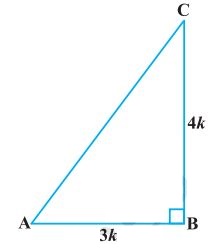
Now, we know that tan \(\mathrm{A}=\frac{\mathrm{BC}}{\mathrm{AB}}=\frac{4}{3}\)
Therefore, if BC = 4k, then AB = 3k, where k is a positive number.
Now, by using the Pythagoras Theorem, we have
AC2 = AB2 + BC2 = (4k)2 + (3k)2 = 25k2
So, AC = 5k
Now, we can write all the trigonometric ratios using their definitions.
\(\begin{aligned} & \sin \mathrm{A}=\frac{\mathrm{BC}}{\mathrm{AC}}=\frac{4 k}{5 k}=\frac{4}{5} \\ \end{aligned}\)
\(\begin{aligned} & \cos \mathrm{A}=\frac{\mathrm{AB}}{\mathrm{AC}}=\frac{3 k}{5 k}=\frac{3}{5} \end{aligned}\)
Therefore, cot \(\mathrm{A}=\frac{1}{\tan \mathrm{A}}=\frac{3}{4}, \operatorname{cosec} \mathrm{A}=\frac{1}{\sin \mathrm{A}}=\frac{5}{4} \text { and } \sec \mathrm{A}=\frac{1}{\cos \mathrm{A}}=\frac{5}{3} .\)
17.
since, sin (A - B) = \(\frac{1}{2}\), therefore, A - B = 30° (1)
Also, since cos (A + B) = \(\frac{1}{2}\), therefore, A + B = 60° (2)
Solving (1) and (2), we get : A = 45° and B = 15°.
18.
92.4 cm2
19.
81.75 cm2
20.
We are given a circle with centre O, a point P lying outside the circle and two tangents PQ, PR on the circle from P see fig. We are required to prove that PQ = PR.
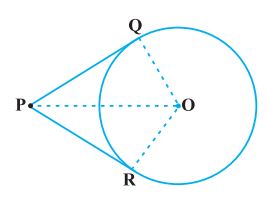
For this, we join OP, OQ and OR. Then \(\angle\)OQP and \(\angle\)ORP are right angles, because these are angles between the radii and tangents, and according to Theorem 10.1 they are right angles. Now in right triangles OQP and ORP,
OQ = OR (Radii of the same circle)
OP = OP (Common)
Therefore, \(\Delta\)OQP \(\cong\)\(\Delta\) ORP (RHS)
This gives PQ = PR (CPCT)
21.
Given, diameter of circle, d = 35 mm
\(\therefore\) Circumference of circle = \(\pi\)d [\(\because\) d = 2r]
\(=\frac{22}{7} \times 35=110 \mathrm{~mm}^2\)
Now, length of 5 diameters = 5 \(\times\) 35 = 175 mm
(i) Total length of the silver wire = \(\pi\)d + 5d
= 110 + 175 = 285 mm2
(ii) Here, we see that total circle is divided into 10 sectors.
\(\therefore\) Angle of each sector = \(\frac{360^{\circ}}{10}=36^{\circ}\)
Then, area of each sector ofthe brooch = \(=\frac{\theta}{360^{\circ}} \times \pi r^2\)
\(\begin{aligned} & =\frac{36^{\circ}}{360^{\circ}} \times \frac{22}{7}\left(\frac{35}{2}\right)^2 \quad\left[\because r=\frac{d}{2}=\frac{35}{2} \mathrm{~mm}\right] \\ \end{aligned}\)
\(\begin{aligned} & =\frac{1}{10} \times \frac{22}{1} \times \frac{5}{2} \times \frac{35}{2}=\frac{11 \times 35}{2 \times 2}=\frac{385}{4} \mathrm{~mm}^2 \end{aligned}\)
22.
(c)
2
23.
(d)
\(\sqrt119\) cm
24.
(a)
50°
25.
(b)
70°
26.
(a)
7 cm
27.
(d)
\({P \over 720^o}\times 2\pi R^2\)
28.
(d)
tan2 A
29.
(d)
cos A
30.
(c)
2
31.
(b)
9
32.
(c)
tan 60°
33.
(a)
0°
34.
(d)
0
35.
(a)
sin 60°
36.
(d)
Sector
37.
(a)
30√3 cm
38.
(a)
30 m
39.
(c)
10cm
40.
If Assertion is incorrect but Reason is correct.
41.
(d) If Assertion is incorrect but Reason is correct.
42.
(i) (c) In quadrilateral PQOR, we have
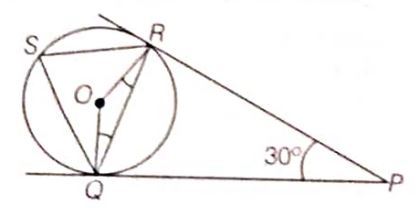
\(\begin{array}{r} \angle Q P R+\angle P R O+\angle P Q O+\angle R O Q=360^{\circ} \\ \end{array}\)
\(\Rightarrow \begin{array}{r} 30^{\circ}+90^{\circ}+90^{\circ}+\angle R O Q=360^{\circ} \end{array}\)
[\(\because\) radius is always perpendicular to the tangent at point of contact]
\(\Rightarrow \quad \angle R O Q=360^{\circ}-210^{\circ}=150^{\circ} \)
\((ii) (a) In \quad \triangle Q O R, O Q=O R\) [radii]
\(\begin{array}{ll} \therefore & \angle O R Q=\angle O Q R \\ \end{array}\)
\(\begin{array}{ll} \text { Now, } & \angle R O Q+\angle O R Q+\angle O Q R=180^{\circ} \\ \end{array}\)
\(\begin{array}{ll} \Rightarrow & 2 \angle O Q R=180^{\circ}-150^{\circ} \\ \end{array}\)
\(\begin{array}{ll} \Rightarrow & 2 \angle O Q R=30^{\circ} \\ \end{array}\)
\(\begin{array}{ll} \Rightarrow & \angle O Q R=15^{\circ} \end{array}\)
Again, \(\begin{array}{ll} \angle O Q R=90^{\circ} \end{array}\) \([\because O Q \perp Q P]\)
\(\begin{aligned} \Rightarrow \angle O Q R+\angle R Q P=90 \\ \end{aligned}\)\({\circ}\)
\(\Rightarrow \quad \angle R Q P=90^{\circ}-15^{\circ}=75^{\circ}\)
(iii) (b) We know that angle subtended by an are at centre is double the angle subtended by it at any other part of the circle.
\(\begin{aligned} 2 \angle R S Q & =\angle R O Q \\ \end{aligned}\)
\(\begin{aligned} \angle R S Q & =\frac{1}{2} \times 150^{\circ}=75^{\circ} \end{aligned}\)
(iv) (a) \(\angle\)ORP = 90\(\circ\) as radius is always perpendicular to the tangent at the point of contact.
43.
(i) (b): \(\angle X A C=45^{\circ}\)
\(\therefore \quad \angle A C D=45^{\circ}\) [Alternate interior angles]
(ii) (b)
(iii) (c) : \(\text { In } \Delta A C D\)
\(\frac{A D}{D C}=\tan 45^{\circ} \)
\(\Rightarrow \frac{100}{D C}=1 \Rightarrow D C=100 \mathrm{~m}\)
(iv) (d): \(\text { In } \Delta A B D, \frac{A D}{B D}=\tan 30^{\circ}\)
\(\Rightarrow \quad \frac{100}{B D}=\frac{1}{\sqrt{3}} \)
\(\Rightarrow \quad B D=100 \sqrt{3} \mathrm{~m}\)
(v) (a): \(\text { In } \Delta A D C\)
\(\frac{A D}{A C}=\sin 45^{\circ} \Rightarrow \frac{100}{A C}=\frac{1}{\sqrt{2}} \Rightarrow A C=100 \sqrt{2} \mathrm{~m}\)
44.
(i) (a): We have, AB = 9 m, BC = 3\(\sqrt{3}\) m
In \(\Delta\)ABC, we have
\(\tan A=\frac{B C}{A B}=\frac{3 \sqrt{3}}{9}=\frac{1}{\sqrt{3}} \)
\(\Rightarrow \tan A=\tan 30^{\circ} \Rightarrow \angle A=30^{\circ}\)
(ii) (c): Similarly, \(\tan C=\frac{A B}{B C}=\frac{9}{3 \sqrt{3}}=\sqrt{3}\)
\(\Rightarrow \tan C=\tan 60^{\circ} \Rightarrow \angle C=60^{\circ}\)
(iii) (d): Since \(\sin A=\frac{B C}{A C} \Rightarrow \sin 30^{\circ}=\frac{B C}{A C}\)
\(\Rightarrow \frac{1}{2}=\frac{3 \sqrt{3}}{A C} \Rightarrow A C=6 \sqrt{3} \mathrm{~m}\)
(iv) (b) : \(\because \angle A=30^{\circ}\) [From (1)]
\(\therefore \quad \cos 2 A=\cos \left(2 \times 30^{\circ}\right)=\cos 60^{\circ}=\frac{1}{2}\)
(v) (b): \(\because \angle C=60^{\circ}\) [Using (2)]
\(\therefore \quad \sin \left(\frac{C}{2}\right)=\sin \left(\frac{60^{\circ}}{2}\right)=\sin 30^{\circ}=\frac{1}{2}\)

10th Standard CBSE Syllabus & Materials
10th Standard CBSE
CBSE 10th Social Science PS - Federalism - New Model Questions Papers Study Material - QB365 Set A
NEW10th Standard CBSE
CBSE 10th Social Science PS - Power Sharing - New Model Questions Papers Study Material - QB365 Set A
NEW10th Standard CBSE
CBSE 10th Social Science GEO - Manufacturing Industries - New Model Questions Papers Study Material - QB365 Set A
NEW10th Standard CBSE
CBSE 10th Social Science GEO - Minerals and Energy Resources - New Model Questions Papers Study Material - QB365 Set A



NCERT Books

Syllabus

Exam Pattern

Sample Question Papers

Previous year Question Papers

Important Notes

MCQ Practice test

NCERT Exemplers

Case study Questions

Image Based Questions

Passage based Questions

HOT Questions

Value Based Questions

Model Questions Papers
NCERT ( Book Back ) Questions

Assertion and Reason
Important Questions And Answers

CBSE 10th Standard CBSE Subjects
CBSE Standards



