
 100% FREE ACCESS
10th Standard CBSE Syllabus & Materials
10th Standard CBSE
CBSE 10th Social Science ECO - Globalisation and the Indian Economy - New Model Questions Papers Study Material - QB365 Set A
NEW10th Standard CBSE
CBSE 10th Social Science ECO - Money and Credit - New Model Questions Papers Study Material - QB365 Set A
NEW10th Standard CBSE
CBSE 10th Social Science ECO - Sectors of the Indian Economy - New Model Questions Papers Study Material - QB365 Set A
NEW10th Standard CBSE
CBSE 10th Social Science ECO - Development - New Model Questions Papers Study Material - QB365 Set A
NEW10th Standard CBSE
CBSE 10th Social Science PS - Outcomes of Democracy - New Model Questions Papers Study Material - QB365 Set A
NEW10th Standard CBSE
CBSE 10th Social Science PS - Gender, Religion and Caste - New Model Questions Papers Study Material - QB365 Set A

Published on: 20/10/2025
Download CBSE Class 10th Standard CBSE Maths question papers, sample papers, important questions, and previous year solved papers in PDF format. Get free study materials, NCERT solutions, and exam preparation resources for Class 10th Standard CBSE Maths
Questions + Answers key
Take MCQ Maths Test
1.
If median of the following distribution is 58 and the sum of all the frequencies is 140. Find the values of x and y.
| Variable | 15-25 | 25-35 | 35-45 | 45-55 | 55-65 | 65-75 | 75-85 | 85-95 |
|---|---|---|---|---|---|---|---|---|
| Frequency | 8 | 10 | x | 25 | 40 | y | 15 | 7 |
2.
If α and β are zeroes of the quadratic polynomial p(x)=6x2+x-1, then find the value of \(\frac { \alpha }{ \beta } +\frac { \alpha }{ \alpha } +2\left( \frac { 1 }{ \alpha } +\frac { 1 }{ \beta } \right) +3\alpha \beta \)
3.
19 cards numbered 1,2,3,.....,19 are put in a box and mixed thoroughly.One person draws one card from the box.Find the probability that the number on the card is:
(i)even
(ii)A prime
(iii)Divisible by 3
(iv)Divisible by 3 and 2 both
4.
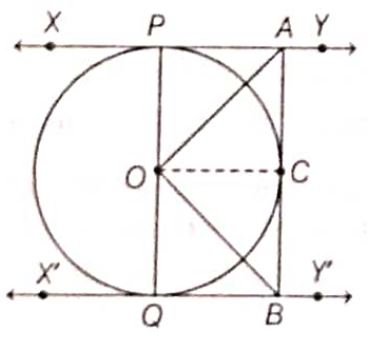
In the given figure, XY and X'Y' are two parallel tangents to a circle with centre O and another tangent AB with point of contact C intersecting XY at A and X'Y' at B.Prove that \(\angle AOB=90^0\)
5.
If \(\alpha\ and\ \beta \) are the zeroes of the quadratic polynomial f(x) = x2 -3x -2, find a polynomial whose zeroes are
\(\frac{2 \alpha}{\beta} \text { and } \frac{2 \beta}{\alpha}\)
6.
A sweetseller has 420 kaju barfis and 130 badam barfis. She wants to stack them in such a way that each stack has the same number, and they take up the least area of the tray. What is the number of that can be placed in each stack for this purpose?
7.
The mean of the following distribution is 31.4.Determine the missing frequency x.
| Class | 0-10 | 10-20 | 20-30 | 30-40 | 40-50 | 50-60 |
| Frequency | 5 | x | 10 | 12 | 7 | 8 |
8.
200 surnames were randomly picked up from a local telephone directory and the frequency distribution of the number of letters in English alphabets in the surnames was obtained as follows:
| Number of letters | 0-5 | 5-10 | 10-15 | 15-20 | 20-25 |
|---|---|---|---|---|---|
| Number of surnames | 20 | 60 | 80 | 32 | 8 |
Find the median of the above data.
9.
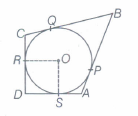
A circle is inscribed in a ΔBC having sides AB=8 cm, BC = 10 cm and CA = 12 cm as shown in figure. Find AD, BE and CF
10.
Prove that opposite sides of a quadrilateral circumscribing a circle subtend supplementary angles at the centre of the circle.
11.
Prove that \(-7-2 \sqrt{3}\) is an irrational number, given that \( \sqrt{3}\) is an irrational number.
12.
If m and n are the zeroes of the polynomial 3x2 + 11x - 4, find the value of \(\frac{m}{n}+\frac{n}{m}\)
13.
Consider the following data:
| Class interval | 65-85 | 85-105 | 105-125 | 125-145 | 145-165 | 165-185 | 185-205 |
|---|---|---|---|---|---|---|---|
| Frequency | 4 | 5 | 13 | 20 | 14 | 7 | 4 |
Find the difference of the upper limit of the median class and the lower limit of the modal class.
14.
If the probability of an event is 0.65, then find the probability of not happening of that event.
15.
Two dice are thrown at the same time.Find the probability of getting a multiple of 3 on first and a multiple of 2 on the other die.
16.
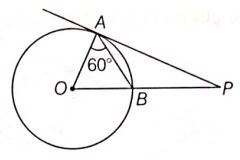
In the given figure, O is the centre of the circle and PA is a tangent to the circle. If \(\angle\)OAB = 60°, then \(\angle\)OPA is equal to
60°
30°
15°
20°
17.
If the mean of 6, 7, x, 8, y, 14 is 9, then
x + y = 21
x + y = 19
x - y = 19
x - y = 21
18.
If \(a = 2 ^ 2 \times 3 ^ x , b = 2 ^ 2 \times 3 \times 5 , c = 2 ^ 2 \times 3 \times 7\) and LCM (a, b, c) = 3780, then x is equal to
1
2
3
0
19.
A box contains 54 marbles each of which is blue, green or white. The probability of selecting a blue marble at random from the box is 1/3 and the probability of selecting a green marble at random is 4/9. The number of white marbles in the box are
10
12
14
16
20.
A letter is chosen at random from the letters of the word 'ASSASSINATION', then the probability that the letter chosen is a vowel is in the form of \(\frac{6}{2 x+1}\) ,then x is equal to
5
6
7
8
21.
The mean of 5 observations x, x + 2, x + 4, x + 6 and x + 8 is 11, then the value of x is:
6
11
4
7
22.
| Expendicture | 0-10 | 10-20 | 20-30 | 30-40 | 40-50 |
| No. of families | 14 | 23 | 27 | 21 | 15 |
What is the mode of the given data?
25
27
22
21
23.
The mean of the following data is: 45, 35, 20, 15, 25, 40
15
25
35
30
24.
If the two zeroes of the quadratic polynomial 7x2 – 15x – k are reciprocals of each other, the value of k is:
1/7
7
-7
5
25.
Which of the given is the set of zeroes of the polynomial p(x) = 2x3+x2-5x+2
-1/2, 1, -2
1/2, -1, -2
-1/2, -1, -2
1/2, 1, -2
26.
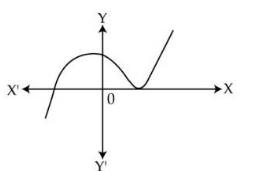
The graph of y = p(x) is given below. The number of zeroes of p(x) are
3
0
4
2
27.
The LCM of two numbers x and y is z. What is their HCF?
yz/x
xy/z
xz/y
xyz
28.
The H.C.F.of 145 and 220 is
11
15
10
5
29.
If the HCF of 85 and 153 is expressible in the form 85n – 153, then value of n is :
4
2
3
1
30.
H.C.F. of two consecutive even numbers is:
1
4
2
0
31.
A die is thrown once. Find the probability of getting a number that is either composite or prime
6/6
5/6
3/6
4/6
32.
The following probabilities are given; choose the correct answer for that which is not possible.
0.15
2/7
7/5
none of these
33.
A line that intersects a circle in exactly one point is called a
Diameter
Tangent
Radius
Secant
34.
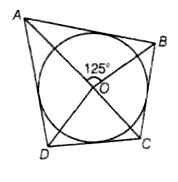
in figure , if ㄥAOB = 125o, then ㄥCOD is equal to
62o
45o
35o
55o
35.
In the given figure, PT is a tangent to a circle whose centre is O. If PT = 12 cm and PO = 13 cm then find teh radius of the circle.
5 cm
4 cm
6 cm
4.5 cm
36.
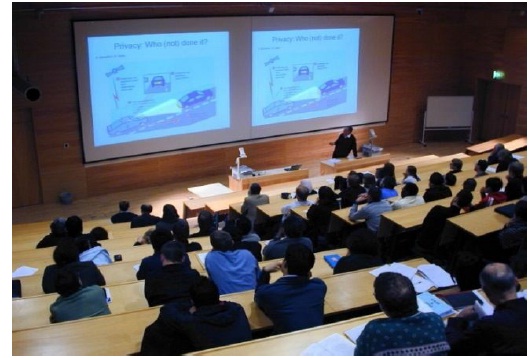
The department of Computer Science and Technology is conducting an International Seminar. In the seminar, the number of participants in Mathematics, Science and Computer Science are 60, 84 and 108 respectively. The coordinator has made the arrangement such that in each room, the same number of participants are to be seated and all of them being in the same subject. Also, they allotted the separate room for all the official other than participants.
(i) Find the total number of participants.
| (a) 60 | (b) 84 | (c) 108 | (d) none of these |
(ii) Find the LCM of 60, 84 and 108.
| (a) 12 | (b) 504 | (c) 544320 | (d) 3780 |
(iii) Find the HCF of 60, 84 and 108.
| (a) 12 | (b) 60 | (c) 84 | (d) 108 |
(iv) Find the minimum number of rooms required, if in each room, the same number of participants are to be seated and all of them being in the same subject.
| (a) 12 | (b) 20 | (c) 21 | (d) none of these |
(v) Based on the above (iv) conditions, find the minimum number of rooms required for all the participants and officials.
| (a) 12 | (b) 20 | (c) 21 | (d) none of these |
37.
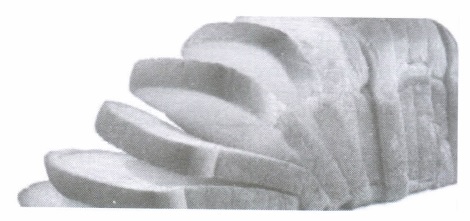
A bread manufacturer wants to know the lifetime of the product. For this, he tested the life time of 400 packets of bread. The following tables gives the distribution of the life time of 400 packets.
| Lifetime (in hours) | Number of packets (Cumulative frequency) |
| 150-200 | 14 |
| 200-250 | 70 |
| 250-300 | 130 |
| 300-350 | 216 |
| 350-400 | 290 |
| 400-450 | 352 |
| 450-500 | 400 |
Based on the above information, answer the following questions.
(i) If m be the class mark and b be the upper limit of a class in a continuous frequency distribution, then lower limit of the class is
| (a) 2m + b | (b) 2m+\(\sqrt{b}\) | (c) m - b | (d) 2m-b |
(ii) The average lifetime of a packet is
| (a) 341 hrs | (b) 300 hrs | (c) 340 hrs | (d) 301 hrs |
(iii) The median lifetime of a packet is
| (a) 347 hrs | (b) 340 hrs | (c) 346 hrs | (d) 342 hrs |
(iv) If empirical formula is used, then modal lifetime of a packet is
| (a) 340 hrs | (b) 341 hrs | (c) 348 hrs | (d) 349 hrs |
(v) Manufacturer should claim that the lifetime of a packet is
| (a) 346 hrs | (b) 341 hrs | (c) 340 hrs | (d) 347hrs |
38.
In an online test, Ishita comes across the statement - If a tangent is drawn to a circle from an external point, then the square of length of tangent drawn is equal to difference of squares of distance of the tangent from the centre of circle and radius of the circle.
Help Ishita, in answering the following questions based on the above statement.
(i) If AB is a tangent to a circle with centre O at B such that AB = 10 cm and OB = 5 cm, then OA =
| \((a) 3 \sqrt{5} \mathrm{~cm}\) | \((b) 5 \sqrt{5} \mathrm{~cm}\) | \((c) 4 \sqrt{5} \mathrm{~cm}\) | \((d) 6 \sqrt{5} \mathrm{~cm}\) |
(ii) In the adjoining figure, radius of the circle is
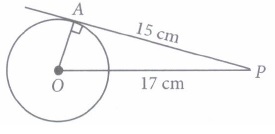
| (a) 8 cm | (b) 7 cm | (c) 9 cm | (d) 10 cm |
(iii) In the adjoining figure, length of tangent AP is
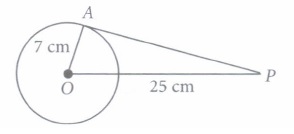
| (a) 12 cm | (b) 24 cm | (c) 30 cm | (d) None of these |
(iv) PT is a tangent to a circle with centre 0 and diameter = 40 cm. If PT = 21 cm, then OP =
| (a) 33 cm | (b) 29 cm | (c) 37 cm | (d) None of these |
(v) In the adjoining figure, the length of the tangent is
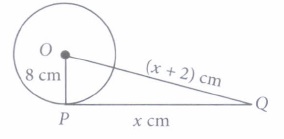
| (a) 15 cm | (b) 9 cm | (c) 8 cm | (d) 10 cm |
1.
x=15, y=20
2.
\(\frac { \alpha }{ \beta } +\frac { \alpha }{ \alpha } +2\left( \frac { 1 }{ \alpha } +\frac { 1 }{ \beta } \right) +3\alpha \beta \)
\(=\frac { \alpha ^{ 2 }+\beta ^{ 2 } }{ \alpha \beta } +2\left( \frac { \alpha +\beta }{ \alpha \beta } \right) +3\alpha \beta =-\frac { 2 }{ 3 } \)
3.
\((i){9\over19}(ii){1\over19}(iii){6\over19}(iv){3\over19}\)
4.
Given XY and X'Y' are two parallel tangents. Another tangent AB touches the circle at C and intersect XY at A and X'Y'at B.
To prove \(\angle\)AOB = 90°
Proof We know that, tangents drawn from an external point to a circle are equal in length.
\(\therefore\) AP = AC [\(\because\) A is an external point] ...(i)
Thus, in \(\Delta\)APO and \(\Delta\)ACO, AP = AC [from Eq. (i)]
AO = AO [common sides]
OP = OC [radii of circle]
\(\Delta\)APO \(\cong\)\(\Delta\)ACO [by SSS congruence rule]
Then, \(\angle\)OAP = \(\angle\)OAC [by CPCT] ...(ii)
\(\Rightarrow\) \(\angle\)PAC = 2 \(\angle\)CAO ....(iii)
Similarly, we can prove that \(\angle\)CBO = \(\angle\)OBQ
\(\Rightarrow\) \(\angle\)CBQ = 2 \(\angle\)CBO ...(iv)
since, XY || X'Y' [given]
\(\therefore\) \(\angle\)PAC + \(\angle\)QBC = 180°
[\(\because\) sum of interior angles on the same side of transversal is 180°]
\(\Rightarrow\) 2 \(\angle\)CAO + 2 \(\angle\)CBO = 180° [from Eqs. (iii) and (iv)]
\(\Rightarrow\) \(\angle\)CAO + \(\angle\)CBO = 90° ...(v)
Now, in \(\Delta\)AOB, \(\angle\)CAO + \(\angle\) CBO + \(\angle\)AOB = 180°
[by angle sum property of triangle]
\(\Rightarrow\) \(\angle\)CAO + \(\angle\)CBO = 180° - \(\angle\)AOB ...(vi)
From Eqs. (v) and (vi), we get
180° - \(\angle\)AOB = 90° \(\Rightarrow\) \(\angle\)AOB = 90° Hence proved.
5.
\(\left[x^{2}-\left(\frac{\alpha^{2}}{\beta}+\frac{\beta^{2}}{\alpha}\right) x+\left(\frac{\alpha^{2}}{\beta}\right)\left(\frac{\beta^{2}}{\alpha}\right)\right]\)
\(=\left[x^{2}-\left(\frac{\alpha^{3}+\beta^{3}}{\alpha \beta}\right) x+\alpha \beta\right]\)
\(=x^{2}-\left[\frac{(\alpha+\beta)\left\{(\alpha+\beta)^{2}-3 \alpha \beta\right\}}{\alpha \beta}\right] x+\alpha \beta\)
\(=x^{2}-\left[\frac{3\left\{(3)^{2}-3(-2)\right\}}{-2}\right] x+(-2)=x^{2}+\frac{45}{2} x-2\)
= \(\frac{1}{2}\left(2 x^{2}+45 x-4\right)\)
6.
This can be done by trial and error. But to do it systematically, we find HCF (420, 130). Then this number will give the maximum number of barfis in each stack and the number of stacks will then be the least. The area of the tray that is used up will be the least. Now, let us use Euclid’s algorithm to find their HCF. We have :
420 = 130 x 3 + 30
130 = 30 x 4 + 10
30 = 10 x 3 + 0
So, the HCF of 420 and 130 is 10.
Therefore, the sweetseller can make stacks of 10 for both kinds of barfi.
7.
| C.I | f | ui | fiui |
| 0-10 | 5 | -3 | -1510-20 |
| 10-20 | x | -2 | -2x |
| 20-30 | 10 | -1 | -10 |
| 30-40 | 12 | 0 | 0 |
| 40-50 | 7 | 1 | 7 |
| 50-608 | 8 | 2 | 16 |
| Total | 42+x | -2x-2 |
A=Assumed mean =35
Mean = A +\(\frac { \Sigma f_{ i }u_{ i } }{ \Sigma f_{ i } } \times 10\)
\(31.4=35+\frac { -2x-2 }{ 42+x } \times 10\)
(2x + 210 = (42 + x)(3.6)
20x + 20=151.2+3.6x
16.4x = 131.2
x = 8
8.
The cumulative frequency table of given data is
| Number of letters | Number of surnames (fi) | Cumulative frequency (cf) |
|---|---|---|
| 0-5 | 20 | 20 |
| 5-10 | 60 | 20+60=8 (cf) |
| 10-15 | 80=f | 80+80=160 |
| 15-20 | 32 | 160+32=192 |
| 20-25 | 8 | 192+8=200 |
| Total | n=200 |
Here, n=200 ∴\(\frac { n }{ 2 } =\frac { 200 }{ 2 } =100\) \(\)
Since, the cumulative frequency just greater than 100 is 160 and the corresponding class interval is 10-15.
∴ Median class=10-15, l=10, cf=80, h=5 ad f=80
Now, median\(\) \(=l+\left\{ \frac { \frac { n }{ 2 } -cf }{ f } \right\} \times h=10+\left\{ \frac { 100-80 }{ 80 } \right\} \times 5\)
\(=10+\left( \frac { 20 }{ 80 } \right) \times 5=10+1.25=11.25\)
9.
We know that, tangents drawn from an exterior point to a circle are equal in length.
AD = AF = x cm
BD = BE = y cm
CE = CF = z cm
Given, AB = 8 cm
⇒ AD + BD = 8cm
⇒ x + y = 8
BC = 10 cm ⇒ BE + CE = 10 cm
⇒ y + z = 10
and CA = 12 cm ⇒ CF + AF = 12 cm
⇒ z + x = 12
On adding Eqs. (i), (ii) and (iii), we get
2(x + y + z) =30
⇒ x + y + z = 15
On subtracting Eq. (ii) from Eq. (iv), we get
x =15 - 10 = 5
On subtracting Eq. (iii) from Eq. (iv), we get
y = 15-12 = 3
On subtracting Eq. (i) from Eq. (iv), we get
z=15-8=7
AD = xcm = 5 cm
BE= ycm = 3 cm
and CF = z cm = 7 cm
Hence, the length of AD, BE and CE are 5 cm, 3 cm and 7 cm, respectively.
10.
Let ABCD is a quadrilateral circumscribing a circle with centre O. Let circle touches the sides of a quadrilatcral at points E, F, G and H.
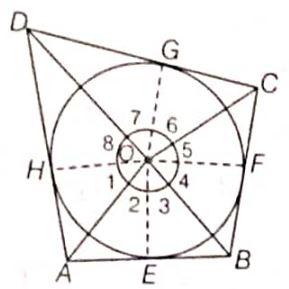
To prove \(\angle\)AOB + \(\angle\)COD = 180°
and \(\angle\) AOD + \(\angle\)BOC = 180°
Construction Join OE, OF, OG and OH.
Proof We know that two tangents drawn from an external point to a circle subtend equal angles at the centre.
and 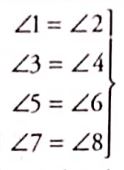 ....(i)
Also, we know that the sum of all angles subtended at a point is 360°.
\(\begin{array}{rlrl} \therefore \angle 1+\angle 2+\angle 3+\angle 4+\angle 5+\angle 6+\angle 7+\angle 8 & =360^{\circ} \\ \end{array}\) ...(ii)
\(\begin{array}{rlrl} \Rightarrow 2(\angle 2+\angle 3+\angle 6+\angle 7) & =360^{\circ} \\ \end{array}\)
\(\begin{array}{rlrl} \Rightarrow & (\angle 2+\angle 3)+(\angle 6+\angle 7)=180^{\circ} \\ \end{array}\)
\(\begin{array}{rlrl} \Rightarrow & \angle A O B+\angle C O D=180^{\circ} \end{array}\)
Similarly, we have
\(\begin{aligned} 2(\angle 1+\angle 8+\angle 4+\angle 5) & =360^{\circ} \\ \end{aligned}\) [from Eq. (i) and (ii)]
\(\begin{aligned} & \Rightarrow(\angle 1+\angle 8)+(\angle 4+\angle 5)=180^{\circ} \\ \end{aligned}\)
\(\begin{aligned} \Rightarrow \quad \angle A O D+\angle B O C=180^{\circ} \end{aligned}\) Hence proved.
11.
Let us assume that -7- 2\(\sqrt{3}\) is rational number.
Then, it will be the form \(\frac{a}{b}\), where a,b are coprime integers and b \(\neq 0\)
Now, \(-7-2 \sqrt{3}=\frac{a}{b}\)
On rearranging, we get
\(\begin{aligned}
-7-\frac{a}{b}=2 \sqrt{3} \\
\end{aligned}\)
\(\begin{aligned}
\Rightarrow \quad-\frac{7}{2}-\frac{a}{2 b}=\sqrt{3}
\end{aligned}\)
Since, \(\frac{7}{2}\) and \(\frac{a}{2b}\) are rational.
So, their difference will be rational.
\(\therefore\) \(\sqrt{3}\) is rational.
But given that \(\sqrt{3}\) is an irrational number.
So, this contradicts the fact that \(\sqrt{3}\) is rational.
Therefore, our assumption is wrong.
Hence, \(-7-2 \sqrt{3}\) is irrational.
12.
Let p(x) = 3x2 + 11x - 4
= 3x2 + 12x - x - 4
= 3x(x + 4) - 1(x + 4)
= (3x - 1)(x + 4)
So, zeroes are \(m=\frac{1}{3}\) and n = - 4
Now, \(\frac { m }{ n } +\frac { n }{ m } =\frac { \left( \frac { 1 }{ 3 } \right) }{ -4 } +\frac { -4 }{ \left( \frac { 1 }{ 3 } \right) } =\frac { 1 }{ -12 } -12\)
\(=\frac{-145}{12}\)
13.
The cumulative frequency table for given data is
| Class interval | Frequency | Cumulative frequency |
|---|---|---|
| 65-85 | 4 | 4 |
| 85-105 | 5 | 9 |
| 105-125 | 13 | 22 |
| 125-145 | 20 | 42 |
| 145-165 | 14 | 56 |
| 165-185 | 7 | 63 |
| 185-205 | 4 | 67 |
Here, \(\frac { n }{ 2 } =\frac { 67 }{ 2 } =33.5\)
The cumulative frequency just greater than 33.5 is 42 and the corresponding class is 125-145.
Thus, we have median class 125-145.
Also, the maximum frequency is of the class 125-145.
Therefore, the modal class is 125-145.
Difference of the upper limit of median class and the lower limit of modal class=145-125=20
14.
0.35
15.
\(1\over6\)
16.
(b)
30°
17.
(b)
x + y = 19
18.
(c)
3
19.
(b)
12
20.
(b)
6
21.
(d)
7
22.
(b)
27
23.
(d)
30
24.
(b)
7
25.
(d)
1/2, 1, -2
26.
(c)
4
27.
(b)
xy/z
28.
(d)
5
29.
(b)
2
30.
(c)
2
31.
(b)
5/6
32.
(c)
7/5
33.
(b)
Tangent
34.
Since, the opposite sides of a quadrilateral circumscribing a circle subtend supplementary angles at the centre of the circle.
i.e ㄥAOB + ㄥCOD = 180o
⇒ ㄥCOD =180o - ㄥAOB
⇒ ㄥCOD = = 180o - 125o = 55o
35.
(b)
4 cm
36.
(i) (d):
Total number of participants = 60 + 84 + 108
= 252
(ii) (d):
60 = 22 x 3 x 5
84 = 22 x 3 x 7
108 = 22 x 33
LCM(60, 84, 108) = 22 x 33 x 5 x 7
= 3780
(iii) (a):
60 = 22 x 3 x 5
84 = 22 x 3 x 7
108 = 22 x 33
HCF(60, 84, 108) = 22 x 3
= 12
(iv) (c):
Minimum number of rooms required for all the participants = 252/12
= 21
(v) (d):
Minimum number of rooms required for all = 21 + 1 = 22
37.
(i) (d): We know that,
\(\text { Class mark }=\frac{\text { Lower limit }+\text { Upper limit }}{2} \)
\(\Rightarrow m=\frac{\text { Lower limit }+b}{2} \Rightarrow \text { Lower limit }=2 m-b\)
(ii) (a):
| Lifetime (in hours) | Class mark (xi) | fi | di=xi-A | fi di |
| 150 -200 | 175 | 14 | -150 | -2100 |
| 200 -250 | 225 | 56 | -100 | -5600 |
| 250 -300 | 275 | 60 | -50 | -3000 |
| 300 -350 | 325 = A | 86 | 0 | 0 |
| 350 -400 | 375 | 74 | 50 | 3700 |
| 400 -450 | 425 | 62 | 100 | 6200 |
| 450 -500 | 475 | 48 | 150 | 7200 |
| Total | 400 | 6400 |
\(\begin{aligned}
&\therefore \quad \text { Average lifetime of a packet }\\
&=A+\frac{\sum f_{i} d_{i}}{\sum f_{i}}=325+\frac{6400}{400}=341 \mathrm{hrs}
\end{aligned}\)
(iii) (b) : \(\text { Here, } N=400 \Rightarrow \frac{N}{2}=200\)
Also, cumulative frequency for the given distribution are 14, 70, 130,216,290,352,400
\(\therefore\) c.f just greater than 200 is 216, which is
corresponding to the interval 300-350.
l= 300, f=86, c.f = 130, h = 50
\(\therefore \quad \text { Median }=l+\left(\frac{\frac{N}{2}-c . f .}{f}\right) \times h=300+\left(\frac{200-130}{86}\right) \times 50\)
= 300 + 40.697 = 340.697 ""340 hrs (approx.)
(iv) (a) : We know that Mode = 3 Median - 2 Mean
= 3(340.697) -2(341)
= 1022.091 - 682 = 340.091 ""340 hrs
(v) (c): Since, minimum of mean, median and mode is approximately 340 hrs. So, manufacturer should claim that lifetime of a packet is 340 hrs.
38.
(i) (b): OA2=AB2+OB2
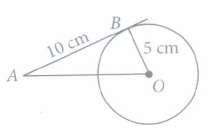
\(\Rightarrow \quad O A=\sqrt{10^{2}+5^{2}}=5 \sqrt{5} \mathrm{~cm}\)
(ii) (a) : \(O A=\sqrt{O P^{2}-A P^{2}} \text { (Given) }\)
\(=\sqrt{17^{2}-15^{2}}=\sqrt{64}=8 \mathrm{~cm}\)
(iii) (b): Length of tangent \(A P=\sqrt{O P^{2}-O A^{2}} \text { (Given) }\)
\(=\sqrt{25^{2}-7^{2}}=\sqrt{576}=24 \mathrm{~cm}\)
(iv) (b):
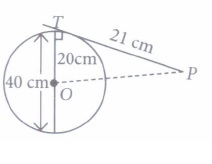
\(\text { Since, } O P=\sqrt{(P T)^{2}+(O T)^{2}}=\sqrt{21^{2}+20^{2}}=29 \mathrm{~cm}\)
(v) (a): Since, OP2 + PQ2 = OQ2
\(\Rightarrow\) 82 + x2 = (x + 2)2\(\Rightarrow\) 64 = 4x + 4\(\Rightarrow\) x = 15 cm
So, length of tangent, PQ = 15 cm.

10th Standard CBSE Syllabus & Materials
10th Standard CBSE
CBSE 10th Social Science PS - Federalism - New Model Questions Papers Study Material - QB365 Set A
NEW10th Standard CBSE
CBSE 10th Social Science PS - Power Sharing - New Model Questions Papers Study Material - QB365 Set A
NEW10th Standard CBSE
CBSE 10th Social Science GEO - Manufacturing Industries - New Model Questions Papers Study Material - QB365 Set A
NEW10th Standard CBSE
CBSE 10th Social Science GEO - Minerals and Energy Resources - New Model Questions Papers Study Material - QB365 Set A



NCERT Books

Syllabus

Exam Pattern

Sample Question Papers

Previous year Question Papers

Important Notes

MCQ Practice test

NCERT Exemplers

Case study Questions

Image Based Questions

Passage based Questions

HOT Questions

Value Based Questions

Model Questions Papers
NCERT ( Book Back ) Questions

Assertion and Reason
Important Questions And Answers

CBSE 10th Standard CBSE Subjects
CBSE Standards



