
 100% FREE ACCESS
10th Standard CBSE Syllabus & Materials
10th Standard CBSE
CBSE 10th Social Science ECO - Globalisation and the Indian Economy - New Model Questions Papers Study Material - QB365 Set A
NEW10th Standard CBSE
CBSE 10th Social Science ECO - Money and Credit - New Model Questions Papers Study Material - QB365 Set A
NEW10th Standard CBSE
CBSE 10th Social Science ECO - Sectors of the Indian Economy - New Model Questions Papers Study Material - QB365 Set A
NEW10th Standard CBSE
CBSE 10th Social Science ECO - Development - New Model Questions Papers Study Material - QB365 Set A
NEW10th Standard CBSE
CBSE 10th Social Science PS - Outcomes of Democracy - New Model Questions Papers Study Material - QB365 Set A
NEW10th Standard CBSE
CBSE 10th Social Science PS - Gender, Religion and Caste - New Model Questions Papers Study Material - QB365 Set A

Published on: 20/10/2025
Download CBSE Class 10th Standard CBSE Maths question papers, sample papers, important questions, and previous year solved papers in PDF format. Get free study materials, NCERT solutions, and exam preparation resources for Class 10th Standard CBSE Maths
Questions + Answers key
Take MCQ Maths Test
1.
Two circles with centres O and O' of radii 3cm and 4cm, respectively intersect at two points P and Q such that OP and O'P are tangents to the two circles.Find the length of the common chord PQ.
2.
In the figure, AB is diameter of a circle with centre O and QC is a tangent to the circle at C.If \(\angle CAB=30^0,\ find \ \angle CQA\ and \angle CBA.\)
-S.jpg)
3.
Prove that the angle between two tangents drawn from an external point to a circle is supplementary to the angle subtended by the line segment joining the points of contact at the centre.
4.
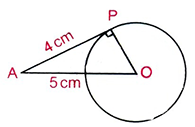
The length of a tangent from a point A at distance 5cm from the centre of the circle is 4cm.Find the radius of the circle.
5.
The tangent at any point of a circle is perpendicular to the radius through the point of contact.
6.
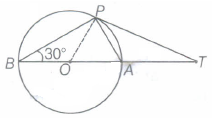
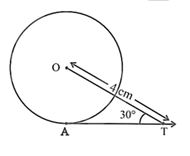
In the given figure, O is the centre of a circle, BOA is its diameter and the tangent at the point P meets BA extended at T. If \(\angle \)PBO = 30\(°\),then find \(\angle \)PTA.
7.
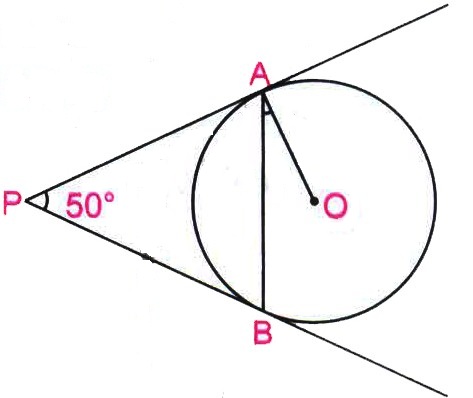
In figure, PA and PB are tangents to the circle with centre O such that\(\angle APB=50^0\).Write the measure of \(\angle OAB\)
8.
From a point P, the length of the tangent to a circle is 15cm and distance of P from the centre of the circle is 17cm.Then what is the radius of the circle?
9.
In the given figure, TA S is a tangent to the circle, with centre O, at the point A. If \(\angle OBA=32^0\), find the value of x.
-S.jpg)
10.
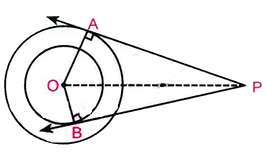
In figure, there are two concentric circles, with centre O and of radii 5cm and 3cm. From an external point P, tangents PA are drawn to these circles. If AP = 12cm, find the length of BP.
-S.jpg)
11.
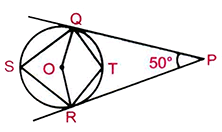
In the figure given below, find \(\angle QSR.\)
12.
Find the length of the tangent drawn from a point whose distance from the centre of a circle is 35 cm.Given that radius of the circle is 7cm.
13.
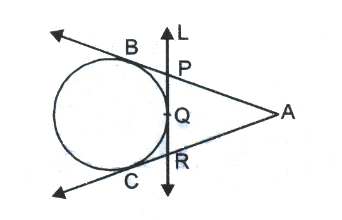
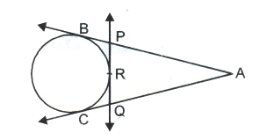
Two tangents are drawn to a circle from an external point A, touching the circle at B and C. From another point L, a third tangent is drawn to the circle intersecting AB in P and AC in R and touching the circle at Q. If AB = 32 cm, find the perimeter of \(\triangle APR\).
14.
Two tangents are drawn to a circle from an exterior point A, touching the circle at B and C. From another point R, on circle a third tangent is drawn to the circle intersecting AB in P and AC in Q and touching the circle at R. If AB = 20 units, find the perimeter of \(\triangle APQ\).
15.
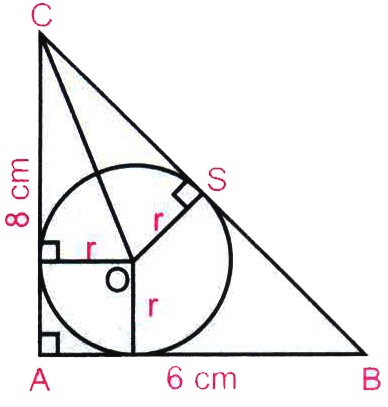
In the given figure, ABC is a right-angled triangle, right angled at A, with AB =6cm and AC=8cm.A circle with centre O has been inscribed inside the triangle Calculate the value of r, the radius of the inscribed circle.
16.
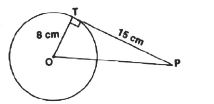
A tangent PQ at a point P of a circle of radius 5 cm meets a line through the centre O at a point Q, so that OQ= 12 cm. Length of PQ is
12 cm
13 cm
8.5 cm
\(\sqrt119\) cm
17.
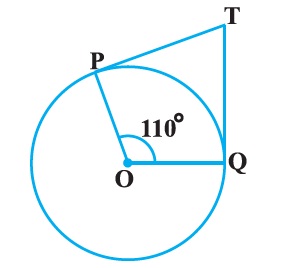
In the given figure, if TP and TQ are the two tangents to a circle with centre O so that \(\angle POQ\)= 110°, then \(\angle PTQ\) is equal to
60°
70°
80°
90°
18.
At one end A of a diameter AB of a circle of radius 5 cm, tangent XAY is drawn to the circle. The length of the chord CD parallel to XY and at a distance 8 cm from A, is
4 cm
5 cm
6 cm
8 cm
19.
If radii of two concentric circles are 4 cm and 5 cm, then length of each chord of one circle which is tangent to the other circle, is
3 cm
6 cm
9 cm
1 cm
20.
In the figure, Ab is a chord of length 16 cm, of a circle of radius 10 cm. The tangents at A and B intersect at a point P. Find the length of PA.
\(\frac { 20 }{ 5 } \)cm
\(\frac { 40 }{ 5 } \)cm
\(\frac { 20 }{ 3 } \)cm
\(\frac { 40 }{ 3 } \)cm
1.
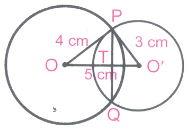
OP is tangent of the circle having centre O'
So \(\angle \)OPO' = 90°
[ ∵ Radius and tangent are to ⊥ each other at the point of contact]
In right-angled OPO'
OP = 4 cm
O'P = 3 cm [Given]
In right-angled \(\triangle\)OPO'
OP = 4 cm
O'P = 3 cm [Given]
OO'2 = OP2 + O'P2
= 42 + 32 = 16 + 9 = 25
OO' = 5 cm
If two circles intersect each other then line joining the two centre always ⊥ bisector of the common chord.
OO' ⊥ PQ and PT = TQ
Area of \(\triangle\) OO'P = \(1\over2\) x base x altitude
Here, base = 4 cm, attitude = 3 cm.
Area = \(1\over2\) x 4 x 3 = 6 cm2 ...(i)
But if base OO' = 5 cm altitude = PT
Area \(\triangle\)POO' = \(1\over2\) x 5 x altitude .....(ii)
6 cm2 = \(1\over2\)x 5 x altitude .....(ii)
Comparing (i) and (ii)
6 cm2 = \(1\over2\) x 5 x altitude
⇒ \(\frac { 2\times 6 }{ 5 } \) = Altitude
⇒ \(\frac { 12 }{ 5 } \) = PT
⇒ PQ = 2PT = \(\frac { 2\times 12 }{ 5 } =\frac { 24 }{ 5 } \)cm
So, length of common chord = \(24\over5\) cm
= 4.8 cm
2.
In \(\triangle\)AOC, OA = OC [Radii of the same circle]
∴ \(\angle \)ACO = \(\angle \)CAO = 30° [Opp Also angles of equal sides are equal.]
Also \(\angle \)ACB = 90° [Angle in semicircle]
∴ \(\angle \)OCB = 90° - 30° = 60°
In \(\triangle\)COB, OC = OB [Radii of the semicircle]
∴ \(\angle \)COB = \(\angle \)OBC = 60° [Opposite angles of equal sides]
Now OC ⊥ CQ
ஃ \(\angle \)OCQ = 90° ⇒ \(\angle \)BCQ = 90° - 60° = 30°
Also \(\angle \)OBC + \(\angle \)CBQ = 180°
⇒ 60°+\(\angle \)CBQ = 180° ⇒ CBQ = 120°
In \(\triangle\)CBQ
\(\angle \)BCQ + \(\angle \)CBQ + \(\angle \)CQB = 180°
⇒ 30° + 120° + CQB = 180° ⇒ CQB = 30°
\(\angle \)CQA = 30°
\(\angle \)CBA = 180° - \(\angle \)CBQ = 180° - 120° = 60°
3.
Let PQ and PR be two tangents drawn from an external point P to a circle with centre O.
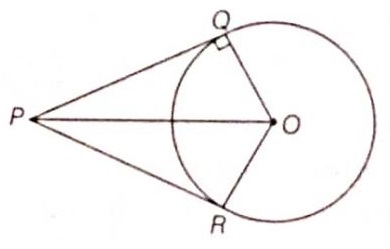
To prove \(\angle\)QOR = 180° – \(\angle\)QPR
or \(\angle\)QOR + \(\angle\)QPR = 180°
Proof In \(\Delta\)OQP and \(\Delta\)ORP,
PQ = PR [\(\because\) tangents drawn from an external point are equal in length]
OQ = OR [radii of circle]
OP = OP [common sides]
\(\therefore\) \(\Delta\)OQP \(\cong\) \(\Delta\)ORP [by SSS congruence rule]
Then, \(\angle\)QPO = \(\angle\)RPO [by CPCT]
and \(\angle\)POQ = \(\angle\)POR [by CPCT]
\(\left.\begin{array}{ll} \Rightarrow & \angle Q P R=2 \angle O P Q \\ \text { and } & \angle Q O R=2 \angle P O Q \end{array}\right\}\) ...(i)
Now, in right angled \(\Delta\)OQP, \(\angle\)QPO + \(\angle\)QOP = 90°
\(\Rightarrow\) \(\angle\)QOP = 90° - \(\angle\)QPO
\(\Rightarrow\) 2\(\angle\)QOP = 180°- 2 \(\angle\)QPO
[multiplying both sides by 2]
\(\Rightarrow\) \(\angle\)QOR = 180° - \(\angle\)QPR [from Eq. (i)]
\(\Rightarrow\) \(\angle\)QOR + \(\angle\)QPR = 180° Hence proved.
4.
OP = Radius of the circle OA = 5 cm; AP = 4 cm
OA2 = AP2 + OP2 [By pythagoras theorem]
52 = 42 + OP2
⇒ 25 = 16 + OP2 ⇒ 25 - 16 = OP2 ⇒ 9 = OP2 ⇒ OP = \(\sqrt9\) = 3
Radius = 3 cm
5.
We are given a circle with centre O and a tangent XY to the circle at a point P. We need to prove that OP is perpendicular to XY.
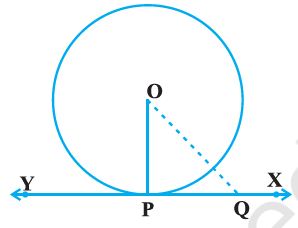
Take a point Q on XY other than P and join OQ see Fig.The point Q must lie outside the circle. (Why? Note that if Q lies inside the circle, XY will become a secant and not a tangent to the circle). Therefore, OQ is longer than the radius OP of the circle. That is, OQ > OP.
Since this happens for every point on the line XY except the point P, OP is the shortest of all the distances of the point O to the points of XY. So OP is perpendicular to XY.
6.
30\(°\)
7.
\(In\ \Delta APB,\ \angle BAP=\angle ABP\)
(angle opp. to equal side)
\(\angle BAP={1\over2}(180-\angle APB)={1\over2}(130^0)=65^0\)|
\(\angle OAP =90^0\)
\(\angle OAP =90^0-\angle BAP=90^0-65^0=25^0\)
8.
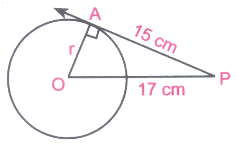
OAP = 90o
⇒ 172 = r2 + 152 [By pythagoras theorem]
⇒ r2 = 172 - 152 = (17 - 15)(17+15)
= 2 x 32
⇒ r2 = 64 ⇒ r = \(\pm \) 8 cm
Ignoring negative value as length cannot be negative.
⇒ r = 8 cm
9.
Given: TAS tangent to the circle with centre O at A.
\(\angle \)OBA = 32o
To find: x
Sol. In \(\triangle\)OAB OA=OB [RAdii of the same circle]
⇒ \(\angle \)1 = 32o [Angle opposite to equal sides of a triangle are equal]
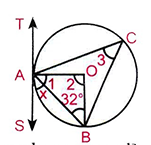
In OAB
\(\angle \)1 + \(\angle \)2 + 32o = 180o [Angle sum property of a triangle]
⇒ \(\angle \)2 + 32o + 32o = 180o ⇒ <2 = 180o - 64o = 116o
\(\angle \)3 = \(1\over2\)\(\angle \)2 = \(1\over2\) x 116o = 58o
TAS is tangent to the circle (Given)
\(\angle \)x = \(\angle \)ABC = 58o [Angles in the alternate segments are equal]
10.
PA = 12 cm, OA = 5 cm, OB = 3 cm
OP2 = OA2 + AP2 = OB2 + BP2
⇒ 25+14 = 9+BP2
⇒ 169-9 = BP2
⇒ BP = \(\sqrt{160}\) cm = 12.65 cm.(Approx.)
11.
In the figure given below, find \(\angle \)QSR.
Given: PQ and PR are tangents to a circle with centre O and
\(\angle \)QPR = 50
To find: QSR
sol. \(\angle \)QOR + \(\angle \)QPR = 180°
⇒ \(\angle \)QOR + 50° = 180°
⇒ \(\angle \)QOR = 130QOR
⇒ \(\angle \)QOR = \(1\over2\) \(\angle \)QSR [Degree measure theorem]
⇒ \(\angle \)QSR = \(1\over2\) x 130° = 65°
12.
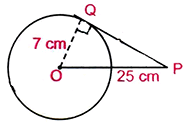
Let O is the centre of the circle and P is a point such that OP = 25 cm and PQ is the tangent to the circle.
OQ = radius = 7 cm
In \(\triangle\)OQP, we have \(\angle \)Q = 90°
OP2 = OQ2 + PQ2
⇒ (25)2 = 72 + PQ2 ⇒ PQ2 = 625 - 49 = 576
⇒ PQ = 24 cm
13.
64 cm
14.
40 units
15.
In right CAB
BC2 = AC2 + AB2 = 82 + 62
BC?2 = 100 ⇒ BC = 10 cm
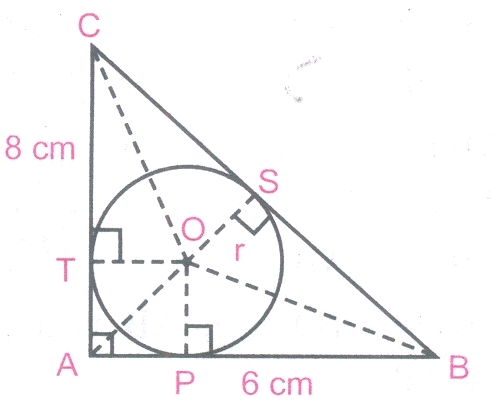
Area of \(\triangle\)CAB = \(1\over2\) x AB x AC
= \(1\over2\) x 6 x 8 = 24 cm2
Area of \(\triangle\)AOB = \(1\over2\) x AB x OP
= \(1\over2\)x 6 x r = 3r cm2
Area of \(\triangle\)AOC = \(1\over2\) x AC x OT
= \(1\over2\) x 8 x r = 4r cm2
Area of \(\triangle\)BOC = \(1\over2\)x BC x OS
= \(1\over2\) x 10 x 10 x r = 5r cm2
Now, area \(\triangle\)AOB + area \(\triangle\)AOC + area \(\triangle\)BOC = Area \(\triangle\)ABC
⇒ 3r + 4r + 5r = 24 ⇒ 12r = 24
ஃ r = 2 cm
16.
(d)
\(\sqrt119\) cm
17.
(b)
70°
18.
Given conditions are described in the diagram given below:
Now, as the perpendicular from centre to the chord of the same circle bisects that chord.
Hence, length of chord CD = 2EC = 2 x 4 = 8 cm
19.
Let C1 and C2 be the two concentric circles, with centre at O and respective radii being r1 = 4cm and r2 = 5cm.
Draw a chord AC of circle C2, to touch circle C1 at B.
Join OB.
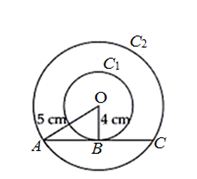
Here OB 丄 AC [As, tangent at any point of circle is perpendicular to radius through the point of contact]
Thus, in right angled OAB ,we have:
OA2 = AB2 + OB2 [By using phythagoras theorem]
⇒ 52 = AB2 + 42
⇒ AB2 = 25 - 16 = 9
∴ Length of chord AC = 2 AB = 2 x 3 = 6 cm
20.
(d)
\(\frac { 40 }{ 3 } \)cm

10th Standard CBSE Syllabus & Materials
10th Standard CBSE
CBSE 10th Social Science PS - Federalism - New Model Questions Papers Study Material - QB365 Set A
NEW10th Standard CBSE
CBSE 10th Social Science PS - Power Sharing - New Model Questions Papers Study Material - QB365 Set A
NEW10th Standard CBSE
CBSE 10th Social Science GEO - Manufacturing Industries - New Model Questions Papers Study Material - QB365 Set A
NEW10th Standard CBSE
CBSE 10th Social Science GEO - Minerals and Energy Resources - New Model Questions Papers Study Material - QB365 Set A



NCERT Books

Syllabus

Exam Pattern

Sample Question Papers

Previous year Question Papers

Important Notes

MCQ Practice test

NCERT Exemplers

Case study Questions

Image Based Questions

Passage based Questions

HOT Questions

Value Based Questions

Model Questions Papers
NCERT ( Book Back ) Questions

Assertion and Reason
Important Questions And Answers

CBSE 10th Standard CBSE Subjects
CBSE Standards



