
 100% FREE ACCESS
10th Standard CBSE Syllabus & Materials
10th Standard CBSE
CBSE 10th Social Science ECO - Globalisation and the Indian Economy - New Model Questions Papers Study Material - QB365 Set A
NEW10th Standard CBSE
CBSE 10th Social Science ECO - Money and Credit - New Model Questions Papers Study Material - QB365 Set A
NEW10th Standard CBSE
CBSE 10th Social Science ECO - Sectors of the Indian Economy - New Model Questions Papers Study Material - QB365 Set A
NEW10th Standard CBSE
CBSE 10th Social Science ECO - Development - New Model Questions Papers Study Material - QB365 Set A
NEW10th Standard CBSE
CBSE 10th Social Science PS - Outcomes of Democracy - New Model Questions Papers Study Material - QB365 Set A
NEW10th Standard CBSE
CBSE 10th Social Science PS - Gender, Religion and Caste - New Model Questions Papers Study Material - QB365 Set A

Published on: 21/10/2025
Download CBSE Class 10th Standard CBSE Maths question papers, sample papers, important questions, and previous year solved papers in PDF format. Get free study materials, NCERT solutions, and exam preparation resources for Class 10th Standard CBSE Maths
Questions + Answers key
Take MCQ Maths Test
1.
In the given figure, AC and AB are tangents to a circle centered at O. If \(\angle\)COD=120°, then \(\angle\)BAO is equal to
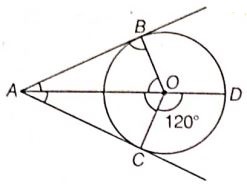
30°
60°
45°
90°
2.
In the given figure, a circle is touching a semi-circle at C and its diameter AB at O. If AB= 28 cm, what is the radius of the inner circle?
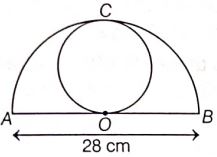
14 cm
28 cm
7 cm
\(\frac{7}{2}\)cm
3.
In the given figure, tangents PA and PB drawn from P to circle are inclined to each other at an angle of 80°.The measure of \(\angle\)PAB is
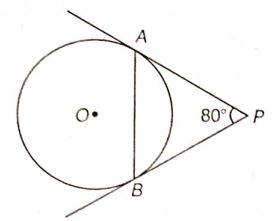
80°
60°
50°
40°
4.
If the mean of the following data is 18.75, then the value of p is
| x1 | 10 | 15 | p | 25 | 30 |
| f1 | 5 | 10 | 7 | 8 | 2 |
18.5
20
15
30
5.
Which measure of central tendency takes in account all the data?
Mean
Median
Mode
All of the above
6.
The value of the observation having greatest frequency is called____
Mean
Median
Mode
All of above
7.
A boy scored the following marks in various tests during a term, each test being marked out of 20 15, 17, 16, 7, 10, 12, 14, 16, 19, 12, 16. The median marks are
15
16
13
18
8.
| Expendicture | 0-10 | 10-20 | 20-30 | 30-40 | 40-50 |
| No. of families | 14 | 23 | 27 | 21 | 15 |
What is the mode of the given data?
25
27
22
21
9.
The mean of a data set with 12 observations is calculated as 19.25. If one more value is included in the data, then for the new data with 13 observations, mean becomes 20. The value of this 13th observation is
29
28
30
31
10.
In fig, area of shaded region is
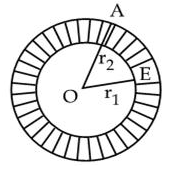
\(\pi \left( { r }_{ 1 }^{ 2 }+{ r }_{ 2 }^{ 2 } \right) \)
\(\pi \left( { r }_{ 1 }+{ r }_{ 2 } \right) \)
\(\pi \left( { r }_{ 1 }-{ r }_{ 2 } \right) \)
\(\pi \left( { r }_{ 2 }^{ 2 }+{ r }_{ 1 }^{ 2 } \right) \)
11.
In the figure, OACB represents a Quadrant of a circle of radius 3.5 cm with centre O. The area of the shaded region is
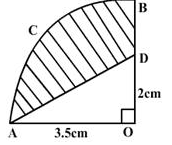
9.625 sq. cm
8.675 sq. cm
5.5 sq. cm
6.125 sq. cm
12.
A momento is made as shown in the figure. Its base shade is to be silver plated from the front at the rate of 20 per cm2. what is the total coast of silver plating?
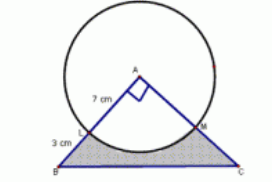
230
260
240
250
13.
In the given figure, ABCPA is a quadrant of a circle of radius 14cm. With AC as diameter, a semi-circle is drawn. Then the area of the shaded region will be
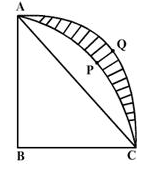
72 cm2
98 cm2
102 cm2
35 cm2
14.
ABCD is a square of side 10 cm. The area of the shaded region will be
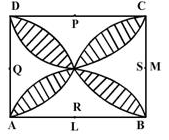
80 cm2
57 cm2
75 cm2
60 cm2
15.
The angle between two tangents drawn from an external point to a circle is 110°. The angle subtended at the centre by the segments joining the points of contact to the centre of circle is:
70o
90o
55o
110o
16.
PQ is a tangent drawn from a point P to a circle with centre O and QOR is a diameter of the circle such that ∠POR=120°, then ∠OPQ is
60o
30o
90o
45o
17.
How many tangents can be drawn to a circle from a point in its interior?
One
Infinite
None
Two
18.
The length of the tangent drawn from a point 8 cm away from the centre of a circle, of radius 6 cm, is :
10 cm
5 cm
√7 cm
2√7 cm
19.
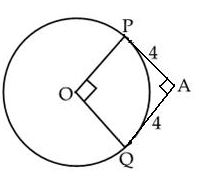
In the figure, the pair of tangents AP and AQ, drawn from an external point A to a circle with centre O, are perpendicular to each other and length of each tangent is 4 cm, then the radius of the circle is
10 cm
4 cm
7.5 cm
2.5 cm
20.
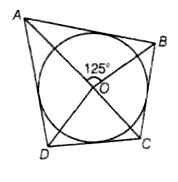
in figure , if ㄥAOB = 125o, then ㄥCOD is equal to
62o
45o
35o
55o
21.
As the demand for the products grew, a manufacturing company decided to hire more employees. For which they want to know the mean time required to complete the work for a worker. The following table shows the frequency distribution of the time required for each worker to complete a work.
| Time (in hours) | 15-19 | 20-24 | 25-29 | 30-34 | 35-39 |
| Number of workers | 10 | 15 | 12 | 8 | 5 |
Based on the above information, answer the following questions.
(i) The class mark of the class 25-29 is
| (a) 17 | (b) 22 | (c) 27 | (d) 32 |
(ii) If xi's denotes the class marks and fi's denotes the corresponding frequencies for the given data, then the value of \(\sum x_{i} f_{i}\) equals to
| (a) 1200 | (b) 1205 | (c) 1260 | (d) 1265 |
(iii) The mean time required to complete the work for a worker is
| (a) 22 hrs | (b) 23 hrs | (c) 24 hrs | (d) none of these |
(iv) If a worker works for 8 hrs in a day, then approximate time required to complete the work for a worker is
| (a) 3 days | (b) 4 days | (c) 5 days | (d) 6 days |
(v) The measure of central tendency is
| (a) Mean | (b) Median | (c) Mode | (d) All of these |
22.
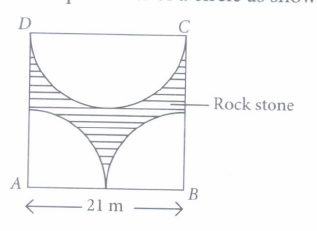
A builder of residential project have a vacant square land of side 21 m. He wants to make a temple in the shape of semi-circle and a park in the shape of two quadrants of a circle as shown in the figure.
Based on the above information, answer the following questions.
(i) Find the area of square.
| (a) 436 m2 | (b) 438 m2 | (c) 441 m2 | (d) 444 m2 |
(ii) Area of two quadrants, shown in figure, is
| (a) 170.25 m2 | (b) 173.25 m2 | (c) 175 m2 | (d) 178.25 m2 |
(iii) Find the area of semi-circular temple.
| (a) 163.25 m2 | (b) 168.25 m2 | (c) 173.25 m2 | (d) 178.25 m2 |
(iv) Find the area of unshaded region
| (a) 340.5 m2 | (b) 346.5 m2 | (c) 350.5 m2 | (d) 355.65 m2 |
(v) Find the area of shaded region
| (a) 88.5 m2 | (b) 90.5 m2 | (c) 92.5 m2 | (d) 94.5 m2 |
23.
For class 10 students, a teacher planned a game for the revision of chapter circles with some questions written on the board, which are to be answered by the students. For each correct answer, a student will get a reward. Some of the questions are given below .

Answer these questions to check your knowledge.
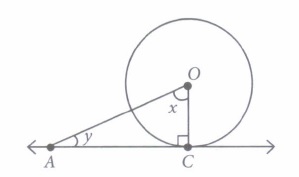
(i) In the given figure, x + y =
| (a) 60° | (b) 90° | (c) 120° | (d) 145° |
(ii) If PA and PB are two tangents drawn to a circle with centre O from P such that \(\angle\)PBA = 50°, then \(\angle\)OAB=
| (a) 50° | (b) 25° | (c) 40° | (d) 130° |
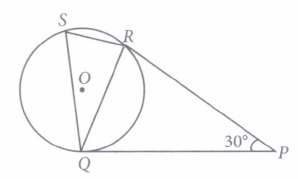
(iii) In the given figure, PQ and PR are two tangents to the circle, then \(\angle\)ROQ =
| (a) 30° | (b) 60° | (c) 105° | (d) 150° |
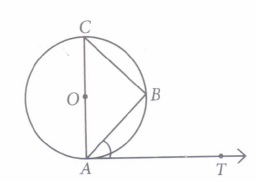
(iv) In the adjoining figure, AB is a chord of the circle and AOC is its diameter such that \(\angle\)ACB = 55°, then \(\angle\)BAT=
| (a) 35° | (b) 55° | (c) 125° | (d) 110° |
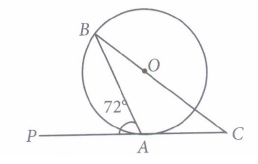
(v) In the adjoining figure, if PC is the tangent at A of the circle with \(\angle\)PAB = 72° and \(\angle\)AOB = 132°, then \(\angle\)ABC=
| (a) 18° | (b) 30° | (c) 60° | (d) can't be determined |
24.
Prem did an activity on tangents drawn to a circle from an external point using 2 straws and a nail for maths project as shown in figure.
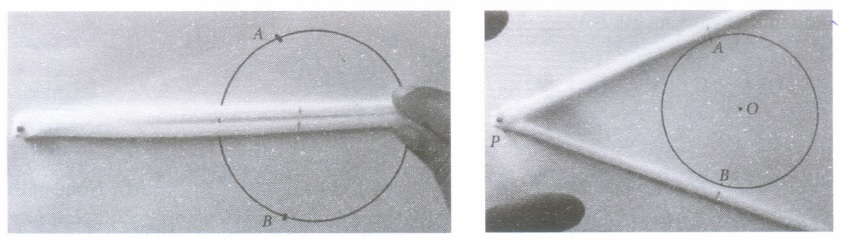
Based on the above information, answer the following questions.
(i) Number of tangents that can be drawn to a circle from an external point is
| (a) 1 | (b) 2 | (c) infinite | (d) any number depending on radius of circle |
(ii) On the basis of which of the following congruency criterion,\(\Delta \mathrm{OAP} \cong \Delta \mathrm{OBP} ?\)
| (a) ASA | (b) SAS | (c) RHS | (d) SSS |
(iii) If \(\angle\)AOB = 150°, then \(\angle\)APB =
| (a) 75° | (b) 30° | (c) 60° | (d) 100° |
(iv) If \(\angle\)APB = 40°, then \(\angle\)BAO =
| (a) 40° | (b) 30° | (c) 50° | (d) 20° |
(v) If \(\angle\)ABO = 45°, then which of the following is correct option?
| (a) \(A P \perp B P\) | (b) PAOB is square | (c) \(\angle\)AOB = 90° | (d) All of these |
1.
(a)
30°
2.
(c)
7 cm
3.
(c)
50°
4.
(b)
20
5.
(a)
Mean
6.
(c)
Mode
7.
(a)
15
8.
(b)
27
9.
(a)
29
10.
(d)
\(\pi \left( { r }_{ 2 }^{ 2 }+{ r }_{ 1 }^{ 2 } \right) \)
11.
(d)
6.125 sq. cm
12.
(a)
230
13.
14.
(b)
57 cm2
15.
(a)
70o
16.
(b)
30o
17.
(c)
None
18.
19.
(b)
4 cm
20.
Since, the opposite sides of a quadrilateral circumscribing a circle subtend supplementary angles at the centre of the circle.
i.e ㄥAOB + ㄥCOD = 180o
⇒ ㄥCOD =180o - ㄥAOB
⇒ ㄥCOD = = 180o - 125o = 55o
21.
(i) (c): Class mark of class 25 - 29
\(=\frac{25+29}{2}=\frac{54}{2}=27\)
(ii) (d): Let us consider the following table:
| Class | Class mark (xi) | Frequency (fi) | = xi fi |
| 15-19 | 17 | 10 | 170 |
| 20-24 | 22 | 15 | 330 |
| 25-29 | 27 | 12 | 324 |
| 30-34 | 32 | 8 | 256 |
| 34-39 | 37 | 5 | 185 |
| Total | \(\Sigma f_{i}=50\) | \(\sum x_{i} f_{i}=1265\) |
\(\therefore \quad \operatorname{Mean}(\bar{x})=\frac{\sum x_{i} f_{i}}{\sum f_{i}}=\frac{1265}{50}=25.3\)
Thus, the mean time to complete the work for a worker
= 25.3 hrs = 3 days
(iii) (d)
(iv) (a)
(v) (d): We know the measure of central tendency are mean, median and mode.
22.
(i) (c) : Area of square ABCD = 21 x 21 = 441 m2
(ii) (b) : Area of two quadrants \(=2\left(\pi r^{2} \times \frac{90^{\circ}}{360^{\circ}}\right)\)
\(=\frac{22}{7} \times \frac{21}{2} \times \frac{21}{2} \times \frac{1}{2}=173.25 \mathrm{~m}^{2}\)
(iii) (c) : Area of semi-circular temple \(=\frac{1}{2}\left(\pi r^{2}\right)\)
\(=\frac{1}{2} \times \frac{22}{7} \times \frac{21}{2} \times \frac{21}{2}=173.25 \mathrm{~m}^{2}\)
(iv) (b): Area of unshaded region =Area of semi-circle + Area of two quadrants
= 173.25 + 173.25 = 346.5 m2
(v) (d): Area of shaded region = Area of square - (Area of two quadrants + Area of semi -circle)
= 441 - 346.5 = 94.5 m2
23.
(i) (b):In \(\Delta\)OAC, \(\angle\)OCA = 90°
[Since, radius at the point of contact is perpendicular to tangent]
\(\therefore\) \(\angle\)OAC + \(\angle\)AOC = 90° \(\Rightarrow\) x + y = 90°
(ii) (c):
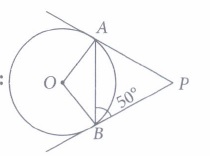
Since, OB \(\perp\) PB [Since, radius at the point of contact is perpendicular to tangent]
and \(\angle\)PBA = 50° (Given)
\(\therefore\) \(\angle\)OBA = 90° - 50° = 40°
Also, OA = OB [Radii of circle]
\(\therefore\) \(\angle\)OAB = \(\angle\)OBA = 40° [Angle opposite to equal sides are equal]
(iii) (d): In quadrilateral OQPR,
\(\angle\)ROQ + \(\angle\)RPQ = 180° [\(\because\)Angle between the two tangents drawn from an external point to a circle is supplementary to the angle subtended by the line segment joining the point of contact at the centre]
\(\Rightarrow\) LROQ = 180° - 30° = 150°
(iv) (b): Here, \(\angle\)ABC = 90° (Angle in a semicircle)
So, in \(\Delta\)ABC, \(\angle\)BAC = 180° - 90° - 55° = 35°
Also, \(\angle\)OA T = 90°
\(\Rightarrow\)\(\angle\)BAT + \(\angle\)OAB = 90° \(\Rightarrow\)\(\angle\)BAT = 90° - 35° = 55°
(v) (b): Here, \(\angle\)PAB = 72°
\(\therefore\) \(\angle\)OAB = 90° - 72° = 18°
Also, \(\angle\)AOB = 132° [Given]
Now, in \(\Delta\)OAB, \(\angle\)ABC = 180° - 132° - 18° = 30°
24.
(i) (b)
(ii) (c): In \(\Delta\)OAP and \(\Delta\)OBP,
\(\angle\)OAP = \(\angle\)OBP = 90°
[Since, radius at the point of contact is perpendicular to tangent]
OP = OP (Common)
OA = OB (Radii of circle)
So, \(\angle\)OAP == \(\angle\)OBP (By RHS congruency criterion)
(iii) (b): In quadrilateral OAPB, \(\angle\)AOB = 150° [Given]
\(\angle\)OAP = \(\angle\)OBP = 90°
\(\therefore\) \(\angle\)APB = 360° - 90° - 90° - 150° = 30°
(iv) (d): We have, \(\angle\)APB = 40°
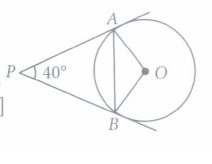
Now,PA =PB [Since, length of tangents drawn from an external point are equal]
In \(\Delta\)PAB, \(\angle\)PAB = \(\angle\)PBA = 70° [Angles opposite to equal sides are equal]
Also, \(\angle\)PAB + \(\angle\)BAO = 90°
[Since, radius at the point of contact is perpendicular to tangent]
\(\Rightarrow\) \(\angle\)BAO = 90° - 70° = 20°
(v) (d): We have, \(\angle\)ABO = 45°
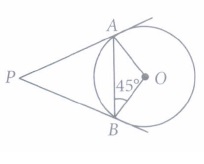
\(\because\) AO = OB (Radii of circle)
\(\therefore\) \(\angle\)BAO = \(\angle\)ABO = 45° [Angles opposite to equal sides are equal]
Now, in \(\Delta\)OAB,
\(\angle\)AOB = 180° - 45° - 45° = 90°
Since, \(\angle\)APB = 360° - 90° - 90° - 90° = 90° i.e., AP\(\perp\) BP
So, OAPB is a square.

10th Standard CBSE Syllabus & Materials
10th Standard CBSE
CBSE 10th Social Science PS - Federalism - New Model Questions Papers Study Material - QB365 Set A
NEW10th Standard CBSE
CBSE 10th Social Science PS - Power Sharing - New Model Questions Papers Study Material - QB365 Set A
NEW10th Standard CBSE
CBSE 10th Social Science GEO - Manufacturing Industries - New Model Questions Papers Study Material - QB365 Set A
NEW10th Standard CBSE
CBSE 10th Social Science GEO - Minerals and Energy Resources - New Model Questions Papers Study Material - QB365 Set A



NCERT Books

Syllabus

Exam Pattern

Sample Question Papers

Previous year Question Papers

Important Notes

MCQ Practice test

NCERT Exemplers

Case study Questions

Image Based Questions

Passage based Questions

HOT Questions

Value Based Questions

Model Questions Papers
NCERT ( Book Back ) Questions

Assertion and Reason
Important Questions And Answers

CBSE 10th Standard CBSE Subjects
CBSE Standards



