
 100% FREE ACCESS
10th Standard CBSE Syllabus & Materials
10th Standard CBSE
CBSE 10th Social Science ECO - Globalisation and the Indian Economy - New Model Questions Papers Study Material - QB365 Set A
NEW10th Standard CBSE
CBSE 10th Social Science ECO - Money and Credit - New Model Questions Papers Study Material - QB365 Set A
NEW10th Standard CBSE
CBSE 10th Social Science ECO - Sectors of the Indian Economy - New Model Questions Papers Study Material - QB365 Set A
NEW10th Standard CBSE
CBSE 10th Social Science ECO - Development - New Model Questions Papers Study Material - QB365 Set A
NEW10th Standard CBSE
CBSE 10th Social Science PS - Outcomes of Democracy - New Model Questions Papers Study Material - QB365 Set A
NEW10th Standard CBSE
CBSE 10th Social Science PS - Gender, Religion and Caste - New Model Questions Papers Study Material - QB365 Set A

Published on: 22/10/2025
Download CBSE Class 10th Standard CBSE Maths question papers, sample papers, important questions, and previous year solved papers in PDF format. Get free study materials, NCERT solutions, and exam preparation resources for Class 10th Standard CBSE Maths
Questions + Answers key
Take MCQ Maths Test
1.
Prove that \(\sqrt{\frac{\sec A+\tan A}{\sec A-\tan A}} \cdot \sqrt{\frac{\operatorname{cosec} A-1}{\operatorname{cosec} A+1}}=1\)
2.
In a \(\angle\)PQR, \(\angle\)Q = 90°. If PQ = 10 cm and PR = 15 cm. Then find the value of tan2 P + sec2 P + 1
3.
Prove that : \(\sec ^{ 4 }{ \theta } -\sec ^{ 2 }{ \theta } =\tan ^{ 4 }{ \theta } +\tan ^{ 2 }{ \theta } \)
4.
Find the ratio in which line segment joining A(1,-5) and B(-4,5) is divided by the x-axis. Also, find the coordinates of the points of division.
5.
The centre of a circle is \((2\alpha -1,7)\) and it passes through the point (-3,-1). If the diameter of the circle is 20 units, then find the value of \(\alpha\)
6.
Evaluate the following : \(\frac { \sec ^{ 2 }{ \left( { 90 }^{ ° }-\theta \right) -\cot ^{ 2 }{ \theta } } }{ 2\left( \sin ^{ 2 }{ { 25 }^{ ° } } +\sin ^{ 2 }{ { 65 }^{ ° } } \right) } -\frac { 2\cos ^{ 2 }{ { 60 }^{ ° }\tan ^{ 2 }{ { 28 }^{ ° }\tan ^{ 2 }{ { 62 }^{ ° } } } } }{ 3\left( \sec ^{ 2 }{ { 43 }^{ ° } } -\cot ^{ 2 }{ { 47 }^{ ° } } \right) } \)
7.
The angle of elevation of a jet fighter from point A on ground is 60°. After flying 10 seconds, the angle changes to 30°. If the jet is flying at a speed of 648 kin/hour, find the constant height at which the jet is flying.
8.
Verify : \(\sqrt { \frac { 1-\cos { \theta } }{ 1+\cos { \theta } } } =\frac { \sin { \theta } }{ 1+\cos { \theta } } ,\quad for\quad \theta ={ 60 }^{ ° }\)
9.
Find the value of y, if the distance between the points (2,y) and (-4,3) is 10.
10.
Find the ratio in which the line 2x+3y-5=0 divides the line segment joining the points (8,-9) and (2,1). Also, find the coordinates of the point of division.
11.
The coordinates of A and B are (-3,3) and (12,-7) respectively. P is a point which divides AB in the ratio AP:AB=2:5 find the coordinates of P.
12.
ABCD is a rectangle formed by the points A(–1, –1), B(– 1, 4), C(5, 4) and D(5, – 1). P, Q, R and S are the mid-points of AB, BC, CD and DA respectively. Is the quadrilateral PQRS a square? a rectangle? or a rhombus? Justify your answer.
13.
Find the area of a triangle formed by the points A(5, 2), B(4, 7) and C (7, – 4).
14.
The angle of elevation of the top of a building from the foot of the tower is 30°and the angle of elevation of the top of the tower from the foot of the building is 60°.If the tower is 60m high, find the height of the building.
15.
If \(\triangle ABC\) is right angles at C, find the value of cos (A + B).
16.
(cos4 A - sin4 A) on simplified form, gives
2 sin2 A - 1
2 sin2 A + 1
2 cos2 A + 1
2 cos2 A - 1
17.
\(\frac{2 \tan 30^{\circ}}{1+\tan ^2 30^{\circ}}\) is equal to
sin 60°
cos 60°
tan 60°
Sin 30°
18.
The point that divides the line segment joining the points (7,-6) and (3,4) in ratio 1 : 2 internally lies in which quadrant?
I quadrant
II quadrant
III quadrant
IV quadrant
19.
The point of intersection of the line represented by 3x - y = 3 and Y -axis is given by
(0,-3)
(0,3)
(2,0)
(-2,0)
20.
The distance between the points \(P\left(-\frac{11}{3}, 5\right)\) and \(Q\left(-\frac{2}{3}, 5\right)\) is
6 units
2 units
4 units
3 units
21.
The distance between the points (a cos θ + b sin θ, 0) and (0, a sin θ - b cosθ), is
a2 + b2
a2 - b2
\(\sqrt{a^2 + b^2}\)
\(\sqrt{a^2 - b^2}\)
22.
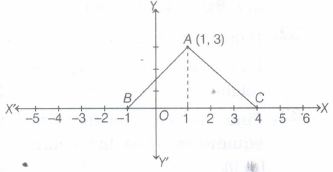
In the given figure, the area of \(\triangle A B C\) in sq units is
15
10
7.5
2.5
23.
If sin\(\theta\) + sin2\(\theta\) + sin3\(\theta\) = 1,then cos 6\(\theta\) - 4 cos4\(\theta\) + 8 cos2\(\theta\) is equal to
1
2
3
4
24.
If sin \(\theta=\frac{a}{b},\) then cos \(\theta\) is equal to
\(\frac{b}{\sqrt{b^{2}-a^{2}}}\)
\(\frac{b}{a}\)
\(\frac{\sqrt{b^{2}-a^{2}}}{b}\)
\(\frac{a}{\sqrt{b^{2}-a^{2}}}\)
25.
If A + B = 90°, then, cosA.cosecB – cosA.sinB =
2 sin A
sin2 A
cos A2
cos 2A
26.
If sinθ = cosθ, then the value of θ is:
45°
30°
90°
60°
27.
If tan\(\theta =\frac { 12 }{ 5 } \) then\(\frac { 1+sin\theta }{ 1-sin\theta } \) is equal to
9
12/13
24
25
28.
If A and B are the angles of a right angled triangle ABC, right angled at C then 1+cot2A=
cot2B
tan2B
cos2B
sec2B
29.
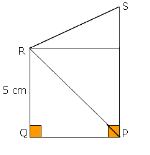
In given figure, if RP = 13 cm, QR = 5 cm and PS = 14 cm, then, tan S =In given figure, if RP = 13 cm, QR = 5 cm and PS = 14 cm, then, tan S =
4/3
9/4
8/4
5/4
30.
The values of x and y, if the distance of the point (x,y) from (-3,0) as well as from (3,0) is 4 are
x = 1, y = 7
x = 2, y = 7
x = 0, y = – √7
x = 0, y = ± √7
31.
If the four points (0,-1), (6,7),(-2,3) and (8,3) are the vertices of a rectangle, then its area is
40√5 sq. units
12 sq. units
10 sq. units
13 sq. units
32.
In what ratio of line x – y – 2 = 0 divides the line segment joining (3, –1) and (8, 9)?
1:2
2:1
2:3
1:3
33.
Find the value of k if the points A(2, 3), B(4, k) and C(6, –3) are collinear
2
3
0
1
34.
If P(-1, 1)is the mid-point of the line segment joining A (-3, b) and B (1, b + 4), then value of bis 1.
35.
cos (A + B) = cos A + cos B
36.
If tan A = 3/4, then find the value of \(\frac{1}{\sin A}+\frac{1}{\cos A}\).
37.
To conduct Sports Day activities, in your rectangular shaped school ground ABCD, lines have been drawn with chalk powder at a distance of 1m each. 100 flower pots have been placed at a distance of 1m from each other along AD, as shown in the below figure. Niharika runs 1/4 th the distance AD on the 2nd line and posts a green flag. Preet runs 1/5 th the distance AD on the eighth line and posts a red flag.
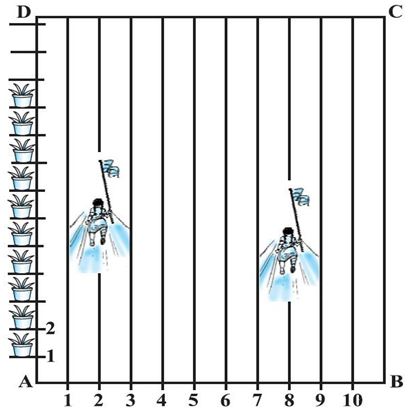
(a) At what distance Niharika posted the green flag from the starting point of second line?
| (i) 20m | (ii) 25 m | (iii) 100 m | (iv) 50 m |
(b) At what distance Preet posted the green flag from the starting point of eighth line?
| (i) 20 m | (ii) 25m | (iii) 100m | (iv) 50 m |
(c) What is the distance between both the flags?
| (i) \(\sqrt{6} 1 \mathrm{~m}\) | (ii) \(\sqrt{101}\) | (iii) \(\sqrt{5} 1 \mathrm{~m}\) | (iv) \(\sqrt{11} \mathrm{~m}\) |
(d) If Rashmi has to post a blue flag exactly halfway between the line segments joining the two flags, where should she post her flag?
| (i) (5, 5) | (ii) (22.5, 5) | (iii) (5, 22.5) | (iv) none of these |
(e) If Shweta has to post a white flag exactly halfway between the line segments joining A and red flag, where should she post her flag?
| (i) (1, 5) | (ii) (12.5, 1) | (iii) (1, 22.5) | (iv) (1, 12.5) |
38.
Ritu's daughter is feeling so hungry and so thought to eat something. She looked into the fridge and found some bread pieces. She decided to make a sandwich. She cut the piece of bread diagonally and found that it forms a
righ.t angled triangle with sides 4 cm, 4\(\sqrt{3}\) cm and 8 cm.
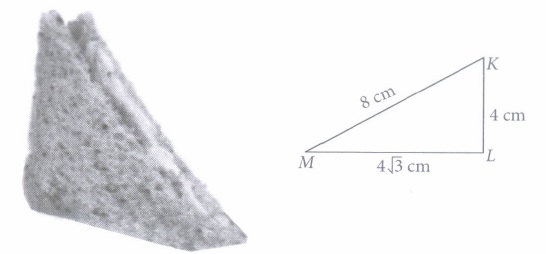
On the basis of above information, answer the following questions.
(i) The value of \(\angle\)M =
| (a) 30° | (b) 60° | (c) 45° | (d) None of these |
(ii) The value of \(\angle\)K =
| (a) 45° | (b) 30 ° | (c) 60° | (d) None of these |
(iii) Find the value of tanM.
| \((a) \sqrt{3}\) | \((b) \frac{1}{\sqrt{3}}\) | (c) 1 | (d) None of these |
(iv) sec2M - 1 =
| (a) tanM | (b) tan2M | (c) tan2M | (d) None of these |
(v) The value of \(\frac{\tan ^{2} 45^{\circ}-1}{\tan ^{2} 45^{\circ}+1}\) is
| (a) 0 | (b) 1 | (c) 2 | (d) -1 |
1.
Use \(\sec A=\frac{1}{\cos A}, \quad \tan A=\frac{\sin A}{\cos A}\) and \(\operatorname{cosec} A=\frac{1}{\sin A}\) in LHS of given equation and simplify.
2.
Use Pythagoras theorem to find QR and then find sec P, tan P and put in given expression
\(\frac{9}{2}\)
3.
To prove \(\sec ^{ 4 }{ \theta } -\sec ^{ 2 }{ \theta } =\tan ^{ 4 }{ \theta } +\tan ^{ 2 }{ \theta } \)
LHS = \(\sec ^{ 4 }{ \theta } -\sec ^{ 2 }{ \theta } \)
\(=\sec ^{ 2 }{ \theta } \left( \sec ^{ 2 }{ \theta } -1 \right) \)
\(\left[ \because \quad 1+\tan ^{ 2 }{ \theta } =\sec ^{ 2 }{ \theta } \right] \)
\(=\sec ^{ 2 }{ \theta } \left( \tan ^{ 2 }{ \theta } \right) \)
\(=\left( 1+\tan ^{ 2 }{ \theta } \right) \tan ^{ 2 }{ \theta } \)
\(=\tan ^{ 2 }{ \theta } \tan ^{ 4 }{ \theta } \)
= RHS
4.
Let P(x,0) divide the line segment AB in the ratio k:1

y-coordinate \(y=\frac { k\times \left( -4 \right) +1\times \left( 1 \right) }{ k+1 } ,\quad y=\frac { -4k+1 }{ k+1 } \)
on x-axis y=0 , \(\therefore \quad 0=\frac { k(5)+1(-5) }{ k-1 } \)
\(0=5k-5\quad \Rightarrow \quad 5k=5\quad \Rightarrow \quad k=1\)
Hence the required ration is 1:1, at point \(\left( \frac { -3 }{ 2 } ,0 \right) \) .
5.
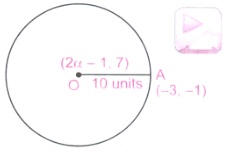
OA = 10 units
\(\Rightarrow \ OA=\sqrt { { (2\alpha -1+3 })^{ 2 }+(7+1)^{ 2 } } \)
\(\Rightarrow \ 10=\sqrt { 4{ \alpha }^{ 2 }+4+8\alpha +64 } \)
Squaring \(100\ =\ { 4\alpha }^{ 2 }+8\alpha +68\)
\(\Rightarrow \ { 4\alpha }^{ 2 }+8\alpha -32=0\ \Rightarrow \ { \alpha }^{ 2 }+2\alpha -8=0\)
\(\Rightarrow \ { \alpha }^{ 2 }+4\alpha -2\alpha -8=0\ \Rightarrow \alpha (\alpha +4)-2(\alpha +4)=0\ \Rightarrow \ (\alpha +4)(\alpha -2)=0\)
\(\\ \alpha =-4\ ,\ \alpha =2\)
6.
\(\frac { \sec ^{ 2 }{ \left( { 90 }^{ ° }-\theta \right) -\cot ^{ 2 }{ \theta } } }{ 2\left( \sin ^{ 2 }{ { 25 }^{ ° } } +\sin ^{ 2 }{ { 65 }^{ ° } } \right) } -\frac { 2\cos ^{ 2 }{ { 60 }^{ ° }\tan ^{ 2 }{ { 28 }^{ ° }\tan ^{ 2 }{ { 62 }^{ ° } } } } }{ 3\left( \sec ^{ 2 }{ { 43 }^{ ° } } -\cot ^{ 2 }{ { 47 }^{ ° } } \right) } \)
\(=\frac { \left( { cosec }^{ 2 }\theta -\cot ^{ 2 }{ \theta } \right) }{ 2\left( \sin ^{ 2 }{ { 25 }^{ ° } } +\cos ^{ 2 }{ { 25 }^{ ° } } \right) } -\frac { 2\times \frac { 1 }{ 2 } \times \frac { 1 }{ 2 } \tan ^{ 2 }{ { 28 }^{ ° } } \times \cot ^{ 2 }{ { 28 }^{ ° } } }{ 3\left[ \sec ^{ 2 }{ { 43 }^{ ° } } -\tan ^{ 2 }{ { 43 }^{ ° } } \right] } \)
\(=\frac { 1 }{ 2\times \left( 1 \right) } -\frac { \frac { 1 }{ 2 } \times \tan ^{ 2 }{ { 28 }^{ ° }\times \frac { 1 }{ \tan ^{ 2 }{ { 28 }^{ ° } } } } }{ 3 } \)
\(=\frac{1}{2}-\frac{1}{6}=\frac{1}{3}\)
7.
In 3600 see distance travelled by plane = 648000 m
In 10 see distance travelled by plane -\(\frac { 648000 }{ 360 } \)
= 18000 m
In \(\Delta\)ABC,
\(\frac { h }{ x } =tan\quad 60°\)
\(\frac { h }{ x } =\sqrt { 3 } ,\)
\(\Rightarrow \quad h=x\sqrt { 3 } \quad ...(i)\)
In \(\Delta\)ABC,
\(\frac { h }{ x+1800 } =tan\quad 30°\)
\(\frac { h }{ x+1800 } =\frac { 1 }{ \sqrt { 3 } } \)
\(\Rightarrow \quad h=\frac { x+1800 }{ \sqrt { 3 } } \) ....(ii)
From equations (i) and (ii), we get
\(x\sqrt { 3 } =\frac { x+1800 }{ \sqrt { 3 } } \)
\(\Rightarrow\) 3x = x + 1800
\(\Rightarrow\) 2x = 1800
\(\Rightarrow\) x = 900 m
h = x\(\sqrt { 3 } \)
= 900 \(\times\) 1.732
= 1558.8 m
\(\therefore\) Height of jet = 1558.8 m.
8.
LHS = \(\sqrt { \frac { 1-\cos { \theta } }{ 1+\cos { \theta } } } =\sqrt { \frac { 1-\frac { 1 }{ 2 } }{ 1+\frac { 1 }{ 2 } } } \left( \because \quad \cos { { 60 }^{ ° } } =\frac { 1 }{ 2 } \right) \)
\(=\sqrt { \frac { \frac { 1 }{ 2 } }{ \frac { 3 }{ 2 } } } =\frac { 1 }{ \sqrt { 3 } } \)
RHS \(=\frac { \sin { \theta } }{ 1+\cos { \theta } } =\frac { \sin { { 60 }^{ ° } } }{ 1+\cos { { 60 }^{ ° } } } \)
\(=\frac { \frac { \sqrt { 3 } }{ 2 } }{ 1+\frac { 1 }{ 2 } } =\frac { \frac { \sqrt { 3 } }{ 2 } }{ \frac { 3 }{ 2 } } \)
\(=\frac { 1 }{ \sqrt { 3 } } =LHS\)
Hence relation is verified for \(\theta ={ 60 }^{ ° }\)
9.
Let points are A(2,y) and B(-4,3). Here, (x1,y1)=(2,y) and (x2,y2) = (-4,3)
\(\therefore\) Distance between two points,
\(AB=\sqrt { { \left( { x }_{ 1 }-{ x }_{ 2 } \right) }^{ 2 }+{ \left( { y }_{ 1 }-{ y }_{ 2 } \right) }^{ 2 } } \) [ by distance formula]
\(\Rightarrow AB\sqrt { ({ 2+4) }^{ 2 }+{ (y-3 })^{ 2 } } \)
\(\Rightarrow 10=\sqrt { { (6) }^{ 2 }+{ (y) }^{ 2 }+9-6y } \)
[\(\because \)AB-10 and (a-b)2-a2+b2 -2ab]
On squariing both sides, we get
100=36+y2+9-6y
\(\Rightarrow \)100 = 45 + y2 - 6y
\(\Rightarrow \)y2-6y-55 = 0
\(\Rightarrow \)y2-11y+5y-55=0 [by factorisation]
\(\Rightarrow \)y(y-11) +5(y-11) = 0
\(\Rightarrow \) (y-11)(y+5) = 0
\(\Rightarrow \) y-11=0 or y+5=0
\(\Rightarrow \)y = 11 or y = -5
Hence, the required value of y are 11 and -5.
10.
Let the line 2x+3-5=0 divides the line segement joining the points (8,-9)and (2,1) in the ration k:1
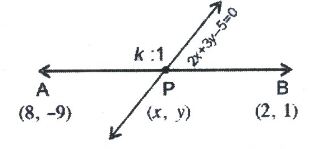
\(\therefore \) \(P\left( \frac { 2k+8 }{ k+1 } ,\frac { k-9 }{ k+1 } \right) \) =P(x,y)
Thus, x= \(\frac { 2k+8 }{ k+1 } \) and y= \(\frac { k-9 }{ k+1 } \)
point P(x,y) lies on the given line
\(\therefore \)\(2\left( \frac { 2k+8 }{ k+1 } \right) +3\left( \frac { k-9 }{ k+1 } \right) -5=0\)
4k+16+3k-27-5k-5=0
2k=16 \(\Rightarrow \) k=8
Thus,the required ration is 8:1
Point of division is given as
\(P\left( \frac { 2(8)+8 }{ 8+1 } ,\frac { 8-9 }{ 8+1 } \right) i.e\quad P\left( \frac { 8 }{ 3 } ,\frac { -1 }{ 9 } \right) \)
11.
P(3,-1)
12.
P is the mid point of side AB
Therefore the coordinates of P are ((-1-1)/2,(-1+4)/2) = (-1, 3/2)
Similary the coordinates of Q , R and S are (2,4),(5, 3/2), and (2, -1) respectilvely
Length of \(\mathrm{PQ}=\sqrt{(-1-2)^{2}+\left(\frac{3}{2}-4\right)^{2}}=\sqrt{9+\frac{25}{4}}=\sqrt{\frac{61}{4}}\)
Length of \(\mathrm{QR}=\sqrt{(2-5)^{2}+\left(4-\frac{3}{2}\right)^{2}}=\sqrt{9+\frac{25}{4}}=\sqrt{\frac{61}{4}}\)
Length of \(R S=\sqrt{(5-2)^{2}+\left(\frac{3}{2}+1\right)^{2}}=\sqrt{9+\frac{25}{4}}=\sqrt{\frac{61}{4}}\)
Length of \(S P=\sqrt{(2+1)^{2}+\left(-1-\frac{3}{2}\right)^{2}}=\sqrt{9+\frac{25}{4}}=\sqrt{\frac{61}{4}}\)
Length of \(Q S=\sqrt{(2-2)^{2}+(4+1)^{2}}=5\)
It can be observed that all sides of the given quadrilateral are of the same measure. However, the diagonals are of different lengths. Therefore, PQRS is a rhombus.
13.
The area of the triangle formed by the vertices A(5, 2), B(4, 7) and C (7, – 4) is given by
\(\frac{1}{2}[5(7+4)+4(-4-2)+7(2-7)]\)
\(=\frac{1}{2}(55-24-35)=\frac{-4}{2}=-2\)
Since area is a measure, which cannot be negative, we will take the numerical value of – 2, i.e., 2. Therefore, the area of the triangle = 2 square units.
14.
In \(\Delta ABD\),
tan 60°=\(\frac{AB}{BD}\)
\(\sqrt{3}\)=\(\frac{60}{x}\)
x=\(\frac { 60 }{ \sqrt { 3 } } \)
=20\(\sqrt{3}\)
Now, in \(\Delta ABCD\),
tan 30° =\(\frac{CD}{BD}\)
\(\frac { 1 }{ \sqrt { 3 } } =\frac { h }{ 20\sqrt { 3 } } \)
\(h=\frac { 20\sqrt { 3 } }{ \sqrt { 3 } } \)
h = 20m
Height of the building is 20 m.
15.
\(A+B+C={ 180 }^{ 0 }\Rightarrow A+B={ 180 }^{ 0 }-C\Rightarrow A+B={ 90 }^{ 0 }\)
16.
(d)
2 cos2 A - 1
17.
(a)
sin 60°
18.
(d)
IV quadrant
19.
(b)
(0,3)
20.
(d)
3 units
21.
(c)
\(\sqrt{a^2 + b^2}\)
22.
(c)
7.5
23.
(d)
4
24.
(c)
\(\frac{\sqrt{b^{2}-a^{2}}}{b}\)
25.
(b)
sin2 A
26.
(a)
45°
27.
(d)
25
28.
(d)
sec2B
29.
(a)
4/3
30.
(d)
x = 0, y = ± √7
31.
(a)
40√5 sq. units
32.
(c)
2:3
33.
(c)
0
34.
(b)
35.
(b)
36.
Given, \(\tan A=\frac{3}{4}\)
\(\tan A=\frac{P}{B}\)
\(\Rightarrow \quad P=3 k \text { and } B=4 k\)
\(\text { As, } \quad H=\sqrt{(3 k)^2+(4 k)^2}=5 k\)
\(\sin A=\frac{P}{H}=\frac{3 k}{5 k}=\frac{3}{5}\)
\(\cos A=\frac{B}{H}=\frac{4 k}{5 k}=\frac{4}{5}\)
\(\frac{1}{\sin A}+\frac{1}{\cos A}=\frac{5}{3}+\frac{5}{4}=\frac{20+15}{12}=\frac{35}{12}\)
37.
(a) (ii) Distance covered by Niharika
= Niharika runs \(\frac{1}{4}\) distance AD on the 2nd line
= \(\frac{1}{4} \times 100=25 \mathrm{~m}\)
(b) (i) Distance covered by Preet
= Preet runs \(\frac{1}{5}\) th distance AD on the 8 th line
= \(\frac{1}{5} \times 100=20 \mathrm{~m}\)
(c) (i) Distance between Green and Red flags
= \(\)\(\sqrt{(8-2)^{2}+(20-25)^{2}}\)
= \(\sqrt{36+25}=\sqrt{61} \mathrm{~m}\)
(d) (iii)Position of blue flag
= Mid-point of green flag and red flag
= \(\left(\frac{2+8}{2}, \frac{25+20}{2}\right)=(5,22.5)\)
(e) (iv) (1,12,5)
38.
We have, KL = 4 cm, ML = 4\(\sqrt{3}\)m, KM = 8 cm
(i) (a): \(\tan M=\frac{K L}{L M}=\frac{4}{4 \sqrt{3}}=\frac{1}{\sqrt{3}}\)
\(\Rightarrow \tan M=\tan 30^{\circ} \Rightarrow \angle M=30^{\circ}\)
(ii) (c) : \(\tan K=\frac{M L}{K L}=\frac{4 \sqrt{3}}{4}=\sqrt{3}=\tan 60^{\circ}\)
\(\Rightarrow \angle K=60^{\circ}\)
(iii) (b)
(iv) (c)
(v) (a) : \(\frac{\tan ^{2} 45^{\circ}-1}{\tan ^{2} 45^{\circ}+1}=\frac{(1)^{2}-1}{1^{2}+1}=\frac{0}{2}=0\)

10th Standard CBSE Syllabus & Materials
10th Standard CBSE
CBSE 10th Social Science PS - Federalism - New Model Questions Papers Study Material - QB365 Set A
NEW10th Standard CBSE
CBSE 10th Social Science PS - Power Sharing - New Model Questions Papers Study Material - QB365 Set A
NEW10th Standard CBSE
CBSE 10th Social Science GEO - Manufacturing Industries - New Model Questions Papers Study Material - QB365 Set A
NEW10th Standard CBSE
CBSE 10th Social Science GEO - Minerals and Energy Resources - New Model Questions Papers Study Material - QB365 Set A



NCERT Books

Syllabus

Exam Pattern

Sample Question Papers

Previous year Question Papers

Important Notes

MCQ Practice test

NCERT Exemplers

Case study Questions

Image Based Questions

Passage based Questions

HOT Questions

Value Based Questions

Model Questions Papers
NCERT ( Book Back ) Questions

Assertion and Reason
Important Questions And Answers

CBSE 10th Standard CBSE Subjects
CBSE Standards



