
 100% FREE ACCESS
10th Standard CBSE Syllabus & Materials
10th Standard CBSE
CBSE 10th Social Science ECO - Globalisation and the Indian Economy - New Model Questions Papers Study Material - QB365 Set A
NEW10th Standard CBSE
CBSE 10th Social Science ECO - Money and Credit - New Model Questions Papers Study Material - QB365 Set A
NEW10th Standard CBSE
CBSE 10th Social Science ECO - Sectors of the Indian Economy - New Model Questions Papers Study Material - QB365 Set A
NEW10th Standard CBSE
CBSE 10th Social Science ECO - Development - New Model Questions Papers Study Material - QB365 Set A
NEW10th Standard CBSE
CBSE 10th Social Science PS - Outcomes of Democracy - New Model Questions Papers Study Material - QB365 Set A
NEW10th Standard CBSE
CBSE 10th Social Science PS - Gender, Religion and Caste - New Model Questions Papers Study Material - QB365 Set A

Published on: 22/10/2025
Download CBSE Class 10th Standard CBSE Maths question papers, sample papers, important questions, and previous year solved papers in PDF format. Get free study materials, NCERT solutions, and exam preparation resources for Class 10th Standard CBSE Maths
Questions + Answers key
Take MCQ Maths Test
1.
Name the type of quadrilateral formed, if any, by the following points, and give reasons for your answer. (4,5), (7,6), (4,3), (1,2)
2.
Show that the points (a,a), (-a, -a) and \(\left( -\sqrt { 3 } a,\sqrt {3 } a \right) \) are the vertices of an equidistant triangle.
3.
If P(2,1), Q(4,2), R(5,4) and S(3,3) are vertices of a quadrilateral, find the area of the quadrilateral PQRS.
4.
If the points (10,5),(8,4) and (6,6) are the mid-points of the sides of a triangle, find its vertices.
5.
Find the relation between x and y such that the point (x,y) is equidistant from the points (7,1) and (3,5).
6.
Find the coordinates of the point which divies the line segment joining the points (3,4) and (-5, -7) internally in the following ratios 2 : 3.
7.
If A(4, -1), B(5, 3), C(2, y) and D(1, 1) are the vertices a parallelogram ABCD, find y.
8.
Find the ratio in which the line segment joining the points A(3, -3) and B(-2, 7) is divided by x-axis. Also find the co-ordinate of point of division.
9.
Find the ratio in which the line segment joining (2,-3) to and (5, 6) is divided by X-axis.
1 : 2
2 : 1
2 : 5
5 : 2
10.
The perpendicular bisector of a line segment A(-8,0) and B(8,0) passes through a point (0, k). The value of k is
0 only
0 or 8 only
any real number
any non-zero real number
11.
The condition that the point (x,y) may lie on the line joining (3,4) and (-5,-6) is
-5x+4y+1=0
-5x-4y+1=0
5x+4y+1=0
5x-4y+1=0
12.
The perimeter of a triangle with vertices (0, 4) (0, 0) and (3, 0) is
15
12
8
10
13.
Find the coordinates of the point equidistant from the points A(5, 1), B(–3, –7) and C(7, –1)
(2, –4)
(3, –6)
(4, 7)
(8, –6)
14.
Assertion: Three points A, B and C are such that AB + BC > AC, then they are collinear.
Reason: Three points are collinear if they lie on a straight line.
Codes :
(a) If both Assertion and Reason are correct and Reason is the correct explanation of Assertion.
(b) If both Assertion and Reason are correct, but Reason is not the correct explanation of Assertion.
(c) If Assertion is correct but Reason is incorrect.
(d) If Assertion is incorrect but Reason is correct.
15.
Aditya asked carpenter to make front door of his guest house. The carpenter suggested him a design which is plotted on a graph as shown in below figure:
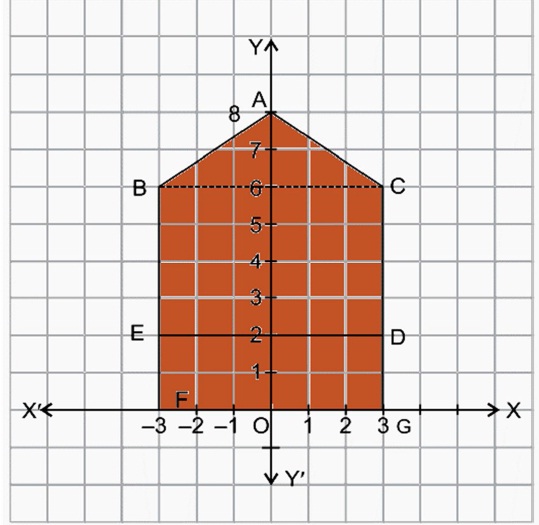
(i) What is the length of the line segment AB?
| (a) \(\sqrt{10}\) units | (b) \(\sqrt{11}\) units | (c) \(\sqrt{13}\) units | (d) \(\sqrt{14}\) units |
(ii) Is AB = AC?
| (a) yes | (b) no | (c) can't be determined | (d) none of these |
(iii) The coordinates of the midpoint of BE are
| (a) (4,-3) | (b) (-3,4) | (c) (-3,-4) | (d) (-4,4) |
(iv) Midpoint of ED will lie on:
| (a) x-axis | (b) y-axis | (c) x = y | (d) x = 2y |
(v) If we join BD, then the y-axis divides BD in the ratio:
| (a) 1:1 | (b) 2:1 | (c) 1:2 | (d) 2:3 |
1.
Let points be A(4,5), B(7,6), C(4,3) and D(1,2)
\(AB=\sqrt { \left( 7-4 \right) ^{ 2 }+\left( 6-5 \right) ^{ 2 } } =\sqrt { 9+1 } =\sqrt { 10 } \)
\(BC=\sqrt { \left( 4-7 \right) ^{ 2 }+\left( 3-6 \right) ^{ 2 } } =\sqrt { 9+9 } =3\sqrt { 2 } \)
\(CD=\sqrt { \left( 1-4 \right) ^{ 2 }+\left( 2-3 \right) ^{ 2 } } =\sqrt { 9+1 } =\sqrt { 10 } \)
\(AD=\sqrt { \left( 1-4 \right) ^{ 2 }+\left( 2-5 \right) ^{ 2 } } =\sqrt { 9+9 } =3\sqrt { 2 } \)
\(AC=\sqrt { \left( 4-4 \right) ^{ 2 }+\left( 3-5 \right) ^{ 2 } } =\sqrt { 4 } =2\)
\(BD=\sqrt { \left( 1-7 \right) ^{ 2 }+\left( 2-6 \right) ^{ 2 } } =\sqrt { 36+16 } =\sqrt { 52 } =2\sqrt { 13 } \)
Here, AB=CD=, BC=AD and AC≠BD
∴ The quadrilateral ABCD is a parallelogram.
2.
Let A ( a,a ), B(-a, -a) and C\(\left( -\sqrt { 3 } a,\sqrt {3 } a \right) \)
Here \(AB=\sqrt { { \left( a+a \right) }^{ 2 }+{ \left( a+a \right) }^{ 2 } } =2\sqrt { 2 } a\)
\(BC=\sqrt { { \left( -a+\sqrt { 3 } a \right) }^{ 2 }+{ \left( -a-\sqrt { 3 } a \right) }^{ 2 } } =2\sqrt { 2 } a\)
\(CA=\sqrt { { \left( a+\sqrt { 3 } a \right) }^{ 2 }+{ \left( a-\sqrt { 3 } a \right) }^{ 2 } } =2\sqrt { 2 } a\)
Since AB = BC = AC, therefore ABC is an equilateral triangle.
3.
Area of △PQR = \(\frac{1}{2}\)[2(2-4)+4(4-1)+5(1-2)]
=\(\frac{1}{2}\)[2x-2+4x3+5x-1]=\(\frac{1}{2}\)[-4+12-5]=\(\frac{3}{2}\)sq.unit.
Area of △PRS =\(\frac{1}{2}\)[2(4-3)+5(3-1)+3(1-4)| = \(\frac{1}{2}\)|2+10-9|=\(\frac{3}{2}\)sq.unit.
∴ Area of quadrilateral = Area of △PQR+ Area of △PRS = \(\frac{3}{2}\)+\(\frac{3}{2}\)=3 sq.units.
4.
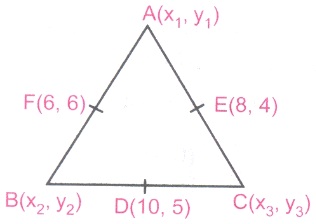
Let A(x1,y2), B (x2, y2) and c(x3,y3) be the vertices of a triangle D (10, 5), E (8, 4) and F(6,6) are mid-points of sides BC, CA and AB respectively.
Therefore \(\left( \frac { { x }_{ 1 }+{ x }_{ 2 } }{ 2 } ,\frac { { y }_{ 1 }+{ y }_{ 2 } }{ 2 } \right) =\left( 6,6 \right) \)
\(\Rightarrow { x }_{ 1 }+{ x }_{ 2 }=12\) ...(i)
\({ y }_{ 1 }+y_{ 2 }=12\) ...(ii)
\( \left( \frac { { x }_{ 2 }+{ x }_{ 3 } }{ 2 } ,\frac { { y }_{ 2 }+{ y }_{ 3 } }{ 2 } \right) =\left( 10,5 \right) \)
\({ x }_{ 2 }+x_{ 3 }=20\) ...(iii)
\(\ { y }_{ 2 }+y_{ 3 }=10\) ...(iv)
\(\ \left( \frac { { x }_{ 1 }+{ x }_{ 3 } }{ 2 } ,\frac { { y }_{ 1 }+{ y }_{ 3 } }{ 2 } \right) =\left( 8,4 \right)\)
\(\Rightarrow \ { x }_{ 1 }+x_{ 3 }=16\)
\(\ { y }_{ 1 }+y_{ 3 }=8\) ...(v)
Adding (i), (iii) and (v) we get,
\(2({ x }_{ 1 }+{ x }_{ 2 }+{ x }_{ 3 })=48\) ...(vi)
\(\Rightarrow { x }_{ 1 }+{ x }_{ 2 }+x_{ 3 }=24\)
Adding (ii), (iv) and (vi) we get,
\(2({ y }_{ 1 }+{ y }_{ 2 }+{ y }_{ 3 })=15\) ...(vii)
From (ii), (iv), (vi) and (xi) we get,
\({ y }_{ 1 }=5,\ { y }_{ 2 }=7,\ { y }_{ 3 }=3\) ...(viii)
Coordinates of vertices are A(4,5) B(8,7) and C(12,3).
5.
Since the point P(x,y) is equidistant from the points A(7, 1) and B(3, 5).
Therefore PA = PB ...(i)
Using distance formula
\(PA=\sqrt { \left( x-7 \right) ^{ 2 }+\left( y-1 \right) ^{ 2 } } \)
\(=\sqrt { { x }^{ 2 }+{ 7 }^{ 2 }-2.7x+{ y }^{ 2 }+{ 1 }^{ 2 }-2.y.1 } =\sqrt { { x }^{ 2 }+{ y }^{ 2 }+49+1-14x-2y } \)
\(PB=\sqrt { \left( x-3 \right) ^{ 2 }+\left( y-5 \right) ^{ 2 } } \) (using distance formula)
\(=\sqrt { { x }^{ 2 }+{ 3 }^{ 2 }-2.3x+{ y }^{ 2 }+{ 5 }^{ 2 }-2.5.y } =\sqrt { { x }^{ 2 }+9-6x+{ y }^{ 2 }+25-10y } \)
Substituting the values of PA and PB in (i). we get
\(\sqrt { { x }^{ 2 }+{ y }^{ 2 }+50-14x-2y } =\sqrt { { x }^{ 2 }+{ y }^{ 2 }-6x-10y+34 } \)
Squaring both sides, We get
\({ x }^{ 2 }+{ y }^{ 2 }+50-14x-2y={ x }^{ 2 }+{ y }^{ 2 }-6x-10y+34\)
⇒ 50-34=14x+2y-6x-10y ⇒16=8x-8y ⇒x-y=2
6.
\(\left(\frac{-1}{5}, \frac{-2}{5}\right)\)
7.
Diagonals of a parallelogram bisect each other.
Mid-points of AC and BD are same
\(\Rightarrow \quad \left( 3,\frac { -1+y }{ 2 } \right) =\left( 3,2 \right) \)
\(\frac { -1+y }{ 2 } =2\quad \Rightarrow \quad y=5\)
8.
Using section formula, we get,
\(0=\frac { 1\left( -3 \right) +k\left( 7 \right) }{ 1+k } \)
Let the ratio be k : 1,
\(\Rightarrow \ k=\frac{3}{7}\)
\(\Rightarrow\) Ratio = 3 : 7
Also, \(x=\frac { { m }_{ 2 }{ x }_{ 1 }+{ m }_{ 1 }{ x }_{ 2 } }{ { m }_{ 1 }+{ m }_{ 2 } } \)
\(=\frac { 1\left( 3 \right) +k\left( -2 \right) }{ 1+k } \)
\(x=\frac { 3-2\times \frac { 3 }{ 7 } }{ 1+\frac { 3 }{ 7 } } =\frac { 3 }{ 2 } \)
\(\therefore\) Co-ordinates of point are \(\left( \frac { 3 }{ 2 } ,0 \right) \)
9.
(a)
1 : 2
10.
(c)
any real number
11.
(d)
5x-4y+1=0
12.
(b)
12
13.
(a)
(2, –4)
14.
(d) Assertion Three points A, B, C are collinear if and only if AB + BC = AC, but AB + BC > AC.
. Ii A, B, C att: not collinear.
15.
(i) (c): \(\mathrm{AB}=\sqrt{(0+3)^{2}+(8-6)^{2}}\)
\(=\sqrt{13} \text { units }\)
(ii) (a): \(A C=\sqrt{(0-3)^{2}+(8-6)^{2}}\)
\(=\sqrt{13} \text { units }=\mathrm{AB}\)
(iii) (b): coordinates of the midpoint of BE are \(\left(\frac{-3-3}{2}, \frac{6+2}{2}\right)=(-3,4)\)
(iv) (b): y-axis
(v) (a): 1:1

10th Standard CBSE Syllabus & Materials
10th Standard CBSE
CBSE 10th Social Science PS - Federalism - New Model Questions Papers Study Material - QB365 Set A
NEW10th Standard CBSE
CBSE 10th Social Science PS - Power Sharing - New Model Questions Papers Study Material - QB365 Set A
NEW10th Standard CBSE
CBSE 10th Social Science GEO - Manufacturing Industries - New Model Questions Papers Study Material - QB365 Set A
NEW10th Standard CBSE
CBSE 10th Social Science GEO - Minerals and Energy Resources - New Model Questions Papers Study Material - QB365 Set A



NCERT Books

Syllabus

Exam Pattern

Sample Question Papers

Previous year Question Papers

Important Notes

MCQ Practice test

NCERT Exemplers

Case study Questions

Image Based Questions

Passage based Questions

HOT Questions

Value Based Questions

Model Questions Papers
NCERT ( Book Back ) Questions

Assertion and Reason
Important Questions And Answers

CBSE 10th Standard CBSE Subjects
CBSE Standards



