
 100% FREE ACCESS
10th Standard CBSE Syllabus & Materials
10th Standard CBSE
CBSE 10th Social Science ECO - Globalisation and the Indian Economy - New Model Questions Papers Study Material - QB365 Set A
NEW10th Standard CBSE
CBSE 10th Social Science ECO - Money and Credit - New Model Questions Papers Study Material - QB365 Set A
NEW10th Standard CBSE
CBSE 10th Social Science ECO - Sectors of the Indian Economy - New Model Questions Papers Study Material - QB365 Set A
NEW10th Standard CBSE
CBSE 10th Social Science ECO - Development - New Model Questions Papers Study Material - QB365 Set A
NEW10th Standard CBSE
CBSE 10th Social Science PS - Outcomes of Democracy - New Model Questions Papers Study Material - QB365 Set A
NEW10th Standard CBSE
CBSE 10th Social Science PS - Gender, Religion and Caste - New Model Questions Papers Study Material - QB365 Set A

Published on: 26/10/2025
Download CBSE Class 10th Standard CBSE Maths question papers, sample papers, important questions, and previous year solved papers in PDF format. Get free study materials, NCERT solutions, and exam preparation resources for Class 10th Standard CBSE Maths
Questions + Answers key
Take MCQ Maths Test
1.
Find the value of k for which the following system of equations has no solution
kx + 2y = 5, 8x + ky = 20
2.
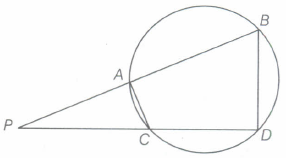
In the given figure, two chords AB and CD of a circle intersect each other at the point P (when produced) outside the circle. Prove that\(\triangle PAC\sim \triangle PDB\)
3.
Find the coordinates of the point C, if the point B \(\left( \frac { 1 }{ 2 } ,6 \right) \)divided the line segment joining the points A (3,5) and C in the ratio 1:3.
4.
How many multiples of 4 lie between 10 and 250? Also find their sum.
5.
Explain why (7 \(\times\) 11 \(\times\)13 + 2 \(\times\) 11) is not a prime number.
6.
Write down the decimal expansions of those rational numbers in which have terminating decimal expansions.
\(\frac{6}{15}\)
7.
In the figure, PQ is parallel to MN. If \(\frac { K }{ PM } =\frac { 4 }{ 13 } \) and KN=20.4 cm, then find KQ.
8.
Is the following statement True or False? Justify your answer. 'If the zeroes of a quadratic polynomial ax2+bx+c are both negative, then a, b and c all have the same sign.'
9.
Write the sequence with nth term: 6 - n
10.
Find the solution of the following system of equations by substitution method.
3x-y=3,9x-3y=9
11.
Prove that \(\frac{2\sqrt 3}{5} \) is an rational number, given that\(\sqrt{3}\)is an irrational number.
12.
If the diagonals of a quadrilateral divide each other proportionally, prove that it is a trapezium.
13.
Solve for x: \(\frac { 16 }{ x } -1=\frac { 15 }{ x+1 } ;x\neq 0,-1\)
14.
How many numbers of two digits are divisible by 7?
15.
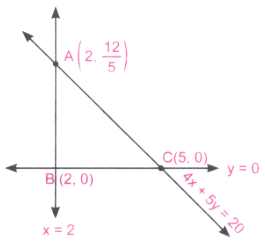
Find the area of the triangle whose sides are along the lines x=2, y=0 and 4x+5y=20
16.
In a right angled Δ ABC right angled at B if P and 0 are points on the sides AB and BC respectively, then
AQ2 + CP2 = 2(AC2 + PQ2)
2(AQ2 + CP2) = AC2 + PQ2
AQ2 + CP2 = AC2 + PQ2
\(A Q+C P=\frac{1}{2}(A C+P Q)\)
17.
Tick the correct answer and justify : In D ABC, AB \(=6 \sqrt{3}\) cm, AC = 12 cm and BC = 6 cm. The angle B is :
120°
60°
90°
45°
18.
Out of a certain number of saras birds, one-fourth the number are moving about lotus plants, \(\frac{1}{9} t h\) are coupled with \(\frac{1}{4} \text { th }\) as well as 7 times the square root of the number move on a hill, 56 birds remain in vakula tree. What is the total number of birds?
576
567
556
557
19.
A graph of quadratic polynomial is given below
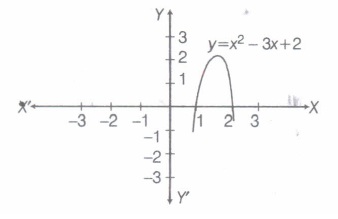
If we rotate the axes at an angle of 90° in anti-clockwise direction, the figure remains at the same position. Find the equation of the graph.
y2 + 3y + 2
y2 -3y + 2
y2 + 2y + 3
y2 - 2y + 3
20.
Suppose b1, b2, ... , b24 are in Ap, such that b1 + b5 + b10 + b15 + b20 + b24 = 300. Then, the sum of first 24 terms of the AP is
1200
900
600
1500
21.
The sum of n terms of sequence \(\frac{1}{1 \times 2}, \frac{1}{2 \times 3}, \frac{1}{3 \times 4}, .\) is
\(\frac{1}{n+1}\)
\(\frac{1}{n}\)
\(\frac{n+1}{n}\)
\(\frac{n}{n+1}\)
22.
Which of the following pair of equations are inconsistent?
3x - y = 9, x - \(\frac{y}{3}\)=3
4x.+ 3y = 24, - 2x+ 3y = 6
5x - y = 10,10x-2y = 20
2x+ y=3,-4x+2y=10
23.
If \(\alpha,\beta and\gamma\)are the zeroes of the polynomial p (x)= ax3 + 3b2 + 3cx+ d and having relation \(2\beta= \alpha +\gamma\) then 2b3 - 3 abc + a2d is
-1
1
0
None of the above
24.
If one of the zeroes of the cubic polynomial ax3 + bx2 + cx + d is zero, the product of then other two zeroes is
\(\frac{-c}{a}\)
\(\frac{c}{a}\)
0
\(\frac{-b}{a}\)
25.
Two positive numbers have their HCF as 12 and their product as 6336. The number of pairs possible for the numbers, is
2
3
4
5
26.
If for an A.P sn= + 3n What is the nth term?
2n-3
n-4
2n+4
2n+2
27.
If the equation px2 – 6x – 2 = 0 has real roots then, ________
p ≥ -9/2
p > -9/2
p < -9/2
p ≤ -9/2
28.
Two congruent triangles are actually similar triangles with the ratio of corresponding sides as.
1:2
1:1
1:3
2:1
29.
In triangle ABC, D and E are points on AB and AC such that DE || BC. If AD = 4x-3, AE = 8x-7, BD = 3x-1 and CE = 5x-3, find the value of x
1
1/2
1/2, -1
1, -1/2
30.
Solution for ax + by = a – b and bx – ay = a + b is
1, -1
-a, -b
a, b
-1, 1
31.
If two of the zeroes of the polynomial f (x) = x4 – 3x3 – x2 + 9x – 6 are -√3 and √3 then all the zeroes are
√3, -√3, 1 ,3
-1, 4, √3, -√3
√3, -√3, 2, 3
√3, -√3, 1, 2
32.
What is the HCF of 235 and 395?
25
35
5
13
33.
If n is a positive integer , then n2 – n is always
multiple of 2 and 4
odd or even
odd
even
34.
The ordinate of a point is twice its abscissa. If its distance from the point (4,3) is \(\sqrt { 10 } \) ,then the coordinates of the point are
(1,2) or (3,6)
(1,2) or (3,5)
(2,1) or (3,6)
(2,1) or (6,3)
35.
Find the value of k if the points A(2, 3), B(4, k) and C(6, –3) are collinear
2
3
0
1
36.
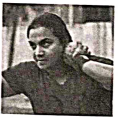
Manpreet Kaur is the national record holder for women in the shot-put discipline. Her throw of 18.86 m at the Asian Grand Prix in 2017 is the biggest distance for an Indian female athlete.
Keeping her as a role model, Sanjitha is determined to earn gold in Olympics one day
Initially her throw reached 7.56 m only. Being an athlete in school, she regularly practiced both in the mornings and in the evenings and was able to improve the distance by 9 cm every week.
During the special camp for 15 days, she started with 40 throws and every day kept increasing the number of throws by 12 to achieve this remarkable progress.
Based on the above information, answer the following questions.
(i) How many throws Sanjitha practiced on 11th day of the camp?
(ii) What would be Sanjitha's throw distance at the end of 6 months? Or When will she be able to achieve a throw of 11.16 m?
(iii) How many throws did she do during the entire camp of 15 days ?
37.
If p(x) is a quadratic polynomial i.e., p(x) = ax2- + bx + c, \(a \neq 0\), then p(x) = 0 is called a quadratic equation. Now, answer the following questions.
(i) Which of the following is correct about the quadratic equation ax2- + bx + c = 0 ?
| (a) a, band c are real numbers, \(c \neq 0\) | (b) a, band c are rational numbers, \(a \neq 0\) |
| (c) a, band c are integers, a, band \(c \neq 0\) | (d) a, band c are real numbers, \(a \neq 0\) |
(ii) The degree of a quadratic equation is
| (a) 1 | (b) 2 | (c) 3 | (d) other than 1 |
(iii) Which of the following is a quadratic equation?
| (a) x(x + 3) + 7 = 5x - 11 | (b) (x - 1)2 - 9 = (x - 4)(x + 3) |
| (c) x2-(2x + 1) - 4 = 5x2- 10 | (d) x(x - 1)(x + 7) = x(6x - 9) |
(iv) Which of the following is incorrect about the quadratic equation ax2- + bx + c = 0 ?
| (a) If a\(\alpha\)2 + b\(\alpha\). + c = 0, then x = -\(\alpha\) is the solution of the given quadratic equation. |
| (b)The additive inverse of zeroes of the polynomial ax2- + bx + c is the roots of the given equation. |
| (c) If a is a root of the given quadratic equation, then its other root is -\(\alpha\). |
| (d) All of these |
(v) Which of the following is not a method of finding solutions of the given quadratic equation?
| (a) Factorisation method | (b) Completing the square method |
| (c) Formula method | (d) None of these |
38.
Pankaj's father gave him some money to buy avocado from the market at the rate of p(x) = x2 - 24x + 128. Let a , \(\beta\) are the zeroes of p(x).
Based on the above information, answer the following questions.
(i) Find the value of a and \(\beta\), where a < \(\beta\).
| (a) -8, -16 | (b) 8,16 | (c) 8,15 | (d) 4,9 |
(ii) Find the value of \(\alpha\) + \(\beta\) + \(\alpha\)\(\beta\).
| (a) 151 | (b) 158 | (c) 152 | (d) 155 |
(iii) The value of p(2) is
| (a) 80 | (b) 81 | (c) 83 | (d) 84 |
(iv) If \(\alpha\) and \(\beta\) are zeroes of \(x^{2}+x-2, \text { then } \frac{1}{\alpha}+\frac{1}{\beta}=\)
| (a) 1/2 | (b) 1/3 | (c) 1/4 | (d) 1/5 |
(v) If sum of zeroes of \(q(x)=k x^{2}+2 x+3 k\) is equal to their product, then k =
| (a) 2/3 | (b) 1/3 | (c) -2/3 | (d) -1/3 |
1.
k = 2
2.
In ΔPAC and ΔPDB,
∠P = ∠P (Common)
∠PAC = ∠PDB (Exterior angle of a cyclic quadrilateral is ∠PCA = ∠PBD equal to the opposite interior angle)
∴ ΔPAC ∼ ΔPDB
3.
( -7,9 )
4.
The multiples of 4 between 10 and 250 be 12, 16, 20, ..., 248.
Here, a = 12, d = 16 - 12 = 4 and an = 248.
From formula, an = a + ( n - 1 )d, we get
12 + ( n - 1 )4 = 248
\(\Rightarrow\) 4 ( n - 1) = 248 - 12 \(\Rightarrow\) 4 ( n - 1 ) = 236
\(\Rightarrow\) n - 1 = \({236 \over 4}\) = 59 \(\Rightarrow\) n = 59 + 1 = 60
\(\because\) Sn = \({n\over2}\) ( a + l ) \(\Rightarrow\) S60 = \({60\over2}\) ( 12 + 248 ) = 30 x 260 = 7800
5.
Simplify the given expression
7\(\times\)11\(\times\)13 + 2\(\times\)11 = 1001 + 22 = 1023
Prime factorisation of 1023 = 3\(\times\)11\(\times\)31.
Thus, 1023 is divisible by 3, 11 and 31.
Since, a prime number is a natural number greater than 1 that has no positive divisors other than 1 and itself.
Therefore, 1023 is not a prime number as it has other divisor other than 1 and itself.
Hence,(7\(\times\)11\(\times\)13 + 2\(\times\)11) is not a prime number.
6.
0.4
7.
PQ || MN
So, \(\frac { KP }{ PM } =\frac { KQ }{ QN } \)
\(\Rightarrow \quad \frac { KP }{ PM } =\frac { KQ }{ KN-KQ } \)
\(\Rightarrow \quad \frac { 4 }{ 13 } =\frac { KQ }{ 20.4-KQ } \)
\(\Rightarrow \) 4 x 20.4-4KQ=13 KQ
\(\Rightarrow \)17 KQ=4 x 20.4
\(\therefore \quad KQ=\frac { 20.4\times 4 }{ 17 } =4.8\quad cm,\)
8.
True, since, \(-\frac { b }{ a } \)= sum of the zeroes <0, so \(\frac { b }{ a } \) >0. Also, the product of the zeroes =\(\frac { c }{ a } \) >0
∴ a,b and c all have same sign.
9.
an=6-n
a1=6-1=5
a2=6-2=4
a3=6-3=3
sequence is 5,4,3,.......
10.
Infintely many solutions
11.
Let us assume that \(\frac{2\sqrt 3}{5} \)is rational number. Then, it will be
of the form \( \frac{a}{b} \) where a, b are coprime integers and b \(\neq\)0
Now \(\frac{2\sqrt 3}{5}\) \(\frac{a}{b}\)
On rearranging, we get \(\frac{5a -2b}{b}\) = \( \sqrt{3} \)
Since, 5 and are rational. So, \(\frac{5a -2b}{b}\) Will be rational
\(\therefore\) \( \sqrt{3} \) is rational.
But given that, \( \sqrt{3} \) is irrational So, this contradicts the fact that \( \sqrt{3} \) is irrational. Therefore, our assumption is wrong.
Hence, \(\frac{ 2+ \sqrt 3}{5}\)is Irrational
12.
In quadrilateral ABCD,
\( \frac { AO }{ BO } =\frac { CO }{ DO } \)
\(\Rightarrow \frac { AO }{ CO } =\frac { BO }{ DO } \)
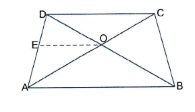
In ABD, EO || AB (Construction)
(By BPT) ...(ii)
From eqns. (i) and (ii),
\(\frac { AE }{ ED } =\frac { AO }{ CO } \)
In ADC, \(\frac { AE }{ ED } =\frac { AO }{ CO } \)
\(\Rightarrow\)EO || DC (Converse of BPT)
EO || AB (Construction)
\(\therefore\) AB || DC
\(\Rightarrow\)In quad. ABCDm AB || DC
\(\Rightarrow\)ABCD is a trapezium.
Hence proved.
13.
Given, \(\frac { 16 }{ x } -1=\frac { 15 }{ x+1 } \)
\(\frac { 16 }{ x } -\frac { 15 }{ x+1 } =1\\ \frac { 16(x+1)-15x }{ x(x+1) } =1 \)
16x+16-15x=x2+x
x+16=x2+x
x2=16
x2=\(\pm\)4
Hence, the roots are 4 and -4.
14.
Two digits numbers are 10,11,12,13,14,15,...,97,98,99 in which only 14,21,28,..., 98 are divisible by 7.
Here, 21 - 14 = 28 - 21 = 7.
So, this list of numbers is an AP, whose first term (a) = 14, common difference (d) = 7 and nth term = 98.
\(\therefore\) a +( n- d ) d = 98
\(\Rightarrow\) 14 + (n - 1) 7 = 98
\(\Rightarrow\) 14 + 7n - 7 = 98 \(\Rightarrow\) 7n=91
\(\Rightarrow\) \(n=\frac{91}{7}=13\)
Hence, 13 numbers of two digits are divisible by 7.
15.
A is point of intersection of line x=2 and 4x+5y=20
⇒ 4 x 2 + 5y =20 ⇒ \(y={12\over 5}\)
Coordinates of A are \(\left(2, {12\over 5}\right)\)
B is point of intersection of x=2 and y=0
Coordinates of A are (2, 0)
C is point of intersection y=0 and 4x+5y=20
⇒ 4x+5x0=20 ⇒ x=5
⇒ Coordinates of C are (5, 0)
Area ΔABC
\(={1\over 2}|x_1(y_2-y_3)+x_2(y_3-y_1)+x_3(y_1-y_2)|\)
\(={1\over 2}\left|2(0-0)+2\left(0-{12\over 5}\right)+5\left({12\over 5}-0\right)\right|\)
\(={1\over 2}\left| {-24\over 5}+12\right|={1\over2}\times{36\over 5}={18\over5}=\)sq.units= 3.6sq. units
16.
(c)
AQ2 + CP2 = AC2 + PQ2
17.
(c)
90°
18.
(a)
576
19.
(a)
y2 + 3y + 2
20.
(a)
1200
21.
(d)
\(\frac{n}{n+1}\)
22.
(d)
2x+ y=3,-4x+2y=10
23.
(c)
0
24.
Let p(x) = ax3 + bx2 + cx + d
Given that, one of the zeroes of the cubic polynomial p(x) is zero.
Let \(\alpha,\beta\) and \( \gamma\) arethe zeroes of cubic polynomial p (x),
where a = 0.
We know that,
Sum of product of two zeroes at a time =\(\frac{c}{a}\)
\(\alpha\beta +\beta\gamma+\beta\alpha=\frac{c}{a}\)
\(\alpha\beta +\beta\gamma+\gamma*0=\frac{c}{a}[\because \alpha=0,given]\)
\(0+\beta\gamma+0=\frac{c}{a}\Rightarrow\beta\gamma=\frac{c}{a}\)
Hence, product of other two zeroes =\(\frac{c}{a}\)
25.
(a)
2
26.
(d)
2n+2
27.
(a)
p ≥ -9/2
28.
(b)
1:1
29.
(b)
1/2
30.
(a)
1, -1
31.
(d)
√3, -√3, 1, 2
32.
(c)
5
33.
(d)
even
34.
(a)
(1,2) or (3,6)
35.
(c)
0
36.
(i) Number of throws on first day a=40
Number of throws on second day =40+12=52
AP formed by number of throws is
40,52,(52+12)…
(I day) (II day) (III day)
Here, common difference, d=12
Number of throws she practiced on 11th day
a11=a+(11−1)d
=40+10×12=160
(ii) Distance of Sanjitha's throw on first day, a=756 m Distance of Sanjitha throw after a week
=(7.56+0.09)m=7.65 m
∴ AP formed by the distances is
7.56,7.65,7.65+(0.09),……
(I week) (II week) (III week)
Here, common difference, d=0.09 m
Sanjitha's throw distance at the end of 6 months (i.e. 26 weeks)
a26=a+(26−1)d
=7.56+25×0.09
=7.56+2.25=9.81 m
Or
\( \text { Here, } a_n=11.16=a+(n-1) d\)
\(\Rightarrow 7.56+(n-1) 0.09=11.16 \)
\( \Rightarrow \quad n-1=\frac{3.6}{0.09} \Rightarrow n=41\)
∴ On 41st week, she will be able to achieve a throw of 11.16 m .
(iii) Total throws done by her during the entire camp of 15 days \(=S_n=\frac{n}{2}[2 a+(n-1) d]\)
where, n is total number of terms
\(\Rightarrow \quad S_{15} =\frac{15}{2}[2 \times 40+14 \times 12]\)
=15[-10+8.1]
\( =15 \times 124=1860\)
37.
(i) (d)
(ii) (b)
(iii) (a): x(x + 3) + 7 = 5x - 11
\(\Rightarrow x^{2}+3 x+7=5 x-11\)
\(\Rightarrow x^{2}-2 x+18=0 \) is a quadratic equation.
\((b) (x-1)^{2}-9=(x-4)(x+3)\)
\(\Rightarrow x^{2}-2 x-8=x^{2}-x-12\)
\(\Rightarrow x-4=0\) is not a quadratic equation.
\((c) x^{2}(2 x+1)-4=5 x^{2}-10\)
\(\Rightarrow 2 x^{3}+x^{2}-4=5 x^{2}-10\)
\(\Rightarrow 2 x^{3}-4 x^{2}+6=0\) is not a quadratic equation.
\((d) x(x-1)(x+7)=x(6 x-9)\)
\(\Rightarrow x^{3}+6 x^{2}-7 x=6 x^{2}-9 x\)
\(\Rightarrow x^{3}+2 x=0\) is not a quadratic equation.
(iv) (d)
(v) (d)
38.
(i) (b): Given, a and \(\beta\) are the zeroes of
\(p(x)=x^{2}-24 x+128\)
\(\text { Putting } p(x)=0 \text { , we get }\)
\( x^{2}-8 x-16 x+128=0 \)
\(\Rightarrow x(x-8)-16(x-8)=0 \)
\(\Rightarrow (x-8)(x-16)=0 \Rightarrow x=8 \text { or } x=16 \)
\(\therefore \alpha=8, \beta=16\)
(ii) (c) : \(\alpha+\beta+\alpha \beta =8+16+(8)(16) =24+128=152 \)
(iii) (d) : \(p(2)=2^{2}-2 4(2)+128=4-48+128=84\)
(iv) (a): Since a and \(\beta\) are zeroes of \(x^{2}+x-2\)
\(\therefore \quad \alpha+\beta=-1 \text { and } \alpha \beta=-2 \)
\(\text { Now, } \frac{1}{\alpha}+\frac{1}{\beta}=\frac{\beta+\alpha}{\alpha \beta}=\frac{-1}{-2}=\frac{1}{2}\)
(v) (c): Sum of zeroes \(=\frac{-2}{k}\)
Product of zeroes \(=\frac{3 k}{k}=3\)
According to question, we have \(\frac{-2}{k}=3\)
\(\Rightarrow \quad k=\frac{-2}{3}\)

10th Standard CBSE Syllabus & Materials
10th Standard CBSE
CBSE 10th Social Science PS - Federalism - New Model Questions Papers Study Material - QB365 Set A
NEW10th Standard CBSE
CBSE 10th Social Science PS - Power Sharing - New Model Questions Papers Study Material - QB365 Set A
NEW10th Standard CBSE
CBSE 10th Social Science GEO - Manufacturing Industries - New Model Questions Papers Study Material - QB365 Set A
NEW10th Standard CBSE
CBSE 10th Social Science GEO - Minerals and Energy Resources - New Model Questions Papers Study Material - QB365 Set A



NCERT Books

Syllabus

Exam Pattern

Sample Question Papers

Previous year Question Papers

Important Notes

MCQ Practice test

NCERT Exemplers

Case study Questions

Image Based Questions

Passage based Questions

HOT Questions

Value Based Questions

Model Questions Papers
NCERT ( Book Back ) Questions

Assertion and Reason
Important Questions And Answers

CBSE 10th Standard CBSE Subjects
CBSE Standards



