
 100% FREE ACCESS
10th Standard CBSE Syllabus & Materials
10th Standard CBSE
CBSE 10th Social Science ECO - Globalisation and the Indian Economy - New Model Questions Papers Study Material - QB365 Set A
NEW10th Standard CBSE
CBSE 10th Social Science ECO - Money and Credit - New Model Questions Papers Study Material - QB365 Set A
NEW10th Standard CBSE
CBSE 10th Social Science ECO - Sectors of the Indian Economy - New Model Questions Papers Study Material - QB365 Set A
NEW10th Standard CBSE
CBSE 10th Social Science ECO - Development - New Model Questions Papers Study Material - QB365 Set A
NEW10th Standard CBSE
CBSE 10th Social Science PS - Outcomes of Democracy - New Model Questions Papers Study Material - QB365 Set A
NEW10th Standard CBSE
CBSE 10th Social Science PS - Gender, Religion and Caste - New Model Questions Papers Study Material - QB365 Set A

Published on: 26/10/2025
Download CBSE Class 10th Standard CBSE Maths question papers, sample papers, important questions, and previous year solved papers in PDF format. Get free study materials, NCERT solutions, and exam preparation resources for Class 10th Standard CBSE Maths
Questions + Answers key
Take MCQ Maths Test
1.
Find the coordinates of point P on AB such that \({PA\over PB}={3\over 4}\), where A(3,1) and B(-2,5)
2.
Find the coordinates of the points which divides the join of (-1,7) and (4,-3) in the ratio 2:3.
3.
Show that the points A(a,a), B(-a,a) and C(\(-a\sqrt3,a\sqrt3\)) form an equilateral triangle.
4.
Find the relation between x and y such that the point (x,y) is equidistant from the points (7,1) and (3,5).
5.
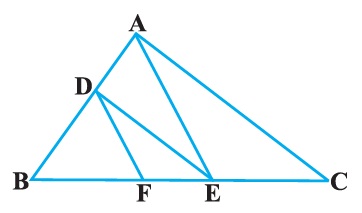
In the given figure, if DE II AC and DF II AE. Prove that \(\frac { BF }{ FE } =\frac { BE }{ EC } .\)
6.
In the given figure, if LM II CB and LN II CD. Prove that \(\frac { AM }{ AB } =\frac { AN }{ AD } .\)
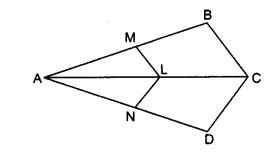
Use the basic proportionality theorem in both \(\Delta\)ABC and \(\Delta\)ACD
7.
Find the coordinates of the point which divides the line segment join of (4, - 3) and (9, 7) in the ratio 3: 2.
8.
Show that the points A(1,0), B(5,3), C(2,7) and D(-2,4) are the vertices of a parallelogram.
9.
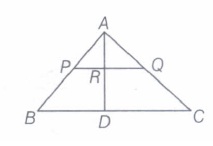
In the given figure, AP = 3 cm, AR = 4.5 cm, AO = 6 cm, AB = 5 cm and AC = 10 cm.
(i) Determine the length of AD.
(ii) Find ratio of areas of ΔARO and ΔADC.
10.
Find the value of k if the points A(2, 3), B(4, k) and C(6, –3) are collinear.
11.
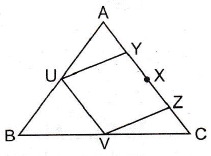
ln ΔABC, X is any point on AC. If Y, Z, U and V are the middle points on AX, XC, AB and BC respectively, then, prove that UY || VZ and UV || YZ.
12.
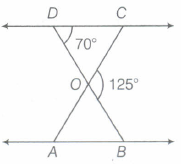
In the given figure, \(\triangle ODC\sim \triangle OBA,\angle BOC={ 125 }^{ ° }\) and \(\angle CDO={ 70 }^{ ° }\) . Find \(\angle DOC,\angle DCO\) and \(\angle OAB\) .
13.
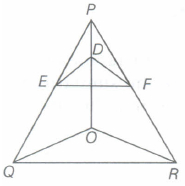
In the given figure, \(DE\parallel OQ\) and \(DF\parallel OR\). Show that \(EF\parallel QR\).
14.
If A( x,y ) is a point on the line joining the points B(2,-3) and C(-4, 5) and A is equidistant form B and C, then prove that 3x-4y+7=0
15.
If (2, 4) is the mid-point of the line segment joining (6,3) and (a, 5), then the value of a is
2
4
-4
-2
16.
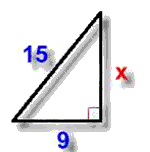
From the given figure, find the unknown x.
12
225
10
144
17.
The distance of the point P(6,-6) from the origin is equal to
3 √4 units
8 units
6 √2 units
3 units
18.
The value of k, if the point P(0,2) is equidistant from A(3,k) and B(k,5) is
0
1
-3
3
19.
Find the value of P for which the point (–1, 3), (2, p) and (5, –1) are collinear.
4
3
2
1
1.
(18,-11)
2.
Let P(x,y) be the point
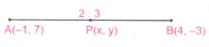
\(x=\frac { { m }_{ 1 }{ x }_{ 2 }+{ m }_{ 2 }{ x }_{ 1 } }{ { m }_{ 1 }+{ m }_{ 2 } } =\frac { 2\times 4+3\times (-1) }{ 2+3 } =\frac { 8-3 }{ 5 } =1\)
\(y=\frac { { m }_{ 1 }{ y }_{ 2 }+{ m }_{ 2 }{ y }_{ 1 } }{ { m }_{ 1 }+{ m }_{ 2 } } =\frac { 2(-3)+3(7) }{ 2+3 } =\frac { -6+21 }{ 5 } =\frac { 15 }{ 5 } =3\)
Then, the coordinates of points are (1,3)
3.
\(AB=\sqrt { ({ -a-a) }^{ 2 }+({ -a-a) }^{ 2 } } =\sqrt { ({ -2a) }^{ 2 }+({ -2a) }^{ 2 } } =\sqrt { (4a^{ 2 }+4a^{ 2 } } =\sqrt { 8a^{ 2 } } =2\sqrt { 2a } \)
\(BC=\sqrt { ({ -a\sqrt { 3 } +a) }^{ 2 }+({ a\sqrt { 3 } +a) }^{ 2 } } =\sqrt { 3a^{ 2 }+a^{ 2 }-2\sqrt { 3 } a^{ 2 }+3a^{ 2 }+a^{ 2 }+2\sqrt { 3 } a^{ 2 } } =\sqrt { 8a^{ 2 } } =2\sqrt { 2a } \)
\(AC=\sqrt { ({ -a\sqrt { 3 } -a) }^{ 2 }+({ a\sqrt { 3 } -a) }^{ 2 } } =\sqrt { 3a^{ 2 }+a^{ 2 }+2\sqrt { 3 } a^{ 2 }+3a^{ 2 }+a^{ 2 }-2\sqrt { 3 } a^{ 2 } } =\sqrt { 8a^{ 2 } } =2\sqrt { 2a } \)
Since AB=BC=AC ∴△ABC is equilateral.
4.
Since the point P(x,y) is equidistant from the points A(7, 1) and B(3, 5).
Therefore PA = PB ...(i)
Using distance formula
\(PA=\sqrt { \left( x-7 \right) ^{ 2 }+\left( y-1 \right) ^{ 2 } } \)
\(=\sqrt { { x }^{ 2 }+{ 7 }^{ 2 }-2.7x+{ y }^{ 2 }+{ 1 }^{ 2 }-2.y.1 } =\sqrt { { x }^{ 2 }+{ y }^{ 2 }+49+1-14x-2y } \)
\(PB=\sqrt { \left( x-3 \right) ^{ 2 }+\left( y-5 \right) ^{ 2 } } \) (using distance formula)
\(=\sqrt { { x }^{ 2 }+{ 3 }^{ 2 }-2.3x+{ y }^{ 2 }+{ 5 }^{ 2 }-2.5.y } =\sqrt { { x }^{ 2 }+9-6x+{ y }^{ 2 }+25-10y } \)
Substituting the values of PA and PB in (i). we get
\(\sqrt { { x }^{ 2 }+{ y }^{ 2 }+50-14x-2y } =\sqrt { { x }^{ 2 }+{ y }^{ 2 }-6x-10y+34 } \)
Squaring both sides, We get
\({ x }^{ 2 }+{ y }^{ 2 }+50-14x-2y={ x }^{ 2 }+{ y }^{ 2 }-6x-10y+34\)
⇒ 50-34=14x+2y-6x-10y ⇒16=8x-8y ⇒x-y=2
5.
In \(\triangle\)ABC DE || AC, (Given)
\(\frac { BD }{ DA } =\frac { BE }{ EC } \quad \quad \quad (BPT)\quad ...(i)\)
In \(\triangle\)ABE, DF || AE, (Given)
\(\frac { BD }{ DA } =\frac { BF }{ FE } \quad \quad \quad (BPT)\quad ...(ii)\)
From (i) and (ii), we have
\(\frac { BF }{ FE } =\frac { BE }{ EC } \)
Hence proved.
6.
In \(\Delta\)ACB, LM || CB [given]
\(\Rightarrow \quad \frac{A M}{M B}=\frac{A L}{L C}\) ....(i)
[ by basic proportionality theorem]
In \(\Delta\)ACD, LN ||CD [given]
\(\Rightarrow \quad \frac{A N}{N D}=\frac{A L}{L C}\) ....(ii)
[by basic proportionality theorem]
From Eqs. (i) and (ii), we get
\(\frac{A M}{M B}=\frac{A N}{N D} \Rightarrow \frac{M B}{A M}=\frac{N D}{A N}\)
[on taking reciprocal of the terms]
\(\Rightarrow \quad \frac{M B}{A M}+1=\frac{N D}{A N}\) + 1 [adding 1 on both sides]
\(\begin{aligned} & \Rightarrow \quad \frac{M B+A M}{A M}=\frac{N D+A N}{A N} \\ \end{aligned}\)
\(\begin{aligned} \Rightarrow \quad \frac{A M}{A M+M B}=\frac{A N}{A N+N D} \end{aligned}\)
[on taking reciprocal of the terms]
\(\therefore \quad \frac{A M}{A B}=\frac{A N}{A D} \quad\left[\begin{array}{c} \because A D=A N+N D \\ \text { and } A B=A M+M B \end{array}\right]\)
Hence proved.
7.
Let P(x, y) be the required point.
Then, P divides AB internally in the ratio 3: 2.
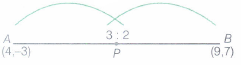
Here, \(\frac { { m }_{ 1 } }{ { m }_{ 2 } } =\frac { 3 }{ 2 } \) and \(\left( { x }_{ 1 },\quad { y }_{ 1 } \right) =(4,\quad -3);\quad \left( { x }_{ 2 },\quad { y }_{ 2 } \right) =(9,\quad 7)\)
Then, \(P(x,\quad y)=P\left( \frac { { m }_{ 1 }{ x }_{ 2 }+{ m }_{ 2 }{ x }_{ 1 } }{ { m }_{ 1 }+{ m }_{ 2 } } ,\frac { { m }_{ 1 }{ y }_{ 2 }+{ m }_{ 2 }{ y }_{ 1 } }{ { m }_{ 1 }+{ m }_{ 2 } } \right) \)
\( =P\left( \frac { 3\times 9+2\times 4 }{ 3+2 } ,\frac { 3\times 7+2\times (-3) }{ 3+2 } \right) \\ \ =P\left( \frac { 27+8 }{ 5 } ,\frac { 21-6 }{ 5 } \right) =P\left( \frac { 35 }{ 5 } ,\frac { 15 }{ 5 } \right) \\=P(7, 3)\)
Therefore, (7, 3) is the required point.
8.
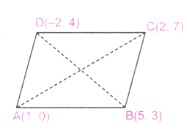
AB =\(\sqrt { { (5-1 })^{ 2 }+(3-0)^{ 2 } } =\sqrt { 16+9 } \) =5
DC = \(\sqrt { { (2+2 })^{ 2 }+(7-4)^{ 2 } } =\sqrt { 16+9 } \) =5
BC = \(\sqrt { { (5-2 })^{ 2 }+(3-7)^{ 2 } } =\sqrt { 9+16 } \) = 5
AD = \(\sqrt { { (1+2 })^{ 2 }+(0-4)^{ 2 } } =\sqrt { 9+16 } \) = 5
Mid - point of AC = \((\frac {1+2}{2} , \frac {0+7}{2})\) = \((\frac {3}{2} , \frac {7}{2})\); Mid-point BD = \((\frac{5-2}{2},\frac{3+4}{2})\) = \(( \frac {3}{2}, \frac {7}{2})\)
Since AB = DC and BC = AD.
Opposite sides are parallel and diagonals bisect each other.
∴ The given points are the vertices of a parallelogram.
9.
(i) Given, AP = 3 cm, AR = 4.5 cm, AQ = 6 cm,AB = 5 cm and AC = 10 cm
Here, \(\frac{A P}{A B}=\frac{3}{5} \text { and } \frac{A Q}{A C}=\frac{6}{10}=\frac{3}{5} \Rightarrow \frac{A P}{A B}=\frac{A Q}{A C}\)
Thus, PQ II BC [by converse of basic proportionality theorem]
In ΔARQ and ΔADC,
∠RAQ = ∠DAC [common angle]
∠ARQ = ∠ADC [corresponding angles]
∠RQA = ∠DCA [corresponding angles]
SO, ΔARQ - ΔADC [by AAA similarity criterion]
\(\Rightarrow \frac{A R}{A D}=\frac{A Q}{A C}\) [since, corresponding sides of similar triangles are proportional]
\(\Rightarrow \frac{4.5}{A D}=\frac{6}{10}\) [∵ AR = 4.5 cm , AQ = 6 cm and AC = 10 cm]
\(\Rightarrow A D=\frac{45}{6}=\frac{15}{2}=7.5 \mathrm{~cm}\)
(ii) Now, \(\frac{\operatorname{ar}(\Delta A R Q)}{\operatorname{ar}(\Delta A D C)}=\left(\frac{A Q}{A C}\right)^{2}\) [by theorem of area of similar triangles]
\(=\left(\frac{6}{10}\right)^{2}=\frac{36}{100}=\frac{9}{25}\)
10.
Since the given points are collinear, the area of the triangle formed by them must be 0, i.e.,
\(\frac{1}{2}[2(k+3)+4(-3-3)+6(3-k)]=0\)
i.e., \(\frac{1}{2}(-4 k)=0\)
Therefore, k=0
Let us verify our answer.
area of \(\Delta \mathrm{ABC}=\frac{1}{2}[2(0+3)+4(-3-3)+6(3-0)]=0\)
11.
Join BX
In ΔABX, U is mid-Point of AB and Y is mid-Point AX
(given)
∴ UY || BX(using mid-Point theorem) ..(i)
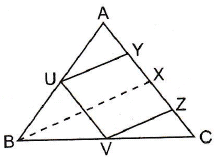
In ΔBCX, V is mid-Point of BC and Z is mid-Point of XC
∴ VZ || BX ....(ii)
From (i) and (ii)
UY || VZ
In ΔABC, U is mid-point of AB and V is mid-point of BE
∴ UV || AC
⇒ UV || YZ
Hence Proved
12.
From the given figure, it is clear that DOB is a straight line.
\(\therefore \quad \angle DOC+\angle COB={ 180 }^{ ° }\)
[by linear pair axiom]
\(\Rightarrow\quad \angle DOC+{ 125 }^{ ° }={ 180 }^{ ° }\)
[given, \(\angle COB = { 180 }^{ ° }\)]
\(\Rightarrow\quad \angle DOC={ 180 }^{ ° } - { 125 }^{ ° }={ 55 }^{ ° }\)
In \(\triangle DOC,\angle DCO+\angle CDO+\angle DOC={ 180 }^{ ° }\)
[by angle sum property of a triangle]
\(\Rightarrow\quad \angle DCO+{ 70 }^{ ° } + { 55 }^{ ° }={ 180 }^{ ° }\)
\(\because\angle CDO={ 70 }^{ ° }\) and \(\angle DOC={55 }^{ ° }]\)
\(\Rightarrow\quad \angle DCO+{ 125 }^{ ° }={ 180 }^{ ° }\)
\(\Rightarrow\quad \angle DCO={ 180 }^{ ° } - { 125 }^{ ° }={ 55 }^{ ° }\) ... (i)
Also, \(\triangle ODC\sim \triangle OBA\) [given]
\(\Rightarrow\quad\angle OAB=\angle OCD=\angle DCO\)
\(\angle OAB={ 55 }^{ ° }\) [from Eq. (i)]
Hence, \(\angle DOC={ 55 }^{ ° },\angle DCO={ 55 }^{ ° }\) and \(\angle OAB={ 55 }^{ ° }\)
13.
In \(\triangle POQ\), \(DE\parallel OQ\) [given]
\(\therefore \frac { PE }{ EQ } =\frac { PD }{ DO } \) ... (i)
[by basic proportionality theorem]
In \(\triangle POR\), \(DF\parallel OR\) [given]
\(\therefore \frac { PF }{ FR } =\frac { PD }{ DO } \)... (ii)
[by basic proportionality theorem]
From Eqs.(i) and (ii),we get
\(\frac { PE }{ EQ } =\frac { PF }{ FR } \)
In \(\triangle PQR\), we have \(\frac { PE }{ EQ } =\frac { PF }{ FR } \)
\(\therefore EF\parallel QR\)
[by converse of basic proportionality theorem]
14.
Distance of AB = Distance of AC.
15.
(d)
-2
16.
(a)
12
17.
(c)
6 √2 units
18.
(b)
1
19.
(d)
1

10th Standard CBSE Syllabus & Materials
10th Standard CBSE
CBSE 10th Social Science PS - Federalism - New Model Questions Papers Study Material - QB365 Set A
NEW10th Standard CBSE
CBSE 10th Social Science PS - Power Sharing - New Model Questions Papers Study Material - QB365 Set A
NEW10th Standard CBSE
CBSE 10th Social Science GEO - Manufacturing Industries - New Model Questions Papers Study Material - QB365 Set A
NEW10th Standard CBSE
CBSE 10th Social Science GEO - Minerals and Energy Resources - New Model Questions Papers Study Material - QB365 Set A



NCERT Books

Syllabus

Exam Pattern

Sample Question Papers

Previous year Question Papers

Important Notes

MCQ Practice test

NCERT Exemplers

Case study Questions

Image Based Questions

Passage based Questions

HOT Questions

Value Based Questions

Model Questions Papers
NCERT ( Book Back ) Questions

Assertion and Reason
Important Questions And Answers

CBSE 10th Standard CBSE Subjects
CBSE Standards



