
 100% FREE ACCESS
10th Standard CBSE Syllabus & Materials
10th Standard CBSE
CBSE 10th Social Science ECO - Globalisation and the Indian Economy - New Model Questions Papers Study Material - QB365 Set A
NEW10th Standard CBSE
CBSE 10th Social Science ECO - Money and Credit - New Model Questions Papers Study Material - QB365 Set A
NEW10th Standard CBSE
CBSE 10th Social Science ECO - Sectors of the Indian Economy - New Model Questions Papers Study Material - QB365 Set A
NEW10th Standard CBSE
CBSE 10th Social Science ECO - Development - New Model Questions Papers Study Material - QB365 Set A
NEW10th Standard CBSE
CBSE 10th Social Science PS - Outcomes of Democracy - New Model Questions Papers Study Material - QB365 Set A
NEW10th Standard CBSE
CBSE 10th Social Science PS - Gender, Religion and Caste - New Model Questions Papers Study Material - QB365 Set A

Published on: 26/10/2025
Download CBSE Class 10th Standard CBSE Maths question papers, sample papers, important questions, and previous year solved papers in PDF format. Get free study materials, NCERT solutions, and exam preparation resources for Class 10th Standard CBSE Maths
Questions + Answers key
Take MCQ Maths Test
1.
Find a relation between x and y such that the point (x , y) is equidistant from the points A (7, 1) and B (3, 5).
2.
Find the sum of the first n positive integers
3.
Find the area of the triangle with vertices at the points (a,b+c), (b,c+a) and (c,a+b)
4.
Two APs have the same common difference. The first term of one AP is 2 and that of the other is 7. The difference between their 10th terms is the same as the difference between their 21st terms, which is the same as the difference between any two corresponding terms. Why?
5.
Find the sum of the odd numbers between 0 and 50.
6.
Find the coordinates of the mid-point of the line segment joining the following points
M(-7,-4) and N(1, 6)
7.
Examine that the sequence 7, 13, 19, 25,... is an AP. Also, find the common difference.
8.
If A(-5,7), B(-4,-5), C(-1,-6) and D(4,5) are vertices of quadrilateral ABCD, find the area of quadrilateral ABCD.
9.
If the sum of the first 14 terms of an AP is 1050 and its first term is 10, find the 20th term.
10.
How many two-digit numbers are divisible by 3?
11.
In a potato race, a bucket is placed at the starting point, which is 5 m from the first potato, and the other potatoes are placed 3 m apart in a straight line. There are ten potatoes in the line (see Fig)
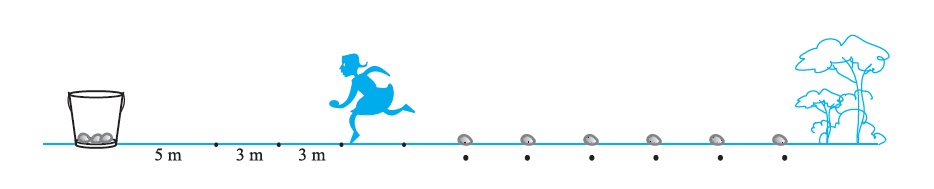
A competitor starts from the bucket, picks up the nearest potato, runs back with it, drops it in the bucket, runs back to pick up the next potato, runs to the bucket to drop it in, and she continues in the same way until all the potatoes are in the bucket. What is the total distance the competitor has to run?
[To pick up the first potato and the second potato, the total distance (in metres) run by a competitor is 2 x 5 + 2 x (5 + 3)]
12.
The minimum age of children to be eligible to participate in a painting competition is 8 years. It is observed that the age of youngest boy was 8 years and the ages of rest of participants are having a common difference of 4 months. If the sum of ages of all the participants is 168 years, find the age of eldest participant in the painting competition.
13.
Find the coordinates of the points which divide the line segment joining A(-2, -2) and B(2, 8) into four equal parts.
14.
11th term of the AP: – 3 ,\(-\frac{1}{2}\) ,2 , ..., is
28
22
- 38
\(-48 \frac{1}{2}\)
15.
30th term of the AP: 10, 7, 4, . . . , is
97
77
- 77
- 87
16.
If for an A.P sn= + 3n What is the nth term?
2n-3
n-4
2n+4
2n+2
17.
The graph of the equation x = 3 is
a point
straight line parallel to y axis
straight line passing through the origin
straight line parallel to x axis
18.
The value of k, if the point P(0,2) is equidistant from A(3,k) and B(k,5) is
0
1
-3
3
19.
Jack is much worried about his upcoming assessment on A.P. He was vigorously practicing for the exam but unable to solve some questions. One of these questions is as shown below. If the 3rd and the 9th terms of an A.P. are 4 and - 8 respectively, then help Jack in solving the problem.
(i) What is the common difference?
| (a) 2 | (b) -1 | (c) -2 | (d) 4 |
(ii) What is the first term?
| (a) 6 | (b) 2 | (c) -2 | (d) 8 |
(iii) Which term of the A.P. is -160?
| (a) 80th | (b) 85th | (c) 81th | (d) 84th |
(iv) Which of the following is not a term of the given A.P.?
| (a) -123 | (b) -100 | (c) 0 | (d) -200 |
(v) What is the 75th term of the A.P.?
| (a) -140 | (b) -102 | (c) -150 | (d) -158 |
1.
Given point P(x, y) is equidistant from the points A(7, 1) and B(3, 5).
So, AP = BP
\(\Rightarrow\) AP2 = BP2
\(\Rightarrow\) (x - 7)2 + (y - 1)2 = (x - 3)2 + (y - 5)2
\(\left[\because \text { distance }=\sqrt{\left(x_2-x_1\right)^2+\left(y_2-y_1\right)^2}\right]\)
\(\Rightarrow\) x2 + 49 - 14x + y2 + 1 - 2y
= x2 + 9 - 6x + y2 + 25 - 10y
\(\Rightarrow\) -14x - 2y + 50 = -6x - 10y + 34
\(\Rightarrow\) -6x - 10y + 14x + 2y = 50 - 34
\(\Rightarrow\) 8x - 8y = 16
\(\Rightarrow\) x - y = 2
[dividing by 8 on both sides]
Hence, the relation between x and y is x - y = 2.
2.
Let Sn = 1 + 2 + 3 + . . . + n
Here a = 1 and the last term l is n.
Therefore, \(\mathrm{S}_{n}=\frac{n(1+n)}{2} \text { or } \mathrm{S}_{n}=\frac{n(n+1)}{2}\)
So, the sum of first n positive integers is given by
\(\mathrm{S}_{n}=\frac{n(n+1)}{2}\)
3.
Using formula for area of a triangle, we get
Area of triangle
= \(\frac{1}{2}\)|a{c+a)-(a+b)}+b{(a+b)-(b+c)}+c{(b+c)-(c+a)}|
= \(\frac{1}{2}\)|a{(c+a)-(a+b)}+b{(a+b)-(b+c)}+c{(b+c)-(c+a)}|
= \(\frac{1}{2}\)|a{c+a-a-b}+b{a+b-b-c}+c{b+c-c-a}|
= \(\frac{1}{2}\)|a(c-b)+b(a-c)+c(b-a)|
= \(\frac{1}{2}\)|ac-ab+ba-bc+cb-ca|=0
4.
Yes
5.
The odd numbers between 0 and 50 are 1,3, 5,., 49 which form an AP.
Here, first term (a) = 1, last term (l) = 49
and common difference (d) = 3 - 1 = 2.
Let there be n numbers in the AP.
Then, nth term (an) = a + (n - 1) d = l
\(\Rightarrow\) 1 + (n - 1) (2) = 49
\(\Rightarrow\) n - 1 = 24 \(\Rightarrow\) n = 25
Now, sum of n terms, \(S_n=\frac{n}{2}(a+l)\)
\(\therefore\) Sum of 25 terms, \(\begin{aligned} S_{25} & =\frac{25}{2}(1+49)=\frac{25}{2} \times 50 \\ \end{aligned}\)
\(\begin{aligned} & =25 \times 25=625 \end{aligned}\)
6.
(-3, 1)
7.
Yes, 6
8.
Area of quadrilateral ABCD is
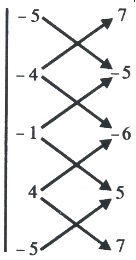
= \(\frac{1}{2}\)|{(-5)(-5)+(-4)(-6)+(-1)(5)+4(7)}-{(-4)(7)+(-1)(-5)+4(-6)+(-5)(5)}|
= \(\frac{1}{2}\)|(25+24-5+28)-(-28+5-24-25)|
=\(\frac{1}{2}\)|72-(-72)|
=\(\frac{1}{2}\)|144|
=\(\frac{1}{2}\)×144
=72 sq.units
9.
Here, S14 = 1050, n = 14, a = 10.
As \(\begin{aligned} \mathrm{S}_n & =\frac{n}{2}[2 a+(n-1) d] \\ \end{aligned}\)
So, \(\begin{aligned} 1050 & =\frac{14}{2}[20+13 d]=140+91 d \end{aligned}\)
i.e., 910 = 91d
or, d = 10
Therefore, a20 = 10 + (20 - 1) \(\times\) 10 = 200, i.e. 20th term is 200.
10.
The list of two-digit numbers divisible by 3 is :
12, 15, 18, . . . , 99
Is this an AP? Yes it is. Here, a = 12, d = 3, an = 99.
As an = a + (n – 1) d,
we have 99 = 12 + (n – 1) x 3
i.e., 87 = (n – 1) x 3
i.e., \(n-1=\frac{87}{3}=29\)
i.e., n = 29 + 1 = 30
So, there are 30 two-digit numbers divisible by 3.
11.
It can be observed that the numbers of logs in rows are in an A.P.
20, 19, 18…
For this A.P.,
a = 20
d = a2 − a1 = 19 − 20 = −1
Let a total of 200 logs be placed in n rows.
Sn = 200
\(S_{n}=\frac{n}{2}[2 a+(n-1) d]\)
\(200=\frac{n}{2}[2(20)+(n-1)(-1)]\)
400 = n (40 − n + 1)
400 = n (41 − n)
400 = 41n − n2
n2 − 41n + 400 = 0
n2 − 16n − 25n + 400 = 0
n (n − 16) −25 (n − 16) = 0
(n − 16) (n − 25) = 0
Either (n − 16) = 0 or n − 25 = 0
n = 16 or n = 25
an = a + (n − 1)d
a16 = 20 + (16 − 1) (−1)
a16 = 20 − 15
a16 = 5
Similarly,
a25 = 20 + (25 − 1) (−1)
a25 = 20 − 24
= −4
Clearly, the number of logs in 16th row is 5. However, the number of logs in 25th row is negative, which is not possible.
Therefore, 200 logs can be placed in 16 rows and the number of logs in the 16th row is 5.
12.
a = 8, d = 1/3 years, Sn = 168
\( { S }_{ n }=\frac { n }{ 2 } [2a+(n-1)d]\)
\(\Rightarrow \quad 168=\frac { n }{ 2 } \left[ 2(8)+(n-1)\frac { 1 }{ 3 } \right] \)
n2 + 47n - 1008 = 0
\(\Rightarrow\) n2 + 63n - 16n - 1008= 0
\(\Rightarrow\) (n - 16)(n + 63) = 0
\(\Rightarrow\) n = 16 or n = - 63
n = 16
(n cannot be negative)
Age of the oldest participant = a + 15d = 13 years
13.

AC : CD : DB = 1 : 1 : 1.Hence, AD : DB = 2 : 1
First, find D using section formula and then find point. C using mid-point formula between A and D, as C is their mid-point.
\(\left( -1,\frac { 1 }{ 2 } \right) ,\left( 0,3 \right) ,\left( 1,\frac { 11 }{ 2 } \right) \)
14.
(b)
22
15.
(c)
- 77
16.
(d)
2n+2
17.
(b)
straight line parallel to y axis
18.
(b)
1
19.
We have, 3rd term = 4 and 9th term = -8 i.e., a + 2d = 4 ........(i)
and a + 8d = -8 .........(ii)
Solving (1) and (2), we get
d = -2, a = 8
(i) (c)
(ii) (d)
(iii) (b): Let tn = -160 \(\Rightarrow\) a + (n - 1) d = -160
\(\Rightarrow\) 8 + (n - 1)(-2) = -160 \(\Rightarrow\) (n - 1)(-2) = -168
\(\Rightarrow\) n - 1 = 84 \(\Rightarrow\) n = 85
So, t85 = -160
(iv) (a)
(v) (a): t75 = a + 74d = 8 + 74( -2) = -140

10th Standard CBSE Syllabus & Materials
10th Standard CBSE
CBSE 10th Social Science PS - Federalism - New Model Questions Papers Study Material - QB365 Set A
NEW10th Standard CBSE
CBSE 10th Social Science PS - Power Sharing - New Model Questions Papers Study Material - QB365 Set A
NEW10th Standard CBSE
CBSE 10th Social Science GEO - Manufacturing Industries - New Model Questions Papers Study Material - QB365 Set A
NEW10th Standard CBSE
CBSE 10th Social Science GEO - Minerals and Energy Resources - New Model Questions Papers Study Material - QB365 Set A



NCERT Books

Syllabus

Exam Pattern

Sample Question Papers

Previous year Question Papers

Important Notes

MCQ Practice test

NCERT Exemplers

Case study Questions

Image Based Questions

Passage based Questions

HOT Questions

Value Based Questions

Model Questions Papers
NCERT ( Book Back ) Questions

Assertion and Reason
Important Questions And Answers

CBSE 10th Standard CBSE Subjects
CBSE Standards



