
 100% FREE ACCESS
10th Standard CBSE Syllabus & Materials
10th Standard CBSE
CBSE 10th Social Science ECO - Globalisation and the Indian Economy - New Model Questions Papers Study Material - QB365 Set A
NEW10th Standard CBSE
CBSE 10th Social Science ECO - Money and Credit - New Model Questions Papers Study Material - QB365 Set A
NEW10th Standard CBSE
CBSE 10th Social Science ECO - Sectors of the Indian Economy - New Model Questions Papers Study Material - QB365 Set A
NEW10th Standard CBSE
CBSE 10th Social Science ECO - Development - New Model Questions Papers Study Material - QB365 Set A
NEW10th Standard CBSE
CBSE 10th Social Science PS - Outcomes of Democracy - New Model Questions Papers Study Material - QB365 Set A
NEW10th Standard CBSE
CBSE 10th Social Science PS - Gender, Religion and Caste - New Model Questions Papers Study Material - QB365 Set A

Published on: 20/10/2025
Download CBSE Class 10th Standard CBSE Maths question papers, sample papers, important questions, and previous year solved papers in PDF format. Get free study materials, NCERT solutions, and exam preparation resources for Class 10th Standard CBSE Maths
Questions + Answers key
Take MCQ Maths Test
1.
If Q(0, 2) is equidistant from P(5, -3) and R(x, 7), then find the value(s) of x.
2.
If the point A (2, - 4) is equidistant from P (3, 8) and 0 (-10, y), then find the value of y. Also, find distance PQ.
3.
Check whether the points (1, 5), (2, 3) and (-2, -1.1) are collinear or not, by using distance formula.
4.
Find the distance of point p(x, y) from the origin.
5.
Show that (a,1), (b,1), (c,1) are collinear points.
6.
The distance between A(1, 3) and B(a, 7) is 5.Find the possible values of a.
7.
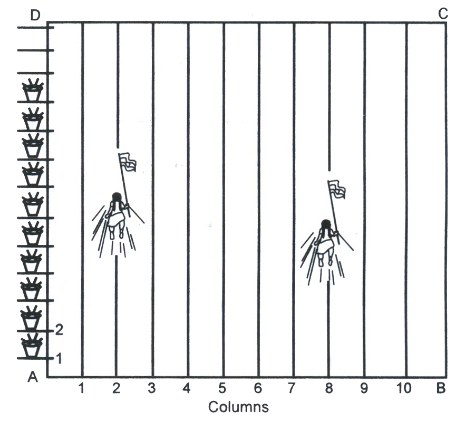
(i) To conduct Sports Day activities, in your rectangular shaped school ground ABCD, lines have been drawn with chalk powder at a distance of 1 m each. 100 flower pots have been placed at a distance of 1 m from each other along AD, as shown in figure. Niharika runs \(\frac { 1 }{ 4 } \) th the distance AD on the 2nd line and posts a green flag. Preet runs \(\frac { 1 }{ 5 } \) th the distance AD on the eighth line and posts a red flag. If Rashmi has to post a blue flag exactly half way between the line segment joining the two flags, where should she post her flag?
(ii) On which day the Sports Day is celebrated?
8.
Prove that (b+a,c), (c+a,b) and (c+b,a) are collinear.
9.
Determine whether the points (1,5), (2,3) and (-2,-11) are collinear.
10.
Find a point on x-axis which is equidistant from A(5,4) and B(-2,3).
11.
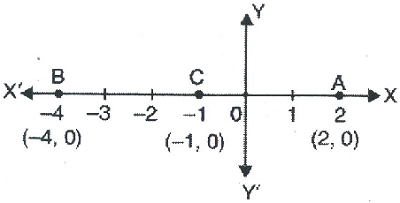
Find the point on the x - axis which is equidistant from (2,0) and (-4,0).
12.
Find the perpendicular distance of A(8,10) from the y-axis.
13.
Show that the following points are collinear: (a,b+c), (b,c+a) and (c,a+b)
14.
Name the type of triangle formed by the points A(-5, 6), B(-4, 2) and C(7, 5).
15.
Show that the points \(P(-{3\over2},3)\), Q(6,-2) and R(-3,4) are collinear
16.
Name the type of triangle formed by the points A(2,3), B(4,6) and C(6,9).
17.
Show that the points A(2,-2), B(14,10), C(11,13) abd D(-1,1) are the vertices of a rectangle
18.
Show that the points A(3,5), B(6,0), C(1,-3) and D(-2,2) are the vertices of a square ABCD.
19.
Show that A(-3,2), B(-5,-5), C(2,-3) and D(4,4) are the vertices of a rhombus.
20.
Find the perimeter of the triangle with vertices (0,4),(0,0) and (3,0).
21.
Show that the following points are collinear: (2,-2),(-3,8) and (-1,4).
22.
Find the distance between the points P(-6,7) and Q(-1,-5)
23.
Use distance formula to show that the points A(-2,3), B(1,2) and (7,0) are collinear.
24.
What point on the x-axis is equidistant from (7,6) and (-3,4)?
25.
Find the point on y-axis which is equidistant from the points (5,-2) and (-3,2)
1.
Given, Q(0, 2) is equidistant from P(5, -3) and R(x, 7), which means PQ = QR.
Find the distance of PQ and QR using distance formula,
\(\sqrt{\left(x_2-x_1\right)^2+\left(y_2-y_1\right)^2}\)
\(\begin{aligned} P Q=\sqrt{(5-0)^2+(-3-2)^2}=5 \sqrt{2} \end{aligned}\)
\(\begin{aligned} Q R=\sqrt{(0-x)^2+(2-7)^2}=\sqrt{x^2+25} \end{aligned}\)
Now, \(\begin{aligned} P Q=Q R \Rightarrow 5 \sqrt{2}=\sqrt{x^2+25} \end{aligned}\)
On squaring both sides of the above equation, we get
50 = x2 + 25 \(\Rightarrow\) x2 = 25 \(\Rightarrow\) x = \(\pm 5\)
Therefore, the values of x are 5 and -5.
2.
Given points are A(2, - 4), P(3, 8) and Q(-10, y).
According to the question, PA = QA
\(\sqrt{(2-3)^{2}+(-4-8)^{2}}=\sqrt{(2+10)^{2}+(-4-y)^{2}}\)
\(\Rightarrow \ \sqrt{(-1)^{2}+(-12)^{2}}=\sqrt{(12)^{2}+(4+y)^{2}}\)
\(\Rightarrow \ \sqrt{145}=\sqrt{160+y^{2}+8 y}\)
On squaring both sides, we get
145=160+y2+8y
\(\Rightarrow \ y^{2}+8 y+160-145=0\)
\(\Rightarrow \ y^{2}+8 y+15=0\)
\(\begin{aligned} \Rightarrow &y=-5 \text { or } y=-3 \end{aligned}\)
Now,\(P Q=\sqrt{(-10-3)^{2}+(y-8)^{2}}\)
For \(y=-5, P Q=\sqrt{(-13)^{2}+(-5-8)^{2}}\)
\(=\sqrt{338} \text { units }\)
and for \(y=-3, P Q=\sqrt{(-13)^{2}+(-3-8)^{2}}\)
\(=\sqrt{290} \text { units }\)
Hence, the values of yare -5, -3 and distance is
\(P Q=\sqrt{338} \text { units or } \sqrt{290} \text { units. }\).
3.
Non-collinear
4.
We know that, distance between two points P(x1, y1)
and \(Q\left(x_{2}, y_{2}\right) \text { is } \sqrt{\left(x_{2}-x_{1}\right)^{2}+\left(y_{2}-y_{1}\right)^{2}}\)
Here, P(x1,yl) = P(x,y)andQ(x2, yz) = Q(O, 0)
\(\therefore\) Distance between point P (x, y) and origin is
\(\sqrt{(0-x)^{2}+(0-y)^{2}}=\sqrt{x^{2}+y^{2}}\) units
5.
Let A=(a,1), B=(b,1) and C = (c,1), then prove AB = BC + CA
6.
Here, A=(x1,y1)=(1, 3) and B=(x2,y2)=(a, 7)
Distance between A and B is AB = \(\sqrt { { \left( a-1 \right) }^{ 2 }+{ (7-3) }^{ 2 } } \) [\(\because \) distance=\(\sqrt { { \left( { x }_{ 2 }-{ x }_{ 1 } \right) }^{ 2 }-{ \left( { y }_{ 2 }-{ y }_{ 1 } \right) }^{ 2 } } \)]
\(\Rightarrow \) 5=\(\sqrt { { \left( a-1 \right) }^{ 2 }+{ (4) }^{ 2 } } \) [\(\because \) distance, AB=5]
\(\Rightarrow \) 5=\(\sqrt { { a }^{ 2 }+1-2a+16 } \)
\(\Rightarrow \) 25=\({ a }^{ 2 }\)-2a+17 [squaring on both sides]
\(\Rightarrow \) \({ a }^{ 2 }\)-2a-8=0
\(\Rightarrow \) \({ a }^{ 2 }\)-4a+2a-8=0
\(\Rightarrow \) a(a-4)+2(a-4)=0
\(\Rightarrow \) (a-4)(a+2) =0 \(\Rightarrow \) a=4, -2
Hence, the possible values of a are 4 and -2.
7.
(i) Considering A as origin (0, 0), AB as x-axis and AD as y-axis.
Niharika runs in the 2nd line with green flag and distance covered (parallel to AD)
= \(\frac{1}{4} \times100 = 25 m\)
∴ Coordinates of green flag are (2, 25) and label it as P i.e., P(2, 25).
Similarly, Preet runs in the eighth line with red flag and distance covered (parallel to AD)
= \(\frac {1}{5} \times100 = 20 m\)
∴ Coordinates of red flag are (8, 20) and label it as Q i.e., Q(8, 20).
Also, Rashmi has to post a blue flag at the mid- point of PQ, therefore, by using mid-point formula, we have \((\frac {2+8}{2} , \frac{25+20}{2})\)
i.e., \(\left( 5,\frac { 45 }{ 2 } \right) \)
Hence, the blue flag is in the fifth line distance of \(\frac {45}{2}\) i.e., 22.5 m along the direction parallel to AD.
(ii) Sports day is celebrated on 29th August, every year.
8.
Let the given points be L (b+a,c) , M(c+a,b) and N(c+b, a).
∴ By using distance formula, we get
LM = \(\sqrt {(c+a-b-a)^{2}+(b-c)^{2}}\)
=\(\sqrt{(c-b)^{2}+(c-b)^{2}(-1)^{2}}\)
=\(\sqrt{(c-b)^{2}+(c-b)^{2}}\)=(c-b)\(\sqrt{2}\)units
MN = \(\sqrt{(c+b-c-a)^{2}+(a-b)^{2}}\)
=\(\sqrt{(b-a)^{2}+(-1)^{2}+(b-a)^{2}}\)
=\(\sqrt{(b-a)^{2}+(b-a)^{2} }= (b-a)\sqrt{2}\)units
and LN = \(\sqrt {(c+b-b-a)^{2}+(a-c)^{2}}\)
=\(\sqrt{(c-a)^{2}+(-1)^{2}(c-a)^{2}}\)
=\(\sqrt{(c-a)^{2}+(c-a)^{2}}\)=(c-a)\(\sqrt{2}\)units
Now, LM+MN = (c-b)\(\sqrt{2}\) + (b-a) \(\sqrt{2}\)
= (c-b+b-a) \(\sqrt{2}\)
=(c-a)\(\sqrt{2}\)
=LN
Hence, the points (b+a, c), (c+a, b) and (c+b, a) are collinear.
9.
Let given points are P(1,5), Q(2,3) and R(-2,-11).
Now, PQ = \(\sqrt{(2-1)^{2}+(3-5)^{2}}\)
=\(\sqrt{(1)^{2}+(-2)^{2}}\)=\(\sqrt{1+4}\)
=\(\sqrt{5}\)units
QR = \(\sqrt{(-2-2)^{2}+(-11-3)^{2}}\)
=\(\sqrt{(-4)^{2}+(-14)^{2}}\) = \(\sqrt{16+196}\)
=\(\sqrt{212}\)=\(2\sqrt{53}\)units
PR = \(\sqrt{(-2-1)^{2}+(-11-5)^{2}}\)
=\(\sqrt{(-3)^{2}+(-16)^{2}}\) = \(\sqrt{9+256}\)
=\(\sqrt{265}\) = \(\sqrt {5} \times \sqrt {53}\) units
Here, PQ+QR ≠ PR+QR ≠ PQ, PQ+PR ≠ QR
Hence, the points P, Q are not collinear.
10.
Let P(x, 0) be the required point on x-axis.
∴ |PA|=|PB|
⇒ PA2=PB2
⇒ (x-5)2+(0-4)2=(x+2)2+(0-3)2
⇒ x2-10x+25+16=x2+4x+4+9
⇒ 14x=28
⇒ x=2
Hence, the required point is (2, 0).
11.
Since (2, 0) and (-4, 0) both lie on x-axis, therefore, the required point on x-axis equidistant from (2, 0) and (-4, 0) is (-1, 0).
12.
8 units
13.
Points (a, b + c), (b, c + a) and (c,a + b) will be collinear if area of the triangle formed by these points is zero.
Area = \(\frac{1}{2}\)[a{c+a-(a+b)}+b{a+b-(b+c)}+c{b+c-c{c+a}]
=\(\frac{1}{2}\)[a(c+a-a-b)+b(a+b-b-c)+c(b+c-c-a)]
=\(\frac{1}{2}\)[ac-ab+ab-bc+bc-ac]
=\(\frac{1}{2}\)[0]=0
Thus, the given points are collinear.
14.
scalene triangle
15.
If \(\left[ { x }_{ 1 }\left( { y }_{ 2 }-{ y }_{ 3 } \right) +{ x }_{ 2 }\left( { y }_{ 3 }-{ y }_{ 1 } \right) +{ x }_{ 3 }\left( { y }_{ 1 }-{ y }_{ 2 } \right) \right] \)
\(\therefore \frac { -3 }{ 2 } \left( -2-4 \right) +6(4-3)+\left[ (-3)\left\{ 3-(-2) \right\} \right] =\frac { -3 }{ 2 } \times (-6)+6\times 1-3\times 5=9+6-15=0.\)
∴ P,Q and R are collinear.
16.
\(AB=\sqrt { (4-{ 2) }^{ 2 }+(6-3)^{ 2 } } =\sqrt { 13 } ;\)
\(BC=\sqrt { (6-{ 4) }^{ 2 }+(9-6)^{ 2 } } =\sqrt { 13 } \)
\(AC=\sqrt { (6-{ 2) }^{ 2 }+(9-3)^{ 2 } } =\sqrt { 52 } =2\sqrt { 13 } \)
Here AB+BC=AC
∴ AB, BC and AC cannot be the side of any triangle.
( ∵ Sum of two sides of a triangle is always more than the third side)
∴ A, B and C are not vertices of any triangle. A, B and C are collinear.
17.
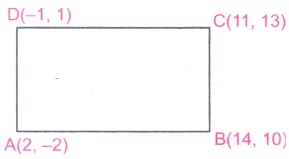
\(AB=\sqrt { (14-{ 2) }^{ 2 }+(10+2)^{ 2 } } =12\sqrt { 2 } units\)
\(BC=\sqrt { (11-{ 14) }^{ 2 }+(13-10)^{ 2 } } =3\sqrt { 2 } units\)
\(CD=\sqrt { (-1-{ 11) }^{ 2 }+(1-13)^{ 2 } } =12\sqrt { 2 } units\)
\(AD=\sqrt { (-1-{ 2) }^{ 2 }+(1+2)^{ 2 } } =3\sqrt { 2 } units\)
⇒ AB=CD and BC = AD
∴ ABCD is a || gm
Now, \(AC=\sqrt { (11-2)^{ 2 }+({ 13+2) }^{ 2 } } =\sqrt { 306 } \)
⇒ AC2=306 units, AB2 = 288 units, BC2 =18 units
AB2+BC2=306 units
⇒ AC2=AB2+BC2⇒∠ABC = 900
⇒ ABCD is a rectangle.
18.
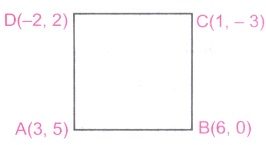
\(AB=\sqrt { (6-{ 3) }^{ 2 }+(0-5)^{ 2 } } =\sqrt { 9+25 } =\sqrt { 34 } \)
\(\\ BC=\sqrt { { (6-1) }^{ 2 }+{ (0+3) }^{ 2 } } =\sqrt { 25+9 } =\sqrt { 34 } \)
\(CD=\sqrt { (1+2)^{ 2 }+({ -3-2) }^{ 2 } } =\sqrt { 9+25 } =\sqrt { 34 } \)
\(\\ DA=\sqrt { (-2-3)^{ 2 }+({ 2-5) }^{ 2 } } =\sqrt { 25+9 } =\sqrt { 34 } \)
\(AC=\sqrt { (1-3)^{ 2 }+({ -3-5) }^{ 2 } } =\sqrt { 4+64 } =\sqrt { 68 } \)
\(BD=\sqrt { (6+2)^{ 2 }+({ 0-2) }^{ 2 } } =\sqrt { 64+4 } =\sqrt { 68 } \)
AB=BC=CD=DA=\(\sqrt{34}\)
Diagonal AC= diagonal BD=\(\sqrt {68}\)
Hence A, B, C and D are vertices of a square.
19.
AB = \(\sqrt { \{ -5-{ (-3) }^{ 2 }\} +(-5-2)^{ 2 } } \)
\(=\sqrt { 4+49 } =\sqrt { 53 } \)
\(BC=\sqrt { \{ 2-{ (-5) }^{ 2 }\} +(-3-(-5)\} ^{ 2 } } =\sqrt { 53 } \)
\(\\ CD=\sqrt { { (4-2) }^{ 2 }+\{ { 4-(-3) }\} ^{ 2 } } =\sqrt { 53 } \)
\(AD=\sqrt { \{ 4-(-3){ \} }^{ 2 }+({ 4-2) }^{ 2 } } =\sqrt { 53 } \)
Now AB=CD, BC=AD
∴ A, B, C and D are vertices of a parallelogram.
Also AB=BC
∴ ABCD is a rhombus.
20.
Let A(0,4), B(0,0) and C(3,0) are the vertices of △ABC
\(AB=\sqrt { ({ 0-0) }^{ 2 }+({ 0-4) }^{ 2 } } =4\)
\(BC=\sqrt { { (0-3) }^{ 2 }+({ 0-0) }^{ 2 } } =3\)
\(AC=\sqrt { { (3-0) }^{ 2 }+({ 0-4) }^{ 2 } } =5\)
Perimeter of △ABC = AB+BC+CA = 4+3+5 = 12 units.
21.
Using distance formula
\(AB=\sqrt { ({ -3-2) }^{ 2 }+[8-({ -2)] }^{ 2 } } \)
\(=\sqrt { { 5 }^{ 2 }+10^{ 2 } } =\sqrt { 25+100 } \)
\(=\sqrt { 125 } =5\sqrt { 5 } units\)
\(BC=\sqrt { [{ -1-(-3)] }^{ 2 }+(4-8)^{ 2 } } \)
\(=\sqrt { { 2 }^{ 2 }+4^{ 2 } } =\sqrt { 4+16 } =\sqrt { 20 } \)
\(=2\sqrt { 5 } units\)
\(AC=\sqrt { ({ -1-2) }^{ 2 }+[4-(-2)]^{ 2 } } \)
\(=\sqrt { { 3 }^{ 2 }+6^{ 2 } } =\sqrt { 9+36 } =\sqrt { 45 } \)
\(=3\sqrt { 5 } units\)
\(\because \ 2\sqrt { 5 } +3\sqrt { 5 } =5\sqrt { 5 } \)
∴ Points are collinear.
22.
P(-6,7) be P(x1,y1) and Q(-1,-5) be (x2,y2).
Then, \(PQ=\sqrt { { ({ x }_{ 2 }-{ x }_{ 1 }) }^{ 2 }-{ ({ y }_{ 2 }-{ y }_{ 1 }) }^{ 2 } } \)
\(=\sqrt { { \{ (-1)-(-6)\} }^{ 2 }-{ \{ (7)-(-5)\} }^{ 2 } } \)
\(=\sqrt { ({ -1+6) }^{ 2 }+({ 7+5) }^{ 2 } } =\sqrt { 25+144 } \)
\(\\ =\sqrt { 169 } =13\quad units\)
23.
\(AB=\sqrt { ({ 1+2) }^{ 2 }+({ 2-3) }^{ 2 } } =\sqrt { 9+1 } =\sqrt { 10 } \)
\(BC=\sqrt { ({ 7-1) }^{ 2 }+({ 0-2) }^{ 2 } } =\sqrt { 36+4 } =\sqrt { 40 } =2\sqrt { 10 } \)
\(AC=\sqrt { ({ 7+2) }^{ 2 }+({ 0-3) }^{ 2 } } =\sqrt { 81+9 } =\sqrt { 90 } =3\sqrt { 10 } \)
Since \(AB+BC=\sqrt { 10 } +2\sqrt { 10 } =(1+2)\sqrt { 10 } =3\sqrt { 10 } =AC\)
Hence, the points A, B and C are collinear.
24.
Let A(7,6), B(-3,4)) be the given points and P(x,0) be the required point.
Since, P is equidistant from A and B, therefore,
AP = BP ⇒ AP2=BP2
⇒ (x-7)2+(0-6)2=(x+3)2+(0-4)2 ⇒ x2+49-14x+36 = x2+9+6x+16
⇒ -14x-6x = 25-85 ⇒ -20x=-60
\(\Rightarrow x=\frac { -60 }{ -20 } =3\)
∴ Required point on axis is (3,0).
25.
Let point on y-axis be (0,a)
Now distance of this point from (5,-2) equal to distance from point (-3,2)
i.e., \(\Rightarrow \sqrt { 5^{ 2 }+\left( -2-a \right) ^{ 2 } } =\sqrt { \left( 3 \right) ^{ 2 }+\left( a-2 \right) ^{ 2 } } \)
Squaring and simplifying, we get
25+4+a2+4a = 9+a2+4-4a ⇒ 8a=-16 ⇒ a=-2

10th Standard CBSE Syllabus & Materials
10th Standard CBSE
CBSE 10th Social Science PS - Federalism - New Model Questions Papers Study Material - QB365 Set A
NEW10th Standard CBSE
CBSE 10th Social Science PS - Power Sharing - New Model Questions Papers Study Material - QB365 Set A
NEW10th Standard CBSE
CBSE 10th Social Science GEO - Manufacturing Industries - New Model Questions Papers Study Material - QB365 Set A
NEW10th Standard CBSE
CBSE 10th Social Science GEO - Minerals and Energy Resources - New Model Questions Papers Study Material - QB365 Set A



NCERT Books

Syllabus

Exam Pattern

Sample Question Papers

Previous year Question Papers

Important Notes

MCQ Practice test

NCERT Exemplers

Case study Questions

Image Based Questions

Passage based Questions

HOT Questions

Value Based Questions

Model Questions Papers
NCERT ( Book Back ) Questions

Assertion and Reason
Important Questions And Answers

CBSE 10th Standard CBSE Subjects
CBSE Standards



