
 100% FREE ACCESS
10th Standard CBSE Syllabus & Materials
10th Standard CBSE
CBSE 10th Social Science ECO - Globalisation and the Indian Economy - New Model Questions Papers Study Material - QB365 Set A
NEW10th Standard CBSE
CBSE 10th Social Science ECO - Money and Credit - New Model Questions Papers Study Material - QB365 Set A
NEW10th Standard CBSE
CBSE 10th Social Science ECO - Sectors of the Indian Economy - New Model Questions Papers Study Material - QB365 Set A
NEW10th Standard CBSE
CBSE 10th Social Science ECO - Development - New Model Questions Papers Study Material - QB365 Set A
NEW10th Standard CBSE
CBSE 10th Social Science PS - Outcomes of Democracy - New Model Questions Papers Study Material - QB365 Set A
NEW10th Standard CBSE
CBSE 10th Social Science PS - Gender, Religion and Caste - New Model Questions Papers Study Material - QB365 Set A

Published on: 20/10/2025
Download CBSE Class 10th Standard CBSE Maths question papers, sample papers, important questions, and previous year solved papers in PDF format. Get free study materials, NCERT solutions, and exam preparation resources for Class 10th Standard CBSE Maths
Questions + Answers key
Take MCQ Maths Test
1.
Prove that :\(\frac { \tan { \theta } }{ 1-\cot { \theta } } +\frac { \cot { \theta } }{ 1-\tan { \theta } } =1+\tan { \theta } +\cot { \theta } \)
2.
A man standing on the bank of a river observes that the angle of elevation of a tree opposite bank is 600.When he moves 50m away from the bank, he find the angle of elevation to be 300.Calculate:
(i)the width of the river and
(ii)the height of the tree
3.
The centre of a circle is (2x-1,3x+1). Find x, if the circle passes through (-3,-1) and the length of the diameter is 20units.
4.
A(0,3), B(-1,-2) and C(4,2) are vertices of a \(\Delta ABC\). D is a point on the side BC such that \({BD\over DC}={1\over2}\). P is a point on AD such that \(AP={2\sqrt5\over3}\)units. Find coordinates of P.
5.
A tower subtends an angle \(\alpha\) at a point A in the plane of its base and the angle of depression of the foot of the tower at a point b metres just above A is \(\beta\). Prove that the height of tower is b tan \(\alpha\cot\beta\).
6.
\(\frac{1+\tan ^{2} A}{1+\cot ^{2} A}=\)
sec2 A
–1
cot2 A
tan2 A
7.
(sec A + tan A) (1 – sin A) =
sec A
sin A
cosec A
cos A
8.
(1 + tan \(\theta\) + sec \(\theta\)) (1 + cot \(\theta\) – cosec \(\theta\)) =
0
1
2
-1
9.
9 sec2 A – 9 tan2 A =
1
9
8
0
10.
\(\frac{2 \tan 30^{\circ}}{1-\tan ^{2} 30^{\circ}}\) =
cos 60°
sin 60°
tan 60°
sin 30°
11.
sin 2A = 2 sin A is true, when A =
0°
30o
45°
60°
12.
\(\frac{1-\tan ^{2} 45^{\circ}}{1+\tan ^{2} 45^{\circ}}\) =
tan 90°
1
sin 45°
0
13.
\(\frac{2 \tan 30^{\circ}}{1+\tan ^{2} 30^{\circ}}\)=
sin 60°
cos 60°
tan 60°
sin 30°
14.
Find the value of P for which the point (–1, 3), (2, p) and (5, –1) are collinear.
4
3
2
1
15.
Find the coordinates of the point equidistant from the points A(1, 2), B (3, –4) and C(5, –6)
(2, 3)
(–1, –2)
(0, 3)
(1, 3)
16.
A vertical tower is 20 m high. A man at some distance from the tower knows that the cosine of the angle of the elevation of the top of tower is 0.5. He is standing from the foot of the tower at a distance of:
30√3 m
20√3 m
20/√3 m
10/√3 m
17.
The length of shadow of a tower on the plane ground is √3 times the height of the tower. The angle of elevation of sun is :
90o
60o
30o
45o
18.
The angles of elevation of the top of a cliff from two points x and y metres from the base and in the same straight line with it are complementary. The height of the cliff is
\(x\sqrt { _{ ym } } m\)
\(\sqrt { x } y\quad m\)
\(\sqrt { XY } m\)
xy m
19.
If altitude of the sun is 60°, the height of a tower which casts a shadow of length 30 m is:
30√3 cm
30/√3 m
15 m
15√2 m
20.
The angle formed by the line of sight with the horizontal, when the point being viewed is above the horizontal level is called:
Obtuse angle
Angle of elevation
Angle of depression
Vertical angle
21.
An observer 1.5 m tall is 28.5 m away from a tower. The angle of elevation of the top of the tower from his eyes is 45°. The height of the tower is
30 m
20 m
40 m
10 m
22.
If the angles of depression from the top of a tower of height 40 m to the top and bottom of a tree are 45° and 60° respectively, then the height of the tree is
\(\frac { 40 }{ 3 } (3-\sqrt { 3 } )\)
\(\frac { 20 }{ 3 } (\sqrt { 3 } +3)\)
\(\frac { 20 }{ 3 } (\sqrt { 3 } +1)\)
\(\frac { 40 }{ 3 } (\sqrt { 3 } -1)\)
23.
The figure shows the observation of point C from point A. The angle of depression from A is:
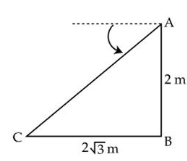
30°
60°
75°
45°
24.
The ratio of the length of rod and its shadow is 1:√3, then the angle of elevation of the sun is:
45°
60°
90°
30°
25.
A tower stands vertically on the ground. From a point on the ground 30 m away from the foot of the tower, the angle of elevation of the top of the tower is 45°. The height of the tower will be
30√3 m
30 m
40 m
40√3 m
26.
If the angle of elevation of a cloud from a point 100 metres above a lake is 30° and the angle of depression of its reflection in the lake is 60°, then the height of the cloud above the lake is
200 m
30 m
500 m
100 m
27.
A man has a height of 1.732 m. He observes the angle of depression to the head and toe of his son as 30° and 60° respectively. What is the height of his son? (Take √3 = 1.732)
3 m
1.155 m
3.464 m
1.732 m
28.
An electrician has to repair an electric fault on a pole of height 4 m. He needs to reach a point 1.3 m below the top of the pole to undertake the repair work. The length of the ladder he should use which when inclined at an angle of 60° to the horizontal would enable him to reach the required position is:
\(\frac { 9\sqrt { 3 } }{ 5 } \)m
\(\frac { 5 }{ 9 } \)m
\(\frac { \sqrt { 3 } }{ 5 } \)m
\(\frac { 9 }{ 5 } \)m
29.
Two pillars are a metres apart and the height of one is double that of the other. If from the middle point of the line joining their feet, an observer finds the angular elevation of their tops to be complementary, then the height of the taller pillar is
a√2m
2a m
a m
a/√2 m
30.
A tower stands vertically on the ground. From a point C on the ground, which is 20 m away from the foot of the tower, the angle of elevation of the top of the tower is found to be 45°. The height of the tower is
10 m
8 m
15 m
20 m
31.
From the given figure, find h
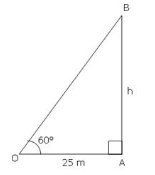
√3 m
25√3m
50√3 m
2 √3 m
32.
If the height and length of the shadow of a man are the same, then the angle of elevation of the sun is
60°
45°
30°
15°
33.
A man is standing on the deck of a ship, which is 8 m above water level. He observes the angle of elevation of the top of a hill as 600 and angle of depression of the base of the hill as 300. What is the height of the hill?
32 m
24√3 m
24m
8√3 m
34.
A tree casts a shadow 4 m long on the ground, when the angle of elevation of the sun is 450. The height of the tree is:
4.5 m
3 m
5.2 m
4 m
35.
A kite is flying, attached to a thread which is 165m long. The thread makes an angle of 300 with the ground. The height of the kite from the ground, assuming that there is no slack in the thread is
84 m
82.5 m
81.5 m
80 m
36.
Which of the following is rational?
√3 + √5
√4 + √9
√2 + √4
√6 + √9
1.
\(LHS=\frac { \tan { \theta } }{ 1-\cot { \theta } } +\frac { \cot { \theta } }{ 1-\tan { \theta } } \)
\(=\frac { \tan { \theta } }{ 1-\frac { 1 }{ \tan { \theta } } } +\frac { \frac { 1 }{ \tan { \theta } } }{ 1-\tan { \theta } } \left( \because \quad \tan { \theta } =\frac { 1 }{ \cot { \theta } } \right) \)
\(=\frac { \tan ^{ 2 }{ \theta } }{ \tan { \theta } -1 } +\frac { 1 }{ \left( 1-\tan { \theta } \right) \tan { \theta } } \)
\(=\frac { \tan ^{ 3 }{ \theta -1 } }{ \left( \tan { \theta } -1 \right) \tan { \theta } } \left[ \because { a }^{ 3 }-{ b }^{ 3 }=\left( a-b \right) \left( { a }^{ 3 }+{ b }^{ 3 }+ab \right) \right] \)
\(=\frac { \left( \tan { \theta } -1 \right) \left( \tan ^{ 2 }{ \theta } +\tan { \theta } +1 \right) }{ \left( \tan { \theta } -1 \right) \tan { \theta } } =\frac { \tan ^{ 2 }{ \theta } +\tan { \theta } +1 }{ \tan { \theta } } \)
\(=\tan { \theta } +1+\cot { \theta } \)
= RHS
2.
(i)50m
(ii)2.13m
3.
\(x={-46\over 13}\) or x=2
4.
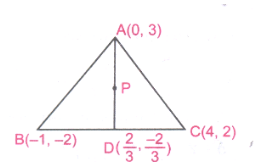
\(\because \) BD:CD =1:2
\(\therefore \) Coordinates of D are
\(\left( \frac { 1\times 4+2\times -1 }{ 1+2 } ,\frac { 1\times 2+2\times -2 }{ 1+2 } \right) \) ie \(\left( \frac { 2 }{ 3 } ,\frac { -2 }{ 3 } \right) \)
AD= \(\sqrt { \left( \frac { 2 }{ 3 } -0 \right) ^{ 2 }+\left( \frac { -2 }{ 3 } -3 \right) ^{ 2 } } \)
= \(\sqrt { \frac { 4 }{ 9 } +\frac { 121 }{ 9 } } =\sqrt { \frac { 125 }{ 9 } } =\frac { 5\sqrt { 5 } }{ 3 } \) units
DP=AD-AP = \(\frac { 5\sqrt { 5 } }{ 3 } -\frac { 2\sqrt { 5 } }{ 3 } \)
=\(\frac { 3\sqrt { 5 } }{ 3 } \) =\(\sqrt { 5 } \) units
\(\therefore \) \(\frac { AD }{ AP } =\frac { \frac { 2\sqrt { 5 } }{ 3 } }{ \sqrt { 5 } } =\frac { 2 }{ 3 } \)
P divides AD in the ratio 2 : 3.
\(\therefore \) x-coordinate of P is
x= \(\frac { 2\times \frac { 2 }{ 3 } +3\times 0 }{ 2+3 } =\frac { 4 }{ 15 } \)
Similarly ,y-coordinates of P is
y= \(\frac { 2\times \frac { -2 }{ 3 } +3\times 3 }{ 2+3 } =\frac { 23 }{ 15 } \)
\(\therefore \) x-Coordinates of P are \(\left( \frac { 4 }{ 15 } ,\frac { 23 }{ 15 } \right) \)
5.
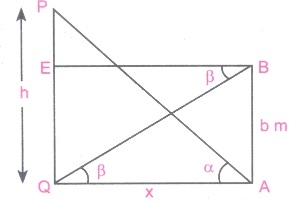
Given: A tower PQ subtending angle α at the point A. Point B is b m vertically above A. From B angle of depression of Q is β.
To prove:
PQ=height of the tower =b tanα cotβ
Proof: Let AQ=x
ㄥEBQ=β
EB||QA
⇒ ㄥBQA=β [Alternate angles]
In right angled ∆BAQ,
\(\frac { AB }{ AQ } =\frac { b }{ x } \)=tanβ
⇒ \(\frac { b }{ x } \)=tanβ
⇒ x=b cotβ
\(\frac { PQ }{ QA } =\frac { h }{ x } \)=tanα
⇒ h=x tanα
=b cotβ tanα=b tanα cotβ
6.
(d)
tan2 A
7.
(d)
cos A
8.
(c)
2
9.
(b)
9
10.
(c)
tan 60°
11.
(a)
0°
12.
(d)
0
13.
(a)
sin 60°
14.
(d)
1
15.
(b)
(–1, –2)
16.
(c)
20/√3 m
17.
(c)
30o
18.
(c)
\(\sqrt { XY } m\)
19.
(a)
30√3 cm
20.
(b)
Angle of elevation
21.
(a)
30 m
22.
(a)
\(\frac { 40 }{ 3 } (3-\sqrt { 3 } )\)
23.
(a)
30°
24.
(d)
30°
25.
(b)
30 m
26.
(d)
100 m
27.
(b)
1.155 m
28.
(a)
\(\frac { 9\sqrt { 3 } }{ 5 } \)m
29.
(a)
a√2m
30.
(d)
20 m
31.
(b)
25√3m
32.
(b)
45°
33.
(a)
32 m
34.
(d)
4 m
35.
(b)
82.5 m
36.
(b)
√4 + √9

10th Standard CBSE Syllabus & Materials
10th Standard CBSE
CBSE 10th Social Science PS - Federalism - New Model Questions Papers Study Material - QB365 Set A
NEW10th Standard CBSE
CBSE 10th Social Science PS - Power Sharing - New Model Questions Papers Study Material - QB365 Set A
NEW10th Standard CBSE
CBSE 10th Social Science GEO - Manufacturing Industries - New Model Questions Papers Study Material - QB365 Set A
NEW10th Standard CBSE
CBSE 10th Social Science GEO - Minerals and Energy Resources - New Model Questions Papers Study Material - QB365 Set A



NCERT Books

Syllabus

Exam Pattern

Sample Question Papers

Previous year Question Papers

Important Notes

MCQ Practice test

NCERT Exemplers

Case study Questions

Image Based Questions

Passage based Questions

HOT Questions

Value Based Questions

Model Questions Papers
NCERT ( Book Back ) Questions

Assertion and Reason
Important Questions And Answers

CBSE 10th Standard CBSE Subjects
CBSE Standards



