
 100% FREE ACCESS
10th Standard CBSE Syllabus & Materials
10th Standard CBSE
CBSE 10th Social Science ECO - Globalisation and the Indian Economy - New Model Questions Papers Study Material - QB365 Set A
NEW10th Standard CBSE
CBSE 10th Social Science ECO - Money and Credit - New Model Questions Papers Study Material - QB365 Set A
NEW10th Standard CBSE
CBSE 10th Social Science ECO - Sectors of the Indian Economy - New Model Questions Papers Study Material - QB365 Set A
NEW10th Standard CBSE
CBSE 10th Social Science ECO - Development - New Model Questions Papers Study Material - QB365 Set A
NEW10th Standard CBSE
CBSE 10th Social Science PS - Outcomes of Democracy - New Model Questions Papers Study Material - QB365 Set A
NEW10th Standard CBSE
CBSE 10th Social Science PS - Gender, Religion and Caste - New Model Questions Papers Study Material - QB365 Set A

Published on: 20/10/2025
Download CBSE Class 10th Standard CBSE Maths question papers, sample papers, important questions, and previous year solved papers in PDF format. Get free study materials, NCERT solutions, and exam preparation resources for Class 10th Standard CBSE Maths
Questions + Answers key
Take MCQ Maths Test
1.
Find a relation between x and y such that the point (x , y) is equidistant from the points A (7, 1) and B (3, 5).
2.
The distance between A(1, 3) and B(a, 7) is 5.Find the possible values of a.
3.
Find the distance between the points (0,0) and (36,15). Can you now find the distance between the two towns A and B by using Pythagoras Theorem?
4.
Find the distance between \(A\left( 0,\ \sqrt { 3 } \right) \ and\ B\left( \sqrt { 3 } +1,\ 1 \right) \)
5.
Find the fourth vertex of a rectangle whose three vertices taken in order are (4,1), (7,4) and (13,-2).
6.
Find the value of k for which points (7, -2), (5, 1), (3, k) are collinear.
7.
Find the ratio in which the line segment joining (2,-3) and (5,6) is divided by x-axis.
8.
Find the distance of the point A(2, 3) from x-axis.
9.
Find the coordinates of the point which divides the line segment joining the points (4,-3) and (8,5) in the ratio 3:1 internally.
10.
If A(1,2), B(4,3) and C(6,6) are the three vertices of a parallelogram ABCD, find the coordinates of the fourth vertex D.
11.
Find the coordinate of the points which divide the line segment joining A(-2,2) and B(2,8) into four equal parts.
12.
If (1,2),(4,y),(x,6) and (3,5) are the vertices of the parallelogram taken in order, find x and y.
13.
Find the ratio in which line segment joining A(1,-5) and B(-4,5) is divided by the x-axis. Also, find the coordinates of the points of division.
14.
Find the centre of a circle passing through (5,-8), (2,-9) and (2,1).
15.
If the centre of s circle is (2a,a,-7). Find the values of a if the circle passes through the point (11,-9) and has diameter \(10\sqrt2\) units.
16.
The centre of a circle is \((2\alpha -1,7)\) and it passes through the point (-3,-1). If the diameter of the circle is 20 units, then find the value of \(\alpha\)
17.
What point on the x-axis is equidistant from (7,6) and (-3,4)?
18.
Find the point on y-axis which is equidistant from the points (5,-2) and (-3,2)
19.
The three vertices of a rhombus PORS are P(2, - 3), Q(6, 5) and R (-2, 1).
(i) Find the coordinates of the point where both the diagonals PR and QS intersect.
(ii) Find the coordinates of the fourth vertex S. Show your steps and give valid reasons.
20.
Prove that the points (2, -2), (-3, 8) and (-1, 4) are collinear.
21.
Find the coordinates of the points of trisection of the line segment joining (2, - 3) and (4, - 1).
22.
Find the coordinates of the point which divides the line segment join of (4, - 3) and (9, 7) in the ratio 3: 2.
23.
Find the ratio in which the point \(P\left( \frac { 3 }{ 4 } ,\frac { 5 }{ 12 } \right) \) divides the line segment joining points \(A\left( \frac { 1 }{ 2 } ,\frac { 3 }{ 2 } \right) \) and B(2,-5).
24.
Find the value of k, for which the points A(6,-1), B(k,-6) and C(0,-7) are collinear.
25.
Find the value of k for which the point (0,2) is equidistant from two points (3,k) and (k, 5).
26.
Show that the points A(1,2), B(5,4), C(3,8) and D(-1,6) are the vertices of a square.
1.
Given point P(x, y) is equidistant from the points A(7, 1) and B(3, 5).
So, AP = BP
\(\Rightarrow\) AP2 = BP2
\(\Rightarrow\) (x - 7)2 + (y - 1)2 = (x - 3)2 + (y - 5)2
\(\left[\because \text { distance }=\sqrt{\left(x_2-x_1\right)^2+\left(y_2-y_1\right)^2}\right]\)
\(\Rightarrow\) x2 + 49 - 14x + y2 + 1 - 2y
= x2 + 9 - 6x + y2 + 25 - 10y
\(\Rightarrow\) -14x - 2y + 50 = -6x - 10y + 34
\(\Rightarrow\) -6x - 10y + 14x + 2y = 50 - 34
\(\Rightarrow\) 8x - 8y = 16
\(\Rightarrow\) x - y = 2
[dividing by 8 on both sides]
Hence, the relation between x and y is x - y = 2.
2.
Here, A=(x1,y1)=(1, 3) and B=(x2,y2)=(a, 7)
Distance between A and B is AB = \(\sqrt { { \left( a-1 \right) }^{ 2 }+{ (7-3) }^{ 2 } } \) [\(\because \) distance=\(\sqrt { { \left( { x }_{ 2 }-{ x }_{ 1 } \right) }^{ 2 }-{ \left( { y }_{ 2 }-{ y }_{ 1 } \right) }^{ 2 } } \)]
\(\Rightarrow \) 5=\(\sqrt { { \left( a-1 \right) }^{ 2 }+{ (4) }^{ 2 } } \) [\(\because \) distance, AB=5]
\(\Rightarrow \) 5=\(\sqrt { { a }^{ 2 }+1-2a+16 } \)
\(\Rightarrow \) 25=\({ a }^{ 2 }\)-2a+17 [squaring on both sides]
\(\Rightarrow \) \({ a }^{ 2 }\)-2a-8=0
\(\Rightarrow \) \({ a }^{ 2 }\)-4a+2a-8=0
\(\Rightarrow \) a(a-4)+2(a-4)=0
\(\Rightarrow \) (a-4)(a+2) =0 \(\Rightarrow \) a=4, -2
Hence, the possible values of a are 4 and -2.
3.
Given points are A(0,0) and B(36,15)
Now, using distance formula, we have
AB = \(\sqrt {(36-0)^{2}+(15-0)^{2}}\)
=\(\sqrt{{36}^{2}+{15}^{2}}\) = \(\sqrt{1296+225}\)
=\(\sqrt{1521}\) =39 units
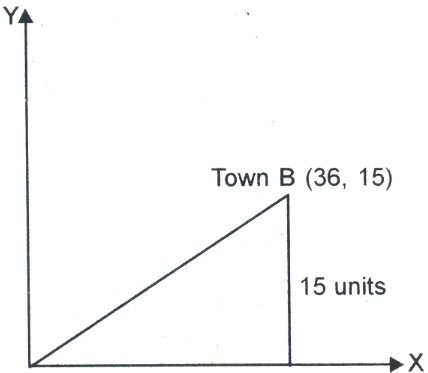
Let us take position of the town A as che origin and the position of the town B as the point B IS) in the coordinate axis as Shown in figure.
Now, |AB|= \(\sqrt{(36^{2}+(15)^{2}}\)
=\(\sqrt{{36}^{2}+{15}^{2}}\) = \(\sqrt{1296+225}\)
=\(\sqrt{1521}\) =39 units
4.
\(2\sqrt { 2 } \ \ units\)
5.
Mid-points of diagonals of a rectangle coincide
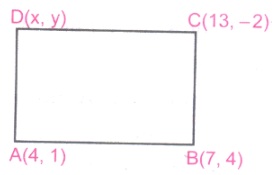
\(\therefore \ \left( \frac { 13+4 }{ 2 } ,\frac { 1-2 }{ 4 } \right) =\left( \frac { x+7 }{ 2 } ,\frac { y+4 }{ 2 } \right) \)
⇒ x=10 and y=-5.
Hence, fourth vertex is D(10,-5)
6.
4
7.
Let the required ratio be k:1.
Then the coordinates of the point of division are \(\left( \frac { 2k+5 }{ k+1 } ,\frac { -3k+6 }{ k+1 } \right) \)
This point lies on the x-axis whose equation is y=0.
\(\therefore \ \frac { -3k+6 }{ k+1 } \ =\ 0\ \Rightarrow \ 3k=6,\ or\ k=2\)
Line segment joining the two points is divided in the ratio 2:1 internally by x-axis.
8.
3
9.
Let coordinates of the required point be R(x, y) this means R divides the join of P(4, -3) and Q(8, 5) in the ratio 3:1 internally.
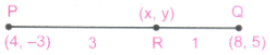
Using the formula for internal division.
\(\left( \frac { { kx }_{ 2 }+{ x }_{ 1 } }{ k+1 } ,\frac { { ky }_{ 2 }+{ y }_{ 1 } }{ k+1 } \right) \)
\(x=\frac { 3(8)+1(4) }{ 3+1 } =\frac { 24+4 }{ 4 } =\frac { 28 }{ 4 } =7\) and \( y=\frac { 3(5)+1(-3) }{ 3+1 } =\frac { 15-3 }{ 4 } =\frac { 12 }{ 4 } =3\)
Thus, the coordinates of R (7, 3) divides PQ in the ratio 3:1.
10.
coordinates of D be \(\left( \alpha ,\beta \right) \) P is mid-point of AC and BD.
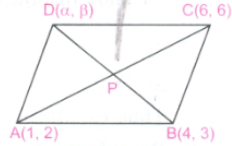
\(\left( \frac { \alpha +4 }{ 2 } ,\frac { \beta +3 }{ 2 } \right) =\left( \frac { 1+6 }{ 2 } ,\frac { 2+6 }{ 2 } \right) \)
\(\Rightarrow \frac { \alpha +4 }{ 2 } =\frac { 7 }{ 2 } ;\frac { \beta +3 }{ 2 } =\frac { 8 }{ 2 } \)
\(\Rightarrow \alpha +4=7;\beta +3=8\Rightarrow \alpha =3;\beta =5\)
∴ Coordinates of D are (3, 3).
11.
P, Q. R divide AB info four equals parts

Now, Q is the mid-point of AB.
Coordinates of Q are \(\left( \frac { -2+2 }{ 2 } ,\frac { 2+8 }{ 2 } \right) \) =(0,5)
P is the mid-point of AQ, then the coordinates of P are
\(\frac { -2+0 }{ 2 } ,\frac { 2+5 }{ 2 } =\left( -1,\frac { 7 }{ 2 } \right) \)
R is the mid-point of QB, then the coordinates of R are
\(\left( \frac { 0+2 }{ 2 } ,\frac { 5+8 }{ 2 } \right) =\left( 1,\frac { 13 }{ 2 } \right) \)
12.
Let A(1, 2), B(4, y), C(x, 6) and D(3, 5) are the vertices of a parallelogram.
Since, ABCD is a parallelogram.
\(\therefore\) Diagonals AC and BD will bisect each other. So, the mid-point of AC and mid-point of BD will be same
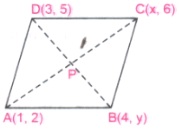
Thus mid-point of AC = Mid-point of BD
\(\begin{aligned} \Rightarrow \quad & \left(\frac{1+x}{2}, \frac{2+6}{2}\right)=\left(\frac{4+3}{2}, \frac{y+5}{2}\right) \\ \end{aligned}\)
\(\begin{aligned} & {\left[\because \text { coordinates of mid-point }=\left(\frac{x_1+x_2}{2}, \frac{y_1+y_2}{2}\right)\right] } \end{aligned}\)
On comparing the coordinate from both sides,we get
\(\frac{1+x}{2}=\frac{4+3}{2} \text { and } \frac{2+6}{2}=\frac{5+y}{2}\)
\(\Rightarrow\) 1 + x = 7 and 8 = 5 + y
\(\therefore\) x = 6 and y = 3
13.
Let P(x,0) divide the line segment AB in the ratio k:1

y-coordinate \(y=\frac { k\times \left( -4 \right) +1\times \left( 1 \right) }{ k+1 } ,\quad y=\frac { -4k+1 }{ k+1 } \)
on x-axis y=0 , \(\therefore \quad 0=\frac { k(5)+1(-5) }{ k-1 } \)
\(0=5k-5\quad \Rightarrow \quad 5k=5\quad \Rightarrow \quad k=1\)
Hence the required ration is 1:1, at point \(\left( \frac { -3 }{ 2 } ,0 \right) \) .
14.
Let H(x. y) is centre of circle passing through A. B and C. Since AM. BH and CH are radius of circle.
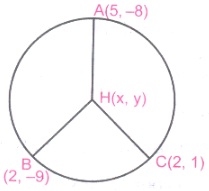
∴ AH=BH and BH=CH
Also AH2=BH2 and BH2=CH2
AH2=(x-5)2+(y+8)2
=x2+25-10x+y2+64+16y
BH=(x-2)2+(y+9)2
=x2+4-4x+y2+81+18y
CH2=(x-2)2+(y-1)2
=x2+4-4x+y2+1-2y
∴ AH2=BH2 [Radii of a circle]
∴ x2+25-10x+y2+64+16y
= x2+4-4x+y2+81+18y.
⇒ -10x+4x+16y-18y=-4
⇒ -6x-2y=-4
⇒ 3x+y=2 ---(i)
Also BH2=CH2 --- (i)
∴ x2+4-4x+16y-18y=-4
= x2+4-4x+y2+1-2y
⇒ 18y+2y=1-81
⇒ 20y= -80 ⇒ y=-4
Putting value of y in (i), we get
3x+(-4) =2 ⇒3x=2+4
⇒ 3x=6 ⇒ x=2
∴ Coordinates of centre are (2,-4).
15.
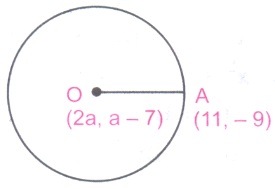
A.T.Q. Diameter = 10\(\sqrt {2}\)
OA2=50
⇒ (2a-11)2+(a-7+9)2=50
⇒ 4a2+121-44a+(a+2)2=50
⇒ 4a2-44a+121+a2+4+4a-50=0
⇒ 5a2-40a+75=0,
⇒ a2-8a+15=0
⇒ (a-5)(a-3)=0 ⇒ a=5,3
16.
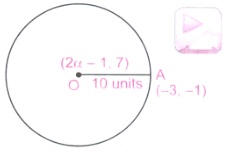
OA = 10 units
\(\Rightarrow \ OA=\sqrt { { (2\alpha -1+3 })^{ 2 }+(7+1)^{ 2 } } \)
\(\Rightarrow \ 10=\sqrt { 4{ \alpha }^{ 2 }+4+8\alpha +64 } \)
Squaring \(100\ =\ { 4\alpha }^{ 2 }+8\alpha +68\)
\(\Rightarrow \ { 4\alpha }^{ 2 }+8\alpha -32=0\ \Rightarrow \ { \alpha }^{ 2 }+2\alpha -8=0\)
\(\Rightarrow \ { \alpha }^{ 2 }+4\alpha -2\alpha -8=0\ \Rightarrow \alpha (\alpha +4)-2(\alpha +4)=0\ \Rightarrow \ (\alpha +4)(\alpha -2)=0\)
\(\\ \alpha =-4\ ,\ \alpha =2\)
17.
Let A(7,6), B(-3,4)) be the given points and P(x,0) be the required point.
Since, P is equidistant from A and B, therefore,
AP = BP ⇒ AP2=BP2
⇒ (x-7)2+(0-6)2=(x+3)2+(0-4)2 ⇒ x2+49-14x+36 = x2+9+6x+16
⇒ -14x-6x = 25-85 ⇒ -20x=-60
\(\Rightarrow x=\frac { -60 }{ -20 } =3\)
∴ Required point on axis is (3,0).
18.
Let point on y-axis be (0,a)
Now distance of this point from (5,-2) equal to distance from point (-3,2)
i.e., \(\Rightarrow \sqrt { 5^{ 2 }+\left( -2-a \right) ^{ 2 } } =\sqrt { \left( 3 \right) ^{ 2 }+\left( a-2 \right) ^{ 2 } } \)
Squaring and simplifying, we get
25+4+a2+4a = 9+a2+4-4a ⇒ 8a=-16 ⇒ a=-2
19.
(i) We know the diagonals of a rhombus bisect each other.
Thus, the point of intersection of both the diagonals is the mid-point of P(2,-3) and R(-2,1).
So, \(\left(\frac{2-2}{2}, \frac{-3+1}{2}\right)=(0,-1)\)
(ii) Finds the mid-point of Q(6,5) and S(x, y) as \(\left(\frac{6+x}{2}, \frac{5+y}{2}\right)\), where x and y are the coordinates of the fourth vertex S.
Uses the above steps and equates the respective coordinates of the mid-points to get the following relationships:
(a) \(0=\frac{6+x}{2} \Rightarrow x=-6\)
(b) \(-1=\frac{5+y}{2} \Rightarrow y=-7\)
Concludes that the coordinates of the fourth vertex S are (-6,-7).
20.
Given points are A (2, -2), B (-3, 8) and C (-1, 4).
Now area of \(\Delta \)ABC = \(\frac { 1 }{ 2 } \)[x1(y2-y3)+x2(y3-y1)+x3(y1-y2)]
=\(\frac { 1 }{ 2 } \)[2(8-4)-3(4+2)-1(-2-8)]
=\(\frac { 1 }{ 2 } \)[8-18+1
=\(\frac { 1 }{ 2 } \)(18-18)=0
Since, the area of \(\Delta \)ABC is zero.
Hence, given points A, B and C are collinear.
Hence proved.
21.
Let P and Q be the points of trisection as shown below

Then, AP: PB=1.2 and AQ: QB=2:1
(i) Let P divides AB in the ratio 1: 2.
Then, \(\frac { { m }_{ 1 } }{ { m }_{ 2 } } =\frac { 1 }{ 2 } \)
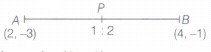
Here, A(x1, y1) = (2, -3) and B(x2, y2) = (4, -1)
Now, \(P(x,\quad y)=P\left( \frac { { m }_{ 1 }{ x }_{ 2 }+{ m }_{ 2 }{ x }_{ 1 } }{ { m }_{ 1 }+{ m }_{ 2 } } ,\frac { { m }_{ 1 }{ y }_{ 2 }+{ m }_{ 2 }{ y }_{ 1 } }{ { m }_{ 1 }+{ m }_{ 2 } } \right) \)
\( =P\left( \frac { 1\times 4+2\times 2 }{ 1+2 } ,\frac { 1\times (-1)+2\times (-3) }{1+2 } \right) \\ =P\left( \frac { 4+4 }{3 } ,\frac { -1-6 }{3} \right) =P\left( \frac { 8 }{ 3 } ,\frac { -7 }{ 3 } \right) \)
(ii) Let Q divides AB in the ratio 2: 1, then \(\frac { { m }_{ 1 } }{ { m }_{ 2 } } =\frac { 2 }{ 1 } \)
Here, A(x1, y1) = (2, -3) and B(x2, y2) = (4, -1)

Now, \(Q(x,\quad y)=Q\left( \frac { { m }_{ 1 }{ x }_{ 2 }+{ m }_{ 2 }{ x }_{ 1 } }{ { m }_{ 1 }+{ m }_{ 2 } } ,\frac { { m }_{ 1 }{ y }_{ 2 }+{ m }_{ 2 }{ y }_{ 1 } }{ { m }_{ 1 }+{ m }_{ 2 } } \right) \)
\(=Q\left( \frac { 2\times 4+1\times 2 }{2+1 } ,\frac { 2\times (-1)+1\times (-3) }{2+1} \right) \\ =Q\left( \frac { 8+2 }{3 } ,\frac { -2-3 }{3} \right) =Q\left( \frac { 10 }{ 3 } ,\frac { -5 }{ 3 } \right) \)
22.
Let P(x, y) be the required point.
Then, P divides AB internally in the ratio 3: 2.
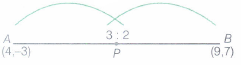
Here, \(\frac { { m }_{ 1 } }{ { m }_{ 2 } } =\frac { 3 }{ 2 } \) and \(\left( { x }_{ 1 },\quad { y }_{ 1 } \right) =(4,\quad -3);\quad \left( { x }_{ 2 },\quad { y }_{ 2 } \right) =(9,\quad 7)\)
Then, \(P(x,\quad y)=P\left( \frac { { m }_{ 1 }{ x }_{ 2 }+{ m }_{ 2 }{ x }_{ 1 } }{ { m }_{ 1 }+{ m }_{ 2 } } ,\frac { { m }_{ 1 }{ y }_{ 2 }+{ m }_{ 2 }{ y }_{ 1 } }{ { m }_{ 1 }+{ m }_{ 2 } } \right) \)
\( =P\left( \frac { 3\times 9+2\times 4 }{ 3+2 } ,\frac { 3\times 7+2\times (-3) }{ 3+2 } \right) \\ \ =P\left( \frac { 27+8 }{ 5 } ,\frac { 21-6 }{ 5 } \right) =P\left( \frac { 35 }{ 5 } ,\frac { 15 }{ 5 } \right) \\=P(7, 3)\)
Therefore, (7, 3) is the required point.
23.
Let p \(\left( \frac { 3 }{ 4 } ,\frac { 5 }{ 12 } \right) \)divides the line segment joining points A\(\left( \frac { 1 }{ 2 } ,\frac { 3 }{ 2 } \right) \) and B (2,-5)in the ration k:1
\(\therefore \) Coordinates of P are
\(P\left( \frac { 2k+\frac { 1 }{ 2 } }{ k+1 } \frac { -5k+\frac { 3 }{ 2 } }{ k+1 } \right) =P\left( \frac { 3 }{ 4 } ,\frac { 5 }{ 12 } \right) \)
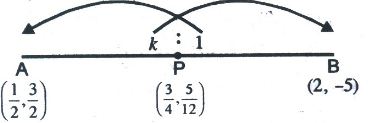
\(\Rightarrow \) \(\frac { 2k+\frac { 1 }{ 2 } }{ k+1 } =\frac { 3 }{ 4 } and\quad \frac { -5k+\frac { 3 }{ 2 } }{ k+1 } =\frac { 5 }{ 2 } \)
\(\Rightarrow \) 8k+2=3k+3 and -60k+18=5k+5
\(\Rightarrow \) 5k=1 and -65k=-13
\(\Rightarrow \) \(k=\frac { 1 }{ 5 } \) and\(k=\frac { 1 }{ 5 } \)
Hence the required ratio is 1:5
24.
Since A(6-1), B(k,-6) and C(0,-7) are collinear.
∴ Area of △ABC = 0
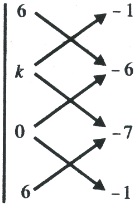
=\(\frac{1}{2}\)|-36-7k-0+k-0+42|=0
⇒ \(\frac{1}{2}\)|-6k+6|=0
⇒ -6k+6=0
⇒ 6k=6
⇒ k=1
25.
Let P(0,2) is equidistant from A(3,k) and B(k,5).
∴ |PA| = |PB|
⇒ PA2 = PB2
⇒ (3-0)2+(k-2)2 = (k-0)2+(5-2)2
⇒ 9+k2+4-4k = k2+9
⇒ 4-4k=0
⇒ k=1
26.
A(1,2), B(5,4), C(3,8) and D(-1, 6)
\(AB=\sqrt{4^2+2^2}=\sqrt{16+4}=\sqrt{20};\ BC=\sqrt{(-2)^2+(4)^2}=\sqrt{4+16}=\sqrt{20}\)
\(CD=\sqrt{(-4)^2+(-2)^2}=\sqrt{16+4}=\sqrt{20};\ DA=\sqrt{(-2)^2+(4)^2}=\sqrt{4+16}=\sqrt{20}\)
Here AB=BC=CA=DA
\(AC=\sqrt{2^2+6^2}=\sqrt{40}\ and\ BD=\sqrt{(-6)^2+(2)^2}=\sqrt{36+4}=\sqrt{40}\)
All sides of quadrilateral are equal and diagonals are equal.
ABCD is square.

10th Standard CBSE Syllabus & Materials
10th Standard CBSE
CBSE 10th Social Science PS - Federalism - New Model Questions Papers Study Material - QB365 Set A
NEW10th Standard CBSE
CBSE 10th Social Science PS - Power Sharing - New Model Questions Papers Study Material - QB365 Set A
NEW10th Standard CBSE
CBSE 10th Social Science GEO - Manufacturing Industries - New Model Questions Papers Study Material - QB365 Set A
NEW10th Standard CBSE
CBSE 10th Social Science GEO - Minerals and Energy Resources - New Model Questions Papers Study Material - QB365 Set A



NCERT Books

Syllabus

Exam Pattern

Sample Question Papers

Previous year Question Papers

Important Notes

MCQ Practice test

NCERT Exemplers

Case study Questions

Image Based Questions

Passage based Questions

HOT Questions

Value Based Questions

Model Questions Papers
NCERT ( Book Back ) Questions

Assertion and Reason
Important Questions And Answers

CBSE 10th Standard CBSE Subjects
CBSE Standards



