
 100% FREE ACCESS
10th Standard CBSE Syllabus & Materials
10th Standard CBSE
CBSE 10th Social Science ECO - Globalisation and the Indian Economy - New Model Questions Papers Study Material - QB365 Set A
NEW10th Standard CBSE
CBSE 10th Social Science ECO - Money and Credit - New Model Questions Papers Study Material - QB365 Set A
NEW10th Standard CBSE
CBSE 10th Social Science ECO - Sectors of the Indian Economy - New Model Questions Papers Study Material - QB365 Set A
NEW10th Standard CBSE
CBSE 10th Social Science ECO - Development - New Model Questions Papers Study Material - QB365 Set A
NEW10th Standard CBSE
CBSE 10th Social Science PS - Outcomes of Democracy - New Model Questions Papers Study Material - QB365 Set A
NEW10th Standard CBSE
CBSE 10th Social Science PS - Gender, Religion and Caste - New Model Questions Papers Study Material - QB365 Set A

Published on: 22/10/2025
Download CBSE Class 10th Standard CBSE Maths question papers, sample papers, important questions, and previous year solved papers in PDF format. Get free study materials, NCERT solutions, and exam preparation resources for Class 10th Standard CBSE Maths
Questions + Answers key
Take MCQ Maths Test
1.
Prove the following identities, where the angles involved are acute angles for which the expressions are defined.
\(\frac { \cos { A } -\sin { A } +1 }{ \cos { A } +\sin { A } -1 } =cosecA+\cot { A } \) using the identity \({ cosec }^{ 2 }A=1+\cot ^{ 2 }{ A } \)
2.
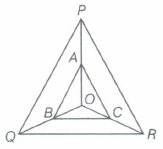
In the given figure, A, B and C are points on OP, OQ and OR respectively, such that \(AB\parallel PQ\) and \(AC\parallel PR\). Show that \(BC\parallel QR\).
3.
Write the missing numbers is the following factorisation.
(i) -q.png) (ii)
(ii) -q.png)
4.
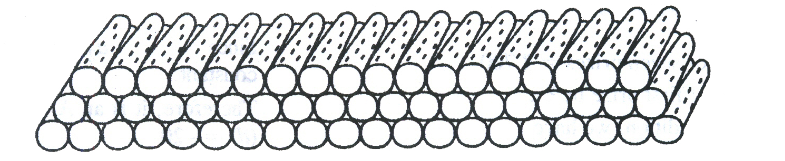
200 logs are stacked in the following manner: 20 logs in the bottom row, 19 in the next row, 18 in the row next to it and so on.
(i) In how many rows are the 200 logs placed and how many logs are in the top row?
(ii) Which value is depicted in the pattern of log?
5.
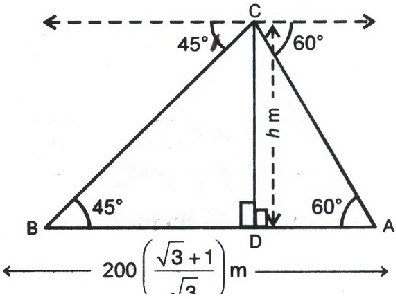
Two ships are sailing in the sea on the either side of the lighthouse, the angles of depression of two ships as observed from the top of the lighthouse are 60o and 45o respectively.If the distance between the ships is \(200\left( { \sqrt{3}+1\over\sqrt{3}} \right) \) metres, find the height of the lighthouse.
6.
If Sn denotes the sum of the first n terms of an AP, prove that S30 = 3(S20 - S10).
1.
LHS = \(\frac { \cos { A } -\sin { A } +1 }{ \cos { A } +\sin { A } -1 } \)
On dividing numerator and denominator by sin A, we get
\(=\frac { \frac { \cos { A } }{ \sin { A } } -\frac { \sin { A } }{ \sin { A } } +\frac { 1 }{ \sin { A } } }{ \frac { \cos { A } }{ \sin { A } } +\frac { \sin { A } }{ \sin { A } } -\frac { 1 }{ \sin { A } } } =\frac { \cot { A } -1+cosecA }{ \cot { A } +1-1cosecA } \) \(\left[ \because \cot { A } =\frac { \cos { \theta } }{ \sin { \theta } } and\frac { 1 }{ \sin { \theta } } =cosec \theta \right] \)
\(=\frac { \cot { A } +cosecA-1 }{ \cot { A } +1-1cosecA } \)
\(=\frac { (\cot { A } +cosecA)-({ cosec }^{ 2 }A-\cot ^{ 2 }{ A } ) }{ \cot { A } +1-1cosecA } \left[ \because 1={ cosec }^{ 2 }A-\cot ^{ 2 }{ A } \right] \)
\(=\frac { (\cot { A } +cosecA)-\left[ (\cot { A } +cosecA)(\cot { A } -cosecA) \right] }{ \cot { A } +1-1cosecA } \) \(\left[ \because \quad { a }^{ 2 }-{ b }^{ 2 }=(a+b)(a-b) \right] \)
\(=\frac { (\cot { A } +cosecA)-\left[ 1-(cosecA-\cot { A } ) \right] }{ \cot { A } +1-1cosecA } \)
\(\quad =\frac { (\cot { A } +cosecA)-\left[ 1-cosecA+\cot { A } \right] }{ \cot { A } +1-1cosecA } \)
\(=cosecA+\cot { A } =RHS\)
Hence proved.
2.
In \(\triangle OPQ\), \(AB\parallel PQ\) [given]
\(\therefore \quad \frac { OA }{ AP } =\frac { OB }{ BQ } \) ... (i)
[by basic proportionality theorem]
Also, in \(\triangle OPR\), \(AC\parallel PR\) [given]
\(\therefore \quad \frac { OA }{ AP } =\frac { OC }{ CR } \) ... (ii)
From Eqs. (i) and (ii),
\(\frac { OB }{ BQ } =\frac { OC }{ CR } \Rightarrow \quad BC\parallel QR\)
[by converse of basic proportionality theorem]
Hence proved.
3.
(i) 36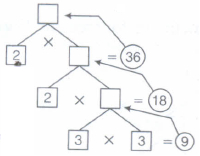
(ii) 42
4.
(i) Number of logs stacked in each row form a sequence 20, 19, 18, 17,...., which is an AP with first term, a= 20 and common difference, d = 19 - 20 = -1.
Suppose number of rows is n, then Sn= 200
\(\begin{aligned} \Rightarrow \frac{n}{2}[2 \times 20+(n-1)(-1)] & =200 \\ \end{aligned}\)
\(\begin{aligned} {\left[\because S_n\right.} & \left.=\frac{n}{2}\{2 a+(n-1) d\}\right] \end{aligned}\)
\(\begin{array}{lr} \Rightarrow & 400=40 n-n^2+n \\ \end{array}\)
\(\begin{array}{lr} \Rightarrow & n^2-41 n+400=0 \\ \end{array}\)
\(\begin{array}{lr} \Rightarrow & n^2-25 n-16 n+400=0 \\ \end{array}\)
\(\begin{array}{lr} \Rightarrow & n(n-25)-16(n-25)=0 \\ \end{array}\)
\(\begin{array}{lr} \Rightarrow & (n-25)(n-16)=0 \\ \end{array}\)
\(\begin{array}{lr} \Rightarrow & n=16 \text { or } n=25 \end{array}\)
Hence, the number of rows is either 25 or 16.
When, n = 16,
an= a + (n -1) d = 20 + (16 - 1) ( - 1)
= 20 - 15 = 5
When, n = 25,
an = a + (n - 1) d = 20 + (25-1) (-1)
= 20 - 24 = - 4
[\(\because\) number of logs cannot be negative]
Hence, the number of rows is 16 and number of logs in the top row is 5.
(ii) The pattern of logs show space saving creativity, reasoning and balancing.
5.
Let CD be the lighthouse of height h m and let A and B be the two ships on the either side of the lighthouse, such that
∠CBD = 45o, ∠CAD - 60o
\(AB=200\left( \frac { \sqrt { 3 } +1 }{ \sqrt { 3 } } \right) m\)
Consider a rt. ΔBDC, ∠D = 90o, ∠CBD=45o, we have
\(\frac { CD }{ BD } ={ tan\quad 45 }^{ o }\)
\(\Rightarrow \frac { CD }{ BD } =1\Rightarrow CD=BD\quad ...(i)\)
Again, in rt.ΔADC, ∠D = 90o, ∠CAD=60o, we have
\(\frac { CD }{ AD } ={ tan\quad 60 }^{ o }\)
\(\Rightarrow \frac { CD }{ AD } =\sqrt { 3 } \)
\(\Rightarrow CD=\sqrt { 3 } AD\)
\(\Rightarrow AD=\frac { AD }{ \sqrt { 3 } } ...(ii)\)
Adding (i) and (ii), we have
\(AD+BD=\frac { CD }{ \sqrt { 3 } } +CD\)
\(\Rightarrow AB=CD\left( \frac { 1+\sqrt { 3 } }{ \sqrt { 3 } } \right) \)
\(200\left( \frac { 1+\sqrt { 3 } }{ \sqrt { 3 } } \right) =CD\left( \frac { 1+\sqrt { 3 } }{ \sqrt { 3 } } \right) \)
\(\left[ \because AB=\frac { 200\left( \sqrt { 3 } +1 \right) }{ \sqrt { 3 } } \right] \)
⇒ CD=200m
Hence, the height of the lighthouse is 200 m.
6.
Let a be the first term and d be the common difference of the given AP.
Consider, RHS = 3 ( S20 - S10 )
\(=\left[ {20\over 2}\{2a+19d \}-{10\over2}\{2a+9d \}\right]\)
= 3[ 20a + 190d - 10a - 45d ]
= 3[ 10a + 145d ] = 15 [ 2a + 29d ]
\(={30\over2}[2a+(30-1)d]\) = S30 = LHS

10th Standard CBSE Syllabus & Materials
10th Standard CBSE
CBSE 10th Social Science PS - Federalism - New Model Questions Papers Study Material - QB365 Set A
NEW10th Standard CBSE
CBSE 10th Social Science PS - Power Sharing - New Model Questions Papers Study Material - QB365 Set A
NEW10th Standard CBSE
CBSE 10th Social Science GEO - Manufacturing Industries - New Model Questions Papers Study Material - QB365 Set A
NEW10th Standard CBSE
CBSE 10th Social Science GEO - Minerals and Energy Resources - New Model Questions Papers Study Material - QB365 Set A



NCERT Books

Syllabus

Exam Pattern

Sample Question Papers

Previous year Question Papers

Important Notes

MCQ Practice test

NCERT Exemplers

Case study Questions

Image Based Questions

Passage based Questions

HOT Questions

Value Based Questions

Model Questions Papers
NCERT ( Book Back ) Questions

Assertion and Reason
Important Questions And Answers

CBSE 10th Standard CBSE Subjects
CBSE Standards



