
 100% FREE ACCESS
10th Standard CBSE Syllabus & Materials
10th Standard CBSE
CBSE 10th Social Science ECO - Globalisation and the Indian Economy - New Model Questions Papers Study Material - QB365 Set A
NEW10th Standard CBSE
CBSE 10th Social Science ECO - Money and Credit - New Model Questions Papers Study Material - QB365 Set A
NEW10th Standard CBSE
CBSE 10th Social Science ECO - Sectors of the Indian Economy - New Model Questions Papers Study Material - QB365 Set A
NEW10th Standard CBSE
CBSE 10th Social Science ECO - Development - New Model Questions Papers Study Material - QB365 Set A
NEW10th Standard CBSE
CBSE 10th Social Science PS - Outcomes of Democracy - New Model Questions Papers Study Material - QB365 Set A
NEW10th Standard CBSE
CBSE 10th Social Science PS - Gender, Religion and Caste - New Model Questions Papers Study Material - QB365 Set A

Published on: 20/10/2025
Download CBSE Class 10th Standard CBSE Maths question papers, sample papers, important questions, and previous year solved papers in PDF format. Get free study materials, NCERT solutions, and exam preparation resources for Class 10th Standard CBSE Maths
Questions + Answers key
Take MCQ Maths Test
1.
If sec A = \(\frac{17}{8}\) show that \(\frac{3-4 \sin ^{2} A}{4 \cos ^{2} A-3}=\frac{3-\tan ^{2} A}{1-3 \tan ^{2} A}\)
2.
A man on the top of a vertical tower observes a car moving at a uniform speed towards him. If it takes 12 min for the angle of depression to change from 30° to 45°, how soon after this, the car will reach the tower?
3.
Determine the value of x, such that
\(2{ cosec }^{ 2 }{ 30 }^{ 0 }+x\sin ^{ 2 }{ { 60 }^{ 0 } } -\frac { 3 }{ 4 } \tan ^{ 2 }{ { 30 }^{ 0 } } =10.\)
4.
If \(\triangle ABC\) is right angles at C, find the value of cos (A + B).
5.
In a \(\triangle ABC,\angle B={ 90 }^{ 0 }\) . If AB=2 cm and AC=3 cm, find the value of sin A,
6.
Prove that (1 + tan A + cos A) (sin A - cos A) = sin A tan A - cot A cos A.
7.
The angle of elevation of an aeroplane from a point on the ground is 60°. After a flight of 30 seconds the angle of elevation becomes 30°.If the aeroplane is flying at a constant height of 3000 √3 m, find the speed of the aeroplane.
8.
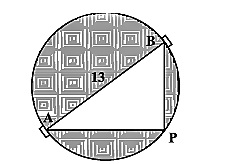
A pole has to be erected at a point on the boundary of a circular park of the diameter of 13 m in such a way that the differences of its distance form two opposite fixed gates A and B on the boundary is 7 m. Is it possible to do so? If so, at what distance from the pole it is to be erected?
9.
The angle of elevation of the top of a tower from a point A on the ground is 30°. On moving a distance of 20 metre towards the foot of the tower to a point B the angle of elevation increases to 60°.Find the height of the tower and the distance of the tower from the point A.
10.
If \(x\sin ^{ 3 }{ \theta } +y\cos ^{ 3 }{ \theta } =\sin { \theta } \cos { \theta } \) and \(x\sin { \theta } =y\cos { \theta } \), prove that x2 + y2 = 1
11.
If \(a\cos { \theta } -b\sin { \theta } =x\) and \(a \sin \theta+b \cos \theta=y\), prove that \({ \quad a }^{ 2 }+{ b }^{ 2 }={ x }^{ 2 }+{ y }^{ 2 }.\)
12.
What happens to value of \(\tan { \theta } \) when \(\theta\) increases from 00 to 900 ?
13.
Show that 2 (cos2 60°+ sin 4 30°) - ( tan2 60o + cot2 45°)+ 3 sec2 30° \(=\frac{1}{4}\)
14.
If 2 cos 3\(\theta\) =.\(\sqrt{3}\), find the value of \(\theta\)
15.
If \(\sqrt{3}\) sin \(\theta\) = cos \(\theta\) , find the value of \(\frac{\sin \theta \tan \theta(1+\cot \theta)}{\sin \theta+\cos \theta}\)
16.
Evaluate : \(\frac{\tan 26^{\circ}}{\cot 64^{\circ}}\)
17.
If tan A = \(\frac{1}{2}\) and tanB = \(\frac{1}{3}\), by using tan(A + B)=\(\frac{tanA+tanB}{1-tanAtanB}\), prove that A + B = 450
18.
If \(\sqrt { 3 } \sin { \theta } -\cos { \theta } =0\) and \({ 0 }^{ ° }<\theta <{ 90 }^{ ° }\), find the value of \(\theta\)
19.
If \(\sin { A } +\sin ^{ 2 }{ A } =1,\) find the value of \(\cos ^{ 2 }{ A } +\cos ^{ 4 }{ A } .\)
20.
(cos4 A - sin4 A) on simplified form, gives
2 sin2 A - 1
2 sin2 A + 1
2 cos2 A + 1
2 cos2 A - 1
21.
In the figure given below, PQRS is a quadrilateral. PR is perpendicular to QR and PS
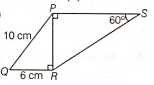
Based on the above information, answer the following questions.
What is the length of RS?
8 units
10 units
8 √2 units
16/3 √3 units
22.
In a right-angled ΔPQR, ∠Q=90°. If ∠P=45°, then value of tan P - cos2 R is
0
1
1/2
3/2
23.
If f(x) = cos 2 x+ sec2 x, then f(x)
\(\geq 1\)
\(\leq 1\)
\(\geq 2\)
\(\leq 2\)
24.
If sin \(\theta=\frac{a}{b},\) then cos \(\theta\) is equal to
\(\frac{b}{\sqrt{b^{2}-a^{2}}}\)
\(\frac{b}{a}\)
\(\frac{\sqrt{b^{2}-a^{2}}}{b}\)
\(\frac{a}{\sqrt{b^{2}-a^{2}}}\)
25.
The value of tan 1°tan 2° tan 3° ... tan 89° is
0
1
\(\infty\)
None of these
26.
If \(\frac { x }{ a } cos\theta +\frac { y }{ b } sin\theta =1\quad and\quad \frac { x }{ a } sin\theta -\frac { y }{ b } cos\theta \quad then\quad \left( \frac { x }{ a } \right) ^{ 2 }+\left( \frac { y }{ b } \right) ^{ 2 }=\)
12
3
2
1
27.
Which of the following is defined
tan 90°
cot 0°
cosec 90°
sec 90°
28.
If sin θ = 1/2 , then the value of sin θ (sin θ – cosec θ) is
√3/2
-√3/2
3/4
-3/4
29.
The value of expression \(\frac { 1-tan\quad x\quad cot({ 90 }^{ o }-x) }{ 1-tan\quad x\quad cot({ 90 }^{ o }-x) } \)is
2cot2 x – 1
2cos2 x – 1
2sin2 x – 1
2tan2 x – 1
30.
If 7sin2x + 3cos2x = 4 then , secx + cosecx =
\(2\sqrt { 3 } \)
\(2+\frac { \sqrt { 3 } }{ 2 } \)
\(\frac { \sqrt { 3 } }{ 2 } \)
\(2+\frac { 2 }{ \sqrt { 3 } } \)
31.
If 3cot A=4, then find cos2 A – sin2 A
25/7
1/25
22/7
7/25
32.
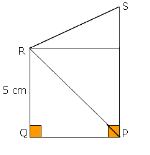
In given figure, if RP = 13 cm, QR = 5 cm and PS = 14 cm, then, tan S =In given figure, if RP = 13 cm, QR = 5 cm and PS = 14 cm, then, tan S =
4/3
9/4
8/4
5/4
33.
Simplify \(\frac { 1+cot\quad A }{ sin\quad A } +\frac { sin\quad A }{ 1+cos\quad A } \)
2 sec A
2 cosec A
2 sin A
2 cos A
34.
If cos (∝+β)=0 , then sin (∝-β) can be reduced to
cos β
sin α
sin 2α
cos 2β
1.
First tan A \(=\sqrt{\sec ^{2} A-1}=\sqrt{\left(\frac{17}{8}\right)^{2} \mid-1}=\frac{15}{8}\)
Now, LHS \(=\frac{3-4 \sin ^{2} A}{4 \cos ^{2} A-3}=\frac{3 \sec ^{2} A-4 \tan ^{2} A}{4-3 \sec ^{2} A}\)
[dividing numerator and denominator by cos2 A]
Now, put values of sec2 A and tan 2A in LHS and RHS and hence verify the equality.
2.
Let AB be the tower of height h.
\(\angle AQB=45°\)
Now, in \(\Delta AQB\) ,
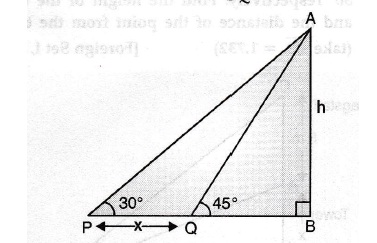
tan 45° =\(\frac{AB}{BQ}\)
1=\(\frac{h}{BQ}\)
BQ=h
In \(\Delta APB\),
tan 30° =\(\frac{AB}{PB}\)
x+h=h\(\sqrt{3}\)
\(\frac { 1 }{ \sqrt { 3 } } \)=\(\frac{h}{x+h}\)
x=h(\(\sqrt{3}\)-1)
Speed=\(\frac { h\left( \sqrt { 3 } -1 \right) }{ 12 } \)
Speed=Distance/Time
Time for remaining distance,
=\(\frac { h }{ \frac { h\left( \sqrt { 3 } -1 \right) }{ 12 } } \)
=\(\frac { 12\left( \sqrt { 3 } +1 \right) }{ 3-1 } \)
=\(\frac { 12 }{ 2 } \left( \sqrt { 3 } +1 \right) \)
= (6\(\sqrt{3}\)+1)
Time = 16·39minutes.
3.
x = 3
4.
\(A+B+C={ 180 }^{ 0 }\Rightarrow A+B={ 180 }^{ 0 }-C\Rightarrow A+B={ 90 }^{ 0 }\)
5.
\(\frac { \sqrt { 5 } }{ 3 } \)
6.
LHS = (1+ tan A + cot A) (sin A - cos A)
\(=\left(1+\frac{\sin A}{\cos A}+\frac{\cos A}{\sin A}\right)(\sin A-\cos A)\)
\(=\left(\frac{\sin A \cos A+\sin ^{2} A+\cos ^{2} A}{\sin A \cos A}\right)(\sin A-\cos A)\)
\(=\frac{\sin ^{3} A-\cos ^{3} A}{\sin A \cos A}=\frac{\sin ^{2} A}{\cos A}-\frac{\cos ^{2} A}{\sin A}\)
= sin A tan A - cos A cot A = RHS
Hence proved.
7.
ㄥAED = 60°, ㄥBEC = 30°
AD = Be = 3000ㄥ3 m
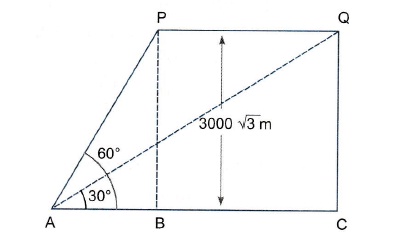
Let the speed of the aeroplane = x m/s
Then, AB = DC = 30 x x
= 30xm
ΔAED is right angled
\(tan\ 60^0={D\over DE}\)
\(\sqrt3={3000\sqrt3\over DE}\)
DE = 3000 m
∆BEC is right angled
\(tan\ 30^0={BC\over EC}\)
\({1\over \sqrt3}={3000\sqrt3\over DE+CD}\)
DE + CD = 3000 x 3
3000 + 30x = 9000
30x = 6000
x = 200 m/s
Speed of plane is 200 m/s.
8.
Let P be the position of the pole and A and B be the oppositely fixed gates.
PA-PB = 7m
a-b = 7
a=7+b ...(i)
In \(\Delta PAB\),
AB2= AP2 + BP2
(13)2 = a2 + b2
a2 + b2 = 169
(7 + b)2 + b2 = 169
49' + b2 + 2(7)(b) + b2 = 169
49 + 14b + 2b2 - 169 = 0
2b2 + 14b - 120 = 0
b2 + 7b - 60 = 0
b2 + 12b-5b-60 = 0
b(b + 12) - 5(b + 12) = 0
(b - 5)(b + 12) = 0
As b cannot be negative, so
b = 5
a = 7 + 5 = 12
Hence, PA = 12 m, PB = 5 m.
9.
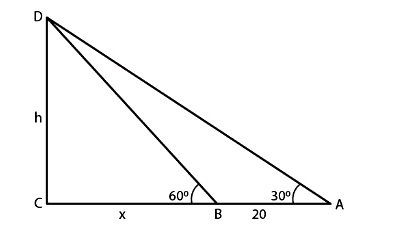
Let height of tower and distance BC = x m
In \(\triangle\)ABC, \(\frac { h }{ x } =\tan { { 60 }^{ 0 } } \)
\(\Rightarrow \quad h=\sqrt { 3 } x\quad ...(i)\)
In \(\triangle\)ADC,
\(\frac { h }{ x+20 } =\tan { { 30 }^{ 0 } } =\frac { 1 }{ \sqrt { 3 } } \)
\(\Rightarrow \quad \sqrt { 3 } =x+20\quad \quad ...(ii)\)
Substituting the value of h from eg. (i) in eq. (ii), we get
3x = x + 20
\(\Rightarrow\) x= 10 m
\(\therefore\) AC= 30m.
Hence, height of tower is 10\(\sqrt3\) m and distance of tower form point A is 30 m.
10.
Given : \(x\sin { \theta } =y\cos { \theta } \)
\(\Rightarrow \quad x=\frac { y\cos { \theta } }{ \sin { \theta } } \) ....(i)
and \(x\sin ^{ 3 }{ \theta } +y\cos ^{ 3 }{ \theta } =\sin { \theta } \cos { \theta } \) ...(ii)
Eliminating x from eqn.(i) amd eqn. (ii),
\(\frac { y\cos { \theta } }{ \sin { \theta } } \sin ^{ 3 }{ \theta } +y\cos ^{ 3 }{ \theta } =\sin { \theta } \cos { \theta } \)
\(\Rightarrow \quad y\cos { \theta } \sin ^{ 2 }{ \theta } +y\cos ^{ 3 }{ \theta } =\sin { \theta } \cos { \theta } \)
\(\Rightarrow \quad y\cos { \theta } \left[ \sin ^{ 2 }{ \theta } +\cos ^{ 2 }{ \theta } \right] =\sin { \theta } \cos { \theta } \)
\(\Rightarrow \quad y=\sin { \theta } \) ... (iii)
Substituting this value of y in eqn. (iii),
\(x=\cos { \theta } \) ... (iv)
Squaring and adding eqn. (iii) and eqn. (iv), we get
\({ x }^{ 2 }+{ y }^{ 2 }=\cos ^{ 2 }{ \theta } +\sin ^{ 2 }{ \theta } =1\)
11.
Given, \(a\cos { \theta } -b\sin { \theta } =x\quad ...(i)\)
and \(a\cos { \theta } +b\sin { \theta } =y\quad ....(ii)\)
On squaring Eqs. (i) and (ii) and then adding, we get
\({ x }^{ 2 }+{ y }^{ 2 }={ \left( a\cos { \theta } -b\sin { \theta } \right) }^{ 2 }+{ \left( a\cos { \theta } +b\sin { \theta } \right) }^{ 2 }\)
\(\Rightarrow { x }^{ 2 }+{ y }^{ 2 }={ a }^{ 2 }\cos ^{ 2 }{ \theta } +{ b }^{ 2 }\sin ^{ 2 }{ \theta } -2ab\cos { \theta } \sin { \theta } +{ a }^{ 2 }\cos ^{ 2 }{ \theta } +{ b }^{ 2 }\sin ^{ 2 }{ \theta } +2ab\cos { \theta } \sin { \theta } \)\(\left[ \because { (a+b) }^{ 2 }={ a }^{ 2 }+{ b }^{ 2 }+2ab\quad and\quad { (a-b) }^{ 2 }={ a }^{ 2 }+{ b }^{ 2 }-2ab\quad \right] \)
\(\Rightarrow { x }^{ 2 }+{ y }^{ 2 }={ a }^{ 2 }\cos ^{ 2 }{ \theta } +{ b }^{ 2 }\sin ^{ 2 }{ \theta } +{ a }^{ 2 }\cos ^{ 2 }{ \theta } +{ b }^{ 2 }\sin ^{ 2 }{ \theta } \)
\(\Rightarrow { x }^{ 2 }+{ y }^{ 2 }={ a }^{ 2 }(\cos ^{ 2 }{ \theta } +\sin ^{ 2 }{ \theta } )+{ b }^{ 2 }(\cos ^{ 2 }{ \theta } +\sin ^{ 2 }{ \theta } )\)
\(\Rightarrow { x }^{ 2 }+{ y }^{ 2 }={ a }^{ 2 }+{ b }^{ 2 }\quad \quad \left[ \because \cos ^{ 2 }{ \theta } +\sin ^{ 2 }{ \theta } =1 \right] \)
Hence proved.
12.
Value of \(\tan { \theta } \) when \(\theta\) increases from 00 to 900 .
13.
Put \(\cos 60^{\circ}=\sin 30^{\circ}=\frac{1}{2}\)
\(\tan 60^{\circ}=\sqrt{3}, \cot 45^{\circ}=1, \sec 30^{\circ}=\frac{2}{\sqrt{3}}\) in LHS and simplify.
14.
We have, 2 cos3 \(\theta=\sqrt{3}\)
\(\Rightarrow \quad \cos 3 \theta=\frac{\sqrt{3}}{2}\)
\(\Rightarrow\) cos3 \(\theta\) = cos30o \(\left[\because \cos 30^{\circ}=\frac{\sqrt{3}}{2}\right]\)
\(\Rightarrow\) 3\(\theta\)= 30o as 3\(\theta\)= 30o are acute angles.
\(\therefore\) \(\theta\) = 10o
15.
As, \(\sqrt{3} \sin \theta=\cos \theta \Rightarrow \tan \theta=\frac{1}{\sqrt{3}}\)
\(\therefore \frac{\sin \theta \tan \theta(1+\cot \theta)}{\sin \theta+\cos \theta}=\frac{\tan \theta \tan \theta(1+\cot \theta)}{\tan \theta+1}\)
\(\frac{1}{\sqrt{3}}\)
16.
\(\frac{\tan 26^{\circ}}{\cot 64^{\circ}}=\frac{\tan \left(90^{\circ}-64^{\circ}\right)}{\cot 64^{\circ}}\)
\(=\frac{\cot 64^{\circ}}{\cot 64^{\circ}}=1\)
17.
tan(A + B)=\(\frac{tanA+tanB}{1-tanAtanB}\)
⇒ tan(A + B)=\(\frac{\frac{1}{2}+\frac{1}{3}}{1-\frac{1}{2}\times\frac{1}{3}}\)
= tan(A + B)=\(\frac{\frac{3+2}{6}}{\frac{6-1}{6}}=\frac{5}{5}=1\)
tan(A + B) = 1 = tan450
A + B = 450
Hence proved
18.
Here \(\sqrt { 3 } \sin { \theta } -\cos { \theta } =0\) and \({ 0 }^{ ° }<\theta <{ 90 }^{ ° }\)
\(\Rightarrow \quad \sqrt { 3 } \sin { \theta } =\cos { \theta } \)
\(\Rightarrow \quad \frac { \sin { \theta } }{ \cos { \theta } } =\frac { 1 }{ \sqrt { 3 } } \)
\(\Rightarrow \quad \tan { \theta } =\frac { 1 }{ \sqrt { 3 } } \)
\(=\tan { { 30 }^{ ° } } \left[ \because \quad \tan { \theta } =\frac { \sin { \theta } }{ \cos { \theta } } \right] \)
\(\therefore \quad \theta =\tan { { 30 }^{ ° } } \)
19.
Given, \(\sin { A } +\sin ^{ 2 }{ A } =1\)
\(\Rightarrow \sin { A } =1-\sin ^{ 2 }{ A } \left[ \because \sin ^{ 2 }{ \theta } +\cos ^{ 2 }{ \theta } =1 \right] \)
On squaring both sides, we get
\(\sin ^{ 2 }{ A } =\cos ^{ 4 }{ A } \)
\(\Rightarrow \quad 1-\cos ^{ 2 }{ A } =\cos ^{ 4 }{ A } \Rightarrow \cos ^{ 2 }{ A } +\cos ^{ 4 }{ A } =1\)
20.
(d)
2 cos2 A - 1
21.
(d)
16/3 √3 units
22.
(c)
1/2
23.
(c)
\(\geq 2\)
24.
(c)
\(\frac{\sqrt{b^{2}-a^{2}}}{b}\)
25.
(b)
1
26.
(c)
2
27.
(c)
cosec 90°
28.
(d)
-3/4
29.
(b)
2cos2 x – 1
30.
(d)
\(2+\frac { 2 }{ \sqrt { 3 } } \)
31.
(d)
7/25
32.
(a)
4/3
33.
(b)
2 cosec A
34.
(d)
cos 2β

10th Standard CBSE Syllabus & Materials
10th Standard CBSE
CBSE 10th Social Science PS - Federalism - New Model Questions Papers Study Material - QB365 Set A
NEW10th Standard CBSE
CBSE 10th Social Science PS - Power Sharing - New Model Questions Papers Study Material - QB365 Set A
NEW10th Standard CBSE
CBSE 10th Social Science GEO - Manufacturing Industries - New Model Questions Papers Study Material - QB365 Set A
NEW10th Standard CBSE
CBSE 10th Social Science GEO - Minerals and Energy Resources - New Model Questions Papers Study Material - QB365 Set A



NCERT Books

Syllabus

Exam Pattern

Sample Question Papers

Previous year Question Papers

Important Notes

MCQ Practice test

NCERT Exemplers

Case study Questions

Image Based Questions

Passage based Questions

HOT Questions

Value Based Questions

Model Questions Papers
NCERT ( Book Back ) Questions

Assertion and Reason
Important Questions And Answers

CBSE 10th Standard CBSE Subjects
CBSE Standards



