
 100% FREE ACCESS
10th Standard CBSE Syllabus & Materials
10th Standard CBSE
CBSE 10th Social Science ECO - Globalisation and the Indian Economy - New Model Questions Papers Study Material - QB365 Set A
NEW10th Standard CBSE
CBSE 10th Social Science ECO - Money and Credit - New Model Questions Papers Study Material - QB365 Set A
NEW10th Standard CBSE
CBSE 10th Social Science ECO - Sectors of the Indian Economy - New Model Questions Papers Study Material - QB365 Set A
NEW10th Standard CBSE
CBSE 10th Social Science ECO - Development - New Model Questions Papers Study Material - QB365 Set A
NEW10th Standard CBSE
CBSE 10th Social Science PS - Outcomes of Democracy - New Model Questions Papers Study Material - QB365 Set A
NEW10th Standard CBSE
CBSE 10th Social Science PS - Gender, Religion and Caste - New Model Questions Papers Study Material - QB365 Set A

Published on: 22/10/2025
Download CBSE Class 10th Standard CBSE Maths question papers, sample papers, important questions, and previous year solved papers in PDF format. Get free study materials, NCERT solutions, and exam preparation resources for Class 10th Standard CBSE Maths
Questions + Answers key
Take MCQ Maths Test
1.
Prove that \(\sec ^{2} A-\left(\frac{\sin ^{2} A-2 \sin ^{4} A}{2 \cos ^{4} A-\cos ^{2} A}\right)=1\)
2.
If cos 9 \(\alpha\) = sin \(\alpha\) and value of tan 5 \(\alpha\) is 9 \(\alpha\) < 90°, then the
3.
Prove that \(\frac{\cot A-\cos A}{\cot A+\cos A}=\frac{\operatorname{cosec} A-1}{\operatorname{cosec} A+1}\)
4.
Find the roots of the following quadratic equation by applying the quadratic formula:
\(\frac{14}{x+3}-1=\frac{5}{x+1} ; x \neq-3,-1\)
5.
Express the HCF of 234 and 111 as 234x + 111y, where x and y are integers
6.
Find the value for k for which x4 + 10x3 + 25x2 + 15x + k is exactly divisible by x + 7.
7.
Find whether the following pair of linear equations is consistent or inconsistent:
3x + 2y = 8
6x-4y = 9
8.
Prove \((\tan { \theta } +2)(2\tan { \theta } +1)=5\tan { \theta } +2\sec ^{ 2 }{ \theta } .\)
9.
The tops of two poles of heights 16 m and 10 m are connected by a wire. If the wire makes an angle of \({ 30 }^{ ° }\)\(\)with the horizontal, then find the width of the river.
10.
Which term of the AP: 3, 15, 27, 39, .... will be 132 more than its 54th term?
11.
Find the value of x if \(4\left(\frac{sec^{2}59^{0}-cot^{2}31^{0}}{3}\right)\)-\(\frac{2}{3}\)sin 900+3tan2560xtan2340=\(\frac{x}{3}\)
12.
For which values of a and b, are the zeroes q(x) =x3+2x2+a also the zeroes of the polynomial p(x) =x5-x4-4x3+3x2+3x+b? Which zeroes of p(x) are not the zeroes of q(x)?
13.
Form the pair of linear equations in the following problems, and find their solutions (if they exist) by the elimination method :
The sum of the digits of a two-digit number is 9.Also, nine times this number is twice the number obtained by reversing the order of the digits. Find the number.
14.
State whether the following are true or false. Justify your answer
(i) The value of tan A is always less than 1.
(ii) \(\sec { A } =\frac { 12 }{ 5 } \) for some value of \(\angle A.\)
(iii) cos A is the abbreviation used for the cosecant of \(\angle A.\)
(iv) cot A is the product of cot and A.
(v) \(\sin { \theta } =\frac { 4 }{ 3 } \) for some \(\angle \theta .\)
15.
What can you say about the prime factorisation of the denominators?
(i) 34.12345 (ii) \(34.\overline { 5678 } \)
16.
Find the roots of the following quadratic equations by the factorisation.
\(x^{ 2 }-3x-10=0\)
17.
A tower subtends an angle \(\alpha\) at a point A in the plane of its base and the angle of depression of the foot of the tower at a point b metres just above A is \(\beta\). Prove that the height of tower is b tan \(\alpha\cot\beta\).
18.
If S1 , S2 , S3 are the sum of n terms of three APs, the first term of each being unity and the respective common difference being 1, 2, 3; prove that S1 + S3 = 2S 2
19.
Find the zeroes of the following quadratic polynomials and verify the relationship between the zeroes and the coefficients.
4u2 + 8u
20.
Solve the following systems of linear equation:
a(x+y) + b(x-y) = a2 - ab + b2
a(x+y) - b(x-y) = a2 + ab + b2
21.
How many terms of the A.P. - 6,-\(\frac { 11 }{ 2 } \) - 5, are needed to give the sum - 25? Explain the double answer.
22.
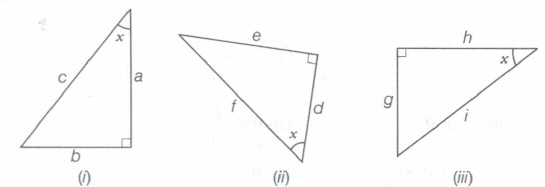
Indicate the perpendicular, the hypotenuse and the base (in that order) with respect to the angle marked x.
23.
If A and B are acute angles such that sin A = cos B, prove that (A + B) = 900 .
24.
The length, breadth and height of a room are 8m 25 cm, 6 m 75 cm, 4 m 50 cm, respectively. Find the length of the longest rod that can measure the three dimensions of the room exactly.
25.
Solve for x: \(\frac { 16 }{ x } -1=\frac { 15 }{ x+1 } ;x\neq 0,-1\)
26.
From a 60 m high building, the angle of depression of the top and bottom of a lamppost are \({ 30 }^{ ° }\)and \({ 60 }^{ ° }\) , respectively. Find the distance between lamppost and building. Also, find the difference of heights between building and lamppost.
27.
Is 184 a term of the A.P. 3, 7, 11,.....?
28.
A tower stands at the centre of a circular park. If A and B are two points on the boundary of the park, such that AB = a m subtends an angle of 60° at the foot of the tower and the angle of elevation of the top of the tower from A or B is 30°. Find, then the height of the tower is
\(\sqrt{3}\) a m
\(a / \sqrt{3} m\)
\(\frac{\sqrt{3}}{a} m\)
None of these
29.
If ABC is a right angled triangle, then find the relation between \(\tan \left(\frac{A-B-C}{2}\right) \text { and }-\tan \left(\frac{A+B-C}{2}\right)\)
equal
Unequal
sum of these equal to 1
None of the above
30.
9 sec2 A – 9 tan2 A =
1
9
8
0
31.
\(\frac{1-\tan ^{2} 45^{\circ}}{1+\tan ^{2} 45^{\circ}}\) =
tan 90°
1
sin 45°
0
32.
11th term of the AP: – 3 ,\(-\frac{1}{2}\) ,2 , ..., is
28
22
- 38
\(-48 \frac{1}{2}\)
33.
30th term of the AP: 10, 7, 4, . . . , is
97
77
- 77
- 87
34.
A and B together can do a piece of work in 12 days, Band C together in 15 days. If A is twice as good a workman as C, then in how many days will B alone do it?
10 days,
15 days,
20 days,
25 days,
35.
On dividing x3 - 3x2 + x+ 2 by a polynomial g(x), the quotient and remainder were x - 2 and -2x + 4 respectively, then g(x) is equal to
x2 + x + 1
x2 + 1
x2 - x + 1
x2 - 1
36.
The number of two digit numbers divisible by 5 is
17
16
19
18
37.
Which term of the A.P 10,8,6,… will be the first negative term?
6
7
5
4
38.
The positive value of k, for which both equations: x2 + kx + 64 = 0 and x2 – 8x + k = 0 have real roots is______
k = -16
k = 16
k ≤ 16
k ≥ 16
39.
The solution of x2 + 4x + 4 = 0 is
None of these
0
-2
2
40.
Which of the following is defined
tan 90°
cot 0°
cosec 90°
sec 90°
41.
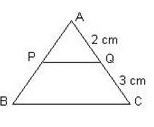
In the adjoining figure, PQ || BC, then what could be the values of AP & PB respectively
1 cm and 3 cm
3 cm and 6 cm
2 cm and 4 cm
4 cm and 6 cm
42.
Triangles ABC, DEF are similar , ∠A = 75° , ∠B = 85° so ∠F =?
20°
30°
10°
35°
43.
3 women and 6 men can together finish a tailoring job in 5 days, while 4 women and 7 men can finish it in 4 days. Find the time taken by 1 woman alone to finish the work, and also that taken by 1 man alone. The linear equations(in standard form) to solve this problem algebraically are
15u + 30v – 1 = 0; 16u + 28v – 1 = 0
15x – 30y + 1 = 0; 16x + 28y +1 = 0
16u + 30v – 1 = 0; 16u + 28v – 1 = 0
16x + 30y – 1 = 0; 16x + 28y – 1 = 0
44.
The value of p when x3 + 9x2 + px – 10 is exactly divisible by (x+ 2 ) is ____
1
6
3
9
45.
If a prime number p divides a2 , then which one of the following is true?
p divides a
p = a
p > a
a divides p
46.
If the HCF of 85 and 153 is expressible in the form 85n – 153, then value of n is :
4
2
3
1
47.
A vertical tower is 20 m high. A man at some distance from the tower knows that the cosine of the angle of the elevation of the top of tower is 0.5. He is standing from the foot of the tower at a distance of:
30√3 m
20√3 m
20/√3 m
10/√3 m
48.
Assertion If the nth term of an AP be (2n2 - 1),then the sum of its first n terms is n3.
Reason If a,l and n are first term, last term and number of terms of an Ap, respectively then \(S_{n}=\frac{n}{2}(a+l)\)
Codes:
(a) If both Assertion and Reason are correct and Reason is the correct explanation of Assertion.
(b) If both Assertion and Reason are correct, but Reason is not the correct explanation of Assertion.
(c) If Assertion is correct but Reason is incorrect.
(d) If Assertion is incorrect but Reason is correct.
49.
Assertion: If the equation
y2 + 4my + n = 0 has real roots, then \(m^{2}=\frac{n}{4}\)
Reason: If the quadratic equation
ax2 + bx + c = 0, a ≠ 0 has b2 - 4ac = 0, then x = \(\frac{-b}{2 a}, \frac{-b}{2 a}\)
Codes:
(a) If both Assertion and Reason are correct and Reason is the correct explanation of Assertion.
(b) If both Assertion and Reason are correct, but Reason is not the correct explanation of Assertion.
(c) If Assertion is correct but Reason is incorrect.
(d) If Assertion is incorrect but Reason is correct.
50.
The production of TV sets in a factory increases uniformly by a fixed number every year. It produced 16000 sets in 6th year and 22600 in 9th year.
(i) Find the production during first year.
| (a) Rs. 5000 | (b) Rs. 2200 | (c) Rs. 10000 | (d) none of these |
(ii) Find the production during 8th year
| (a) Rs. 7200 | (b) Rs. 22000 | (c) Rs. 20400 | (d) none of these |
(iii) Find the production during first 3 years.
| (a) Rs. 21600 | (b) Rs. 22000 | (c) Rs. 20400 | (d) none of these |
(iv) In which year, the production is Rs. 29,200.
| (a) 10 | (b) 11 | (c) 12 | (d) 13 |
(v) Find the difference of the production during 7th year and 4th year.
| (a) Rs. 5000 | (b) Rs. 2200 | (c) Rs. 10000 | (d) none of these |
51.
There is fire incident in the house. The house door is locked so, the fireman is trying to enter the house from the window. He places the ladder against the wall such that its top reaches the window as shown in the figure .
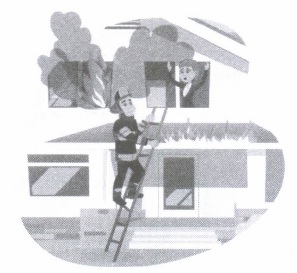
Based on. the above information, answer the following questions.
(i) If window is 6 m above the ground and angle made by the foot ofladder to the ground is 30°, then length of the ladder is
| (a) 8m | (b) 10m | (c) 12m | (d) 14m |
(ii) If fireman place the ladder 5 m away from the wall and angle of elevation is observed to be 30°, then length of the ladder is
| (a) 5 m | \((b) \frac{10}{\sqrt{3}} \mathrm{~m}\) | \((c) \frac{15}{\sqrt{2}} \mathrm{~m}\) | (d) 20 m |
(iii) If fireman places the ladder 2.5 m away from the wall and angle of elevation is observed to be 60°, then find the height of the window. (Take \(\sqrt{3}\) = 1.73)
| (a) 4.325 m | (b) 5.5 m | (c) 6.3 m | (d) 2.5 m |
(iv) If the height of the window is 8 m above the ground and angle of elevation is observed to be 45°, then horizontal distance between the foot of ladder and wall is
| (a) 2 m | (b) 4 m | (c) 6 m | (d) 8 m |
(v) If the fireman gets a 9 m long ladder and window is at 6 m height, then how far should the ladder be placed?
| (a) 5 m | (b) 3\(\sqrt{5}\)m | (c) 3 m | (d) 4 m |
1.
Let LHS = \(\frac{1}{\cos ^{2} A}-\frac{\sin ^{2} A\left(1-2 \sin ^{2} A\right)}{\cos ^{2} A\left(2 \cos ^{2} A-1\right)}\) \(\left[\because \sec ^{2} \theta=\frac{1}{\cos ^{2} \theta}\right]\)
\(=\frac{1}{\cos ^{2} A}-\frac{\sin ^{2} A\left[1-2\left(1-\cos ^{2} \frac{1}{A}\right)\right]}{\cos ^{2} A\left(2 \cos ^{2} A-1\right)}\) \(\left[\because \sin ^{2} \theta=1-\cos ^{2} \theta\right]\)
2.
cos9 \(\alpha\) = sin \(\alpha\)
\(\Rightarrow \sin \left(90^{\circ}-9 \alpha\right)=\sin \alpha\) \(\left[\because \cos \theta=\sin \left(90^{\circ}-\theta\right)\right]\)
90°- 90 \(\alpha\) = \(\alpha\) \(\left[\because 9 \alpha<90^{\circ} \text { i. e. acute angle }\right]\)
\(\Rightarrow \quad 10 \alpha=90^{\circ} \Rightarrow \alpha=9^{\circ}\)
Hence, find tan 5\(\alpha\)
= 1
3.
\(L H S=\frac{\cot A-\cos A}{\cot A+\cos A}=\frac{\frac{\cos A}{\sin A}-\cos A}{\frac{\cos A}{\sin A}+\cos A}\)
\(=\frac{\cos A\left(\frac{1}{\sin A}-1\right)}{\cos A\left(\frac{1}{\sin A}+1\right)}=\frac{\left(\frac{1}{\sin A}-1\right)}{\left(\frac{1}{\sin A}+1\right)}=\frac{\operatorname{cosec} A-1}{\operatorname{cosec} A+1}=\operatorname{RHS}\)
4.
1,4
5.
Using Euclid's division lemma for 234 and 111, we get
234 =111 x 2 + 12
Now 111 = 12 x 9 +3 and 12 = 3 x 4 + 0
\(\therefore\) HCF = 3
A.TQ. 3 = 234x + 111y
\(\Rightarrow\) 3 - 234x = 111y \(\Rightarrow\) \({{3-234x}\over{111}}=y\)
Taking x = - 9 we get \({{3-234\times-9}\over{111}}=y\)
\(\Rightarrow\) y = 19.
6.
If x + 7 is a factor then (-7) is a root.
So, f(-7) = (-7)4 + 10(-7)3 + 25(-7)2 + 15(-7) + k = 0
(when it is a root the polynomial should be equal to zero when value is substituted)
2401 - 3430 + 1225 - 105 + k = 0
\(\Rightarrow\) 3626 - 3535 + k = 0
\(\Rightarrow\) 91 + k = 0
\(\therefore\) k = - 91
7.
\(\frac { 3 }{ 6 } \neq \frac { 2 }{ -4 } \)
i.e., \(\\ \frac { { a }_{ 1 } }{ { a }_{ 2 } } \neq \frac { { b }_{ 1 } }{ { b }_{ 2 } } \)
Hence, the pair of linear equations is consistent.
8.
LHS=\((\tan { \theta } +2)(2\tan { \theta } +1)\)
\(=2\tan ^{ 2 }{ \theta } +4\tan { \theta } +\tan { \theta } +2\)
\(=2\tan ^{ 2 }{ \theta } +2+5\tan { \theta } \)
\(=2(\tan ^{ 2 }{ \theta } +1)+5\tan { \theta } \)
\(=2\sec ^{ 2 }{ \theta } +5\tan { \theta } \quad \left[ \because 1+\tan ^{ 2 }{ \theta } =\sec ^{ 2 }{ \theta } \right] \)
\(=5\tan { \theta } +2\sec ^{ 2 }{ \theta } \)=RHS
Hence proved.
9.
12 m
10.
3, 15, 27, 39, ....
Here, a = 3, d = 15 - 3 = 12
Let an = 132 + a54
\(\Rightarrow\) an - a54 = 132
\(\Rightarrow\) (n - 54) 12 = 132
\(\Rightarrow\) n - 54 = \(\frac{132}{12}\) \(\Rightarrow\) n - 54 = 11
\(\Rightarrow\) n = 11 + 54 = 65
\(\therefore\) an = 65
11.
\(4\left(\frac{sec^{2}59^{0}-cot^{2}31^{0}}{3}\right)\)-\(\frac{2}{3}\)sin 900+3tan2560xtan2340=\(\frac{x}{3}\)
⇒ \(4\left(\frac{sec^{2}59^{0}-tan^{2}(90^{0}-31^{0})}{3}\right)-\frac{2}{3}\)x1+3tan2560xtan2340=\(\frac{x}{3}\)
⇒ 4x\(\frac{1}{3}-\frac{2}{3}+3\times{1}=\frac{x}{3}\)⇒ \(\frac{4}{3}-\frac{2}{3}+3=\frac{x}{3}\)⇒ x=11
12.
If all the zeroes of q(x) are also the zeroes of p(x). Then q(x) is a factor of p(x) and if we divide p(x) with q(x). then the remainder must be zero. So
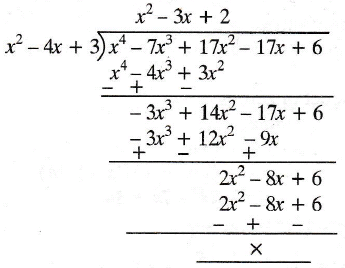
So; -1-a=0 or 3+3a=0 or b-2a=0
⇒ a=-1 or a=-1 or b=2a ⇒ b=-2.
So for a = -1, b = - 2 q(x) has all the zeroes of the polynomial p(x).
By division algorithm,
x5-x4-4x3+3x2+3x-2=(x3+2x2-1)(x2-3x+2)
x2-3x+2=0
⇒ (x-2)(x-1)=0 ⇒ x=1,2
All zeroes of p(x) but not g(x).
13.
Let x be the digit at unit's place and y be the digit at ten's place of the value of the number.
According to the given condition
x + y = 9 .....(i)
Value of the number = x + 10y
When we reverse the order of the digits, the value of the new number = y + 10x
We are given that,
9 \(\times\) (x + 10y) = 2 \(\times\) (y + 10x)
\(\Rightarrow\) 9x + 90y = 2y + 20x
\(\Rightarrow\) 88y = 11x
\(\Rightarrow\) x = 8y \(\Rightarrow\) x - 8y = 0.....(ii)
Subtract (ii) from (i),
x + y = 9
x - 8y = 0
\(\underline { - \quad + \quad - } \)
\(\Rightarrow\) 9y = 9
\(\therefore\) Y = 1
From (i), x + 1 = 9
\(\therefore\)x = 8
Hence, the number is : 10y + x = 10 \(\times\) 1 + 8 = 18
14.
(i) False, because the value of tan A lies between +\(\infty\) and -\(\infty\)
(ii) True, because sec A is always greater than 1.
(iii) False, because cos A is the abbreviation of cosine of \(\angle A\) and for cosecant of \(\angle A\) the abbreviation is cosec A.
(iv) False, because cot A is just a symbol and cannot be separated.
(v) False, because the value of sin\(\theta\) is always less than or equal to 1. Here sin\(\theta\) = 4/3 which is greater than 1, so it is not possible for any \(\theta.\)
15.
First, write the given number in the form of p/q and then factorise the denominator.
(i) Denominator is of the form 2n 5m
(ii) Denominator contains a factor other than 2 or 5.
16.
Given equations is \(x^{ 2 }-3x-10=0\)
\(\Rightarrow x^{ 2 }-5x+2x-10=0\)
\(\left[ \because -5x(2)=-10\\ and-5+2=-3 \right] \)
\(\Rightarrow x(x-5)+2(x-5)=0\)
\(\Rightarrow x-5=0\quad \Rightarrow x=5\)
\(\Rightarrow x+2=0\Rightarrow x=-2\)
Hence, the roots of the equation
\(x^{ 2 }-3x-10=0\quad are-2\quad and\quad 5\)
17.
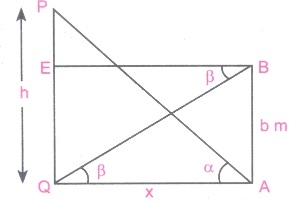
Given: A tower PQ subtending angle α at the point A. Point B is b m vertically above A. From B angle of depression of Q is β.
To prove:
PQ=height of the tower =b tanα cotβ
Proof: Let AQ=x
ㄥEBQ=β
EB||QA
⇒ ㄥBQA=β [Alternate angles]
In right angled ∆BAQ,
\(\frac { AB }{ AQ } =\frac { b }{ x } \)=tanβ
⇒ \(\frac { b }{ x } \)=tanβ
⇒ x=b cotβ
\(\frac { PQ }{ QA } =\frac { h }{ x } \)=tanα
⇒ h=x tanα
=b cotβ tanα=b tanα cotβ
18.
Here d1 = 1, d2 = 2, d3 = 3
Ist term, a = 1
S1 = \({n\over2}[2\times1+(n-1){d}_{1}]\)
\(={n\over2}[2+(n-1)1]\)
\(={n\over2}(n+1)\)
S2 = \({n\over2}[2\times1+(n-1){d}_{2}]\)
\(={n\over 2}[2+(n-1)]={n}^{2}\)
S3 = \({n\over2}[2\times1+(n-1)3]\)
\(={n\over2}[3n-1]\)
Now S1 + S2 = \({n\over2}(n+1)+{n\over2}(3n-1)\)
\(={n\over2}(n+1+3n-1)\)
\(={n\over2}\times4n={2n}^{2}\) .....(i)
and 2 X S2 = 2 X n2 .....(ii)
From (i) and (ii), we have
S1 + S3 = 2S2
19.
Let p(u) = 4u2 + 8u = 4u(u+2)
To find zeroes, put p(u) = 0
\(\Rightarrow\) 4u(u+2) = 0 \(\Rightarrow\) u = 0 or u + 2 = 0 [\(\because\) 4 \(\neq\)0]
\(\Rightarrow\) u = 0 or u = -2
Hence, zeroes of the given polynonial are 0 and -2.
Verification
Here, sum of zeroes = 0 - 2 = -2 = -(8/4)
=-\(\frac{Coefficient \quad of \quad u}{Coefficient \quad of \quad u^{2}}\)
and product of zeroes
=0 \(\times\)-2 = 0 = (0/4) = \(\frac{Constant \quad term}{Coefficient \quad of \quad u^{2}}\)
so, the relationship between the zeroes and its coefficients is verified.
20.
a(x + y) + b(x -.y) = a.2 - ab + b2 ......(i)
a(x + y) - b(x - y) = a2 + b2 + ab ......(ii)
Rearrange (i) x (a - b) and (ii) x (a + b).
(a - b) [(a + b)x + (a - b)y = a2 - ab + b2]
(a + b)[(a -b)x + (a + b)y = a2 + ab + b2]
(a2-b2)x + (a-b)2y = (a - b)(a2-ab+b2) .....(iii)
(a2-b2)x + (a+b)2y = (a+b)(a2+ab+b2) .......(iv)
On subtracting (iv) from (iii)
[(a-b)2-(a+b)2]y = a3 - a2b + ab2 - ba2 + ab2 - b3 - b3 - a3 - a2b - ab2 - ba2 - ab2
-4aby = -4a2b-2b3
-4aby = -2b[2a2+b2]
y=\(\left[ \frac { { 2a }^{ 2 }+{ b }^{ 2 } }{ 2a } \right] \)
Put in equation (i), we have
(a+b)x = a2-ab+b2-(a-b)
(a+b)x = a2 - ab + b2 - (a-b)\({ \left( \frac { { 2a }^{ 2 }+{ b }^{ 2 } }{ 2a } \right) }\)
2a(a+b)x = 2a3 - 2a2b + 2ab2 - 2a3 - ab2 + 2a2b+b2
2a(a+b)x = ab2 + b3 = b2(a+b)
\(x={b^2\over2a}\)
21.
A.P is -6,-\( \frac { 11 }{ 2 } \),-5,.......
a = - 6
\(d=-\frac { 11 }{ 2 } +\frac { 6 }{ 1 } =\frac { 1 }{ 2 } \)
Sn = - 25
\(\Rightarrow \quad { S }_{ n }=\frac { n }{ 2 } [2a+(n-1)d]\)
\(\Rightarrow \quad -25=\frac { n }{ 2 } \left[ -12+(n-1)\times \frac { 1 }{ 2 } \right] \)
\(\Rightarrow \quad -50=n\left[ \frac { -24+(n-1) }{ 2 } \right] \)
\(\Rightarrow\) - 100 = n[n-25]
\(\Rightarrow\) n2 - 25n + 100 = 0
\(\Rightarrow\) (n-20)(n-5) = 0
\(\Rightarrow\) n = 20, 5
\(\Rightarrow\) S20 = S5
Two answers\(\because\) a is negative and d is positive and the sum of the terms from 6th to 20th is zero.
22.
With reference to angle x,
(i) perpendicular = b, hypotenuse = c and base = a
(ii) perpendicular = e, hypotenuse = f and base = d
(iii) perpendicular = g, hypotenuse = i and base = h
23.
sin A = cos B \(\Rightarrow\)sin A = sin (900- B)
\(\Rightarrow\) A = 900 - B [\(\because\)A and (900 - B) are acute angles]
\(\therefore\) A + B = 900
Hence proved.
24.
Given, length of the room = 8 m 25 cm
= 825 cm [ \(\because \) 1 m - 100 cm]
Breadth of the room = 6 m 75 cm
= 675 cm
and height of the room = 4 m 50 cm
= 450 cm
Clearly, the length of the longest rod (in cm) is the HCF of 825, 675 and 450.
| 3 | 825 |
| 5 | 275 |
| 5 | 55 |
| 11 | 11 |
| 1 |
| 3 | 675 |
| 3 | 225 |
| 3 | 75 |
| 5 | 25 |
| 5 | 5 |
| 1 |
| 2 | 450 |
| 3 | 225 |
| 3 | 75 |
| 5 | 25 |
| 5 | 5 |
| 1 |
Thus, 825 = 3 x 52 x 11
675 = 33 x 52 and 450 = 2 x 32 x 52
Now, HCF(825, 675, 450) = Product of the smallest power of each common prime factor
= 3 x 52 = 75
Hence, the required length of the longest rod is 75 cm.
25.
Given, \(\frac { 16 }{ x } -1=\frac { 15 }{ x+1 } \)
\(\frac { 16 }{ x } -\frac { 15 }{ x+1 } =1\\ \frac { 16(x+1)-15x }{ x(x+1) } =1 \)
16x+16-15x=x2+x
x+16=x2+x
x2=16
x2=\(\pm\)4
Hence, the roots are 4 and -4.
26.
34.64 m; 20 m
27.
No
28.
(b)
\(a / \sqrt{3} m\)
29.
(b)
Unequal
30.
(b)
9
31.
(d)
0
32.
(b)
22
33.
(c)
- 77
34.
(c)
20 days,
35.
(c)
x2 - x + 1
36.
(d)
18
37.
(b)
7
38.
(b)
k = 16
39.
(c)
-2
40.
(c)
cosec 90°
41.
(d)
4 cm and 6 cm
42.
(a)
20°
43.
(a)
15u + 30v – 1 = 0; 16u + 28v – 1 = 0
44.
(c)
3
45.
(a)
p divides a
46.
(b)
2
47.
(c)
20/√3 m
48.
(a) If both Assertion and Reason are correct and Reason is the correct explanation of Assertion.
49.
(a) If both Assertion and Reason are correct and Reason is the correct explanation of Assertion.
50.
(i) (a): Let the production during first year be a and let d be the increase in production every year. Then,
a6 = 16000 \(\Rightarrow\)a + 5d = 16,000 (i)
and a9 = 22600 \(\Rightarrow\)a + 8d = 22600 (ii)
On substracting (i) from (ii) , we get
3d = 6600 \(\Rightarrow\) d = 2200
Putting d = 2200 in (i) we get,
a + 5 x 2200 = 16000
\(\Rightarrow\) a + 11000 = 16000 \(\Rightarrow\) a = 16000 - 11000 = 5000
Thus , a = 5000 and d = 2200
Production during first year, a = 5000.
(ii) (c): Production during 8th year is given by a8
= (a + 7d)
= (5000 + 7(2200))
= (5000 + 15400)
= 20400.
(iii) (a): a2 = (a + d)
= (5000 + 2200) = 7200.
a3 = (a2 + d)
= 7200 + 2200 = 9400.
Production during first 3 years = 5000 + 7200 + 9400 = 21600
(iv) (c): an = 5000 + (n – 1)2200 = 29200
(n – 1)2200 = 29200 – 5000 = 24200
⇒ n – 1 = 11
⇒ n = 12
(v) (d): a4 = (a + 3d)
= (5000 + 3(2200)) = 5000 + 6600 = 11600.
a7 = (a6 + d)
= 16000 + 2200 = 18200.
Difference = 18200 – 11600 = 6600
51.
(i) (c) : Let AC be the length of the ladder.
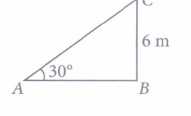
\(\text { In } \Delta A B C, \frac{B C}{A C}=\sin 30^{\circ} \)
\(\Rightarrow \frac{6}{A C}=\frac{1}{2} \Rightarrow A C=12 \mathrm{~m}\)
(ii) (b): \(\text { In } \Delta A B C, \frac{A B}{A C}=\cos 30^{\circ}\)
\(\Rightarrow \frac{5}{A C}=\frac{\sqrt{3}}{2} \Rightarrow A C=\frac{10}{\sqrt{3}} \mathrm{~m}\)
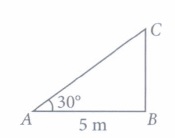
(iii) (a) : Let BC be the height of window from ground.
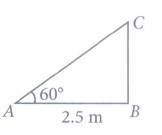
\(\text { In } \Delta A B C, \frac{B C}{A B}=\tan 60^{\circ} \)
\(\Rightarrow \frac{B C}{2.5}=\sqrt{3} \)
\(\Rightarrow B C=2.5 \times 1.73=4.325 \mathrm{~m}\)
(iv) (d): Let AB be the horizontal distance between the foot of ladder and wall.
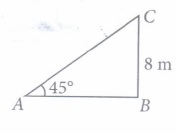
\(\text { In } \Delta A B C, \frac{B C}{A B}=\tan 45^{\circ} \)
\(\Rightarrow \quad \frac{8}{A B}=1 \Rightarrow A B=8 \mathrm{~m}\)
(v) (b): Let the required distance be x.
\(\text { In } \Delta A B C,(9)^{2}=x^{2}+(6)^{2}\)
[By Pythagoras theorem]
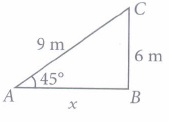
\(\Rightarrow 81-36=x^{2} \Rightarrow 45=x^{2} \)
\(\Rightarrow \quad x=3 \sqrt{5} \mathrm{~m}\)

10th Standard CBSE Syllabus & Materials
10th Standard CBSE
CBSE 10th Social Science PS - Federalism - New Model Questions Papers Study Material - QB365 Set A
NEW10th Standard CBSE
CBSE 10th Social Science PS - Power Sharing - New Model Questions Papers Study Material - QB365 Set A
NEW10th Standard CBSE
CBSE 10th Social Science GEO - Manufacturing Industries - New Model Questions Papers Study Material - QB365 Set A
NEW10th Standard CBSE
CBSE 10th Social Science GEO - Minerals and Energy Resources - New Model Questions Papers Study Material - QB365 Set A



NCERT Books

Syllabus

Exam Pattern

Sample Question Papers

Previous year Question Papers

Important Notes

MCQ Practice test

NCERT Exemplers

Case study Questions

Image Based Questions

Passage based Questions

HOT Questions

Value Based Questions

Model Questions Papers
NCERT ( Book Back ) Questions

Assertion and Reason
Important Questions And Answers

CBSE 10th Standard CBSE Subjects
CBSE Standards



