
 100% FREE ACCESS
10th Standard CBSE Syllabus & Materials
10th Standard CBSE
CBSE 10th Social Science ECO - Globalisation and the Indian Economy - New Model Questions Papers Study Material - QB365 Set A
NEW10th Standard CBSE
CBSE 10th Social Science ECO - Money and Credit - New Model Questions Papers Study Material - QB365 Set A
NEW10th Standard CBSE
CBSE 10th Social Science ECO - Sectors of the Indian Economy - New Model Questions Papers Study Material - QB365 Set A
NEW10th Standard CBSE
CBSE 10th Social Science ECO - Development - New Model Questions Papers Study Material - QB365 Set A
NEW10th Standard CBSE
CBSE 10th Social Science PS - Outcomes of Democracy - New Model Questions Papers Study Material - QB365 Set A
NEW10th Standard CBSE
CBSE 10th Social Science PS - Gender, Religion and Caste - New Model Questions Papers Study Material - QB365 Set A

Published on: 22/10/2025
Download CBSE Class 10th Standard CBSE Maths question papers, sample papers, important questions, and previous year solved papers in PDF format. Get free study materials, NCERT solutions, and exam preparation resources for Class 10th Standard CBSE Maths
Questions + Answers key
Take MCQ Maths Test
1.
On comparing the ratios \(\frac{a_{1}}{a_{2}}, \frac{b_{1}}{b_{2}} and \frac{c_{1}}{c_{2}}\) find out whether the following pair of linear equations are consistent, or inconsistent.
\(\frac{4}{3} x+2 y=8 ; 2 x+3 y=12\)
2.
Find a quadratic polynomial each with the given numbers as the sum and product of its zeroes respectively.
\(\sqrt{2}, \frac{1}{3}\)
3.
Find the HCF of 96 and 404 by the prime factorisation method. Hence, find their LCM.
4.
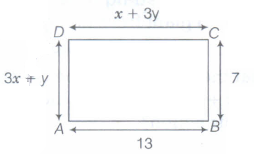
Find the values of x and y in the given rectangle.
5.
Find the value of k, for which system of equations kx+3y=3 and 12x+ky=6 represent parallel lines.
6.
Find the zeroes of the quadratic polynomial (x2+5x+6) and verify the relation between the zeroes and the coefficients.
7.
For what value of n, 2n x 5n ends with 5?
8.
Find the nature of the roots of the following quadratic equation. If the real roots exist, find them: \(3x^2-4\sqrt3 x+4=0\)
9.
Find the roots of the following equations: \({1\over x+4}-{1\over x-7}={11\over 30}, \ x\ne-4,7\)
10.
Check whether the following are quadratic equations: (2x – 1)(x – 3) = (x + 5)(x – 1)
11.
Find the dimensions of the prayer hall whose carpet area is 300 square metres and whose length is 1 metre more than twice its breadth. R
12.
Find the zeroes of the following quadratic polynomials and verify the relationship between the zeroe and the coefficients.
6x2 – 3 – 7x
13.
Use elimination method to find all possible solutions of the following pair of linear equation
2x+3y=8 (1)
4x+6y=7 (2)
14.
Prove that \(\sqrt { 5 } \) is irrational number.
15.
Use Euclid's division lemma to show that the cube of any positive integer is either of the form 9m or 9m + 1 or 9m + 8.
16.
A motor boat whose speed is 24km/h in still water takes 1 hour more to go 32 km upstream than no return downstream to the same spot. Find the speed of the steam.
1.
\(\frac{4}{3} x+2 y=8 ; 2 x+3 y=12\)
Here,\(\frac{a_{1}}{a_{2}}=\frac{4}{3 \times 2}=\frac{2}{3}, \frac{b_{1}}{b_{2}}=\frac{2}{3}, \frac{c_{1}}{c_{2}}=\frac{-8}{-12}=\frac{2}{3}\)
\(\because \quad \frac{a_{1}}{a_{2}}=\frac{b_{1}}{b_{2}}=\frac{c_{1}}{c_{2}}\)
\(\therefore\) Pair of equations is consistent with infinitely many solutions.
2.
Let the polynomial be ax2 + bx + c, and its zeroes be α and ß
Given \(\alpha+\beta=\sqrt{2}=\frac{-b}{a}\)
\(\alpha \beta=\frac{1}{3}=\frac{c}{a}\)
If a = 3, then \(b=\sqrt{2}\) and c = 1/3
Therefore, the quadratic polynomial is \(3 x^{2}-3 \sqrt{2} x+1\).
3.
The prime factorisation of 96 and 404 gives :
96 = 25 x 3, 404 = 22 x 101
Therefore, the HCF of these two integers is 22 = 4.
Also,LCM (96, 404) = \(\frac{96 \times 404}{\mathrm{HCF}(96,404)}=\frac{96 \times 404}{4}=9696\)
4.
By property of rectangle, we know that its opposite sides are of equal lengths.
i.e. DC=AB \(\Rightarrow\) x+3y=13 ...(i)
and AD=BC \(\Rightarrow\) 3x+y=7 .....(ii)
On multiplying Eq. (ii) by 3 and then subtracting Eq. (i), we get
| 9x+3y=21 |
| x+3y=13 |
| 8x=8 |
\(\Rightarrow\) x=1
On putting x=1 in Eq. (i), we get
3y=12 \(\Rightarrow\) y=4
Hence, x=1 and y=4.
5.
For parallel lines, \(\frac { { a }_{ 1 } }{ { a }_{ 2 } } =\frac { { b }_{ 1 } }{ { b }_{ 2 } } \neq \frac { { c }_{ 1 } }{ { c }_{ 2 } } \)
k=-6
6.
-2 and -3
7.
We have, 2n x 5n
If n = 1, then 2 x 5 = 10
If n = 2, then 22 x 52 = (2 x 5)2 = 102 = 100 and soon.
Thus, for any value of n, we get that 2n x 5n ends with zero (always). So, for no value of n, 2n x 5n ends with 5.
8.
\(3 x^{2}-4 \sqrt{3} x+4=0\)
Comparing it with ax2 + bx + c = 0, we get
a = 3, b = \(-4 \sqrt{3}\) and c = 4
Discriminant = b2 - 4ac
\(=(-4 \sqrt{3})^{2}-4(3)(4)\)
= 48 - 48 = 0
As b2 - 4ac = 0,
Therefore, real roots exist for the given equation and they are equal to each other.
And the roots will be \(\frac{-b}{2 a}\)
Therefore, the roots are \(\frac{2}{\sqrt{3}} \text { and } \frac{2}{\sqrt{3}}\)
9.
\(\frac { 1 }{ x+4 } -\frac { 1 }{ x-7 } =\frac { 11 }{ 30 } \quad \Rightarrow \quad \frac { x-7-(x+4) }{ (x+4)(x-7) } =\frac { 11 }{ 30 } \)
\(\Rightarrow \quad \frac { x-7-x-4 }{ { x }^{ 2 }-7x+4x-28 } =\frac { 11 }{ 30 } \quad \Rightarrow \quad \frac { -11 }{ { x }^{ 2 }-3x-28 } =\frac { 11 }{ 30 } \quad or\quad \frac { -1 }{ { x }^{ 2 }-3x-28 } =\frac { 1 }{ 30 } \)
\(\Rightarrow\) x2-3x-28+30=0 \(\Rightarrow\) x2-3x+2=0
This is of the form ax2+bx+c=0, where a=1, b=-3 and c=2
Discriminant(D)=b2-4ac=(-3)2-4 x 1 x 2=9-8=1
Let roots be \(\alpha\)and \(\beta\), \(\alpha =\frac { -b+\sqrt { D } }{ 2a } =\frac { -(-3)+\sqrt { 1 } }{ 2\times 1 } =\frac { 3+1 }{ 2 } =\frac { 4 }{ 2 } =2\)
\(\beta =\frac { -b-\sqrt { D } }{ 2a } =\frac { -(-3)-\sqrt { 1 } }{ 2\times 1 } =\frac { 3-1 }{ 2 } =\frac { 2 }{ 2 } =1\)
Hence roots are 2 and 1.
10.
(2x-1)(x-3)=(x+5)(x-1)
2x2-6x-x+3=x2-x+5x-5
2x2-6x-x+3-x2+x-5x+5=0
x2-11x+8=0
Which is of the form ax2+bx+c=0. Hence the given equation is a quadratic equation.
11.
we found that if the breadth of the hall is x m, then x satisfies the equation 2x2 + x - 300 = 0. Applying the factorisation method, we write this equation as
2x2 - 24x + 25x - 300 = 0
2x (x - 12) + 25 (x - 12) = 0
i.e., (x - 12)(2x + 25) = 0
So, the roots of the given equation are x = 12 or x = - 12.5. Since x is the breadth of the hall, it cannot be negative.
Thus, the breadth of the hall is 12 m. Its length = 2x + 1 = 25 m.
12.
6x2 - 3 - 7x = 6x2 - 7x - 3
=6x2 -9x + 2x -3
=3x(2x - 3) + 1(2x - 3)
=(2x - 3)(3x + 1)
\(=2\left(x-\frac{3}{2}\right) 3\left(x+\frac{1}{2}\right)\)
\(=6\left(x-\frac{3}{2}\right)\left(x+\frac{1}{3}\right)\)
The zeroes of the polynomial are {3/2, -1/3}
Relationship between the zeroes and the coeffieicients of the polynomial
Also sum of the zeroes = \(\frac{3}{2}-\frac{1}{3}=\frac{9-2}{6}=\frac{7}{6}\)
Also product of the zeroes = \(\frac{3}{2} \times-\frac{1}{3}=-\frac{1}{2}\)
Hence Verified.
13.
Step 1 : Multiply Equation (1) by 2 and Equation (2) by 1 to make the coefficients of x equal. Then we get the equations as
4x + 6y = 16 (3)
4x + 6y = 7 (4)
Step 2 : Subtracting Equation (4) from Equation (3),
(4x - 4x) + (6y - 6y) = 16 - 7
i.e., 0 = 9, which is a false statemnt.
Therefore, the pair of equations has no solution.
14.
Suppose, \(\sqrt { 5 } \) is a rational number. Then, \(\sqrt { 5 } \) can be expressed in the form \(\frac{a}{b}\), where a and b are coprime integers and \(b\neq 0\).
\(\therefore \sqrt { 5 } =\frac { a }{ b } \)
On squaring both sides, we get
\(5=\frac { { a }^{ 2 } }{ { b }^{ 2 } } \quad \Rightarrow { a }^{ 2 }=5{ b }^{ 2 }\) ....(i)
\(\Rightarrow \) 5 divides a2.
\(\Rightarrow \) 5 divides a. [by theorem 1] ...(ii)
So, we can take a = 5m
\(\Rightarrow \) a2 = 25m2 [squaring both sides]
On putting the value of a2 in Eq. (i), we get
\(\Rightarrow \) 5 divides b2
\(\Rightarrow \) 5 divides b. [by theorem 1] ... (iii)
Thus, from Eq.(ii), 5 divides a and from Eq. (iii), 5 divides b. It means 5 is a common factor of a and b. This contradicts that there is no common factor of a and b.
This contradiction arises by assuming that \(\sqrt { 5 } \) is rational.
Hence, \(\sqrt { 5 } \) is irrational number.
15.
Consider an arbitrary positive integer y, then y is of the form 3q, (3q + 1) or (3q + 2), where q is some integer.
Consider, y = 3q and taking cube on both sides, we get
y3 = (3q)3 = 27q3 = 9(3q3) = 9m .... (i)
[taking 3q3 = m, where m is some integer.]
Consider, y = 3q + 1 and taking cube on both sides, we get
y3 = (3q + 1)3 = 27q3 + 27q2 + 9q + 1
[\(\because \) (a + b)3 = a3 + 3a2b + 3ab2 + b3]
\(\Rightarrow \) y3 = 9(3q3 + 3q2 + q) + 1 = 9m + 1 ..... (ii)
[taking 3q3 + 3q2 + q = m, where m is some integer.]
Consider, y = 3q + 2 and taking cube on both sides, we get
y3 = (3q + 2)3 \(\Rightarrow \) y3 + 27q3 + 54q2 + 36q + 8
= 9(3q3 + 6q2 + 4q) + 8 = 9m + 8 .... (iii)
[taking 3q3 + 6q2 + 4q = m, where m is some integer]
From Eqs. (i), (ii) and (iii), we get
y3 = 9m, (9m + 1) or (9m + 8)
Thus, the cube of any positive integer is either of the form 9m, (9m + 1) or (9m + 8).
16.
Speed of motor boat in still water is 24 km/h
Let speed of the stream be x km/h
Speed of the boat in downstream direction
=(24+x)km/h
Distance covered in downstream direction
= 32 km
Time taken in downstream direction
\(=\frac { 32 }{ 24+x } \) hours
Speed of the boat in upstream direction (24 +x) km/h
Distance covered in upstream direction = 32 km
ATQ \(\frac { 32 }{ 24-x } -\frac { 32 }{ 24+x } =1\)
\(\Rightarrow \frac { 32(24+x)-32(24-x) }{ (24-x)(24+x) } =1\)
\(\Rightarrow 64x=576-x^{ 2 }\)
\(\Rightarrow x^{ 2 }+64x-576=0\)
\(\Rightarrow x^{ 2 }+72x-8x-576=0\)
\(\Rightarrow (x+72)(x-8)=0\)
x=-72 (rejected) or x=8
\(\therefore \) x=8 speed of stream = 8 km/hr

10th Standard CBSE Syllabus & Materials
10th Standard CBSE
CBSE 10th Social Science PS - Federalism - New Model Questions Papers Study Material - QB365 Set A
NEW10th Standard CBSE
CBSE 10th Social Science PS - Power Sharing - New Model Questions Papers Study Material - QB365 Set A
NEW10th Standard CBSE
CBSE 10th Social Science GEO - Manufacturing Industries - New Model Questions Papers Study Material - QB365 Set A
NEW10th Standard CBSE
CBSE 10th Social Science GEO - Minerals and Energy Resources - New Model Questions Papers Study Material - QB365 Set A



NCERT Books

Syllabus

Exam Pattern

Sample Question Papers

Previous year Question Papers

Important Notes

MCQ Practice test

NCERT Exemplers

Case study Questions

Image Based Questions

Passage based Questions

HOT Questions

Value Based Questions

Model Questions Papers
NCERT ( Book Back ) Questions

Assertion and Reason
Important Questions And Answers

CBSE 10th Standard CBSE Subjects
CBSE Standards



