
 100% FREE ACCESS
10th Standard CBSE Syllabus & Materials
10th Standard CBSE
CBSE 10th Social Science ECO - Globalisation and the Indian Economy - New Model Questions Papers Study Material - QB365 Set A
NEW10th Standard CBSE
CBSE 10th Social Science ECO - Money and Credit - New Model Questions Papers Study Material - QB365 Set A
NEW10th Standard CBSE
CBSE 10th Social Science ECO - Sectors of the Indian Economy - New Model Questions Papers Study Material - QB365 Set A
NEW10th Standard CBSE
CBSE 10th Social Science ECO - Development - New Model Questions Papers Study Material - QB365 Set A
NEW10th Standard CBSE
CBSE 10th Social Science PS - Outcomes of Democracy - New Model Questions Papers Study Material - QB365 Set A
NEW10th Standard CBSE
CBSE 10th Social Science PS - Gender, Religion and Caste - New Model Questions Papers Study Material - QB365 Set A

Published on: 26/10/2025
Download CBSE Class 10th Standard CBSE Maths question papers, sample papers, important questions, and previous year solved papers in PDF format. Get free study materials, NCERT solutions, and exam preparation resources for Class 10th Standard CBSE Maths
Questions + Answers key
Take MCQ Maths Test
1.
Use Euclid's division algorithm to find the HCF of the following three numbers
4407,2938 and 1469
2.
By using Euclid's division algorithm, find the largest number which when divides 2011 and 2623 gives the remainder 9 and 5, respectively.
3.
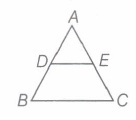
In \(\triangle ABC\) shown below, \(DE\parallel BC\). If BC = 8 cm, DE = 6 cm and area of \(\triangle ADE\) = 45 cm2 , what is the area of \(\triangle ABC\)?
4.
If α and β are the zeroes of the quadratic polynomial p(x)=4x2-5x+1, then find the value of α2β+β2α.
5.
Which of the following are A.P.s? If they from an A.P., find the common difference d and write three more terms: a = -10, d = ......, n = 15, an = 18
6.
2 men and 7 boys can do a piece of work in 4 days. It is done by 4 men and 4 boys in 3 days. How long would it take for one man or one boy to do it?
7.
From an airport, two aeroplanes start at the same time. If speed of first aeroplane due North is 500 km/h and that of other due East is 650 km/h then find the distance between the two aeroplanes after 2 hours.
8.
Fin he HCF of 180, 252 and 324 by Euclid's Division algorithm.
9.
If A=(-5.7), B=(-4,-5) and C=(-1,-6), then find the area of \(\Delta \) ABC
10.
A tourist has Rs 20000 with him.He calculated that he could spend Rs y everyday on his holidays. He spent Rs (y-50) on his every holiday and extended his holiday by 20 days.
(i) Find the amount spent everyday.
(ii) Which value is depicted by the tourist?
11.
How many three-digit numbers are divisible by 11?
12.
Form the pair of linear equation in the following problem and find their solutions graphically.
4 chairs and 3 tables cost Rs 2100 and 5 chairs and 2 tables cost Rs 1750. Find the cost of one chair and one table separately.
13.
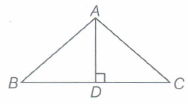
In the given figure, if \(\angle BAC\) = 90° and \(AD\bot BC\) . prove thart AD2 = BD.CD
14.
Find the coordinates of the point R on the line segment joining the points P(-1,3) and Q(2,5) such that PR=\(\frac { 3 }{ 5 } PQ\) .
15.
Sathyam purchases every year bank certificates of value exceeding the last year purchase by Rs 25. After 20 yr, he find that the total value of the certificate purchased by him is Rs 7250. Find the value of the certificate purchased
(i) in the first year. (ii) in the 13th year.
16.
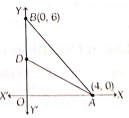
The vertices of a △OAB are O(0, 0), A(4, 0) and A(1, 4) B(-2, 3) and C(5, 8). The ordinate of the fourth vertex D is
\(\sqrt{52} \text{units}\)
5 units
25 units
10 units
17.
The LCM of two numbers is 2400. Which of the following cannot be their HCF?
300
400
500
600
18.
Draw the graph of y = x2 + x - 12. If y = 0, then area of the triangle formed by joining the intersection point of curve.
12 sq units
24 sq units
42 sq units
48 sq units
19.
A graph of quadratic polynomial is given below
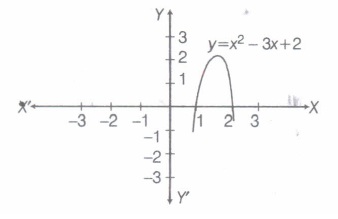
If we rotate the axes at an angle of 90° in anti-clockwise direction, the figure remains at the same position. Find the equation of the graph.
y2 + 3y + 2
y2 -3y + 2
y2 + 2y + 3
y2 - 2y + 3
20.
A circle with area A1 is contained in the interior of a larger circle with area A 1 + A 2. If the radius of the larger circle is 3 and A 1, A 2 and A 1+ A 2 are in Ap, then the radius of the smaller circle is
3
\(\sqrt {3}\)
2
\(\sqrt{2}\)
21.
In an Ap, if a = 3.5, d = 0 and n = 101,then an will be
0
3.5
103.5
104.5
22.
After covering a distance of 30 km with a uniform speed, there is some defect in a train engine and therefore, its speed is reduced to 4/5 of its original speed. Consequently, the train reaches its destination late by 45 min. Had it happened after covering 18 km more, the trains would have seached 9 min earlier. The speed of train and the distance of journey is
20 km/h and 100 km
18 km/h and 120 km
30 km/h and 120 km
None of these
23.
Which term of the A.P. 1, 4, 7 … is 88?
35
26
27
30
24.
The solution of x2 + 4x + 4 = 0 is
None of these
0
-2
2
25.
If ABC~QRP \(\frac { ar(\triangle ABC) }{ ar(\triangle PQR) } =\frac { 9 }{ 4 } \) ,AB = 18 cm and BC = 15 cm then PR is equal to
10 cm
12 cm
\(\frac { 20 }{ 3 } \)cm
8 cm
26.
In right triangle ABC, right angled at A, A perpendicular is dropped from A to BC, meeting BC at D. Then which of the following is true?
ΔADC ~ ΔABD
ΔDCA ~ ΔDABD
ΔDAC ~ ΔDABD
ΔDAC ~ ΔDABA
27.
In two triangles ABC and PQR,Given that ∠A = ∠R and ∠B = ∠Q, which of the following is true?
ΔABC ~ ΔQRP
ΔABC ~ ΔPQR
ΔABC ~ ΔPRQ
ΔABC ~ ΔRQP
28.
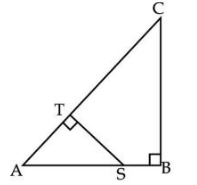
In the given figure, T and B are right angles. If the lengths of AT, BC and AS (in centimeters) are 15, 16 and 17 respectively, then the length of TC (in centimeters) is:
18
12
19
16
29.
In an examination, one mark is awarded for every correct answer, while 1/4 mark is deducted for every wrong answer. A student answered 120 questions and got 20 marks. Which of the following pair of equations would give the result for how many questions did he answered correctly?
x + y = 120; – x + 4y = 80
x + y = 60; x + 4y = 80
x + y = 120; 4x + 3y = 80
x + y = 120; 3x + 4y = 80
30.
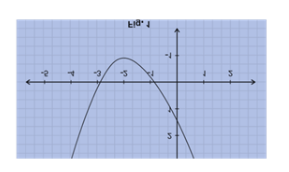
The polynomial drawn in above graph has how many zeros?
1
3
4
2
31.
The number of polynomials having zeroes -2 and 5 is:
1
3
2
more than 3
32.
23 x 3 x 23 Any rational number x in the form p/q (where p and q are co primes), whose decimal expression terminates. Which of the following represents the correct form of prime factorisation of q?
2n, where n is a whole number
2m×5n, where m and n are the whole numbers
1
5n, where n is a whole number
33.
What is the HCF of 1076 and 584
16
4
12
24
34.
The coordinates of the centre of a circle passing through (1, 2), (3, – 4) and (5, – 6) is:
(11, – 2)
(-2, 11)
(11, 2)
(2, 11)
35.
Which of the following is not the graph of a quadratic polynomial?
-q.png)
-q.png)
-q.png)
-q.png)
36.
Anjali places a mirror on level ground to determine the height of a tree (see the diagram). She stands at a certain distance so that she can see the top of the tree reflected from the mirror. Anjali's eye level is 2 m above the ground. The distance of Anjali and the tree from the mirror are 1.4 m and 2.8 m respectively.
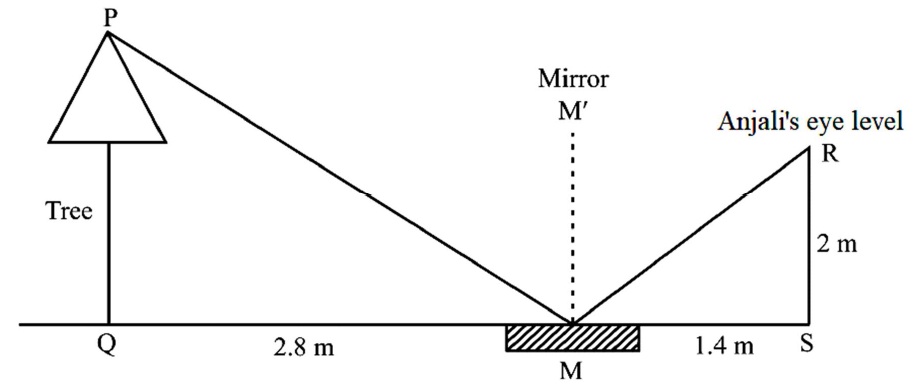
(i) What are the two \(\triangle\)s formed in the above diagram, which are used to calculate the height of the tree?
| (a) \(\triangle\)s QMM' and PQM | (b) \(\triangle\)s PQM and RSM | (c) \(\triangle\)s RM'M and MRS | (d) \(\triangle\)s PM'M and RM'M |
(ii) State the criterion of similarity, that will be used in the above found triangles.
| (a) RHS | (b) SSS | (c) SAS | (d) AA |
(iii) What is the height of the tree?
| (a) 4 m | (b) 5 cm | (c) 6 m | (d) 7 cm |
(iv) What is the distance between Rashmi and Gulmohar tree?
| (a) 3.2 m | (b) 5.2 m | (c) 4.2 m | (d) 2.2 m |
37.
The camping alpine tent is usually made using high quality canvas and it is water proof. These alpine tents are mostly used in hilly areas, as the snow will not settle on the tent and make it damp. It is easy to layout and one need not use a manual to set it up. One alpine tent is shown in the figure given below, which has two triangular faces and three rectangular faces. Also, the image of canvas on graph paper is shown in the adjacent figure.
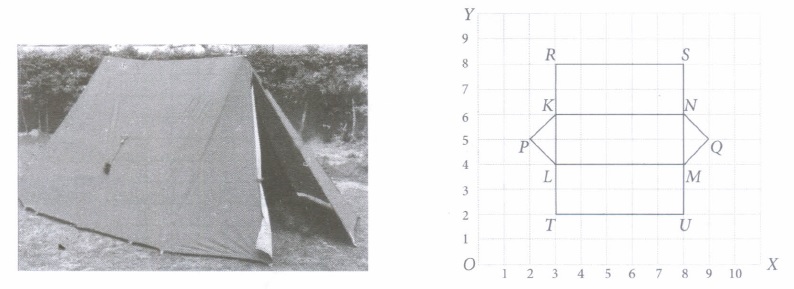
Based on the above information, answer the following questions.
(i) Distance of point Q from y-axis is
| (a) 9 units | (b) 8 units | (c) 4 units | (d) 5 units |
(ii) What are the coordinates of U?
| (a) (2,8) | (b) (8,2) | (c) (6,9) | (d) (9,6) |
(iii) The distance between the points P and Q is
| (a) 4 units | (b) 5 units | (c) 6 units | (d) 7 units |
(iv) If a point A(x, y) is equidistant from Rand T, then
| (a) y - 2 = 0 | (b) y - 3 = 0 | (c) y-5=0 | (d) y - 6 = 0 |
(v) Perimeter of image of a rectangular face is
| (a) 5 units | (b) 8 units | (c) 10 units | (d) 14 units |
38.
Two friends Trisha and Rohan during their summer vacations went to Manali. They decided to go for trekking. While trekking they observes that the trekking path is in the shape of a parabola. The mathematical representation of the track is shown in the graph.
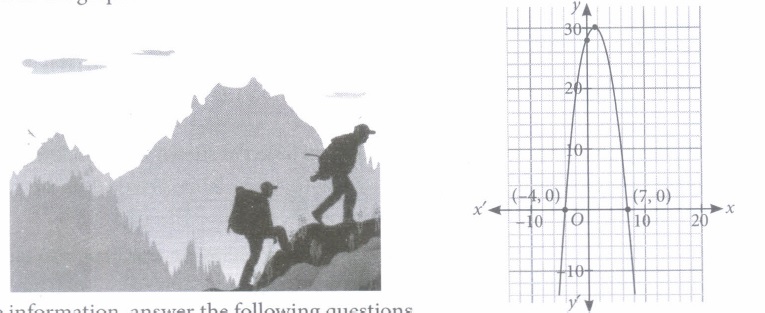
Based on the above information, answer the following questions.
(i) The zeroes of the polynomial whose graph is given, are
| (a) 4,7 | (b) -4,7 | (c) 4,3 | (d) 7,10 |
(ii) What will be the expression of the given polynomial p(x)?
| \((a) x^{2}-3 x+\mathbf{3} 8\) | \((b) -x^{2}+4 x+28\) | \((c) x^{2}-4 x+28\) | \((d) -x^{2}+3 x+28\) |
(iii) Product of zeroes of the given polynomial is
| (a) -28 | (b) 28 | (c) -30 | (d) 30 |
(iv) The zeroes of the polynomial 9x2 - 5 are
| \((a) \frac{3}{\sqrt{5}}, \frac{-3}{\sqrt{5}}\) | \((b) \frac{2}{\sqrt{5}}, \frac{-2}{\sqrt{5}}\) | \((c) \frac{\sqrt{5}}{3}, \frac{-\sqrt{5}}{3}\) | \((d) \frac{\sqrt{5}}{2}, \frac{-\sqrt{5}}{2}\) |
(v) If f(x) = x2 - 13x + 1, then f(4) =
| (a) 35 | (b) -35 | (c) 36 | (d) -36 |
1.
1469
2.
154
3.
\(\Delta A D E \sim \Delta A B C \) [by AA similarily]
\(\Rightarrow \frac{\operatorname{ar}(\Delta A D E)}{\operatorname{ar}(\Delta A B C)}=\left(\frac{D E}{B C}\right)^{2}\)
80 cm2
4.
\(\frac { 5 }{ 16 } \)
5.
d = 2
6.
Let the man can finish the work in x days and the boy can finish the same work in y days.
Work done by one man in one day = \(\frac { 1 }{ x } \)
Now, work done by one boy in one day = \(\frac { 1 }{ y } \)
According to the question,
\(\frac { 2 }{ x } +\frac { 7 }{ y } =\frac { 1 }{ 4 } \quad \quad \quad \quad .....(i)\)
\(and\quad \frac { 4 }{ x } +\frac { 4 }{ y } =\frac { 1 }{ 3 } \quad \quad ....(ii)\)
Let \(\frac { 1 }{ x } =aand\frac { 1 }{ y } =b,then\)
\(2a+7b=\frac { 1 }{ 4 } \quad \quad \quad \quad ....(iii)\)
and \(\\ \\ 4a+4b=\frac { 1 }{ 3 } \quad \quad \quad .....(iv)\)
Multiply eqn. (iii) by 2 and subtract it from eqn. (iv),
\(4a+14b=\frac { 1 }{ 2 } \)
\(4a+4b=\frac { 1 }{ 3 }\)
\( \\ \underline { -\quad -\quad - } \\ 10b=\frac { 1 }{ 6 } \)
\(\Rightarrow \quad b=\frac { 1 }{ 60 } =\frac { 1 }{ y } \)
\(\therefore \quad y=60\quad days\)
Put b=\(\frac { 1 }{ 60 } \) in equation (iii),
\(2a+\frac { 7 }{ 60 } =\frac { 1 }{ 4 } \)
\(\Rightarrow \quad 2a=\frac { 1 }{ 4 } -\frac { 7 }{ 60 } \)
\(\Rightarrow \quad a=\frac { 1 }{ 15 } \)
\(So\quad \frac { 1 }{ 15 } =\frac { 1 }{ x } \)
\(\therefore\) x = 15 days.
7.
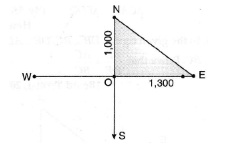
Distance covered by first aeroplane due North after two hours = 500 x 2 = 1,000 km. 1
Distance covered by second aeroplane due East after two hours = 650 x 2 = 1,300 km. 1
Distance between two aeroplane after 2 hours
\(NE=\sqrt { { ON }^{ 2 }+{ OE }^{ 2 } } \)
\(=\sqrt { { (1000) }^{ 2 }+{ (1300) }^{ 2 } } \)
\(=\sqrt { 1000000+1690000 } \)
\(=\sqrt { 2690000 } \)
\(=1640.12\quad km\)
8.
HCF of 324 and 252 = 36
HCF of 36 and 180 = 36
∴ HCF of 180, 252 and 324 is 36
9.
Given, A = (-5, 7), B= (-4, -5) and C = (-1, -6)
Here, x1 = -5, y1 = 7, x2 = -4, y2 = -5, x3 = -1 and y3 = -6
\(\therefore\) Area of \(\Delta \) ABC
\(=\frac { 1 }{ 2 } \left| { x }_{ 1 }({ y }_{ 2 }-{ y }_{ 3 })+{ x }_{ 2 }({ y }_{ 3 }-{ y }_{ 1 })+{ x }_{ 3 }({ y }_{ 1 }-{ y }_{ 2 }) \right| \)
\(=\frac { 1 }{ 2 } \left| -5(-5+6)-4(-6-7)-1(7+5) \right| \)
\(=\frac { 1 }{ 2 } \left| -5(1)-4(-13)-1(12) \right| \)
\(=\frac { 1 }{ 2 } \left| -5+52-12 \right| \)
\(=\frac { 1 }{ 2 } \times 35=17.5\quad sq\quad units\)
10.
Given money spent by tourist everyday = Rs y and total money spent by tourist=Rs 20000
\(\therefore Numberofholidays=\frac { 20000 }{ y } \)
When money spent by tourist everyday is Rs (y-50), then
Number of holidays =\(\frac { 20000 }{ y-50 } \)
According to the given condition,
\(\frac { 20000 }{ y-50 } =\frac { 20000 }{ y } +20\)
\(\frac { 20000 }{ y-50 } =\frac { 20000 }{ y } =20\)
\(\Rightarrow \frac { 1000 }{ y-50 } -\frac { 1000 }{ y } =1\) [dividing by 20]
\(\Rightarrow \frac { 1000y-1000y+50000 }{ y(y-50) } =1\)
\(\Rightarrow 50000=y^{ 2 }-50y\)
\(\Rightarrow y^{ 2 }-50y-50000=0\)
\(\Rightarrow y^{ 2 }-250y+200y-50000=0\)
\(\Rightarrow y(y-250)+200(y-250)=0\)
\(\Rightarrow (y+200)(y-250)=0\)
\(\Rightarrow y-250=0and \quad y+200=0\)
Since money spent by tourist cannot be negative .
\(\therefore y=250\)
Hence,amount spent every day is Rs 250.
(ii) Value of money and carefully planning.
11.
The three-digit numbers which are divisible by 11 are 110, 121, 132, ..., 990
Let there are n, 3-digit numbers divisible by 11
Clearly, it forms an A.P. with a = 110, d = 11
So, an = 990
\(\Rightarrow\) a + ( n - 1 )d = 990
110 + ( n - 1 )d = 990
110 + 11n - 11 = 990
11n + 99 = 990 \(\Rightarrow\) 11n = 891
\(\Rightarrow\) n = 81
Thus, there are 81 numbers of three-digit which are divisible by 11.
12.
Let cost of 1 chair = Rs x and cost of 1 table = Rs y
According to the question,
4x +3y = 2100 ....(i)
5x +2y = 1750 ....(ii)
Multiplying eqn. (i) by 2 and eqn. (ii) by 3,
8x +6y = 4200 ....(iii)
15x + 6y = 5250 ...(iv)
eqn. (iv) - eqn. (iii)
\(\Rightarrow\) 7x = 1050
\(\Rightarrow\) x = 150
Substituting the value of x in (i), y = 500
Cost of chair and table = Rs 150, Rs 500 respectively.
13.
Prove \(\triangle ADB\sim \triangle ADC\), then \(\frac { BD }{ AD } =\frac { AD }{ CD } \)
\(\Rightarrow \) AD2 = BD.CD
14.
\(\left( \frac { 4 }{ 5 } ,\frac { 21 }{ 5 } \right) \)
15.
(i) Rs 125.
(ii) Rs 425.
16.
(b)
5 units
17.
(c)
500
18.
(c)
42 sq units
19.
(a)
y2 + 3y + 2
20.
(b)
\(\sqrt {3}\)
21.
(b)
3.5
22.
(c)
30 km/h and 120 km
23.
(d)
30
24.
(c)
-2
25.
(a)
10 cm
26.
(d)
ΔDAC ~ ΔDABA
27.
(d)
ΔABC ~ ΔRQP
28.
(c)
19
29.
(a)
x + y = 120; – x + 4y = 80
30.
(d)
2
31.
(d)
more than 3
32.
(b)
2m×5n, where m and n are the whole numbers
33.
(b)
4
34.
(c)
(11, 2)
35.
(d)
36.
(i) (b): (b) \(\triangle\)s PQM and RSM
(ii) (d): AA similarity
As \(\angle \mathrm{PQM}=\angle \mathrm{RSM}=90^{\circ}\)
and angle of incidence is equal to angle of reflection.
Then, \(\angle \mathrm{PMQ}=\angle \mathrm{RMS}\)
(iii) (a): Since, \(\Delta \mathrm{PMQ} \sim \Delta \mathrm{RMS}\)
Then, \(\frac{\mathrm{PQ}}{\mathrm{RS}}=\frac{\mathrm{QM}}{\mathrm{MS}} \Rightarrow \mathrm{PQ}=\frac{2.8 \times 2}{1.4}\)
= 4m
(iv) (c): Distance between Rashmi and Gulmohar tree
QS = QM + MS = 2.8 + 1.4 = 4.2 m
37.
(i) (a): Coordinates of Q are (9, 5).
\(\therefore\) Distance of point Q from y-axis = 9 units
(ii) (b): Coordinates of point U are (8, 2).
(iii) (d): We have, P(2, 5) and Q (9, 5)
\(\therefore \quad P Q=\sqrt{(2-9)^{2}+(5-5)^{2}}=\sqrt{49+0}=7 \text { units }\)
(iv) (c): Point A(x, y) is equidistant from R (3, 8) and T(3,2).
\(\therefore \quad A R=A T \Rightarrow A R^{2}=A T^{2} \)
\(\Rightarrow \quad(x-3)^{2}+(y-8)^{2}=(x-3)^{2}+(y-2)^{2} \)
\(\Rightarrow y^{2}+64-16 y=y^{2}+4-4 y \)
\(\Rightarrow 16 y-4 y=64-4 \)
\(\Rightarrow 12 y=60 \Rightarrow y=5\)
(v) (d): Length of TU = 5 units and of TL = 2 units
\(\therefore\) Perimeter of image of a rectangular face = 2(5 + 2) = 14 units
38.
(i) (b): Since, the graph intersects the x-axis at two points, namely x = -4, 7
So, -4, 7 are the zeroes of the polynomial.
(ii) (d): p(x) = -x2 + 3x + 28
(iii) (a) : \(\text { Product of zeroes }=\frac{\text { Constant term }}{\text { Coefficient of } x^{2}}\)
\(\therefore \quad \text { Required product of zeroes }=\frac{28}{-1}=-28\)
(iv) (c): We have \(9 x^{2}-5 =(3 x)^{2}-(\sqrt{5})^{2} =(3 x-\sqrt{5})(3 x+\sqrt{5})
\)
\(\therefore x=\frac{\sqrt{5}}{3} \text { or } \frac{-\sqrt{5}}{3}\)
(v) (b): Here, \(f(x)=x^{2}-13 x+1\)
\(\therefore \quad f(4)=4^{2}-13(4)+1=16-52+1=-35\)

10th Standard CBSE Syllabus & Materials
10th Standard CBSE
CBSE 10th Social Science PS - Federalism - New Model Questions Papers Study Material - QB365 Set A
NEW10th Standard CBSE
CBSE 10th Social Science PS - Power Sharing - New Model Questions Papers Study Material - QB365 Set A
NEW10th Standard CBSE
CBSE 10th Social Science GEO - Manufacturing Industries - New Model Questions Papers Study Material - QB365 Set A
NEW10th Standard CBSE
CBSE 10th Social Science GEO - Minerals and Energy Resources - New Model Questions Papers Study Material - QB365 Set A



NCERT Books

Syllabus

Exam Pattern

Sample Question Papers

Previous year Question Papers

Important Notes

MCQ Practice test

NCERT Exemplers

Case study Questions

Image Based Questions

Passage based Questions

HOT Questions

Value Based Questions

Model Questions Papers
NCERT ( Book Back ) Questions

Assertion and Reason
Important Questions And Answers

CBSE 10th Standard CBSE Subjects
CBSE Standards



