
 100% FREE ACCESS
10th Standard CBSE Syllabus & Materials
10th Standard CBSE
CBSE 10th Social Science ECO - Globalisation and the Indian Economy - New Model Questions Papers Study Material - QB365 Set A
NEW10th Standard CBSE
CBSE 10th Social Science ECO - Money and Credit - New Model Questions Papers Study Material - QB365 Set A
NEW10th Standard CBSE
CBSE 10th Social Science ECO - Sectors of the Indian Economy - New Model Questions Papers Study Material - QB365 Set A
NEW10th Standard CBSE
CBSE 10th Social Science ECO - Development - New Model Questions Papers Study Material - QB365 Set A
NEW10th Standard CBSE
CBSE 10th Social Science PS - Outcomes of Democracy - New Model Questions Papers Study Material - QB365 Set A
NEW10th Standard CBSE
CBSE 10th Social Science PS - Gender, Religion and Caste - New Model Questions Papers Study Material - QB365 Set A

Published on: 20/10/2025
Download CBSE Class 10th Standard CBSE Maths question papers, sample papers, important questions, and previous year solved papers in PDF format. Get free study materials, NCERT solutions, and exam preparation resources for Class 10th Standard CBSE Maths
Questions + Answers key
Take MCQ Maths Test
1.
Find a quadratic polynomial each with the given numbers as the sum and product of its zeroes respectively.
\(-\frac{1}{4}, \frac{1}{4}\)
2.
ABCD is a trapezium in which AB || DC and its diagonals intersect each other at the point O. Show that \(\frac { AO }{ BO } =\frac { CO }{ DO } .\)
3.
Given that HCF (306, 1,314) = 18. Find LCM (306, 1,314).
4.
Find the value of k, for which system of equations kx+3y=3 and 12x+ky=6 represent parallel lines.
5.
Name the type of triangle formed by the points A(2,3), B(4,6) and C(6,9).
6.
A ladder, leaning against a wall, makes an angle of 60o with the horizontal. If the foot of the ladder is 2.5 m away from the wall. find the length of the ladder.
7.
Find two numbers whose sum is 27 and product is 182.
8.
Following is the distribution of the long jump competition in which 250 students participated. Find the median distance jumped by the students. Interpret the median
| Distance (in m) | 0-1 | 1-2 | 2-3 | 3-4 | 4-5 |
| Number of Students | 40 | 80 | 62 | 38 | 30 |
9.
Find the mode of the following frequency distribution.
| Class | 0-10 | 10-20 | 20-30 | 30-40 | 40-50 | 50-60 | 60-70 |
| Frequency | 8 | 10 | 10 | 16 | 12 | 6 | 7 |
10.
Find the zeroes of the following quadratic polynomials and verify the relationship between the zeroes and the coefficients
3x2 – x – 4
11.
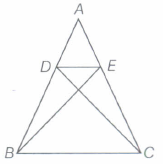
In the given figure, if \(\triangle ABE\cong \triangle ACD\), show that \(\triangle ADE\sim \triangle ABC\) .
12.
Solve the following pair of linear equations.
41x+53y=135 and 53x+41y=147
13.
There are 156, 208 and 260 students in groups A, B and C respectively. Buses are to be hired to take them for a field trip. Find the minimum number of buses to be hired, if the same number of students should be accommodated in each bus.
14.
If the P(k,-1,2) is equidistant from the points A(3,k) and B(k,5) find the values of k.
15.
A statue 1.46 m tall stand on the top of a pedestal. From a point on the ground, the angle of elevation of the top of the statue is 60o and from the same point, the angle of elevation of the top of the pedestal is 45o . Find the height of the pedestal. \((\sqrt { 3 } =1.73)\) .
16.
A speed of a boat in still water is 11km/hour. It can go 12km upstream and return downstream to the original point in 2 hours 45 minutes. Find the speed of the stream.
17.
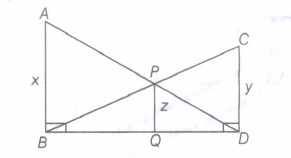
In the given figure, AB II PQ II CD, AB = x units, CD = y units and PQ = z units, prove that \(\frac { 1 }{ x } +\frac { 1 }{ y } =\frac { 1 }{ z } .\)
18.
Solve for x: \(\frac { x-3 }{ x-4 } +\frac { x-5 }{ x-6 } =\frac { 10 }{ 3 } ;x\neq 4,6\)
19.
Solve 2x + 3y = 11 and 2x - 4y = - 24 and hence find the value of m for which y = mx + 3.
20.
Find the coordinates of the point which divide the line segment joining A(2, -3) and B(-4, -6) into three equal parts.
21.
In a retail market, fruit vendors were selling mangoes kept in packing boxes. These boxes contained varying number of mangoes. The following was the distribution of mangoes according to the number of boxes.
| Number of mangoes | 50-52 | 53-55 | 56-58 | 59-61 | 62-64 |
|---|---|---|---|---|---|
| Number of boxes | 15 | 110 | 135 | 115 | 25 |
Find the mean of mangoes kept in a packing box. Which method of finding the mean did you choose?
22.
A straight highway leads to the foot of a tower. A man standing at the top of the tower observes a car at an angle of depression of 30o , which is approaching the foot of the tower with a uniform speed. Six seconds later, the angle of depression of the car is found to be 60o . Find the time taken by the car to reach the foot of the tower from this point.
23.
ΔABC - ΔDEF and their perimeters are 32 cm and 24 cm, respectively. If AB = 10 cm, then DE equals
8 cm
7.5 cm
15 cm
\(5\sqrt{3} \) cm
24.
The pair of linear equations x + 2y + 5 = 0 and -3x = 6y - 1 has
unique solution
exactly two solutions
infinitely many solutions
no solution
25.
The values of x and y is the given figure are
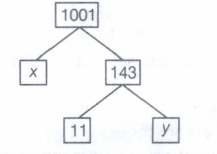
7,13
13,7
9,12
12,9
26.
Which of the following equations has two distinct real roots?
5x2 – 3x + 1 = 0
x2 + 3x + 2√2 = 0
2x2 – 3√2 x + 9/4 = 0
x2 + x – 5 = 0
27.
The nature of the roots of following quadratic equation 3x2-4√3x+4=0 is
Unequal
Equal
No real roots
None of above
28.
The mean of 5 observations x, x + 2, x + 4, x + 6 and x + 8 is 11, then the value of x is:
6
11
4
7
29.
In the given figure, T and B are right angles. If the lengths of AT, BC and AS (in centimeters) are 15, 16 and 17 respectively, then the length of TC (in centimeters) is:
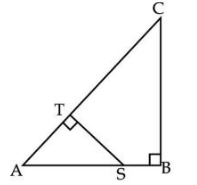
18
12
19
16
30.
The length of an altitude of an equilateral triangle of side a is
\(\frac { a }{ 2\sqrt { 3 } } \)
\(\frac { 2a }{ \sqrt { 3 } } \)
\(\frac { \sqrt { 3 } a }{ 2 } \)
\(\frac { \sqrt { 3 } }{ 2a } \)
31.
From the given figure, find the unknown x.
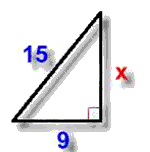
12
225
10
144
32.
Find the solution to the following system of linear equations:
2p+3q=9
p-q=2
(4,2)
(-4,1)
(2,-3)
(3,1)
33.
A fraction becomes when subtracted from the numerator and it becomes . when 8 is added to its denominator. Find the fraction
4/12
3/13
5/12
11/7
34.
If sum of the squares of zeros of the quadratic polynomial f(x) = x2 – 8x + k is 40, find the value of k.
14
12
-14
-12
35.
If x = 23 x 52 , y = 22 x 32 then HCF (x, y) is :
36
12
6
18
36.
The points (3, 2), (0, 5), (-3, 2) and (0, -1) are the vertices of a quadrilateral. Which quadrilateral is it?
Rectangle
Square
Parallelogram
Rhombus
37.
The vertices of a ΔABC and given by A(2, 3) and B(–2, 1) and its centroid is G\(\left( 1,\frac { 2 }{ 3 } \right) \) Find the coordinates of the third vertex C of the ΔABC
(0, 2)
(1, –2)
(2, –3)
(–2, 3)
38.
In the following figure α is
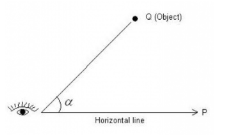
Angle of Depression
Angle of incidence
Angle of Elevation
Angle of sight
39.
A tree casts a shadow 4 m long on the ground, when the angle of elevation of the sun is 450. The height of the tree is:
4.5 m
3 m
5.2 m
4 m
40.
Which of the following is not the graph of a quadratic polynomial?
-q.png)
-q.png)
-q.png)
-q.png)
41.
Assertion : The number 5n cannot end with the digit 0. where n is a natural number.
Reason : Prime factorisation of 5 has only two factors 1 and 5.
(a) Both Assertion and Reason are correct and Reason is the correct explanation of Assertion.
(b) Both Assertion and Reason are correct but Reason is not the correct explanation of Assertion.
(c) Assertion is correct but Reason is incorrect.
(d) Assertion is incorrect but Reason is correct.
42.
Assertion: Δ ABC ∼ Δ POR such that ar(ΔABC) = 36 cm2 and ar(ΔPOR) = 49 cm2. If AB = 6 cm, then PQ = 10 cm.
Reason: If Δ ABC - Δ DEP, then \(\frac{\operatorname{ar}(\Delta A B C)}{\operatorname{ar}(\Delta D E F)}=\frac{A B^{2}}{D E^{2}}=\frac{B C^{2}}{E F^{2}}=\frac{A C^{2}}{D F^{2}}\)
Codes:
(a) If both Assertion and Reason are correct and Reason is the correct explanation of Assertion.
(b) If both Assertion and Reason are correct, but Reason is not the correct explanation of Assertion.
(c) If Assertion is correct but Reason is incorrect.
(d) If Assertion is incorrect but Reason is correct.
43.
In the figure given below, a folding table is shown. The legs of the table are represented by line segments AB and CD intersecting at O. Join AC and BD. Considering table top is a parallel to the ground and OB = x, OD = x + 3, OC = 3x + 19 and OA = 3x + 4, answer the following questions.
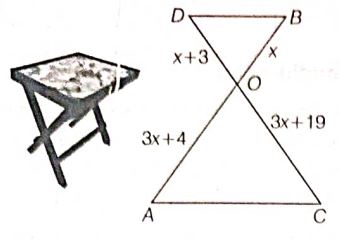
(i) Prove that \(\Delta\) OAC is similar to \(\Delta\) OBD
(ii) Prove that \(\frac{O A}{A C}=\frac{O B}{B D}\)
(iii) (a) Observe the figure and find the value of x. Hence, find the length of OC.
Or
(b) Observe the figure and find \(\frac{B D}{A C} .\)
44.
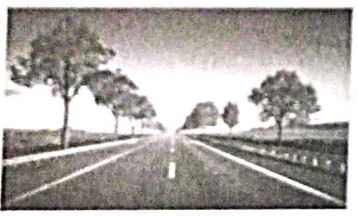
Raj and Ajay are very close friends. Both the families decide to go to Ranikhet by their own cars. Raj's car travels at a speed of x km/h while Ajay's car travels 5 km/h faster than Raj's car. Raj took 4 h more than Ajay to complete the journey of 400 km.
(i) What will be the distance covered by Ajay's car in 2 h?
(a) 2(x + 5) km (b) (x - 5) km
(c) 2(x + 10)km (d) (2x + 5) km
(ii) Which of the following quadratic equation describe the speed of Raj's car?
(a) x2 - 5x - 500 = 0 (b) x2 + 4x - 400 = 0
(c) x2 + 5x - 500 = 0 (d) x2 - 4x + 400 = 0
(iii) What is the speed of Raj's car?
(a) 20 km/h (b) 15 km/h
(c) 25 km/h (d) 10 km/h
(iv) How much time took Ajay to travel 400 km?
(a) 20 h (b) 40 h
(c) 25 h (d) 16 h
45.
A coaching institute conducts at Mathematics classes in two batches I and Il and fee for rich and poor children are different. In batch I there are 20 poor and 5 rich children, whereas in batch II, there are 5 poor and 25 rich children. The total monthly collection of fees from batch I is Rs 9000 and from batch Il is Rs 26000.
Assume that each poor child pays Rs x per month and each rich child pays Rs y per month.
Based on the above information, answer the following questions.
(i) Represents the information given above in terms of x and y.
(ii) Find the monthly fee paid by a poor child.
Or
Find the difference in the monthly fee paid by a poor child and a rich child.
(iii) If there are 10 poor and 20 rich children in batch II, what is the total monthly collection of fees from batch II?
1.
\(-\frac{1}{4}, \frac{1}{4}\)
Let the quadratic polynomial be ax2 + bx + c, and its zeroes be α + ß
Given \(\alpha+\beta=-\frac{1}{4}=-\frac{b}{a}\)
\(\alpha \beta=\frac{1}{4}=\frac{c}{a}\)
If a = 4, b = 1, c = 1
Therefore, the quadratic polynomial is 4x2 + x +1.
2.
In \(\triangle\)AOB and \(\triangle\)COD,
AB || CD
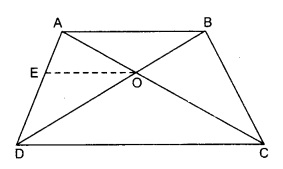
OAB = DCO and OBA = ODC (Alternate angles)
\(\triangle\)AOB ~\(\triangle\)COD (AA similarity)
\(\therefore \frac { AO }{ BO } =\frac { CO }{ DO } .\\ \) (Corresponding sides of similar triangles)
or \(\frac { AO }{ CO } =\frac { BO }{ DO } \)
3.
Given HCF (306, 1,314) =18
LCM (306, 1,314) = ?
Let a = 306
b = 1,314
We know that
a x b = LCM (a, b) x HCF (a, b)
⇒ 306 x 1,314 = LCM (a, b) x 18
\(\Rightarrow \quad LCM(a,b)=\frac { 306\times 1,314 }{ 18 } \)
∴ LCM (306, 1,314) = 22,338
4.
For parallel lines, \(\frac { { a }_{ 1 } }{ { a }_{ 2 } } =\frac { { b }_{ 1 } }{ { b }_{ 2 } } \neq \frac { { c }_{ 1 } }{ { c }_{ 2 } } \)
k=-6
5.
\(AB=\sqrt { (4-{ 2) }^{ 2 }+(6-3)^{ 2 } } =\sqrt { 13 } ;\)
\(BC=\sqrt { (6-{ 4) }^{ 2 }+(9-6)^{ 2 } } =\sqrt { 13 } \)
\(AC=\sqrt { (6-{ 2) }^{ 2 }+(9-3)^{ 2 } } =\sqrt { 52 } =2\sqrt { 13 } \)
Here AB+BC=AC
∴ AB, BC and AC cannot be the side of any triangle.
( ∵ Sum of two sides of a triangle is always more than the third side)
∴ A, B and C are not vertices of any triangle. A, B and C are collinear.
6.
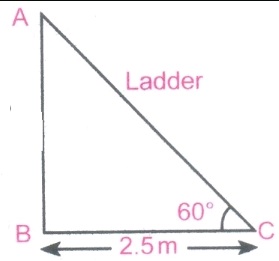
In right ΔABC
\(\frac { BC }{ AC } \) = cos 60\(\unicode{xb0} \)
⇒ \(\frac { 2.5 }{ AC } =\frac { 1 }{ 2 } \)
⇒ AC = 2.5 x 2 = 5 m
7.
Let one number be x,
Then, another number be 27 - x
[\(\because\) sum of two numbers = 27]
According to the question,
Product of these two numbers = 182
\(\therefore\) x(27-x)=182
\(\Rightarrow\) 27x-x2 = 182
\(\Rightarrow\) x2-27x+182=0
\(\Rightarrow\) x2-14x-13x+182=0
[\(\because\) (-14) \(\times\) (-13) =182 and -14-13=-27
\(\Rightarrow\) x(x-14)-13(x-14)=0 \(\Rightarrow\) (x-14)(x-13)=0
\(\Rightarrow\) x-14 = 0 or x-13 = 0
\(\Rightarrow\) x=14 or x=13
If x = 14, then 27-x= 27-14 =13 and if x=13, then 27-x= 27-13 = 14 Hence, in both cases, the numbers are 13 and 14.
8.
| Class interval (distance in m) |
Frequency (number of students) |
cf |
| 0-1 | 40 | 40 |
| 1-2 | 80 | 120 |
| 2-3 | 62 | 182 |
| 3-4 | 38 | 220 |
| 4-5 | 30 | 250 |
| Total | 250 (=n) |
\(\therefore \quad \frac{n}{2}=\frac{250}{2}=125 \text {, }\) which lies in the interval 2-3.
\(\begin{aligned}
\therefore \text { Median } & =l+\frac{\left(\frac{n}{2}-c f\right)}{f} \times h
\end{aligned}\)
\(\begin{aligned}
=2+\frac{125-120}{62} \times 1
\end{aligned}\)
\(\begin{aligned}
=2+\frac{5}{62}=2+0.08=2.08 \mathrm{~m}
\end{aligned}\)
Hence, we observe that 50% of students jump below 2.08 m and 50% above it.
9.
Here, the maximum frequency is 10 and the corresponding class is 30-40. So, this is the modal class.
We have, 1= 30, h = 10, f = 16, f1 = 10 and f2 = 12
\(\therefore \quad \text { Mode } =l+\frac{f-f_{1}}{2 f-f_{1}-f_{2}} \times h \)
\(=30+\frac{16-10}{2(16)-10-12} \times 10 \)
\(=30+\frac{6}{32-22} \times 10 \)
\(=30+\frac{6}{10} \times 10 \)
\(=30+6\)
Mode = 36
10.
3x2 – x – 4 = 3x2 – 4x + 3x – 4
= x(3x - 4) +1(3x - 4)
=(3x - 4)(x +1)
The zeroes of the polynomial are {4/3, -1}
Relationship between the zeroes and the coefficient of the polynomial:
Also sum of the zeroes = \(\frac{4}{3}-1=\frac{4-3}{3}=\frac{1}{3}\)
Also product of the zeroes = \(\frac{4}{3} x-1=-\frac{4}{3}\)
Hence verified.
11.
Given, \(\triangle ABE\cong \triangle ACD\)
\(\Rightarrow \) AB = AC and AE = AD [by CPCT]
\(\Rightarrow \) \(\frac{AB}{AC} =1\)
and \(\frac{AD}{AE}=1\)
\(\Rightarrow\frac { AB }{ AC } =\frac { AD }{ AE } \) .... (i)
In \(\triangle ADE\) and \(\triangle ABC\) , we have
\(\frac{AD}{AE}=\frac{AB}{AC}\) [from Eq.(i)]
\(\Rightarrow\frac{AD}{AB}=\frac{AE}{AC}\)
and \(\angle DAE=\angle BAC\) [common angle]
\(\therefore \) \(\triangle ADE\sim \triangle ABC\) [by SAS similarity criterion]
Hence proved.
12.
Given pair of linear equations is
41x+53y=135 ..(i)
and 53x+41y=147 ...(ii)
On adding Eqs. (i) and (ii), we get
94x+94y=282
\(\Rightarrow\) x+y=3 [dividingboth sides by 94] ...(iii)
On subtracting Eq. (i) from Eq. (ii), we get
12x-12y=12
\(\Rightarrow\) x-y=1 [dividing both sides by 12] ...(iv)
Now, on adding Eqs.(iii) and (iv), we get
2x=4 \(\Rightarrow\) x=2
On substituting x=2 in Eq. (iii), we get
y=3-2=1
Hence, x=2 and y=1 is the required solution.
13.
Given numbers are 156, 208 and 260.
Here, 260 > 208 > 156
Let us first find the HCF of 260 and 208
By using Euclid's division lemma for 260 and 208,
we get
260 = (208 x 1) + 52
Here, remainder = 52 \(\neq \) 0
On taking 208 as new dividend and 52 as new divisor and then apply Euclid's division lemma, we get
208 = (52 x 4) + 0
Here, the remainder is zero and the divisor is 52.
So, 52 is the HCF of 208 and 260.
Now, 156 > 52
Let us find the HCF of 52 and 156. By using Euclid's division lemma, we get
156 = (52 x 3) + 0
Here, the remainder is zero and the divisor is 52.
So, 52 is the HCF of 52 and 156.
Thus, HCF of 156, 208 and 260 is 52.
Hence, the minimum number of buses
\(=\frac { 156 }{ 52 } +\frac { 208 }{ 52 } +\frac { 260 }{ 52 } \)
= 3 + 4 + 5 = 12
14.
Point P(k-1,2) is equidistant from the points A(3,k) and B(k,5).
∴ AP = BP
⇒ AP2=BP2
⇒ (k-1-3)2+(2-k)2 = (k-1-k)2+(2-5)2
⇒ (k-4)2+(2-k)2=(-1)2+(-3)2
⇒ k2-8k+16+4-4k+k2 =1+9
⇒ 2k2-12k+10=0
⇒ k2-6k+5=0
⇒ k2-5k-k+5=0
⇒ k(k-5)-1(k-5)=0
⇒ (k-1)(k-5)=0
⇒ k-1=0 or k-5=0
⇒ k=1,5
15.
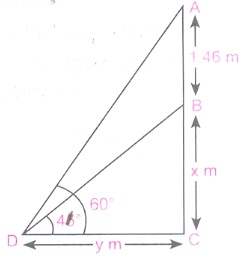
Let AB is statue, BC is pedestal and BC=x m, CD=y m.
In right ΔBCD, ΔBCD, \(\frac { BC }{ CD } \)=tan 45o
⇒, \(\frac { x }{ y } \)=1 ⇒ x=y .....(i)
In right ΔACD, \(\frac { AC }{ CD } \)=tan 600
⇒ \(\frac { x+1.46 }{ y } =\sqrt { 3 } \)
⇒ \(\frac { x+1.46 }{ x } \)=1.73 [Using (i)]
⇒ x+1.46=1.73x ⇒ 0.73x=1.46 ⇒ x=2
16.
Let speed of the stream be x km/h
Speed of the boat in still water = I I km/h
\(\therefore \) Upstream speed be (11-x) km/h and downstream speed be (11+x) km/h
Distance = 12 km
Time taken for downstream direction = \(\frac { 12 }{ 11+x } \) hours
Time taken for upstream direction = \(\frac { 12 }{ 11-x } \) hours
ATQ \(\frac { 12 }{ 11+x } +\frac { 12 }{ 11-x } =2\frac { 3 }{ 4 } \Rightarrow \frac { 12(11-x)+12(11+x) }{ (11+x)(11-x) } =\frac { 11 }{ 4 } \)
\(\Rightarrow \frac { 132+132 }{ 121-x^{ 2 } } =\frac { 11 }{ 4 } \Rightarrow 4\times 264=11(121-x^{ 2 })\)
\(\Rightarrow \frac { 4\times 264 }{ 11 } =121-x^{ 2 }\Rightarrow 4\times 24=121-x^{ 2 }\)
\(\Rightarrow x^{ 2 }=25\Rightarrow x=\pm 5\)
Hence speed of the stream is x=5 km/h
17.
\(\because\) AB II PQ
\(\angle\)ABQ = \(\angle\).PQD (Corresponding angles)
In \(\triangle\)ADB and \(\triangle\)PDQ,
\(\angle\)ADB = \(\angle\).PDQ (Common)
\(\angle\)ABQ = L\(\angle\)PQD (Proved above)
By AAsimilarity,
\(\triangle\)PDB~\(\triangle\)PDQ
\(\frac { DQ }{ DB } =\frac { PQ }{ AB } \)
\(\Rightarrow \frac { DQ }{ DB } =\frac { z }{ x } ...(i)\)
Similarly, \(\triangle\)PBQ~\(\triangle\)CBD
\(\therefore \frac { BQ }{ DB } =\frac { z }{ y } ...(ii)\)
Adding (i) and (ii), we get
\(\frac { z }{ x } +\frac { z }{ y } =\quad \frac { DQ+BQ }{ DB } =\frac { BD }{ BD } \)
\(\Rightarrow \frac { z }{ x } +\frac { z }{ y } =1\quad \)
\(\therefore \frac { 1 }{ x } +\frac { 1 }{ y } =\frac { 1 }{ z } .\)
18.
\(\frac { x-3 }{ x-4 } +\frac { x-5 }{ x-6 } =\frac { 10 }{ 3 } \)
\(\frac { (x-3)(x-6)+(x-4)(x-5) }{ (x-4)(x-6) } =\frac { 10 }{ 3 } \)
\(\frac { (x-3)(x-6)+(x-4)(x-5) }{ (x-4)(x-6) } =\frac { 10 }{ 3 } \)
\(3(2x^{ 2 }-18x+38)=10x^{ 2 }-100x+240\)
\(6x^{ 2 }-54x+114=10x^{ 2 }-100x+240\)
4x2-46x+126=0
2x2-14x-9x+63=0
2x(x-7)-9(x-7)=0
(2x-9)(x-7)=0
2x-9=0,x-7=0
x=9/2 , x=7
19.
Given, a pair of linear equations is :
2x + 3y = 11 ......(i)
and 2x - 4y = - 24 ......(ii)
From eqn. (ii), 4y = 2x + 24
\(\\ \Rightarrow \quad y=\frac { x+12 }{ 2 } \) ......(iii)
On substituting y from eqn. (iii) in eqn. (i), we get
2x + 3 \(\left( \frac { x+12 }{ 2 } \right) \)= 11
\(\Rightarrow\) 4x + 3(x + 12) = 11 \(\times\) 2
\(\Rightarrow\) 4x + 3x + 36 = 22
\(\Rightarrow\) 7x=22 - 36
\(\Rightarrow\) 7x = -14
\(\therefore\) x = -2
From eqn. (iii), \(y=\frac { -2+12 }{ 2 } \)
\(\therefore\) y = 5
On substituting x = - 2 and y = 5 in the equation
y = mx + 3,
5 = m \(\times\) (- 2) + 3
\(\Rightarrow\) 5 = -2m + 3
\(\Rightarrow\) 2m = 3 - 5 = -2
\(\therefore\) m = -1
20.
Let P(x1 , y1) and Q(x2 , y2) are two points which divide AB in three equal parts.
By section formula
\(P\left( { x }_{ 1 }{ y }_{ 1 } \right) =\left( \frac { 1\times \left( -4 \right) +2\times \left( 2 \right) }{ 1+2 } ,\frac { 1\times \left( -6 \right) +2\times \left( -3 \right) }{ 1+2 } \right) \)
\(=\left( \frac { -4+4 }{ 3 } ,\frac { -6+(-6) }{ 3 } \right) \)
= (0, -4)
\(Q\left( { x }_{ 2 }{ y }_{ 2 } \right) =\left( \frac { 2\times \left( -4 \right) +1\times \left( 2 \right) }{ 2+1 } ,\frac { 2\times \left( -6 \right) +1\times \left( -3 \right) }{ 2+1 } \right) \)
\(=\left( \frac { -8+2 }{ 3 } ,\frac { -12+(-3) }{ 3 } \right) \)
= (- 2, - 5)
21.
| Number of mangoes | Number of boxes fi |
| 50 − 52 | 15 |
| 53 − 55 | 110 |
| 56 − 58 | 135 |
| 59 − 61 | 115 |
| 62 − 64 | 25 |
It can be observed that class intervals are not continuous. There is a gap of 1 between two class intervals. Therefore,1/2 has to be added to the upper class limit and1/2 has to be subtracted from the lower class limit of each interval.
Class mark (xi) can be obtained by using the following relation.
\(x_{i}=\frac{\text { Upper class limit }+\text { Lower class limit }}{2}\)
Class size (h) of this data = 3
Taking 57 as assumed mean (a), di, ui, fiui are calculated as follows.
| Class interval | fi | xi | di = xi − 57 | ui= di/3 | fiui |
| 49.5-52.5 | 15 | 51 | -6 | -2 | -30 |
| 52.5-55.5 | 110 | 54 | -3 | -1 | -110 |
| 55.5-58.5 | 135 | 57 | 0 | 0 | 0 |
| 58.5-61.5 | 115 | 60 | 3 | 1 | 115 |
| 61.5-64.5 | 25 | 63 | 6 | 2 | 50 |
| Total | 400 | 25 |
It can be observed that
\(\sum f_{i}=400 \)
\(\sum f_{i} u_{i}=25 \)
\(\text { Mean } \bar{x}=a+\left(\frac{\sum f_{1} u_{i}}{\sum f_{i}}\right) x h \)
\(=57+\left(\frac{25}{400}\right) \times 3\)
= 57+3/16 = 57+ 0.1875
= 57.1875
= 57.19
Mean number of mangoes kept in a packing box is 57.19.
Step deviation method is used here as the values of fi, di are big and also, there is a common multiple between all di.
22.
Let CD = h m be the height of the tower. At point D of the tower, a man is standing and observes the car at an angle of depression of 30°. After six seconds, the angle of depression of the car is 60°.
i.e. \(\angle\)ODA = 30° and \(\angle\)ODB = 60°
\(\Rightarrow\) \(\angle\)DAC = \(\angle\)ODA = 30° [alternate angles]
and \(\angle\)DBC = \(\angle\)ODB = 60° [alternate angles]
Let AB = y m and BC = x m
In right angled \(\Delta\)BCD,

\(\begin{array}{rlrl} \tan 60^{\circ} & =\frac{P}{B}=\frac{C D}{B C} \\ \end{array}\)
\(\begin{array}{rlrl} \Rightarrow \quad \sqrt{3} & =\frac{h}{x} \\ \end{array}\)
\(\begin{array}{rlrl} \Rightarrow \quad h & =\sqrt{3} x & {\left[\because \tan 60^{\circ}=\sqrt{3}\right]} \end{array}\)
\(\Rightarrow \quad h = \sqrt3 x\)....(i)
In right angled \(\Delta\)ACD,
\(\begin{array}{rlrl} \tan 30^{\circ} & =\frac{C D}{A C}=\frac{C D}{A B+B C} & & {[\because A C=A B+B C]} \\ \end{array}\)
\(\begin{array}{rlrl} \Rightarrow \quad \frac{1}{\sqrt{3}} & =\frac{h}{x+y} & & {\left[\because \tan 30^{\circ}=\frac{1}{\sqrt{3}}\right]} \\ \end{array}\)
\(\begin{array}{rlrl} \Rightarrow \quad x+y & =h \sqrt{3} & \end{array}\)
\(\Rightarrow \quad x + y=\sqrt3 x(\sqrt3)\) [from Eq. (i)]
\(\Rightarrow\) x + y = 3x .....(ii)
It is given that a car moves from point A to B in six seconds. Let its speed be k km/s.
\(\therefore \quad \text { Time }=\frac{\text { Distance }}{\text { Speed }}\)
\(\Rightarrow \quad 6=\frac{y}{k} \Rightarrow y=6 k\)
On putting y = 6k in Eq. (ii), we get
x + 6k = 3x \(\Rightarrow\) 6k - 2x \(\Rightarrow\) x = 3k
\(\therefore \quad \text { Time }=\frac{\text { Distance }}{\text { Speed }}=\frac{x}{k}=\frac{3 k}{k}=3 \mathrm{~s}\)
Hence, the car moves from point B to point C in 3s.
23.
(b)
7.5 cm
24.
(d)
no solution
25.
(a)
7,13
26.
(d)
x2 + x – 5 = 0
27.
(b)
Equal
28.
(d)
7
29.
(c)
19
30.
(c)
\(\frac { \sqrt { 3 } a }{ 2 } \)
31.
(a)
12
32.
(d)
(3,1)
33.
(c)
5/12
34.
(b)
12
35.
(b)
12
36.
(b)
Square
37.
(d)
(–2, 3)
38.
(c)
Angle of Elevation
39.
(d)
4 m
40.
(d)
41.
(a) Both Assertion and Reason are correct and Reason is the correct explanation of Assertion.
42.
(d) If Assertion is incorrect but Reason is correct.
43.
Given OB = x, OD = x + 3, OC = 3x + 19 and OA = 3x + 4
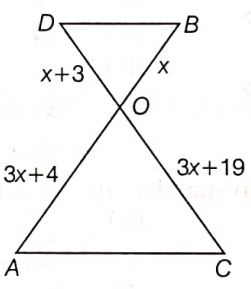
and AC || BD
To prove \(\triangle O A C \sim \triangle O B D\)
Proof In \(\triangle O A C \text { and } \triangle O B D\)
\(\angle D O B=\angle C O A\)
[vertically opposite angles]
As, AC is parallel to BD, AB and DC are transversal
\(\begin{aligned} & \angle B A C=\angle A B D \end{aligned}\)
and \(\begin{aligned} & \angle C D B=\angle D C A \end{aligned}\)
[\(\because\)alternate interior angles]
\(\triangle O A C \sim \triangle O B D\)
[by AA similarity criteria]
Hence proved.
(ii) To prove \(\frac{O A}{A C}=\frac{O B}{B D}\)
Proof From part (i) we know that
\(\triangle O A C \sim \triangle O B D\)
Corresponding sides of \(\Delta\)OAC and \(\Delta\)OBD must be proportional
\(\begin{aligned} \frac{O A}{O B} & =\frac{A C}{B D} \\ \end{aligned}\)
\(\begin{aligned} \Rightarrow \quad & \frac{O A}{A C}=\frac{O B}{B D} \end{aligned}\) Hence proved.
(iii) (a) From part (i)
\(\begin{aligned} \triangle O A C & \sim \triangle O B D \\ \end{aligned}\)
\(\begin{aligned} \Rightarrow \quad \frac{O A}{O B} & =\frac{O C}{O D} \Rightarrow \frac{3 x+4}{x}=\frac{3 x+19}{x+3} \end{aligned}\)
[given OA = 3x +4, OB = x, OC = 3x+19, OD = x+3]
\(\Rightarrow\) (3x + 4)(x + 3) = (3x + 19)x
\(\Rightarrow\) 3x2 + 9x + 4x + 12 = 3x2 + 19x
\(\Rightarrow\) 13x + 12 = 19x \(\Rightarrow\) x = 2
Given, OC = 3x + 19
On substituting x = 2, we get
OC = 3 \(\times\) 2 + 19 = 6 + 19 = 25
Therefore, OC = 25
(b) From part (ii), we have
\(\begin{aligned} & \frac{O A}{A C}=\frac{O B}{B D} \\ \end{aligned}\)
\(\begin{aligned} & \Rightarrow \quad \frac{B D}{A C}=\frac{O B}{O A} \\ \end{aligned}\)
\(\begin{aligned} & \Rightarrow \quad \frac{B D}{A C}=\frac{x}{3 x+4} \end{aligned}\)
[given, OB = x and OA = 3x + 4]
On substituting x = 2, we get
\(\frac{B D}{A C}=\frac{2}{3 \times 2+4}=\frac{2}{10} \Rightarrow \frac{B D}{A C}=\frac{1}{5}\)
Therefore, \(\frac{B D}{A C}=\frac{1}{5}\)
44.
(i) (a) Since, Ajay's car travels a distance in one hour is (x + 5) km. Therefore, Ajay's car travels a distance two hours is 2(x + 5) km.
(ii) (c) \(\because \text { Time }=\frac{\text { Distance }}{\text { Speed }}\)
Time taken by Ajay and Raj to complete the 400 km journey,
\(t_1=\frac{400}{x+5} \mathrm{~h} \)
and \(t_2=\frac{400}{x} \mathrm{~h}\)
According to the question,
t2 = t1 + 4
\( \therefore \frac{400}{x}=\frac{400}{x+5}+4\)
\(\Rightarrow \frac{100}{x}=\frac{100}{x+5}+1\) [dividing by 4]
\(\Rightarrow\) 100(x + 5) = 100x + x(x + 5)
\(\Rightarrow\) 100x + 500 = 100x + x2 + 5x
\(\Rightarrow\) x2 +5x - 500 = 0
(iii) (a) Consider the quadratic equation x2 + 5x - 500 = 0
On comparing with ax2 + bx + c =0, we get
a = 1, b = 5 and c = -500
\(\begin{aligned} \because \quad x & =\frac{-b \pm \sqrt{b^2-4 a c}}{2 a} \\ \end{aligned}\)
\(\begin{aligned} & =\frac{-5 \pm \sqrt{(5)^2-4 \times(1)(-500)}}{2 \times 1} \\ \end{aligned}\)
\(\begin{aligned} & =\frac{-5 \pm \sqrt{25+2000}}{2}=\frac{-5 \pm \sqrt{2025}}{2} \\ \end{aligned}\)
\(\begin{aligned} & =\frac{-5 \pm 45}{2}=\frac{-50}{2}, \frac{40}{2}=-25,20 \end{aligned}\)
Since, speed cannot be negative, so we consider only x = 20.
Hence, the speed of Raj's car is 20 km/h.
(iv) (d) To travel 400 km, time taken by Ajay
\(\begin{aligned} t_1 & =\frac{400}{(x+5)} \\ \end{aligned}\)
\(\begin{aligned} & =\frac{400}{20+5}=\frac{400}{25}=16 \mathrm{~h} \end{aligned}\)
45.
(i) For batch I,
20x + 5y = 9000
For batch II,
5x + 25y = 26000
(ii) We have,
20x + 5y = 9000
\(\Rightarrow\) 4x + y = 1800 ...(i)
and 5x + 25y = 26000
\(\Rightarrow\) x + 5y = 5200 ...(ii)
Multiplying Eq. (i) by 5 and subtracting Eq. (ii) from it.
5(4x + y) - (x + 5y) = 5 \(\times\) 1800 - 5200
\(\Rightarrow\) 19x = 3800
\(\Rightarrow\) x = 200
Or
On substituting x = 200 in Eq. (i), we get
4(200) + y = 1800
\(\Rightarrow\) 800 + y = 1800
\(\Rightarrow\) y = 1000
\(\therefore\) Difference in the monthly fee paid by a poor child and a rich child = y - x = Rs (1000 - 200) = Rs 800
(iii) Total monthly collection of fees, if there are 10 poor and 20 rich children = 10x + 20 y
= 10 \(\times\) 200 + 20 \(\times\)1000
= 2000 + 20000
= Rs 22000

10th Standard CBSE Syllabus & Materials
10th Standard CBSE
CBSE 10th Social Science PS - Federalism - New Model Questions Papers Study Material - QB365 Set A
NEW10th Standard CBSE
CBSE 10th Social Science PS - Power Sharing - New Model Questions Papers Study Material - QB365 Set A
NEW10th Standard CBSE
CBSE 10th Social Science GEO - Manufacturing Industries - New Model Questions Papers Study Material - QB365 Set A
NEW10th Standard CBSE
CBSE 10th Social Science GEO - Minerals and Energy Resources - New Model Questions Papers Study Material - QB365 Set A



NCERT Books

Syllabus

Exam Pattern

Sample Question Papers

Previous year Question Papers

Important Notes

MCQ Practice test

NCERT Exemplers

Case study Questions

Image Based Questions

Passage based Questions

HOT Questions

Value Based Questions

Model Questions Papers
NCERT ( Book Back ) Questions

Assertion and Reason
Important Questions And Answers

CBSE 10th Standard CBSE Subjects
CBSE Standards



