
 100% FREE ACCESS
10th Standard CBSE Syllabus & Materials
10th Standard CBSE
CBSE 10th Social Science ECO - Globalisation and the Indian Economy - New Model Questions Papers Study Material - QB365 Set A
NEW10th Standard CBSE
CBSE 10th Social Science ECO - Money and Credit - New Model Questions Papers Study Material - QB365 Set A
NEW10th Standard CBSE
CBSE 10th Social Science ECO - Sectors of the Indian Economy - New Model Questions Papers Study Material - QB365 Set A
NEW10th Standard CBSE
CBSE 10th Social Science ECO - Development - New Model Questions Papers Study Material - QB365 Set A
NEW10th Standard CBSE
CBSE 10th Social Science PS - Outcomes of Democracy - New Model Questions Papers Study Material - QB365 Set A
NEW10th Standard CBSE
CBSE 10th Social Science PS - Gender, Religion and Caste - New Model Questions Papers Study Material - QB365 Set A

Published on: 20/10/2025
Download CBSE Class 10th Standard CBSE Maths question papers, sample papers, important questions, and previous year solved papers in PDF format. Get free study materials, NCERT solutions, and exam preparation resources for Class 10th Standard CBSE Maths
Questions + Answers key
Take MCQ Maths Test
1.
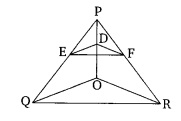
In the given figure, DE || OQ and DF || OR. Show that EF || QR.
2.
Find a relation between x and y such that the point (x , y) is equidistant from the points A (7, 1) and B (3, 5).
3.
Solve for x: \(9x^2-6a^2x+(a^4-b^4)=0\)
4.
A two digit number is seven times the sum of its digits and is also equal to 12 less than three times the product of its digits. Find the number.
5.
Prove that the tangents drawn at the ends of a diameter of a circle are parallel.
6.
A manufacturer of TV sets produced 600 sets in the third year and 700 sets in the seventh year. Assuming that the production increases uniformly by a fixed number every year, find :
(i) the production in the 1st year
(ii) the production in the 10th year
(iii) the total production in first 7 years
7.
Sides AB and AC and median AD of △ABC are respectively proportional to sides PQ and PR and median PM of another △PQR. Show that \(\triangle\)ABC ~ \(\triangle\)PQR.
8.
Find the ratio in which the line segment joining A(1, – 5) and B(– 4, 5) is divided by the x-axis. Also find the coordinates of the point of division.
9.
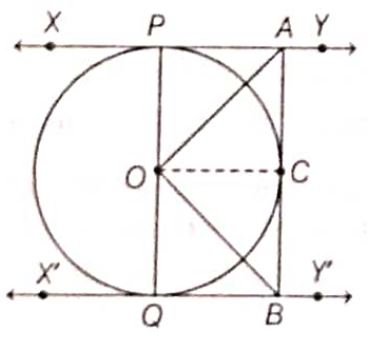
In the given figure, XY and X'Y' are two parallel tangents to a circle with centre O and another tangent AB with point of contact C intersecting XY at A and X'Y' at B.Prove that \(\angle AOB=90^0\)
10.
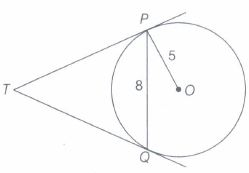
In figure, PO is a chord at length 8 cm at a circle at radius 5 cm and centre O. The tangents at P and O intersect at point T Find the length at TP.
11.
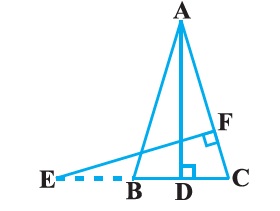
In the given figure, E is a point on side CB produced of an isosceles ΔABC with AB = AC. If AD ⊥ BC and EF ⊥ AC, prove that ΔABD ∼ ΔECF.
12.
Find the value of k for which the following pair of equations has no solution:
x + 2y = 3, (k-1)x + (k +1)y = (k + 2).
13.
A train travels at a certain average speed for a distance of 63 km and then travels a distance of 72km at an average speed of 6km/h more than its original speed. If it takes 3h to complete the total journey, then what is its original average speed?
14.
Show that the points A(1,0), B(5,3), C(2,7) and D(-2,4) are the vertices of a parallelogram.
15.
In an AP, if the 12th term is -13 and the sum of its four terms is 24, find the sum of its first ten terms.
16.
Find the value of the middle term of the following AP: -6, -2, 2, ....., 58
17.
The production of TV sets in a factory increases uniformly by a fixed number every year. It produced 16000 sets in 6th year and 22600 in 9th year.
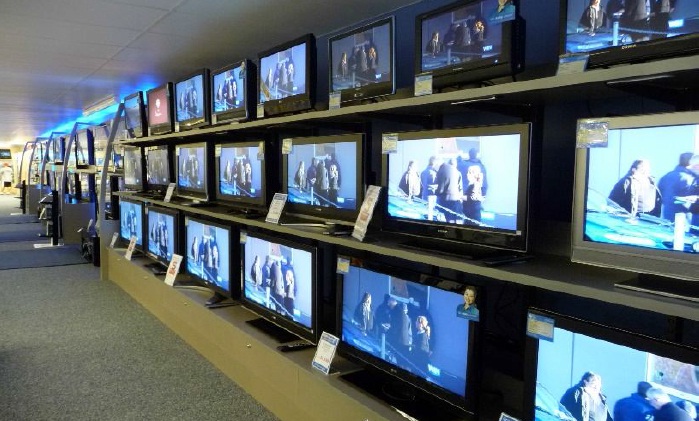
(i) Find the production during first year.
| (a) Rs. 5000 | (b) Rs. 2200 | (c) Rs. 10000 | (d) none of these |
(ii) Find the production during 8th year
| (a) Rs. 7200 | (b) Rs. 22000 | (c) Rs. 20400 | (d) none of these |
(iii) Find the production during first 3 years.
| (a) Rs. 21600 | (b) Rs. 22000 | (c) Rs. 20400 | (d) none of these |
(iv) In which year, the production is Rs. 29,200.
| (a) 10 | (b) 11 | (c) 12 | (d) 13 |
(v) Find the difference of the production during 7th year and 4th year.
| (a) Rs. 5000 | (b) Rs. 2200 | (c) Rs. 10000 | (d) none of these |
18.
Prem did an activity on tangents drawn to a circle from an external point using 2 straws and a nail for maths project as shown in figure.
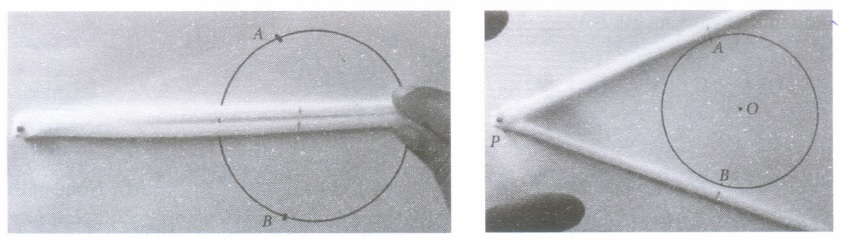
Based on the above information, answer the following questions.
(i) Number of tangents that can be drawn to a circle from an external point is
| (a) 1 | (b) 2 | (c) infinite | (d) any number depending on radius of circle |
(ii) On the basis of which of the following congruency criterion,\(\Delta \mathrm{OAP} \cong \Delta \mathrm{OBP} ?\)
| (a) ASA | (b) SAS | (c) RHS | (d) SSS |
(iii) If \(\angle\)AOB = 150°, then \(\angle\)APB =
| (a) 75° | (b) 30° | (c) 60° | (d) 100° |
(iv) If \(\angle\)APB = 40°, then \(\angle\)BAO =
| (a) 40° | (b) 30° | (c) 50° | (d) 20° |
(v) If \(\angle\)ABO = 45°, then which of the following is correct option?
| (a) \(A P \perp B P\) | (b) PAOB is square | (c) \(\angle\)AOB = 90° | (d) All of these |
19.
In an examination hall, students are seated at a distance of 2 m from each other, to maintain the social distance due to CORONA virus pandemic. Let three students sit at points A, Band C whose coordinates are (4, -3), (7,3) and (8, 5) respectively.
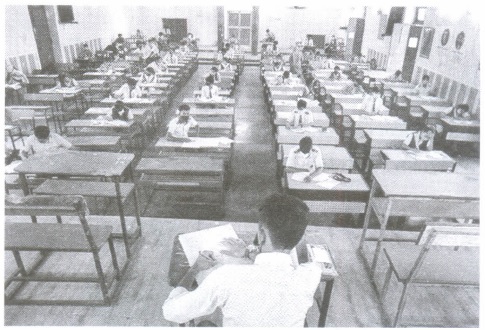
Based on the above information, answer the following questions.
(i) The distance between A and C is
| (a) \(\sqrt{5}\) units | (b) \(4\sqrt{5}\) units | (c) \(3\sqrt{5}\) units | (d) none of these |
(ii) If an invigilator at the point I, lying on the straight line joining Band C such that it divides the distance between them in the ratio of 1 : 2. Then coordinates of I are
| \((a) \left(\frac{22}{3}, \frac{11}{3}\right)\) | \((b) \left(\frac{23}{3}, \frac{13}{3}\right)\) | (c) (6,1) | (d) (9,1) |
(iii) The mid-point of the line segment joining A and C is
| (a) (1.6) | (b) (6.1) | \(\text { (c) }\left(\frac{11}{2}, 0\right)\) | (d) none of these |
(iv) The ratio in which B divides the line segment joining A and C is
| (a) 2:1 | (b) 3:1 | (c) 1:2 | (d) none of these |
(v) The points A, Band C lie on
| (a) a straight line | (b) an equilateral triangle |
| (c) a scalene triangle | (d) an isosceles triangle |
1.
In Δ POQ, DE || OQ [given]
\(\therefore \frac{P E}{E Q}=\frac{P D}{D O}\) ...(i)
[by basic proportionality theorem]
In ΔPOR, DF || OR [given]
\(\therefore \frac{P F}{F R}=\frac{P D}{D O}\) ...(ii)
[by basic proportionality theorem]
From Eqs. (i) and (ii), we get
\(\frac{P E}{E Q}=\frac{P F}{F R}\)
In ΔPQR, we have \(\frac{P E}{E Q}=\frac{P F}{F R}\)
∴ EF || QR
[by Converse of basic proportionally theorem]
Hence proved.
2.
Given point P(x, y) is equidistant from the points A(7, 1) and B(3, 5).
So, AP = BP
\(\Rightarrow\) AP2 = BP2
\(\Rightarrow\) (x - 7)2 + (y - 1)2 = (x - 3)2 + (y - 5)2
\(\left[\because \text { distance }=\sqrt{\left(x_2-x_1\right)^2+\left(y_2-y_1\right)^2}\right]\)
\(\Rightarrow\) x2 + 49 - 14x + y2 + 1 - 2y
= x2 + 9 - 6x + y2 + 25 - 10y
\(\Rightarrow\) -14x - 2y + 50 = -6x - 10y + 34
\(\Rightarrow\) -6x - 10y + 14x + 2y = 50 - 34
\(\Rightarrow\) 8x - 8y = 16
\(\Rightarrow\) x - y = 2
[dividing by 8 on both sides]
Hence, the relation between x and y is x - y = 2.
3.
9x2-6a2x+(a4-b4) =0
Here A=9 , B=-6a2,C=a4-b4
D=B2- 4AC
=36a4-36a4+36b4 =36b4
\(\therefore \quad x=\frac { -B+\sqrt { D } }{ 2A } ,\frac { -B-\sqrt { D } }{ 2A } \)
\(\Rightarrow \quad x=\frac { 6a^{ 2 }+6b^{ 2 } }{ 18 } ,\frac { 6a^{ 2 }-6b^{ 2 } }{ 18 } \)
\(\Rightarrow x=\frac { a^{ 2 }+b^{ 2 } }{ 3 } ,\frac { a^{ 2 }-b^{ 2 } }{ 3 } \)
4.
Let digit at unit's place be x and digit at ten's place by y
\(\therefore\) Number 10y+x
ATQ
10y+x=7(x+y)
\(\Rightarrow\) 10y+x=7x+7y
\(\Rightarrow\) 6x=3y
\(\Rightarrow\) y=2x ...(i)
Also 10y+x=3xy-12
\(\Rightarrow\) 10 x 2x + x=3x.2x-12
\(\Rightarrow\) 6x2-21x-12=0
\(\Rightarrow\) 2x2-7x-4=0
\(\Rightarrow\) 2x2-8x+x-4=0
\(\Rightarrow\) 2x(x-4)+1(x-4)=0
\(\Rightarrow\) (x-4)(2x+1)=0
\(\Rightarrow\) x=4 or x=\(-\frac{1}{2}\) (rejecting)
When x=4, y=2 x 4=8
\(\therefore\) Number is 10 x 8+4=84
5.
Let AB be a diameter of a given circle and LM and PQ be the tangent lines drawn to the circle at points A and B, respectively.
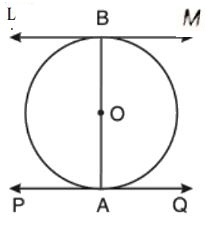
To prove LM || PQ
Proof We know that the tangent at any point of a circle is perpendicular to the radius through the point of contact.
\(\therefore\) OA \(\perp\) PQ and OB \(\perp\) LM
\(\Rightarrow\) AB \(\perp\) PQ
and AB \(\perp\) LM
\(\Rightarrow\) \(\angle\)PAB = 90°
and \(\angle\)ABM = 90°
\(\Rightarrow\) \(\angle\)PAB = \(\angle\)ABM
[each = 90°]
But these are alternate angles.
\(\therefore\) PQ || LM
Hence, the tangents drawn at the ends of a diameter of a circle are parallel.
Hence proved.
6.
(i) Since the production increases uniformly by a fixed number every year, the number of TV sets manufactured in 1st, 2nd, 3rd, . . ., years will form an AP. Let us denote the number of TV sets manufactured in the nth year by an.
Then, a3 = 600 and a7 = 700
or, a + 2d = 600
and a + 6d = 700
Solving these equations, we get d = 25 and a = 550.
Therefore, production of TV sets in the first year is 550.
(ii) Now a10 = a + 9d = 550 + 9 x 25 = 775
So, production of TV sets in the 10th year is 775.
(iii) Also \(S_{7}=\frac{7}{2}[2 \times 550+(7-1) \times 25]\)
\(=\frac{7}{2}[1100+150]=4375\)
Thus, the total production of TV sets in first 7 years is 4375.
7.
Given, in △ABC and △PQR, AD and PM are their medians, respectively.
\(\therefore \quad \frac{A B}{P Q}=\frac{A C}{P R}=\frac{A D}{P M}\) ...(i)
To prove △ABC ~ △PQR
Construction Produce AD to E such that AD = DE and produce PM to N such that PM = MN.
Join BE, CE, QN and RN.
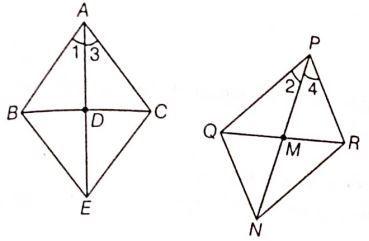
In above figures, quadrilaterals ABEC and PQNR are parallelograms because their diagonals bisect each other at D and M, respectively.
\(\therefore\) BE = AC and QN = PR
\(\begin{array}{ll} \Rightarrow & \frac{B E}{A C}=1 \quad \text { and } \frac{Q N}{P R}=1 \\ \end{array}\)
\(\begin{array}{ll} \Rightarrow & \frac{B E}{A C}=\frac{Q N}{P R} \text { or } \frac{B E}{Q N}=\frac{A C}{P R} \\ \end{array}\)
\(\begin{array}{ll} \Rightarrow & \frac{B E}{Q N}=\frac{A B}{P Q} \\ \end{array}\) [from Eq. (i)]
\(\begin{array}{ll} \text { or } & \frac{A B}{P Q}=\frac{B E}{Q N} \end{array}\) ....(ii)
From Eq. (i), we get
\(\frac{A B}{P Q}=\frac{A D}{P M}=\frac{2 A D}{2 P M}=\frac{A E}{P N}\) [since, diagonals bisect each other]
\(\Rightarrow \quad \frac{A B}{P Q}=\frac{A E}{P N}\) ...(iii)
From Eqs. (ii) and (iii),
\(\frac{A B}{P Q}=\frac{B E}{Q N}=\frac{A E}{P N}\)
\(\Rightarrow \quad \triangle A B E \sim \triangle P Q N \Rightarrow \angle 1=\angle 2\) ...(iv)
[since, corresponding angles of two similar triangles are equal]
Similarly, we can prove that
\(\begin{aligned} & \triangle A C E \sim \triangle P R N \\ \end{aligned}\)
\(\begin{aligned} \Rightarrow \quad \angle 3=\angle 4 \end{aligned}\) ....(v)
On adding Egs. (iv) and (v), we get
\(\begin{array}{rlrl} \angle 1+\angle 3 & =\angle 2+\angle 4 \\ \end{array}\)
\(\begin{array}{rlrl} \Rightarrow \angle B A C =\angle Q P R \\ \end{array}\)
and \(\begin{array}{rlrl} \frac{A B}{P Q} & =\frac{A C}{P R} \end{array}\) [from Eq. (i)]
\(\therefore\) \(\triangle ABC \sim \triangle PQR\) [by SAS similarity criterion]
Hence proved.
8.
Let X-axis divides the line joining the points A(1, -5) and B(-4, 5)in the ratio k : 1 at point M.

By section formula, we get
Coordinates of M = \(\left(\frac{-4 k+1}{k+1}, \frac{5 k-5}{k+1}\right)\) ...(i)
Since, point M lies on X-axis.
\(\therefore\) y-coordinate of M = 0
On equating y-coordinate of M to 0, we get
\(\frac{5 k-5}{k+1}=0 \Rightarrow 5 k-5=0 \Rightarrow k=1\)
On putting k = 1 in Eq. (i) we get
\(\begin{aligned} M=\left(\frac{-4 \times 1+1}{1+1}, \frac{5 \times 1-5}{1+1}\right) & =\left(\frac{-4+1}{2}, \frac{5-5}{2}\right) \\ \end{aligned}\)
\(\begin{aligned} \Rightarrow \quad M & =\left(\frac{-3}{2}, 0\right) \end{aligned}\)
So, the required ratio is 1 : 1 and the coordinates of point of division M is \(\left(\frac{-3}{2}, 0\right)\)
9.
Given XY and X'Y' are two parallel tangents. Another tangent AB touches the circle at C and intersect XY at A and X'Y'at B.
To prove \(\angle\)AOB = 90°
Proof We know that, tangents drawn from an external point to a circle are equal in length.
\(\therefore\) AP = AC [\(\because\) A is an external point] ...(i)
Thus, in \(\Delta\)APO and \(\Delta\)ACO, AP = AC [from Eq. (i)]
AO = AO [common sides]
OP = OC [radii of circle]
\(\Delta\)APO \(\cong\)\(\Delta\)ACO [by SSS congruence rule]
Then, \(\angle\)OAP = \(\angle\)OAC [by CPCT] ...(ii)
\(\Rightarrow\) \(\angle\)PAC = 2 \(\angle\)CAO ....(iii)
Similarly, we can prove that \(\angle\)CBO = \(\angle\)OBQ
\(\Rightarrow\) \(\angle\)CBQ = 2 \(\angle\)CBO ...(iv)
since, XY || X'Y' [given]
\(\therefore\) \(\angle\)PAC + \(\angle\)QBC = 180°
[\(\because\) sum of interior angles on the same side of transversal is 180°]
\(\Rightarrow\) 2 \(\angle\)CAO + 2 \(\angle\)CBO = 180° [from Eqs. (iii) and (iv)]
\(\Rightarrow\) \(\angle\)CAO + \(\angle\)CBO = 90° ...(v)
Now, in \(\Delta\)AOB, \(\angle\)CAO + \(\angle\) CBO + \(\angle\)AOB = 180°
[by angle sum property of triangle]
\(\Rightarrow\) \(\angle\)CAO + \(\angle\)CBO = 180° - \(\angle\)AOB ...(vi)
From Eqs. (v) and (vi), we get
180° - \(\angle\)AOB = 90° \(\Rightarrow\) \(\angle\)AOB = 90° Hence proved.
10.
Join OT
Let OT intersect PQ at R
\(\because \ T P=T Q\)
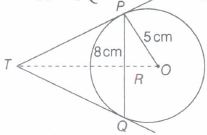
In \(\Delta T P Q\) ,
TP = TQ, i.e. two sides are equal
So, \(\Delta T P Q\) is an isosceles triangle
Here, OT is bisector of \(\angle P T Q\)
So, \(O T \perp P Q\)
So, PR = RQ
\(P R=\frac{1}{2} P Q=\frac{8}{2}=4 \mathrm{~cm}\)
In right \(\Delta O R P\) ,
(OP)2 = (PR)2 + (OR)2
\(\Rightarrow \ (5)^{2}=(4)^{2}+(O R)^{2}\)
\(\Rightarrow \ (O R)^{2}=25-16=9 \Rightarrow O R=3\)
Let TP = x
In right \(\Delta P R T,(T P)^{2}=(P R)^{2}+(R T)^{2}\)
\(\Rightarrow \ x^{2}=16+R T^{2}\) ...(i)
Now, since TP is a tangent
\(O P \perp T P\)
In right \(\Delta O P T,(O T)^{2}=(O P)^{2}+(T P)^{2}\)
\(\Rightarrow \ (O T)^{2}=5^{2}+x^{2}\)
\(\Rightarrow \ (O R+R T)^{2}=5^{2}+x^{2}\)
\(\Rightarrow \ (3+R T)^{2}=5^{2}+x^{2}\)
\(\Rightarrow 9+R T^{2}+6 R T=25+x^{2}\)
\(\Rightarrow \quad 9+R T^{2}+6 R T=25+16+R T^{2}\) [from Eq. (i)]
\(6 R T=32 \Rightarrow R T=\frac{32}{6}=\frac{16}{3}\)
From Eq. (i), x2=16+RT2
\(\Rightarrow \ x^{2}=16+\left(\frac{16}{3}\right)\)
\(\Rightarrow \ x^{2}=\frac{144+256}{9} \Rightarrow x^{2}=\frac{400}{9}\)
\(\Rightarrow \ x=\frac{20}{3}\)
11.
Given, ΔABC is an isosceles triangle with AB = AC. Also,
we have AD \(\perp\) BC and EF \(\perp\)AC.
To prove ΔABD \(\sim\) ΔECF
Proof Since, in ΔABC, AB = AC
∴ \(\angle\)B = \(\angle\)C [\(\therefore\) angle opposite to equal sides are equal]
Now consider ΔABD and ΔECF. In this we have
∠ABD = ∠ECF [\(\because\) \(\angle\)B = \(\angle\)C proved above]
and ∠ADB = ∠EFC [Each 90°]
∴ ΔABD ∼ ΔECF [by AA similarly criterion]
Hence proved.
12.
For x + 2y = 3
a1 = 1, b1 = 2 ,c1 = - 3
For (k-1)x + (k +1)y= (k + 2)
a2 = (k - 1), b2= (k + 1), c2 = - (k + 2)
For no solution, \(\frac { { a }_{ 1 } }{ { a }_{ 2 } } =\frac { { b }_{ 1 } }{ { b }_{ 2 } } \neq \frac { c_{ 1 } }{ { c }_{ 2 } } \)
\(\Rightarrow \quad \frac { 1 }{ k-1 } =\frac { 2 }{ k+1 } \neq \frac { 3 }{ k+2 } \)
I II III
From I and II, \(\frac { 1 }{ k-1 } =\frac { 2 }{ k+1 } \)
\(\Rightarrow\) k + 1 = 2k - 2
\(\therefore\) k = 3
From II and III, \(\frac { 2 }{ k+1 } \neq \frac { 3 }{ k+2 } \)
\(\Rightarrow\) 2(k + 2) \(\neq\) 3(k + 1)
\(\Rightarrow\) 2k+4\(\neq\)3k+3
\(\therefore\) k \(\neq\) 1
From I and III, \(\frac { 1 }{ k-1 } \neq \frac { 3 }{ k+2 } \)
\(\Rightarrow \quad k+2\neq 3k-3\)
\(\therefore \quad k\neq -\frac { 5 }{ 2 } \)
Hence, k = 3 but k \(\neq\)1 and \(\\ \\ k\neq -\frac { 5 }{ 2 } \)
13.
42 km/h
14.
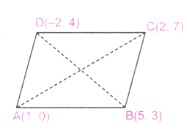
AB =\(\sqrt { { (5-1 })^{ 2 }+(3-0)^{ 2 } } =\sqrt { 16+9 } \) =5
DC = \(\sqrt { { (2+2 })^{ 2 }+(7-4)^{ 2 } } =\sqrt { 16+9 } \) =5
BC = \(\sqrt { { (5-2 })^{ 2 }+(3-7)^{ 2 } } =\sqrt { 9+16 } \) = 5
AD = \(\sqrt { { (1+2 })^{ 2 }+(0-4)^{ 2 } } =\sqrt { 9+16 } \) = 5
Mid - point of AC = \((\frac {1+2}{2} , \frac {0+7}{2})\) = \((\frac {3}{2} , \frac {7}{2})\); Mid-point BD = \((\frac{5-2}{2},\frac{3+4}{2})\) = \(( \frac {3}{2}, \frac {7}{2})\)
Since AB = DC and BC = AD.
Opposite sides are parallel and diagonals bisect each other.
∴ The given points are the vertices of a parallelogram.
15.
Let first term of the AP = a and common difference = d
Now a12 = -13
\(\Rightarrow \) a+11d = -13
\(\Rightarrow \) a=-13-11d .......... 9i)
Also, a+a+d+a+2d+a+3d=24
\(\Rightarrow \) 4a+6d = 24
\(\Rightarrow \) 4(-13-11d)+6d=24 [using (i)]
\(\Rightarrow \) -52-44d+6d=24 \(\Rightarrow \) -38d=76
\(\Rightarrow \) d=-2
From (i), a = -13+22=9
Now \({ S }_{ 10 }=\frac { 10 }{ 2 } \left( 2a+9d \right) \)
\(=5\left( 2\times 9+9\times -2 \right) =0\)
16.
Here, a = -6, d = - 2 + 6 and an = 58
an = 58
\(\Rightarrow\) a + ( n - 1 )d = 58 \(\Rightarrow\) - 6 + ( n - 1 )4 = 58
\(\Rightarrow\) ( n - 1 )4 = 64 \(\Rightarrow\) n - 1 = 16 \(\Rightarrow\) n = 17 (odd)
\(\therefore\) Middle term = \(\frac{17+1}{2}=\frac{18}{2}\) = 9th term
\(\therefore\) 9th term is the middle term.
Now, a9 = a + 8d = - 6 + 8 X 4 = - 6 + 32 = 26
17.
(i) (a): Let the production during first year be a and let d be the increase in production every year. Then,
a6 = 16000 \(\Rightarrow\)a + 5d = 16,000 (i)
and a9 = 22600 \(\Rightarrow\)a + 8d = 22600 (ii)
On substracting (i) from (ii) , we get
3d = 6600 \(\Rightarrow\) d = 2200
Putting d = 2200 in (i) we get,
a + 5 x 2200 = 16000
\(\Rightarrow\) a + 11000 = 16000 \(\Rightarrow\) a = 16000 - 11000 = 5000
Thus , a = 5000 and d = 2200
Production during first year, a = 5000.
(ii) (c): Production during 8th year is given by a8
= (a + 7d)
= (5000 + 7(2200))
= (5000 + 15400)
= 20400.
(iii) (a): a2 = (a + d)
= (5000 + 2200) = 7200.
a3 = (a2 + d)
= 7200 + 2200 = 9400.
Production during first 3 years = 5000 + 7200 + 9400 = 21600
(iv) (c): an = 5000 + (n – 1)2200 = 29200
(n – 1)2200 = 29200 – 5000 = 24200
⇒ n – 1 = 11
⇒ n = 12
(v) (d): a4 = (a + 3d)
= (5000 + 3(2200)) = 5000 + 6600 = 11600.
a7 = (a6 + d)
= 16000 + 2200 = 18200.
Difference = 18200 – 11600 = 6600
18.
(i) (b)
(ii) (c): In \(\Delta\)OAP and \(\Delta\)OBP,
\(\angle\)OAP = \(\angle\)OBP = 90°
[Since, radius at the point of contact is perpendicular to tangent]
OP = OP (Common)
OA = OB (Radii of circle)
So, \(\angle\)OAP == \(\angle\)OBP (By RHS congruency criterion)
(iii) (b): In quadrilateral OAPB, \(\angle\)AOB = 150° [Given]
\(\angle\)OAP = \(\angle\)OBP = 90°
\(\therefore\) \(\angle\)APB = 360° - 90° - 90° - 150° = 30°
(iv) (d): We have, \(\angle\)APB = 40°
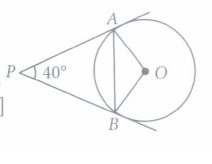
Now,PA =PB [Since, length of tangents drawn from an external point are equal]
In \(\Delta\)PAB, \(\angle\)PAB = \(\angle\)PBA = 70° [Angles opposite to equal sides are equal]
Also, \(\angle\)PAB + \(\angle\)BAO = 90°
[Since, radius at the point of contact is perpendicular to tangent]
\(\Rightarrow\) \(\angle\)BAO = 90° - 70° = 20°
(v) (d): We have, \(\angle\)ABO = 45°
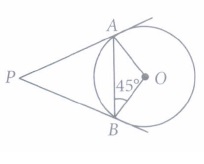
\(\because\) AO = OB (Radii of circle)
\(\therefore\) \(\angle\)BAO = \(\angle\)ABO = 45° [Angles opposite to equal sides are equal]
Now, in \(\Delta\)OAB,
\(\angle\)AOB = 180° - 45° - 45° = 90°
Since, \(\angle\)APB = 360° - 90° - 90° - 90° = 90° i.e., AP\(\perp\) BP
So, OAPB is a square.
19.
(i) (b): The distance between A and C
\(=\sqrt{(8-4)^{2}+(5+3)^{2}}=\sqrt{4^{2}+8^{2}} \)
\(=\sqrt{16+64}=\sqrt{80}=4 \sqrt{5} \text { units }\)
(ii) (a): Let the coordinates of I be (x, y).
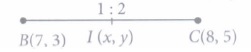
Then, by section formula
\(x =\frac{1 \times 8+2 \times 7}{1+2}=\frac{8+14}{3}=\frac{22}{3}\)
\(\text { and } y =\frac{1 \times 5+2 \times 3}{1+2}=\frac{5+6}{3}=\frac{11}{3}\)
Thus, the coordinates of I is \(\left(\frac{22}{3}, \frac{11}{3}\right)\)
(iii) (b): The mid -point of A and C
\(=\left(\frac{8+4}{2}, \frac{5-3}{2}\right)=(6,1)\)
(iv) (b): Let B divides the line segment joining A and C in the ratio k : 1. Then, the coordinates of B will be
\(\left(\frac{8 k+4}{k+1}, \frac{5 k-3}{k+1}\right)\)
\(\text { Thus, we have }\left(\frac{8 k+4}{k+1}, \frac{5 k-3}{k+1}\right)=(7,3)\)
\(\Rightarrow \frac{8 k+4}{k+1}=7 \text { and } \frac{5 k-3}{k+1}=3
\)
\(\text { Consider, } \frac{8 k+4}{k+1}=7 \Rightarrow 8 k+4=7 k+7 \Rightarrow k=3\)
Hence, the required ratio is 3 : 1
(v) (a):\(\because\) B divides AC in the ratio 3 : 4.
\(\therefore\) A, B, C lie on a straight line.

10th Standard CBSE Syllabus & Materials
10th Standard CBSE
CBSE 10th Social Science PS - Federalism - New Model Questions Papers Study Material - QB365 Set A
NEW10th Standard CBSE
CBSE 10th Social Science PS - Power Sharing - New Model Questions Papers Study Material - QB365 Set A
NEW10th Standard CBSE
CBSE 10th Social Science GEO - Manufacturing Industries - New Model Questions Papers Study Material - QB365 Set A
NEW10th Standard CBSE
CBSE 10th Social Science GEO - Minerals and Energy Resources - New Model Questions Papers Study Material - QB365 Set A



NCERT Books

Syllabus

Exam Pattern

Sample Question Papers

Previous year Question Papers

Important Notes

MCQ Practice test

NCERT Exemplers

Case study Questions

Image Based Questions

Passage based Questions

HOT Questions

Value Based Questions

Model Questions Papers
NCERT ( Book Back ) Questions

Assertion and Reason
Important Questions And Answers

CBSE 10th Standard CBSE Subjects
CBSE Standards



