
 100% FREE ACCESS
10th Standard CBSE Syllabus & Materials
10th Standard CBSE
CBSE 10th Social Science ECO - Globalisation and the Indian Economy - New Model Questions Papers Study Material - QB365 Set A
NEW10th Standard CBSE
CBSE 10th Social Science ECO - Money and Credit - New Model Questions Papers Study Material - QB365 Set A
NEW10th Standard CBSE
CBSE 10th Social Science ECO - Sectors of the Indian Economy - New Model Questions Papers Study Material - QB365 Set A
NEW10th Standard CBSE
CBSE 10th Social Science ECO - Development - New Model Questions Papers Study Material - QB365 Set A
NEW10th Standard CBSE
CBSE 10th Social Science PS - Outcomes of Democracy - New Model Questions Papers Study Material - QB365 Set A
NEW10th Standard CBSE
CBSE 10th Social Science PS - Gender, Religion and Caste - New Model Questions Papers Study Material - QB365 Set A

Published on: 22/10/2025
Download CBSE Class 10th Standard CBSE Maths question papers, sample papers, important questions, and previous year solved papers in PDF format. Get free study materials, NCERT solutions, and exam preparation resources for Class 10th Standard CBSE Maths
Questions + Answers key
Take MCQ Maths Test
1.
Identify the type of the polynomials given below:
\(p(v)=\sqrt { 3v^{ 4 } } -\frac { 2 }{ 3 } v+7\)
2.
Identify the type of the polynomial given below (on the basis of degree).
3+2z+4z4
3.
Graph of a quadratic polynomial meet X-axis at .......... points.
4.
Is x=-4, a solution of the equation 2x2+5x-12=0?
5.
Identify the type of the polynomials given below:
\(f(p)=3-p^{ 2 }+\sqrt { 7 } p\)
6.
If the zeroes of the polynomial ax2 + bx + b = 0 are in the ratio m : n, then find the value of \(\frac{\sqrt{m}}{\sqrt{n}}+\frac{\sqrt{n}}{\sqrt{m}}\)
7.
If the polynomial f(x)=3x4-9x3+x2+15x+k is completely divisible by 3x2-5, then find the value of k and hence the other two zeroes of the polynomial.
8.
If one zero of a polynomial 2x2+x2-7x-6 is 2, then find all the zeroes.
9.
Find the zeroes of quadratic polynomial y2+92y+1920.
10.
Find the zeroes of the quadratic polynomial x2 - 15 and verify the relationship between the zeroes and the coefficients of the polynomial.
11.
Find the zeroes of the following polynomial by factorisation method and verify the relations between the zeroes and their coefficients \(\frac{-2}{\sqrt{3}}, \frac{3}{4 \sqrt{3} / 2}\)
12.
Which of the following is not the graph quadratic polynomal?

13.
If (x + a) is a factor of two polynomials x2 + px + q and x2 + mx + n, then prove that
a = \({\frac{n -q }{m -p } }\)
14.
The central and state government of India allotted relief fund to help the families whose suffered from Corona virus. Both governments define the fund in the form of an expression p(x) = 6x3 + 11x2 - 3x - 2, where x is a contribution amount by the state government. Some part of this fund spend on their medicine Rs (3x + 1) and treatment Rs(x + 2).
(i) Find the rest of the amount, which is used for their children education.
(ii) If state government contribute the fund of 1 million, how much amount contribute by the central government?
(iii) Suppose state government released the tund of 50 lakh and central government also contribute some amounts, how much amount spend in medicine, treatment and children education?
15.
Find the zeroes of the following quadratic polynomial and verify the relationship between the zeroes and their coefficients. \(q(x)=\sqrt { 3x^{ 2 } } +10x+7\sqrt { 3 } \)
16.
The quadratic polynomial, the sum of whose zeroes is -5 and their product is 6, is
x2 + 5x + 6
x2 - 5x + 6
x2 - 5x - 6
-x2 + 5x + 6
17.
If the zeroes of the quadratic polynomial x² + (a + 1)x + b are 2 and -3, then
a = -7 and b = -1
a = 5 and b = -1
a = 2 and b = -6
a = 0 and b = -6
18.
In the given figure, graph of a polynomial f(x) is shown. The number of zeroes of polynomial f(x) is
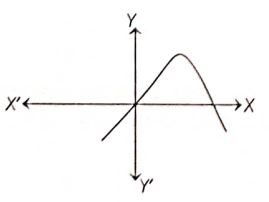
3
1
0
2
19.
Find the zeroes of the quadratic polynomial y2 - 3y + 2 with the help of the graph.
1,-2
\(\frac{-1}{4},\frac{3}{2}\)
6,-1
1,2
20.
If one of the zeroes of the cubic polynomial x3 + ax2 + bx + c is -1, then the product of the other two zeroes is
b - a + 1
b - a -1
a - b + 1
a - b - 1
21.
If one of the zeroes of the quadratic polynomial (k - 1)x2 + kx + 1 is -3, then the value of k is
\(\frac{4}{3}\)
\(\frac{-4}{3}\)
\(\frac{2}{3}\)
\(\frac{-2}{3}\)
22.
If α, β, γ be the zeros of the polynomial p(x) such that α+ β+ γ = 3 , αβ+ βγ+ γα = -10 and αβγ = -24 then p(x) is
x3 – 3x2 – 10x – 24
x3 + 3x2 – 10x + 24
x3 + 3x2 + 10x – 24
x3 – 3x2 – 10x + 24
23.
If one zero of the polynomial x2+ kx+18 is double the other zero then k =?
±3
9
3
±9
24.
When the polynomial f(x) = 4x3 + 8x2 + 8x + 7 is divided by the polynomial g(x) = 2x2 – x + 1, the quotient and the remainder are
Quotient = 2x – 5, Remainder = 11x
Quotient = 2x + 5, Remainder = 11x + 2
Quotient = x2 – 5, Remainder = 15
Quotient = x -5, Remainder = 13
25.
value of ‘a’ so that (x + 6) is a factor of the polynomial x3 + 5x2 – 4x + a
10
12
13
0
26.
If one root of polynomial equation ax2+bx+c=0 be reciprocal of other, then
a = c
a = 0
b = 0
b = c
27.
The number of zeroes for the polynomial y = p (x) from the given graph is :
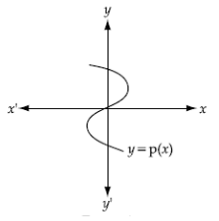
2
3
0
1
28.
Sum and the product of zeroes of the polynomial x2 +7x +10 is
7 and -10
-7 and 10
10/7 and -10/7
7/10 and -7/10
29.
If “1” is a zero of the polynomial P(a) = x2a2 – 2xa + 3x – 2 , then x =
-2
-2, 0
+2, 2
2
30.
If sum of the squares of zeros of the quadratic polynomial f(x) = x2 – 8x + k is 40, find the value of k.
14
12
-14
-12
31.
If one zero of 2x2 – 3x + k is reciprocal to the other, then the value of k is :
-3
2
-3/2
-2/3
32.
The graph y= p(x) is shown below. How many zeroes does the polynomial p(x) have?
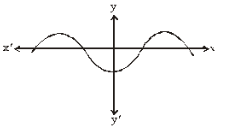
2
4
3
1
33.
The graph of y = p(x) is given below. The number of zeroes of p(x) are
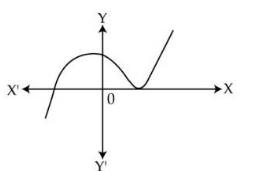
3
0
4
2
34.
The graph of the polynomial f(x) = 2x – 5 crosses the X-axis at the point
(1, -3)
(5/2, 0)
(0, 0)
(4, 3)
35.
If the degree of the dividend is 5 and the degree of the divisor is 3, then the degree of the quotient will be
0
2
1
-2
36.
One day, due to heavy storm an electric wire got bent as shown in the figure. It followed some mathematical shape of curve. Answer the following questions below.
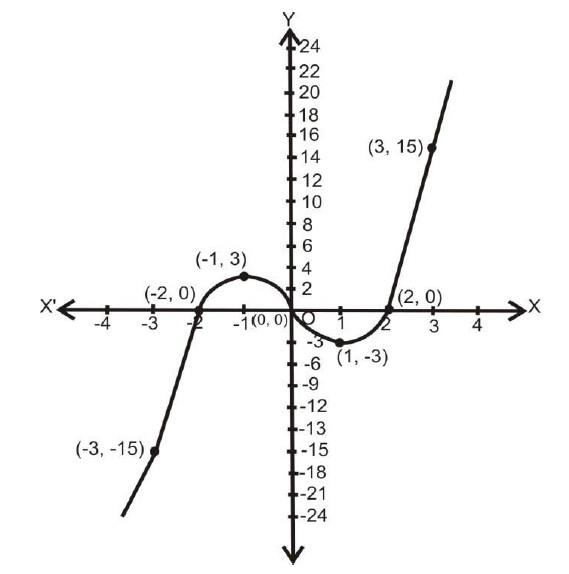
(i) How many zeroes are there for the polynomial (shape of the wire)
| (a) 2 | (b) 3 | (c) 4 | (d) 5 |
(b) Find the zeroes of the polynomial.
| (a) 2, 0, -2 | (b) 2, -2, -5 | (c) -2, 2, -5.5 | (d) None of these |
37.
Shruti is very good in painting. So she thought of exhibiting her paintings in which she want to display her latest painting which is in the form of a graph of a polynomial as shown below:
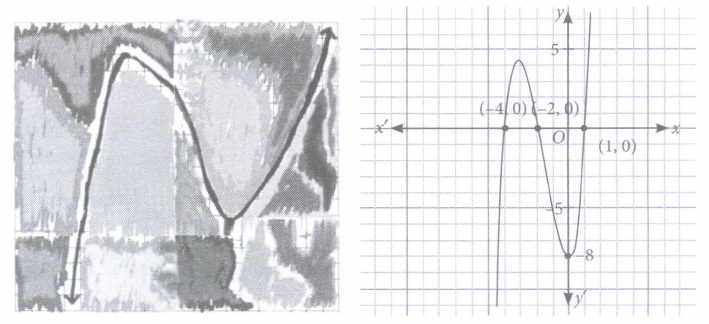
Based on the above information, answer the following questions.
(i) The number of zeroes of the polynomial represented by the graph is
| (a) 1 | (b) 2 | (c) 3 | (d) can't be determined |
(ii) The sum of zeroes of the polynomial represented by the graph is
| (a) -4 | (b) -3 | (c) 2 | (d) -5 |
(iii) Find the value of the polynomial represented by the graph when x = 0.
| (a) -6 | (b) -8 | (c) 6 | (d) 8 |
(iv) The polynomial representing the graph drawn in the painting by Shruti is a
| (a) quadratic polynomial | (b) cubic polynomial |
| (c) bi-quadratic polynomial | (d) linear polynomial |
(v) The sum of product of zeroes, taken two at a time, of the polynomial represented by the graph is
| (a) 2 | (b) 3 | (c) -2 | (d) -3 |
38.
Priya visited a temple in Gwalior. On the way she sees the Agra Fort. The entrance gate of the fort has a shape of quadratic.polynomial (parabolic). The mathematical representation of the gate is shown in the figure .
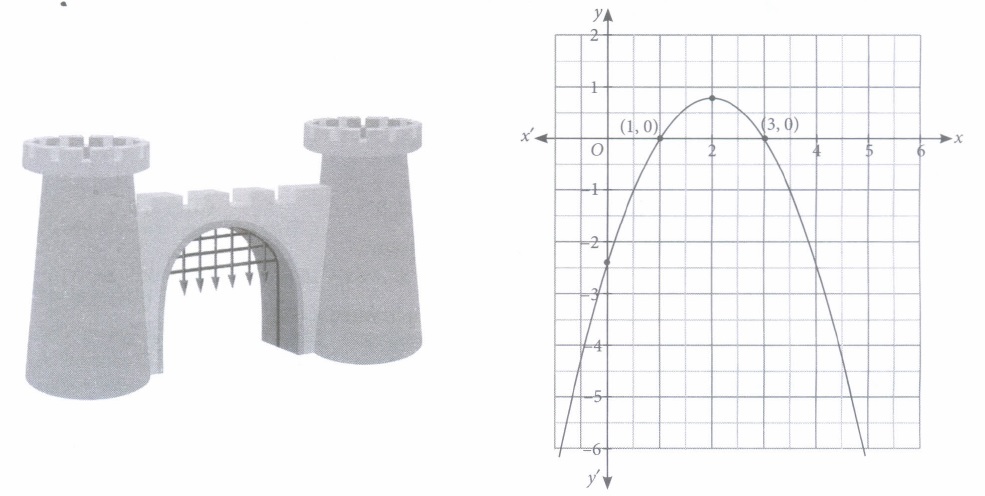
Based on the above information, answer the following questions.
(i) Find the zeroes of the polynomial represented by the graph.
| (a) -1,3 | (b) 1,3 | (c) 1,-3 | (d) 0,1 |
(ii) What will be the expression for the polynomial represented by the graph?
| \((a) x^{2}+4 x-5\) | \((b) x^{2}-4 x+5\) | \((c) -x^{2}+4 x-3\) | \((d) x^{2}+5 x-4\) |
(iii) What will be the value of polynomial, represented by the graph, when x = 4?
| (a) -2 | (b) 3 | (c) -3 | (d) 2 |
(iv) If one zero of a polynomial p(x) is 7 and product of its zeroes is -35, then p(x) =
| \((a) -x^{2}+{2 x}+35 \) | \((b) x^{2}+2 x+35\) | \((c) x^{2}+12 x-35\) | \((d) x^{2}-12 x-35\) |
(v) If the gate is represented by the polynomial \(-x^{2}+5 x-6\) then its zeroes are
| (a) 2,-3 | (b) 2,3 | (c) -2,3 | (d) -2,-3 |
1.
Biquadratic
2.
Here, the highest power of z in the given polynomial is 4, so it is a biquadratic polynomial.
3.
two
4.
Yes
5.
Quadratic
6.
Let the zeroes of the given polynomial ax2 + bx +b be m \(\alpha\) and n \(\alpha\)
\(\therefore\) Sum of zeroes
m\(\alpha\)+n\(\alpha\) = \( -\frac{Coefficient of x}{Coefficient of x^{2}}\) = \( -\frac{b }{a }\)
and product of zeroes,
m \(\alpha\)x n\(\alpha\) = \( \frac{Coefficient of x}{Coefficient of x^{2}}\) = \( -\frac{b }{a}\)
\(-\sqrt{\frac{b}{a } }\)
7.
On dividing f(x) by 3x2-5, we get
Quotient=x2-3x+2 and remainder =k+10.
Since, f(x) is exactly divisible by 3x2-5, so remainder =0.
⇒ k+10=0⇒ k-10
Now, for other zeroes, put x2-3x+2=0
⇒ (x2)(x1)=0⇒x=1,2
8.
\(-1,\quad -\frac { 3 }{ 2 } \)
9.
Let p(y)=y2+92y+1920=(y+32)(y+60)
Now, for zeroes of p(y), put p(y)=0
Zeroes y=-32, -60
10.
Let f(x) = x2 - 15
\(\Rightarrow f(x)=(x-\sqrt{15})(x+\sqrt{15}) \quad\left[\because a^2-b^2=(a-b)(a+b)\right]\)
On putting f(x) = 0, we get
\(\begin{aligned}
& (x-\sqrt{15})(x+\sqrt{15})=0 \\
\end{aligned}\)
\(\begin{aligned}
& \Rightarrow x-\sqrt{15}=0 \text { or } x+\sqrt{15}=0 \\
\end{aligned}\)
\(\begin{aligned}
& \Rightarrow \quad x=\sqrt{15} \text { or } x=-\sqrt{15}
\end{aligned}\)
Thus, the zeros of given polynomial are \(\alpha=\sqrt{15}\) and \(\beta=-\sqrt{15}\)
Verification
Here, the sum of zeroes, \(\alpha+\beta=\sqrt{15}-\sqrt{15}=0\)
\(=-\frac{0}{1}=-\frac{\text { Coefficient of } x}{\text { Coefficient of } x^2}\)
and product of zeroes,
\(\begin{aligned}
\alpha \beta=\sqrt{15} \times(-\sqrt{15}) & =-15=\frac{-15}{1}
\end{aligned}\)
\(\begin{aligned}
& =\frac{\text { Constant term }}{\text { Coefficient of } x^2}
\end{aligned}\)
So, the relationship between the zeroes and the coefficients is verified.
11.
= \(\frac{-2}{\sqrt{3}}, \frac{3}{4 \sqrt{3} / 2}\)
12.
(d) We know that, for any quadratic polynomial ax2 +bx +c, \(a \neq 0\), the graph of the corresponding equation y = {[x2 +bx + c has one of the two shapes ei ther open upwards like  or open downwards like
 depending on whether a> 0 or a < 0. So, option (d) cannot be possible. Also, the curve of a quadratic polynomial crosses the X-axis atrnost two points, but in option (d) the curve crosses the X-axis at three points, so it does not represent the quadratic polynomial.
13.
If x +a is a factor of x2 +px +q and x2 +mx +n
then (-a)2 +p(-a)+ q = (-a)2 +m(-a)+n [\( \because\)x = -a]
14.
(i) Rs (2x -1)
(ii) 12 million
(iii) Medicine = 151 lakh
Treatment = 52 lakh
Children Education = 99 lakh
15.
We have, \(q(x)=\sqrt { 3x^{ 2 } } +10x+7\sqrt { 3 } \)
On splitting the middle term, i.e.10x into two parts, we get
\(q(x)=\sqrt { 3x^{ 2 } } +3x+7+7\sqrt { 3 } \)
\(=\sqrt { 3x } (x+\sqrt { 3 } )+7(x+\sqrt { 3 } )\)
\(=(x+\sqrt { 3 } )\sqrt { 3x } +7)\)
For the zeroes of q(x), put q(x)=0
\(\therefore \quad (x+\sqrt { 3 } )\sqrt { 3x } +7)=0\)
\(\Rightarrow \quad x+\sqrt { 3 } =0\) and \(\sqrt { 3x } +7=0\)
\(\Rightarrow \quad x=-\sqrt { 3 } \) and \(x=\frac { -7 }{ \sqrt { 3 } } \)
Hence, the zeroes of q(x) are \(\alpha =-\sqrt { 3 } \) and \(\beta =\frac { -7 }{ \sqrt { 3 } } \)
Verification
Here, \(\alpha +\beta =-\sqrt { 3 } +\left( \frac { -7 }{ \sqrt { 3 } } \right) =\frac { -3-7 }{ \sqrt { 3 } } =-\frac { 10 }{ \sqrt { 3 } } \)
\(=-\frac { Coefficient\quad of\quad x }{ Coefficient\quad of\quad x^{ 2 } } \)
and \(\alpha \beta =-\sqrt { 3 } \times \left( \frac { -7 }{ \sqrt { 3 } } \right) =\frac { 7\sqrt { 3 } }{ \sqrt { 3 } } =-\frac { Constant \ term }{ Coefficient \ of \ x^{ 2 } } \)
Hence, the relations between the zeroes and the coefficients of the polynomial is verified.
16.
(a)
x2 + 5x + 6
17.
(a)
a = -7 and b = -1
18.
(d)
2
19.
(d)
1,2
20.
(a)
b - a + 1
21.
Given that, one of the zeroes of the quadratic polynomial say p(x) = (k -1)x2 + kx + 1 is -3, then
p(-3)=0
\( \Rightarrow\) (k -1)(-3)2 + k(-3) + 1= 0
22.
(d)
x3 – 3x2 – 10x + 24
23.
(d)
±9
24.
(b)
Quotient = 2x + 5, Remainder = 11x + 2
25.
(b)
12
26.
(a)
a = c
27.
(d)
1
28.
(b)
-7 and 10
29.
30.
(b)
12
31.
(b)
2
32.
(b)
4
33.
(c)
4
34.
(b)
(5/2, 0)
35.
(b)
2
36.
(i) (c): 3
(ii) (a): 2, 0, -2
37.
(i) (c) :Since the graph intersect the x-axis at 3 points, therefore the polynomial has 3 zeroes.
(ii) (d): Clearly the graph intersect the x-axis at x = -4, x = -2 and x = 1, therefore the zeroes are -4, -2 and 1. Now, the sum of zeroes = -4 - 2 + 1 = -5
(iii) (b): From the graph, it can be seen that When x = 0, then y = -8.
(iv) (b): Since there are 3 zeroes, therefore the graph represents a cubic polynomial.
(v) (a): The sum of product of zeroes taken two at a time = (-4)(-2) + (-2)(1) + (1)(-4) = 8 - 2 - 4 = 2
38.
(i) (b): Since, the graph of the polynomial intersect the x-axis at x = 1, 3 therefore required zeroes of the polynomial are 1 and 3.
(ii) (c)
(iii) (c): Let \(f(x)=-x^{2}+4 x-3\)
then \(f(4) =-4^{2}+4 \times 4-3 \)
\(=-16+16-3=-3\)
(iv) (a): Clearly, other zero \(=\frac{-35}{7}=-5\)
Thus, the zeroes are 7 and -5. From the options, 7 and -5 satisfies only \(-x^{2}+2 x+35\)
\(\text { So, } p(x)=-x^{2}+2 x+35\)
(v) (b): Let \(p(x)=-x^{2}+5 x-6\)
For zeroes, consider p(x) = 0
\(\begin{array}{l}
\Rightarrow \quad-x^{2}+5 x-6=0 \Rightarrow x^{2}-5 x+6=0 \\
\Rightarrow \quad x^{2}-3 x-2 x+6=0 \\
\Rightarrow \quad(x-3)(x-2)=0 \Rightarrow x=3,2
\end{array}\)
Thus, the required zeroes are 3 and 2.

10th Standard CBSE Syllabus & Materials
10th Standard CBSE
CBSE 10th Social Science PS - Federalism - New Model Questions Papers Study Material - QB365 Set A
NEW10th Standard CBSE
CBSE 10th Social Science PS - Power Sharing - New Model Questions Papers Study Material - QB365 Set A
NEW10th Standard CBSE
CBSE 10th Social Science GEO - Manufacturing Industries - New Model Questions Papers Study Material - QB365 Set A
NEW10th Standard CBSE
CBSE 10th Social Science GEO - Minerals and Energy Resources - New Model Questions Papers Study Material - QB365 Set A



NCERT Books

Syllabus

Exam Pattern

Sample Question Papers

Previous year Question Papers

Important Notes

MCQ Practice test

NCERT Exemplers

Case study Questions

Image Based Questions

Passage based Questions

HOT Questions

Value Based Questions

Model Questions Papers
NCERT ( Book Back ) Questions

Assertion and Reason
Important Questions And Answers

CBSE 10th Standard CBSE Subjects
CBSE Standards



