
 100% FREE ACCESS
10th Standard CBSE Syllabus & Materials
10th Standard CBSE
CBSE 10th Social Science ECO - Globalisation and the Indian Economy - New Model Questions Papers Study Material - QB365 Set A
NEW10th Standard CBSE
CBSE 10th Social Science ECO - Money and Credit - New Model Questions Papers Study Material - QB365 Set A
NEW10th Standard CBSE
CBSE 10th Social Science ECO - Sectors of the Indian Economy - New Model Questions Papers Study Material - QB365 Set A
NEW10th Standard CBSE
CBSE 10th Social Science ECO - Development - New Model Questions Papers Study Material - QB365 Set A
NEW10th Standard CBSE
CBSE 10th Social Science PS - Outcomes of Democracy - New Model Questions Papers Study Material - QB365 Set A
NEW10th Standard CBSE
CBSE 10th Social Science PS - Gender, Religion and Caste - New Model Questions Papers Study Material - QB365 Set A

Published on: 22/10/2025
Download CBSE Class 10th Standard CBSE Maths question papers, sample papers, important questions, and previous year solved papers in PDF format. Get free study materials, NCERT solutions, and exam preparation resources for Class 10th Standard CBSE Maths
Questions + Answers key
Take MCQ Maths Test
1.
Examine that the list of numbers 7, 13, 19, 25, .... form an AP.It.they form an Ap, write the next two terms
2.
Three numbers in A.P. have sum 24, find the middle term.
3.
It the point P(x, y) is equidistant from the points A(5, 1) and B(1, 5), then prove that x = y.
4.
Check whether the points A(0, 0), B(5, -5) and C(-5, 5) are collinear?
5.
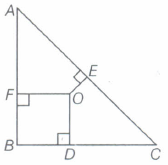
In the given figure, O is a point in the interior of a \(\triangle ABC,OD\bot BC,OE\bot AC\) and \(OF\bot AB\) .
AF2 + BD2 + CE2 = AE2 + CD2 + BF2
6.
If \(4\sin { \theta } =3\), find the value of x if \(\sqrt { \frac { { cosec }^{ 2 }\theta -\cot ^{ 2 }{ \theta } }{ \sec ^{ 2 }{ \theta -1 } } } +2\cot { \theta } =\frac { \sqrt { 7 } }{ x } +\cos { \theta } \)
7.
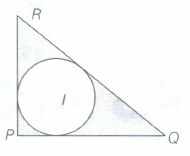
In the given figure, POR is a right angled triangle at P. Find the area of shaded region, if PR = 4 cm, RO = 5 em and I is centre of in circle of \(\triangle\)POR.
8.
In the given figure, ABC is a right angled triangle at A. Find the area of the shaded region, if AB = 6 cm, BC = 10 cm and I is the centre of incircle of delta ABC.
9.
The positive root of \(\sqrt { { 3x }^{ 2 }+6 } =9\)is
3
4
5
7
10.
If 4 is a root of the equation x2 + 3x + k = 0 , then k is
-12
12
28
-28
11.
Assertion : If TA and TB are tangents to the circle with centre O such that \(\angle \mathrm{OAB}=35^{\circ}\),then \(\angle O A B=35^{\circ}\)
Reason : Two tangents TP and TO are drawn to a circle with centre O from an external point T, then \(\angle P T Q=2 \angle O P Q\), \(\angle O A B=35^{\circ}\).
Codes :
(a) If both Assertion and Reason are correct and Reason is the correct explanation of Assertion.
(b) If both Assertion and Reason are correct, but Reason is not the correct explanation of Assertion.
(c) If Assertion is correct but Reason is incorrect.
(d) If Assertion is incorrect but Reason is correct.
12.
Assertion : A tangent PA at point A of a circle of radius 6 cm meets a line through the centre O at a point P so that OP = 10 cm, then PA = 9 cm.
Reason : The tangents drawn at the ends of a diameter of a circle are parallel.
Codes :
(a) If both Assertion and Reason are correct and Reason is the correct explanation of Assertion.
(b) If both Assertion and Reason are correct, but Reason is not the correct explanation of Assertion.
(c) If Assertion is correct but Reason is incorrect
(d) If Assertion is incorrect but Reason is correct.
13.
One day, due to heavy storm an electric wire got bent as shown in the figure. It followed some mathematical shape of curve. Answer the following questions below.
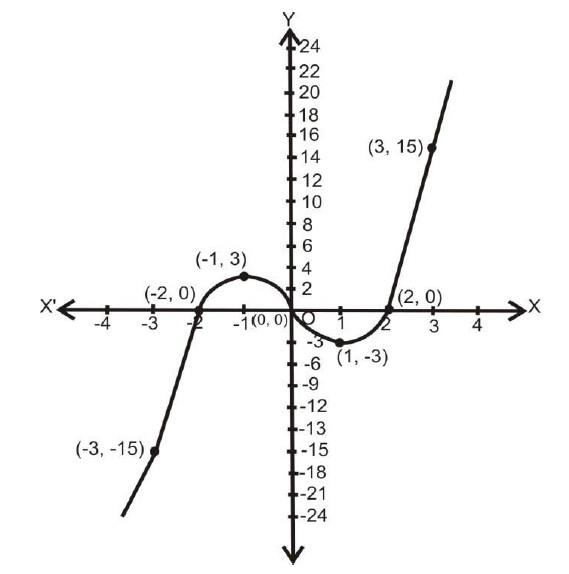
(i) How many zeroes are there for the polynomial (shape of the wire)
| (a) 2 | (b) 3 | (c) 4 | (d) 5 |
(b) Find the zeroes of the polynomial.
| (a) 2, 0, -2 | (b) 2, -2, -5 | (c) -2, 2, -5.5 | (d) None of these |
14.
In a classroom activity on real numbers, the students have to pick a number card from a pile and frame question on it if it is not a rational number for the rest of the class. The number cards picked up by first 5 students and their questions on the numbers for the rest of the class are as shown below. Answer them.
(i) Suraj picked up \(\sqrt{8}\) and his question was - Which of the following is true about \(\sqrt{8}\)?
| (a) It is a natural number | (b) It is an irrational number |
| (c) It is a rational number | (d) None of these |
(ii) Shreya picked up 'BONUS' and her question was - Which of the following is not irrational?
| (a) 3-4\(\sqrt{5}\) | (b) \(\sqrt{7}\) -6 | (c) 2+2\(\sqrt{9}\) | (d) 4\(\sqrt{11}\)-6 |
(iii) Ananya picked up \(\sqrt{5}\) -.\(\sqrt{10}\) and her question was - \(\sqrt{5}\) -.\(\sqrt{10}\) _________is number.
| (a) a natural | (b) an irrational | (c) a whole | (d) a rational |
(iv) Suman picked up \(\frac{1}{\sqrt{5}}\) and her question was - \(\frac{1}{\sqrt{5}}\) is __________ number.
| (a) a whole | (b) a rational | (c) an irrational | (d) anatural |
(v) Preethi picked up \(\sqrt{6}\) and her question was - Which of the following is not irrational?
| (a) 15 + 3\(\sqrt{6}\) | (b) \(\sqrt{24}\)- 9 | (c) 5.\(\sqrt{150}\) | (d) None of these |
1.
Yes; 31, 37
2.
8
3.
Given point P(x,y) is equidistant from the points A(5,1) and B(1,5).
So, AP=BP
\(\Rightarrow A P^{2}=B P^{2}\) [squaring both sides]
\(\Rightarrow (x-5)^{2}+(y-1)^{2}=(x-1)^{2}+(y-5)^{2}\) \(\left[\because \text { distance }=\sqrt{\left(x_{2}-x_{1}\right)^{2}+\left(y_{2}-y_{1}\right)^{2}}\right]\)
\(\Rightarrow x^{2}+25-10 x+y^{2}+1-2 y=x^{2}+1-2 x+y^{2}+25-10 y\) \(\left[\because(a-b)^{2}=a^{2}+b^{2}-2 a b\right]\)
\(\Rightarrow -10 x+2 x=-10 y+2 y\)
\(\Rightarrow-8 x=-8 y \Rightarrow x=y\)
Hence proved.
4.
No
5.
From part (i),
OA2 + OB2 + OC2 - OD2 - OE2 - OF2 = AF2 + BD2 + CE2 ......(i)
Similarly, we can prove that
OA2 + OB2 + OC2 - OD2 - OE2 - OF2 = BF2 + CD2 + AE2 ...... (ii)
From Eqs. (iv) and (v),
AF2 + BD2 + CE2 = AE2 + CD2 + BF2
6.
\(\sin { \theta } =\frac { 3 }{ 4 } \) (Given)
\(\Rightarrow \quad \sin ^{ 2 }{ \theta } =\frac { 9 }{ 16 } \)
\(\because \quad \sin ^{ 2 }{ \theta } +\cos ^{ 2 }{ \theta } =1\)
\(\Rightarrow \quad \cos ^{ 2 }{ \theta } =1-\sin ^{ 2 }{ \theta } \)
\(=1-\frac { 9 }{ 16 } =\frac { 7 }{ 16 } \)
\(\cos { \theta } =\frac { \sqrt { 7 } }{ 4 } \)
and \(\tan { \theta } =\frac { \sin { \theta } }{ \cos { \theta } } \)
\(=\frac { \frac { 3 }{ 4 } }{ \frac { \sqrt { 7 } }{ 4 } } \)
\(=\frac { 3 }{ \sqrt { 7 } } \)
\(\therefore \quad \sqrt { \frac { { cosec }^{ 2 }\theta -\cot ^{ 2 }{ \theta } }{ \sec ^{ 2 }{ \theta -1 } } } +2\cot { \theta } =\frac { \sqrt { 7 } }{ x } +\cos { \theta } \)
\(\Rightarrow \quad \sqrt { \frac { 1 }{ \tan ^{ 2 }{ \theta } } } +2\times \frac { \sqrt { 7 } }{ 3 } =\frac { \sqrt { 7 } }{ x } +\frac { \sqrt { 7 } }{ 4 } \)
\(\Rightarrow \quad \frac { 1 }{ \tan { \theta } } +\frac { 2\sqrt { 7 } }{ 3 } =\frac { \sqrt { 7 } }{ x } +\frac { \sqrt { 7 } }{ 4 } \)
\(\Rightarrow \quad \frac { \sqrt { 7 } }{ 3 } +\frac { 2\sqrt { 7 } }{ 3 } -\frac { \sqrt { 7 } }{ 4 } =\frac { \sqrt { 7 } }{ x } \)
\(\Rightarrow \quad \frac { 4\sqrt { 7 } -\sqrt { 7 } }{ 4 } =\frac { \sqrt { 7 } }{ x } \)
\(\Rightarrow \quad \frac { 3\sqrt { 7 } }{ 4 } =\frac { \sqrt { 7 } }{ x } \)
\(\because \quad x=\frac { 4 }{ 3 } \)
7.
\(\frac {22}{7}\) cm2
8.
In right angled delta BAC,
\({ BC }^{ 2 }={ AB }^{ 2 }+{ AC }^{ 2 }\)
\(\Rightarrow { AC }^{ 2 }={ BC }^{ 2 }-{ AB }^{ 2 }\\ \Rightarrow { AC }^{ 2 }={ (10) }^{ 2 }-{ (6) }^{ 2 }\quad [\because BC=10cmandAB=6cm]\\ \Rightarrow { AC }^{ 2 }=100-36\\ \Rightarrow { AC }^{ 2 }=64\Rightarrow AC=8cm\)
Therefore, Area of \(\Delta ABC=\frac { 1 }{ 2 } \times AB\times AC\)
\(=\frac { 1 }{ 2 } \times 6\times 8={ 24cm }^{ 2 }\)
Area of deltaABC = Area of deltaIBC + Area of deltaICA + Area of deltaIAB
\(\Rightarrow 24=\frac { 1 }{ 2 } (BC\times r)+\frac { 1 }{ 2 } (CA\times r)+\frac { 1 }{ 2 } (AB\times r)\)
\(\Rightarrow 24=\frac { 1 }{ 2 } r(BC+CA+AB)\\ \Rightarrow 24=\frac { 1 }{ 2 } \times r\times (10+8+6)\\ \Rightarrow 24=12r\\ \Rightarrow \quad r=2cm\)
Therefore, Area of the shaded region = Area of deltaABC - Area of incircle
\(=24-{ \pi r }^{ 2 }=24-\frac { 22 }{ 7 } \times { (2) }^{ 2 }=24-\frac { 88 }{ 7 } \\ =\frac { 168-88 }{ 7 } =\frac { 80 }{ 7 } { cm }^{ 2 }\)
9.
(c)
5
10.
(d)
-28
11.
If both Assertion and Reason are correct and Reason is the correct explanation of Assertion.
12.
If Assertion is incorrect but Reason is correct.
13.
(i) (c): 3
(ii) (a): 2, 0, -2
14.
(i) (b): Here \(\sqrt{8}\) = 2\(\sqrt{2}\) = product of rational and irrational numbers = irrational number
(ii) (c): Here, \(\sqrt{9}\) = 3 So, 2 + 2\(\sqrt{9}\)= 2 + 6 = 8 , which is not irrational.
(iii) (b): Here.\(\sqrt{15}\) and \(\sqrt{10}\) are both irrational and difference of two irrational numbers is also irrational.
(iv) (c): As \(\sqrt{5}\) is irrational, so its reciprocal is also irrational.
(v) (d): We know that \(\sqrt{6}\) is irrational. So, 15 + 3.\(\sqrt{6}\) is irrational.
Similarly, \(\sqrt{24}\) - 9 = 2.\(\sqrt{6}\) - 9 is irrational.
And 5\(\sqrt{150}\) = 5 x 5.\(\sqrt{6}\) = 25\(\sqrt{6}\) is irrational.

10th Standard CBSE Syllabus & Materials
10th Standard CBSE
CBSE 10th Social Science PS - Federalism - New Model Questions Papers Study Material - QB365 Set A
NEW10th Standard CBSE
CBSE 10th Social Science PS - Power Sharing - New Model Questions Papers Study Material - QB365 Set A
NEW10th Standard CBSE
CBSE 10th Social Science GEO - Manufacturing Industries - New Model Questions Papers Study Material - QB365 Set A
NEW10th Standard CBSE
CBSE 10th Social Science GEO - Minerals and Energy Resources - New Model Questions Papers Study Material - QB365 Set A



NCERT Books

Syllabus

Exam Pattern

Sample Question Papers

Previous year Question Papers

Important Notes

MCQ Practice test

NCERT Exemplers

Case study Questions

Image Based Questions

Passage based Questions

HOT Questions

Value Based Questions

Model Questions Papers
NCERT ( Book Back ) Questions

Assertion and Reason
Important Questions And Answers

CBSE 10th Standard CBSE Subjects
CBSE Standards



