
 100% FREE ACCESS
10th Standard CBSE Syllabus & Materials
10th Standard CBSE
CBSE 10th Social Science ECO - Globalisation and the Indian Economy - New Model Questions Papers Study Material - QB365 Set A
NEW10th Standard CBSE
CBSE 10th Social Science ECO - Money and Credit - New Model Questions Papers Study Material - QB365 Set A
NEW10th Standard CBSE
CBSE 10th Social Science ECO - Sectors of the Indian Economy - New Model Questions Papers Study Material - QB365 Set A
NEW10th Standard CBSE
CBSE 10th Social Science ECO - Development - New Model Questions Papers Study Material - QB365 Set A
NEW10th Standard CBSE
CBSE 10th Social Science PS - Outcomes of Democracy - New Model Questions Papers Study Material - QB365 Set A
NEW10th Standard CBSE
CBSE 10th Social Science PS - Gender, Religion and Caste - New Model Questions Papers Study Material - QB365 Set A

Published on: 26/10/2025
Download CBSE Class 10th Standard CBSE Maths question papers, sample papers, important questions, and previous year solved papers in PDF format. Get free study materials, NCERT solutions, and exam preparation resources for Class 10th Standard CBSE Maths
Questions + Answers key
Take MCQ Maths Test
1.
Ananya had red, blue and yellow marbles in the ratio 4 : 5 : 3. She gave all her red marbles and some blue marbles to Neha. The ratio of the number of blue marbles and yellow marbles left with Ananya was 7 : 9. If Ananya gave 20 marbles to Neha, then how many of them are red marbles? Show your work.
2.
A company has a locker in which valuable documents are kept. The passcode is a four-digit number of the form xyyx. The Chief Executive Officer (CEO) and the Vice President (VP) of the company have each been given one clue. On solving both clues, the passcode that opens the locker can be found.
CEO's clue: When twice the ones digit is subtracted from the tens digit, the result is 1.
VP's clue: Three more than the tens digit is thrice the ones digit.
Find the passcode that opens the locker. Show your work.
3.
Solve the following pair of linear equations by substitution method.
\(\frac{3 x-4 y}{2}=10, \frac{3 x+2 y}{4}=2\)
4.
Solve the following pair of linear equations by substitution method.
x - y = 2, 3x + 2y = 16
5.
If \(\alpha\ and\ \beta \) are the zeroes of the quadratic polynomial f(x) = x2 -3x -2, find a polynomial whose zeroes are \((2 \alpha+3 \beta) \text { and }(3 \alpha+2 \beta)\)
6.
For which value(s) of \(\lambda \) do the pair of linear equations \(\lambda \)x+y=\(\lambda ^{ 2 }\) and x+\(\lambda \)y=1 have
(i) no solution?
(ii) infinitely many solutions?
(iii) a unique solution
7.
Use a single graph paper and draw the graph of the following equations
2y - x = 8; 5y - x = 14; y - 2x = 1
Obtain the vertices of the triangle obtained.
8.
If \(\alpha\) and \(\beta\) are the zeroes of the polynomial 6y2 - 7y + 2, find a quadratic polynomial whose zeroes are \(\frac{1}{\alpha}\) and \(\frac{1}{\beta}\)
9.
Find the zeroes of the given polynomial by factorisation method and verify the relations between the zeroes and the coefficients of the polynomials \(7y^{ 2 }-\frac { 11 }{ 3 } Y-\frac { 2 }{ 3 } \)
10.
Find a quadratic polynomial whose one zero is 7 and sum of zeroes is -18.
11.
If a and β are zeroes of the polynomial x2-P(x+1)+c such that (a+1) (β+1)=0, then find the value of c.
12.
Find a quadratic polynomial each with the given numbers as the sum and product of its zeroes respectively.
1, 1
13.
can we have any n \(\in \)N, where, 4n ends with the zero digit?
14.
If \(\alpha\) and \(\beta\) are the zeroes of a polynomial \({ x }^{ 2 }-4\sqrt { 3 } x+3\), then find the value of \(\alpha+\beta-\alpha\beta\)
15.
Find the value of k, if - 1 is a zero of the polynomial p(x) = kx2 - 4x + k.
16.
Find whether the lines represented by 2x + y = 3 and 4x + 2y = 6 are parallel, coincident or intersecting.
17.
Solve the pair of linear equations by cross-multiplication method.
2x-21=5y; 3+4y-3x
18.
For what value of k, the pair of equations kx+2y=5, 3x-4y=10 has no solution?
19.
Find nature of the lines representing the linear equations 2x-y=3 and 4x-y=5.
20.
If x=a, y=b is the solution of the equations x-y=2 and x+y=4, then find the values of a and b.
21.
Sheena went to a bank to withdraw Rs.1000 and asked the cashier to give her Rs.100 and Rs.50 notes only. She got 14 notes in all. Find how many notes of Rs.100 and Rs. 50 she received?
22.
The area of a rectangle gets reduced by 80 sq units, if its length is reduced by 5 units and the breadth is increased by 2 units. If we increase the length by 10 units and decrease the breadth by 5 units, then the area is increased by 50 q units. Find the length and the breadth of the rectangle.
23.
If α, β and ⋎ are zeroes of the polynomial 2x3+x2-13x+6, then evaluate (αβ+β⋎+⋎α).
24.
If m and n are the zeroes of the polynomial 3x2+11x-4, then find the value of \(\frac { m }{ n } +\frac { n }{ m } \) .
25.
Find a quadratic polynomial with zeroes \(3+\sqrt { 2 } \) and \(3-\sqrt { 2 } \) .
26.
If α and β are the zeroes of the polynomial 2y2+7y+5, then find the value of α+β+αβ.
27.
Identify the type of the polynomials given below:
\(f(p)=3-p^{ 2 }+\sqrt { 7 } p\)
28.
The pair of equations x + 2y + 5 = 0 and - 3x - 6y + 1= 0 has
a unique solution
exactlytwo solutions
infinitely many solutions
no solution
29.
A and B together can do a piece of work in 12 days, Band C together in 15 days. If A is twice as good a workman as C, then in how many days will B alone do it?
10 days,
15 days,
20 days,
25 days,
30.
The values of x and y is the given figure are
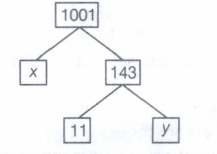
7,13
13,7
9,12
12,9
31.
The pair of linerar equations 2x+ky-3, 6x+ \(\frac { 2 }{ 3 } \)y+7 =0 have a unique solution for all values of k except
\(k\neq \frac { 2 }{ 3 } \)
\(k=\frac { 2 }{ 3 } \)
\(k\neq \frac { 2 }{ 9 } \)
\(k=\frac { 2 }{ 9 } \)
32.
How many solutions of the equation 15x – 14y + 11 = 0 are possible?
2
No solution
Infinite
1
33.
If the two zeroes of the quadratic polynomial 7x2 – 15x – k are reciprocals of each other, the value of k is:
1/7
7
-7
5
34.
If (x + 1) is a factor of x2 – 3ax + 3a – 7, then the value of a is:
-2
1
-1
0
35.
If sum of the squares of zeros of the quadratic polynomial f(x) = x2 – 8x + k is 40, find the value of k.
14
12
-14
-12
36.
If one root of the equation (p + q)2 x2 – 2 (p + q) x + k =0 is 5/p+q , then k is
15
50
-15
-50
37.
The number of polynomials having zeroes -2 and 5 is:
1
3
2
more than 3
38.
The HCF of 135 and 165 is …
25
5
15
35
39.
HCF of the smallest composite number and the smallest prime number is
0
4
2
1
40.
Write the HCF of the smallest composite number and the smallest even number
4
1
2
0
41.
H.C.F. of two consecutive even numbers is:
1
4
2
0
42.
What is the HCF of 161 and 303?
1
11
13
3
1.
Ananya had 4x red, 5x blue and 3x yellow marbles. Let number of blue marbles given to Neha be y. According to question
4x+ y= 20
and \(\frac{5x - y}{3x} = \frac{7}{9}\)
Number of red marbles = 12
2.
Given, the ones digit is x and the tens digit is y. According to CEO's clue,
y - 2x = 1..(i)
According to VP's clue,
y + 3 = 3x ..(ii)
Now, solve Eqs. (i) and (ii).
Required passcode is 4994
3.
Given equations are
\(\frac{3 x-4 y}{2}=10 \Rightarrow 3 x-4 y=20\)
and \(\frac{3 x+2 y}{4}=2 \Rightarrow 3 x+2 y=8\)
x = 4, y = - 2
4.
Given equations are x - y= 2 ...(i)
and 3x+ 2y = 16 ...(ii)
On substituting y=x- 2from Eq. (i) in Eq. (ii), we get
x = 4
y=2
5.
\(x^{2}-(2 \alpha+3 \beta+3 \alpha+2 \beta) x+(2 \alpha+3 \beta)(3 \alpha+2 \beta)\)
\(=x^{2}-(5 \alpha+5 \beta) x+\left(6 \alpha^{2}+4 \alpha \beta+9 \alpha \beta+6 \beta^{2}\right)\)
\(=x^{2}-5(\alpha+\beta) x+\left[6\left(\alpha^{2}+\beta^{2}\right)+13 \alpha \beta\right]\)
= x2 - 15x+ 52
6.
∵ \(\lambda x+y=\lambda ^{ 2 }\)
\(x+\lambda y=1\)
(i) For no solution,
\(\frac { { a }_{ 1 } }{ { a }_{ 2 } } =\frac { { b }_{ 1 } }{ { b }_{ 2 } } \neq \frac { { c }_{ 1 } }{ { c }_{ 2 } } \)
⇒ \(\frac { \lambda }{ 1 } =\frac { 1 }{ \lambda } \neq \frac { { \lambda }^{ 2 } }{ 1 } \Rightarrow \frac { 1 }{ \lambda } \)
⇒ \({ \lambda }^{ 2 }=1\quad or\quad 1\neq { \lambda }^{ 3 }\)
⇒ \(\lambda =\pm 1\)
(ii) For infinitely many solutions,
\(\frac { { a }_{ 1 } }{ { a }_{ 2 } } =\frac { { b }_{ 1 } }{ { b }_{ 2 } } \neq \frac { { c }_{ 1 } }{ { c }_{ 2 } } \Rightarrow \frac { \lambda }{ 1 } =\frac { 1 }{ \lambda } =\frac { { \lambda }^{ 2 } }{ 1 } \)
⇒ \({ \lambda }^{ 2 }=1\quad or\quad { \lambda }^{ 3 }=1\)
⇒ \(\lambda =\pm 1\quad or\quad \lambda =1,\omega ,{ \omega }^{ 2 }\)
where \(\omega \) and \({ \omega }^{ 2 }\) are cube roots of unity.
(iii) For a unique solution,
\(\frac { { a }_{ 1 } }{ { a }_{ 2 } } \neq \frac { { b }_{ 1 } }{ { b }_{ 2 } } \Rightarrow \frac { \lambda }{ 1 } \neq \frac { 1 }{ \lambda } \)
⇒ \({ \lambda }^{ 2 }\neq 1\)
⇒ \(\lambda \neq \pm 1\)
7.
2y - x = 8
| x | 0 | -8 | 2 | 4 | -4 |
|---|---|---|---|---|---|
| y | 4 | 0 | 5 | 6 | 2 |
5y - x = 14
| x | 1 | -4 | 6 |
|---|---|---|---|
| y | 3 | 2 | 4 |
y - 2x = 1
| x | 2 | 0 | 1 |
|---|---|---|---|
| y | 5 | 1 | 3 |
The vertices of the triangle fromed are (1, 3), (-4, 2) and (2, 5)

8.
p(y) = 6y2 - 7y + 2
\(\alpha +\beta =-\left( -\frac { 7 }{ 6 } \right) =\frac { 7 }{ 6 } \)
and \(\alpha\beta=\frac{2}{6}=\frac{1}{3}\)
Now \(\frac { 1 }{ \alpha } +\frac { 1 }{ \beta } =\frac { \alpha +\beta }{ \alpha \beta } =\frac { { 7 }/{ 6 } }{ { 2 }/{ 6 } } =\frac { 7 }{ 2 } \)
and \(\frac { 1 }{ \alpha } \times \frac { 1 }{ \beta } =\frac { 1 }{ \alpha \beta } =3\)
The required polynomial is \({ y }^{ 2 }-\frac { 7 }{ 2 } y+3=\frac { 1 }{ 2 } \left[ 2{ y }^{ 2 }-7y+6 \right] \)
9.
Let \(f(y)=7y^{ 2 }-\frac { 11 }{ 3 } y-\frac { 2 }{ 3 }\)
\(=\frac { 21y^{ 2 }-11y-2 }{ 3 } \)
\(=\frac { 21y^{ 2 }-14y+3y-2 }{ 3 } \) [by splitting the middle term]
\(=\frac { 7y(3y-2)+1(3y-2) }{ 3 } \)
\(=\frac { 1 }{ 3 } (3y-2)(7y+1)\)
So, the value of \(7y^{ 2 }-\frac { 11 }{ 3 } y-\frac { 2 }{ 3 } \) is zero whe 3y-2=0 or 7y+1=0, i.e. when \(y=\frac { 2 }{ 3 } \) or \(y=\frac { 1 }{ 7 } \).
Thus, the zeroes\(=\frac { 2 }{ 3 } -\frac { 1 }{ 7 } =\frac { 14-3 }{ 21 } =\frac { 11 }{ 21 } =-\left( \frac { -11 }{ 3\times 7 } \right) \)
\(=-(1).\left( \frac { Coefficient \ of \ y }{ Coefficient \ of \ y^{ 2 } } \right) \) and product of zeroes\(=\left( \frac { 2 }{ 3 } \right) \left( -\frac { 1 }{ 7 } \right) =\frac { -2 }{ 21 } =\frac { -2 }{ 3\times 7 } \)
\(=\left( \frac { Constant \ term }{ Coefficient \ of \ y^{ 2 } } \right) \)
Hence, the relations between the zeroes and the coefficients of the polynomials is verified.
10.
Let other zeroes be a.
Then, according to the given condition,
a+7=-18
⇒ a=-25
Required quadratic polynomial will be (x-7)(x+25)
or x2+18x-175
11.
Since, a and β are the zeroes of polynomial x2 -px-p+c.
So, sum of zeroes, a+β =p ...(i)
and product of zeroes, aβ =c-p| ...(ii)
Also, (a+1)(β+1)=0 [given]
aβ+(a+β)+1=0
⇒ c-p+p+1=0 [from Eqs. (i) and (ii)]
⇒ c-1
12.
Let the quadratic polynomial be ax2 + bx + c, and its zeroes be α and ß
Given \(\alpha+\beta=-\frac{b}{a}=1\)
\(\alpha \beta=\frac{c}{a}=1\)
If a = 1, b = -1, and c = 1
Therefore, the quadratic polynomial is x2 – x +1.
13.
For unit's digit to be 0, then 4n should have 2 and 5 as its prime factors, but 4n=(22)n = 22n.lt does not contain 5 as one of its prime factors.
ஃ 4n will not end with digit 0 for n \(\in \) N.
14.
\({ x }^{ 2 }-4\sqrt { 3 } x+3=0\)
If \(\alpha\) and \(\beta\) are the zeroes of \({ x }^{ 2 }-4\sqrt { 3 } x+3\)
then \(\alpha+\beta=-\frac{b}{a}\)
\(\Rightarrow \quad \alpha +\beta =-\frac { \left( -4\sqrt { 3 } \right) }{ 1 } \)
\(\Rightarrow \quad \alpha +\beta=4\sqrt { 3 }\)
and \(\alpha\beta=\frac{c}{a}\)
\(\Rightarrow \quad \alpha\beta=\frac{3}{1}\)
\(\Rightarrow \quad \alpha\beta=3\)
\(\therefore \quad \alpha +\beta -\alpha \beta =4\sqrt { 3 } -3\)
15.
Since, - 1 is a zero of the polynomial
p(x) = kx2 - 4x + k,
then p(-1) = 0
\(\therefore\) k(-1)2 - 4 (- 1) + k = 0
\(\Rightarrow\) k + 4 + k = 0
\(\Rightarrow\) 2k + 4 = 0
\(\Rightarrow\) 2k = - 4
Hence, K = - 2
16.
Here a1 = 2, b1 = 1, c1 = 3
and a2 = 4, b2 = 2, c2 = 6
Clearly \(\frac { { a }_{ 1 } }{ { a }_{ 2 } } =\frac { { b }_{ 1 } }{ { b }_{ 2 } } =\frac { { c }_{ 1 } }{ { c }_{ 2 } } \)
i.e.\(\frac { 2 }{ 4 } =\frac { 1 }{ 2 } =\frac { 3 }{ 6 } \)
Hence lines are coincident.
17.
x=3, y=-3
18.
k=-3/2
19.
Intersect at a point
20.
Since, x = a and y = b is the solution of the equations x - y = 2 and x + y = r, therefore these values will satisfy that equations . Thus, we have
a - b = 2 ..(i)
and a+b=4 ...(ii)
On adding Eqs. (i) and (ii), we get
2a = 6 ⇒ a = 3
On substituting a=3 in Eq. (i), we get
3 - b = 2 ⇒ b = 1
Hence, a = 3 and b = 1
21.
Let the number of Rs.100 and Rs.50 notes be x and y, respectively. Then, according to the question, x+y=14100x+50y=1000
Rs.100 notes=6, Rs.50 notes=8
22.
Let x and y be length and breadth of rectangle.
Then, its area=xy
According to the questions,
9x-5)(y+2)=xy-80 \(\Rightarrow\) 2x-5y=-70
(x+10)(y-5)=xy+50 \(\Rightarrow\) -5x+10y=100
Length=40 units, breadth=30 units
23.
\(-\frac { 13 }{ 2 } \)
24.
\(-\frac { 145 }{ 12 } \)
25.
x2-6x+7
26.
α+β+αβ=\(-\frac { 7 }{ 2 } +\frac { 5 }{ 2 } =-1\)
27.
Quadratic
28.
(d)
no solution
29.
(c)
20 days,
30.
(a)
7,13
31.
(d)
\(k=\frac { 2 }{ 9 } \)
32.
(c)
Infinite
33.
(b)
7
34.
(b)
1
35.
(b)
12
36.
(b)
50
37.
(d)
more than 3
38.
(c)
15
39.
(c)
2
40.
(c)
2
41.
(c)
2
42.
(a)
1

10th Standard CBSE Syllabus & Materials
10th Standard CBSE
CBSE 10th Social Science PS - Federalism - New Model Questions Papers Study Material - QB365 Set A
NEW10th Standard CBSE
CBSE 10th Social Science PS - Power Sharing - New Model Questions Papers Study Material - QB365 Set A
NEW10th Standard CBSE
CBSE 10th Social Science GEO - Manufacturing Industries - New Model Questions Papers Study Material - QB365 Set A
NEW10th Standard CBSE
CBSE 10th Social Science GEO - Minerals and Energy Resources - New Model Questions Papers Study Material - QB365 Set A



NCERT Books

Syllabus

Exam Pattern

Sample Question Papers

Previous year Question Papers

Important Notes

MCQ Practice test

NCERT Exemplers

Case study Questions

Image Based Questions

Passage based Questions

HOT Questions

Value Based Questions

Model Questions Papers
NCERT ( Book Back ) Questions

Assertion and Reason
Important Questions And Answers

CBSE 10th Standard CBSE Subjects
CBSE Standards



