
 100% FREE ACCESS
10th Standard CBSE Syllabus & Materials
10th Standard CBSE
CBSE 10th Social Science ECO - Globalisation and the Indian Economy - New Model Questions Papers Study Material - QB365 Set A
NEW10th Standard CBSE
CBSE 10th Social Science ECO - Money and Credit - New Model Questions Papers Study Material - QB365 Set A
NEW10th Standard CBSE
CBSE 10th Social Science ECO - Sectors of the Indian Economy - New Model Questions Papers Study Material - QB365 Set A
NEW10th Standard CBSE
CBSE 10th Social Science ECO - Development - New Model Questions Papers Study Material - QB365 Set A
NEW10th Standard CBSE
CBSE 10th Social Science PS - Outcomes of Democracy - New Model Questions Papers Study Material - QB365 Set A
NEW10th Standard CBSE
CBSE 10th Social Science PS - Gender, Religion and Caste - New Model Questions Papers Study Material - QB365 Set A

Published on: 26/10/2025
Download CBSE Class 10th Standard CBSE Maths question papers, sample papers, important questions, and previous year solved papers in PDF format. Get free study materials, NCERT solutions, and exam preparation resources for Class 10th Standard CBSE Maths
Questions + Answers key
Take MCQ Maths Test
1.
Find a quadratic polynomial, the sum and product of whose zeroes are, respectively
\(2+\sqrt{3} \text { and } 2-\sqrt{3}\)
2.
a and b are two positive integers such that the least prime factor of a is 3 and the least prime factor of b is 5. Then calculate the least prime factor of (a + b).
3.
8 men and 12 boys can finish a piece of work in 10 days while 6 men and 8 boys can finish it in 14 days. Find the time taken to finish the work by one man alone.
4.
The coordinates of A,,C and D are (6,3), (-3,5), (4,-2) and (x,3x) respectively. If ar(\(\triangle\)DBC) : ar(\(\triangle\)ABC) = 1 : 2, find x.
5.
If (1,2),(4,y),(x,6) and (3,5) are the vertices of the parallelogram taken in order, find x and y.
6.
If the sum of the zeroes of the polynomial p(x) = (a+1)x2 + (2a + 3)x +(3a + 4) is -1, then find the product of its zeroes.
7.
Prove that the following are irrational :
7\(\sqrt 5\)
8.
Solve the following pair of linear equations by the substitution method
s - t = 3
\(\\ \frac { s }{ 3 } +\frac { t }{ 2 } =6\)
9.
If \(\alpha\) and \(\beta\) are the zeroes of the polynomial 6y2 - 7y + 2, find a quadratic polynomial whose zeroes are \(\frac{1}{\alpha}\) and \(\frac{1}{\beta}\)
10.
Find the value of k, for which points (k, 2-2k), (-k+1, 2k) and (-4-k, 6-2k) are collinear.
11.
Find the value of k if the points A(2, 3), B(4, k) and C(6, –3) are collinear.
12.
Find the value of k for which the following system of equations has infinitely many solution.
4x + 7y = 10; (k + 2)x+ 21y =3k
13.
The sum of a two-digit number and the number obtained by reversing the digits is 66. If the digits of the number differ by 2, find the number. How many such numbers are there?
14.
If \(\alpha\) and \(\beta\) are the zeroes of polynomial p(x) = 3x2 + 2x + 1, find the polynomial whose zeroes are \(\frac { 1-\alpha }{ 1+\alpha } \) and \(\frac { 1-\beta}{ 1+\beta} \)
15.
Find the LCM and HCF of the following integers by applying the prime factorisation method.
12, 15 and 21
16.
If (2, 4) is the mid-point of the line segment joining (6,3) and (a, 5), then the value of a is
2
4
-4
-2
17.
if \(\alpha\) and \(\beta\)are zeroes and the polynomial f(x) = x2 - x - 4 value of \(\frac{1}{\alpha}+\frac{1}{\beta}-\alpha \beta\)
\(\frac{15}{4}\)
\(\frac{-15}{4}\)
4
15
18.
Which of the following equation is not a linear equation
2a-b =1
a + b =1
√a+b =1
2a+b =1
19.
A system of simultaneous linear equations has infinitely many solutions if two lines:
intersect at one point
are parallel
intersect at two points
are coincident
20.
Find the zero of a linear polynomial ax + b
-b/a
a/b
b/a
-a/b
21.
The number 7 x 11 x 13 + 13 is :
prime number
negative integer
irrational number
composite number
22.
The diagrams show the plans for a sun room. It will be built onto the wall of a house. The four walls of the sunroom are square clear is made using
(i) Four clear glass panels, trapezium in shape, all the same size
(ii) One tinted glass panel, half a regular octagon in shape
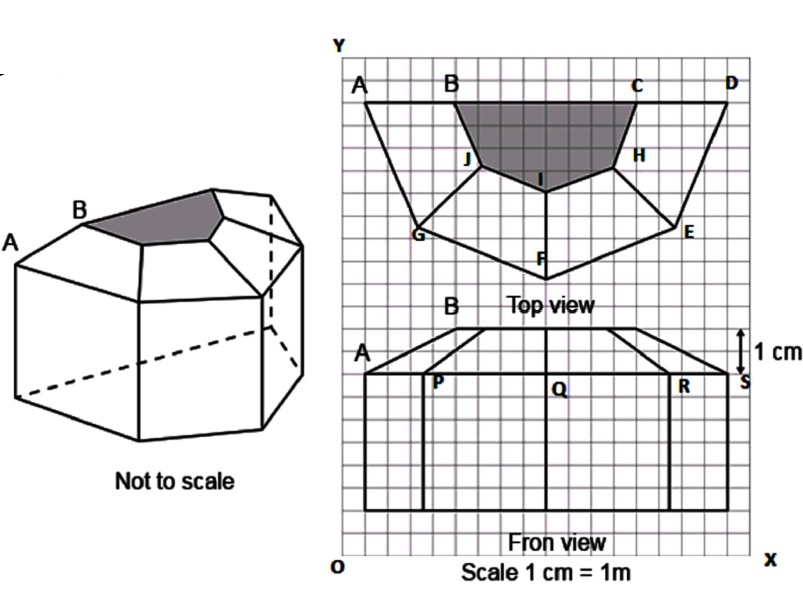
(i) Find the midpoint of the segment joinig the points J (6,17) and I (9,16)
| (a) \(\frac{33}{2}, \frac{15}{2}\) | (b) \(\frac{3}{2}, \frac{1}{2}\) | (c) \(\frac{15}{2}, \frac{33}{2}\) | (d) \(\frac{1}{2}, \frac{3}{2}\) |
(ii) The distance of the point P from the y- axis is
| (a) 4 | (b) 15 | (c) 19 | (d) 25 |
(iii) The distance between the points A and S is
| (a) 4 | (b) 8 | (c) 16 | (d) 20 |
(iv) Find the co-ordinates of the point which divides the line segment joining the points A and B in the ratio 1:3 internally.
| (a) (8.5,2.0) | (b) (2.0,9.5) | (c) (3.0,7.5) | (d) (2.0,8.5) |
(v) If a point (x,y) is equidistant from the Q(9,8) and S(17,8), then
| (a) x + y = 13 | (b) x - 13 = 0 | (c) y - 13 = 0 | (d) x - y =13 |
23.
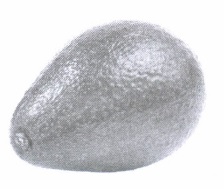
Pankaj's father gave him some money to buy avocado from the market at the rate of p(x) = x2 - 24x + 128. Let a , \(\beta\) are the zeroes of p(x).
Based on the above information, answer the following questions.
(i) Find the value of a and \(\beta\), where a < \(\beta\).
| (a) -8, -16 | (b) 8,16 | (c) 8,15 | (d) 4,9 |
(ii) Find the value of \(\alpha\) + \(\beta\) + \(\alpha\)\(\beta\).
| (a) 151 | (b) 158 | (c) 152 | (d) 155 |
(iii) The value of p(2) is
| (a) 80 | (b) 81 | (c) 83 | (d) 84 |
(iv) If \(\alpha\) and \(\beta\) are zeroes of \(x^{2}+x-2, \text { then } \frac{1}{\alpha}+\frac{1}{\beta}=\)
| (a) 1/2 | (b) 1/3 | (c) 1/4 | (d) 1/5 |
(v) If sum of zeroes of \(q(x)=k x^{2}+2 x+3 k\) is equal to their product, then k =
| (a) 2/3 | (b) 1/3 | (c) -2/3 | (d) -1/3 |
1.
\(x^{2}-(2+\sqrt{3}) x+(2-\sqrt{3})\)
2.
a and b are two positive integers such that the least prime factor of a is 3 and the least prime factor of b is 5. Then least prime factor of (a + b) is 2.
3.
Let the man finishes the work in x days and the boy in y
According to question,
\(\frac { 8 }{ x } +\frac { 12 }{ y } =\frac { 1 }{ 10 } \quad ...(i)\)
and \(\frac { 6 }{ x } +\frac { 8 }{ y } =\frac { 1 }{ 14 } \quad \quad ...(ii)\)
Solve Eq. (i) and Eq. (ii) to get value of x.
Man alone finish the work in 140 days.
4.
Let coordinates of A, B, C and D are A(6,3), B(-3,5), C(4,-2) and D(x,3x).
Now, area of △DBC
⇒ \(\frac{1}{2}\)|x(5+2)-3(-2-3x)+4(3x-5)|
= \(\frac{1}{2}\)|7x+6+9x+12x-20|
= \(\frac{1}{2}\)|28x-14|
Again, area of △ABC
= \(\frac{1}{2}\)|6(5+2)-3(-2-3)+4(3-5)|
=\(\frac{1}{2}\)|42+15-8|=\(\frac{1}{2}\)|49|
=\(\frac {49}{2}\)sq.units.
\(\frac {ar(\Delta DBC)} {ar(\Delta ABC)} \)=\(\frac{1}{2}\)
⇒ \(\frac{|14x-7|}{49} = \frac{1}{2}\)
⇒ |14x-7| = \(\frac{49}{4}\)
⇒14x -7 = \(\frac{49}{4}\) or 14x-7 = -\(\frac{49}{4}\)
14x=\(\frac{49}{4}\)+7 or 14x = 7-\(\frac{49}{4}\)
14x = \(\frac {77}{4}\) or 14x=-\(\frac{21}{4}\)
x=\(\frac {77}{4 \times14}\) or x=\(- \frac {21}{4\times14}\)
14x = \(\frac {77}{4}\) or 14x=\(-\frac {21}{4}\)
x=\(\frac {11}{8}\) or x=\(\frac {-3}{8}\)
5.
Let A(1, 2), B(4, y), C(x, 6) and D(3, 5) are the vertices of a parallelogram.
Since, ABCD is a parallelogram.
\(\therefore\) Diagonals AC and BD will bisect each other. So, the mid-point of AC and mid-point of BD will be same
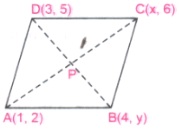
Thus mid-point of AC = Mid-point of BD
\(\begin{aligned} \Rightarrow \quad & \left(\frac{1+x}{2}, \frac{2+6}{2}\right)=\left(\frac{4+3}{2}, \frac{y+5}{2}\right) \\ \end{aligned}\)
\(\begin{aligned} & {\left[\because \text { coordinates of mid-point }=\left(\frac{x_1+x_2}{2}, \frac{y_1+y_2}{2}\right)\right] } \end{aligned}\)
On comparing the coordinate from both sides,we get
\(\frac{1+x}{2}=\frac{4+3}{2} \text { and } \frac{2+6}{2}=\frac{5+y}{2}\)
\(\Rightarrow\) 1 + x = 7 and 8 = 5 + y
\(\therefore\) x = 6 and y = 3
6.
Hint Sum of zeroes = - Coefficient of x/ Coefficient of x2
⇒ -1 = \(\frac{-(2a+3)}{a+1}\) = -2
7.
Let a = 7\(\sqrt5\) be a rational number.
\(\Rightarrow \frac{a}{7}=\sqrt{5}\)
Now, \(\frac{a}{7}\) is a rational number since product of two rational number is a rational number.
The above will imply that \(\sqrt5\) is a rational number. But \(\sqrt5\) is an irrational number.
his contradicts our assumption. Therefore we can conclude that 7\(\sqrt5\) is an irrational number and hence the result.
8.
Given, a pair of linear equations is :
s - t = 3
\(\Rightarrow\) s = t + 3 ....(i)
and \(\frac { s }{ 3 } +\frac { t }{ 2 } =6\) ...(ii)
On substituting s = t + 3, from egn. (i) in eqn. (ii),
we get
\(\\ \frac { t+3 }{ 3 } +\frac { t }{ 2 } =6\)
\(\Rightarrow\) 2(t + 3) + 3t = 36
\(\Rightarrow\) 5t + 6 = 36
\(\Rightarrow\) 5t = 30
\(\Rightarrow\) t = 6
From eqn., (i), s = 6 + 3 = 9
Hence, s = 9, t = 6
9.
p(y) = 6y2 - 7y + 2
\(\alpha +\beta =-\left( -\frac { 7 }{ 6 } \right) =\frac { 7 }{ 6 } \)
and \(\alpha\beta=\frac{2}{6}=\frac{1}{3}\)
Now \(\frac { 1 }{ \alpha } +\frac { 1 }{ \beta } =\frac { \alpha +\beta }{ \alpha \beta } =\frac { { 7 }/{ 6 } }{ { 2 }/{ 6 } } =\frac { 7 }{ 2 } \)
and \(\frac { 1 }{ \alpha } \times \frac { 1 }{ \beta } =\frac { 1 }{ \alpha \beta } =3\)
The required polynomial is \({ y }^{ 2 }-\frac { 7 }{ 2 } y+3=\frac { 1 }{ 2 } \left[ 2{ y }^{ 2 }-7y+6 \right] \)
10.
Given points are A(k, 2-2k), B(-k+1, 2k) and C(-4-k, 6-2k).Here, k is an unknown.
Since given points are collinear.
So, area of \(\Delta \)ABC=0
i.e. x1(y2-y3)+x2(y3-y1)+x3(y1-y2)=0
\(\Rightarrow \) k(2k-6+2k)+(-k+1)(6-2k-2+2k)+(-4-k)(2-2k-2k)=0
\(\Rightarrow \) 4k2-6k+(-k+1)(4)+(-4-k)(2-4k)=0
\(\Rightarrow \) 4k2-6k-4k+4-8+16k-2k+4k2=0
\(\Rightarrow \) 8k2+4k-4=0
\(\Rightarrow \) 2k2+k-1=0 [divide by 4]
\(\Rightarrow \) 2k2+2k-k-1=0
\(\Rightarrow \) 2k(k+1)-1(k+1)=0
\(\Rightarrow \) 2k-1=0 and k+1=0
\(\Rightarrow \) k=\(\frac { 1 }{ 2 } \quad \) and k=-1
Hence, for k=\(\frac { 1 }{ 2 } \) and k=-1, given points are collinear.
11.
Since the given points are collinear, the area of the triangle formed by them must be 0, i.e.,
\(\frac{1}{2}[2(k+3)+4(-3-3)+6(3-k)]=0\)
i.e., \(\frac{1}{2}(-4 k)=0\)
Therefore, k=0
Let us verify our answer.
area of \(\Delta \mathrm{ABC}=\frac{1}{2}[2(0+3)+4(-3-3)+6(3-0)]=0\)
12.
For infinitely many solutions,\(\frac{a_{1}}{a_{2}}=\frac{b_{1}}{b_{2}}=\frac{q}{c_{2}}\)
\(\Rightarrow \frac{4}{k+2}=\frac{7}{21}=\frac{-10}{-3 k} \Rightarrow \frac{4}{k+2}=\frac{7}{21} \Rightarrow k=10\)
13.
Let the ten’s and the unit’s digits in the first number be x and y, respectively. So, the first number may be written as 10x + y in the expanded form (for example, 56 = 10(5) + 6).
When the digits are reversed, x becomes the unit’s digit and y becomes the ten’s digit. This number, in the expanded notation is 10y + x (for example, when 56 is reversed, we get 65 = 10(6) + 5).
According to the given condition.
(10x + y) + (10y + x) = 66
i.e., 11(x + y) = 66
i.e., x + y = 6 ...(1)
We are also given that the digits differ by 2, therefore,
either, x – y = 2 ...(2)
or y – x = 2 ...(3)
If x – y = 2, then solving (1) and (2) by elimination, we get x = 4 and y = 2.
In this case, we get the number 42.
If y – x = 2, then solving (1) and (3) by elimination, we get x = 2 and y = 4.
In this case, we get the number 24.
Thus, there are two such numbers 42 and 24.
Verification : Here 42 + 24 = 66 and 4 – 2 = 2. Also 24 + 42 = 66 and 4 – 2 = 2.
14.
Since \(\alpha\) and \(\beta\) are the zeroes of polynomial p(x) = 3x2 + 2x + 1
Hence, \(\alpha+\beta=-\frac{2}{3}\)
and \(\alpha\beta=\frac{1}{3}\)
Now for the new polynomial,
Sum of the zeroes = \(\frac { 1-\alpha }{ 1+\alpha } +\frac { 1-\beta}{ 1+\beta} \)
\(=\frac { \left( 1-\alpha +\beta -\alpha \beta \right) +\left( 1+\alpha -\beta -\alpha \beta \right) }{ \left( 1+\alpha \right) \left( 1+\beta \right) } \)
\(=\frac { 2-2\alpha \beta }{ \left( 1+\alpha +\beta +\alpha \beta \right) } =\frac { 2-\frac { 2 }{ 3 } }{ 1-\frac { 2 }{ 3 } +\frac { 1 }{ 3 } } \)
\(\therefore\) Sum of zeroes \(=\frac { { 4 }/{ 3 } }{ { 2 }/{ 3 } } =2\)
Product of zeroes \(=\left[ \frac { 1-\alpha }{ 1+\alpha } \right] \left[ \frac { 1-\beta }{ 1+\beta } \right] \)
\(=\frac { \left( 1-\alpha \right) \left( 1-\beta \right) }{ \left( 1+\alpha \right) \left( 1+\beta \right) } \)
\(=\frac { 1-\alpha -\beta +\alpha \beta }{ 1+\alpha +\beta +\alpha \beta } =\frac { 1-\left( \alpha +\beta \right) +\alpha \beta }{ 1+\left( \alpha +\beta \right) +\alpha \beta } \)
\(\therefore\) Product of zeroes \(=\frac { 1+\frac { 2 }{ 3 } +\frac { 1 }{ 3 } }{ 1-\frac { 2 }{ 3 } +\frac { 1 }{ 3 } } =\frac { \frac { 6 }{ 3 } }{ \frac { 2 }{ 3 } } =3\)
Hence, Required polynomial = x2 - (Sum of zeroes)x + Product of zeroes
= x2 - 2x + 3
15.
We have, 12, 15 and 21
\(\therefore\) 12 = 2 \(\times\) 2 \(\times\) 3 = 22 \(\times\) 3
15 = 3 \(\times\) 5 and 21 = 3 \(\times\) 7
Here, 3 is a common prime factor of the given numbers and has smallest power 1.
\(\therefore\) HCF of 12, 15 and 21 = 3
and LCM = Product of each prime factor, with greatest power
= 22 \(\times\)3 \(\times\) 5 \(\times\) 7
= 2 \(\times\) 2 \(\times\) 3 \(\times\) 5 \(\times\) 7 = 420
16.
(d)
-2
17.
(a)
\(\frac{15}{4}\)
18.
(c)
√a+b =1
19.
(d)
are coincident
20.
(a)
-b/a
21.
(d)
composite number
22.
(i) (c): Mid-point of J (6,17) and I (9,16) is
\(x=\frac{6+9}{2} \text { and } y=\frac{17+16}{2}\)
\(x=\frac{15}{2} \text { and } y=\frac{33}{2}\)
(ii) (a): In the top view figure, when we draw perpendicular from point P to the Y-axis, its distance is 4 units.
(iii) (c): In the front view figure, it is clear the coordinates of A and S are A(1, 8) and (17, 8) The distance between the points A and S is
\(\sqrt{(17-1)^{2}+(8-8)^{2}}\)
\(=\sqrt{16^{2}}=16\)
(iv) (d): In the front view figure, the coordinates of A and B are A(1 ,8) and B(5, 10)
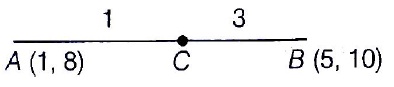
Let C be point, which divides the line joining A and B in the ratio 1:3
By using internal division formula
\(C=\left(\frac{1 \times 5+3 \times 1}{1+3}, \frac{1 \times 10+3 \times 8}{1+3}\right)=\left(\frac{5+3}{4}, \frac{10+24}{4}\right)\)
\(=\left(\frac{8}{4}, \frac{34}{4}\right)=(2,8.5)\)
(v) (b): Let Point be P(x,y)
PQ2 = PS2
or, \((x-9)^{2}+(y-8)^{2}=(x-17)^{2}+(y-8)^{2}\)
\(\Rightarrow x^{2}-18 x+81=x^{2}-34 x+289\)
\(\Rightarrow\) 34x - 18x = 289 - 81
\(\Rightarrow\) 16x - 208
\(\Rightarrow\) x - 13 = 0
23.
(i) (b): Given, a and \(\beta\) are the zeroes of
\(p(x)=x^{2}-24 x+128\)
\(\text { Putting } p(x)=0 \text { , we get }\)
\( x^{2}-8 x-16 x+128=0 \)
\(\Rightarrow x(x-8)-16(x-8)=0 \)
\(\Rightarrow (x-8)(x-16)=0 \Rightarrow x=8 \text { or } x=16 \)
\(\therefore \alpha=8, \beta=16\)
(ii) (c) : \(\alpha+\beta+\alpha \beta =8+16+(8)(16) =24+128=152 \)
(iii) (d) : \(p(2)=2^{2}-2 4(2)+128=4-48+128=84\)
(iv) (a): Since a and \(\beta\) are zeroes of \(x^{2}+x-2\)
\(\therefore \quad \alpha+\beta=-1 \text { and } \alpha \beta=-2 \)
\(\text { Now, } \frac{1}{\alpha}+\frac{1}{\beta}=\frac{\beta+\alpha}{\alpha \beta}=\frac{-1}{-2}=\frac{1}{2}\)
(v) (c): Sum of zeroes \(=\frac{-2}{k}\)
Product of zeroes \(=\frac{3 k}{k}=3\)
According to question, we have \(\frac{-2}{k}=3\)
\(\Rightarrow \quad k=\frac{-2}{3}\)

10th Standard CBSE Syllabus & Materials
10th Standard CBSE
CBSE 10th Social Science PS - Federalism - New Model Questions Papers Study Material - QB365 Set A
NEW10th Standard CBSE
CBSE 10th Social Science PS - Power Sharing - New Model Questions Papers Study Material - QB365 Set A
NEW10th Standard CBSE
CBSE 10th Social Science GEO - Manufacturing Industries - New Model Questions Papers Study Material - QB365 Set A
NEW10th Standard CBSE
CBSE 10th Social Science GEO - Minerals and Energy Resources - New Model Questions Papers Study Material - QB365 Set A



NCERT Books

Syllabus

Exam Pattern

Sample Question Papers

Previous year Question Papers

Important Notes

MCQ Practice test

NCERT Exemplers

Case study Questions

Image Based Questions

Passage based Questions

HOT Questions

Value Based Questions

Model Questions Papers
NCERT ( Book Back ) Questions

Assertion and Reason
Important Questions And Answers

CBSE 10th Standard CBSE Subjects
CBSE Standards



