
 100% FREE ACCESS
10th Standard CBSE Syllabus & Materials
10th Standard CBSE
CBSE 10th Social Science ECO - Globalisation and the Indian Economy - New Model Questions Papers Study Material - QB365 Set A
NEW10th Standard CBSE
CBSE 10th Social Science ECO - Money and Credit - New Model Questions Papers Study Material - QB365 Set A
NEW10th Standard CBSE
CBSE 10th Social Science ECO - Sectors of the Indian Economy - New Model Questions Papers Study Material - QB365 Set A
NEW10th Standard CBSE
CBSE 10th Social Science ECO - Development - New Model Questions Papers Study Material - QB365 Set A
NEW10th Standard CBSE
CBSE 10th Social Science PS - Outcomes of Democracy - New Model Questions Papers Study Material - QB365 Set A
NEW10th Standard CBSE
CBSE 10th Social Science PS - Gender, Religion and Caste - New Model Questions Papers Study Material - QB365 Set A

Published on: 20/10/2025
Download CBSE Class 10th Standard CBSE Maths question papers, sample papers, important questions, and previous year solved papers in PDF format. Get free study materials, NCERT solutions, and exam preparation resources for Class 10th Standard CBSE Maths
Questions + Answers key
Take MCQ Maths Test
1.
A polynomial is given by q(x) = x3 - 2x2 - 9x + k where k is a constant.The sum of two zeroes of g (x) is zero. Using the relationship between the zeroes and coefficients of a polynomial, find the
(i) zeroes of q(x).
(ii) value of k.
Show your steps
2.
Find the zeroes of the following quadratic polynomials and verify the relationship between the zeroes and the coefficients
3x2 – x – 4
3.
Find the zeroes of the following quadratic polynomials and verify the relationship between the zeroe and the coefficients.
t2 – 15
4.
Find the zeroes of the following quadratic polynomials and verify the relationship between the zeroes and the coefficients.
4u2 + 8u
5.
If \(\alpha\ and\ \beta \)are the zeroes of the quadratic polynomial f(x) = x2 -3x -2, find a polynomial whose zeroes are \(\frac{2\alpha}{\beta}\ and\ \frac{2\beta }{\alpha}\)
6.
If zeros of the polynomial x2+(a+1)x+b are 2 and -3, then find the value of (a+b).
7.
∝,β,⋎ are zeroes of cubic polynomial x3-2x2+qx-r. If ∝+β=0 then show that 2q = r.
8.
The graphs of y = p(x) are given below, for some polynomials p(x). Find the number of zeroes of p(x) in each case.
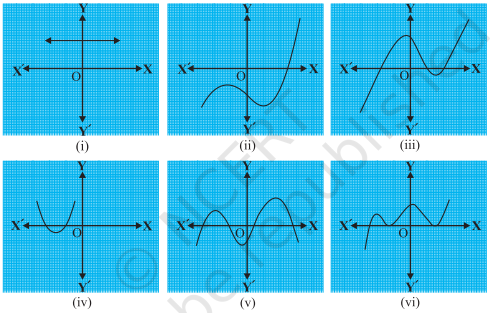
9.
Find the zeroes of the polynomial x2-3 and verify the relationship between the zeroes and the coefficients.
10.
Find the quadratic polynomial, whose sum of zeroes is 8 and their products is 12. Then, find the zeroes of the polynomial.
11.
The zeroes of the quadratic polynomial 2x2 - 3x - 9 are
3, \(\frac{-3}{2}\)
-3, \(\frac{-3}{2}\)
-3, \(\frac{3}{2}\)
3, \(\frac{3}{2}\)
12.
If one of the zeroes of the cubic polynomial ax + bx + cx + d is zero, then product of other two zeroes is
\(\frac{-c}{a}\)
\(\frac{c}{q}\)
0
\(\frac{-b}{a}\)
13.
If the square of difference of the zeroes of the quadratic polynomial x2 + px + 45 is equal to 144, then the value of p is
土9
土12
土15
土18
14.
The graph of a polynomial p(x) cuts the X-axis at 3 points and touches it at 2 other points. The number of zeroes of p(x) is
1
2
3
5
15.
What should be added from the polynomial x2 - 5x + 4, so that 3 is the zero of the resulting polynomial?
1
2
4
5
16.
In the given figure, graph of a polynomial f(x) is shown. The number of zeroes of polynomial f(x) is
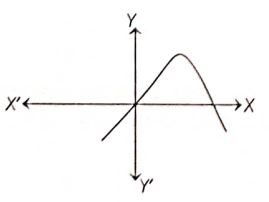
3
1
0
2
17.
If a quadratic polynomial curve in the shape of semi-circle is shown below. Then, the equation of this curve.
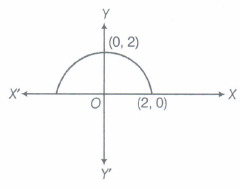
-x2 +2
x2 +2
\(\frac{1}{2}x ^{2}+2\)
\(-\frac{1}{2}x ^{2}+2\)
18.
If one of the zeroes of a quadratic polynomial of the form x2 + ax + b is the negative of the other, then which of the following is correct?
Polynomial has linear factors
Constant term of polynomial is negative
Both (a) and (b) are correct
Neither (a) nor (b) is correct
19.
If α, β, γ be the zeros of the polynomial p(x) such that α+ β+ γ = 3 , αβ+ βγ+ γα = -10 and αβγ = -24 then p(x) is
x3 – 3x2 – 10x – 24
x3 + 3x2 – 10x + 24
x3 + 3x2 + 10x – 24
x3 – 3x2 – 10x + 24
20.
A polynomial of degree 2 is called a
Quadratic polynomial
Binomial
Biquadratic polynomial
Trinomial
21.
If sum of the zeroes of the polynomial is 4 and their product is 4, then the quadratic polynomial is
x2 + 2x + 2
x2 + 4x + 4
x2 – 4x + 4
x2 – 2x + 2
22.
If one root of polynomial equation ax2+bx+c=0 be reciprocal of other, then
a = c
a = 0
b = 0
b = c
23.
Sum and the product of zeroes of the polynomial x2 +7x +10 is
7 and -10
-7 and 10
10/7 and -10/7
7/10 and -7/10
24.
α,β,γ are the zeros of the polynomial 2x3 + x2 – 13x + 6, then the value of αβγ is
-3
-13/2
3
1/2
25.
A fourth degree polynomial is called
Cubic polynomial
A bi-quadratic polynomial
Binomial
Quadratic polynomial
26.
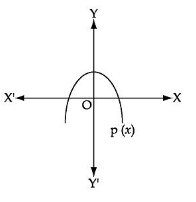
In figure, the graph of a polynomial p (x) is shown, the number of zeroes of p (x) is :
1
0
2
None of these
27.
If the polynomial (2x + 3 ) is a factor of the polynomial 2x3 + 9x2 – x – b. The value of b is_______
10
20
5
15
28.
Given a polynomial p(x) of degree ‘n’, the graph of y = p(x) intersects the X-axis
at most n points
at most n – 1 points
at most n + 1 points
at most 0 points
29.
If one root of the equation (p + q)2 x2 – 2 (p + q) x + k =0 is 5/p+q , then k is
15
50
-15
-50
30.
Which of the following is not the graph of a quadratic polynomial?
-q.png)
-q.png)
-q.png)
-q.png)
31.
Find a quadratic polynomial each with the given numbers as the sum and product of its zeroes respectively.
\(-\frac{1}{4}, \frac{1}{4}\)
32.
Find a quadratic polynomial each with the given numbers as the sum and product of its zeroes respectively.
1, 1
33.
Find a quadratic polynomial each with the given numbers as the sum and product of its zeroes respectively.
\(\frac{1}{4},-1\)
34.
Check whether the g(x) is a factor of the p(x) by applying the division algorithm.
p(x)=2x2 -4x3 + 2x2 + 5x + 1,g(x)=x3-4x + 1
35.
Find all the zeroes of f(x) = x2 - 2x
36.
Shruti is very good in painting. So she thought of exhibiting her paintings in which she want to display her latest painting which is in the form of a graph of a polynomial as shown below:
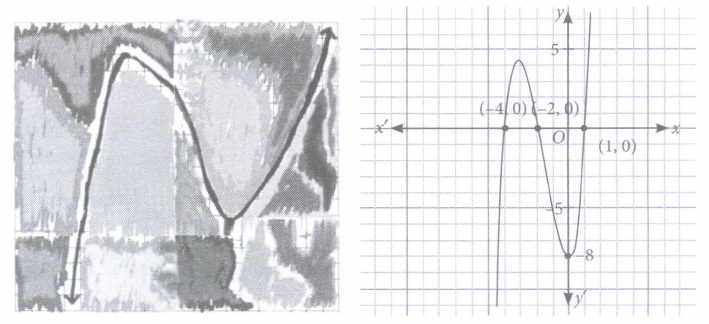
Based on the above information, answer the following questions.
(i) The number of zeroes of the polynomial represented by the graph is
| (a) 1 | (b) 2 | (c) 3 | (d) can't be determined |
(ii) The sum of zeroes of the polynomial represented by the graph is
| (a) -4 | (b) -3 | (c) 2 | (d) -5 |
(iii) Find the value of the polynomial represented by the graph when x = 0.
| (a) -6 | (b) -8 | (c) 6 | (d) 8 |
(iv) The polynomial representing the graph drawn in the painting by Shruti is a
| (a) quadratic polynomial | (b) cubic polynomial |
| (c) bi-quadratic polynomial | (d) linear polynomial |
(v) The sum of product of zeroes, taken two at a time, of the polynomial represented by the graph is
| (a) 2 | (b) 3 | (c) -2 | (d) -3 |
37.
Just before the morning assembly a teacher of kindergarten school observes some clouds in the sky and so she cancels the assembly. She also observes that the clouds has a shape of the polynomial. The mathematical representation of a cloud is shown in the figure.
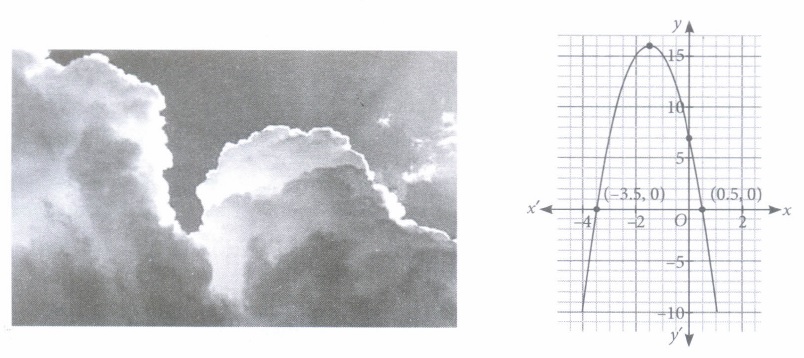
(i) Find the zeroes of the polynomial represented by the graph.
| (a) -1/2,7/2 | (b) 1/2, -7/2 | (c) -1/2, -7/2 | (d) 1/2,7/2 |
(ii) What will be the expression for the polynomial represented by the graph?
| \((a) p(x)=12 x^{2}-4 x-7\) | \((b) p(x)=-x^{2}-12 x+3\) | \((c) p(x)=4 x^{2}+12 x+7\) | \((d) p(x)=-4 x^{2}-12 x+7\) |
(iii) What will be the value of polynomial represented by the graph, when x = 3?
| (a) 65 | (b) -65 | (c) 68 | (d) -68 |
(iv) If a and \(\beta\) are the zeroes of the polynomial \(f(x)=x^{2}+2 x-8 \text { , then } \alpha^{4}+\beta^{4}=\)
| (a) 262 | (b) 252 | (c) 272 | (d) 282 |
(v) Find a quadratic polynomial where sum and product of its zeroes are 0,\(\sqrt (7)\) respectively.
| \((a) k\left(x^{2}+\sqrt{7}\right)\) | \((b) k\left(x^{2}-\sqrt{7}\right)\) | \((c) k\left(x^{2}+\sqrt{5}\right)\) | (d) none of these |
38.
ABC construction company got the contract of making speed humps on roads. Speed humps are parabolic in shape and prevents overspeeding, mini mise accidents and gives a chance for pedestrians to cross the road. The mathematical representation of a speed hump is shown in the given graph.
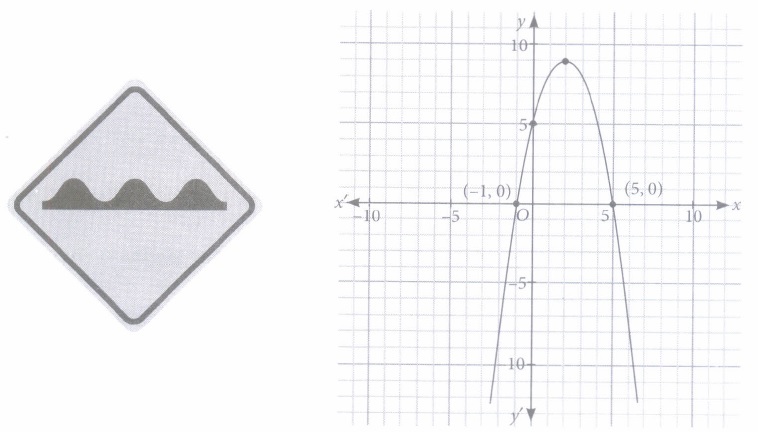
Based on the above information, answer the following questions.
(i) The polynomial represented by the graph can be _______polynomial.
| (a) Linear | (b) Quadratic |
| (c) Cubic | (d) Zero |
(ii) The zeroes of the polynomial represented by the graph are
| (a) 1,5 | (b) 1,-5 |
| (c) -1,5 | (d) -1,-5 |
(iii) The sum of zeroes of the polynomial represented by the graph are
| (a) 4 | (b) 5 | (c) 6 | (d) 7 |
(iv) If a and β are the zeroes of the polynomial represented by the graph such that \(\beta>\alpha, \text { then }|8 \alpha+\beta|=\)
| (a) 1 | (b) 2 | (c) 3 | (d) 4 |
(v) The expression of the polynomial represented by the graph is
| \(\text { (a) }-x^{2}-4 x-5\) | \((b) x^{2}+4 x+5\) | \((c) x^{2}+4 x-5\) | \((d) -x^{2}+4 x+5\) |
1.
(i) Assume the values of zeroes of q(x) as \((-\alpha), \alpha\) and \(\beta\).
Write the sum of zeroes as
\(-\alpha+\alpha+\beta=2 \Rightarrow \beta=2\)
Writes the equation for the sum of the products of zeroes taken two at a time as:
\((-\alpha \times \alpha)+\alpha \beta+(-\alpha) \beta=-9\)
\( \Rightarrow \quad-\alpha^2-\alpha \beta+\beta \alpha=-9 \Rightarrow \alpha^2=9 \Rightarrow \alpha= \pm 3\)
Thus, 3 zeroes of q(x) are (-3), 3 and 2 .
(ii) Product of zeroes of given polynomial is \( (-\alpha)(\alpha) \beta =-k \)
\(\Rightarrow (-3)(3)(2) =-k \Rightarrow-18=-k \)
\(\therefore k =18\)
2.
3x2 – x – 4 = 3x2 – 4x + 3x – 4
= x(3x - 4) +1(3x - 4)
=(3x - 4)(x +1)
The zeroes of the polynomial are {4/3, -1}
Relationship between the zeroes and the coefficient of the polynomial:
Also sum of the zeroes = \(\frac{4}{3}-1=\frac{4-3}{3}=\frac{1}{3}\)
Also product of the zeroes = \(\frac{4}{3} x-1=-\frac{4}{3}\)
Hence verified.
3.
Let p(t) = t2 - 15 = t2 - \(\left ( \sqrt{15} \right )^{2}\)
= (t - \(\sqrt{15}\))(t + \(\sqrt{15}\)) [\(\because\) a2 - b2 = (a - b) (a + b)]
To find zeroes, put p(t) = 0
\(\Rightarrow (t-\sqrt{15})(t+\sqrt{15})=0\)
\(\Rightarrow t-\sqrt{15}=0\) or t + \(\sqrt{15}\) = 0 \(\Rightarrow\) t = \(\sqrt{15}\) or t = -\(\sqrt{15}\)
Hence, zeroes of the given polynomial are -\(\sqrt{15}\) and \(\sqrt{15}\).
Verification
Hence, sum of zeroes = -\(\sqrt{15}\) + \(\sqrt{15}\) = 0 = -(0/1)
\(=-\frac{Coefficient \quad of \quad t}{Coefficient \quad of \quad t^{2}}\)
and product of zeroes = -\(\sqrt{15}\) \(\times\)\(\sqrt{15}\)= -15 = \(\frac{-15}{1}\)
\(=\frac{Constant \quad term}{Coefficient \quad of \quad t^{2}}\)
So, the relationship between the zeroes and its coefficients is verified.
4.
Let p(u) = 4u2 + 8u = 4u(u+2)
To find zeroes, put p(u) = 0
\(\Rightarrow\) 4u(u+2) = 0 \(\Rightarrow\) u = 0 or u + 2 = 0 [\(\because\) 4 \(\neq\)0]
\(\Rightarrow\) u = 0 or u = -2
Hence, zeroes of the given polynonial are 0 and -2.
Verification
Here, sum of zeroes = 0 - 2 = -2 = -(8/4)
=-\(\frac{Coefficient \quad of \quad u}{Coefficient \quad of \quad u^{2}}\)
and product of zeroes
=0 \(\times\)-2 = 0 = (0/4) = \(\frac{Constant \quad term}{Coefficient \quad of \quad u^{2}}\)
so, the relationship between the zeroes and its coefficients is verified.
5.
We have, \(\alpha+\beta=3\) and \(\alpha \beta=-2\) Now, required polynomial is given by
\(x^{2}-\left(\frac{2 \alpha}{\beta}+\frac{2 \beta}{\alpha}\right) x+\left(\frac{2 \alpha}{\beta}\right) \cdot\left(\frac{2 \beta}{\alpha}\right)\)
\(=x^{2}-2\left(\frac{\alpha^{2}+\beta^{2}}{\alpha \beta}\right) x+4\)
\(=x^{2} - 2\left(\frac{(\alpha+\beta)^{2}-2 \alpha \beta}{\alpha \beta}\right) x+4\)
Ans.x2+ 13x+ 4
6.
Given, 2 and -3 are the zeros of x2+(a+1)x+b.
On putting x=2, we get
(2)2+(a+1)2+b=0
⇒ 4+2a+2+b=0
⇒ 2a+b=6 ..(i)
Again putting x=-3, we get
(-3)2+(a+1)(-3)+b=0
⇒ 9-3a-3+b=0
⇒ -3a+b=-6 ..(ii)
On subtracting Eq. (ii) from Eq. (i), we get
5a=0⇒a=0
On putting a=0 in Eq. (ii), we get
-3(0)+b=-6⇒0+b=-6⇒b=6
Now, a+b=0-6=-6
Hence, the value of (a+b) is -6.
7.
p(x)=x3-2x2+qx-r
Here,a =1,b = -2,c = q,d= -r
Sum of zeroes=\(\frac{-b}{a}\) ⇒ ∝+β+Y=\(\frac{-(-2)}{1}\)=2
⇒ 0+Y=2
⇒ Y=2...(i)
Also ∝β+βY+∝Y=\(\frac{c}{a}\) ⇒ ∝β+Υ(∝+β)=\(\frac{q}{r}\)
⇒ ∝β+Υx0=q ⇒ ∝β=q...(ii)
and ∝.β.Υ=\(\frac{-d}{a}\)
⇒ q.2=-(-r)
⇒ 2q=r
8.
(i) Here, the graph of y = p(x) does not intersect the X-axis, so p(x) has no zero.
(ii) The number of zeros is one, as the graph of y = p(x) intersects the X-axis at one point only.
(iii) The number of zeros is three, as the graph of y = p(x) intersects the X-axis at three points.
(iv) The number of zeros is two, as the graph of y = p(x) intersects the X-axis at two points.
(v) The number of zeros is four, as the graph of y = p(x) intersects the X-axis at four points.
(vi) The number of zeros is three, as the graph of y = p(x) intersects the X-axis at three points.
9.
Recall the identity a2 - b2 = (a - b)(a + b). Using it, we can write:
x2 - 3 = (x - \(\sqrt{3}\))(x + \(\sqrt{3}\))
So, the value of x2 - 3 is zero when x = \(\sqrt{3}\) or x = -\(\sqrt{3}\)
Therefore, the zeroes of x2 - 3 are \(\sqrt{3}\) and -\(\sqrt{3}\)
Now,
sum of zeroes = \(\sqrt{3}\) - \(\sqrt{3}\) = 0 = \(\frac{-(Coefficient \quad of \quad x)}{Coefficient \quad of \quad x^{2}}\)
product of zeroes = (\(\sqrt{3}\))(-\(\sqrt{3}\)) = -3 = \(\frac{-3}{1}=\frac{Constant \quad term}{Coefficient \quad of \quad x^{2}}\)
10.
Now, for finding zeroes, put x2-8x+12=0
⇒ (x-6)(x-2)=0⇒ x=2, 6
Hence, the required quadratic polynomial is x2-8x+12 and their zeroes are 2 and 6.
11.
(a)
3, \(\frac{-3}{2}\)
12.
(a)
\(\frac{-c}{a}\)
13.
(d)
土18
14.
(d)
5
15.
(b)
2
16.
(d)
2
17.
(a)
-x2 +2
18.
(c)
Both (a) and (b) are correct
19.
(d)
x3 – 3x2 – 10x + 24
20.
(a)
Quadratic polynomial
21.
(c)
x2 – 4x + 4
22.
(a)
a = c
23.
(b)
-7 and 10
24.
(a)
-3
25.
(b)
A bi-quadratic polynomial
26.
(c)
2
27.
(d)
15
28.
(a)
at most n points
29.
(b)
50
30.
(d)
31.
\(-\frac{1}{4}, \frac{1}{4}\)
Let the quadratic polynomial be ax2 + bx + c, and its zeroes be α + ß
Given \(\alpha+\beta=-\frac{1}{4}=-\frac{b}{a}\)
\(\alpha \beta=\frac{1}{4}=\frac{c}{a}\)
If a = 4, b = 1, c = 1
Therefore, the quadratic polynomial is 4x2 + x +1.
32.
Let the quadratic polynomial be ax2 + bx + c, and its zeroes be α and ß
Given \(\alpha+\beta=-\frac{b}{a}=1\)
\(\alpha \beta=\frac{c}{a}=1\)
If a = 1, b = -1, and c = 1
Therefore, the quadratic polynomial is x2 – x +1.
33.
Given, sum of zeroes = 1/4 and product of zeroes = -1
Then, the quadratic polynomial
=x2 - (sum of zeroes)x + product of zeroes
\(=x^{2}-\left ( \frac{1}{4} \right )x-1=x^{2}-\frac{x}{4}-1=\frac{4x^{2}-x-4}{4}\)
We can consider 4x2 - x - 4 as required quadratic polynomial because it will also staisfy the given conditions.
34.
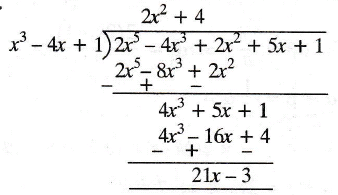
Remainder=21x-3≠0
∴ g(x) is not a factor of p(x).
35.
f(x) = x2 - 2x
= x(x - 2)
i.e. f(x) = 0 \(\Rightarrow \) x = 0 or x = 2
Hence zeroes are 0 & 2.
36.
(i) (c) :Since the graph intersect the x-axis at 3 points, therefore the polynomial has 3 zeroes.
(ii) (d): Clearly the graph intersect the x-axis at x = -4, x = -2 and x = 1, therefore the zeroes are -4, -2 and 1. Now, the sum of zeroes = -4 - 2 + 1 = -5
(iii) (b): From the graph, it can be seen that When x = 0, then y = -8.
(iv) (b): Since there are 3 zeroes, therefore the graph represents a cubic polynomial.
(v) (a): The sum of product of zeroes taken two at a time = (-4)(-2) + (-2)(1) + (1)(-4) = 8 - 2 - 4 = 2
37.
(i) (b): Since the graph of the polynomial intersect the x-axis at \(x=\frac{1}{2}, \frac{-7}{2}\), therefore required zeroes of the polynomial are \(\frac{1}{2} \text { and } \frac{-7}{2}\)
(ii) (d): \(\because \frac{1}{2} \text { and } \frac{-7}{2}\) are the zeroes of the polynomial.
So, at \(x=\frac{1}{2}, \frac{-7}{2}\) the value of the polynomial will be 0.
From options, required polynomial is
p(x) = -4x2 - 12x + 7
(iii) (b) : we have, \(p(x)=-4 x^{2}-12 x+7\)
\(\therefore \quad p(3)=-4(3)^{2}-12(3)+7=-36-36+7=-65
\)
(iv) (c): Here \(f(x)=x^{2}+2 x-8 \text { and } \alpha, \beta \text { are its zeroes. }\)
\(\therefore \quad \alpha+\beta=-2 \text { and } \alpha \beta=-8 \)
\(\text { Now, } \alpha^{4}+\beta^{4}=\left(\alpha^{2}+\beta^{2}\right)^{2}-2 \alpha^{2} \beta^{2} \)
\(=\left((\alpha+\beta)^{2}-2 \alpha \beta\right)^{2}-2(\alpha \beta)^{2} \)
\(=\left[(-2)^{2}-2(-8)\right]^{2}-2(-8)^{2} \)
\(=[4+16]^{2}-2(-8)^{2}=(20)^{2}-2(64) \)
\(=400-128=272\)
(v) (a): We have sum of zeroes = 0 and product of zeroes = \(\sqrt(7)\)
So, required polynomial .\(=k\left(x^{2}-0 \cdot x+\sqrt{7}\right) \)
\(=k\left(x^{2}+\sqrt{7}\right)\)
38.
(i) (b): Since, the given graph is parabolic is shape, therefore it will represent a quadratic polynomial.
[\(\therefore\) Graph of quadratic polynomial is parabolic in shape 1
(ii) (c): Since, the graph cuts the x-axis at -1, 5. So the polynomial has 2 zeroes i.e., -1 and 5.
(iii) (a) : Sum of zeroes = -1 + 5 = 4
(iv) (c): Since a and β are zeroes of the given polynomial and β > a
\(\therefore\)a = - 1 and β = 5.
\(\therefore|8 \alpha+\beta|=|8(-1)+5|=|-8+5|=|-3|=3 .\)
(v) (d): Since the zeroes of the given polynomial are - 1 and 5.
\(\therefore\) Required polynomial p(x)
= k{ x2 -(-1 + 5)x + (-1)(5)} = k(.x2 - 4x - 5)
For k = -1, we get
p(x) = -.x2 + 4x + 5, which is the required polynomial.

10th Standard CBSE Syllabus & Materials
10th Standard CBSE
CBSE 10th Social Science PS - Federalism - New Model Questions Papers Study Material - QB365 Set A
NEW10th Standard CBSE
CBSE 10th Social Science PS - Power Sharing - New Model Questions Papers Study Material - QB365 Set A
NEW10th Standard CBSE
CBSE 10th Social Science GEO - Manufacturing Industries - New Model Questions Papers Study Material - QB365 Set A
NEW10th Standard CBSE
CBSE 10th Social Science GEO - Minerals and Energy Resources - New Model Questions Papers Study Material - QB365 Set A



NCERT Books

Syllabus

Exam Pattern

Sample Question Papers

Previous year Question Papers

Important Notes

MCQ Practice test

NCERT Exemplers

Case study Questions

Image Based Questions

Passage based Questions

HOT Questions

Value Based Questions

Model Questions Papers
NCERT ( Book Back ) Questions

Assertion and Reason
Important Questions And Answers

CBSE 10th Standard CBSE Subjects
CBSE Standards



