
 100% FREE ACCESS
10th Standard CBSE Syllabus & Materials
10th Standard CBSE
CBSE 10th Social Science ECO - Globalisation and the Indian Economy - New Model Questions Papers Study Material - QB365 Set A
NEW10th Standard CBSE
CBSE 10th Social Science ECO - Money and Credit - New Model Questions Papers Study Material - QB365 Set A
NEW10th Standard CBSE
CBSE 10th Social Science ECO - Sectors of the Indian Economy - New Model Questions Papers Study Material - QB365 Set A
NEW10th Standard CBSE
CBSE 10th Social Science ECO - Development - New Model Questions Papers Study Material - QB365 Set A
NEW10th Standard CBSE
CBSE 10th Social Science PS - Outcomes of Democracy - New Model Questions Papers Study Material - QB365 Set A
NEW10th Standard CBSE
CBSE 10th Social Science PS - Gender, Religion and Caste - New Model Questions Papers Study Material - QB365 Set A

Published on: 20/10/2025
Download CBSE Class 10th Standard CBSE Maths question papers, sample papers, important questions, and previous year solved papers in PDF format. Get free study materials, NCERT solutions, and exam preparation resources for Class 10th Standard CBSE Maths
Questions + Answers key
Take MCQ Maths Test
1.
Find the discriminant of the equation \(3 x^{2}-2 x+\frac{1}{3}=0\) and hence find the nature of its roots. Find them, if they are real.
2.
Check whether the following are quadratic equations: (x+1)2=2(x-3)
3.
Find a quadratic polynomial each with the given numbers as the sum and product of its zeroes respectively.
4, 1
4.
Find a quadratic polynomial each with the given numbers as the sum and product of its zeroes respectively.
1, 1
5.
Find a quadratic polynomial each with the given numbers as the sum and product of its zeroes respectively.
\(\sqrt{2}, \frac{1}{3}\)
6.
Find the zeroes of the quadratic polynomial x2 + 7x + 10, and verify the relationship between the zeroes and the coefficients.
7.
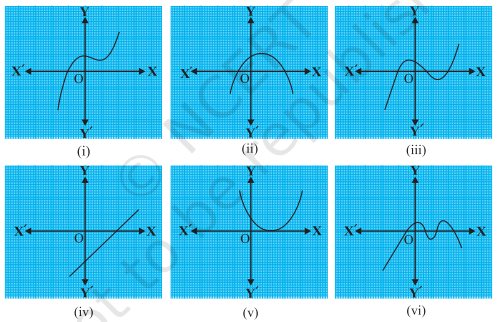
Look at the graphs in Fig. given below. Each is the graph of y = p(x), where p(x) is a polynomial. For each of the graphs, find the number of zeroes of p(x)
8.
solve for x : \(\sqrt {2} x^{2} + 7x + 5 \sqrt {2} = 0\)
9.
The perimeter of a right triangle is 60 cm. Its hypotenuse is 25 cm. Find the area of the triangle.
10.
Find the positive root of \(\sqrt {4x^{2}} + 9 = 5.\)
11.
If the quadratic equation \(x^{2} + 4x + k = 0, \) has real and distinct roots, find the value of k.
12.
Two years ago, my age was three times the square of my daughter's age. In three years time from now my age would be four times my daughter's age. Find our present ages.
13.
For what value of k, are the roots of the quadratic equation \((k - 12) x^{2} (k - 12 ) x + 2 = 0\) equal ?
14.
Find the roots of the quadratic equation \(3\sqrt {2}x^{2} - 5x - \sqrt {2} = 0\) by factorisation method.
15.
Two numbers are positive. The larger is 1 less than twice the other. The product of the two numbers is 91. What are the numbers?
16.
The sum of the squares of two consecutive natural numbers is 313.Find the numbers.
17.
Find two positive consecutive numbers such that the sum of their squares is 61.
18.
If equation x2-(2+m)x+(-m2-4m-4)=0 has coincident roots then find the value of m.
19.
Find the value of \(\alpha\) such that the quadratic equation \((\alpha-12)x^2+2(\alpha-12)x+2=0\) has equal roots.
20.
A quadratic equation ax2+bx+c=0, \(a\ne0\) has equal roots. What is the value of D?
21.
Find the roots of the following quadratic equations by applying the quadratic formula: \(4x^2+4\sqrt3+3=0\)
22.
Find the roots of the following quadratic equations by fractorisation: \( \sqrt2x^2+7x+5\sqrt2=0\)
23.
Represents the following situation in the form of quadratic equations: Rohan's mother is 26 years older than him, The product of their ages (in years) 3 years from now will be 360. We would like to find Rohan's present age.
24.
Represent the following situations in the form of quadratic equations :
The product of two consecutive positive integers is 306. We need to find the integers.
25.
Check whether the following are quadratic equations: (x+2)3=2x(x2-1)
26.
The same value of x satisfies the equations 4x + 5 = 0 and 4x2 + (5 + 3p)x + 3p2=0, then p is
0 or 5/4
¼ or ½
0 or ¼
0 or ½
27.
For what value of k, the equation kx2 – 6x – 2 = 0 has equal roots?
-9/2
-7/2
7/2
-3
28.
If x = 1 is a root of equation x2 – Kx + 5 = 0 then value of K is
5
6
4
-6
29.
If the equation px2 – 6x – 2 = 0 has real roots then, ________
p ≥ -9/2
p > -9/2
p < -9/2
p ≤ -9/2
30.
Which of the following is a root of the equation x2-3√3 +6 = 0?
3
√2
√3
2
31.
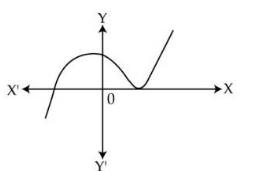
The graph of y = p(x) is given below. The number of zeroes of p(x) are
3
0
4
2
32.
The value of quadratic polynomial f (x)=2x2– 3x- 2 at x =-2 is
15
16
-12
12
33.
The graph of the polynomial f(x) = 2x – 5 crosses the X-axis at the point
(1, -3)
(5/2, 0)
(0, 0)
(4, 3)
34.
The number of polynomials having zeroes -2 and 5 is:
1
3
2
more than 3
35.
If 1 is a zero of the polynomial p(a)=x2a2-2xa+3x-2 . Then x=
-1, -2
2, 1
2,-1
-2, 1
1.
Here a = 3, b = - 2 and \(c=\frac{1}{3} \text { . }\)
Therefore, discriminant b2 - 4ac = (-2)2 - 4 x 3 x \(\frac{1}{3}\) = 4 - 4 = 0.
Hence, the given quadratic equation has two equal real roots.
The roots are \(\frac{-b}{2 a}, \frac{-b}{2 a}, \text { i.e., } \frac{2}{6}, \frac{2}{6}, \text { i.e., } \frac{1}{3}, \frac{1}{3} .\)
2.
(x+1)2=2(x-3)
x2+2x+1=2x-6
x2+2x-2x+1+6=0
x2+7=0
Which is of the form ax2+bx+c=0. Hence the given equation is a quadratic equation.
3.
Let the quadratic polynomial be ax2 + bx + c, and its zeroes be α and ß
Given \(\alpha+B=4=-\frac{b}{a}\)
\(\alpha \beta=1=\frac{c}{a}\)
If a = 1, then b = -4, c = 1
Therefore, the quadratic polynomial is x2 – 4x +1.
4.
Let the quadratic polynomial be ax2 + bx + c, and its zeroes be α and ß
Given \(\alpha+\beta=-\frac{b}{a}=1\)
\(\alpha \beta=\frac{c}{a}=1\)
If a = 1, b = -1, and c = 1
Therefore, the quadratic polynomial is x2 – x +1.
5.
Let the polynomial be ax2 + bx + c, and its zeroes be α and ß
Given \(\alpha+\beta=\sqrt{2}=\frac{-b}{a}\)
\(\alpha \beta=\frac{1}{3}=\frac{c}{a}\)
If a = 3, then \(b=\sqrt{2}\) and c = 1/3
Therefore, the quadratic polynomial is \(3 x^{2}-3 \sqrt{2} x+1\).
6.
We have
x2 + 7x + 10 = (x + 2)(x + 5)
So, the value of x2 + 7x + 10 is zero when x + 2 = 0 or x + 5 = 0, i.e., when x = – 2 or x = –5. Therefore, the zeroes of x2 + 7x + 10 are – 2 and – 5. Now,
sum of zeroes = \(-2+(-5)=-(7)=\frac{-(7)}{1}=\frac{-(\text { Coefficient of } x)}{\text { Coefficient of } x^{2}}\)
product of zeroes = \((-2) \times(-5)=10=\frac{10}{1}=\frac{\text { Constant term }}{\text { Coefficient of } x^{2}}\)
7.
(i) The number of zeroes is 1 as the graph intersects the x-axis at one point only.
(ii) The number of zeroes is 2 as the graph intersects the x-axis at two points.
(iii) The number of zeroes is 3. (Why?)
(iv) The number of zeroes is 1. (Why?)
(v) The number of zeroes is 1. (Why?)
(vi) The number of zeroes is 4. (Why?)
8.
\(\sqrt { 2x^{ 2 } } +7x+5\sqrt { 2 } =0\)
\(\Rightarrow \sqrt { 2 } x^{ 2 }+2x+5x+5\sqrt { 2 } =0\)
\(\Rightarrow \sqrt { 2x } (x+\sqrt { 2 } )+5(x+\sqrt { 2 } )=0\)
\(\Rightarrow (x+\sqrt { 2 } )(\sqrt { 2x } +5)=0\)
\(\Rightarrow \) Either \(x+\sqrt { 2 } =0\) or \(\sqrt { 2x } +5=0\)
\(\Rightarrow x=\sqrt { 2 } \) or \(x=-\frac { 5 }{ \sqrt { 2 } } \)
9.
Here, the perimeter of a right triangle= 60 cm
Length of the hypotenuse = 25 cm
Let the base of the right triangle be x cm
\(\therefore \) Perpendicular of the right triangle = 60 - 25 -x
= (35 - x) cm
By using Pythagoras Theorem, we have
x2+(35-x)2= (25)2
\(\Rightarrow x^{ 2 }+(35-x)^{ 2 }=(25)^{ 2 }\)
\(\Rightarrow x^{ 2 }+1225+x^{ 2 }-70x=625\)
\(\Rightarrow 2x^{ 2 }-70x+600=0\)
or x2-35x+300=0
x2-15x-20x+300=0
\(\Rightarrow x(x-15)-20x(x-15)=0\)
\(\Rightarrow (x-15)(x-20)=0\)
\(\Rightarrow x=15\) or x=20
When x = 15, Base = 15 cm, Altitude = 35 - 15 = 20 cm
When x = 20, Base = 20 cm Altitude 15 cm
Now, area of the right triangle
\(=\frac { 1 }{ 2 } \)x Base x altitude
\(=\frac { 1 }{ 2 } \) x15x20 or \(\frac { 1 }{ 2 } \) x20x15
= 150 cm2
10.
2
11.
k < 4
12.
29 years, 5 years
13.
k = 14
14.
\(-{\sqrt {2}\over 6} , \sqrt{2}\)
15.
13 , 7
16.
12 , 13
17.
5 , 6
18.
For coincident roots,D=0
\(\Rightarrow \) [-(2+m)]2-4X1(-m2-4m-4)=0
\(\Rightarrow \) (2+m)2+4(m2+4m+4)=0
\(\Rightarrow \) (2+m)2+4(m+2)2=0
\(\Rightarrow \) 5(2+m)2=0
\(\Rightarrow \) (2+m)2=0
\(\Rightarrow \) m=-2
19.
Here a= \(\alpha -12,b=2(\alpha -12),c=2\)
For equal roots D=0 \(\Rightarrow \) b2-4ac=0
\(\Rightarrow \) [2( \(\alpha -12)]^{ 2 }\) -4X[2 \(\alpha -12)]=0\)
\(2(\alpha -12)[2\alpha -12)]=0\)
\(\Rightarrow \left( \alpha -12 \right) [(2\alpha -12)-4]=0\)
\(\Rightarrow \alpha =12,14\)
\(\alpha =12\) is not possible take \(\alpha =14\)
20.
For equal roots, D = 0.
21.
This is of the form ax2+bx+c=0, where a=4, b=4\(\sqrt { 3 } \) and c=3.
Discriminant(D)=b2-4ac=\({ \left( 4\sqrt { 3 } \right) }^{ 2 }\)-4 x 4 x 3=48-48=0
Roots are \(\alpha =\frac { -b+\sqrt { D } }{ 2a } =\frac { -4\sqrt { 3 } +0 }{ 8 } =\frac { -4\sqrt { 3 } }{ 8 } =\frac { -\sqrt { 3 } }{ 8 } \)
and \(\beta =\frac { -b-\sqrt { D } }{ 2a } =\frac { -4\sqrt { 3 } -0 }{ 8 } =\frac { -4\sqrt { 3 } }{ 8 } =\frac { -\sqrt { 3 } }{ 2 } \)
Hence, the roots are \(\frac { -\sqrt { 3 } }{ 2 } ,\frac { -\sqrt { 3 } }{ 2 } \)
22.
Given, equation is \( \sqrt2x^2+7x+5\sqrt2=0\)
\(\Rightarrow\) \( \sqrt2x^2+5x+2x+5\sqrt2=0\) [\(\because\) 5 \(\times\)2 = 10 and 5 + 2 = 7]
\(\Rightarrow\)\(x(\sqrt2x+5)+\sqrt2(\sqrt2x+5)=0\)
\(\Rightarrow\) (\(\sqrt{2}\)x + 5) (x + \(\sqrt{2}\)) = 0
\(\Rightarrow\) \(\sqrt{2}\)x+5 = 0 or x + \(\sqrt{2}\) = 0
\(\Rightarrow\) x=\(\frac{-5}{\sqrt{2}}\) or x = -\(\sqrt{2}\)
Hence, the roots of the equation
\(\sqrt{2} x^2+7 x+5 \sqrt{2}=0 \text { are } \frac{-5}{\sqrt{2}} \text { and }-\sqrt{2} \text {. }\)
23.
Let present age of Rohan be x years.
Rohan's mother's present age be (x+26+3)years.
After 3 years, Rohan's age = (x+3) years.
After 3 years, Rohan's mother's age= (x+26+3)years
ATQ (x+3)(x+29)=360
x2+32x-273=0
Which is the required quadratic equation.
24.
Let the two consecutive positive integers be x and x+1
Then, according to the question,
x(x+1) = 306 \(\Rightarrow\) x2 + x = 306
\(\Rightarrow\) x2 + x - 306 = 0,
Which is the required quadratic equation.
25.
Given, equation is (x+2)3=2x(x2-1)
\(\Rightarrow\) x3 + 8 + 3x2(2) + 3x (2)2 = 2x3 - 2x
[\(\because\) (a + b)3 = a3 + b3 + 3a2b + 3ab2]
\(\Rightarrow\) x3 + 8 + 6x2 + 12x = 2x3 - 2x
\(\Rightarrow\) x3 + 8 + 6x2 + 12x - 2x3 + 2x = 0
\(\Rightarrow\) -x3 + 6x2 + 14x + 8 = 0
which is not of the form ax2 + bx + c = 0,
because it has cubic term, i.e. x3.
\(\therefore\) It is not a quadratic equation.
26.
(a)
0 or 5/4
27.
(a)
-9/2
28.
(b)
6
29.
(a)
p ≥ -9/2
30.
(c)
√3
31.
(c)
4
32.
(d)
12
33.
(b)
(5/2, 0)
34.
(d)
more than 3
35.
(d)
-2, 1

10th Standard CBSE Syllabus & Materials
10th Standard CBSE
CBSE 10th Social Science PS - Federalism - New Model Questions Papers Study Material - QB365 Set A
NEW10th Standard CBSE
CBSE 10th Social Science PS - Power Sharing - New Model Questions Papers Study Material - QB365 Set A
NEW10th Standard CBSE
CBSE 10th Social Science GEO - Manufacturing Industries - New Model Questions Papers Study Material - QB365 Set A
NEW10th Standard CBSE
CBSE 10th Social Science GEO - Minerals and Energy Resources - New Model Questions Papers Study Material - QB365 Set A



NCERT Books

Syllabus

Exam Pattern

Sample Question Papers

Previous year Question Papers

Important Notes

MCQ Practice test

NCERT Exemplers

Case study Questions

Image Based Questions

Passage based Questions

HOT Questions

Value Based Questions

Model Questions Papers
NCERT ( Book Back ) Questions

Assertion and Reason
Important Questions And Answers

CBSE 10th Standard CBSE Subjects
CBSE Standards



