
 100% FREE ACCESS
10th Standard CBSE Syllabus & Materials
10th Standard CBSE
CBSE 10th Social Science ECO - Globalisation and the Indian Economy - New Model Questions Papers Study Material - QB365 Set A
NEW10th Standard CBSE
CBSE 10th Social Science ECO - Money and Credit - New Model Questions Papers Study Material - QB365 Set A
NEW10th Standard CBSE
CBSE 10th Social Science ECO - Sectors of the Indian Economy - New Model Questions Papers Study Material - QB365 Set A
NEW10th Standard CBSE
CBSE 10th Social Science ECO - Development - New Model Questions Papers Study Material - QB365 Set A
NEW10th Standard CBSE
CBSE 10th Social Science PS - Outcomes of Democracy - New Model Questions Papers Study Material - QB365 Set A
NEW10th Standard CBSE
CBSE 10th Social Science PS - Gender, Religion and Caste - New Model Questions Papers Study Material - QB365 Set A

Published on: 20/10/2025
Download CBSE Class 10th Standard CBSE Maths question papers, sample papers, important questions, and previous year solved papers in PDF format. Get free study materials, NCERT solutions, and exam preparation resources for Class 10th Standard CBSE Maths
Questions + Answers key
Take MCQ Maths Test
1.
Sides of triangles are given below. Determine which of them are right triangles. In case of a right triangle, write the length of its hypotenuse.
50 cm, 80 cm, 100 cm
2.
If m and n are the zeroes of the polynomial 3x2+11x-4, then find the value of \(\frac { m }{ n } +\frac { n }{ m } \) .
3.
A bag contains 6 red, 3 black and 6 white balls. A ball si selected at random from the bag. Find the probability that the selected ball is
(i) red or black
(ii) not black
4.
Find the next term of the A.P. \(\sqrt { 3 } ,\sqrt { 12 } ,\sqrt { 27 } \), .........
5.
Solve for x: \(\sqrt{2x+9}+x=13\)
6.
CD and GH are respectively the bisectors of ∠ACB and ∠EGF such that D and H lie on sides AB and FE of ΔABC and ΔEFG respectively. If ΔABC ~ ΔFEG, Show that
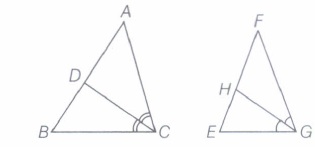
ΔDCA ~ ΔHGF
7.
Weekly income of 600 families is given below
| Income (in Rs) | 0-1000 | 1000-2000 | 2000-3000 | 3000-4000 | 4000-5000 | 5000-6000 |
| No of Families | 250 | 190 | 100 | 40 | 15 | 5 |
8.
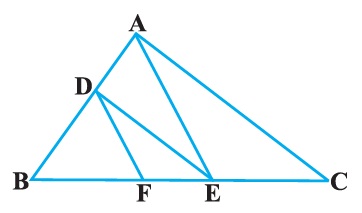
In the given figure, if DE II AC and DF II AE. Prove that \(\frac { BF }{ FE } =\frac { BE }{ EC } .\)
9.
Solve the following quadratic equation for x
\(p^{ 2 }x^{ 2 }+(p^{ 3 }-q^{ 2 })xq^{ 2 }=0\)
10.
A box contains 19 balls bearing numbers 1, 2, 3, ..., 19. A ball is drawn at random from the box. What is the probability that the number on the ball is
(i) a prime number (ii) divisible by 3 or 5
(iii) neither divisible by 5 nor by 10 (iv) an even number
11.
Two arithmetic progressions have the same first term. The common difference of one progression is 4 more than the other progression, 124th term of the first arithmetic progression is the same as 42nd term of the second. Find one set of possible values of the common differences, Show your work,
12.
A bag contains 6 red, 4 black and some white balls.
(i) Find the number of white balls in the bag, if the probability of drawing a white ball is 1/3.
(ii) How many red balls should be removed from the bag for the probability of drawing a white ball to be \(\frac{1}{2}\)?
13.
In a flight of 2800 km, an aircraft was slowed down due to bad weather. Its average speed is reduced by 100 km/h and by doing so, the time of flight is increased by 30 min. Find the original duration of the flight.
14.
Determine the mean of the following distribution.
| Marks | Number of students |
|---|---|
| Below 10 | 5 |
| Below 20 | 9 |
| Below 30 | 17 |
| Below 40 | 29 |
| Below 50 | 45 |
| Below 60 | 60 |
| Below 70 | 70 |
| Below 80 | 78 |
| Below 90 | 83 |
| Below 100 | 85 |
15.
State whether the given pairs of triangles are similar or not. In case of similarity, mention the criterion.
-q.png)
-q.png)
16.
The origin divides the line segment AB joining the points A (1, -3) and B(3, 9) in the ratio
3 : 1
1 : 3
2 : 3
1 : 1
17.
The values of k for which the roots of quadratic equation \(x^2+4 x+k=0\) are real, is
\(k \geq 4\)
\(k \leq 4\)
\(k \geq-4\)
\(k \leq-4\)
18.
The probability of guessing the correct answer to a certain test question is \(\frac{x}{6}\). If the probability of not guessing the correct answer to this question is \(\frac{2}{3}\), then the value of x is
2
3
4
6
19.
In an AP,if d = - 4,n = 7 and an = 4,thena is equal to
6
7
20
28
20.
The polynomial [(x) = ax3 + bx - c is divisible by the polynomial g(x) = x2 + bx + c, c \(\neq\) 0, if
ab = 2
ab = 1
ac = 2
c = 2b
21.
The remainder on dividing given integers a and b by 7 are respectively 5 and 4. Then, the remainder when ab is divided by 7 is
5
4
0
6
22.
Find the sum of first 40 integers divisible by 6
4000
4920
2460
4290
23.
The mean and median of same data are 24 and 26 respectively. The value of mode is :
23
25
30
26
24.
In the given figure, T and B are right angles. If the lengths of AT, BC and AS (in centimeters) are 15, 16 and 17 respectively, then the length of TC (in centimeters) is:
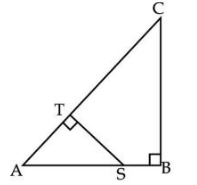
18
12
19
16
25.
The sum of two digits and the number formed by interchanging its digit is 110. If ten is subtracted from the first number, the new number is 4 more than 5 times of the sum of the digits in the first number. Find the first number
46
48
64
84
26.
If n is a positive integer , then n2 – n is always
multiple of 2 and 4
odd or even
odd
even
27.
Length of line joining two points (1, 2) and (4, 8) is
3
9
?45
45
28.
The probability of happening of an event is P. The maximum and minimum values of p are
max(p) = 4, min(p) = 1
max (p) = 3, min (p) = 2
max (p) = 1, min (p) = 0
max (p) = 2, min (p) = 3
29.
To enhance the reading skills of grade X students, the school nominates you and two of your friends to set up a class library. There are two sections- section A and Section B of grade X. There are 32 students in section A and 36 students in section B.
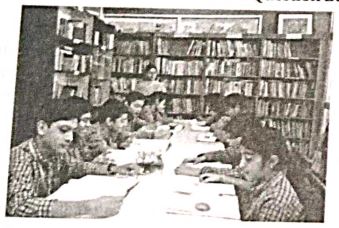
(i) What is the minimum number of books you will acquire for the class library, so that they can be distributed equally among students of section A or section B?
(a) 144 (b) 128
(c) 288 (d) 272
(ii) If the product of two positive integers is equal to the product of their HCF and LCM is true, then the HCF (32, 36) is
(a) 2 (b) 4 (c) 6 (d) 8
(iii) 36 can be expressed as a product of its primes as
(a) 22 \(\times\)32 (b) 21 \(\times\)33 (c) 23 \(\times\)31 (d) 20 \(\times\)30
(iv) 7 \(\times\) 11 \(\times\)13 \(\times\)15 +15 is a
(a) prime number
(b) composite number
(c) neither prime nor composite
(d) None of the above
(v) If p and q are positive integers such that p=ab2 and q= a2b, where a and b are prime numbers, then the LCM (p, q) is
(a) ab (b) a2b2 (c) a3b2 (d) a3b3
30.
If p(x) is a quadratic polynomial i.e., p(x) = ax2- + bx + c, \(a \neq 0\), then p(x) = 0 is called a quadratic equation. Now, answer the following questions.
(i) Which of the following is correct about the quadratic equation ax2- + bx + c = 0 ?
| (a) a, band c are real numbers, \(c \neq 0\) | (b) a, band c are rational numbers, \(a \neq 0\) |
| (c) a, band c are integers, a, band \(c \neq 0\) | (d) a, band c are real numbers, \(a \neq 0\) |
(ii) The degree of a quadratic equation is
| (a) 1 | (b) 2 | (c) 3 | (d) other than 1 |
(iii) Which of the following is a quadratic equation?
| (a) x(x + 3) + 7 = 5x - 11 | (b) (x - 1)2 - 9 = (x - 4)(x + 3) |
| (c) x2-(2x + 1) - 4 = 5x2- 10 | (d) x(x - 1)(x + 7) = x(6x - 9) |
(iv) Which of the following is incorrect about the quadratic equation ax2- + bx + c = 0 ?
| (a) If a\(\alpha\)2 + b\(\alpha\). + c = 0, then x = -\(\alpha\) is the solution of the given quadratic equation. |
| (b)The additive inverse of zeroes of the polynomial ax2- + bx + c is the roots of the given equation. |
| (c) If a is a root of the given quadratic equation, then its other root is -\(\alpha\). |
| (d) All of these |
(v) Which of the following is not a method of finding solutions of the given quadratic equation?
| (a) Factorisation method | (b) Completing the square method |
| (c) Formula method | (d) None of these |
31.
A part of monthly hostel charges in a college is fixed and the remaining depends on the number of days one has taken food in the mess. When a student Anu takes food for 25 days, she has to pay Rs 4500 as hostel charges, whereas another student Bindu who takes food for 30 days, has to pay Rs 5200 as hostel charges.
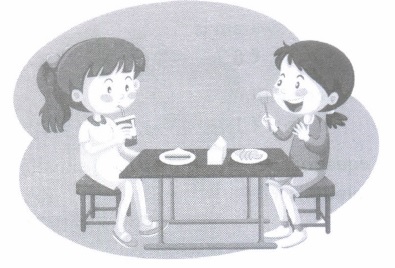
Considering the fixed charges per month by Rs x and the cost of food per day by Rs y, then answer the following questions.
(i) Represent algebraically the situation faced by both Anu and Bindu.
| (a) x + 25y = 4500, x + 30y = 5200 | (b) 25x + y = 4500, 30x + Y = 5200 |
| (c) x - 25y = 4500, x - 30y = 5200 | (d) 25x - y = 4500, 30x - Y = 5200 |
(ii) The system of linear equations, represented by above situations has
| (a) No solution | (b) Unique solution |
| (c) Infinitely many solutions | (d) None of these |
(iii) The cost of food per day is
| (a) Rs 120 | (b) Rs 130 | (c) Rs 140 | (d) Rs 1300 |
(iv) The fixed charges per month for the hostel is
| (a) Rs 1500 | (b) Rs 1200 | (c) Rs 1000 | (d) Rs 1300 |
(v) If Bindu takes food for 20 days, then what amount she has to pay?
| (a) Rs 4000 | (b) Rs 3500 | (c) Rs 3600 | (d) Rs 3800 |
32.
Assertion When two coins are tossed together, the probability of getting no tail is \(\frac{1}{4}\).
Reason The probability P(E) of an event Esatisfies \(0 \leq P(E) \leq 1\).
(a) Both Assertion and Reason are correct and Reason is the correct explanation of Assertion.
(b) Both Assertion and Reason are correct but Reason is not the correct explanation of Assertion.
(c) Assertion is correct but Reason is incorrect.
(d) Assertion is incorrect but Reason is correct.
33.
Assertion (A) The point which divides the line segment joining the points A (1, 2) and B(-1, 1) internally in the ratio 1 : 2 is \(\left(\frac{-1}{3}, \frac{5}{3}\right)\)
Reason (R) The coordinates of the point which divides the line segment joining the points A (x1, y1 )and B (x2, y2 ) in the ratio m1 : m2 are \(\left(\frac{m_1 x_2+m_2 x_1}{m_1+m_2}, \frac{m_1 y_2+m_2 y_1}{m_1+m_2}\right)\)
(a) Both Assertion (A) and Reason (R) are true and Reason (R) is the correct explanation of the Assertion (A).
(b) Both Assertion (A) and Reason (R) are true but Reason (R) is not correct explanation ot the Assertion (A).
(c) Assertion (A) is true but Reason (R) is false.
(d) Assertion (A) is false but Reason (R) is true.
1.
Given that sides are 50 cm, 80 cm, and 100 cm.
Squaring the lengths of these sides, we will obtain 2500, 6400, and 10000.
However, 2500 + 6400 ≠ 10000
Or, 502 + 802 ≠ 1002
Clearly, the sum of the squares of the lengths of two sides is not equal to the square of the length of the third side.
Therefore, the given triangle is not satisfying Pythagoras theorem.
Hence, it is not a right triangle.
2.
\(-\frac { 145 }{ 12 } \)
3.
(i) \(\frac{3}{5}\) (ii) \(\frac{4}{5}\)
4.
Here, \(a=\sqrt { 3 } ,\ d-\sqrt { 12 } -\sqrt { 3 } =2\sqrt { 3 } -\sqrt { 3 } =\sqrt { 3 } \)
Next term to \(\sqrt { 27 } =\sqrt { 27 } +\sqrt { 3 } =3\sqrt { 3 } +\sqrt { 3 } =4\sqrt { 3 } \)
\(=\sqrt { 3\times 16 } =\sqrt { 48 } \)
5.
Here \(\sqrt { 2x+9 } +x=13\)
\(\Rightarrow \sqrt { 2x+9 } =13-x\)
On squaring both side, we get
\(\left( \sqrt { 2x+9 } \right) ^{ 2 }=(13-x)^{ 2 }\)
\(\Rightarrow 2x+9=169+x^{ 2 }-26x\)
\(\Rightarrow x^{ 2 }-28x+160=0\)
\(\Rightarrow x^{ 2 }-20x-8x+160=0\)
\(\Rightarrow (x-20)(x-8)=0\)
\(\Rightarrow \) x = 20 or x = 8
6.
In ΔDCA = ΔHGF,
∠DAC = ∠HFG ......(i)
\(\left[\begin{array}{l} \because \quad \Delta A B C \sim \Delta F E G \\ \therefore \angle C A B=\angle G F E \\ \Rightarrow \angle C A D=\angle G F H \text { or } \angle D A C=\angle H F G \end{array}\right]\)
and ∠DCA = ∠HGF ........(ii)
\(\left[\begin{array}{l} \because \Delta A B C \sim \Delta F E G \\ \therefore \angle A C B=\angle F G E \\ \Rightarrow \frac{1}{2} \angle A C B=\frac{1}{2} \angle F G E \Rightarrow \angle D C A=\angle H G F \end{array}\right]\)
From Eqs. (i) and (ii),
ΔDCA - ΔHGF [by AA similarity criterion)
7.
| Income | No of families | c.f |
| 0-1000 | 250 | 250 |
| 1000-2000 | 190 | 440 |
| 2000-3000 | 100 | 540 |
| 3000-4000 | 40 | 580 |
| 4000-5000 | 15 | 595 |
| 5000-6000 | 5 | 600 |
\(N=600\Rightarrow \frac { N }{ 2 } =300\)
Median class= 1000-2000
\(Median\quad =\quad l+\left( \frac { \frac { N }{ 2 } -c.f }{ f } \right) \times h\)
\(Median\quad =\quad 1000+\left( \frac { 300-250 }{ 190 } \right) \times 1000\)
\(=1000+\frac { 50 }{ 190 } \times 1000\)
=1000+263.16=1263.16
Median = Rs 1263.16
8.
In \(\triangle\)ABC DE || AC, (Given)
\(\frac { BD }{ DA } =\frac { BE }{ EC } \quad \quad \quad (BPT)\quad ...(i)\)
In \(\triangle\)ABE, DF || AE, (Given)
\(\frac { BD }{ DA } =\frac { BF }{ FE } \quad \quad \quad (BPT)\quad ...(ii)\)
From (i) and (ii), we have
\(\frac { BF }{ FE } =\frac { BE }{ EC } \)
Hence proved.
9.
a=p2,b=p2-q2,c=-q2
D=b2-4ac
= (p2 - q2)2-4(p)2(-q)2
= p4+q4-2p3q3+4p2q2
= p4+q4-+2p2q2
=(p2+q2)3
\(x=\frac { -b\pm \sqrt { b^{ 2 }-4ac } }{ 2a } \)
\(\therefore \quad x=\quad \frac { q^{ 2 }-p^{ 2 }\pm \sqrt { p^{ 2 }+q^{ 2 } } }{ 2p^{ 2 } } \)
\(\therefore x_{ 1 }=\frac { q^{ 2 }-p^{ 2 }\pm p^{ 2 }+q^{ 2 } }{ 2p^{ 2 } } =\frac { q^{ 2 } }{ p^{ 2 } } \)
and \(x_{ 2 }=\frac { q^{ 2 }-p^{ 2 }-p^{ 2 }-q^{ 2 } }{ 2p^{ 2 } } =-1\)
The roots are \(\frac { q^{ 2 } }{ p^{ 2 } } -1\)
10.
Total number of balls = 19
(i) Prime numbers from 1 to 19 are 2, 3, 5, 7, 9, 11, 13, 17, 19 = Total 8 prime numbers
\(\therefore\) Probability of drawing a prime number = \(\frac{8}{19}\)
(ii) Numbers divisible by 3 or 5 are 3, 6, 9, 15, 18, 10, 5, 12 = Total 8 numbers
\(\therefore\) Probability of drawing a number divisible by 3 or 5 = \(\frac{8}{19}\)
(iii) Number divisible by 5 and 10 are 5, 10, 15 = Total 3
\(\therefore\) Numbers which are neither divisible by 5 nor 10 are 19 - 3 = 16
\(\therefore\) Probability of drawing a number which is neither divisible by 5 nor by 10 = \(\frac{16}{19}\)
(iv) Even numbers from 1- 19 are 2, 4, 6, 8, 10, 12, 14, 16, 18 [Total 9 even numbers]
\(\therefore\) Probability of drawing an even number = \(\frac{9} {19}\)
11.
Considers \(d_1=d_2+4\) or \(d_2=d_1+4\), where \(d_1\) and \(d_2\) are the common differences of the two arithmetic progressions.
Also, \(a_{124}=b_{42} \Rightarrow a_1+123 d_1=b_1+41 d_2\) where \(a_1, a_{124}, b_1\) and \(b_{42}\) are the \(1 \mathrm{st}, 124 \mathrm{th}, 1\) st and 42 nd terms of the two arithmetic progressions, respectively.
\(\Rightarrow \quad a_1+123 d_1=a_1+41 d_2 \quad\left[\because a_1=b_1\right]\)
Solve the above two equations and the value of \(d_1=-2\) and \(d_2=-6\) or \(d_1=2\) and \(d_2=6\).
One set of possible value of common difference is as follows
\(a_{124} =b_{42} \)
\(\Rightarrow a_1+123\left(4+d_2\right) =b_1+41 d_2\)
\(\Rightarrow \quad 492+123 d_2 =41 d_2 \Rightarrow d_2=-6\)
12.
(i) Let number of white balls be n.
Total number of balls = 6 + 4 + n = 10 + n
Let E be the event of drawing a white ball.
Given, \(P(E)=\frac{1}{3}\)
\(\begin{aligned}
\Rightarrow \frac{\text { Number of outcomes favourable to } E}{\text { Total number of outcomes }}=\frac{1}{3}
\end{aligned}\)
\(\begin{aligned}
\Rightarrow \quad \frac{n}{10+n}=\frac{1}{3} \Rightarrow n=5
\end{aligned}\)
(ii) Now, total number of balls = 10 + n = 10 + 5 = 15
Let x red balls are removed from the bag.
\(\therefore\) Total number of balls in the bag = 15 - x
Now, \(\begin{gathered}
P(E)=\frac{1}{2}
\end{gathered}\)
\(\begin{gathered}
\Rightarrow
\frac{5}{15-x}=\frac{1}{2}
\end{gathered}\)
\(\Rightarrow\) x = 5
13.
Total distance to be travelled by aircraft = 2800 km
Let the original average speed be x km/h.
Original duration of the flight = \(\frac{2800}{x} \mathrm{~h}\)
It is given that the average speed is reduced by 100 km/h.
So, the reduced average speed = (x - 100) km/h
Time taken to cover the distance at the reduced
\(\text { speed }=\frac{2800}{x-100} h\)
According to the given condition,
\(\frac{2800}{x-100}-\frac{2800}{x}=\frac{30}{60}\)
\(\Rightarrow \frac{2800 x-2800 x+280000}{x(x-100)}=\frac{1}{2}\)
\(\Rightarrow\) x(x-100) = 560000
\(\Rightarrow\) x2 - 100x - 560000 = 0
\(\Rightarrow\) x2 - 800x + 700x - 560000 = 0
\(\Rightarrow\) x(x - 800) + 700(x - 800) = 0
\(\Rightarrow\) (x - 800) (x + 700) = 0
\(\Rightarrow\) x = 800, x \(\neq\)- 700 [speed cannot be negative]
\(\Rightarrow\) x = 800
\(\therefore\) Original duration of flight = \(\frac{2800}{800} h=\frac{7}{2} h=3 \frac{1}{2} h\)
14.
Here, we observe that 5 students have scored marks below 10, i.e it lies between class interval 0-10 and 9 students have scored marks below 20.
So, (9-5)=4 students lie in the class interval 10-20. Continuing in the same manner, we get the following frequency distribution table for given data.
| Marks | Number of students (fi) | Class marks (xi) | \(=\frac { x_{ i }^{ u_{ i } }-45 }{ h } \) | fiui |
|---|---|---|---|---|
| 0-10 | 5 | 5 | -4 | -20 |
| 10-20 | 9-5=4 | 15 | -3 | -12 |
| 20-30 | 17-9=8 | 25 | -2 | -16 |
| 30-40 | 29-17=12 | 35 | -1 | -12 |
| 40-50 | 45-29=16 | 45 | 0 | 0 |
| 50-60 | 60-45=15 | 55 | 1 | 15 |
| 60-70 | 70-60=10 | 65 | 2 | 20 |
| 70-80 | 78-70=8 | 75 | 3 | 24 |
| 80-90 | 83-78=5 | 85 | 4 | 20 |
| 90-100 | 85-83=2 | 95 | 5 | 10 |
| Total | \(n=\sum { f_{ i } } =85\) | \(\sum { f_{ i }u_{ i } } =29\) |
Here, assumed mean(a)=45 and class width (h)=10
By step deviation method,
Mean \(\left( \overline { x } \right) =a+\left\{ \frac { \sum { f_{ i }u_{ i } } }{ \sum { f_{ i } } } \right\} \times h\)
\(=45+\left\{ \frac { 29 }{ 85 } \right\} \times 10=45+\frac { 58 }{ 17 } \\ =45+3.41=48.41\)
15.
In Figure (i), corresponding sides are not in proportion.
In Figure (ii), In \(\triangle LMN\)
\(\angle LMN+\angle MNL+\angle MLN\) = 180°
[by angle sum property of a triangle]
45° + \(\angle MNL\) + 57° = 180°
\(\angle MNL\) = 78°
\(\angle QPR=\angle LMN\) = 45°
\(\angle PQR = \angle MNL\) = 78°
So, \(\angle PQR\sim \angle MNL\) [by AA similarity criterion]
16.
(b)
1 : 3
17.
(b)
\(k \leq 4\)
18.
(a)
2
19.
(d)
28
20.
(b)
ab = 1
21.
(d)
6
22.
(b)
4920
23.
(c)
30
24.
(c)
19
25.
(c)
64
26.
(d)
even
27.
Coordinates of midpoint of line joining two points (16, 4) and (36, 6) are:
28.
(c)
max (p) = 1, min (p) = 0
29.
(i) (c) Given, number of students in section A = 32 and number of students in section B = 36 The minimum number of books acquire for the class library
= LCM of (32,36) = 2 \(\times\) 2 \(\times\) 2 \(\times\) 2 \(\times\) 2 \(\times\) 3 \(\times\) 3 = 25 \(\times\) 32= 32 \(\times\) 9 = 288
(ii) (b) Given, product of the two numbers
=LCM \(\times\) HCF
\(\therefore\) 32 \(\times\) 36 = LCM (32, 36) \(\times\) HCF (32, 36)
\(\Rightarrow\) 32 \(\times\) 36 = 288 \(\times\)HCF(32, 36)
\(\Rightarrow \operatorname{HCF}(32,36)=\frac{32 \times 36}{288}=4\)
(iii) (a) The prime factors of 36 are
36 = 2 \(\times\) 2 \(\times\)3 \(\times\) 3 = 22\(\times\) 32
(iv) (b) 7 \(\times\) 11 \(\times\) 13 \(\times\) 15 \(\times\)15 = 15015 + 15 = 15030
Hence, it is a composite number.
(v) (b) Given, p = ab2 and q = a2b
LCM (p, q) = Product of the greatest power of each prime factor involved in the numbers, with highest power
= a2 \(\times\)b2
30.
(i) (d)
(ii) (b)
(iii) (a): x(x + 3) + 7 = 5x - 11
\(\Rightarrow x^{2}+3 x+7=5 x-11\)
\(\Rightarrow x^{2}-2 x+18=0 \) is a quadratic equation.
\((b) (x-1)^{2}-9=(x-4)(x+3)\)
\(\Rightarrow x^{2}-2 x-8=x^{2}-x-12\)
\(\Rightarrow x-4=0\) is not a quadratic equation.
\((c) x^{2}(2 x+1)-4=5 x^{2}-10\)
\(\Rightarrow 2 x^{3}+x^{2}-4=5 x^{2}-10\)
\(\Rightarrow 2 x^{3}-4 x^{2}+6=0\) is not a quadratic equation.
\((d) x(x-1)(x+7)=x(6 x-9)\)
\(\Rightarrow x^{3}+6 x^{2}-7 x=6 x^{2}-9 x\)
\(\Rightarrow x^{3}+2 x=0\) is not a quadratic equation.
(iv) (d)
(v) (d)
31.
(i) (a): For student Anu: Fixed charge + cost of food for 25 days = Rs 4500
i.e., x + 25y = 4500 For student Bindu:
Fixed charges + cost of food for 30 days = Rs 5200
i.e., x + 30y = 5200
(ii) (b): From above, we have a1 = 1, b1, = 25
\(c_{1}=-4500 \text { and } a_{2}=1, b_{2}=30, c_{2}=-5200 \)
\(\therefore \frac{a_{1}}{a_{2}}=1, \frac{b_{1}}{b_{2}}=\frac{25}{30}=\frac{5}{6}, \frac{c_{1}}{c_{2}}=\frac{-4500}{-5200}=\frac{45}{52} \)
\(\Rightarrow \frac{a_{1}}{a_{2}} \neq \frac{b_{1}}{b_{2}} \neq \frac{c_{1}}{c_{2}}\)
Thus, system of linear equations has unique solution
(iii) (c) : We have x + 25y = 4500 .......(i)
and x + 30y = 5200 ........(ii)
Subtracting (i) from (ii), we get
5y=700 \(\Rightarrow\) y=140
\(\therefore\) Cost of food per day is Rs 140
(iv) (c): We have, x + 25y = 4500
\(\Rightarrow\) x = 4500 - 25 x 140
\(\Rightarrow\) x = 4500 - 3500 = 1000
\(\therefore\) Fixed charges per month for the hostel is Rs 1000
(v) (d): We have, x = 1000, Y = 140 and Bindu takes food for 20 days.
\(\therefore\) Amount that Bindu has to pay = Rs (1000 + 20 x 140) = Rs 3800
32.
(b) S = {HH, HT, TH, TT}
Favourable outcomes = {HH}
Total number of outcomes = 4
\(\therefore \text { Probability }=\frac{\text { Number of favourable outcomes }}{\text { Total number of outcomes }}=\frac{1}{4}\)
Reason is true but not correct explanation of Assertion.
33.
(d) Let the point C divides A (1, 2) and B(-1, 1) internally in the ratio 1 : 2.
Then, by section formula, we have
\(x=\frac{m_1 x_2+m_2 x_1}{m_1+m_2} \text { and } y=\frac{m_1 y_2+m_2 y_1}{m_1+m_2}\)
So, \(x=\frac{2 \times 1+1 \times(-1)}{2+1} \text { and } y=\frac{2 \times 2+1 \times 1}{2+1}\)
\(\Rightarrow x=\frac{2-1}{3} \text { and } y=\frac{4+1}{3} \Rightarrow x=\frac{1}{3} \text { and } y=\frac{5}{3}\)
\(\therefore \quad x=\frac{1}{3} \text { and } y=\frac{5}{3}\)
\(\therefore\) Assertion (A) is false but Reason (R) is true.

10th Standard CBSE Syllabus & Materials
10th Standard CBSE
CBSE 10th Social Science PS - Federalism - New Model Questions Papers Study Material - QB365 Set A
NEW10th Standard CBSE
CBSE 10th Social Science PS - Power Sharing - New Model Questions Papers Study Material - QB365 Set A
NEW10th Standard CBSE
CBSE 10th Social Science GEO - Manufacturing Industries - New Model Questions Papers Study Material - QB365 Set A
NEW10th Standard CBSE
CBSE 10th Social Science GEO - Minerals and Energy Resources - New Model Questions Papers Study Material - QB365 Set A



NCERT Books

Syllabus

Exam Pattern

Sample Question Papers

Previous year Question Papers

Important Notes

MCQ Practice test

NCERT Exemplers

Case study Questions

Image Based Questions

Passage based Questions

HOT Questions

Value Based Questions

Model Questions Papers
NCERT ( Book Back ) Questions

Assertion and Reason
Important Questions And Answers

CBSE 10th Standard CBSE Subjects
CBSE Standards



