
 100% FREE ACCESS
10th Standard CBSE Syllabus & Materials
10th Standard CBSE
CBSE 10th Social Science ECO - Globalisation and the Indian Economy - New Model Questions Papers Study Material - QB365 Set A
NEW10th Standard CBSE
CBSE 10th Social Science ECO - Money and Credit - New Model Questions Papers Study Material - QB365 Set A
NEW10th Standard CBSE
CBSE 10th Social Science ECO - Sectors of the Indian Economy - New Model Questions Papers Study Material - QB365 Set A
NEW10th Standard CBSE
CBSE 10th Social Science ECO - Development - New Model Questions Papers Study Material - QB365 Set A
NEW10th Standard CBSE
CBSE 10th Social Science PS - Outcomes of Democracy - New Model Questions Papers Study Material - QB365 Set A
NEW10th Standard CBSE
CBSE 10th Social Science PS - Gender, Religion and Caste - New Model Questions Papers Study Material - QB365 Set A

Published on: 26/10/2025
Download CBSE Class 10th Standard CBSE Maths question papers, sample papers, important questions, and previous year solved papers in PDF format. Get free study materials, NCERT solutions, and exam preparation resources for Class 10th Standard CBSE Maths
Questions + Answers key
Take MCQ Maths Test
1.
A motor bost whose speed is 18km/hr in still water takes 1 hr more to go 24 km upstream than to return downstream to the same spot. Find the speed of the stream.
2.
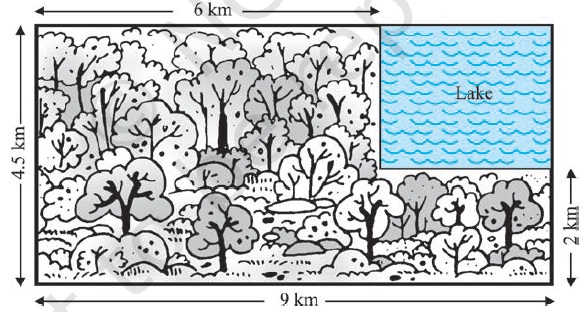
A missing helicopter is reported to have crashed somewhere in the rectangular region shown in Fig. What is the probability that it crashed inside the lake shown in the figure?
3.
Find the roots of the equation 2x2 - 5x + 3 = 0, by factorisation.
4.
Find the values of k for each of the following quadratic equation, so that they have two equal roots \(kx(x-2)+6=0\)
5.
There are 40 students in Class X of a school of whom 25 are girls and 15 are boys. The class teacher has to select one student as a class representative. She writes the name of each student on a separate card, the cards being identical. Then she puts cards in a bag and stirs them thoroughly. She then draws one card from the bag. What is the probability that the name written on the card is the name of (i) a girl? (ii) a boy?
6.
A child's game has 8 triangles of which 3 are blue and rest are red, and 10 squares of which 6 are blue and rest are red. One piece is lost at random. Find the probability that it is a
(i) triangle (ii) square
(iii) square of blue colour (iv) triangle of red colour
7.
Represent the following situations mathematically:
John and Jivanti together have 45 marbles. Both of them lost 5 marbles each, and the product of the number of marbles they now have is 124. We would like to find out how many marbles they had to start with.
8.
A carton consists of 100 shirts of which 88 are good, 8 have minor defects and 4 have major defects. Jimmy, a trader, will only accept the shirts which are good, but Sujatha, another trader, will only reject the shirts which have major defects. One shirt is drawn at random from the carton. What is the probability that
(i) it is acceptable to Jimmy?
(ii) it is acceptable to Sujatha?
9.
Ankita and Nagma are two friends.They were both born in 1990.What is the probability that they have
(i)Same birthday
(ii)Different birthdays?
10.
Find the nature of the roots of the quadratic equation \(3x^{2} + 4x + 1 = 0.\) If the real roots exist, find them.
11.
Find two consecutive positive integers, sum of whose squares in 365.
12.
Represent the following situations mathematically:
A cottage industry produces a certain number of toys in a day. The cost of production of each toy (in rupees) was found to be 55 minus the number of toys produced in a day. On a particular day, the total cost of production was Rs. 750. We would like to find out the number of toys produced on that day.
13.
A child has a die whose six faces show the letters as given below:

The die is thrown once. What is the probability of getting (i) A? (ii) D?
14.
Which of the following experiments have equally likely outcomes? Explain
(i) A driver attempts to start a car. The car starts or does not start.
(ii) A player attempts to shoot a basketball. She/he shoots or misses the shot.
(iii) A trial is made to answer a true-false question. The answer is right or wrong.
(iv) A baby is born. It is a boy or a girl.
15.
State whether the following quadratic equations have two different real roots. Justify your answer. \((x-\sqrt2)^2-2(x+1)=0\)
16.
Is it possible to design a rectangular park of perimeter 80 m and area 400 m2? If so, find its length and breadth.
17.
Find two numbers whose sum is 27 and product is 182.
1.
Hint Let the speed of stream be \(x \mathrm{~km} / \mathrm{h}\).
\(\therefore\) Speed of upstream \(=(18-x) \mathrm{km} / \mathrm{h}\)
and speed of downstream \(=(18+x) \mathrm{km} / \mathrm{h}\)
According to the question, we get
\(\frac{24}{18-x}-\frac{24}{18+x}=1\)
Now, solve it. Ans. Speed of stream \(=6 \mathrm{~km} / \mathrm{h}\)
2.
The helicopter is equally likely to crash anywhere in the region.
Area of the entire region where the helicopter can crash
= (4.5 x 9) km2 = 40.5 km2
Area of the lake = (2.5 x 3) km2 = 7.5 km2
Therefore, P (helicopter crashed in the lake) = \(\frac{7.5}{40.5}=\frac{75}{405}=\frac{5}{27}\)
3.
Let us first split the middle term - 5x as -2x -3x [because (-2x) x (-3x) = 6x2 = (2x2 ) x 3].
So, 2x2 - 5x + 3 = 2x2 - 2x - 3x + 3 = 2x (x - 1) -3(x - 1) = (2x - 3)(x - 1)
Now, 2x2 - 5x + 3 = 0 can be rewritten as (2x - 3)(x - 1) = 0.
So, the values of x for which 2x2 - 5x + 3 = 0 are the same for which (2x - 3)(x - 1) = 0,
i.e., either 2x - 3 = 0 or x - 1 = 0.
Now, 2x - 3 = 0 gives x = \(\frac{3}{2}\) and x - 1 = 0 gives x = 1.
So, x = \(\frac{3}{2}\) and x = 1 are the solutions of the equation.
In other words, 1 and \(\frac{3}{2}\) are the roots of the equation 2x2 - 5x + 3 = 0.
Verify that these are the roots of the given equation.
Note that we have found the roots of 2x2 - 5x + 3 = 0 by factorising 2x2 - 5x + 3 into two linear factors and equating each factor to zero.
4.
kx(x - 2) + 6 = 0
or kx2 - 2kx + 6 = 0
Comparing this equation with ax2 + bx + c = 0, we get
a = k, b = - 2k and c = 6
= ( - 2k)2 - 4 (k) (6)
= 4k2 - 24k
For equal roots,
b2 - 4ac = 0
4k2 - 24k = 0
4k (k - 6) = 0
Either 4k = 0 or
k = 6 = 0
k = 0 or k = 6
However, if k = 0, then the equation will not have the terms 'x2' and 'x'.
Therefore, if this equation has two equal roots, k should be 6 only.
5.
There are 40 students, and only one name card has to be chosen.
(i) The number of all possible outcomes is 40
The number of outcomes favourable for a card with the name of a girl = 25
Therefore, P (card with name of a girl) = P(Girl) = \(\frac{25}{40}=\frac{5}{8}\)
(ii) The number of outcomes favourable for a card with the name of a boy = 15
Therefore, P(card with name of a boy) = P(Boy) \(=\frac{15}{40}=\frac{3}{8}\)
Note : We can also determine P(Boy), by taking
P(Boy) = 1 – P(not Boy) = 1 – P(Girl) \(=1-\frac{5}{8}=\frac{3}{8}\)
6.
Total number of pieces = 8 + 10 = 18
(i) No.of triangles = 8. Hence, P(triangle is lost) = \(\frac{8}{18}=\frac{4}{9}\)
(ii) No.of squares = 10. Hence, P(square is lost) = \(\frac{10}{18}=\frac{5}{9}\)
(iii) No.of squares of blue colour = 6. So, P(square of blue colour is lost) = \(\frac{6}{18}=\frac{1}{3}\)
(iv) No.of triangles of red colour = 8 - 3 = 5. So, P(triangle of red colour is lost) = \(\frac{5}{18}\)
7.
Let the number of marbles John had be x
Then the number of marbles Jivanti had be = 45 – x (Why?).
The number of marbles left with john, when he lost 5 marbles = x – 5
The number of marbles left with Jivanti, when she lost 5 marble = 45 – x – 5 = 40 – x
Therefore, their product = (x – 5) (40 – x)
= 40x – x2 – 200 + 5x
= – x2 + 45x – 200
So, – x2 + 45x – 200 = 124 (Given that product = 124)
i.e., – x2 + 45x – 324 = 0
i.e., x2 – 45x + 324 = 0
Therefore, the number of marbles John had, satisfies the quadratic equation
x2 – 45x + 324 = 0
which is the required representation of the problem mathematically
8.
One shirt is drawn at random from the carton of 100 shirts. Therefore, there are 100 equally likely outcomes
(i) The number of outcomes favourable (i.e., acceptable) to Jimmy = 88 (Why?)
Therefore, P (shirt is acceptable to Jimmy) = \(\frac{88}{100}=0.88\)
(ii) The number of outcomes favourable to Sujatha = 88 + 8 = 96 (Why?)
So, P (shirt is acceptable to Sujatha) = \(\frac{96}{100}=0.96\)
9.
(i)Total number of days in the year 1990=365
Total number of ways in which two friends Ankita and Nagma may have their birthday = 365 x 365,
the number of ways in which both have same birthday = 365
Probability that both have same birthday
\(={365\over 365\times365}={1\over 365}\)
(ii)Probability that both have different birthday
\(=1-{1\over 365}={364\over 365}\)
10.
\(\left[-{1\over 3} , -1\right]\)
11.
Let the two consecutive integers be x and x+1
ATQ x2+(x+1)2=365
\(\Rightarrow\) x2+x2+2x+1=365 \(\Rightarrow\) 2x2+2x-364=0
\(\Rightarrow\) x2+x-182=0 \(\Rightarrow\) x2+14x-13x-182=0
\(\Rightarrow\) x(x+14)-13(x+14)=0 \(\Rightarrow\) (x-13)(x+14)=0
\(\Rightarrow\) x=13, -14 (-14 is rejected because it is a negative integer)
Hence, the two consecutive positive integers are 13 and 13+1=14
12.
Let the number of toys produced on that day be x.
Therefore, the cost of production (in rupees) of each toy that day = 55 – x
So, the total cost of production (in rupees) that day = x (55 – x)
Therefore, x (55 – x) = 750
i.e., 55x – x2 = 750
i.e., – x2 + 55x – 750 = 0
i.e., x2 – 55x + 750 = 0
Therefore, the number of toys produced that day satisfies the quadratic equation
x2 – 55x + 750 = 0
which is the required representation of the problem mathematically.
13.
Total number of outcomes in a single throw of a six faces die = 6
(i) Let E1 = Event of getting a letter A
then, number of outcomes favourable to E1 = 2
Hence, probability of getting a letter A,
\(P\left(E_1\right)=\frac{2}{6}=\frac{1}{3}\)
(ii) Let E2 = Event of getting a letter D
Then, number of outcomes favourable to E2 = 1
Hence, probability of getting a letter D,
\(P\left(E_2\right)=\frac{1}{6}\)
14.
(i) The car starts normally but when there is some defect, then car does not start. So, the outcomes are not equally likely.
(ii) The outcomes in this situation are not equally likely because the outcomes depends on many factors such as training ofthe player, quality of basketball, etc.
(iii) The outcomes in trial of true-false question is either true or false. Hence, the two outcomes are equally likely.
(iv) A new baby can be either a boy or a girl, so both the outcomes are equally likely.
15.
Yes x2+2-2 \(\sqrt { 2x } -2x-2=0\)
\(\Rightarrow x^{ 2 }-2(\sqrt { 2 } +1)x=0\)
b2-4ac=4 \(\sqrt { 2 } +1)^{ 2 }\) -4X1X0
4(2+1+\(2\sqrt { 2 } )=12+8\sqrt { 2 } \)
\(\therefore \) D>0 Distinct real roots
16.
Let the breadth of the park be x m.
Given, perimeter of a rectangular park = 80 m
\(\Rightarrow\) 2(Length + Breadth) = 80 m
\(\Rightarrow\) Length + Breadth = 40 m
\(\Rightarrow\) Length = (40 - x)m
Now, area of a rectangular park = Length \(\times\)Breadth
=(40 - x)x m2
But according to the question, area of the rectangular park is 400 m2.
\(\therefore\) (40 - x) x = 400
\(\Rightarrow\) x2 - 40x + 400 = 0
\(\Rightarrow\) x2 - 2x \(\times\) 20 + (20)2 = 0
\(\Rightarrow\) (x - 20)2 = 0 [\(\because\) a2 - 2ab + b2 = (a - b)2]
\(\Rightarrow\) x = 20
thus, breadth of the park = 20 m
and length of the park = 40 - 20 = 20 m
Hence, it is possible to design the rectangular park having perimeter 80 m and area 400 m with equal length and breadth, i.e. 20 m each.
17.
Let one number be x,
Then, another number be 27 - x
[\(\because\) sum of two numbers = 27]
According to the question,
Product of these two numbers = 182
\(\therefore\) x(27-x)=182
\(\Rightarrow\) 27x-x2 = 182
\(\Rightarrow\) x2-27x+182=0
\(\Rightarrow\) x2-14x-13x+182=0
[\(\because\) (-14) \(\times\) (-13) =182 and -14-13=-27
\(\Rightarrow\) x(x-14)-13(x-14)=0 \(\Rightarrow\) (x-14)(x-13)=0
\(\Rightarrow\) x-14 = 0 or x-13 = 0
\(\Rightarrow\) x=14 or x=13
If x = 14, then 27-x= 27-14 =13 and if x=13, then 27-x= 27-13 = 14 Hence, in both cases, the numbers are 13 and 14.

10th Standard CBSE Syllabus & Materials
10th Standard CBSE
CBSE 10th Social Science PS - Federalism - New Model Questions Papers Study Material - QB365 Set A
NEW10th Standard CBSE
CBSE 10th Social Science PS - Power Sharing - New Model Questions Papers Study Material - QB365 Set A
NEW10th Standard CBSE
CBSE 10th Social Science GEO - Manufacturing Industries - New Model Questions Papers Study Material - QB365 Set A
NEW10th Standard CBSE
CBSE 10th Social Science GEO - Minerals and Energy Resources - New Model Questions Papers Study Material - QB365 Set A



NCERT Books

Syllabus

Exam Pattern

Sample Question Papers

Previous year Question Papers

Important Notes

MCQ Practice test

NCERT Exemplers

Case study Questions

Image Based Questions

Passage based Questions

HOT Questions

Value Based Questions

Model Questions Papers
NCERT ( Book Back ) Questions

Assertion and Reason
Important Questions And Answers

CBSE 10th Standard CBSE Subjects
CBSE Standards



