
 100% FREE ACCESS
10th Standard CBSE Syllabus & Materials
10th Standard CBSE
CBSE 10th Social Science ECO - Globalisation and the Indian Economy - New Model Questions Papers Study Material - QB365 Set A
NEW10th Standard CBSE
CBSE 10th Social Science ECO - Money and Credit - New Model Questions Papers Study Material - QB365 Set A
NEW10th Standard CBSE
CBSE 10th Social Science ECO - Sectors of the Indian Economy - New Model Questions Papers Study Material - QB365 Set A
NEW10th Standard CBSE
CBSE 10th Social Science ECO - Development - New Model Questions Papers Study Material - QB365 Set A
NEW10th Standard CBSE
CBSE 10th Social Science PS - Outcomes of Democracy - New Model Questions Papers Study Material - QB365 Set A
NEW10th Standard CBSE
CBSE 10th Social Science PS - Gender, Religion and Caste - New Model Questions Papers Study Material - QB365 Set A

Published on: 26/10/2025
Download CBSE Class 10th Standard CBSE Maths question papers, sample papers, important questions, and previous year solved papers in PDF format. Get free study materials, NCERT solutions, and exam preparation resources for Class 10th Standard CBSE Maths
Questions + Answers key
Take MCQ Maths Test
1.
One card is drawn at random from a well-shuffled deck of 52 playing cards. What is the probability of getting a black king?
\(\frac{1}{26}\)
\(\frac{1}{13}\)
\(\frac{1}{52}\)
\(\frac{1}{2}\)
2.
A dice is rolled twice. The probability that 5 will not come up either time is
\(\frac{11}{36}\)
\(\frac{1}{3}\)
\(\frac{13}{36}\)
\(\frac{25}{36}\)
3.
The probability that a leap year has 53 Sundays is
3/7
2/7
1/7
4/7
4.
A bag contains cards which are numbered from 2 to 90. A card is drawn at random from the bag. The probability that it bears a two digit number is:
88/92
81/89
88/90
89/90
5.
If three coins are tossed simultaneously, than the probability of getting at least two heads, is
1/4
3/8
1/2
1/8
6.
The probability that a prime number selected at random from the numbers (1,2,3, ..........35) is
12/35
11/35
13/35
none of these
7.
Which of the following cannot be the probability of an event?
\(\frac{2}{3}\)
-1.5
15%
0.7
8.
Three coins are tossed simultaneously.Find the probability of getting:
(a)Three heads
(b)Exactly 2 heads
(c)At least 2 heads
9.
A box contains 35blue, 25 white and 40 red marbles.If a marble is drawn at random from the box, find the probability that the drawn marble is:
(iWhite
(ii)Not blue
(iii)Neither white nor blue
10.
One card is drawn from a well-shuffled deck of 52 cards. Find the probability of drawing : (i) an ace (ii) '2' spades (iii) '10' of a black suit
11.
A box contains 19 balls bearing numbers 1, 2, 3, ..., 19. A ball is drawn at random from the box. What is the probability that the number on the ball is
(i) a prime number (ii) divisible by 3 or 5
(iii) neither divisible by 5 nor by 10 (iv) an even number
12.
Five cards - the ten, jack, queen, king and ace of diamonds, are well shuffled with their face downwards. One card is then picked up at random.
(i) What is the probability that the card is the queen?
(ii) If the queen is drawn and put a side, what is the probability that the second card picked up is
(a) an ace?
(b) a queen?
13.
All the black face cards are removed from a pack of 52 cards. Find the probability of getting a,
(i) face card
(ii) red card
(iii) black card
(iv) king
14.
A card is drawn at random from a well shuffled deck of playing cards.Find the probability that the card drawn is:
(i)A card of spade or an ace
(ii)A black king
(iii)Neither a jack nor a king
(iv)Either a king or a queen
15.
A child's game has 8 triangles of which 3 are blue and rest are red, and 10 squares of which 6 are blue and rest are red. One piece is lost at random. Find the probability that it is a
(i) triangle (ii) square
(iii) square of blue colour (iv) triangle of red colour
16.
A box contains 90 discs which are numbered from 1 to 90. If one disc is drawn at random from the box, find the probability that is bears
(i) a two digit number
(ii) a perfect square number
(iii) a number divisible by 5
17.
A coin is tossed two times. Find the probability of getting at least one head.
18.
Cards marked with numbers 3, 4, 5, ...., 50 are placed in a box and mixed thoroughly. One card is drawn at random from the box. Find the probability that number on the drawn card is
(i) divisible by 7
(ii) a number which is a perfect square.
19.
A ticket is drawn at random from a bag containing tickets numbered from 1 to 40. Find the probability that the selected ticket has a number,
(i) which is a multiple of 7
(ii) which is a multiple of 5.
20.
Two players, Sangeeta and Reshma, play a tennis match. It is known that the probability of Sangeeta winning the match is 0.62. What is the probability of Reshma winning the match?ncer
21.
Find the probability of getting 53 Fridays in a leap year.
22.
In a toy shop, there is a spinning wheel for their customers. The spinning wheel has different types of prizes as shown in figure. A customer can only spin the wheel after buying something from the shop.
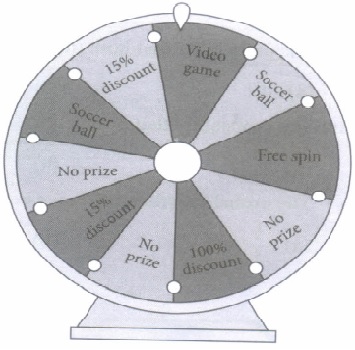
On the basis of above information, answer the following questions.
(i) If Mr Sharma spins the wheel, then the probability that he gets 100% discount is
| (a) 0 | (b) \(\begin{equation} \frac{1}{10} \end{equation}\) |
| (c) \(\begin{equation} \frac{1}{5} \end{equation}\) | (d) \(\begin{equation} \frac{1}{4} \end{equation}\) |
(ii) If Anita spins the wheel, then the probability of getting no prize is
| (a) \(\begin{equation} \frac{1}{10} \end{equation}\) | (b) \(\begin{equation} \frac{1}{5} \end{equation}\) |
| (c) \(\begin{equation} \frac{3}{10} \end{equation}\) | (d) \(\begin{equation} \frac{2}{5} \end{equation}\) |
(iii) Anshu spins the wheel, the probability that the wheel stops at soccer ball is
| (a) \(\begin{equation} \frac{1}{10} \end{equation}\) | (b) \(\begin{equation} \frac{1}{5} \end{equation}\) |
| (c) \(\begin{equation} \frac{3}{10} \end{equation}\) | (d) \(\begin{equation} \frac{2}{5} \end{equation}\) |
(iv) The probability that one customer wins 15% discount is
| (a) \(\begin{equation} \frac{1}{10} \end{equation}\) | (b) \(\begin{equation} \frac{1}{5} \end{equation}\) |
| (c) \(\begin{equation} \frac{3}{10} \end{equation}\) | (d) \(\begin{equation} \frac{2}{5} \end{equation}\) |
(v) The probability of getting a free spin is
| (a) \(\begin{equation} \frac{1}{10} \end{equation}\) | (b) \(\begin{equation} \frac{1}{5} \end{equation}\) |
| (c) \(\begin{equation} \frac{3}{10} \end{equation}\) | (d) \(\begin{equation} \frac{2}{5} \end{equation}\) |
23.
Two friends were playing a game with two dice. Anju has a blue dice and Nitish has a grey dice. They decided to throw both the dice simultaneously and note down all the possible outcomes appearing on the top of both the dice.
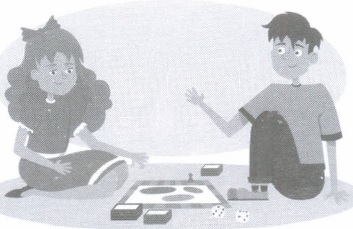
On the basis of above information, answer the following questions.
(i) The total number of possible outcomes they noted, is
| (a) 24 | (b) 36 |
| (c) 18 | (d) 6 |
(ii) The probability of getting the sum of numbers on two dice is 16, is
| (a) 1 | (b) \(\begin{equation} \frac{5}{36} \end{equation}\) |
| (c) 0 | (d) \(\begin{equation} \frac{18}{35} \end{equation}\) |
(iii) The probability that both the numbers are prime numbers, is
| (a) 0 | (b) \(\begin{equation} \frac{1}{2} \end{equation}\) |
| (c) \(\begin{equation} \frac{1}{4} \end{equation}\) | (d) \(\begin{equation} \frac{1}{8} \end{equation}\) |
(iv) The probability that product of two numbers is odd, is|
| (a) 1 | (b) \(\begin{equation} \frac{1}{2} \end{equation}\) |
| (c) \(\begin{equation} \frac{1}{4} \end{equation}\) | (d) \(\begin{equation} \frac{1}{8} \end{equation}\) |
(v) The probability that difference between numbers is zero, is
| (a) \(\begin{equation} \frac{1}{2} \end{equation}\) | (b) \(\begin{equation} \frac{1}{4} \end{equation}\) |
| (c) \(\begin{equation} \frac{1}{6} \end{equation}\) | (d) \(\begin{equation} \frac{1}{8} \end{equation}\) |
1.
(a)
\(\frac{1}{26}\)
2.
(d)
\(\frac{25}{36}\)
3.
(b)
2/7
4.
(b)
81/89
5.
(c)
1/2
6.
(b)
11/35
7.
(b)
-1.5
8.
(a) When three coins are tossed simultaneously, then the number of possible outcomes = 8,
(i.e. , HHH, HTH, THH, TTH, HHT, HTT, THT, TTT)
Number of favourable outcomes (three heads) = l, (i.e., HHH)
\(\therefore\)Required probability = \(\frac{1}{8}\)
(b) Number of favourable outcomes (exactly 2 3, (i.e., HTH, THH, HHT)
\(\therefore\)Required probability =\(\frac{3}{8}\)
(c) Number of favourable outcomes (at least two heads) = 4, (i.e., HTH, THH, HHT, HHH)
Required probability =\(\frac{4}{8}=\frac{1}{2}\)
9.
Number of blue marbles = 35
Number of white marbles = 25
Number of red marbles = 40
Total marbles in box = 35 + 25 + 40
=100
(i) Probability of a white marble = P (white)
=\(\frac{25}{100}=\frac{1}{4}\)
(ii) Number of non-blue marbles = 100-35
= 65
P (not blue) = \(\frac{65}{100}=\frac{13}{20}\)
(iii) Number of white or blue marbles= 25 + 35
= 60
Number of neither white nor blue marbles = 100-60
= 40
P (neither white nor-blue marbles) =\(\frac{40}{100}=\frac{2}{5}\)
10.
Total number of cards = 52
(i) Number of ace = 4
\(\therefore\) Probability of drawing an ace = \(\frac{4}{52}=\frac{1}{13}\)
(ii) There is only one '2' of spades
\(\therefore\) Probability of drawing a '2' of spade = \(\frac{1}{52}\)
(iii) '10' of a black suit there are two cards
\(\therefore\) Probability of drawing 10 of black suit = \(\frac{2}{52}=\frac{1}{26}\)
11.
Total number of balls = 19
(i) Prime numbers from 1 to 19 are 2, 3, 5, 7, 9, 11, 13, 17, 19 = Total 8 prime numbers
\(\therefore\) Probability of drawing a prime number = \(\frac{8}{19}\)
(ii) Numbers divisible by 3 or 5 are 3, 6, 9, 15, 18, 10, 5, 12 = Total 8 numbers
\(\therefore\) Probability of drawing a number divisible by 3 or 5 = \(\frac{8}{19}\)
(iii) Number divisible by 5 and 10 are 5, 10, 15 = Total 3
\(\therefore\) Numbers which are neither divisible by 5 nor 10 are 19 - 3 = 16
\(\therefore\) Probability of drawing a number which is neither divisible by 5 nor by 10 = \(\frac{16}{19}\)
(iv) Even numbers from 1- 19 are 2, 4, 6, 8, 10, 12, 14, 16, 18 [Total 9 even numbers]
\(\therefore\) Probability of drawing an even number = \(\frac{9} {19}\)
12.
(i) Total number of cards = 5
\(\therefore\) Number of all possible outcomes = 5
P (picking a queen card)= \(\frac{1}{5}\)
[\(\because\) as there is only one queen]
(ii) Suppose a queen is drawn and put a side. then, four cards are left namely, ten, jack, king and ace of diamonds.
Now, number of all possible outcomes = 4
(a) P(the second card picked up is an ace) = \(\frac{1}{4}\)
(b) P (the second card picked up is a queen)
\(=\frac{0}{4}=0\) [\(\because\) queen is drawn before]
13.
Since all the black face cards are removed, the total number of remaining cards = 46
(i) P(face card) = \(\frac{6}{46}\) = \(\frac{3}{23}\)
(ii) P(red card) = \(\frac{26}{46}\) = \(\frac{13}{23}\)
(iii) P(black card) = -\(\frac{20}{46}\)= \(\frac{10}{23}\)
(iv) P(king card) = \(\frac{2}{46}\)= \(\frac{1}{23}\)
14.
\((i){4\over13}(ii){1\over26}(iii){11\over13}(iv){2\over13}\)
15.
Total number of pieces = 8 + 10 = 18
(i) No.of triangles = 8. Hence, P(triangle is lost) = \(\frac{8}{18}=\frac{4}{9}\)
(ii) No.of squares = 10. Hence, P(square is lost) = \(\frac{10}{18}=\frac{5}{9}\)
(iii) No.of squares of blue colour = 6. So, P(square of blue colour is lost) = \(\frac{6}{18}=\frac{1}{3}\)
(iv) No.of triangles of red colour = 8 - 3 = 5. So, P(triangle of red colour is lost) = \(\frac{5}{18}\)
16.
(i) Total number of discs in a box = 90
\(\therefore\) Number of all possible outcomes = 90
Let E1 = Event of getting a disc bearing a two-digit number
Here, two-digit numbers are 10, 11, .., 90
\(\therefore\)Number of outcomes favourable to E1 =81
Hence, probability of getting a disc bearing a two-digit number, \(P\left(E_1\right)=\frac{81}{90}=\frac{9}{10}\)
(ii) Let E2 = Event of getting a disc bearing a perfect square number
Here, perfect square number are 1, 4, 9, 16, 25, 36, 49, 64 and 81.
\(\therefore\) Number of outcomes favourable to E2 =9
Hence, probability of getting a disc bearing a perfect square number, \(P\left(E_2\right)=\frac{9}{90}=\frac{1}{10}\)
(iii) Let E3 = Event of getting a disc bearing a number divisible by 5
Here, the numbers divisible by 5 are
5, 10, 15, 20, 25, 30, 35, 40, 45, 50, 55, 60, 65, 70, 75, 80, 85 and 90
\(\therefore\) Number of outcomes favourable to E3 = 18
Hence, required probability = \(P\left(E_3\right)=\frac{18}{90}=\frac{1}{5}\)
17.
Possible outcomes are HH, HT, TH, TT
\(\Rightarrow\) Number of total outcomes = 4
Let A = Atleast one head
Favourable outcomes of event A are HH, HT or TH
\(\therefore\) Number of favourable outcomes = 3
P(A) = \(\frac{3}{4}\)
18.
Total number of cards in the box = 48
(i) Numbers divisible by 7 are = 7, 14, 21, 28, 35, 42, 49 [Total 7 numbers]
Thus the probability of drawing a number divisible by 7 = \(\frac { 7 }{ 48 } \)
(ii) Perfect squares from 3 to 50 are = 9, 16, 25,36 and 49 [Total 5 numbers]
\(\therefore \)Probability of drawing a perfect square = \(\frac { 5 }{ 48 } \)
19.
Total number of tickets = 40 and multiple of 5 are 5, 10, 15, 20, 25, 30, 35, 40
P(a number which is a multiple of 5)
\(=\frac{8}{40}=\frac{1}{5}\)
20.
Let S and R denote the events that Sangeeta wins the match and Reshma wins the match, respectively.
The probability of sangeeta's winning = P(S) = 0.62 (given)
The probability of Reshma's winning = P(R) = 1 - P(S)
[As the events R and S are complementary]
= 1 - 0.62 = 0.38
21.
Leap year contains 366 days. \(\Rightarrow \) 52 weeks + 2 days
52 weeks contain 52 Fridays
We will get 53 Fridays if one of the remaining two days is a Friday. Total possibilities for two days are:
(Sunday, Monday), (Monday, Tuesday), (Tuesday, Wednesday), (Wednesday, Thursday), (Thursday, Friday), (Friday, Saturday), (Saturday, Sunday)
There are 7 possibilities and out of these there are 2 favourable cases.
\(\therefore P(53 Fridays) = \frac{2}{7}\)
22.
Total number of possible outcomes = 10
(i) (b): P(getting 100% discount) = \(\begin{equation} \frac{1}{10} \end{equation}\)
(ii) (c): P(getting no prize) = \(\begin{equation} \frac{3}{10} \end{equation}\)
(iii) (b) : P(getting a soccer ball) = \(\begin{equation} \frac{2}{10}=\frac{1}{5} \end{equation}\)
(iv) (b) : P(getting 15% discount) = \(\begin{equation} \frac{2}{10}=\frac{1}{5} \end{equation}\)
(v) (a): P(getting a free spin) = \(\begin{equation} \frac{1}{10} \end{equation}\)
23.
(i) (b):Total number of possible outcomes on throwing two dice simultaneously = 6 x 6 = 36
(ii) (c): As we know, that maximum sum of numbers on two dice = 6 + 6 = 12
It is an impossible event.
So, required probability = 0
(iii) (c) : Let A be the event that both the numbers on dice are prime.
A = {(2, 2), (2, 3), (2, 5), (3,2), (3, 3), (3, 5), (5, 2), (5,3), (5, 5)}
\(\Rightarrow\)n(A) = 9
\(\begin{equation} P(A)=\frac{9}{36}=\frac{1}{4} \end{equation}\)
(iv) (c) : Let B the event that product of two numbers is odd.
B = {(1, 1), (1, 3), (1, 5), (3,1), (3, 3), (3, 5), (5,1), (5,3), (5, 5)}
\(\Rightarrow\)n(B) = 9
\(\begin{equation} P(B)=\frac{9}{36}=\frac{1}{4} \end{equation}\)
(v) (c) : Let C be the event that difference of two numbers is zero.
C = {(1, 1), (2,2), (3, 3), (4,4), (5, 5), (6, 6)}
\(\Rightarrow\)n(C) = 6
\(\begin{equation} P(C)=\frac{6}{36}=\frac{1}{6} \end{equation}\)

10th Standard CBSE Syllabus & Materials
10th Standard CBSE
CBSE 10th Social Science PS - Federalism - New Model Questions Papers Study Material - QB365 Set A
NEW10th Standard CBSE
CBSE 10th Social Science PS - Power Sharing - New Model Questions Papers Study Material - QB365 Set A
NEW10th Standard CBSE
CBSE 10th Social Science GEO - Manufacturing Industries - New Model Questions Papers Study Material - QB365 Set A
NEW10th Standard CBSE
CBSE 10th Social Science GEO - Minerals and Energy Resources - New Model Questions Papers Study Material - QB365 Set A



NCERT Books

Syllabus

Exam Pattern

Sample Question Papers

Previous year Question Papers

Important Notes

MCQ Practice test

NCERT Exemplers

Case study Questions

Image Based Questions

Passage based Questions

HOT Questions

Value Based Questions

Model Questions Papers
NCERT ( Book Back ) Questions

Assertion and Reason
Important Questions And Answers

CBSE 10th Standard CBSE Subjects
CBSE Standards



