
 100% FREE ACCESS
10th Standard CBSE Syllabus & Materials
10th Standard CBSE
CBSE 10th Social Science ECO - Globalisation and the Indian Economy - New Model Questions Papers Study Material - QB365 Set A
NEW10th Standard CBSE
CBSE 10th Social Science ECO - Money and Credit - New Model Questions Papers Study Material - QB365 Set A
NEW10th Standard CBSE
CBSE 10th Social Science ECO - Sectors of the Indian Economy - New Model Questions Papers Study Material - QB365 Set A
NEW10th Standard CBSE
CBSE 10th Social Science ECO - Development - New Model Questions Papers Study Material - QB365 Set A
NEW10th Standard CBSE
CBSE 10th Social Science PS - Outcomes of Democracy - New Model Questions Papers Study Material - QB365 Set A
NEW10th Standard CBSE
CBSE 10th Social Science PS - Gender, Religion and Caste - New Model Questions Papers Study Material - QB365 Set A

Published on: 20/10/2025
Download CBSE Class 10th Standard CBSE Maths question papers, sample papers, important questions, and previous year solved papers in PDF format. Get free study materials, NCERT solutions, and exam preparation resources for Class 10th Standard CBSE Maths
Questions + Answers key
Take MCQ Maths Test
1.
(i) Find the probability of getting 53 Fridays in a leap year.
(ii) A die is thrown, find the probability of getting an odd prime number.
2.
Onkar draws a card from a well shuffled deck of 52 cards.Find the probability of getting:
(i)a jack of red suit
(ii)'5' or '9' of club
(iii)a diamond card
(iv)'2' or '3' or '5' of black suit.
3.
Two dice are numbered 1,2,3,4,5,6 and 1,1,2,2,3,3 respectively.They are thrown and the sum of the numbers on them is noted.Find the probability of getting each sum from 2 to 9 separately
4.
In a game, the entry fee is Rs. 5. The game consists of tossing a coin 3 times. If one or two heads show, then Sweta gets her entry fee back. If she tosses 3 heads, then she receives double the entry fees. Otherwise she will lose. For tossing a coin three times, find the probability that she
(i) loses the entry fee
(ii) gets double entry fee
(iii) just gets her entry fee
5.
The king, queen and jack of diamonds are removed from pack of 52 cards and then the pack is well shuffled.A card is drawn from the remaining cards.Find the probability of getting a card of
(i)diamonds (ii) a jack
6.
A box has cards numbered 114 to 199. Cards are mixed thoroughly and a card is drawn from the bag at random. Find the probability that the number on the card, drawn from the box is
(a) an odd number
(b) a perfect square number
7.
A bag contains 24 balls out of which x are white. If one ball is drawn at random the probability of drawing a white ball is y. 12 more white balls are added to the bag. Now if a ball is drawn from the bag, the probability of drawing the white ball is \(\frac{5}{3}y\). Find the value of x.
8.
A fair dice is rolled. What is the probability of getting number x such that \(1\le x\le 6\) .
9.
Two dice are thrown at the same time.Find the probability of getting:
(i) sum of two numbers appearing on both the dice is 8.
10.
a game consists of tossing a one-rupee coin three times and noting its outcome each time. Find the probability of getting:
(i) three heads,
(ii) at least two tails.
11.
Two coins are tossed simultaneously. Find the probability of getting
(i) exactly two head
(ii) atleast one head
12.
A traffic signal displays green light for 2 min to allow passage of traffic on a particular road. If the signal is currently displaying green light, then find the probability that, it will turn red within the next half a minute.
13.
One card is drawn at random from a well-shuffled deck of 52 playing cards. What is the probability of getting a black king?
\(\frac{1}{26}\)
\(\frac{1}{13}\)
\(\frac{1}{52}\)
\(\frac{1}{2}\)
14.
A die is thrown once. The probability of getting a number less than 6 is
0
\(\frac{5}{6}\)
\(\frac{1}{6}\)
1
15.
A box contains 54 marbles each of which is blue, green or white. The probability of selecting a blue marble at random from the box is 1/3 and the probability of selecting a green marble at random is 4/9. The number of white marbles in the box are
10
12
14
16
16.
The given figure shows a disc on which a player spins an arrow twice.
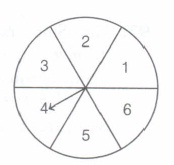
The fraction \(\frac{x}{y}\) is formed, where 'a' is y the number of sectors on which the arrow stops on the first spin and 'b' is the number of the sectors in which the arrow stops on the second spin. In each spin, each sector has equal chance of selection by the arrow, then the probability that the fraction \(\frac{x}{y}\) ≥ 1.
\(\frac{7}{12}\)
\(\frac{5}{12}\)
\(\frac{11}{12}\)
\(\frac{1}{2}\)
17.
A fair die is cast in the game of ‘Ludo’. The probability of getting a score greater than 6 is
zero
2/3
1/6
1
18.
Some students were asked to list theirs favourite colour. The measure of each colour is shown by the central angle of a pie-chart given below :
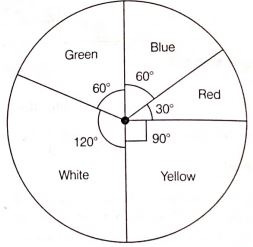
Study the pie-chart and answer the following questions :
(i) If a student is chosen at random, then find the probability of his/her favourite colour being white?
(ii) What is the probability of his/her favourite colour being blue or green?
(iii) If 15 students liked the colour yellow, how many students participated in the survey?
Or
What is the probability of the favourite colour being red or blue?
19.
Two friends were playing a game with two dice. Anju has a blue dice and Nitish has a grey dice. They decided to throw both the dice simultaneously and note down all the possible outcomes appearing on the top of both the dice.
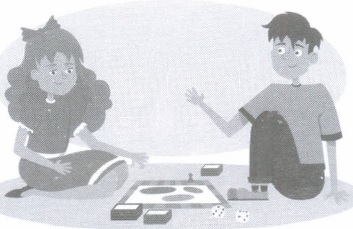
On the basis of above information, answer the following questions.
(i) The total number of possible outcomes they noted, is
| (a) 24 | (b) 36 |
| (c) 18 | (d) 6 |
(ii) The probability of getting the sum of numbers on two dice is 16, is
| (a) 1 | (b) \(\begin{equation} \frac{5}{36} \end{equation}\) |
| (c) 0 | (d) \(\begin{equation} \frac{18}{35} \end{equation}\) |
(iii) The probability that both the numbers are prime numbers, is
| (a) 0 | (b) \(\begin{equation} \frac{1}{2} \end{equation}\) |
| (c) \(\begin{equation} \frac{1}{4} \end{equation}\) | (d) \(\begin{equation} \frac{1}{8} \end{equation}\) |
(iv) The probability that product of two numbers is odd, is|
| (a) 1 | (b) \(\begin{equation} \frac{1}{2} \end{equation}\) |
| (c) \(\begin{equation} \frac{1}{4} \end{equation}\) | (d) \(\begin{equation} \frac{1}{8} \end{equation}\) |
(v) The probability that difference between numbers is zero, is
| (a) \(\begin{equation} \frac{1}{2} \end{equation}\) | (b) \(\begin{equation} \frac{1}{4} \end{equation}\) |
| (c) \(\begin{equation} \frac{1}{6} \end{equation}\) | (d) \(\begin{equation} \frac{1}{8} \end{equation}\) |
1.
(i) Number of days in a leap year=366 days
\(=(52\times 7+2)\) days=52 weeks and 2 days
Thus, a leap year always has 52 Fridays.
The remaining 2 days can be
(a) Sunday and Monday
(b) Monday and Tuesday
(c) Tuesday and Wednesday
(d) Wednesday and Thursday
(e) Thursday and Friday
(f) Friday and Saturday
(g) Saturday and Sunday.
Out of these 7 cases, we have Friday in two cases.
So, total number of possible outcomes, n(S)=7 and total number of favourable outcomes, n(E)=2
∴ P(53 Fridays)\(=\frac { n(E) }{ n(S) } =\frac { 2 }{ 7 } \)
(ii) Sample space of a die, S={1,2,3,4,5,6}
∴ n(S)=6
Let E=Event of getting an odd prime number
={3,5}
∴ n(E)=2
Hence, required probability\(=\frac { n(E) }{ n(S) } =\frac { 2 }{ 6 } =\frac { 1 }{ 3 } \)
2.
\((i){1\over26}(ii){}{1\over26}(iii){1\over4}(iv){3\over26}\)
3.
When two dice are thrown simultaneously, then sample space contain ( 6 X6=36) outcomes
Sum 2 i.e., [(1,1),(1,1)] = two outcomes
P( Sum 2) = 2 / 36 = 1 / 18
Sum 3 i.e., (1,2), (1,2), (2,1), (2,1) =4 outcomes.
P( Sum 3) = 4 / 36 = 1 / 9
Sum 4 i.e., [(1,3), (1,3), (2,2), (2,2),(3,1), (3,1)] =6 outcomes
P( Sum 4) = 6 / 36 = 1 / 6
Sum 5 i.e., [(2,3), (2,3), (3,2), (3,2),(4,1), (4,1)] =6 outcomes
P( Sum 5) = 6 / 36 = 1 / 6
Sum 6 i.e., [(3,3), (3,3), (4,2), (4,2),(5,1), (5,1)] =6 outcomes
P( Sum 6) = 6 / 36 = 1 / 6
Sum 7 i.e., [(4,3), (4,3), (5,2), (5,2),(6,1), (6,1)] =6 outcomes
P( Sum 7) = 6 / 36 = 1 / 6
Sum 8 i.e., [(5,3), (5,3), (6,2), (6,2)] =4 outcomes
P( Sum 8) = 4 / 36 = 1 / 9
Sum 9 i.e., [(6,3), (6,3)] =2 outcomes.
P( Sum 9) = 2 / 36 = 1 / 18
4.
Possible outcomes on tossing a coin 3 times, are HHH, HHT, HTH, THH, HTT, THT, TTH, TTT
\(\therefore\) Total number of outcomes = 8
(i) Let E1 be the event that Sweta losses the entry fee
i.e. shen tosses tail three times i.e. TTT.
\(\therefore\) Number of outcomes favourable to E1 = 1
Hence, required probability = P(E1) = \(\frac{1}{8}\)
(ii) Let E2, be the event that Sweta gets double entry fee
i.e. she tosses heads three times
i.e. HHH
\(\therefore\) Number of outcomes favourable to E2 = 1
Hence, required probability \(=P\left(E_2\right)=\frac{1}{8}\)
(iii) Let E3 be the event that Sweta gets her entry fee back
i.e. Sweta gets heads one or two times
i.e. event of getting
HTT, THT, TTH, HHT, HTH or THH
\(\therefore\) Number of outcomes favourable to E3 = 6
Hence, required probability = P(E3) = \(\frac{6}{8}=\frac{3}{4}\)
5.
\((i){10\over49}(ii){3\over49}\)
6.
\((a) \frac{1}{2} \ \ \ \ (b) \frac{3}{43}\)
7.
Total number of ways to draw ball from bag = 24
Number of ways to draw a white ball = x
\(\therefore \) Probability of drawing a white ball = \(\frac { x }{ 24 } \)
A.T.Q., \(\frac { x }{ 24 } \)=y ....(i)
When 12 more white balls are added to the bag,
Number of balls in the bag = 24 + 12 = 36 Number of white balls in the bag = (x + 12)
\(\therefore \)Probability of drawing a white ball
=\(\frac { x+12 }{ 36 } \)
A.T.Q., \(\\ \frac { x+12 }{ 36 } =\frac { 5 }{ 3 } \times x\)
\(\Rightarrow \frac { x+12 }{ 36 } =\frac { 5 }{ 3 } \times \frac { x }{ 24 } \quad \{ using\quad (i)\} \)
\(\therefore \quad x+12=\frac { 36\times 5x }{ 72 } \)
\(\Rightarrow x+12=\frac { 35x }{ 2 } \)
\(\Rightarrow \) 2x+24=5x\(\Rightarrow \)3x=24\(\Rightarrow \)x=8
8.
When a fair dice is rolled then possible outcomes are 1, 2, 3, 4, 5 or 6.
\(\therefore\) Probability of x = 1.
9.
P(sum is 8) = \(\frac{5}{36}\)
10.
Total number of outcomes = 23 = 8
(i) P(three heads) = \(\frac{1}{8}\)
(ii) P(atleast two tails) = \(\frac{4}{8}\)=\(\frac{1}{2}\)
11.
When two coins are tossed simultaneously, then possible outcomes are (H, H), (H, T), (T, H) and (T, T)
\(\therefore \) Total number of outcomes = 4
(i) Let E1 be the event of getting exactly two head.
Then, the outcomes favourable to E1 is (H, H).
\(\therefore \) Number of outcomes favourable to E1 = 1
\(\therefore \) P(E1) = \(\frac{1}{4}\)
(ii) Let E2 be the event of getting atleast one head, i.e. one head or two head.
Then, favourable outcomes are (H, T), (H, H) and (H, T)
\(\therefore \) Number of outcomes favourable to E2 = 3
\(\therefore \) P (E2 ) = \(\frac{3}{4}\)
12.
\(\frac { 1 }{ 4 } \)
13.
(a)
\(\frac{1}{26}\)
14.
(b)
\(\frac{5}{6}\)
15.
(b)
12
16.
(a)
\(\frac{7}{12}\)
17.
(a)
zero
18.
(i) Total angle = 360°
Angle of white = 120°
\(\therefore \text { Probability }=\frac{120^{\circ}}{360^{\circ}}=\frac{1}{3}\)
(ii) Total angle = 360°
Angle of blue = 60°
Angle of green = 60°
\(\therefore \text { Probability }=\frac{60^{\circ}+60^{\circ}}{360^{\circ}}=\frac{120^{\circ}}{360^{\circ}}=\frac{1}{3}\)
(iii) Let n students participated in the survey
\(\Rightarrow \frac{90^{\circ}}{360^{\circ}} \times n=15 \Rightarrow n=15 \times 4=60\)
\(\therefore\) 60 students participated in the survey.
Or
Total angle = 360°
Angle of red = 30°
Angle of blue = 60°
\(\therefore \text { Probability }=\frac{60^{\circ}+30^{\circ}}{360^{\circ}}=\frac{90^{\circ}}{360^{\circ}}=\frac{1}{4}\)
19.
(i) (b):Total number of possible outcomes on throwing two dice simultaneously = 6 x 6 = 36
(ii) (c): As we know, that maximum sum of numbers on two dice = 6 + 6 = 12
It is an impossible event.
So, required probability = 0
(iii) (c) : Let A be the event that both the numbers on dice are prime.
A = {(2, 2), (2, 3), (2, 5), (3,2), (3, 3), (3, 5), (5, 2), (5,3), (5, 5)}
\(\Rightarrow\)n(A) = 9
\(\begin{equation} P(A)=\frac{9}{36}=\frac{1}{4} \end{equation}\)
(iv) (c) : Let B the event that product of two numbers is odd.
B = {(1, 1), (1, 3), (1, 5), (3,1), (3, 3), (3, 5), (5,1), (5,3), (5, 5)}
\(\Rightarrow\)n(B) = 9
\(\begin{equation} P(B)=\frac{9}{36}=\frac{1}{4} \end{equation}\)
(v) (c) : Let C be the event that difference of two numbers is zero.
C = {(1, 1), (2,2), (3, 3), (4,4), (5, 5), (6, 6)}
\(\Rightarrow\)n(C) = 6
\(\begin{equation} P(C)=\frac{6}{36}=\frac{1}{6} \end{equation}\)

10th Standard CBSE Syllabus & Materials
10th Standard CBSE
CBSE 10th Social Science PS - Federalism - New Model Questions Papers Study Material - QB365 Set A
NEW10th Standard CBSE
CBSE 10th Social Science PS - Power Sharing - New Model Questions Papers Study Material - QB365 Set A
NEW10th Standard CBSE
CBSE 10th Social Science GEO - Manufacturing Industries - New Model Questions Papers Study Material - QB365 Set A
NEW10th Standard CBSE
CBSE 10th Social Science GEO - Minerals and Energy Resources - New Model Questions Papers Study Material - QB365 Set A



NCERT Books

Syllabus

Exam Pattern

Sample Question Papers

Previous year Question Papers

Important Notes

MCQ Practice test

NCERT Exemplers

Case study Questions

Image Based Questions

Passage based Questions

HOT Questions

Value Based Questions

Model Questions Papers
NCERT ( Book Back ) Questions

Assertion and Reason
Important Questions And Answers

CBSE 10th Standard CBSE Subjects
CBSE Standards



