
 100% FREE ACCESS
10th Standard CBSE Syllabus & Materials
10th Standard CBSE
CBSE 10th Social Science ECO - Globalisation and the Indian Economy - New Model Questions Papers Study Material - QB365 Set A
NEW10th Standard CBSE
CBSE 10th Social Science ECO - Money and Credit - New Model Questions Papers Study Material - QB365 Set A
NEW10th Standard CBSE
CBSE 10th Social Science ECO - Sectors of the Indian Economy - New Model Questions Papers Study Material - QB365 Set A
NEW10th Standard CBSE
CBSE 10th Social Science ECO - Development - New Model Questions Papers Study Material - QB365 Set A
NEW10th Standard CBSE
CBSE 10th Social Science PS - Outcomes of Democracy - New Model Questions Papers Study Material - QB365 Set A
NEW10th Standard CBSE
CBSE 10th Social Science PS - Gender, Religion and Caste - New Model Questions Papers Study Material - QB365 Set A

Published on: 20/10/2025
Download CBSE Class 10th Standard CBSE Maths question papers, sample papers, important questions, and previous year solved papers in PDF format. Get free study materials, NCERT solutions, and exam preparation resources for Class 10th Standard CBSE Maths
Questions + Answers key
Take MCQ Maths Test
1.
If Q(0, 2) is equidistant from P(5, -3) and R(x, 7), then find the value(s) of x.
2.
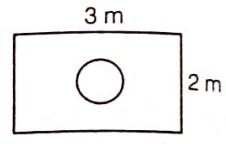
Suppose you drop a die at random on the rectangular region shown in Figure. What is the probability that it will land inside the circle of diameter 1m?
3.
A straight highway leads to the foot of a 100 m tall tower. From the top of the tower, angle of depression of a car on the highway is 30o . Find the distance of the car from foot of the tower.
4.
A chord of a circle of radius 10 cm subtends a right angle at the centre. Find area of the corresponding
(i) minor segment
(ii) major sector \(( Take, \quad \pi = 3.14)\)
5.
Prove that the tangents drawn at the ends of a diameter of a circle are parallel.
6.
If AB is a tangent drawn from a point B to a circle with centre C and radius 1.5 cm such that \(\angle C B A=30^{\circ}\),then find the length of a tangent AB.
7.
Find the zeroes of the following quadratic polynomials and verify the relationship between the zeroes and the coefficients.
4u2 + 8u
8.
A part of monthly hostel charges in a college hostel are fixed and the remaining depends on the number of days one has taken food in the mess. When a student A takes food for 25 days, he has to pay Rs 4500, whereas a student B who takes food for 30 days, has to pay Rs 5200. Find the fixed charges per month and the cost of food per day.
9.
If d is the HCF of 30, 72, find the value of x & y satisfying d = 30x + 72y.
10.
If the difference between the circumference and the radius of a circle is 37 crn, then using \(\pi =\frac { 22 }{ 7 } \)
11.
A hemispherical depression is cut out from one face of a cubical wooden block such that the diameter l of the hemisphere is equal to the edge of the cube. Determine the surface area of the remaining solid.
12.
Prove that the perpendicular at the point of contact to the tangent to a circle passes through the centre.
13.
If the LCM of 26 and 91 is 182. find their HCF.
14.
A chord of a circle of the radius 12 cm subtends an angle of \(120^o\) at the centre. Find the area of the corresponding segment of the circle. \((USE\ \pi = 3.14\ and \ \sqrt3 = 1.73).\)
15.
Prove that the parallelogram circumscribing a circle is a rhombus.
16.
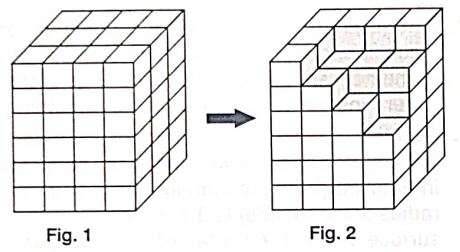
Figure 1 below is a solid cuboid made of unit cubes. Figure 2 is obtained after removing some unit cubes from figure 1.
(Note The figures are not to scale.)
Based on the figures shown above, the surface area of the cuboid in Figure 1 is _________ the surface area of the solid in Figure 2.
less than
more than
equal to
cannot be concluded with the given information
17.
A tangent PQ at a point P of a circle of radius 5 cm meets a line through the centre O at a point Q, so that OQ= 12 cm. Length of PQ is
12 cm
13 cm
8.5 cm
\(\sqrt119\) cm
18.
A is a point at a distance 13 cm from the centre O of a circle of radius 5 cm. AP and AQ are the tangents to the circle at P and Q. If a tangent BC is drawn at a point R lying on the minor arc PQ to intersect AP at Band AQ at C, then the perimeter of the MBC is
12 cm
24 cm
36 cm
48 cm
19.
If the area of the triangle formed by the points (x, 2x), (- 2, 6) and (3, 1)is 5 sq units then x equals.
2/3
3/5
3
5
20.
If tangents PA and PB from a point P to a circle with centre O are inclined to each other at angle of 80°, then \(\angle POA \) is equal to
50°
60°
70°
80°
21.
A letter is chosen at random from the letters of the word 'ASSASSINATION', then the probability that the letter chosen is a vowel is in the form of \(\frac{6}{2 x+1}\) ,then x is equal to
5
6
7
8
22.
An observer, 1.5 m tall is 20.5 away from a tower 22 m high, then the angle of elevation of the top of the tower from the eye of the observer is
30°
45°
60°
90°
23.
Tick the correct answer in the following:
Area of a sector of angle P (in degrees) of a circle with radius R is
\({P \over 180^o}\times 2\pi R\)
\({P \over 180^o}\times \pi R^2\)
\({P \over 360^o}\times 2\pi R\)
\({P \over 720^o}\times 2\pi R^2\)
24.
If a pair of linear equations is consistent, then the lines will be
parallel
always coincident
intersecting or coinciden
always intersecting
25.
A quadratic polynomial, whose zeroes are -3 and. 4, is
x2-x+12
x2+x+12
\( \frac{x ^{2}}{2}-\frac{x}{2}-6\)
2x2 + 2x - 24
26.
The product of a non-zero rational and an irrational number is
always irrational
always rational
rational or irrational
one
27.
A fraction becomes when subtracted from the numerator and it becomes . when 8 is added to its denominator. Find the fraction
4/12
3/13
5/12
11/7
28.
he degree of the polynomial 8x³- 3x²+ 5x -9 is
3
0
1
2
29.
What is the HCF of 161 and 303?
1
11
13
3
30.
A toy is in the form of a cone mounted on a hemisphere of diameter 7 cm. The total height of the toy is 14.5 cm. The total surface area of the toy will be
304 .5 cm2
400 cm2
203.94 cm2
231 cm2
31.
The ratio of radii of two circles is in the ratio of 1:5. Calculate the ratio of their perimeters
1:8
1:2
1:6
1:5
32.
In what ratio of line x – y – 2 = 0 divides the line segment joining (3, –1) and (8, 9)?
1:2
2:1
2:3
1:3
33.
Suppose you drop a dice in a rectangular region with sides 6 m and 4 m. A circle of diameter 1 m is drawn inside it. What is the probability that it will land inside the circle?
π/24
π/96
π/6
π/48
34.
A bag contains 3 red and 2 blue marbles. A marble is drawn at random. The probability of drawing a black ball is :
3/5
2/5
0/5
1/5
35.
An electrician has to repair an electric fault on a pole of height 4 m. He needs to reach a point 1.3 m below the top of the pole to undertake the repair work. The length of the ladder he should use which when inclined at an angle of 60° to the horizontal would enable him to reach the required position is:
\(\frac { 9\sqrt { 3 } }{ 5 } \)m
\(\frac { 5 }{ 9 } \)m
\(\frac { \sqrt { 3 } }{ 5 } \)m
\(\frac { 9 }{ 5 } \)m
36.
Assertion (A) Total surface area of the toy is the sum of the curved surface area of the hemisphere and the curved surface area of the cone.
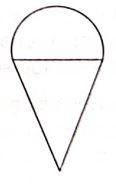
Reason (R) Toy is obtained by fixing the plane surfaces of the hemisphere and cone together.
(a) Both Assertion and Reason are correct and Reason is the correct explanation of Assertion.
(b) Both Assertion and Reason are correct but Reason is not the correct explanation of Assertion.
(c) Assertion is correct but Reason is incorrect.
(d) Assertion is incorrect but Reason is correct.
37.
Assertion : In the given figure, AP and AO are tangents to a circle such that AP = 11cm and \(\angle P A Q=60^{\circ}\), then length of PQ is 8 cm.
Reason : The centre of the circle lies on the bisector of the angle between the two tangents.
Codes :
(a) If both Assertion and Reason are correct and Reason is the correct explanation of Assertion.
(b) If both Assertion and Reason are correct, but Reason is not the correct explanation of Assertion.
(c) If Assertion is correct but Reason is incorrect.
(d) If Assertion is incorrect but Reason is correct.
38.
While preparing for a competitive examination, Akbar came across a match-stick pattern based question. The pattern is given below.
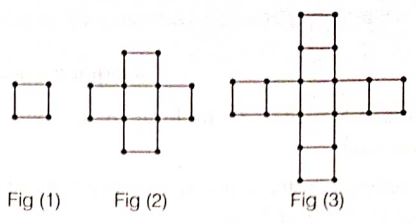
Based on the above information answer the following questions.
(i) Write first term and common difference of the AP formed by number of squares in each figure.
(ii) Write first term and common difference of the AP formed by number of sticks used in each figure.
(iii) (a) How many squares are there in fig (10)? Also, write the number of stick used in fig. (10).
Or (b) If 88 sticks are used to make mth (fig (m)), then find the value of m. How many squares are formed in this figure?
39.
A farmer has a rectangular field oflength 30 m and breadth 15 m. By the farmer a pit of diameter 7 m is dug 12 m deep for rain water harvesting. The earth taken out is spread in the field.
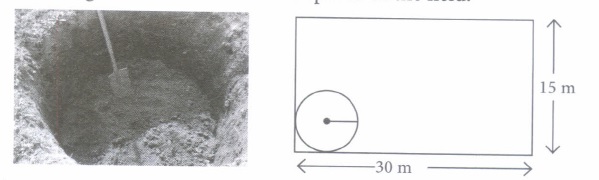
Based on the above information, answer the following questions.
(I) Find the volume of the earth taken out.
| (a) 460 m3 | (b) 462 m3 | (c) 465 m3 | (d) 468 m3 |
(ii) The area of the rectangular field is
| (a) 420 m2 | (b) 430 m2 | (c) 440 m2 | (d) 450m2 |
(iii) Find'the area of the top of the pit.
| (a) 38.5 m2 | (b) 40.5 m2 | (c) 41.5 m2 | (d) None of these |
(iv) The area of the remaining field is
| (a) 402.3 m2 | (b) 405 m2 | (c) 410 m2 | (d) 411.5 m2 |
(v) Find the level rise in the field
| (a) 0.5 m | (b) 3 m | (c) 1.12 m | (d) 2.12 m |
40.
Real numbers are extremely useful in everyday life. That is probably one of the main reasons we all learn how to count and add and subtract from a very young age. Real numbers help us to count and to measure out quantities of different items in various fields like retail, buying, catering, publishing etc. Every normal person uses real numbers in his daily life. After knowing the importance of real numbers, try and improve your knowledge about them by answering the following questions on real life based situations.
(i) Three people go for a morning walk together from the same place. Their steps measure 80 cm, 85 cm, and 90 cm respectively. What is the minimum distance travelled when they meet at first time after starting the walk assuming that their walking speed is same?
| (a) 6120 cm | (b) 12240 cm | (c) 4080 cm | (d) None of these |
(ii) In a school Independence Day parade, a group of 594 students need to march behind a band of 189 members. The two groups have to march in the same number of columns. What is the maximum number of columns in which they can march?
| (a) 9 | (b) 6 | (c) 27 | (d) 29 |
(iii) Two tankers contain 768litres and 420 litres of fuel respectively. Find the maximum capacity of the container which can measure the fuel of either tanker exactly.
| (a) 4litres | (b) 7litres | (c) 12litres | (d) 18litres |
(iv) The dimensions of a room are 8 m 25 cm, 6 m 75 crn and 4 m 50 cm. Find the length of the largest measuring rod which can measure the dimensions of room exactly.
| (a) 1 m 25cm | (b) 75cm | (c) 90cm | (d) 1 m 35cm |
(v) Pens are sold in pack of 8 and notepads are sold in pack of 12. Find the least number of pack of each type that one should buy so that there are equal number of pens and notepads
| (a) 3 and 2 | (b) 2 and 5 | (c) 3 and 4 | (d) 4 and 5 |
1.
Given, Q(0, 2) is equidistant from P(5, -3) and R(x, 7), which means PQ = QR.
Find the distance of PQ and QR using distance formula,
\(\sqrt{\left(x_2-x_1\right)^2+\left(y_2-y_1\right)^2}\)
\(\begin{aligned} P Q=\sqrt{(5-0)^2+(-3-2)^2}=5 \sqrt{2} \end{aligned}\)
\(\begin{aligned} Q R=\sqrt{(0-x)^2+(2-7)^2}=\sqrt{x^2+25} \end{aligned}\)
Now, \(\begin{aligned} P Q=Q R \Rightarrow 5 \sqrt{2}=\sqrt{x^2+25} \end{aligned}\)
On squaring both sides of the above equation, we get
50 = x2 + 25 \(\Rightarrow\) x2 = 25 \(\Rightarrow\) x = \(\pm 5\)
Therefore, the values of x are 5 and -5.
2.
Area of restangle = 3 \(\times\) 2 = 6 m2
and area of circle of radius \(\frac{1}{2} \mathrm{~m}=\pi\left(\frac{1}{2}\right)^2=\frac{\pi}{4} \mathrm{~m}^2\)
\(\left[\because \text { diameter }=1 \mathrm{~m} \Rightarrow \text { radius }=\frac{1}{2} \mathrm{~m}\right]\)
Now, probanility that the die land inside the circle
\(=\frac{\text { Area of circle }}{\text { Area of rectangle }}=\frac{\pi / 4}{6}=\frac{\pi}{24}\)
3.
Let AB is tower and car is at C on the highway.
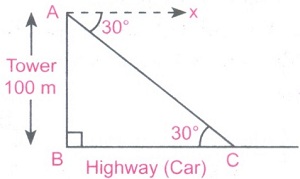
In right \(\Delta\)ABC,
\(\frac { AB }{ BC } =\tan { { 30 }^{ o } } \)
\(\Rightarrow\) \(\frac { 100 }{ BC } =\frac { 1 }{ \sqrt { 3 } } \)
\(\Rightarrow\) \(BC=100\sqrt { 3 }\) m
4.
Given, radius of a circle, AO = 10 cm and \(\angle\)AOC = 90°
Area of \(\triangle A O C=\frac{1}{2} \times O A \times O C=\frac{1}{2} \times 10 \times 10=50 \mathrm{~cm}^2\)
\(\begin{aligned} \text { Area of sector } O A E C O & =\frac{\theta}{360^{\circ}} \times \pi r^2 \\ \end{aligned}\)
\(\begin{aligned} =\frac{90^{\circ}}{360^{\circ}} \times 3.14 \times(10)^2 \\ \end{aligned}\)
\(\begin{aligned} =\frac{314}{4}=78.5 \mathrm{~cm}^2 \end{aligned}\)
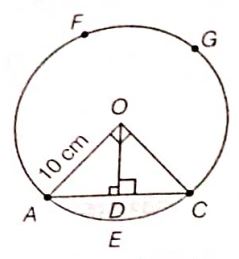
(i) Area of minor segment AECDA
= Area of sector OAECO - Area of \(\Delta\)AOC
= 78.5 - 50 = 28.5 cm2
(ii) Area of major sector OAFGCO
= Area of circle - Area of sector OAECO
= 3.14 \(\times\)(10)2 - 78.5
= 314 - 78.5 = 235.5 cm2
5.
Let AB be a diameter of a given circle and LM and PQ be the tangent lines drawn to the circle at points A and B, respectively.
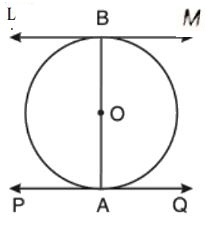
To prove LM || PQ
Proof We know that the tangent at any point of a circle is perpendicular to the radius through the point of contact.
\(\therefore\) OA \(\perp\) PQ and OB \(\perp\) LM
\(\Rightarrow\) AB \(\perp\) PQ
and AB \(\perp\) LM
\(\Rightarrow\) \(\angle\)PAB = 90°
and \(\angle\)ABM = 90°
\(\Rightarrow\) \(\angle\)PAB = \(\angle\)ABM
[each = 90°]
But these are alternate angles.
\(\therefore\) PQ || LM
Hence, the tangents drawn at the ends of a diameter of a circle are parallel.
Hence proved.
6.
\(3 \mathrm{~cm} \text { and } \frac{3 \sqrt{3}}{2} \mathrm{~cm}\)
7.
Let p(u) = 4u2 + 8u = 4u(u+2)
To find zeroes, put p(u) = 0
\(\Rightarrow\) 4u(u+2) = 0 \(\Rightarrow\) u = 0 or u + 2 = 0 [\(\because\) 4 \(\neq\)0]
\(\Rightarrow\) u = 0 or u = -2
Hence, zeroes of the given polynonial are 0 and -2.
Verification
Here, sum of zeroes = 0 - 2 = -2 = -(8/4)
=-\(\frac{Coefficient \quad of \quad u}{Coefficient \quad of \quad u^{2}}\)
and product of zeroes
=0 \(\times\)-2 = 0 = (0/4) = \(\frac{Constant \quad term}{Coefficient \quad of \quad u^{2}}\)
so, the relationship between the zeroes and its coefficients is verified.
8.
Let fixed hostel charge (monthly) = Rs.y
and cost of food for one day = Rs.x
In case of student A,
25 x+ y = 4500 ....(i)
In case of student B,
30 x+ y = 5200 ....(ii)
Solve by cross-multiplication method.
x = 140, y = 1000
9.
Using Euclid's algorithm, the HCF (30, 72)
72 = 30 x 2 + 12 ...(i)
30 = 12 x 2 + 6 ...(ii)
12 = 6 x 2 + 0 ...(iii)
HCF (30, 72) = 6
6 = 30-12 x 2 [From (ii)]
6 = 30 - (72 - 30 x 2) x 2
6 = 30 - 2 x 72 + 30 x 4
6 = 30 (1 + 4) - 72 x 2
6 = 30 x 5 + 72 x (- 2)
x = 5,y =-2
Also, 6 = 30 x 5 + 72(-2) + 30 x 72-30 x 72
6 = 30 x (77) + 72 x (-32)
∴ x=77, y=-32
Hence, x and yare not unique
10.
44 cm
11.
Given, side of the cube = Diameter of the hemisphere = l units
\(\therefore\) Radius of the hemisphere, \(r=\frac{l}{2}\) units
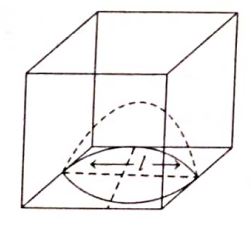
Now, required surface area of the remaining solid = TSA of the cube + CSA of hemisphere - Area of circular base of hemisphere
\(\begin{aligned} & =6 \times(\text { Edgc })^2+2 \pi r^2-\pi r^2 \\ \end{aligned}\)
\(\begin{aligned} & =6 \times l^2+2 \pi \times\left(\frac{l}{2}\right)^2-\pi\left(\frac{l}{2}\right)^2 \\ \end{aligned}\)
\(\begin{aligned} & =6 l^2+2 \pi \times \frac{l^2}{4}-\pi \frac{l^2}{4}=6 l^2+\pi \frac{l^2}{4} \\ \end{aligned}\)
\(\begin{aligned} & =\frac{l^2}{4}(\pi+24) \text { sq units } \end{aligned}\)
12.
Let AB be the tangent drawn at a point C on the circle with centre O.
To prove Perpendicular at point C passes through the centre O. If possible, let the perpendicular passing through some other point say O'.
Construction Join OC and O' C.
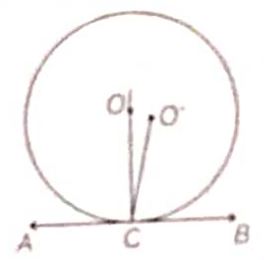
Proof Since, tangent at any point of a circle is perpendicular to the radius through the point of contact.
\(\therefore\) OC \(\perp\) AB \(\Rightarrow\) \(\angle\)OCB = 90o
Also, \(\angle\)O'CB = 90o [as it is supposed that CO' \(\perp\)AB]
\(\therefore\) \(\angle\)OCB = \(\angle\)O' CB
which is possible only when points O and O' coincide.
So, our assumption is wrong.
Hence, the perpendicular at the point of contact to the tangent to a circle always passes through the centre.
Hence proved.
13.
Given, LCM (26, 91) = 182
\(\therefore \quad HCF(26,91)=\frac { 26\times 91 }{ LCM(26,91) } =\frac { 26\times 91 }{ 182 } =13\)
14.
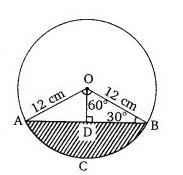
Let us draw a perpendicular OV on chord ST. It will bisect the chord ST.
SV = VT
In ΔOVS,
OV/OS = cos 60º
OV/12 = 1/2
OV = 6 cm
\(S \frac{V}{S} O=\sin 60^{\circ}=\frac{\sqrt{3}}{2}\)
\(\frac{S V}{12}=\frac{\sqrt{3}}{2} \)
\(S V=6 \sqrt{3} \mathrm{~cm} \)
\(S T=2 S V=2 \times 6 \sqrt{3}=12 \sqrt{3} \mathrm{~cm}\)
Area of ΔOST = 1/2 x ST x OV
\(\frac{1}{2} \times 12 \sqrt{3} \times 6 \)
\(=36 \sqrt{3}=36 \times 1.73=62.28 \mathrm{~cm}^{2}\)
Area of sector OSUT \(=\frac{120^{\circ}}{360^{\circ}} \times \pi(12)^{2}\)
Area of segment SUT = Area of sector OSUT − Area of ΔOST
= 150.72 − 62.28
= 88.44 cm2
15.
Let ABCD be a parallelogram circumscribing a circle.
To prove ABCD is a rhombus.
i.e. to prove AB = BC = CD= DA
Proof We know that the tangents to circle from an external point are equal in length.
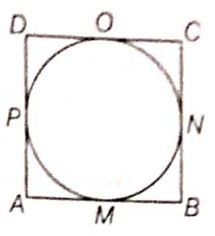
\(\therefore\) AM = AP, BM = BN, CO = CN and DO = DP
On adding all above equations, we get
(AM + BM) + (CO + DO) = AP + BN + CN + DP
\(\Rightarrow\) AB + CD = (AP + PD) + (BN + NC)
= AD + BC ....(i)
Given, ABCD is a parallelogram.
\(\therefore\) AB = CD and BC = AD ....(ii)
[\(\because\) opposite sides of a parallelogram are equal]
Then, from Eq. (i), we get
2 AB = 2BC
\(\Rightarrow\) AB = BC ...(iii)
From Eqs. (ii) and (iii), we get
AB = BC = CD = DA
\(\Rightarrow\) ABCD is a rhombus.
Hence, the parallelogram circumscribing a circle is a rhombus.
Hence proved.
16.
(c)
equal to
17.
(d)
\(\sqrt119\) cm
18.
(b)
24 cm
19.
(a)
2/3
20.
(a)
50°
21.
(b)
6
22.
(b)
45°
23.
(d)
\({P \over 720^o}\times 2\pi R^2\)
24.
(c)
intersecting or coinciden
25.
(c)
\( \frac{x ^{2}}{2}-\frac{x}{2}-6\)
26.
(a)
always irrational
27.
(c)
5/12
28.
(a)
3
29.
(a)
1
30.
(c)
203.94 cm2
31.
(d)
1:5
32.
(c)
2:3
33.
(b)
π/96
34.
(c)
0/5
35.
(a)
\(\frac { 9\sqrt { 3 } }{ 5 } \)m
36.
Total surface area (TSA) of toy = CSA of hemisphere + CSA of cone
This is because the toy is obtained by joining the plane surfaces of hemisphere and cone.
37.
If Assertion is incorrect but Reason is correct.
38.
Given matchstick pattern
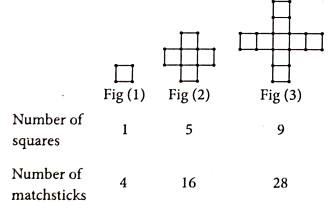
(i) The AP corresponding to number of squares in each figure is 1, 5, 9 .........
First term of AP = 1
Common difference of AP = 5 - 1 = 4
(ii) The AP corresponding to the number of sticks used in each figure is 4, 16, 28 ..........
First term of AP = 4
Common difference of AP = 16 – 4 = 12
(iii) (a) From part (i), the AP corresponding to number of squares is 1, 5, 9, ......
Here, a = 1 and 5 - 1 = 4
We have to find a10
We know that an = a + (n - 1)d
= 1 + (10 - 1)4
=1 + 9 \(\times\) 4 = 37
\(\therefore\) Fig. (10) will have 37 squares.
From part (ii), the AP we get corresponding to number of matchstick used is 4, 16, 28, ...
Here, a = 4 and d = 16 - 4 = 12
We have to find a10.
We know that
an = a + (n - 1)d
a10 = 4 + (10 - 1) 12
= 4 + 9 \(\times\) 12
= 4 + 108 = 112
\(\therefore\) Fig. (10) will have 112 matchsticks.
Or
(b) We have given, am = 88
a + (m - 1)d = 88
\(\Rightarrow\) 4+(m - 1)12 = 88 [\(\because\) a = 4, d = 12]
\(\Rightarrow\) (m - 1)12 = 84
\(\Rightarrow\) m - 1 = 7
m = 8
\(\therefore\) Fig. (8) will have 88 matchsticks.
To find number of squares in 8th figure we have to find a8 for the AP 1, 5, 9, .......
a8 = a + (8 - 1)d
a8 = 1 + 7 \(\times\) 4 = 29
Therefore, 8th figure will have 29 squares.
39.
(i) (b): Volume of the earth taken out
\(=\pi\left(\frac{7}{2}\right)^{2} \times 12=\frac{22}{7} \times \frac{7}{2} \times \frac{7}{2} \times 12=462 \mathrm{~m}^{3}\)
(ii) (d): Area of the rectangular field = 30 x 15 = 450 m2
(iii) (a): Area of top of the pit = \(=\pi\left(\frac{7}{2}\right)^{2} =\frac{22}{7} \times \frac{7}{2} \times \frac{7}{2} \)
\(=\frac{77}{2}=38.5 \mathrm{~m}^{2}\)
(iv) (d): Area of the remaining field = Area of rectangular field - area of top of pit
= 450 - 38.5 = 411.5 m2
(v) (c): The rise in the level of field = \(=\frac{462}{411.5}=1.12 \mathrm{~m}\)
40.
(i) (b): Here 80 = 24 x 5, 85 = 17 x 5
and 90 = 2 x 32 x 5
L.C.M of 80, 85 and 90 = 24 x 3 x 3 x 5 x 17 = 12240
Hence, the minimum distance each should walk when they at first time is 12240 cm.
(ii) (c): Here 594 = 2 x 33 x 11 and 189 = 33 x 7
HCF of 594 and 189 = 33= 27
Hence, the maximum number of columns in which they can march is 27.
(iii) (c) : Here 768 = 28 x 3 and 420 = 22 x 3 x 5 x 7
HCF of 768 and 420 = 22 x 3 = 12
So, the container which can measure fuel of either tanker exactly must be of 12litres.
(iv) (b): Here, Length = 825 ern, Breadth = 675 cm and Height = 450 cm
Also, 825 = 5 x 5 x 3 x 11 , 675 = 5 x 5 x 3 x 3 x 3 and 450 = 2 x 3 x 3 x 5 x 5
HCF = 5 x 5 x 3 = 75
Therefore, the length of the longest rod which can measure the three dimensions of the room exactly is 75cm.
(v) (a): LCM of 8 and 12 is 24.
\(\therefore \)The least number of pack of pens = 24/8 = 3
\(\therefore \)The least number of pack of note pads = 24/12 = 2

10th Standard CBSE Syllabus & Materials
10th Standard CBSE
CBSE 10th Social Science PS - Federalism - New Model Questions Papers Study Material - QB365 Set A
NEW10th Standard CBSE
CBSE 10th Social Science PS - Power Sharing - New Model Questions Papers Study Material - QB365 Set A
NEW10th Standard CBSE
CBSE 10th Social Science GEO - Manufacturing Industries - New Model Questions Papers Study Material - QB365 Set A
NEW10th Standard CBSE
CBSE 10th Social Science GEO - Minerals and Energy Resources - New Model Questions Papers Study Material - QB365 Set A



NCERT Books

Syllabus

Exam Pattern

Sample Question Papers

Previous year Question Papers

Important Notes

MCQ Practice test

NCERT Exemplers

Case study Questions

Image Based Questions

Passage based Questions

HOT Questions

Value Based Questions

Model Questions Papers
NCERT ( Book Back ) Questions

Assertion and Reason
Important Questions And Answers

CBSE 10th Standard CBSE Subjects
CBSE Standards



