
 100% FREE ACCESS
10th Standard CBSE Syllabus & Materials
10th Standard CBSE
CBSE 10th Social Science ECO - Globalisation and the Indian Economy - New Model Questions Papers Study Material - QB365 Set A
NEW10th Standard CBSE
CBSE 10th Social Science ECO - Money and Credit - New Model Questions Papers Study Material - QB365 Set A
NEW10th Standard CBSE
CBSE 10th Social Science ECO - Sectors of the Indian Economy - New Model Questions Papers Study Material - QB365 Set A
NEW10th Standard CBSE
CBSE 10th Social Science ECO - Development - New Model Questions Papers Study Material - QB365 Set A
NEW10th Standard CBSE
CBSE 10th Social Science PS - Outcomes of Democracy - New Model Questions Papers Study Material - QB365 Set A
NEW10th Standard CBSE
CBSE 10th Social Science PS - Gender, Religion and Caste - New Model Questions Papers Study Material - QB365 Set A

Published on: 20/10/2025
Download CBSE Class 10th Standard CBSE Maths question papers, sample papers, important questions, and previous year solved papers in PDF format. Get free study materials, NCERT solutions, and exam preparation resources for Class 10th Standard CBSE Maths
Questions + Answers key
Take MCQ Maths Test
1.
An urn contains 8 white balls, 7 black balls, 5 red balls and 4 green balls.A ball is drawn at random from the bag.Find the probability that it is:
(i)Black
(ii)Not green
2.
1000 tickets of a lottery were sold and there are 5 prizes on these tickets. If John has purchased one lottery ticket, what is the probability of winning a prize?
3.
One card is drawn from a well-shuffled deck of 52 cards. Find the probability of getting the jack of hearts.
4.
The probability of getting a bad pen in a lot of 400 pens is 0.25. Find the number of good pen in the lot.
5.
Find the probability of getting 53 Fridays in a leap year.
6.
Cards marked with numbers 5 to 50, are placed in a box and mixed thoroughly. A card is drawn from the box at random. Find the probability that the number on the taken is
(i) a prime number less than 10.
(ii) a number which is a perfect square.
7.
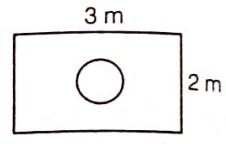
Suppose you drop a die at random on the rectangular region shown in Figure. What is the probability that it will land inside the circle of diameter 1m?
8.
Which of the following experiments have equally likely outcomes? Explain
(i) A driver attempts to start a car. The car starts or does not start.
(ii) A player attempts to shoot a basketball. She/he shoots or misses the shot.
(iii) A trial is made to answer a true-false question. The answer is right or wrong.
(iv) A baby is born. It is a boy or a girl.
9.
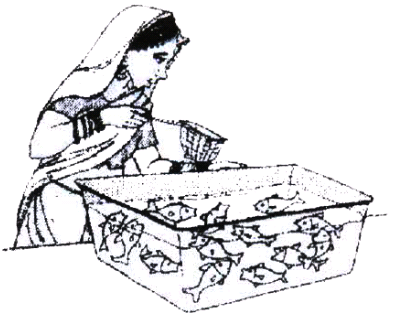
Gopi buys a fish from a shop for his aquarium. The shopkeeper takes out one fish at random from a tank containing 5 male fish and 8 female fish (see Fig.). What is the probability that the fish taken out is a male fish?
10.
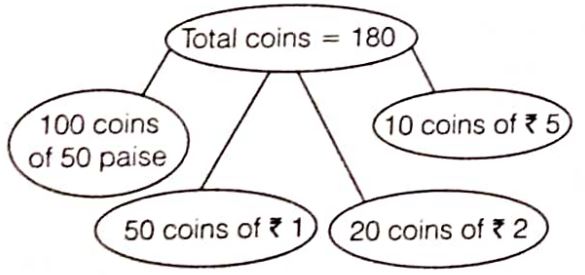
A piggy bank contains hundred 50 paise coins, fifty Rs. 1 coins, twenty Rs. 2 coins and ten Rs. 5 coins. If it is equally likely that one of the coins will fall out when the bank is turned upside down, then what is the probability that the coin
(i) will be a 50 paise coin?
(ii) will not be a Rs. 5 coin?
11.
A bag contains 3 red balls and 5 black balls. A ball is drawn at random from the bag. What is the probability that the ball drawn is (i) red? (ii) not red?
12.
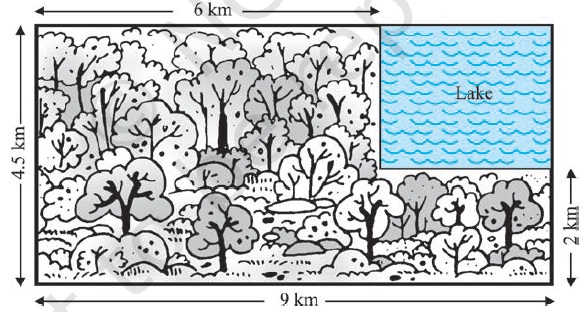
A missing helicopter is reported to have crashed somewhere in the rectangular region shown in Fig. What is the probability that it crashed inside the lake shown in the figure?
13.
A box contains 3 blue, 2 white, and 4 red marbles. If a marble is drawn at random from the box, what is the probability that it will be (i) white? (ii) blue? (iii) red?
14.
Two dice one blue and one grey, are thrown at the same time. Then
(i) Complete the following table:
| Event: (Sum on 2 dice) | 2 | 3 | 4 | 5 | 6 | 7 | 8 | 9 | 10 | 11 | 12 |
| Probability | \(\frac{1}{36}\) | \(\frac{5}{36}\) | \(\frac{1}{36}\) |
(ii) A student argues that-there are 11 possible outcomes (2, 3, 4, 5, 6, 7, 8, 9, 10, 11 and 12). Therefore, each of them has a probability \(\frac{1}{11}\). Do you agree with the argument? Justify your answer.
15.
One card is drawn from a well-shuffled deck of 52 cards. Find the probability of getting
(i) a king of red colour.
(ii) a face card.
(iii) a red face card.
(iv) the jack of hearts.
(v) a spade.
(vi) the queen of diamonds.
16.
A number is chosen at random from the numbers -3, -2, -1, 0, 1, 2, 3. The probability that |X| < 2 is
3/7
1/7
2/7
5/7
17.
A bag contains cards which are numbered from 2 to 90. A card is drawn at random from the bag. The probability that it bears a two digit number is:
88/92
81/89
88/90
89/90
18.
If three coins are tossed simultaneously, than the probability of getting at least two heads, is
1/4
3/8
1/2
1/8
19.
What is the probability that a number selected from the numbers (1, 2, 3,..........,15) is a multiple of 4?
1/5
4/5
2/15
1/3
20.
The probability of a leap year selected at random contain 53 Sunday is
53/ 366
1/7
2/7
53/365
1.
(i)\(7\over24\)
(ii)\(5\over6\)
2.
Total number of tickets 1000, Number tickets with prizes = 5
\(\therefore\) Probability of winning a prize = \(\frac{5}{1000}\)
= 0.005
3.
Total number of cards = 52 and number of Jack of hearts =1
\(\therefore\) Probability of drawing a Jack of hearts = \(\frac{1}{52}\)
4.
Let number of bad pens = x.
\(\therefore\) Probability of getting a bad pen = \(\frac{x}{400}\)
A.T.Q. \(\frac{x}{400}\) =0.25
\(\Rightarrow\) x = 0.25 x 400 = 100
\(\therefore\) Number of good pens = 400 - 100 = 300
5.
Leap year contains 366 days. \(\Rightarrow \) 52 weeks + 2 days
52 weeks contain 52 Fridays
We will get 53 Fridays if one of the remaining two days is a Friday. Total possibilities for two days are:
(Sunday, Monday), (Monday, Tuesday), (Tuesday, Wednesday), (Wednesday, Thursday), (Thursday, Friday), (Friday, Saturday), (Saturday, Sunday)
There are 7 possibilities and out of these there are 2 favourable cases.
\(\therefore P(53 Fridays) = \frac{2}{7}\)
6.
Total no.of cards = 46
Total no.of ways to select a card = 46
(i) Prime no.less than 10 in these cards are 5, 7
\(\therefore\) No.of ways to select a prime no.less than 10 = 2
\(\therefore\) Probability that the number on the card is prime = \(\frac{2}{46}=\frac{1}{23}\)
(ii) No. which is a perfect square, i.e. 9, 16, 25, 36, 49
No. of ways to select a card with perfect square = 5
\(\therefore\) Probability = \(\frac{5}{46}\)
7.
Area of restangle = 3 \(\times\) 2 = 6 m2
and area of circle of radius \(\frac{1}{2} \mathrm{~m}=\pi\left(\frac{1}{2}\right)^2=\frac{\pi}{4} \mathrm{~m}^2\)
\(\left[\because \text { diameter }=1 \mathrm{~m} \Rightarrow \text { radius }=\frac{1}{2} \mathrm{~m}\right]\)
Now, probanility that the die land inside the circle
\(=\frac{\text { Area of circle }}{\text { Area of rectangle }}=\frac{\pi / 4}{6}=\frac{\pi}{24}\)
8.
(i) The car starts normally but when there is some defect, then car does not start. So, the outcomes are not equally likely.
(ii) The outcomes in this situation are not equally likely because the outcomes depends on many factors such as training ofthe player, quality of basketball, etc.
(iii) The outcomes in trial of true-false question is either true or false. Hence, the two outcomes are equally likely.
(iv) A new baby can be either a boy or a girl, so both the outcomes are equally likely.
9.
Total number of fishes in the tank = 5 male fishes + 8 female fishes = 13 fishes
\(\therefore\) Probability of taken out a male fish
\(=\frac{\text { Number of male fishes }}{\text { Total number of fishes }}=\frac{5}{13}\)
10.
Given, number of 50 paise coins = 100,
number of Rs 1 coins = 50,
number of Rs 2 coins = 20
and number of Rs 5 coins = 10
\(\therefore\) total number of coins = 100 + 50 + 20 + 10 = 180
(i) P (50 paise coin)=\(\begin{aligned} & \frac{\text { Number of } 50 \text { paise coins }}{\text { Total number of coins }} \\ \end{aligned}\)
=\(\begin{aligned} \frac{100}{180}=\frac{5}{9} \end{aligned}\)
(ii) Number of coins which are not of Rs 5
= Total number of coins - Number of Rs 5 coins = 180 - 10 = 170
\(\therefore\) P (that the coin will not be a Rs 5 coin) \(\begin{aligned} & =\frac{170}{180} \\ \end{aligned}\)
\(\begin{aligned} & =\frac{17}{18} \end{aligned}\)
11.
Number of red balls = 3
Number of black balls = 5
Total number of balls = 3 + 5 = 8
(i) P(red ball) = \(\frac{Number \ \ of \ \ red \ \ balls}{Total \ \ number \ \ of \ \ balls}=\frac{3}{8}\)
(ii) P(not red) = \(1-\frac{3}{8}=\frac{5}{8}\)
12.
The helicopter is equally likely to crash anywhere in the region.
Area of the entire region where the helicopter can crash
= (4.5 x 9) km2 = 40.5 km2
Area of the lake = (2.5 x 3) km2 = 7.5 km2
Therefore, P (helicopter crashed in the lake) = \(\frac{7.5}{40.5}=\frac{75}{405}=\frac{5}{27}\)
13.
Saying that a marble is drawn at random is a short way of saying that all the marbles are equally likely to be drawn. Therefore, the
number of possible outcomes = 3 +2 + 4 = 9 (Why?)
Let W denote the event ‘the marble is white’, B denote the event ‘the marble is blue' and R denote the event ‘marble is red’.
(i) The number of outcomes favourable to the event W = 2
So, P(W) \(=\frac{2}{9}\)
Similarly, (ii) P(B) \(=\frac{3}{9}=\frac{1}{3} \ \text { and } \ (\text { iii }) P(R)=\frac{4}{9}\)
Note that P(W) + P(B) + P(R) = 1
14.
(i) Total possible outcomes on throwing two dice are
(1,1), (1, 2), (1,3), (1, 4), (1,5), (1,6)
(2,1),(2, 2), (2, 3), (2, 4), (2, 5), (2, 6)
(3, 1), (3, 2), (3, 3), (3, 4), (3, 5), (3, 6)
(4, 1),(4, 2), (4, 3),(4, 4),(4, 5), (4, 6)
(5, 1),(5, 2), (5, 3), (5, 4), (5, 5),(5, 6)
(6,1), (6, 2), (6, 3), (6, 4), (6, 5) and (6, 6)
\(\therefore\) Number of all possible outcomes = 36
a) Let E1 = Sum of two dice is 3.
Then, E1 would consist of two outcomes, namely (1, 2) and (2, 1).
\(\therefore\) Number of outcomes favourable to E1 = 2
Hence, \(P\left(E_1\right)=\frac{2}{36}=\frac{1}{18}\)
(b) Let E2 = Sum of two dice is 4.
Then, E2 would consist of three outcomes, namely (1, 3), (2, 2) and (3, 1).
\(\therefore\) Number of outcomes favourable to E2 = 3
Hence, \(P\left(E_2\right)=\frac{3}{36}=\frac{1}{12}\)
(c) Let E3 = Sum of two dice is 5.
Then, E3 would consist of four outcomes, namely (1, 4), (2, 3), (3, 2) and (4, 1).
\(\therefore\) Number of outcomes favourable to E3 = 4
Hence, P(E3) = \(\frac{4}{36}=\frac{1}{9}\)
(d) Let E4 = Sum of two dice is 6.
Then, E4 would consist of five outcomes, namely (1, 5), (2, 4), (3, 3), (4, 2) and (5, 1).
\(\therefore\) Number of outcomes favourable to E4 = 5
Hence, P(E4) = \(\frac{5}{36}\)
(e) Let E5 = Sum of two dice is 7.
then, E5 would consist of six outcomes, namely (1, 6), (2, 5), (3, 4), (4, 3), (5, 2) and (6, 1).
\(\therefore\) Number of outcomes favourable to E5 = 6
Hence, P(E5) = \(\frac{6}{36}=\frac{1}{6}\)
(f) Let E6 = Sum of two dice is 9.
Then, E6 would consist of four outcomes, namely (3, 6), (4, 5), (5, 4) and (6, 3).
\(\therefore\) Number of outcomes favourable to E6 = 4
Hence, P(E6) = \(\frac{4}{36}=\frac{1}{9}\)
(g) Let E7 = Sum of two dice is 10.
Then, E7 would consist of three outcomes, namely (4, 6), (5, 5) and (6, 4).
\(\therefore\) Number of outcomes favourable to E7 = 3
Hence, P(E7) = \(\frac{3}{36}=\frac{1}{12}\)
(h) Let E8 = Sum of two dice is 11.
Then, E8 would consist of two outcomes, namely (6, 5) and (5, 6).
\(\therefore\) Number of outcomes favourable to E8 = 2
Hence, P(E8) = \(\frac{2}{36}=\frac{1}{18}\)
(ii) No, we do not agree with the given argument because the events of eleven sumd are not equally likely.
15.
Total number of cards in one deck of cards is 52.
\(\therefore\) Total number of outcomes =52
(i) Let E1 = Event of getting a king of red colour
\(\therefore\) Number of outcomes favourable to E1 =2
[\(\because\) there are four kings in a deck of playing cards out of which two are red and two are black]
Hence, probability of getting a king of red colour,
\(P\left(E_1\right)=\frac{2}{52}=\frac{1}{26}\)
(ii) Let E2 = Event of getting a face card
\(\therefore\) Number of outcomes favourable to E2 =12
(\(\because\) in a deck of cards, there are 12 face cards, namely 4 kings, 4 jacks, 4 queens]
Hence, probability of getting a face card,
\(P\left(E_2\right)=\frac{12}{52}=\frac{3}{13}\)
(iii) P(a red face card) \(\frac{6}{52}\) = \(\frac{3}{26}\)
(iv) Let E4= Event of getting a jack of heart
\(\therefore\)Number of outcomes favourable to E4 = 1
[\(\because\) there are four jack cards in a deck, namely 1 of heart, 1 of club, 1 of spade and 1 of diamond]
Hence, probability of getting a jack of heart,
\(P\left(E_4\right)=\frac{1}{52}\)
(v) Let E5 = Event of getting a spade
\(\therefore\) Number of outcomes favourable to E5 = 13
[\(\because\) in a deck of cards, there are 13 spades, 13 clubs, 13 hearts and 13 diamonds]
Hence, probability of getting a spade,
\(P\left(E_5\right)=\frac{13}{52}=\frac{1}{4}\)
(vi) P(the queen of diamonds) =\(\frac{1}{52}\)
16.
(a)
3/7
17.
(b)
81/89
18.
(c)
1/2
19.
(a)
1/5
20.
(a)
53/ 366

10th Standard CBSE Syllabus & Materials
10th Standard CBSE
CBSE 10th Social Science PS - Federalism - New Model Questions Papers Study Material - QB365 Set A
NEW10th Standard CBSE
CBSE 10th Social Science PS - Power Sharing - New Model Questions Papers Study Material - QB365 Set A
NEW10th Standard CBSE
CBSE 10th Social Science GEO - Manufacturing Industries - New Model Questions Papers Study Material - QB365 Set A
NEW10th Standard CBSE
CBSE 10th Social Science GEO - Minerals and Energy Resources - New Model Questions Papers Study Material - QB365 Set A



NCERT Books

Syllabus

Exam Pattern

Sample Question Papers

Previous year Question Papers

Important Notes

MCQ Practice test

NCERT Exemplers

Case study Questions

Image Based Questions

Passage based Questions

HOT Questions

Value Based Questions

Model Questions Papers
NCERT ( Book Back ) Questions

Assertion and Reason
Important Questions And Answers

CBSE 10th Standard CBSE Subjects
CBSE Standards



