
 100% FREE ACCESS
10th Standard CBSE Syllabus & Materials
10th Standard CBSE
CBSE 10th Social Science ECO - Globalisation and the Indian Economy - New Model Questions Papers Study Material - QB365 Set A
NEW10th Standard CBSE
CBSE 10th Social Science ECO - Money and Credit - New Model Questions Papers Study Material - QB365 Set A
NEW10th Standard CBSE
CBSE 10th Social Science ECO - Sectors of the Indian Economy - New Model Questions Papers Study Material - QB365 Set A
NEW10th Standard CBSE
CBSE 10th Social Science ECO - Development - New Model Questions Papers Study Material - QB365 Set A
NEW10th Standard CBSE
CBSE 10th Social Science PS - Outcomes of Democracy - New Model Questions Papers Study Material - QB365 Set A
NEW10th Standard CBSE
CBSE 10th Social Science PS - Gender, Religion and Caste - New Model Questions Papers Study Material - QB365 Set A

Published on: 20/10/2025
Download CBSE Class 10th Standard CBSE Maths question papers, sample papers, important questions, and previous year solved papers in PDF format. Get free study materials, NCERT solutions, and exam preparation resources for Class 10th Standard CBSE Maths
Questions + Answers key
Take MCQ Maths Test
1.
Calculate \(\frac { 3 }{ 8 } \) in the decimal form.
2.
Find the probability that a leap year has 53 Sundays.
3.
Find the roots of the quadratic equation \(-3x^{2} + 5x + 12 = 0\) by using the quadratic formula.
4.
If two vertices of a triangle are (6, 3) and (-1, 7) and centroid (1, 5), then find the third vertex.
5.
The sum of four numbers in AP is 26 and the sum of their squares is 214. Find the numbers.
6.
The following distribution gives the weights of 60 students of a class. Find the mean and mode weights of the students.
| Weight (in kg) | 40-44 | 44-48 | 48-52 | 52-56 | 56-60 | 60-64 | 64-68 | 68-72 |
| Number of students | 4 | 6 | 10 | 14 | 10 | 8 | 6 | 2 |
7.
A part of monthly charges in a college is fixed and the remaining depend on the number of days one has taken food in the mess. When a student X takes food for 25 days, he has to pay Rs.1750 as hostel charges, whereas a student Y, who takes food for 28 days, pays Rs.1900 as hostel charges. Find the fixed charge and the cost of food per day.
8.
Write the cubic polynomial, whose zeroes are \(2-2\sqrt { 5 } ,2+2\sqrt { 5 }\) and 1, respectively.
9.
In an AP, given \({a}_{n}=4, n=8, {S}_{n}=192,\) find d.
10.
Find the roots of the following quadratic equations by factorisation.
\(2x^{ 2 }-x\frac { 1 }{ 8 } =0\)
11.
Two dice are numbered 1,2,3,4,5,6 and 1,1,2,2,3,3 respectively.They are thrown and the sum of the numbers on them is noted.Find the probability of getting each sum from 2 to 9 separately
12.
Find the area of the triangle formed by joining the mid-points of the sides of the triangle whose vertices are (0,-1), (2,1) and (0,3). Find the ratio of this area to the area of the given triangle.
13.
(x, y) is 5 units from the origin. How many such points lie in the third quadrant?
0
1
2
infinitely many
14.
The values of k for which the roots of quadratic equation \(x^2+4 x+k=0\) are real, is
\(k \geq 4\)
\(k \leq 4\)
\(k \geq-4\)
\(k \leq-4\)
15.
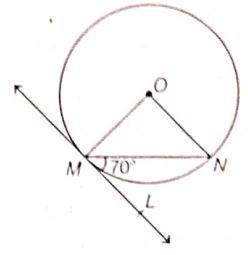
In the given figure, O is the centre of the circle, MN is the chord and the tangent ML at point M makes an angle of 70° with MN The measure of \(\angle\)MON is
120°
140°
70°
90°
16.
HCF of 92 and 152 is
4
19
23
57
17.
At a fate, cards bearing numbers 1to 1000. One number on one card are put in a box. Each player selects one card at random and that card is not replaced. If the selected card has a perfect square number greater than 500, the player wins a prize.
The probability that the first player wins is
0.009
0.099
0.999
1
18.
The pair of equations 3x+y =81. 81x-y = 3 has
no solution
unique solution
infinitelymany solutions
\(x=2 \frac{1}{8}, y=1 \frac{7}{8}\)
19.
The solution of x2 + 4x + 4 = 0 is
None of these
0
-2
2
20.
If the mean of the following distribution is 6, find the value of ‘p’.
| x | 2 | 4 | 6 | 10 | p+6 |
| f | 3 | 2 | 3 | 1 | 2 |
7
12
8
6
21.
22.
One equation of a pair of dependent linear equations is -5x + 7y = 2, the second equation can be
10x + 14y + 4 = 0
-10x – 14x + 4 = 0
10x – 14y = -4
10x + 14y + 4 =0
23.
Given that the H.C.F. of 35 and 49 is 7, what is their LCM?
265
245
195
225
24.
Consider a line passing through (1, 2) and (4, 8), gradient of this line is equal to:
1/2
-1/2
2
-2
25.
An urn contains lottery tickets numbered from 1 to 100. If a ticket is selected at random, then the probability that it is a perfect square is
0.01
0.08
0.09
0.1
26.
Assertion: In a lottery, there are 5 prizes and 20 blanks, the probability of not getting a prize 4 is \(\frac{4}{5}\)
Reason: A die is tossed once, then the probability of getting a number less than 5 is \(\frac{2}{3}\)
Codes
(a) If both Assertion and Reason are correct and Reason is the correct explanation of Assertion.
(b) If both Assertion and Reason are correct, but Reason is not the correct explanation of Assertion.
(c) If Assertion is correct but Reason is incorrect.
(d) If Assertion is incorrect but Reason is correct.
27.
Assertion Sum of first 10 even natural number is 120.
Reason If a is the first term, l is the last term and d is the common difference of an Ap, then nth term from the end is given by 1- (n -1) d.
Codes:
(a) If both Assertion and Reason are correct and Reason is the correct explanation of Assertion.
(b) If both Assertion and Reason are correct, but Reason is not the correct explanation of Assertion.
(c) If Assertion is correct but Reason is incorrect.
(d) If Assertion is incorrect but Reason is correct.
28.
Two families- Gupta's and Singhal's are lived in a colony. Gupta family has two children while Singhal family has 3 children.
On the basis of the above information, answer the following questions.
(i) Find the probability that Mr Singhal has exactly 2 girls and 1 boy.
| (a) \(\begin{equation} \frac{1}{2} \end{equation}\) | (b) \(\begin{equation} \frac{1}{4} \end{equation}\) |
| (c) \(\begin{equation} \frac{1}{6} \end{equation}\) | (d) \(\begin{equation} \frac{1}{8} \end{equation}\) |
(ii) The probability that Gupta's has atleast 1 boy is
| (a) \(\begin{equation} \frac{1}{3} \end{equation}\) | (b) \(\begin{equation} \frac{2}{3} \end{equation}\) |
| (c) 1 | (d) \(\begin{equation} \frac{4}{5} \end{equation}\) |
(iii) The probability that Gupta's has atmost 1 girl is
| (a) \(\begin{equation} \frac{1}{3} \end{equation}\) | (b) \(\begin{equation} \frac{2}{3} \end{equation}\) |
| (c) 1 | (d) \(\begin{equation} \frac{2}{5} \end{equation}\) |
(iv) The probability that Singhal's has no boy is
| (a) \(\begin{equation} \frac{1}{2} \end{equation}\) | (b) \(\begin{equation} \frac{1}{4} \end{equation}\) |
| (c)\(\begin{equation} \frac{1}{6} \end{equation}\) | (d) \(\begin{equation} \frac{1}{8} \end{equation}\) |
(v) The sum of probabilities that both families have exactly two girls is
| (a) \(\begin{equation} \frac{1}{12} \end{equation}\) | (b) \(\begin{equation} \frac{1}{4} \end{equation}\) |
| (c) \(\begin{equation} \frac{7}{12} \end{equation}\) | (d) 0 |
29.
A quadratic equation can be defined as an equation of degree 2. This means that the highest exponent of the polynomial in it is 2. The standard form of a quadratic equation is ax2+ bx + c = 0, where a, b, and c are real numbers and \(a \neq 0\) Every quadratic equation has two roots depending on the nature of its discriminant, D = b2 - 4ac.Based on the above information, answer the following questions.
(i) Which of the following quadratic equation have no real roots?
| \((a) -4 x^{2}+7 x-4=0\) | \((b) -4 x^{2}+7 x-2=0\) |
| \((c) -2 x^{2}+5 x-2=0\) | \((d) 3 x^{2}+6 x+2=0\) |
(ii) Which of the following quadratic equation have rational roots?
| \((a) x^{2}+x-1=0\) | \((b) x^{2}-5 x+6=0\) |
| \((c) 4 x^{2}-3 x-2=0\) | \((d) 6 x^{2}-x+11=0\) |
(iii) Which of the following quadratic equation have irrational roots?
| \((a) 3 x^{2}+2 x+2=0\) | \((b) 4 x^{2}-7 x+3=0\) |
| \((c) 6 x^{2}-3 x-5=0\) | \((d) 2 x^{2}+3 x-2=0\) |
(iv) Which of the following quadratic equations have equal roots?
| \((a) x^{2}-3 x+4=0\) | \((b) 2 x^{2}-2 x+1=0\) |
| \((c) 5 x^{2}-10 x+1=0\) | \((d) 9 x^{2}+6 x+1=0\) |
(v) Which of the following quadratic equations has two distinct real roots?
| \((a) x^{2}+3 x+1=0\) | \((b) -x^{2}+3 x-3=0\) |
| \((c) 4 x^{2}+8 x+4=0\) | \((d) 3 x^{2}+6 x+4=0\) |
30.
In a classroom activity on real numbers, the students have to pick a number card from a pile and frame question on it if it is not a rational number for the rest of the class. The number cards picked up by first 5 students and their questions on the numbers for the rest of the class are as shown below. Answer them.
(i) Suraj picked up \(\sqrt{8}\) and his question was - Which of the following is true about \(\sqrt{8}\)?
| (a) It is a natural number | (b) It is an irrational number |
| (c) It is a rational number | (d) None of these |
(ii) Shreya picked up 'BONUS' and her question was - Which of the following is not irrational?
| (a) 3-4\(\sqrt{5}\) | (b) \(\sqrt{7}\) -6 | (c) 2+2\(\sqrt{9}\) | (d) 4\(\sqrt{11}\)-6 |
(iii) Ananya picked up \(\sqrt{5}\) -.\(\sqrt{10}\) and her question was - \(\sqrt{5}\) -.\(\sqrt{10}\) _________is number.
| (a) a natural | (b) an irrational | (c) a whole | (d) a rational |
(iv) Suman picked up \(\frac{1}{\sqrt{5}}\) and her question was - \(\frac{1}{\sqrt{5}}\) is __________ number.
| (a) a whole | (b) a rational | (c) an irrational | (d) anatural |
(v) Preethi picked up \(\sqrt{6}\) and her question was - Which of the following is not irrational?
| (a) 15 + 3\(\sqrt{6}\) | (b) \(\sqrt{24}\)- 9 | (c) 5.\(\sqrt{150}\) | (d) None of these |
1.
\(\frac { 3 }{ 8 } =\frac { 3 }{ { 2 }^{ 3 } } \)
\(=\frac { { 3\times 5 }^{ 3 } }{ { 2 }^{ 3 }\times { 5 }^{ 3 } } \)
\(=\frac { 375 }{ 10^{ 3 } } =\frac { 375 }{ 1000 } \)
\(=0.375\)
2.
\(2\over7\)
3.
\(-{3\over2} , {2\over3}\)
4.
(-2, 5)
5.
2,5,8,11 or 11,8,5,2
6.
| C.I | xi | fi | \(u_{ i }=\frac { x_{ i }-a }{ n } \) | fiui |
| 40-44 | 42 | 4 | -3 | -12 |
| 44-48 | 46 | 6 | -2 | -12 |
| 52-56 | 54 | 14 | 0 | 0 |
| 56-60 | 58 | 10 | 1 | 10 |
| 60-64 | 62 | 8 | 2 | 16 |
| 64-68 | 66 | 6 | 3 | 18 |
| 68-72 | 70 | 2 | 4 | 8 |
Let a = Assumed mean = 54
\(\overset { - }{ x } =a+\frac { \Sigma f_{ i }u_{ i } }{ \Sigma f_{ i } } \times h\)
Mean = 54+\(\frac { 18 }{ 60 } \times 4=55.2\)
Maximum frequency =14 Modal class =52-56,l=52 f1=14,f0=10,f2=10,h=4
Mode=52+\(\frac { 14-10 }{ 28-10-10 } \times 4=54\)
7.
Fixed charges=Rs.500; cost of food per day=Rs.50
8.
x3-5x2-12x+16
9.
Here \({a}_{n}=4, n=8, \) and \({S}_{n}=192\)
Let d be the common difference of the given AP.
Then, \({ S }_{ n }=\frac { n }{ 2 } \left[ 2a+\left( n-1 \right) d \right] \)
\(\therefore\) \(192=\frac { 8 }{ 2 } \left[ 2\times 3+\left( 8-1 \right) d \right] \)
\(\Rightarrow\) \(192=4\left( 6+7d \right) \)
\(\Rightarrow\) \(48=6+7d\)
\(\Rightarrow\) \(7d=48-6=42\)
\(\Rightarrow\) \(d=\frac { 42 }{ 7 } =6\)
Hence, d = 6
10.
Given equation is \(2x^{ 2 }-x\frac { 1 }{ 8 } =0\)
On multiplying both sides by 8, we get \(16x^{ 2 }-8x+1=0\)
\(\Rightarrow 16x^{ 2 }-4x-4x+1=0\)
\(\left[ \because (-4)X(-4)=16\quad and\quad -4-4=-8 \right] \)
\(\Rightarrow 4x(4x-1)-1(4x-1)=0\)
\(\Rightarrow 4x-1=0\Rightarrow x=\frac { 1 }{ 4 } \)
and 4x-1=0 \(\Rightarrow x=\frac { 1 }{ 4 } \)
Hence the roots of the equation \(2x^{ 2 }-x+\frac { 1 }{ 8 } =0\)are \(\frac { 1 }{ 4 } \quad and\quad \frac { 1 }{ 4 } \)
11.
When two dice are thrown simultaneously, then sample space contain ( 6 X6=36) outcomes
Sum 2 i.e., [(1,1),(1,1)] = two outcomes
P( Sum 2) = 2 / 36 = 1 / 18
Sum 3 i.e., (1,2), (1,2), (2,1), (2,1) =4 outcomes.
P( Sum 3) = 4 / 36 = 1 / 9
Sum 4 i.e., [(1,3), (1,3), (2,2), (2,2),(3,1), (3,1)] =6 outcomes
P( Sum 4) = 6 / 36 = 1 / 6
Sum 5 i.e., [(2,3), (2,3), (3,2), (3,2),(4,1), (4,1)] =6 outcomes
P( Sum 5) = 6 / 36 = 1 / 6
Sum 6 i.e., [(3,3), (3,3), (4,2), (4,2),(5,1), (5,1)] =6 outcomes
P( Sum 6) = 6 / 36 = 1 / 6
Sum 7 i.e., [(4,3), (4,3), (5,2), (5,2),(6,1), (6,1)] =6 outcomes
P( Sum 7) = 6 / 36 = 1 / 6
Sum 8 i.e., [(5,3), (5,3), (6,2), (6,2)] =4 outcomes
P( Sum 8) = 4 / 36 = 1 / 9
Sum 9 i.e., [(6,3), (6,3)] =2 outcomes.
P( Sum 9) = 2 / 36 = 1 / 18
12.
Let P(O, —1), Q(2, 1) and R(O, 3) be the vertices of the given PQR L,M and N are the midpoints of QR,RP and PQ respectively
\(\therefore \) Coorinates of L,M and N are
L\(\left( \frac { 2+0 }{ 2 } ,\frac { 1+3 }{ 2 } \right) \) i.e L(1,2)
M \(\left( \frac { 0+0 }{ 2 } ,\frac { 3-1 }{ 2 } \right) \)
i.e M (0,1)
and N \(\left( \frac { 0+2 }{ 2 } ,\frac { -1+1 }{ 2 } \right) \)
i.e N(1,0)
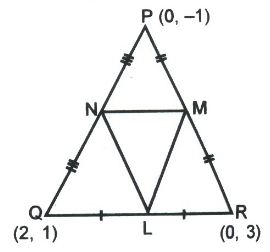
Area of \(\triangle \)PQR = \(\frac { 1 }{ 2 } \left| \{ 0\times 1+2\times 3+0\times (-1)\} -\{ 2\times (-1)+0\times 1+0\times 3\} \right| \)
= \(\frac { 1 }{ 2 } \)|(0+6+0)-(-2+0+0)|
=\(\frac { 1 }{ 2 } \) |6+2|=4 sq.units
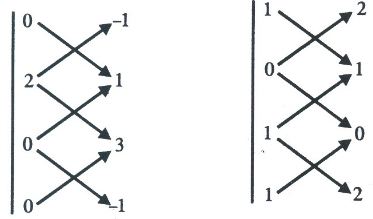
Area of \(\triangle \)LMN= \(\frac { 1 }{ 2 } \left| \{ 1\times 1+0\times 0+0\times 1\times 2\} -\{ 0\times 2+1\times 1\times 0\} \right| \)
=\(\frac { 1 }{ 2 } \) |(1+0+2)-(0+1+0)|
=\(\frac { 1 }{ 2 } \) |3-1|
\(\frac { 1 }{ 2 } \) x 2
= 1 sq.units
Ratio of area of \(\triangle \)LMN and area of \(\triangle \)PQR=1:4
13.
(d)
infinitely many
14.
(b)
\(k \leq 4\)
15.
(b)
140°
16.
(a)
4
17.
(a)
0.009
18.
(d)
\(x=2 \frac{1}{8}, y=1 \frac{7}{8}\)
19.
(c)
-2
20.
(d)
6
21.
(c)
22.
(c)
10x – 14y = -4
23.
(b)
245
24.
(c)
2
25.
(d)
0.1
26.
(b) If both Assertion and Reason are correct, but Reason is not the correct explanation of Assertion.
27.
(d) If Assertion is incorrect but Reason is correct.
28.
Let Band G denotes boy and girl respectively.
Then,
Possible outcomes for Gupta's family having two kids is {BB, BG, GG}
Similarly, possible outcomes for Singhal's family having 3 kids is {BBB, BBG, BGG, GGG}
(i) (b): Required probability = \(\begin{equation} \frac{1}{4} \end{equation}\)
(ii) (b): Required probability = \(\begin{equation} \frac{2}{3} \end{equation}\)
(iii) (b): Required probability = \(\begin{equation} \frac{2}{3} \end{equation}\)
(iv) (b) : Required probability = \(\begin{equation} \frac{1}{4} \end{equation}\)
(v) (c): Required probability = \(\begin{equation} \frac{1}{3}+\frac{1}{4}=\frac{7}{12} \end{equation}\)
29.
(i) (a): To have no real roots, discriminant (D = b2 - 4ac) should be < 0.
(a) D = 72 - 4(-4)(-4) = 49 - 64 = -15 < 0
(b) D=72-4(-4)(-2)=49-32=17>0
(c) D = 52 - 4(-2)(-2) = 25 - 16 = 9 > 0
(d) D = 62 - 4(3)(2) = 36 - 24 = 12> 0
(ii) (b): To have rational roots, discriminant (D = b2 - 4ac) should be> 0 and also a perfect square
(a) D = 12- 4(1)( -1) = 1 + 4 = 5, which is not a perfect square.
(b) D = (-5)2 - 4(1)(6) = 25 - 24 = I, which is a perfect square.
(c) D = (-3)2 - 4(4)(-2) = 9 + 32 = 41, which is not a perfect square.
(d) D = (-1)2 - 4(6)(11) = 1 - 264 = -263, which is not a perfect square.
(iii) (c) : To have irrational roots, discriminant (D = b2 - 4ac) should be > 0 but not a perfect square.
(a) D = 22 - 4(3)(2) = 4 - 24 = -20 < 0
(b) D = (-7)2 - 4(4)(3) = 49 - 48 = 1 > 0 and also a perfect square.
(c) D = (-3)2 - 4(6)(-5) = 9 + 120 = 129> 0 and not a perfect square.
(d) D = 32 - 4(2)(-2) = 9 + 16 = 25 > 0 and also a perfect square.
(iv) (d): To have equal roots, discriminant (D = b2 - 4ac) should be = 0.
(a) D=(-3)2-4(1)(4)=9-16=-7<0
(b) D = (-2)2 - 4(2)(1) = 4 - 8 = -4 < 0
(c) D = (-10)2 - 4(5)(1) = 100 - 20 = 80 > 0
(d) D = 62 - 4(9)(1) = 36 - 36 = 0
(v) (a): To have two distinct real roots, discriminant (D = b2 - 4ac) should be > 0.
(a) D = 32 - 4(1)(1) = 9 - 4 = 5 > 0
(b) D = 32 - 4(-1)( -3) = 9 - 12 = -3 < 0
(c) D=82- 4(4)(4) = 64-64 = 0
(d) D = 62 - 4(3)(4) = 36 - 48 = -12 < 0
30.
(i) (b): Here \(\sqrt{8}\) = 2\(\sqrt{2}\) = product of rational and irrational numbers = irrational number
(ii) (c): Here, \(\sqrt{9}\) = 3 So, 2 + 2\(\sqrt{9}\)= 2 + 6 = 8 , which is not irrational.
(iii) (b): Here.\(\sqrt{15}\) and \(\sqrt{10}\) are both irrational and difference of two irrational numbers is also irrational.
(iv) (c): As \(\sqrt{5}\) is irrational, so its reciprocal is also irrational.
(v) (d): We know that \(\sqrt{6}\) is irrational. So, 15 + 3.\(\sqrt{6}\) is irrational.
Similarly, \(\sqrt{24}\) - 9 = 2.\(\sqrt{6}\) - 9 is irrational.
And 5\(\sqrt{150}\) = 5 x 5.\(\sqrt{6}\) = 25\(\sqrt{6}\) is irrational.

10th Standard CBSE Syllabus & Materials
10th Standard CBSE
CBSE 10th Social Science PS - Federalism - New Model Questions Papers Study Material - QB365 Set A
NEW10th Standard CBSE
CBSE 10th Social Science PS - Power Sharing - New Model Questions Papers Study Material - QB365 Set A
NEW10th Standard CBSE
CBSE 10th Social Science GEO - Manufacturing Industries - New Model Questions Papers Study Material - QB365 Set A
NEW10th Standard CBSE
CBSE 10th Social Science GEO - Minerals and Energy Resources - New Model Questions Papers Study Material - QB365 Set A



NCERT Books

Syllabus

Exam Pattern

Sample Question Papers

Previous year Question Papers

Important Notes

MCQ Practice test

NCERT Exemplers

Case study Questions

Image Based Questions

Passage based Questions

HOT Questions

Value Based Questions

Model Questions Papers
NCERT ( Book Back ) Questions

Assertion and Reason
Important Questions And Answers

CBSE 10th Standard CBSE Subjects
CBSE Standards



