
 100% FREE ACCESS
10th Standard CBSE Syllabus & Materials
10th Standard CBSE
CBSE 10th Social Science ECO - Globalisation and the Indian Economy - New Model Questions Papers Study Material - QB365 Set A
NEW10th Standard CBSE
CBSE 10th Social Science ECO - Money and Credit - New Model Questions Papers Study Material - QB365 Set A
NEW10th Standard CBSE
CBSE 10th Social Science ECO - Sectors of the Indian Economy - New Model Questions Papers Study Material - QB365 Set A
NEW10th Standard CBSE
CBSE 10th Social Science ECO - Development - New Model Questions Papers Study Material - QB365 Set A
NEW10th Standard CBSE
CBSE 10th Social Science PS - Outcomes of Democracy - New Model Questions Papers Study Material - QB365 Set A
NEW10th Standard CBSE
CBSE 10th Social Science PS - Gender, Religion and Caste - New Model Questions Papers Study Material - QB365 Set A

Published on: 20/10/2025
Download CBSE Class 10th Standard CBSE Maths question papers, sample papers, important questions, and previous year solved papers in PDF format. Get free study materials, NCERT solutions, and exam preparation resources for Class 10th Standard CBSE Maths
Questions + Answers key
Take MCQ Maths Test
1.
In a single throw of a pair of different dice, what is probability of getting (i) a prime number on each dice? (ii) a total of 9 or 11?
2.
The king, queen and jack of clubs are removed from a deck of 52 playing cards and then well-shuffled. One card is selected from the remaining cards. Find the probability of getting
(i) a heart (ii) a king (iii) a club (iv) the '10' of hearts
3.
One card is drawn from a well-shuffled deck of 52 cards. Find the probability of drawing : (i) an ace (ii) '2' spades (iii) '10' of a black suit
4.
A card is drawn at random from a well shuffled pack of 52 playing cards.Find the probability of getting a red face.
5.
For travelling different mode of transport is used by 500 people are as follows:
| Mode of transport | No. of People |
| Car | 80 |
| Scooter | 120 |
| Bus | 100 |
| Train | 70 |
| Cycle | 110 |
| No mode of transport | 20 |
Find the probability of number of people:
(i) Used car or scooter only
(ii) Used cycle only
(iii) Used at least one kind of mode of transport
(iv) Which value would you learn from above data
6.
A bag contains cards which are numbered from 2 to 90. A card is drawn at random from the bag. Find the probability that it bears
(a) a two digit number,
(b) a number which is a perfect square.
7.
Cards marked with numbers 3, 4, 5, 50 are placed in a bag and mixed thoroughly. One card is drawn at random from the bag. Find the probability that number on the card drawn is :
(a) Divisible by 7.
(b) A perfect square.
(c) A multiple of 6.
8.
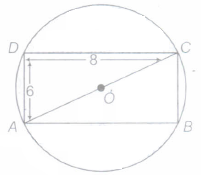
In the given figure, a dart is thrown and lands in the interior of the circle. What is the probability that the dart will land in the shaded region?
9.
Anu, Priya and Jyoti were fighting to get first chance in a game. Anu says, "Let us toss two coins. If both heads appear, Priya will take chance, if both tails appear, Jyoti will get it and if one head and one tail appears, I will get the chance".
(i) What is the probability of Anu, Priya and Jyoti getting the first chance?
(ii) Is her decision fair?
(iii) What quality of her character is being depicted here?
10.
When a dice is thrown once, the probability of getting an even number less than 4 is
\(\frac{1}{4}\)
0
\(\frac{1}{2}\)
\(\frac{1}{6}\)
11.
One card is drawn from a deck of 52 cards. The probability of drawing a black card is
1/4
1/2
1/52
1/3
12.
One day Rahul visited park along with his friend. There he saw a game of chance that consists of spinning an arrow (as shown in below figure) that comes to rest pointing at one of the numbers 1, 2, 3, 4, 5,6, 7, 8 and these are equally likely outcomes.
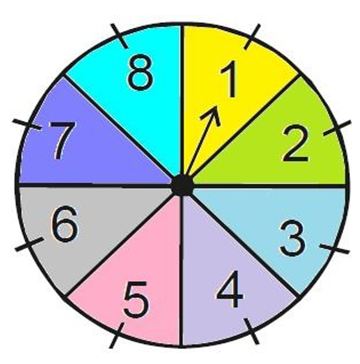
(a) Find the probability that the arrow will point at 2 .
| (i) \( \frac{1}{2}\) | (ii) \(\frac{1}{8}\) | (iii) \(\frac{3}{8}\) | (iv) \( \frac{5}{8}\) |
(b) Find the probability that the arrow will point at an even number.
| (i) \(\frac{1}{2}\) | (ii) \(\frac{1}{8}\) | (iii) \(\frac{3}{8}\) | (iv) \(\frac{1}{4}\) |
(c) Find the probability that the arrow will point at a prime number.
| (i) \(\frac{1}{2}\) | (ii) \(\frac{1}{8}\) | (iii) \(\frac{3}{8}\) | (iv) \(\frac{5}{8}\) |
(d) Find the probability that the arrow will point at a number divisible by 3 .
| (i) \(\frac{1}{2}\) | (ii) \(\frac{1}{8}\) | (iii) \(\frac{3}{8}\) | (iv) \(\frac{1}{4}\) |
(e) Find the probability that the arrow will point at a number greater than 2 .
| (i) \(\frac{1}{2}\) | (ii) \( \frac{1}{8}\) | (iii) \(\frac{3}{4}\) | (iv) \( \frac{1}{4}\) |
13.
Mr Verma is a production manager in a factory that makes footballs. On one day, he noticed that at every 100
pieces produced in the factory, 15 are defective. If the total number of footballs produced in one day in the
factory is 22000, then answer the following questions.
(i) A football is selected at random, then the probability of selecting a defective football is
| (a) \(\begin{equation} \frac{1}{20} \end{equation}\) | (b) \(\begin{equation} \frac{1}{10} \end{equation}\) |
| (c) \(\begin{equation} \frac{3}{20} \end{equation}\) | (d) \(\begin{equation} \frac{1}{5} \end{equation}\) |
(ii) A football is selected at random, the probability of selecting a non-defective football is
| (a) \(\begin{equation} \frac{1}{20} \end{equation}\) | (b) \(\begin{equation} \frac{13}{20} \end{equation}\) |
| (c) \(\begin{equation} \frac{3}{4} \end{equation}\) | (d) \(\begin{equation} \frac{17}{20} \end{equation}\) |
(iii) The total number of defective footballs produced in one day is
| (a) 4200 | (b) 3300 |
| (c) 9200 | (d) 11000 |
(iv) The total number of non-defective footballs produced in one day is
| (a) 18700 | (b) 17800 |
| (c) 12800 | (d) 11000 |
(v) If the probability of selecting a defective football is , then the number of non-defective footballs produced in one day, if everyday same number of footballs produced in the factory, is
| (a) 13640 | (b) 9200 |
| (c) 7040 | (d) 14960 |
1.
Total outcomes = 36
(i) let A = a prime number on each die.
Favourable outcomes of event A are (2, 2), (2,3), (2, 5), (3, 3), (3, 2), (3, 5),(5,2),(5,3),(5,5)
\(\therefore\)P(A)=\(\frac{9}{36}=\frac{1}{4}\)
(ii) let B = a total of 9 or 11
Favourable outcomes of event B are
(3,6),(4,5),(5,4),(5,6),(6,3),(6,5)
\(\therefore\)P(B)=\(\frac{6}{36}=\frac{1}{6}\)
2.
Card removed = king, queen and jack of clubs = 3
Cards left = 52- 3 = 49
(i) Number. of hearts = 13
Probability of drawing a heart = \(\frac {13}{49}\)
(ii) Number of king = 4
Number of kings left = 4 - 1 = 3
Probability of drawing a king = \(\frac {3}{49}\)
(iii) 3 clubs are removed
Number of clubs left=13-3=10
Probability of drawing a club = \(\frac {10}{49}\)
(iv) There is only one '10' of hearts.
\(\therefore\)Probability of drawing a '10' of hearts =\(\frac {1}{49}\)
3.
Total number of cards = 52
(i) Number of ace = 4
\(\therefore\) Probability of drawing an ace = \(\frac{4}{52}=\frac{1}{13}\)
(ii) There is only one '2' of spades
\(\therefore\) Probability of drawing a '2' of spade = \(\frac{1}{52}\)
(iii) '10' of a black suit there are two cards
\(\therefore\) Probability of drawing 10 of black suit = \(\frac{2}{52}=\frac{1}{26}\)
4.
\(3\over26\)
5.
Here, Total number of people=500
(i) Number of people who used car or only
=80+120=200
P (Number of people who used car or scooter only) = \(\frac{200} {500} = \frac{2} {5}\)
(ii) Number of who used only cycle = 110
P (Number of People who used only cycle) =\(\frac{110} {500} = \frac{11} {50}\)
(iii) Number of people who used at least one kind of mode of transport 500 -20 = 480
P (Number of people who used at least one kind of mode of transport) = \(\frac{480} {500} = \frac{24} {25}\)
(iv) Keeping save environment good health and save energy in mind, cycle should be promoted as a mode of transport.
6.
\((a) \frac{81}{89} (b) \frac{8}{89}\)
7.
Total number of cards = 48
Probability of an event = \(\frac{Total\ number \ of \ favourable \ outcomes}{Total\ number\ of \ outcomes}\)
Number of cards divisible by 7 = 7
P(cards divisible by 7) = \(\frac{7}{48}\)
Number of cards having a perfect square = 6
P(cards having a perfect square) =\(\frac{6}{48}\)=\(\frac{1}{8}\)
Number of multiples of 6 from 3 to 50 = 8
P(multiple of 6 from 3 to 50) = \(\frac{8}{48}\) =\(\frac{1}{6}\)
8.
Since ΔADC is right angled at D.
\(\Rightarrow A C^{2}=A D^{2}+D C^{2}=6^{2}+8^{2}\) [by Pythagoras theorem)
= 36 + 64 = 100
\(\Rightarrow A C=10\) [taking positive sqaure root)
Now radius of circle = OC \(=\frac{1}{2} A C=5\)
P (dart will land in the shaded region)
\(=\frac{\text { Area of shaded region }}{\text { Area of the circle }} \)
\(=\frac{\text { Area of the circle }-\text { Area of the rectangle }}{\text { Area of the circle }} \)
\(= \frac{25 \pi-48}{25 \pi}\)
9.
The possible outcomes of the experiment of tossing two coins are HH, HT, TH and TT.
(i) Outcomes favourable to Anu are HT and TH.
P (Anu getting first chance) = \(\frac{2}{4}=\frac{1}{2}\)
Outcomes favourable to Priya is HH.
\(\therefore \) P ( Priya getting first chance) = \(\frac{1}{4}\)
Outcomes favourable to Jyoti is TT.
\(\therefore \) P (Jyoti getting first chance) = \(\frac{1}{4}\)
(ii) No, the number of cases favourable to each one of them are not equal.
(iii) Dishonesty, as she kept two cases favourable for herself and one each for the other two friends.
10.
(d)
\(\frac{1}{6}\)
11.
(b)
1/2
12.
(a) (ii) \(\frac{1}{8}\)
(b) (i) \(\frac{1}{2}\)
(c) (i) \(\frac{1}{2}\)
(d) (iv) \(\frac{1}{4}\)
(e) (iii) \(\frac{3}{4}\)
13.
Total number of footballs produced in one day = 220000
(i) (c): P(selecting a defective football) = \(\begin{equation} \frac{15}{100}=\frac{3}{20} \end{equation}\)
(ii) (d): P(selecting a non-defective football) = 1- P(selecting a defective football) = \(\begin{equation} 1-\frac{3}{20}=\frac{17}{20} \end{equation}\)
(iii) (b) : Total number of defective footballs produced in 1 day = \(\begin{equation} \frac{3}{20} \times 22000=3300 \end{equation}\)
(iv) (a) : Total number of non-defective footballs produced in 1 day = 22000 - 3300 = 18700
(v) (d): P(selecting defective football) \(\begin{equation} =\frac{8}{25} \end{equation}\)
P (selecting non-defective football) = \(\begin{equation} 1-\frac{8}{25}=\frac{17}{25} \end{equation}\)
Number of non-defective footballs produced \(\begin{equation} =\frac{17}{25} \times 22000=14960 \end{equation}\)

10th Standard CBSE Syllabus & Materials
10th Standard CBSE
CBSE 10th Social Science PS - Federalism - New Model Questions Papers Study Material - QB365 Set A
NEW10th Standard CBSE
CBSE 10th Social Science PS - Power Sharing - New Model Questions Papers Study Material - QB365 Set A
NEW10th Standard CBSE
CBSE 10th Social Science GEO - Manufacturing Industries - New Model Questions Papers Study Material - QB365 Set A
NEW10th Standard CBSE
CBSE 10th Social Science GEO - Minerals and Energy Resources - New Model Questions Papers Study Material - QB365 Set A



NCERT Books

Syllabus

Exam Pattern

Sample Question Papers

Previous year Question Papers

Important Notes

MCQ Practice test

NCERT Exemplers

Case study Questions

Image Based Questions

Passage based Questions

HOT Questions

Value Based Questions

Model Questions Papers
NCERT ( Book Back ) Questions

Assertion and Reason
Important Questions And Answers

CBSE 10th Standard CBSE Subjects
CBSE Standards



