
 100% FREE ACCESS
10th Standard CBSE Syllabus & Materials
10th Standard CBSE
CBSE 10th Social Science ECO - Globalisation and the Indian Economy - New Model Questions Papers Study Material - QB365 Set A
NEW10th Standard CBSE
CBSE 10th Social Science ECO - Money and Credit - New Model Questions Papers Study Material - QB365 Set A
NEW10th Standard CBSE
CBSE 10th Social Science ECO - Sectors of the Indian Economy - New Model Questions Papers Study Material - QB365 Set A
NEW10th Standard CBSE
CBSE 10th Social Science ECO - Development - New Model Questions Papers Study Material - QB365 Set A
NEW10th Standard CBSE
CBSE 10th Social Science PS - Outcomes of Democracy - New Model Questions Papers Study Material - QB365 Set A
NEW10th Standard CBSE
CBSE 10th Social Science PS - Gender, Religion and Caste - New Model Questions Papers Study Material - QB365 Set A

Published on: 20/10/2025
Download CBSE Class 10th Standard CBSE Maths question papers, sample papers, important questions, and previous year solved papers in PDF format. Get free study materials, NCERT solutions, and exam preparation resources for Class 10th Standard CBSE Maths
Questions + Answers key
Take MCQ Maths Test
1.
A survey conducted on 20 households in a locality by a group of students resulted in the following frequency table for the number of family members in a household:
| Family Size | 1-3 | 3-5 | 5-7 | 7-9 | 9-11 |
| Number of Familes | 7 | 8 | 2 | 2 | 1 |
Find the mode of this data.
2.
Which of the following pairs of linear equations are consistent/inconsistent? If consistent, obtain the solution graphically:
x + y = 5, 2x + 2y = 10
3.
There are 40 students in Class X of a school of whom 25 are girls and 15 are boys. The class teacher has to select one student as a class representative. She writes the name of each student on a separate card, the cards being identical. Then she puts cards in a bag and stirs them thoroughly. She then draws one card from the bag. What is the probability that the name written on the card is the name of (i) a girl? (ii) a boy?
4.
Do the points (3,2), (-2,-3) and (2,3) form a triangle? If so, name the type of the triangle formed.
5.
Represent the following situations mathematically:
John and Jivanti together have 45 marbles. Both of them lost 5 marbles each, and the product of the number of marbles they now have is 124. We would like to find out how many marbles they had to start with.
6.
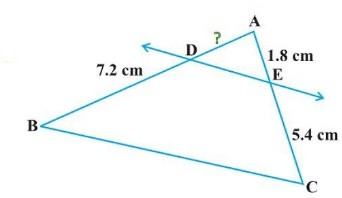
See the given Figure. DE || BC. Find AD
7.
Find the LCM and HCF of the following pairs of integers and verify that LCM x HCF = Product of the two numbers.
336 and 54
8.
On comparing the ratios \(\frac { { a }_{ 1 } }{ { a }_{ 2 } } ,\frac { { b }_{ 1 } }{ { b }_{ 2 } } and\frac { { c }_{ 1 } }{ { c }_{ 2 } } \), find out whether the following pairs of linear equations are consistent or inconsistent:
3x + 2y = 5; 2x - 3y = 7
9.
If P(E) = 0.05, what is the probability of 'not E'?
10.
Find the nature of the roots of the following quadratic equation. If the real roots exist, find them: \(3x^2-4\sqrt3 x+4=0\)
11.
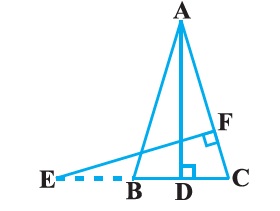
In the given figure, E is a point on side CB produced of an isosceles ΔABC with AB = AC. If AD ⊥ BC and EF ⊥ AC, prove that ΔABD ∼ ΔECF.
12.
Prove that the following are irrational :
6 +\(\sqrt 2\)
13.
E is a point on the side AD produced of a parallelogram ABCD and BE intersects CD at F. Show that \(\triangle ABE\sim \triangle CFB\) .
14.
On comparing the ratios \(\frac { { a }_{ 1 } }{ { a }_{ 2 } } ,\frac { { b }_{ 1 } }{ { b }_{ 2 } } \) and \(\frac { { c }_{ 1 } }{ { c }_{ 2 } } ,\) find out whether the lines representing the following pair of linear equations intersect at a point are parallel or coincident.
5x-4y+8=0; 7x+6y-9=0
15.
Which term of the AP : 21, 18, 15, . . . is – 81? Also, is any term 0? Give reason for your answer
16.
Two dice are thrown together. The probability that they show different numbers is
1/6
5/6
1/3
2/3
17.
The prime factorization of the number 2304 is
28 x 32
27 x 33
28 x 31
27 x 32
18.
If the points (a, 0), (0, b) and (1, 1) are collinear, then \(\frac{1}{a}+\frac{1}{b}\) equals.
1
2
0
-1
19.
Which term of the AP 5, 15,25, ... will be 130 more than its 31st term?
42
44
46
48
20.
Which of the following pair of equations are inconsistent?
3x - y = 9, x - \(\frac{y}{3}\)=3
4x.+ 3y = 24, - 2x+ 3y = 6
5x - y = 10,10x-2y = 20
2x+ y=3,-4x+2y=10
21.
The solution of (2x + 1) (x – 5) = 3 is____
\(\frac { 9\pm \sqrt { 145 } }{ 4 } \)
\(\frac { 9+\sqrt { 145 } }{ 4 } \)
None of these
\(\frac { 9-\sqrt { 145 } }{ 4 } \)
22.
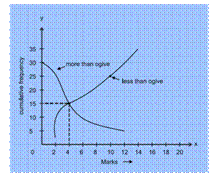
Which measure of central tendency is obtained graphically by the point of intersection of less than and more than o gives
Arithmetic mean
Geometric mean
Mode
Median
23.
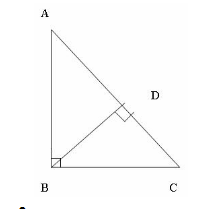
In the above figure, AB = c, BC = a, AC = b, AD = y, DB = p. Check which of the following options is correct?
cy=ap
ac=by
ay=cp
cy=ab
24.
If sum of the zeroes of the polynomial is 4 and their product is 4, then the quadratic polynomial is
x2 + 2x + 2
x2 + 4x + 4
x2 – 4x + 4
x2 – 2x + 2
25.
Largest number that divides 679 and 599 leaving remainder 4 is
5
35
25
15
26.
If A and B are the points (-6, 7) and (-1, -5) respectively, then the distance 2AB is equal to
26
169
13
238
27.
If three coins are tossed simultaneously, than the probability of getting at least two heads, is
1/4
3/8
1/2
1/8
28.
Assertion The rational number \(\frac{129}{2^{2} \times 5^{7} \times 7^{2}}\) is non-terminating repeating decimals.
Reason Let x be a rational number whose decimal expansion terminates. Then, x can expressed in the form of \(\frac{p}{q}\) where p and q are coprime and the prime factorisation of q is of the form 2m x 5 n, where m and n are non-negative integers.
codes:
(a) If both Assertion and Reason are correct and Reason is the correct explanation of Assertion.
(b) If both Assertion and Reason are correct, but Reason is not the correct explanation of Assertion.
(c) If Assertion is correct but Reason is incorrect.
(d) If Assertion is incorrect but reason is correct.
29.
Assertion x2 + 4kx + 25 = 0 has no real roots if \(\frac{-5}{2}<\ k\ \frac{5}{2}\)
Reason Quadratic equation
Codes:
ax2 + bx + c = 0, a \(\neq \) 0 has real roots if b2- 4ac \(\geq\)0.
(a) If both Assertion and Reason are correct and Reason is the correct explanation of Assertion.
(b) If both Assertion and Reason are correct, but Reason is not the correct explanation of Assertion.
(c) If Assertion is correct but Reason is incorrect.
(d) If Assertion is incorrect but Reason is correct.
30.
Find value of the roots of quadratic equation \(x^2-x-6=0\)
31.
Ruby and Rita are best friends. They are staying in the same colony. Both are studying in the same class and in the same school. During Winter vacation Ruby visited Rita’s house to play Ludo. They decided to play Ludo with 2 dice.

(a) To win a game, Ruby wanted a total of 7 . What is the probability of winning a game by Ruby?
| (i) \(\frac{1}{6}\) | (ii) \(\frac{7}{12}\) | (iii) \(\frac{5}{18}\) | (iv) \(\frac{1}{9}\) |
(b) To win a game, Rita wanted 8 as the sum. What is the probability of winning a game by Rita?
| (i) \(\frac{1}{12}\) | (ii) \(\frac{7}{36}\) | (iii) \(\frac{5}{36}\) | (iv) \(\frac{1}{4}\) |
(c) What is the probability that the sum of the numbers on the both the dice is divisible by 4 or 6 ?
| (i) \(\frac{7}{18}\) | (ii) \(\frac{7}{15}\) | (iii) \(\frac{2}{3}\) | (iv) \(\frac{2}{9}\) |
(d) The probability of getting a total of atleast 10 is
| (i) \(\frac{1}{6}\) | (ii) \(\frac{1}{3}\) | (iii) \(\frac{2}{3}\) | (iv) \(\frac{1}{4}\) |
(e) The probability that 5 will come up at least in 1 die is
| (i) \(\frac{7}{36}\) | (ii) \(\frac{11}{36}\) | (iii) \(\frac{25}{36}\) | (iv) \(\frac{2}{9}\) |
32.
Applications of Parabolas-Highway Overpasses/Underpasses A highway underpass is parabolic in shape.
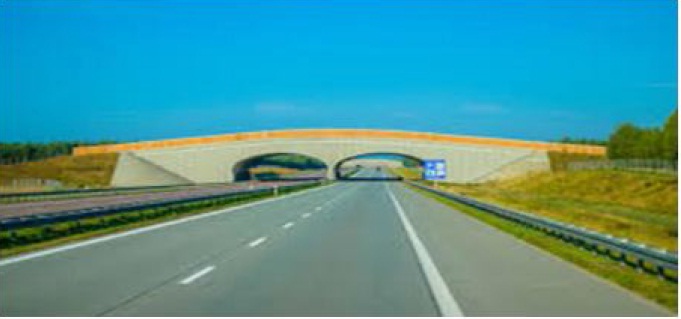
Parabola
A parabola is the graph that results from p(x) = ax2 + bx + c Parabolas are symmetric about a vertical line known as the Axis of Symmetry.
The Axis of Symmetry runs through the maximum or minimum point of the parabola which is called the vertex.
Shape of the cross slope
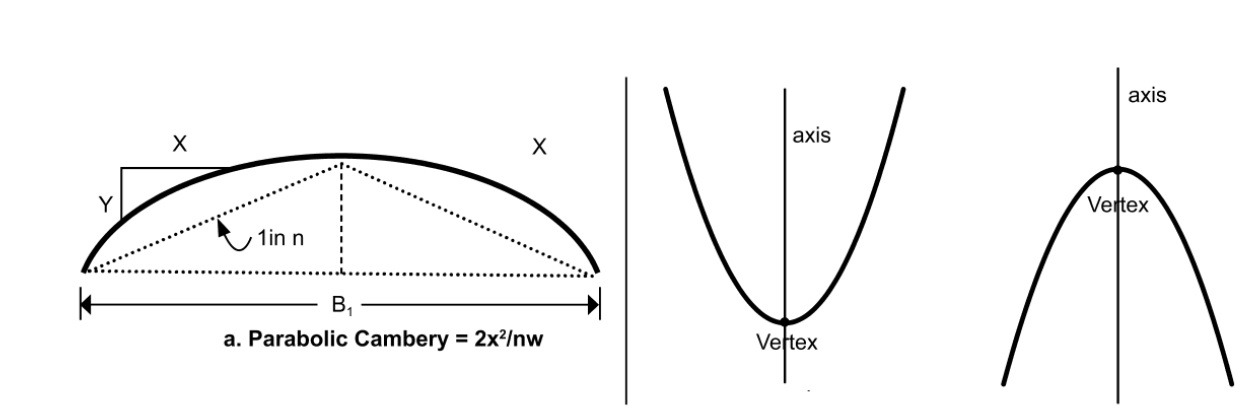
(i) If the highway overpass is represented by x2 - 2x -8.then its zero are
| (a) (2,-4) | (b) (4,-2) | (c) (-2,-2) | (d) (-4,-4) |
(ii) The highway overpass is represented graphically. Zeroes of a polynomial can be expressed graphically. Number of zeroes of polynomial is equal to number of points where the graph of polynomial
| (a) Intersects x-axis | (b) Intersects y-axis | (c) Intersects y-axis or x-axis | (d) None of the above |
(iii) Graph of a quadratic polynomial is a
| (a) straight line | (b) circle | (c) parabola | (d) ellipse |
(iv) The representation of Highway Underpass whose one zero is 6 and sum of the zeroes is 0, is
| (a) x2 – 6x + 2 | (b) x2 – 36 | (c) x2 – 6 | (d) x2 – 3 |
(v) The number of zeroes that polynomial f(x) = (x – 2)2 + 4 can have is:
| (a) 1 | (b) 2 | (c) 0 | (d) 3 |
1.
Here the maximum class frequency is 8, and the class corresponding to this frequency is 3 – 5. So, the modal class is 3 – 5.
Now
modal class = 3 – 5, lower limit (l ) of modal class = 3, class size (h) = 2
frequency ( f1 ) of the modal class = 8,
frequency ( f0 ) of class preceding the modal class = 7,
frequency ( f2) of class succeeding the modal class = 2.
Now, let us substitute these values in the formula :
\(\text { Mode } =l+\left(\frac{f_{1}-f_{0}}{2 f_{1}-f_{0}-f_{2}}\right) \times h \)
\(=3+\left(\frac{8-7}{2 \times 8-7-2}\right) \times 2=3+\frac{2}{7}=3.286\)
Therefore, the mode of the data above is 3.286.
2.
Given, pair of linear equations is
x + y = 5 \(\Rightarrow\) x + y - 5 = 0 ....(i)
and 2x + 2y = 10 \(\Rightarrow\) 2x + 2y - 10 = 0 ....(ii)
On comparing with standard form of pair of linear equations, we get
a1 = 1, b1 = 1, c1 = -5
and a2 = 2, b2 = 2, c2 = -10
Here, \(\frac{a_{1}}{a_{2}}=\frac{1}{2},\frac{b_{1}}{b_{2}}=\frac{1}{2}\) and \(\frac{c_{1}}{c_{2}}=\frac{-5}{-10}=\frac{1}{2}\)
Thus, \(\frac{a_{1}}{a_{2}}=\frac{b_{1}}{b_{2}}=\frac{c_{1}}{c_{2}}=\frac{1}{2}\)
So, the pair of linear equations is consistent.
Now, table for x + y = 5 or y = 5 - x is ....(iii)
| x | 0 | 5 | 2 |
| y=5-x | 5 | 0 | 3 |
| Points | A(0,5) | B(5,0) | C(2,3) |
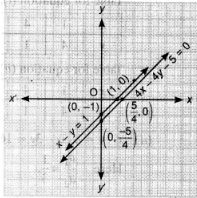
Here, Eq. (ii) is same as Eq. (i) because on dividing Eq (ii) by 2 on both sides, it becomes same as Eq (i). Therefore., table for both equations is same.
On plotting and joining these points on graph paper, we observe that the lines are coincident., so pair of linear equations have infinitely many solutions and hence consistent. All the points lying on the line ACB satisfy the given pair of linear equations.
3.
There are 40 students, and only one name card has to be chosen.
(i) The number of all possible outcomes is 40
The number of outcomes favourable for a card with the name of a girl = 25
Therefore, P (card with name of a girl) = P(Girl) = \(\frac{25}{40}=\frac{5}{8}\)
(ii) The number of outcomes favourable for a card with the name of a boy = 15
Therefore, P(card with name of a boy) = P(Boy) \(=\frac{15}{40}=\frac{3}{8}\)
Note : We can also determine P(Boy), by taking
P(Boy) = 1 – P(not Boy) = 1 – P(Girl) \(=1-\frac{5}{8}=\frac{3}{8}\)
4.
Let us apply the distance formula to find the distances PQ, QR and PR, where P(3, 2), Q(–2, –3) and R(2, 3) are the given points. We have
\(\mathrm{PQ}=\sqrt{(3+2)^{2}+(2+3)^{2}}=\sqrt{5^{2}+5^{2}}=\sqrt{50}=7.07(\text { approx. })\)
\(\mathrm{QR}=\sqrt{(-2-2)^{2}+(-3-3)^{2}}=\sqrt{(-4)^{2}+(-6)^{2}}=\sqrt{52}=7.21(\text { approx. })\)
\(P R=\sqrt{(3-2)^{2}+(2-3)^{2}}=\sqrt{1^{2}+(-1)^{2}}=\sqrt{2}=1.41 \text { (approx.) }\)
Since the sum of any two of these distances is greater than the third distance, therefore, the points P, Q and R form a triangle.
Also, PQ2 + PR2 = QR2, by the converse of Pythagoras theorem, we have \(\angle \mathrm{P}=90^{\circ}\)
Therefore, PQR is a right triangle.
5.
Let the number of marbles John had be x
Then the number of marbles Jivanti had be = 45 – x (Why?).
The number of marbles left with john, when he lost 5 marbles = x – 5
The number of marbles left with Jivanti, when she lost 5 marble = 45 – x – 5 = 40 – x
Therefore, their product = (x – 5) (40 – x)
= 40x – x2 – 200 + 5x
= – x2 + 45x – 200
So, – x2 + 45x – 200 = 124 (Given that product = 124)
i.e., – x2 + 45x – 324 = 0
i.e., x2 – 45x + 324 = 0
Therefore, the number of marbles John had, satisfies the quadratic equation
x2 – 45x + 324 = 0
which is the required representation of the problem mathematically
6.
Let AD = x cm
It is given that DE || BC.
By using basic proportionality theorem, we obtain
\( \frac{A D}{D B}=\frac{A E}{E C} \)
\(\frac{x}{7.2}=\frac{1.8}{5.4} \)
\(x=\frac{1.8 \times 7.2}{5.4}\)
x = 2.4
∴ AD = 2.4 cm
7.
336 and 54
336 = 2 x 168
= 2 x 168
= 2 x 2 x 84
= 2 x 2 x 2 x 42
= 2 x 2 x 2 x 2 x 21
= 2 x 2 x 2 x 2 x 7 x 3 x 1
Therefore 336 = 2 x 2 x 2 x 2 x 7 x 3 .......(A)
54 = 2 x 27
= 2 x 3 x 9
= 2 x 3 x 3 x 3
Therefore 54 = 2 x 3 x 3 x 3 ......(B)
From (A) and (B) HCF of 336 and 54 = 2 x 3 = 6
LCM of 336 and 54 = 2 x 3 x 2 x 2 x 2 x 7 x 3 x 3 = 24 x 33 x 7 = 3024
Product of 336 and 54 = 18144
Product of LCM and HCF = 6 x 3024 = 18144
Therefore it is proved that LCM X HCF = Product of the two numbers.
8.
The given equations can be rewritten as
3x + 2y - 5 = 0 and 2x - 3y - 7 = 0
On comparing with standard form of pair of linear equations, we get a1 = 3, b1 = 2, c1 = -5
and a2 = 2, b2 = -3, c2 = -7
Now, \(\frac{a_{1}}{a_{2}}=\frac{3}{2}, \frac{b_{1}}{b_{2}}=-\frac{2}{3}\) and \(\frac{c_{1}}{c_{2}}=\frac{5}{7}\)
Thus, \(\frac{3}{2}\neq -\frac{2}{3},i.e.\frac{a_{1}}{a_{2}}\neq \frac{b_{1}}{b_{2}}\)
Hence, the pair of linear equations is consistent.
9.
Given, P(E) = 0.05
we know that P(E) + P(\(\bar{E}\)) = 1
\(\therefore\) P(\(\bar{E}\)) = 1 - P(E) \(\Rightarrow\) P(\(\bar{E}\)) = 1 - 0.05 = 0.95
10.
\(3 x^{2}-4 \sqrt{3} x+4=0\)
Comparing it with ax2 + bx + c = 0, we get
a = 3, b = \(-4 \sqrt{3}\) and c = 4
Discriminant = b2 - 4ac
\(=(-4 \sqrt{3})^{2}-4(3)(4)\)
= 48 - 48 = 0
As b2 - 4ac = 0,
Therefore, real roots exist for the given equation and they are equal to each other.
And the roots will be \(\frac{-b}{2 a}\)
Therefore, the roots are \(\frac{2}{\sqrt{3}} \text { and } \frac{2}{\sqrt{3}}\)
11.
Given, ΔABC is an isosceles triangle with AB = AC. Also,
we have AD \(\perp\) BC and EF \(\perp\)AC.
To prove ΔABD \(\sim\) ΔECF
Proof Since, in ΔABC, AB = AC
∴ \(\angle\)B = \(\angle\)C [\(\therefore\) angle opposite to equal sides are equal]
Now consider ΔABD and ΔECF. In this we have
∠ABD = ∠ECF [\(\because\) \(\angle\)B = \(\angle\)C proved above]
and ∠ADB = ∠EFC [Each 90°]
∴ ΔABD ∼ ΔECF [by AA similarly criterion]
Hence proved.
12.
6 +\(\sqrt 2\)
if possible let a = 6 +\(\sqrt 2\) be a rational number.
Squaring a2 = \((6+\sqrt{2})^{2}\)
a2 =38 + 12\(\sqrt 2\)
\(\sqrt{2}=\frac{a^{2}-38}{12}-(1)\)
Since a is a rational number the expression \(\frac{a^{2}-38}{12}\) is also rational number.
⇒ \(\sqrt 2\) is a rational number.
This is a contradiction. Hence, 6 +\(\sqrt 2\) is irrational.
Hence proved.
13.
Draw a parallelogram ABCD and produce the line AD to E and join BE.
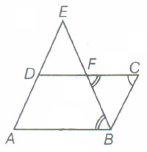
In parallelogram ABCD, \(\angle A=\angle C\) ...(i)
[since, opposite angles of a parallelogram are equal]
In \(\triangle ABE\) and \(\triangle CFB\)
\(\angle EAB=\angle BCF\) [from Eq.(i)]
\(\angle ABE=\angle CFB\) [alternate interior angles as AB || FC and BE is transversal]
\(\therefore\triangle ABE\sim \triangle CFB\) [by AA similarity criterion]
Hence proved.
14.
The given pair of linear equations is
5x-4y+8=0 ....(i)
and 7x+6y-9=0 ....(ii)
On comparing with standard form of pair of linear equations, we get
a1=5, b1=-4, c1=8
and a2=7, b2=6, c2=-9
Here, \(\frac { 5 }{ 7 } \neq \frac { -4 }{ 6 } \) i.e., \(\frac { { a }_{ 1 } }{ { a }_{ 2 } } \neq \frac { { b }_{ 1 } }{ { b }_{ 2 } } \)
So, lines (i) and (ii) are intersecting lines.
15.
Here, a = 21, d = 18 – 21 = – 3 and an = – 81, and we have to find n.
As an = a + ( n – 1) d,
we have – 81 = 21 + (n – 1)(– 3)
– 81 = 24 – 3n
– 105 = – 3n
So, n = 35
Therefore, the 35th term of the given AP is – 81.
Next, we want to know if there is any n for which an = 0. If such an n is there, then
21 + (n – 1) (–3) = 0
i.e., 3 (n – 1) = 21
i.e., n = 8
So, the eighth term is 0.
16.
(b)
5/6
17.
(a)
28 x 32
18.
(a)
1
19.
(b)
44
20.
(d)
2x+ y=3,-4x+2y=10
21.
(a)
\(\frac { 9\pm \sqrt { 145 } }{ 4 } \)
22.
(d)
Median
23.
(c)
ay=cp
24.
(c)
x2 – 4x + 4
25.
(a)
5
26.
(a)
26
27.
(c)
1/2
28.
(a) If both Assertion and Reason are correct and Reason is the correct explanation of Assertion
29.
(b) If both Assertion and Reason are correct, but Reason is not the correct explanation of Assertion.
30.
Therefore, the roots of the equation x² - x - 6 = 0 is +3 and -2.
31.
(a) (i) \(\frac{1}{6}\)
(b) (iii) \(\frac{5}{36}\)
(c) (i) \(\frac{7}{18}\)
(d) (i) \(\frac{1}{6}\)
(e) (ii) \(\frac{11}{36}\)
32.
(i) (b):
x2 - 2x -8 =0
\(\Rightarrow\) x2 -4x + 2x - 8 = 0 \(\Rightarrow\) x(x - 4) + 2(x - 4) = 0
\(\Rightarrow\)(x - 4)(x + 2) = 0 \(\Rightarrow\)x = 4, x = -2
(ii) (a):
Intersects x-axis
(iii) (c):
parabola
(iv) (b): x2 - 36 = 0 \(\Rightarrow\) x = 6,-6
x2 – 36
(v) (c):
f(x) = (x – 2)2 + 4 = 0
⇒ x2 – 4x + 4 + 4 = 0
⇒ x2 – 4x + 8 = 0
Now, D= b2 – 4ac = (–4)2 – 4.1.8
⇒ D = 16 – 32 = –16 < 0
Hence, the number of zeroes of given polynomial is zero.

10th Standard CBSE Syllabus & Materials
10th Standard CBSE
CBSE 10th Social Science PS - Federalism - New Model Questions Papers Study Material - QB365 Set A
NEW10th Standard CBSE
CBSE 10th Social Science PS - Power Sharing - New Model Questions Papers Study Material - QB365 Set A
NEW10th Standard CBSE
CBSE 10th Social Science GEO - Manufacturing Industries - New Model Questions Papers Study Material - QB365 Set A
NEW10th Standard CBSE
CBSE 10th Social Science GEO - Minerals and Energy Resources - New Model Questions Papers Study Material - QB365 Set A



NCERT Books

Syllabus

Exam Pattern

Sample Question Papers

Previous year Question Papers

Important Notes

MCQ Practice test

NCERT Exemplers

Case study Questions

Image Based Questions

Passage based Questions

HOT Questions

Value Based Questions

Model Questions Papers
NCERT ( Book Back ) Questions

Assertion and Reason
Important Questions And Answers

CBSE 10th Standard CBSE Subjects
CBSE Standards



