
 100% FREE ACCESS
10th Standard CBSE Syllabus & Materials
10th Standard CBSE
CBSE 10th Social Science ECO - Globalisation and the Indian Economy - New Model Questions Papers Study Material - QB365 Set A
NEW10th Standard CBSE
CBSE 10th Social Science ECO - Money and Credit - New Model Questions Papers Study Material - QB365 Set A
NEW10th Standard CBSE
CBSE 10th Social Science ECO - Sectors of the Indian Economy - New Model Questions Papers Study Material - QB365 Set A
NEW10th Standard CBSE
CBSE 10th Social Science ECO - Development - New Model Questions Papers Study Material - QB365 Set A
NEW10th Standard CBSE
CBSE 10th Social Science PS - Outcomes of Democracy - New Model Questions Papers Study Material - QB365 Set A
NEW10th Standard CBSE
CBSE 10th Social Science PS - Gender, Religion and Caste - New Model Questions Papers Study Material - QB365 Set A

Published on: 21/10/2025
Download CBSE Class 10th Standard CBSE Maths question papers, sample papers, important questions, and previous year solved papers in PDF format. Get free study materials, NCERT solutions, and exam preparation resources for Class 10th Standard CBSE Maths
Questions + Answers key
Take MCQ Maths Test
1.
Find median of the data, using an empirical relation when it is given that Mode = 12.4 and Mean = 10.5.
2.
Consider the following data:
| Class interval | 65-85 | 85-105 | 105-125 | 125-145 | 145-165 | 165-185 | 185-205 |
|---|---|---|---|---|---|---|---|
| Frequency | 4 | 5 | 13 | 20 | 14 | 7 | 4 |
Find the difference of the upper limit of the median class and the lower limit of the modal class.
3.
For the following distribution, find the modal class.
| Marks | Number of students |
|---|---|
| Below 10 | 3 |
| Below 20 | 12 |
| Below 30 | 27 |
| Below 40 | 57 |
| Below 50 | 75 |
| Below 60 | 80 |
4.
If \(u_{ i }=\frac { x_{ i }-20 }{ 10 } ,\quad \sum { f_{ i }u_{ i }=30 } \) and \(\sum { f_{ i }=40 } \) , find the value of \(\overline { x } \) .
5.
Why probability of an event cannot be negative?
6.
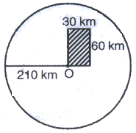
A ship is reported to reach somwhere in the region shown in figure below.What is the probability that the ship reach in the shaded region?
(i)If on the way back to home from school you suddenly chaange your way to your friends house to do some assignment given to you by your class teacher you should:
(a)Report your parents first
(b)Report your friends parents first
(c)You should not report to any one because work is mpre important than reporting
7.
A bag contains 14balls of which x are white.If 6 more white balls are added to the bag, the probability of drawing a white ball is \({1\over2}\) .Find the value of x.
8.
The table below gives the frequency distribution of the number of teachers in Higher Secondary Schools in 2012 in India. Find the average number of teachers per Higher Secondary School in India for 2012.
| Number of Teachers | Number of H.S. Schools |
|---|---|
| 6-10 11-15 16 -20 27 -25 26-30 31-35 36-40 41-45 46-50 |
955 1067 1663 1492 1220 7129 745 637 442 |
9.
Find the mean of the following distribution by step deviation method
| Class | 0-10 | 10-20 | 20-30 | 30-40 | 40-50 | 50-60 |
| Frequency | 5 | 13 | 20 | 15 | 7 | 5 |
Let assumed mean, a = 35 and h = 10
10.
A bag contains cards numbered 1 to 49. Find the probability that the number on the drawn card is:
(i) an odd number
(ii) a multiple 5
(iii) Even prime
11.
Obtain the median for the following frequency distribution.
| x | 1 | 2 | 3 | 4 | 5 | 6 | 7 | 8 | 9 |
|---|---|---|---|---|---|---|---|---|---|
| y | 8 | 10 | 11 | 16 | 20 | 25 | 15 | 9 | 6 |
12.
If the mean of the following distribution is 54, find the value of p.
| Class | 0-20 | 20-40 | 40-60 | 60-80 | 80-100 |
|---|---|---|---|---|---|
| Frequency | 7 | p | 10 | 9 | 13 |
13.
In answering question of MCQ Test with 4 choices per question, one of them being correct, a student knows the answer, guesses or copies the answer.
(i) What is the probability that is answer is correct, if Shivam does not know the answer to one of the question in the test?
(ii) Which value would Shivam violate, if he copies the answer?
(iii) How would an act like the above, hamper his character development in coming years?
14.
A jar contains 24 marbles, some are green and others are blue.If a marble is drawn at random from the jar, the probability that it is green is \(2\over3\).Find the number of blue marbles.
15.
In a certain distribution, mean and median are 9.5 and 10, respectively. Find the mode of the distribution, using an empirical relation?
16.
Find the value of f1 from the following data, if its mode is 65:
| CIass | Frequency |
| 0 - 20 20 - 40 40 - 60 60 - 80 80 - 100 100 - 120 |
6 8 f1 72 6 5 |
Where frequency 6, 8, f1 and 12 are in ascending order.
17.
The following distribution gives the weights of 60 students of a class. Find the mean and mode weights of the students.
| Weight (in kg) | 40-44 | 44-48 | 48-52 | 52-56 | 56-60 | 60-64 | 64-68 | 68-72 |
| Number of students | 4 | 6 | 10 | 14 | 10 | 8 | 6 | 2 |
18.
Calculate the mean of the following data.
| Class | 4-7 | 8-11 | 12-15 | 16-19 |
|---|---|---|---|---|
| Frequency | 5 | 4 | 9 | 10 |
19.
A game consists of spinning an arrow which comes to rest pointing at one of the regions (1, 2 or 3). Are the outcomes 1, 2 and 3 equally likely to occur? Give reasons.
20.
A group consists of 12 persons, out of which 3 are extremely patient, other 6 are extremely honest and rest are extremely kind. A person from the group is selected at random. Assuming that each person is equally likely to be selected, find the probability of selecting a person who is
(i) extremely kind or honest
(ii) Which of the above values you prefer more?
21.
A box contains 90 discs, numbered from 1 to 90. If one disc is drawn at random from the box, the probability that it bears a prime number less than 23 is
\(\frac{7}{90}\)
\(\frac{1}{9}\)
\(\frac{4}{45}\)
\(\frac{9}{89}\)
22.
The probability of getting a bad egg in a lot of 400 eggs is 0.045. The number of good eggs in the lot is
18
180
382
220
23.
A box contains 54 marbles each of which is blue, green or white. The probability of selecting a blue marble at random from the box is 1/3 and the probability of selecting a green marble at random is 4/9. The number of white marbles in the box are
10
12
14
16
24.
For the following distribution the modal class is
| Marks below | 10 | 20 | 30 | 40 | 50 | 60 |
| Number of students | 2 | 11 | 25 | 45 | 57 | 75 |
20-30
40-50
30-40
10-20
25.
The value of the observation having greatest frequency is called____
Mean
Median
Mode
All of above
26.
Median of the data given below will lie in the class
| Height(in cm) | frequency |
| Below 140 | 4 |
| 140-145 | 7 |
| 145-150 | 18 |
| 150-155 | 11 |
| 155-160 | 6 |
| 160-165 | 5 |
150-155
140-145
160-165
145-150
27.
The median of first ten natural numbers is
6
5.5
11
5
28.
29.
Which of the following cannot be the probability of an event?
0
1
3/2
2/3
30.
If a digit is chosen at random from the digits 1, 2, 3, 4, 5, 6, 7, 8, 9 then the probability that it is odd is
1/9
2/3
4/9
5/9
1.
Median = \(\frac { 1 }{ 3 } \) Mode+ \(\frac { 2 }{ 3 } \) Mean
= \(\frac { 1 }{ 3 } (12.4)+\frac { 2 }{ 3 } (10.5)\)
\(=\frac { 12.4 }{ 3 } +\frac { 21 }{ 3 } \)
\(=\frac { 12.4+21 }{ 3 } =\frac { 33.4 }{ 3 } \)
\(\frac { 33.4 }{ 3 } =11.13\)
2.
The cumulative frequency table for given data is
| Class interval | Frequency | Cumulative frequency |
|---|---|---|
| 65-85 | 4 | 4 |
| 85-105 | 5 | 9 |
| 105-125 | 13 | 22 |
| 125-145 | 20 | 42 |
| 145-165 | 14 | 56 |
| 165-185 | 7 | 63 |
| 185-205 | 4 | 67 |
Here, \(\frac { n }{ 2 } =\frac { 67 }{ 2 } =33.5\)
The cumulative frequency just greater than 33.5 is 42 and the corresponding class is 125-145.
Thus, we have median class 125-145.
Also, the maximum frequency is of the class 125-145.
Therefore, the modal class is 125-145.
Difference of the upper limit of median class and the lower limit of modal class=145-125=20
3.
| Marks | Class interval | Number of students | Cumulative frequency |
|---|---|---|---|
| Below 10 | 0-10 | 3 | 3 |
| Below 20 | 10-20 | 9 | 12 |
| Below 30 | 20-30 | 15 | 27 |
| Below 40 | 30-40 | 30 | 57 |
| Below 50 | 40-50 | 18 | 75 |
| Below 60 | 50-60 | 5 | 80 |
Here, the highest frequency is 30, which lies in the interval 30-40. So, it is the modal class, i.e. 30-40.
4.
Given, \( \sum { f_{ i }u_{ i }=30 } \), \(\sum { f_{ i }=40 } \) and \(u_{ i }=\frac { x_{ i }-20 }{ 10 } \)
We know that, \(u_{ i }=\frac { x_{ i }-a }{ h } \)
On comparing, we get a=20, h=10
\(\therefore \quad \overline { x } =a+\left\{ \frac { \sum { f_{ i }u_{ i } } }{ \sum { f_{ i } } } \right\} \times h=20+\left\{ \frac { 30 }{ 40 } \right\} \times 10\\ =20+\frac { 30 }{ 4 } =\frac { 80+30 }{ 4 } =\frac { 110 }{ 4 } =27.5\)
5.
Probability of an event cannot be negative
6.
Area of the circle =\(\pi { r }^{ 2 }\)
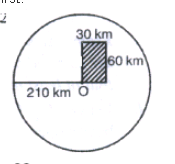
=\(\frac {22} {7} \times 210 \times 210\)
= 138600km2
Area of shaded region = 60 x 30
= 1800 km2
Required probability = \(\frac {1800} {138600} =\frac {1} {77}\)
(i) (a) Report your parents first.
7.
Total balls in a bag = 14
Number of white balls = x
Now, 6 more white balls are added to the bag.
\(\Rightarrow \)Number of white balls = x + 6
And, total balls in the bag = 14 + 6 = 20
Now, according to the statement of the question
\(\frac { x+6 }{ 20 } =\frac { 1 }{ 2 } \)
\(\Rightarrow \) 2x+12=20
\(\Rightarrow \) 2x=8
\(\Rightarrow \) x=4
8.
Let a = 28, h = 5
| Number of teachers | xi | Number of H.S. Schools | \({u}_{i}={ { {x}_{i}-a}\over{h } }\) | fiui |
|---|---|---|---|---|
| 5.5 - 10.5 10.5 - 15.5 1,5.5 -20.5 20.5 -25.5 25.5 -30.5 30.5 - 35.5 35.5 - 40.5 40.5 - 45.5 45.5 - 50.5 |
8 13 18 23 28 33 38 43 48 |
955 1067 1663 1492 !220 1t29 745 637 442 |
4 -3 -2 -1 0 1 2 3 4 |
-3820 -3201 -3326 -1492 0 1 129 1490 1911 1768 |
| Total | \(\sum { { f }_{ i } } \) =9350 | \(\sum { { f }_{ i } } {u}_{i}\) = -5541 |
\(\bar{x}=28-{ {5541 }\over{9350 } }\times5\)
= 28 - 2.96 = 25.04
9.
| xi (class marks) | \(u_{ i }=\frac { x_{ i }-a }{ h } \) | fi | fiui |
| 5 | -3 | 5 | -15 |
| 15 | -2 | 13 | -26 |
| 25 | -1 | 20 | -20 |
| 35 | 0 | 15 | 0 |
| 45 | 1 | 7 | 7 |
| 55 | 2 | 5 | 10 |
| Total | \(\Sigma f_{ i }=65\) | \(\Sigma f_{ i }u_{ i }=-44\) |
\(\overset { - }{ x } =a+\frac { \Sigma f_{ i }u_{ i } }{ \Sigma f_{ i } } \times h\)
\(=35+\frac { -44 }{ 65 } \times 10=35-6.76=28.24\)
10.
Total cards = 49
(i) P(odd number) = \(\frac{25}{49}\)
(ii) P(multiple of 5) = \(\frac{9}{49}\)
(iii) P(even prime) = \(\frac{1}{49}\)
11.
Here, the given data is in ascending order of xi.
Cumulative frequency table for the given data is
| xi | fi | cf |
|---|---|---|
| 1 | 8 | 8 |
| 2 | 10 | 18 |
| 3 | 11 | 29 |
| 4 | 16 | 45 |
| 5 | 20 | 65 |
| 6 | 25 | 90 |
| 7 | 15 | 105 |
| 8 | 9 | 114 |
| 9 | 6 | 120 |
Here, n=120 [even]
Median\(=\frac { 1 }{ 2 } \times Value\quad of\quad \left[ \left( \frac { n }{ 2 } \right) th+\left( \frac { n }{ 2 } +1 \right) th \right] observation\)
\(\\ =\frac { 1 }{ 2 } \times Value\quad of\quad \left[ \left( \frac { 120 }{ 2 } \right) th+\left( \frac { 120 }{ 2 } +1 \right) th \right] observation\)
\(=\frac { 1 }{ 2 } \)[Value of 60th observation+Value of 61th observation]
Both 60th and 61th observations lie in the cumulative frequency 65 and its corresponding value of x is 5.
Median\(\) \(=\frac { 1 }{ 2 } [5+5]=5\)
12.
Table for given data is
| Class | Class marks (xi) | Frequency (fi) | fixi |
|---|---|---|---|
| 0-20 | \(\frac { 0+20 }{ 2 } =10\) | 7 | 70 |
| 20-40 | \(\frac { 20+40 }{ 2 } =30\) | p | 30 p |
| 40-60 | \(\frac { 40+60 }{ 2 } =50\) | 10 | 500 |
| 60-80 | \(\frac { 60+80 }{ 2 } =70\) | 9 | 630 |
| 80-100 | \(\frac { 80+100 }{ 2 } =90\) | 13 | 1170 |
| Total | \(\sum { f_{ i } } =39+p\) | \(\sum { f_{ i }x_{ i }=2370+30\quad p } \) |
Here, \(\sum { f_{ i } } =39+p\) and \(\sum { f_{ i }x_{ i }=2370+30\quad p } \)
Mean \(\left( \overline { x } \right) =\frac { \sum { f_{ i }x_{ i } } }{ \sum { f_{ i } } } \)
\(54=\frac { 2370+30p }{ 39+p } \quad \left[ \because \quad mean=54,\quad given \right] \)
\(\Rightarrow \quad 54(39+p)=2370+30p\\ \Rightarrow \quad 2106+54p=2370+30p\\ \Rightarrow \quad 24p=264\\ \Rightarrow \quad p=11\)
Hence, the value of p is 11.
13.
(i) Total number of possible outcomes=4
∴ n(S)=4
Let E be the event of getting correct answer,
∴ Total number of favourable outcomes,
n(E)=1
P(getting his correct answer)\(=\frac { n(E) }{ n(S) } =\frac { 1 }{ 4 } \)
(ii) If Shivam copies the answer, he will be violating the value of honesty.
(iii) Cheating may get him marks in this test but this habit may not let him develop an integrity of character in the long run.
14.
Let the number of green marbles out of 24 marbles in a jar be x.
Probability of getting green marbles = \(\frac { 2 }{ 3 } \)
\(\frac { x }{ 24 } =\frac { 2 }{ 3 } \)
3x = 48
x = 16
Number of green marbles = 16
Hence, the number of blue marbles = 24 - 16
=8
15.
Ans. 11
16.
| CIass | Frequency |
| 0 - 20 20 - 40 40 - 60 60 - 80 80 - 100 100 - 120 |
6 8 f1 72 6 5 |
Mode = \(l+\frac { f-{ f }_{ 0 } }{ 2f-{ f }_{ 0 }-{ f }_{ 2 } } \times h\)
\(65=60+\frac { 12-{ f }_{ 1 } }{ 2\times 12-{ f }_{ 1 }-6 } \times 20\)
\(5=\frac { 12-{ f }_{ 1 } }{ 18-{ f }_{ 1 } } \times 20\)
90 - 5f1 = 240 - 20 f1
15f1 = 150 ⇒ f1 =10.
∵ Mode = 65
∴ Modal class = 60 - 80 as its frequency is 12.
I = 60, f = 12, fo= f1, f2= 6, h = 20.
17.
| C.I | xi | fi | \(u_{ i }=\frac { x_{ i }-a }{ n } \) | fiui |
| 40-44 | 42 | 4 | -3 | -12 |
| 44-48 | 46 | 6 | -2 | -12 |
| 52-56 | 54 | 14 | 0 | 0 |
| 56-60 | 58 | 10 | 1 | 10 |
| 60-64 | 62 | 8 | 2 | 16 |
| 64-68 | 66 | 6 | 3 | 18 |
| 68-72 | 70 | 2 | 4 | 8 |
Let a = Assumed mean = 54
\(\overset { - }{ x } =a+\frac { \Sigma f_{ i }u_{ i } }{ \Sigma f_{ i } } \times h\)
Mean = 54+\(\frac { 18 }{ 60 } \times 4=55.2\)
Maximum frequency =14 Modal class =52-56,l=52 f1=14,f0=10,f2=10,h=4
Mode=52+\(\frac { 14-10 }{ 28-10-10 } \times 4=54\)
18.
Here, class interval are not continuous. But it does not affect mid-values. So, we will solve it without making it continuous.
| Class | Class marks | Frequency | fixi |
|---|---|---|---|
| 4-7 | 5.5 | 5 | 27.5 |
| 8-11 | 9.5 | 4 | 38 |
| 12-15 | 13.5 | 9 | 121.5 |
| 16-19 | 17.5 | 10 | 175 |
| \(\sum { f_{ i } } =28\) | \(\sum { f_{ i }x_{ i } } =362\) |
Mean \(\left( \overline { x } \right) =\frac { \sum { f_{ i }x_{ i } } }{ \sum { f_{ i } } } =\frac { 362 }{ 28 } =12.93\)
19.
No, the outcomes are not equally likely. The outcomes '3' is more likely to occur than the others.
20.
Given, a group consists 12 persons.
\(\therefore \) Total number of outcomes = 12
(i) Given, number of extremely patient persons = 3
\(\therefore \) Number of favourable outcomes = 3
\(\therefore \) P (extremely patient) = \(\frac{3}{12} = \frac{1}{4}\)
(ii) Given, number of extremely honest persons = 6 and number of extremely kind persons
= 12 - 6 - 3 = 3
\(\therefore \) Number of favourable outcomes = Number of extremely kind persons + Number of extremely honest persons = 6 + 3 = 9
\(\therefore \) P (extremely kind or honest) = \(\frac{9}{12}=\frac{3}{4}\)
21.
(c)
\(\frac{4}{45}\)
22.
(c)
382
23.
(b)
12
24.
(b)
40-50
25.
(c)
Mode
26.
(d)
145-150
27.
(b)
5.5
28.
(d)
29.
(c)
3/2
30.
(d)
5/9

10th Standard CBSE Syllabus & Materials
10th Standard CBSE
CBSE 10th Social Science PS - Federalism - New Model Questions Papers Study Material - QB365 Set A
NEW10th Standard CBSE
CBSE 10th Social Science PS - Power Sharing - New Model Questions Papers Study Material - QB365 Set A
NEW10th Standard CBSE
CBSE 10th Social Science GEO - Manufacturing Industries - New Model Questions Papers Study Material - QB365 Set A
NEW10th Standard CBSE
CBSE 10th Social Science GEO - Minerals and Energy Resources - New Model Questions Papers Study Material - QB365 Set A



NCERT Books

Syllabus

Exam Pattern

Sample Question Papers

Previous year Question Papers

Important Notes

MCQ Practice test

NCERT Exemplers

Case study Questions

Image Based Questions

Passage based Questions

HOT Questions

Value Based Questions

Model Questions Papers
NCERT ( Book Back ) Questions

Assertion and Reason
Important Questions And Answers

CBSE 10th Standard CBSE Subjects
CBSE Standards



