
 100% FREE ACCESS
10th Standard CBSE Syllabus & Materials
10th Standard CBSE
CBSE 10th Social Science ECO - Globalisation and the Indian Economy - New Model Questions Papers Study Material - QB365 Set A
NEW10th Standard CBSE
CBSE 10th Social Science ECO - Money and Credit - New Model Questions Papers Study Material - QB365 Set A
NEW10th Standard CBSE
CBSE 10th Social Science ECO - Sectors of the Indian Economy - New Model Questions Papers Study Material - QB365 Set A
NEW10th Standard CBSE
CBSE 10th Social Science ECO - Development - New Model Questions Papers Study Material - QB365 Set A
NEW10th Standard CBSE
CBSE 10th Social Science PS - Outcomes of Democracy - New Model Questions Papers Study Material - QB365 Set A
NEW10th Standard CBSE
CBSE 10th Social Science PS - Gender, Religion and Caste - New Model Questions Papers Study Material - QB365 Set A

Published on: 21/10/2025
Download CBSE Class 10th Standard CBSE Maths question papers, sample papers, important questions, and previous year solved papers in PDF format. Get free study materials, NCERT solutions, and exam preparation resources for Class 10th Standard CBSE Maths
Questions + Answers key
Take MCQ Maths Test
1.
A 5 m wide cloth is used to make a conical tent of base diameter 14 m and height 24 m. Find the cost of cloth used at the rate of Rs.25 per metre.
2.
In the given figure, DE || BC. If AD=1.5 cm, BD=2AD, then find \(\frac { ar(\triangle ABC) }{ ar(trapeziumBCED) } .\)
3.
If the centroid of triangle formed by points P(a, b), Q(b, c) and R(c, a) is at the origin. What is the value of (a + b + c) ?
4.
Two dice are thrown simultaneously.Find the probability that the sum of the two numbers appearing on the top is less than or equal to 10.
5.
In A.P., a16 = p, then find the sum of first 31 terms.
6.
From a well-shuffled pack of cards, a card is drawn at random. Find the probability of getting a black queen.
7.
The first term of an AP is p and its common difference is q. Find its 10th term.
8.
Shweta prepared two posters on National Integration for decoration on Independence day on triangular sheets (say ABC and DEF). The sides AB and AC and the perimeter P1 of \(\triangle ABC\) are respectively four times the corresponding sides DE and DF and the perimeter P2 of \(\triangle DEF\). Are the two triangular sheets similar? If yes, find \(\frac { ar\left( \triangle ABC \right) }{ ar\left( \triangle DEF \right) } \). What values can be indicated through celebration of national festivals?
9.
A solid cone of base radius 10 cm is cut into two parts through the mid-point of its height by a plane parallel to its base. Find the ratio of the volumes of the two parts of the coe.
10.
If the sum of 7 terms of an AP is 49 and that of 17 terms is 289, then find the sum of n terms.
11.
Find the 31st term of an AP, whose 11th term is 38 and the 16th term is 73.
12.
19 cards numbered 1,2,3,.....,19 are put in a box and mixed thoroughly.One person draws one card from the box.Find the probability that the number on the card is:
(i)even
(ii)A prime
(iii)Divisible by 3
(iv)Divisible by 3 and 2 both
13.
Check whether (1,-1),(2,1) and (4,5) are collinear?
14.
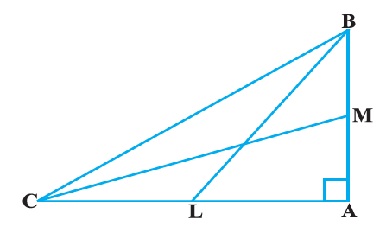
In the given figure, BL and CM are medians of \(\triangle\)ABC, right angled at A. Prove that 4(BL2 + CM2) = 5BC2.
15.
In the given figure, \(\frac { PA }{ AQ } =\frac { PB }{ BR } =3.\) If the area of \(\triangle\)PQR is 32 cm2, then find the area of the quadrilateral AQRB.
16.
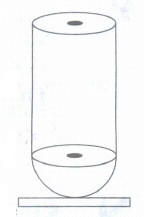
A trophy awarded to the best student in the class is in the form of a solid cylinder mounted on a solid emisphere with the same radius and is made from some metal. This trophy is mounted on a wooden cuboid as shown in the figure. The diameter of the hemisphere is 21cm and the total height of the trophy is 24.5 cm. Find the weight of the metal used in making the trophy, if the weight of 1 cm3 of the metal is 1.2 g. \(\\ \\ \left[ take,\pi =\frac { 22 }{ 7 } \right] \)
17.
Check the points (1, -1),(5,2) and (9,5) are collonear.
18.
From a solid cylinder whose height is 2.4 cm and diameter 1.4 cm, a conical cavity of the same height and same diameter is hollowed out. Find the total surface area of the remaining solid to the nearest cm2.
19.
Two dice are thrown together. Find the probability that the product of the numbers on the top of the dice is
(i) 6
(ii) 12
(iii) 7
20.
If (1,2), (4,y), (x,6) and (3,5) are the vertices of a parallelogram taken in order, find x and y.
21.
If the sum of the first 7 terms of an A.P. is 119 and that of the first 17 terms is 714, find the sum of its first n terms.
22.
If (2, 4) is the mid-point of the line segment joining (6,3) and (a, 5), then the value of a is
2
4
-4
-2
23.
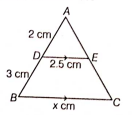
In the given figure, AD= 2cm, DB = 3 cm, DE = 2.5 cm and DE || BC. The value of x is
6
3.75 cm
6.25 cm
7.5 cm
24.
One card is drawn at random from a well-shuffled deck of 52 playing cards. The probability that it is a red king is
\(\frac{1}{52}\)
\(\frac{1}{26}\)
\(\frac{2}{26}\)
\(\frac{2}{13}\)
25.
Two APs have the same common difference. The first term of one of these is - 1 and that of the other is -8. Then, the difference between their 4 th terms is
1
8
7
9
26.
If in an AP, a = 2 and S10 = 335, then its 10th term is
55
65
68
58
27.
If the area of the triangle formed by the points (x, 2x), (- 2, 6) and (3, 1)is 5 sq units then x equals.
2/3
3/5
3
5
28.
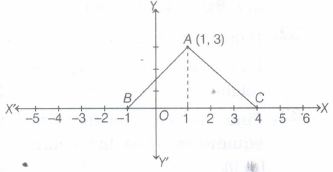
In the given figure, the area of \(\triangle A B C\) in sq units is
15
10
7.5
2.5
29.
The given figure shows a disc on which a player spins an arrow twice.
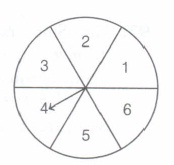
The fraction \(\frac{x}{y}\) is formed, where 'a' is y the number of sectors on which the arrow stops on the first spin and 'b' is the number of the sectors in which the arrow stops on the second spin. In each spin, each sector has equal chance of selection by the arrow, then the probability that the fraction \(\frac{x}{y}\) ≥ 1.
\(\frac{7}{12}\)
\(\frac{5}{12}\)
\(\frac{11}{12}\)
\(\frac{1}{2}\)
30.
O is the point of intersection of the diagonals AC and BD of a trapezium ABCD with AB II DC. Through O, a line segment PQ is drawn parallel to AB meeting AD in P and BC in Q, then OP =
OP = OQ
OP = 2 OQ
OQ = 2 OP
\(O P=\frac{1}{3} O Q\)
31.
How many terms of AP 54, 51, 48… are required to give a sum of 513
21 or 25
23 or 24
18 or 19
22 or 23
32.
Which geometric figures are always similar?
Circles
Circles and all regular polygons
Circles and triangles
Regular polygons
33.
The sum of the first three terms of an AP is 33. If the product of the first and the third term exceeds the second term by 29, the AP is ?
2 ,21,11
1,10,19
-1 ,8,17
2 ,11,20
34.
A right circular cylinder of radius r cm and height h cm (h>2r) just enclosed a sphere of diameter
r cm
h cm
2h cm
2r cm
35.
If the radius of the base of a right circular cylinder is halved keeping the height same, then the ratio of the volume of the cylinder thus obtained to the volume of original cylinder is
1:2
2:1
4:1
1:4
36.
A toy is in the form of a cone mounted on a hemisphere of common base radius 7 cm. The total height of the toy is 31 cm. Find the total surface area of the toy.
465
912
769
858
37.
Find the coordinates of the point equidistant from the points A(5, 1), B(–3, –7) and C(7, –1)
(2, –4)
(3, –6)
(4, 7)
(8, –6)
38.
A card is drawn from a well-shuffled deck of 52 playing cards. The probability that the card will not be an ace card is
12/13
1/13
3/4
1/4
39.
A bag contains 3 white and 5 red balls. If a ball is drawn at random, the probability that the drawn ball is red is
3/8
3/15
5/8
5/15
40.
Assertion (A) In a cricket match, a batsman hits a boundary 9 times out of 45 balls he plays. The probability that in a given ball, he does not hit the boundary is \(\frac{4}{5}\).
Reason (R) P(E) + P(not E) = 1
(a) Both Assertion (A) and Reason (R) are true and Reason (R) is the correct explanation of the Assertion (A).
(b) Both Assertion (A) and Reason (R) are true but Reason (R) is not correct explanation ot the Assertion (A).
(c) Assertion (A) is true but Reason (R) is false.
(d) Assertion (A) is false but Reason (R) is true.
41.
Assertion The first term of an AP is m and its common difference is p, then the 13th term is a + 10p.
Reason In an AP Sn - Sn-1 = an.
Codes:
(a) If both Assertion and Reason are correct and Reason is the correct explanation of Assertion.
(b) If both Assertion and Reason are correct, but Reason is not the correct explanation of Assertion.
(c) If Assertion is correct but Reason is incorrect.
(d) If Assertion is incorrect but Reason is correct.
42.
Anjali places a mirror on level ground to determine the height of a tree (see the diagram). She stands at a certain distance so that she can see the top of the tree reflected from the mirror. Anjali's eye level is 2 m above the ground. The distance of Anjali and the tree from the mirror are 1.4 m and 2.8 m respectively.
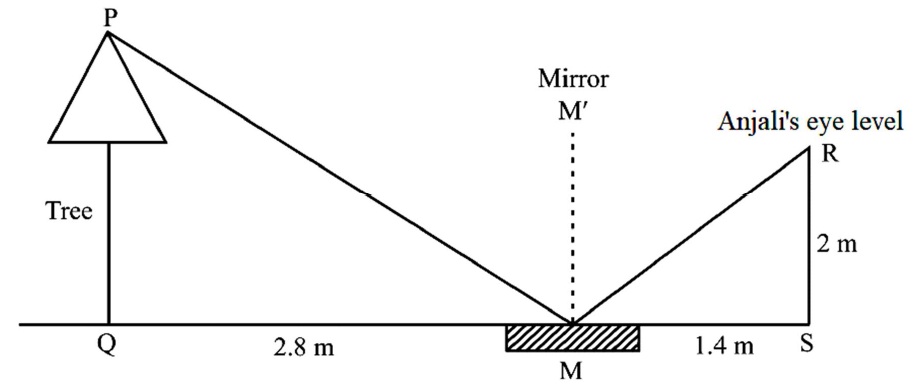
(i) What are the two \(\triangle\)s formed in the above diagram, which are used to calculate the height of the tree?
| (a) \(\triangle\)s QMM' and PQM | (b) \(\triangle\)s PQM and RSM | (c) \(\triangle\)s RM'M and MRS | (d) \(\triangle\)s PM'M and RM'M |
(ii) State the criterion of similarity, that will be used in the above found triangles.
| (a) RHS | (b) SSS | (c) SAS | (d) AA |
(iii) What is the height of the tree?
| (a) 4 m | (b) 5 cm | (c) 6 m | (d) 7 cm |
(iv) What is the distance between Rashmi and Gulmohar tree?
| (a) 3.2 m | (b) 5.2 m | (c) 4.2 m | (d) 2.2 m |
43.
Isha is 10 years old girl. On the result day, Isha and her father Suresh were very happy as she got first position in the class. While coming back to their home, Isha asked for a treat from her father as a reward for her success. They went to a juice shop and asked for two glasses of juice.
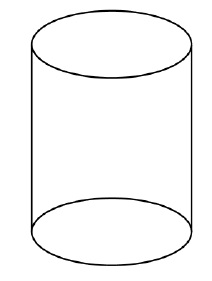
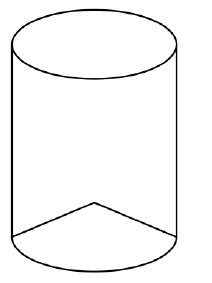
Aisha, a juice seller, was serving juice to her customers in two types of glasses. Both the glasses had inner radius 3cm. The height of both the glasses was 10 cm.
First type: A Glass with hemispherical raised bottom.
Second type: A glass with conical raised bottom of height 1.5 cm
Give answer the following questions based on above conditions :
(i) What is the capacity of first glass?
| (a) 72\(\pi\) cm2 | (b) 72\(\pi\) cm3 | (c) 85\(\pi\) cm2 | (d) 85\(\pi\) cm3 |
(ii) What is the capacity of second glass?
| (a) 85.5 \(\pi\)cm3 | (b) 85\(\pi\) cm3 | (c) 85\(\pi\) cm2 | (d) 85 \(\pi\)cm3 |
(iii) Find the ratio of the capacity of both types of glass.
| (a) 16 : 19 | (b) 17 : 19 | (c) 15 : 19 | (d) 18 : 19 |
(iv) Isha insisted to have the juice is first type of glass and her father decided to have the juice in second type of glass. Out of the two, Isha or her father Suresh, who got more quantities of juice to drink and by how much?
| (a) Isha; 72\(\pi\) cm3 | (b) Suresh; 85.5\(\pi\) cm3 | (c) Suresh; 72\(\pi\) cm3 | (d) Suresh; 13.5\(\pi\) cm3 |
(v) How much quantity of juice is purchased by Suresh from a juice seller?
| (a) 157.5\(\pi\) cm3 | (b) 1575\(\pi\) cm3 | (c) 157.5\(\pi\) cm3 | (d) none of these |
44.
Two friends Richa and Sohan have some savings in their piggy bank. They decided to count the total coins they both had. After counting they find that they have fifty \(\begin{equation} ₹ \end{equation} \) 1 coins, forty eight \(\begin{equation} ₹ \end{equation} \) 2 coins, thirty six \(\begin{equation} ₹ \end{equation} \) 5 coins, twenty eight \(\begin{equation} ₹ \end{equation} \)10 coins and eight \(\begin{equation} ₹ \end{equation} \) 20 coins. Now, they said to Nisha, their another friends, to choose a coin randomly.
Find the probability that the coin chosen is
(i) \(\begin{equation} ₹ \end{equation} \)5 coin
| (a) \(\begin{equation} \frac{17}{55} \end{equation}\) | (b) \(\begin{equation} \frac{36}{85} \end{equation}\) |
| (c) \(\begin{equation} \frac{18}{85} \end{equation}\) | (d) \(\begin{equation} \frac{1}{15} \end{equation}\) |
(ii) \(\begin{equation} ₹ \end{equation} \) 20 coin
| (a) \(\begin{equation} \frac{13}{85} \end{equation}\) | (b) \(\begin{equation} \frac{4}{85} \end{equation}\) |
| (c) \(\begin{equation} \frac{3}{85} \end{equation}\) | (d) \(\begin{equation} \frac{4}{15} \end{equation}\) |
(iii) not a \(\begin{equation} ₹ \end{equation} \) 10 coin
| (a) \(\begin{equation} \frac{15}{31} \end{equation}\) | (b) \(\begin{equation} \frac{36}{85} \end{equation}\) |
| (c) \(\begin{equation} \frac{1}{5} \end{equation}\) | (d) \(\begin{equation} \frac{71}{85} \end{equation}\) |
(iv) of denomination of atleast \(\begin{equation} ₹ \end{equation} \)10.
| (a) \(\begin{equation} \frac{18}{85} \end{equation}\) | (b) \(\begin{equation} \frac{36}{85} \end{equation}\) |
| (c) \(\begin{equation} \frac{1}{17} \end{equation}\) | (d) \(\begin{equation} \frac{16}{85} \end{equation}\) |
(v) of denomination of atmost \(\begin{equation} ₹ \end{equation} \) 5.
| (a) \(\begin{equation} \frac{67}{85} \end{equation}\) | (b) \(\begin{equation} \frac{36}{85} \end{equation}\) |
| (c) \(\begin{equation} \frac{4}{85} \end{equation}\) | (d) \(\begin{equation} \frac{18}{85} \end{equation}\) |
1.
Given, radius and height = 7 m & 24 m.
Slant height(l)=\(\sqrt { { r }^{ 2 }+{ h }^{ 2 } } =\sqrt { { 7 }^{ 2 }+{ 24 }^{ 2 } } \)
\(=\sqrt { 625 } =25\quad m\)
\(C.S.A=\pi rl\)
\(=\frac { 22 }{ 7 } \times 7\times 25=550\quad { m }^{ 2 }.\)
Let x m of cloth is required C.S.A.
= area of cloth.
\(\Rightarrow \quad 5x=550\quad \Rightarrow \quad x=\frac { 550 }{ 5 } =110cm\)
110 m of cloth is required.
Cost of cloth = 25 x 110=Rs.2750
2.
Given: AD=1.5 cm, BD=3 cm and AB=AD+BD=1.5+3.0=4.5 cm.
Given, In triangle ADE and ABC,
\(\angle\)A is common and DE || BC
\(\angle\)ADE=\(\angle\)ABC (Corresponding angles)
\(\triangle\)ADE~\(\triangle\)ABC, (AA similarity)
\(\frac { ar(\triangle ADE) }{ ar(\triangle ABC) } =\frac { { AD }^{ 2 } }{ { AB }^{ 2 } } =\frac { { (1.5) }^{ 2 } }{ { (4.5) }^{ 2 } } =\frac { 1 }{ 9 } \)
\(\Rightarrow \quad \frac { ar(\triangle ADE) }{ ar(\triangle ABC)-ar(\triangle ADE) } =\frac { 1 }{ 9-1 } \)
\(\Rightarrow \quad \frac { ar(\triangle ADE) }{ ar(trapezium\quad BCED) } =\frac { 1 }{ 8 } \)
3.
We know that,
Centroid of \(\Delta =\left( \frac { { x }_{ 1 }+{ x }_{ 2 }+{ x }_{ 3 } }{ 3 } ,\frac { { y }_{ 1 }+{ y }_{ 2 }+{ y }_{ 3 } }{ 3 } \right) \)
Given, (0, 0) = \(\left( \frac { a+b+c }{ 3 } ,\frac { b+c+a }{ 3 } \right) \)
On comparing x-coordinates both sides, we get
\(\frac { a+b+c }{ 3 } =0\Rightarrow a+b+c=0\)
4.
\(\frac{11}{12}\)
5.
31p
6.
Total number of ways to draw a card = 52
Number of ways to draw a black queen = 2
\(\therefore\) Probability of getting a black green = \(\frac{2}{52}=\frac{1}{26}\)
7.
a = p and d = q
an = a + (n - 1)d
a10 = p + 9q
8.
Yes, 16 : 1 ; unity of nation, fraternity and patriotism.
9.
1:7
10.
Let a be the first term and d be the common difference of the given AP.
Given, sum of 7 terms, \({S}_{7}=49\)
\(\Rightarrow\) \(\frac {7}{2}[2a+(7-1)d]=49\)
\(\left[ \because { S }_{ n }=\frac { n }{ 2 } \left\{ 2a+\left( n-1 \right) d \right\} \right] \)
\(\Rightarrow\) \(\frac { 7 }{ 2 } \left( 2a+6d \right) =49\)
\(\Rightarrow\) a+3d= 7 ...(i)
and sum of 17 terms,\({ S }_{ 17 }=289\)
\(\Rightarrow\) \(\frac { 17 }{ 2 } \left[ 2a+(17-1)d \right] =289\)
\(\Rightarrow\) \(\frac { 17 }{ 2 } \left[ (2a+16d) \right] =289\)
\(\Rightarrow\) a + 8d =17 ...(ii)
On subtracting Eq. (i) from Eq. (ii), we get
5d = 10
\(\Rightarrow\) d = 2
On putting d = 2 in Eq. (i), we get a + 3(2)=7
\(\Rightarrow\) \(a+6=7\Rightarrow a=1\)
Now, sum of n terms \({ S }_{ n }=\frac { n }{ 2 } \left[ 2a+\left( n-1 \right) d \right] \)
\(=\frac { n }{ 2 } \left[ 2\times 1+\left( n-1 \right) 2 \right] \)
\(=\frac { n }{ 2 } \left( 2+2n-2 \right) \)
\(=\frac { n }{ 2 } \left( 2+2n-2 \right) \)
11.
Let a be the first term and d be the common difference of an AP.
We know that, the nth term of an AP is
\({ a } _ { n } = a + ( n - 1 ) d\)
Then, 11th term, \({ a } _ { 11 } = a + 10d =38\)...(i)
[\(\because a_{11} = 38,\) given]
and 16th term, \({ a } _ { 16 } = a 15d = 73\) ...(iii)
[\(\because a_{16} = 73\) given]
On subtracting Eq. (i) from Eq. (ii), we get
\(5d=35\quad \quad \Rightarrow \quad \quad d=\frac { 35 }{ 5 } =7\)
On putting the value of d in Eq. (i), we get
\(a + 10 \times 7 =38\)
\(\Rightarrow\) a = 38 -70 = -32
Now, 31st term, \({ a } _ { 31 } = a + 30d\)
\(= -32 + 30 \times 7\)
\(= -32 + 210 = 178\)
12.
\((i){9\over19}(ii){1\over19}(iii){6\over19}(iv){3\over19}\)
13.
Yes
14.
Given: \(\triangle\)ABC, right angled at A. BL and CM are medians.
To prove :
4(BL2 + CM2) = 5BC2.
Proof: In \(\triangle\)ABL,
BL2 = AB2 + AL2
= AB2 + \({ \left( \frac { AC }{ 2 } \right) }^{ 2 }\)(BL is median)
In \(\triangle\)ACM, CM2 = AC2 + AM2
= AC2 +\({ \left( \frac { AB }{ 2 } \right) }^{ 2 }\) (CM is median)
BL2 + CM2 = AB2 + AC2 + \({ \left( \frac { AC }{ 2 } \right) }^{ 2 }\)+\({ \left( \frac { AB }{ 2 } \right) }^{ 2 }\)
\(\Rightarrow\) 4(BL2 + CM2) = 5AB2+5AC2
= 5(AB2 + AC2)
= 5BC2.
Hence proved.
15.
We have, \(\triangle\)PQR~\(\triangle\)PAB \(\left( \because \angle P is common\frac { PA }{ AQ } =\frac { PB }{ PR } \quad \right) \)
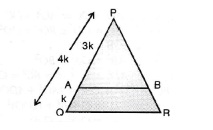
\(\Rightarrow \quad \frac { ar(\triangle PQR) }{ ar(\triangle PAB) } ={ \left( \frac { PQ }{ PA } \right) }^{ 2 }\)
\(\Rightarrow \quad \frac { 32 }{ ar(\triangle PAB) } ={ \left( \frac { 4k }{ 3k } \right) }^{ 2 }\)
are \(\triangle\)PAB = 18 cm2
area of quadrilateral AQRB
= area of \(\triangle\)PQR-area of \(\triangle\)PAB
= 32-18
= 14 cm2
16.
It is given that diameter of a hemisphere = 21
Let radius of hemisphere be r.
\(\therefore\) \(r=\frac { 21 }{ 2 } cm\)
and total height of tropy = 24.5 cm
\(\therefore\) Height of cylinder = Height of trophy - Radius of hemisphere
\(=24.5-\frac { 21 }{ 2 } =24.5-10.5=14\quad cm\)
\(\therefore\) Volume of the metal used in the trophy
= Volume of cylinder + Volume of hemisphere
\(=\pi { r }^{ 2 }h+\frac { 2 }{ 3 } \pi { r }^{ 3 }=\pi { r }^{ 2 }\left( h+\frac { 2 }{ 3 } r \right) \)
\(=\frac { 22 }{ 7 } \times \frac { 21 }{ 2 } \times \frac { 21 }{ 2 } \left( 14+\frac { 2 }{ 3 } \times \frac { 21 }{ 2 } \right) \)
\(=\frac { 22 }{ 7 } \times \frac { 21 }{ 2 } \times \frac { 21 }{ 2 } (14+7)\)
\(=\frac { 22 }{ 7 } \times \frac { 21 }{ 2 } \times \frac { 21 }{ 2 } \times 21\)
\(=\frac { 11\times 3\times 21\times 21 }{ 2 } { cm }^{ 3 }\)
\(\therefore\) Weight of metal=\(\frac { 11\times 3\times 21\times 21 }{ 2 } \times 1.2\quad g\)
\(=11\times 3\times 21\times 21\times 0.6\)
= 8731.8g = 8.7318 kg
17.
Let the given points be A=(1,-1), B=(5,2) and C=(9,5),
Then, AB = \(\sqrt { { (5-1) }^{ 2 }+{ (2+1) }^{ 2 } } \)
\(\left[ \because \ distance=\sqrt { { \left( { x }_{ 2 }-{ x }_{ 1 } \right) }^{ 2 }{ ({ y }_{ 2 }-{ y }_{ 1 }) }^{ 2 } } \right] \)
\(=\sqrt { { \left( 4 \right) }^{ 2 }{ (3) }^{ 2 } } =\sqrt { 16+9 } =\sqrt { 25 } =\quad 5\quad units\)
\(BC=\sqrt { { \left( 9-5 \right) }^{ 2 }+{ (5-2) }^{ 2 } } \)
\(=\sqrt { { \left( 4 \right) }^{ 2 }+{ (3) }^{ 2 } } =\sqrt { 25 } =5\quad units\)
and \(AC=\sqrt { { (9-1) }^{ 2 }+{ (5+1) }^{ 2 } } =\sqrt { { (8) }^{ 2 }+{ (6) }^{ 2 } } \)
\(=\sqrt { 100 } =10 \ units\)
Clearly, AC=AB + BC
Hence, A, B and C are collinear points.
Hence proved.
18.
Given, diameter of cylinder = Diameter of conical cavity
= 1.4 cm
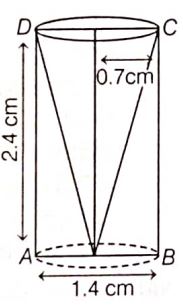
\(\therefore\) Radius of cylinder = Radius of conical cavity
\(=\frac{\text { Diameter }}{2}=\frac{1.4}{2}=0.7 \mathrm{~cm}\)
Height of the cylinder = height of the conical cavity
= 2.4 cm
\(\therefore\) Slant height of the conical cavity,
\(\begin{aligned} l & =\sqrt{b^2+r^2}=\sqrt{(2.4)^2+(0.7)^2} \\ \end{aligned}\)
\(\begin{aligned} & =\sqrt{5.76+0.49} \\ \end{aligned}\)
\(\begin{aligned} & =\sqrt{6.25}=2.5 \mathrm{~cm} \end{aligned}\)
Now, TSA of remaining solid = CSA of conical cavity + CSA of cylinder + Area of the base of the cylinder
\(\begin{aligned} & =\pi r l+2 \pi r h+\pi r^2 \\ \end{aligned}\)
\(\begin{aligned} & =\pi r(l+2 h+r) \\ \end{aligned}\)
\(\begin{aligned} & =\frac{22}{7} \times 0.7 \times(2.5+2 \times 2.4+0.7) \\ \end{aligned}\)
\(\begin{aligned} & =22 \times 0.1 \times(2.5+4.8+0.7) \end{aligned}\)
\(\begin{aligned} & =2.2 \times 8 \\ \end{aligned}\)
\(\begin{aligned} & =17.6 \approx 18 \mathrm{~cm}^2 \end{aligned}\)
19.
Number of total outcomes, n(S)=36
(i) When product of the numbers on the top of the dice is 6.
So, the possible ways are {(1,6), (2,3), (3,2), (6,1).}
Number of possible ways, n(E1)=4
∴ Required probability\(=\frac { n(E_{ 1 }) }{ n(S) } =\frac { 4 }{ 36 } =\frac { 1 }{ 9 } \)
(ii) When the product of the numbers on the top of the dice is 12.
So, the possible ways are {(2,6), (3,4), (4,3), (6,2)}
Number of possible ways, n(E2)=4
∴ Required probability\(=\frac { n(E_{ 2 }) }{ n(S) }\)
\( =\frac { 4 }{ 36 } =\frac { 1 }{ 9 } \)
(iii) Product of the numbers on the top of the dice cannot be7. its probability is zero
20.
We know that the diagonals of a parallelogram bisect each other, therefore, mid-points of two diagonals coincide each other.
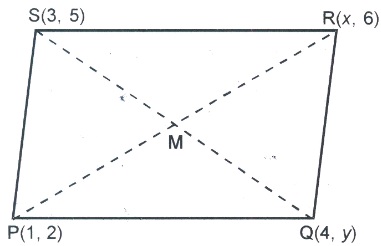
Let P (1, 2), Q (4, y), R(x, 6) and S(3, 5) are the vertices of the parallelogram PQRS. Now, using mid-point formula, we have
For, diagonal PR
M\((\frac{x+1}{2},\frac{6+2}{2})\) i.e., M\((\frac{x+1}{2},{4})\)
For, diagonal QS
M\((\frac{4+3}{2},\frac{y+5}{2})\) i.e., M\((\frac{7}{2},\frac{y+5}{2})\)
Now, comparing the coordinates of M, we have
\(\frac{x+1}{2}=\frac{7}{2}\) and \(\frac{y+5}{2}=4\)
⇒ x=6 and y=3
Hence, x=6 and y=3.
21.
Here, sum of first seven terms. i.e., S7 = 119
\({7 \over 2}[2a+(7-1)d]=119\)
14a + 42d = 238
a + 3d = 17
S17 = 714
\({17 \over 2}(2a+16d)=714\)
\(\Rightarrow\) 17a + 136d = 714
a + 8d = 42 ....(ii)
Subtracting (i) from (ii), we have
5d = 25 \(\Rightarrow\) d = 5Therefore, a + 3 X 5 = 17 \(\Rightarrow\) a = 2 [ Using (i) ]
\(\Rightarrow\) Sn = \({n\over 2}[2\times2+(n-1)5]\)
[ Using Sn = \({n \over 2}[2a+(n-1)d]\)]
\(={n \over 2}(4+5n-5)\)
\(={n \over 2}[5n-1]\)
\(={(n)(5n-1)\over2}\)
Sn = \({5{n}^{2}-n\over 2}\)
22.
(d)
-2
23.
(a)
6
24.
(b)
\(\frac{1}{26}\)
25.
(c)
7
26.
(b)
65
27.
(a)
2/3
28.
(c)
7.5
29.
(a)
\(\frac{7}{12}\)
30.
(a)
OP = OQ
31.
(c)
18 or 19
32.
(b)
Circles and all regular polygons
33.
(d)
2 ,11,20
34.
(d)
2r cm
35.
(d)
1:4
36.
(d)
858
37.
(a)
(2, –4)
38.
(a)
12/13
39.
(c)
5/8
40.
(a) A bastman hits a boundary 9 times out of 45 balls he plays.
P(A) = P (hits a target) = \(\frac{9}{45}=\frac{1}{5}\)
Since, \(P(A)+P(\bar{A})=1\)
\(\begin{aligned}
\Rightarrow \quad P(\bar{A}) & =1-P(A)
\end{aligned}\)
\(\begin{aligned}
=1-\frac{1}{5}=\frac{4}{5}
\end{aligned}\)
\(\therefore\) Probability of not hitting the boundary is \(\frac{4}{5}\)
\(\therefore\) Both Assertion (A) and reason (R) are correct.
41.
(d) If Assertion is incorrect but Reasonis correct.
42.
(i) (b): (b) \(\triangle\)s PQM and RSM
(ii) (d): AA similarity
As \(\angle \mathrm{PQM}=\angle \mathrm{RSM}=90^{\circ}\)
and angle of incidence is equal to angle of reflection.
Then, \(\angle \mathrm{PMQ}=\angle \mathrm{RMS}\)
(iii) (a): Since, \(\Delta \mathrm{PMQ} \sim \Delta \mathrm{RMS}\)
Then, \(\frac{\mathrm{PQ}}{\mathrm{RS}}=\frac{\mathrm{QM}}{\mathrm{MS}} \Rightarrow \mathrm{PQ}=\frac{2.8 \times 2}{1.4}\)
= 4m
(iv) (c): Distance between Rashmi and Gulmohar tree
QS = QM + MS = 2.8 + 1.4 = 4.2 m
43.
(i) (b): capacity of first glass \(=\pi r^{2} h-\frac{2}{3} \pi r^{3}\)
\(=\pi r^{2}\left(h-\frac{2}{3} r\right)\)
\(=\pi(3)^{2}\left(10-\frac{2}{3} \times 3\right)\)
\(=9 \pi(10-2)\)
72\(\pi\) cm3
(ii) (a): capacity of second glass \(=\pi r^{2} \mathrm{H}-\frac{1}{3} \pi r^{2} h\)
\(=\pi r^{2}\left(\mathrm{H}-\frac{1}{3} h\right)\)
\(=\pi(3)^{2}\left(10-\frac{1}{3} \times 1.5\right)\)
\(=9 \pi(10-0.5)\)
= 85.5 \(\pi\)cm3
(iii) (a): \(\text { Ratio }=\frac{\text { Capacity of first glass }}{\text { Capacity of second glass }}=\frac{72 \pi}{85.5 \pi}=\frac{16}{19}=16: 19 .\)
(iv) (d): From part (i) and (ii)
Suresh got more quantity of juice.
\(=85.5 \pi \mathrm{cm}^{3}-72 \pi \mathrm{cm}^{3}=13.5 \pi \mathrm{cm}^{3}\)
(v) (a): Total quantity of juice is purchased by Suresh = (72 \(\pi\) + 85.5 \(\pi\) ) cm3
= 157.5\(\pi\) cm3
44.
Total number of coins = 50 + 48 + 36 + 28 + 8 = 170
(i) (c): Number of \(\begin{equation} ₹ \end{equation} \) 5 coins = 36
Required probability = \(\begin{equation} \frac{36}{70}=\frac{18}{85} \end{equation}\)
(ii) (b): Number of \(\begin{equation} ₹ \end{equation} \)20 coins = 8
Required probability = \(\begin{equation} \frac{8}{170}=\frac{4}{85} \end{equation}\)
(iii) (d): Number of \(\begin{equation} ₹ \end{equation} \)10 coins = 28
Probability (coin is of \(\begin{equation} ₹ \end{equation} \)10) = \(\begin{equation} \frac{28}{170} \end{equation}\)
Required probability = 1 - P(coin is of 10)
\(\begin{equation} =1-\frac{28}{170}=\frac{142}{170}=\frac{71}{85} \end{equation}\)
(iv) (a) : Total number of coins of \(\begin{equation} ₹ \end{equation} \)10 and \(\begin{equation} ₹ \end{equation} \) 20
= 28 + 8 = 36
Required probability = \(\begin{equation} \frac{36}{170}=\frac{18}{85} \end{equation}\)
(v) (a): Total number of coins of \(\begin{equation} ₹ \end{equation} \)1, \(\begin{equation} ₹ \end{equation} \)2 and \(\begin{equation} ₹ \end{equation} \) 5
= 50 + 48 + 36 = 134
Required probability = \(\begin{equation} \frac{134}{170}=\frac{67}{85} \end{equation}\)

10th Standard CBSE Syllabus & Materials
10th Standard CBSE
CBSE 10th Social Science PS - Federalism - New Model Questions Papers Study Material - QB365 Set A
NEW10th Standard CBSE
CBSE 10th Social Science PS - Power Sharing - New Model Questions Papers Study Material - QB365 Set A
NEW10th Standard CBSE
CBSE 10th Social Science GEO - Manufacturing Industries - New Model Questions Papers Study Material - QB365 Set A
NEW10th Standard CBSE
CBSE 10th Social Science GEO - Minerals and Energy Resources - New Model Questions Papers Study Material - QB365 Set A



NCERT Books

Syllabus

Exam Pattern

Sample Question Papers

Previous year Question Papers

Important Notes

MCQ Practice test

NCERT Exemplers

Case study Questions

Image Based Questions

Passage based Questions

HOT Questions

Value Based Questions

Model Questions Papers
NCERT ( Book Back ) Questions

Assertion and Reason
Important Questions And Answers

CBSE 10th Standard CBSE Subjects
CBSE Standards



