
 100% FREE ACCESS
10th Standard CBSE Syllabus & Materials
10th Standard CBSE
CBSE 10th Social Science ECO - Globalisation and the Indian Economy - New Model Questions Papers Study Material - QB365 Set A
NEW10th Standard CBSE
CBSE 10th Social Science ECO - Money and Credit - New Model Questions Papers Study Material - QB365 Set A
NEW10th Standard CBSE
CBSE 10th Social Science ECO - Sectors of the Indian Economy - New Model Questions Papers Study Material - QB365 Set A
NEW10th Standard CBSE
CBSE 10th Social Science ECO - Development - New Model Questions Papers Study Material - QB365 Set A
NEW10th Standard CBSE
CBSE 10th Social Science PS - Outcomes of Democracy - New Model Questions Papers Study Material - QB365 Set A
NEW10th Standard CBSE
CBSE 10th Social Science PS - Gender, Religion and Caste - New Model Questions Papers Study Material - QB365 Set A

Published on: 26/10/2025
Download CBSE Class 10th Standard CBSE Maths question papers, sample papers, important questions, and previous year solved papers in PDF format. Get free study materials, NCERT solutions, and exam preparation resources for Class 10th Standard CBSE Maths
Questions + Answers key
Take MCQ Maths Test
1.
On comparing the ratios \(\frac{a_{1}}{a_{2}}, \frac{b_{1}}{b_{2}} and \frac{c_{1}}{c_{2}}\) find out whether the following pairs of linear equations are consistent, or inconsistent.
2x – 3y = 8 ; 4x – 6y = 9
2.
Given that HCF (306, 657) = 9, find LCM (306, 657).
3.
Form a quadratic polynomial whose zeroes are \({3-\sqrt3\over 5}\ and\ {3+\sqrt3\over 5}\)
4.
Show that \(5\sqrt { 6 } \) is an irrational number.
5.
What should be the value of \(\lambda \) , for the given equations to have infinitely many solutions?
5x+\(\lambda \)y=4 and 15x+3y=12
6.
Find the nature of the roots of the following quadratic equation. If the real roots exist, find them: 2x2-6x+3=0
7.
Solve the equation by factorisation: 9x2-17x+8=0
8.
Solve the following pair of equations by substitution method:
7x – 15y = 2 ,
x + 2y = 3.
9.
If \(\alpha\ and\ \beta \)are the zeroes of the quadratic polynomial f(x) = x2 -3x -2, find a polynomial whose zeroes are \(\frac{2\alpha}{\beta}\ and\ \frac{2\beta }{\alpha}\)
10.
The HCF of 65 and 117 is expressible in the form 65m - 117.Find the value of m.Also find the LCM of 65 and 117 using prime factorization method.
11.
Form a pair of linear equations in two variables using the following information and solve it graphically. Five years ago, Sagar was twice as old as Tim. Ten years later; Sagar's age will be ten years more than Tiru's age. Find their present ages.
12.
Find the zeroes of the given polynomial by factorisation method and verify the relations between the zeroes and the coefficients of the polynomials \(7y^{ 2 }-\frac { 11 }{ 3 } Y-\frac { 2 }{ 3 } \)
13.
If one zero of the polynomial 2x2-5x-(2k+1) is twice the other, then find both the zeroes of the polynomial and the value of k.
14.
Check whether 6n can end with the digit 0 for any natural number n.
15.
Solve the equation: \({4x\over x-2}-{3x\over x-1}=7{1\over2}\)
16.
Two water taps together can fill a tank in \(1 \frac{7}{8}\) hrs. The tap with longer diameter takes 2 hrs less than the tap with smaller one to till the tank separately. Find the time in which each tap can fill the tank separately.
17.
If 2 is subtracted from the numerator and 1 is added to the denominator, a fraction becomes \(\frac { 1 }{ 2 } \) but when 4 is added to the numerator and 3 is subtracted from the denominator, it becomes \(\frac { 3 }{ 2 } \) . Find the fraction.
18.
If \(\alpha\) and \(\beta\) are the zeroes of the polynomial p(x) = 2x2 + 5x + k satisfying the relation, \({ \alpha }^{ 2 }+{ \beta }^{ 2 }+\alpha \beta =\frac { 21 }{ 4 } \), then find the value of k.
19.
Solve graphically the following pair of equations.
2x-y+3=0 and 3x-5y+1=0
20.
If α and β are zeroes of the quadratic polynomial p(x)=6x2+x-1, then find the value of \(\frac { \alpha }{ \beta } +\frac { \alpha }{ \alpha } +2\left( \frac { 1 }{ \alpha } +\frac { 1 }{ \beta } \right) +3\alpha \beta \)
21.
The traffic lights at three different roads crossings change after 48, 72 and 108 s, respectively. If they change simultaneously at 7 am, then at what time will they change simultaneously again?
22.
If one zero of the polynomial kx2 +3x+ k is 2, then the value of k is
\(-\frac{6}{5}\)
\(\frac{6}{5}\)
\(\frac{5}{6}\)
\(-\frac{5}{6}\)
23.
Given HCF (2520, 6600) = 40 and LCM (2520, 6600) = 252 x k, then the value of k is
1650
1600
165
1625
24.
If the coefficient of x in the quadratic equation x2 + px + q = owas taken as 17 in the place of 13 and its roots were found to be -2 and -15 then the roots of the original equation.
3,10
-3, -10
-3, 10
3, -10
25.
(x2 + 1)2 - x2 = 0 has
four real roots
two real roots
no real roots
one real root
26.
The pair of equations x + 2y + 5 = 0 and - 3x - 6y + 1= 0 has
a unique solution
exactlytwo solutions
infinitely many solutions
no solution
27.
The values of x and y is the given figure are
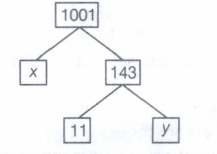
7,13
13,7
9,12
12,9
28.
If one root of a Quadratic equation is m + √n , then the other root is
√m + n
Can not be determined
m + √n
m – √n
29.
The solution of x2 + 4x + 4 = 0 is
None of these
0
-2
2
30.
Solution for ax + by = a – b and bx – ay = a + b is
1, -1
-a, -b
a, b
-1, 1
31.
The pair of linear equations 8x – 5y = 7 and 5x – 8y = -7 have
One solution
Two solutions
Many solutions
No solution
32.
A system of simultaneous linear equations has infinitely many solutions if two lines:
intersect at one point
are parallel
intersect at two points
are coincident
33.
In elimination method_______is an important condition
Equating only the x co-efficient
Equating only the y coefficient
Equating either of the coefficients
Equating both the coefficients
34.
A polynomial of degree 2 is called a
Quadratic polynomial
Binomial
Biquadratic polynomial
Trinomial
35.
A quadratic polynomial____
Is always a binomial
Is always a Trinomial
May be a monomial, binomial or a trinomial
Is always a Monomial
36.
Sum and the product of zeroes of the polynomial x2 +7x +10 is
7 and -10
-7 and 10
10/7 and -10/7
7/10 and -7/10
37.
Find the zero of a linear polynomial ax + b
-b/a
a/b
b/a
-a/b
38.
There are 135 partcipants in English and 165 in Mathematics in a seminar. What is the minimum number of rooms required to seat them if each room must have the same number of participants from each of the two subjects.
25
30
15
20
39.
Write the HCF of the smallest composite number and the smallest even number
4
1
2
0
40.
Assertion : The number 5n cannot end with the digit 0. where n is a natural number.
Reason : Prime factorisation of 5 has only two factors 1 and 5.
(a) Both Assertion and Reason are correct and Reason is the correct explanation of Assertion.
(b) Both Assertion and Reason are correct but Reason is not the correct explanation of Assertion.
(c) Assertion is correct but Reason is incorrect.
(d) Assertion is incorrect but Reason is correct.
41.
Assertion: The equation x2 + x + 4 = 0 has equal roots.
Reason: Quadratic equation
Codes:
ax2 + bx + c = 0, a \(\neq \) 0 has equal roots if b2 -4ac = 0.
(a) If both Assertion and Reason are correct and Reason is the correct explanation of Assertion.
(b) If both Assertion and Reason are correct, but Reason is not the correct explanation of Assertion.
(c) If Assertion is correct but Reason is incorrect.
(d) If Assertion is incorrect but Reason is correct.
42.
In our daily life we use quadratic formula as for calculating areas, determining a product's profit or formulating the speed of an object and many more.
Based on the above information, answer the following questions.
(i) If the roots of the quadratic equation are 2, -3, then its equation is
| (a) x2 - 2x + 3 = 0 | (b) x2 + x - 6 = 0 | (c) 2x2 - 3x + 1 = 0 | (d) x2 - 6x - 1= 0 |
(ii) If one root of the quadratic equation 2x2 + kx + 1 = 0 is -1/2, then k =
| (a) 3 | (b) -5 | (c) -3 | (d) 5 |
(iii) Which of the following quadratic equations, has equal and opposite roots?
| (a) x2 - 4=0 | (b) 16x2 - 9=0 | (c) 3x2 + 5x - 5=0 | (d) Both (a) and (b) |
(iv) Which of the following quadratic equations can be represented as (x - 2)2 + 19 = 0?
| (a) x2 + 4x+15=0 | (b) x2 - 4x+15=0 | (c) x2 - 4x+23=0 | (d) x2 + 4x+23=0 |
(v) If one root of a qua drraattiic equation is \(\frac{1+\sqrt{5}}{7}\),then I.ts other root is
| \((a) \frac{1+\sqrt{5}}{7}\) | \((b) \frac{1-\sqrt{5}}{7}\) | \((c) \frac{-1+\sqrt{5}}{7}\) | \((d) \frac{-1-\sqrt{5}}{7}\) |
43.
From a shop, Sudhir bought 2 books of Mathematics and 3 books of Physics of class X for Rs 850 and Suman bought 3 books of Mathematics and 2 books of Physics of class X for Rs 900. Consider the price of one Mathematics book and that of one Physics book be Rs x and Rs y respectively.
Based on the above information, answer the following questions.
(i) Represent the situation faced by Sudhir, algebraically,
| (a) 2x + 3y = 850 | (b) 3x+2y=850 | (c) 2x - 3y = 850 | (d) 3x - 2y = 850 |
(ii) Represent the situation faced by Suman, algebraically
| (a) 2x + 3y = 90 | (b) 3x + 2y = 900 | (c) 2x - 3y = 900 | (d) 3x - 2y = 900 |
(iii) The price of one Physics book is
| (a) Rs 80 | (b) Rs 100 | (c) Rs 150 | (d) Rs 200 |
(iv) The price of one Mathematics book is
| (a) Rs 80 | (b) Rs 100 | (c) Rs 150 | (d) Rs 200 |
(v) The system of linear equations represented by above situation, has
| (a) unique solution | (b) no solution |
| (c) infinitely many solutions | (d) none of these |
44.
Decimal form of rational numbers can be classified into two types.
(i) Let x be a rational number whose decimal expansion terminates. Then x can be expressed in the form \(\frac{p}{\sqrt{q}}\) where p and q are co-prime and the prime faetorisation of q is of the form 2n·5m, where n, mare non-negative integers and vice-versa.
(ii) Let x = \(\frac{p}{\sqrt{q}}\) be a rational number, such that the prime faetorisation of q is not of the form 2n 5m, where n and m are non-negative integers. Then x has a non-terminating repeating decimal expansion.
(i) Which of the following rational numbers have a terminating decimal expansion?
| (a) 125/441 | (b) 77/210 | (c) 15/1600 | (d) 129/(22 x 52 x 72) |
(ii) 23/(23 x 52) =
| (a) 0.575 | (b) 0.115 | (c) 0.92 | (d) 1.15 |
(iii) 441/(22 x 57 x 72) is a_________decimal.
| (a) terminating | (b) recurring |
| (c) non-terminating and non-recurring | (d) None of these |
(iv) For which of the following value(s) of p, 251/(23 x p2) is a non-terminating recurring decimal?
| (a) 3 | (b) 7 | (c) 15 | (d) All of these |
(v) 241/(25 x 53) is a _________decimal.
| (a) terminating | (b) recurring |
| (c) non-terminating and non-recurring | (d) None of these |
1.
The given equations can be rewritten as
2x - 3y - 8 = 0 and 4x - 6y - 9 = 0
On comparing with standard form of pair of linear equations, we get
a1 = 2, b1 = -3, c1 = -8
and a2 = 4, b2 = -6, c2 = -9
Now, \(\frac{a_{1}}{a_{2}}=\frac{2}{4}=\frac{1}{2},\frac{b_{1}}{b_{2}}=\frac{-3}{-6}=\frac{1}{2} and \frac{c_{1}}{c_{2}}=\frac{-8}{-9}=\frac{8}{9}\)
Thus, \(\frac{1}{2}=\frac{1}{2}\neq \frac{8}{9}\) i.e.,\(\frac{a_{1}}{a_{2}}=\frac{b_{1}}{b_{2}} \neq \frac{c_{1}}{c_{2}}\)
Hence, the pair of linear equations is inconsistent.
2.
Given, HCF of 306 and 657 = 9
We know that
LCM \(\times\) HCF = Product of two numbers
\(\Rightarrow\) LCM \(\times\) 9 = 306 \(\times\) 657
\(\Rightarrow\) LCM = \( \frac{306 \times 657}{9}\)
= 34 \(\times\) 657 = 22338
\(\therefore\) LCM of 306 and 657 = 22338
3.
Sum of zeroes,
\(S={3-\sqrt3\over 5}+{3+\sqrt3\over 5}={3-\sqrt3+3+\sqrt3\over 5}={6\over 5}\)
Product of zeroes
\(P=\left(3-\sqrt3\over5\right)\times\left(3+\sqrt3\over 5\right)={3^2-(\sqrt{3})\over 5\times5}={6\over 5}\)
Polynomial
\(p(x) =x^2+ P = x^2 -{6\over 5}x+{6\over 25}\)
=k(25x2 - 30x + 6)
4.
Let \(5\sqrt { 6 } \) be a rational number, which can be put in a/b, where b\(\neq \)0; a and b are co-prime
\(5\sqrt { 6 } =\frac { a }{ b } \)
\(\sqrt { 6 } =\frac { a }{ 5b } \)
⇒ \(\sqrt { 6 } \) =rational
But, we know that \(\sqrt { 6 } \) is an irrational number.
Thus, our assumption is wrong.
Hence, \(\sqrt { 6 } \) is an irrational number
5.
Given, pair of equations is
5x+\(\lambda \)y=4
and 15x+3y=12
Here, \(\frac { { a }_{ 1 } }{ { a }_{ 2 } } =\frac { 5 }{ 15 } =\frac { 1 }{ 3 } ,\quad \frac { { b }_{ 1 } }{ { b }_{ 2 } } =\frac { \lambda }{ 3 } \)
and \(\frac { { c }_{ 1 } }{ { c }_{ 2 } } =\frac { -4 }{ -12 } =\frac { 1 }{ 3 } \)
Condition for infinitely many solutions is
\(\frac { { a }_{ 1 } }{ { a }_{ 2 } } =\frac { { b }_{ 1 } }{ { b }_{ 2 } } =\frac { { c }_{ 1 } }{ { c }_{ 2 } } \)
\(\Rightarrow \frac { 1 }{ 3 } =\frac { \lambda }{ 3 } =\frac { 1 }{ 3 } \Rightarrow \lambda =1\)
6.
2x2 - 6x + 3 = 0
Comparing this equation with ax2 + bx + c = 0, we get
a = 2, b = -6, c = 3
Discriminant = b2 - 4ac
= (-6)2 - 4 (2) (3)
= 36 - 24 = 12
As b2 - 4ac > 0,
Therefore, distinct real roots exist for this equation
\( x=\frac{-b \pm b^{2}-4 a c}{2 a} \)
\(=\frac{-(-6) \pm \sqrt{(-6)^{2}-4(2)(3)}}{2(2)} \)
\(=\frac{6 \pm \sqrt{12}}{4}=\frac{6 \pm 2 \sqrt{3}}{4} \)
\(=\frac{3 \pm \sqrt{3}}{2} \)
Therefore the root are \(=\frac{3 \pm \sqrt{3}}{2} \)
7.
9x2-17x+8=0
9x2-9x-8x+8=0
(9x-8)(x-1)=0
x=\(8\over 9\) or x=1
8.
7x – 15y = 2 ..(1)
x + 2y = 3...(2)
Step 1 :We pick either of the equations and write one variable in terms of the other.
Let us consider the Equation (2) :
x + 2y = 3
and write it as x = 3 – 2y ...(3)
Step 2 : Substitute the value of x in Equation (1). We get
7(3 – 2y) – 15y = 2
i.e., 21 – 14y – 15y = 2
i.e., – 29y = –19
Therefore,\(y=\frac{19}{29}\)
Step 3 : Substituting this value of y in Equation (3), we get
\(x=3-2\left(\frac{19}{29}\right)=\frac{49}{29}\)
Therefore, the solution is \(x=\frac{49}{29}, y=\frac{19}{29}\)
Verification : Substituting \(x=\frac{49}{29}, y=\frac{19}{29}\) , you can verify that both the Equations (1) and (2) are satisfied.
To understand the substitution method more clearly, let us consider it stepwise:
Step 1 : Find the value of one variable, say y in terms of the other variable, i.e., x from either equation, whichever is convenient.
Step 2 : Substitute this value of y in the other equation, and reduce it to an equation in one variable, i.e., in terms of x, which can be solved. Sometimes, as in Examples 9 and 10 below, you can get statements with no variable. If this statement is true, you can conclude that the pair of linear equations has infinitely many solutions. If the statement is false, then the pair of linear equations is inconsistent
Step 3 : Substitute the value of x (or y) obtained in Step 2 in the equation used in Step 1 to obtain the value of the other variable.
9.
We have, \(\alpha+\beta=3\) and \(\alpha \beta=-2\) Now, required polynomial is given by
\(x^{2}-\left(\frac{2 \alpha}{\beta}+\frac{2 \beta}{\alpha}\right) x+\left(\frac{2 \alpha}{\beta}\right) \cdot\left(\frac{2 \beta}{\alpha}\right)\)
\(=x^{2}-2\left(\frac{\alpha^{2}+\beta^{2}}{\alpha \beta}\right) x+4\)
\(=x^{2} - 2\left(\frac{(\alpha+\beta)^{2}-2 \alpha \beta}{\alpha \beta}\right) x+4\)
Ans.x2+ 13x+ 4
10.
We have 117 = 65 x 1 + 52
65 = 52 x 1 + 13
and 52 = 13 x 4 + 0
Hence, HCF = 13
65m-117 =13
⇒ 65m = 117 + 13 = 130
∴ m=\(\\ m=\frac { 130 }{ 65 } =2\)
Now, 65=13 x 5
117 =32x 13
LCM = 13 x 5 x 32= 585
11.
Let the present age of Sagar be x yr and the age of Tiru be y yr.
5 yr ago, Sagar's age = (x - 5) yr and Tiru's age = (y - 5) yr
According to the given condition,
(x-5)=2(y-5)
\(\Rightarrow\) x-5=2y-10
\(\Rightarrow\) x-2y+5=0
After 10 yr, Sagar's age = (x + 10) yr and Tiru's age = (y + 10) yr
According to the given condition,
x+10=(y+10)=10
\(\Rightarrow\)x+10=y+20
\(\Rightarrow\) x-y-10=0
Thus, we get the following pair of linear equations
x-2y+5=0 ..(i)
x-y-10=0 ..(ii)
Now, let us draw the graphs of Eqs.(i) and (ii), by finding at least two solutions for each of these equations: The solutions of the equations are given in tables.
Table for x-2y+5=0 or \(y=\frac { x+5 }{ 2 } \) is
| x | 5 | -5 |
| \(y=\frac { x+5 }{ 2 } \) | 5 | 0 |
| Points | A(5,5) | B(-5, 0) |
Table for x-y-10=0 or y=x-10 is
| x | 5 | 10 |
| y=x-10 | -5 | 0 |
| Points | C(5,-5) | D(10, 0) |
Plot the points A (5, 5) and B (-5,0) and join them to get the line AB. Similarly, plot the points C (5,-5) and D (10, 0) and join-them to get the line CD.
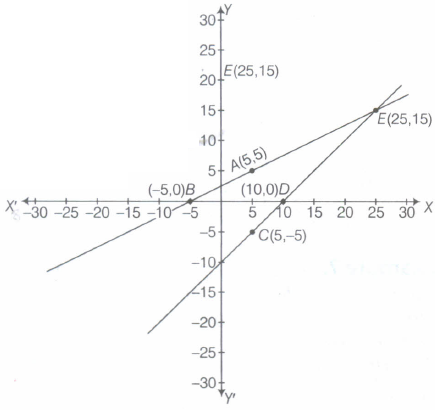
It is clear from the graph that, lines AB and CD intersect each other at point E (25,15).
So, x= 25 and y=15 is the required solution.
Hence, Sagar's present age = 25 yr and Tiru's present age = 15 yr.
12.
Let \(f(y)=7y^{ 2 }-\frac { 11 }{ 3 } y-\frac { 2 }{ 3 }\)
\(=\frac { 21y^{ 2 }-11y-2 }{ 3 } \)
\(=\frac { 21y^{ 2 }-14y+3y-2 }{ 3 } \) [by splitting the middle term]
\(=\frac { 7y(3y-2)+1(3y-2) }{ 3 } \)
\(=\frac { 1 }{ 3 } (3y-2)(7y+1)\)
So, the value of \(7y^{ 2 }-\frac { 11 }{ 3 } y-\frac { 2 }{ 3 } \) is zero whe 3y-2=0 or 7y+1=0, i.e. when \(y=\frac { 2 }{ 3 } \) or \(y=\frac { 1 }{ 7 } \).
Thus, the zeroes\(=\frac { 2 }{ 3 } -\frac { 1 }{ 7 } =\frac { 14-3 }{ 21 } =\frac { 11 }{ 21 } =-\left( \frac { -11 }{ 3\times 7 } \right) \)
\(=-(1).\left( \frac { Coefficient \ of \ y }{ Coefficient \ of \ y^{ 2 } } \right) \) and product of zeroes\(=\left( \frac { 2 }{ 3 } \right) \left( -\frac { 1 }{ 7 } \right) =\frac { -2 }{ 21 } =\frac { -2 }{ 3\times 7 } \)
\(=\left( \frac { Constant \ term }{ Coefficient \ of \ y^{ 2 } } \right) \)
Hence, the relations between the zeroes and the coefficients of the polynomials is verified.
13.
Let a and 2a are the zeroes of the polynomial 2x2-5x-(2k+1).
Then, \(\alpha +2\alpha =\frac { 5 }{ 2 } \Rightarrow 3\alpha =\frac { 5 }{ 2 } \Rightarrow \alpha =\frac { 5 }{ 6 } \)
\(2\alpha =2\times \frac { 5 }{ 6 } =\frac { 5 }{ 3 } \)
So, the zeroes of the polynomial are \(\frac { 5 }{ 6 } \) and \(\frac { 5 }{ 3 } \)
Now, as \(\alpha \times 2\alpha =\frac { -2k-1 }{ 2 } \)
\(\frac { 5 }{ 6 } \times \frac { 5 }{ 3 } =\frac { -2k-1 }{ 2 } \Rightarrow \frac { 25 }{ 18 } =\frac { -2k-1 }{ 2 } \)
\(\Rightarrow \quad 25-9(-2k-1)\)
\( \Rightarrow \quad 25=-18k-9\)
\( \Rightarrow \quad 18k=-9-25\)
14.
Here, n is a natural number and let 6n ends with 0.
Hence, 6n is divisible by 5.
But the prime factors of 6 are 2 and 3, so 5 is not a factor.
\(\Rightarrow \) 6n = (2 x 3)n
In the prime factorisation of 6n , 5 is not a factor.
By using the fundamental theorem of arithmetic, every composite number can be expressed as a product of primes and this factorisation is unique apart from the order, in which the prime factors occur.
So, our assumption, 6n ends with 0, is wrong.
Thus, there does not exist any natural number n, for which 6n ends with zero.
15.
\(\frac { 4x }{ x-2 } -\frac { 3x }{ x-1 } =7\frac { 1 }{ 2 } \)
\(\Rightarrow \frac { 4x(x-1)-3x(x-2) }{ (x-2)(x-1) } =\frac { 15 }{ 2 } \)
\(\Rightarrow \frac { 4x^{ 2 }-4x-3x^{ 2 }+6x }{ x^{ 2 }-3x+2 } =\frac { 15 }{ 2 } \)
\(\Rightarrow 2(x^{ 2 }+2x)=15(x^{ 2 }-3x+2)\)
\(\Rightarrow 2x^{ 2 }+4x=15x^{ 2 }-45x+30\)
\(\Rightarrow 13x^{ 2 }+49x+30=0\)
\(\Rightarrow 13x-39x-10x+30=0\)
\(\Rightarrow (x-3)(13x-10)=0\)
\(\Rightarrow x=3\quad x=\frac { 10 }{ 13 } \)
16.
Let the time taken by smaller tap to fill tank completely = x hrs
So, volume of tank filled by smaller tap in 1 hr \(=\frac{1}{x}\)
Volume of tank filled by larger tap in 1 hr \(=\frac{1}{x-2}\)
Now, time taken by both taps to fill \(=1 \frac{7}{8}=\frac{15}{8} \mathrm{hrs}\)
Tank filled by smaller tap in \(\frac{15}{8} \mathrm{hrs}=\frac{1}{x} \times \frac{15}{8}=\frac{15}{8 x}\)
Tank filled by larger tap in \(\frac{15}{8} \mathrm{hrs}=\frac{1}{x-2} \times \frac{15}{8}=\frac{15}{8(x-2)}\)
Therefore, \(\frac{15}{8 x}+\frac{15}{8(x-2)}=1 \Rightarrow \frac{15}{8}\left[\frac{1}{x \mid y}+\frac{1}{x-2}\right]=1\)
\(\Rightarrow \quad \frac{2(x-1)}{x^{2}-2 x}=\frac{8}{15}\)
⇒ 15(x -1) = 4(x2 - 2x)
⇒ 23x = 4x2 + 15
⇒ 4x2 - 23x + 15 = 0
\(
x=\frac{-(-23) \pm \sqrt{(-23)^{2}-4 \cdot 4 \cdot 15}}{2 \cdot 4}
\)
\(x=\frac{23 \pm 17}{8}
\)
Taking positive sign,
\(x=\frac{23+17}{8}=5\)
Taling negative sign,
\(x=\frac{23-17}{8}=\frac{3}{4}\)
When, taking x = 5
Time taken by smaller tap = 5 hrs
Time taken by larger tap = x - 2 = 5 - 2 = 3 hrs
When, taking x = \(\frac{3}{4}\)
Time taken by smaller tap \(=\frac{3}{4} \mathrm{hr}\)
Time taken by larger tap = x - 2
\(=\frac{3}{4}-2=\frac{-5}{4}\), Its not solution.
Hence, time taken by smaller tap = 5 hr and time taken by larger tap = 3 hr.
17.
Let the fraction be \(\frac { x }{ y } \)
\(\frac { x-2 }{ y+1 } =\frac { 1 }{ 2 } \)
\(\Rightarrow\) 2x - 4 = y + 1
\(\Rightarrow\) 2x - y = 5 ......(i)
Also, \(\frac { x+4 }{ y-3 } =\frac { 3 }{ 2 } \)
\(\Rightarrow\) 2x + 8 = 3y - 9
\(\Rightarrow\) 2x - 3y = - 17 ......(ii)
Subtracting this value of y in eqn. (i),
2x - 11 = 5
\(\therefore\) x = 8
Hence, x = 8, y = 11
\(\therefore \) Fraction \(=\frac { 8 }{ 11 }\)
18.
p(x) = 2x2 + 5x + k
Sum of zeroes \(=-\frac { Coeff. \ of \ x }{ Coeff. \ of \ { x }^{ 2 } } \)
\(=\alpha+\beta=\frac{-5}{2}\)
and product of zeroes \(=\frac { Costant \ term }{ Coeff. \ of \ { x }^{ 2 } } \)
\(\Rightarrow \quad =\alpha\beta=\frac{k}{2}\)
According to the question,
\({ \alpha }^{ 2 }+{ \beta }^{ 2 }+\alpha \beta =\frac { 21 }{ 4 } \)
\(\Rightarrow \quad \left( \alpha +\beta \right) ^{ 2 }-2\alpha \beta +\alpha \beta =\frac { 21 }{ 4 } \)
\(\left[ \because \left( \alpha +\beta \right) ^{ 2 }={ \alpha }^{ 2 }+{ \beta }^{ 2 }+2\alpha \beta \quad \right] \)
\(\Rightarrow \quad \left( \frac { -5 }{ 2 } \right) ^{ 2 }-\frac { k }{ 2 } =\frac { 21 }{ 4 } \)
\(\Rightarrow \quad ( \frac { 25 }{ 4 })-\frac { 21 }{ 4 } = \frac { k }{ 2 }\)
\(\Rightarrow \quad 1=\frac{k}{2}\Rightarrow k=2\)
Hence, k = 2
19.
x=-2, y=-1
20.
\(\frac { \alpha }{ \beta } +\frac { \alpha }{ \alpha } +2\left( \frac { 1 }{ \alpha } +\frac { 1 }{ \beta } \right) +3\alpha \beta \)
\(=\frac { \alpha ^{ 2 }+\beta ^{ 2 } }{ \alpha \beta } +2\left( \frac { \alpha +\beta }{ \alpha \beta } \right) +3\alpha \beta =-\frac { 2 }{ 3 } \)
21.
Hint LCM of 48. 72 and 108 = 2 x 2 x 2 x 2 x 3 × 3 x 3 = 432
Therefore, after 432 s, they will change simultaneously. We know that 60 s = 1min
⇒ 1s = 1/60 min
⇒ 432 s = 432/60 min =7min 12 s
Hence, the lights change simultaneously at 7 : 07 : 12 am.
22.
(a)
\(-\frac{6}{5}\)
23.
(d)
1625
24.
(b)
-3, -10
25.
(c)
no real roots
26.
(d)
no solution
27.
(a)
7,13
28.
(d)
m – √n
29.
(c)
-2
30.
(a)
1, -1
31.
(a)
One solution
32.
(d)
are coincident
33.
(c)
Equating either of the coefficients
34.
(a)
Quadratic polynomial
35.
(c)
May be a monomial, binomial or a trinomial
36.
(b)
-7 and 10
37.
(a)
-b/a
38.
(d)
20
39.
(c)
2
40.
(a) Both Assertion and Reason are correct and Reason is the correct explanation of Assertion.
41.
(d) If Assertion is incorrect but Reason is correct.
42.
(i) (b): Roots of the quadratic equation are 2 and -3.
\(\therefore\) The required quadratic equation is
\((x-2)(x+3)^{n}=0 \Rightarrow x^{2}+x-6=0\)
(ii) (a): We have, 2x2 + kx + 1 = 0
Since, -1/2 is the root of the equation, so it will satisfy the given equation
\(\therefore \quad 2\left(-\frac{1}{2}\right)^{2}+k\left(-\frac{1}{2}\right)+1=0 \Rightarrow 1-k+2=0 \Rightarrow k=3\)
(iii) (d): If the roots of the quadratic equations are opposites to each other, then coefficient of x (sum of roots) is 0.
So, both (a) and (b) have the coefficient of x = 0.
(iv) (c): The given equation is (x - 2)2 + 19 = 0
\(\Rightarrow x^{2}-4 x+4+19=0 \Rightarrow x^{2}-4 x+23=0\)
(v) (b): If one root of a quadratic equation is irrational, then its other root is also irrational and also its conjugate i.e., if one root is p +.\(\sqrt(q)\) then its other root is p -.\(\sqrt(q)\).
43.
(i) (a): Situation faced by Sudhir can be represented algebraically as 2x + 3y = 850
(ii) (b): Situation faced by Suman can be represented algebraically as 3x + 2y = 900
(iii) (c) : We have 2x + 3y = 850 .........(i)
and 3x + 2y = 900 .........(ii)
Multiplying (i) by 3 and (ii) by 2 and subtracting, we get
5y = 750 \(\Rightarrow\) Y = 150
Thus, price of one Physics book is Rs 150.
(iv) (d): From equation (i) we have, 2x + 3 x 150 = 850
\(\Rightarrow\) 2x = 850 - 450 = 400 \(\Rightarrow\) x = 200
Hence, cost of one Mathematics book = Rs 200
(v) (a): From above, we have
\(a_{1} =2, b_{1}=3, c_{1}=-850 \)
\(\text { and } a_{2} =3, b_{2}=2, c_{2}=-900\)
\(\therefore \quad \frac{a_{1}}{a_{2}}=\frac{2}{3}, \frac{b_{1}}{b_{2}}=\frac{3}{2}, \frac{c_{1}}{c_{2}}=\frac{-850}{-900}=\frac{17}{18} \Rightarrow \frac{a_{1}}{a_{2}} \neq \frac{b_{1}}{b_{2}} \neq \frac{c_{1}}{c_{2}}\)
Thus system of linear equations has unique solution.
44.
(i) (c): Here, the simplest form of given options are
125/441 = 53/(32 x 72), 77/210 = 11/(2 x 3 x 5),
15/1600 = 3/(26 x 5) Out of all the given options, the denominator of option (c) alone has only 2 and 5 as factors. So, it is a terminating decimal.
(ii) (b): 23/(23 x 52) = 23/200 = 0.115
(iii) (a): 441/(22 x 57 x 72) = 9/(22 x 57), which is a terminating decimal.
(iv) (d): The fraction form of a non-terminating recurring decimal will have at least one prime number other than 2 and 5 as its factors in denominator. So, p can take either of 3, 7 or 15.
(v) (a): Here denominator has only two prime factors i.e., 2 and 5 and hence it is a terminating decimal.

10th Standard CBSE Syllabus & Materials
10th Standard CBSE
CBSE 10th Social Science PS - Federalism - New Model Questions Papers Study Material - QB365 Set A
NEW10th Standard CBSE
CBSE 10th Social Science PS - Power Sharing - New Model Questions Papers Study Material - QB365 Set A
NEW10th Standard CBSE
CBSE 10th Social Science GEO - Manufacturing Industries - New Model Questions Papers Study Material - QB365 Set A
NEW10th Standard CBSE
CBSE 10th Social Science GEO - Minerals and Energy Resources - New Model Questions Papers Study Material - QB365 Set A



NCERT Books

Syllabus

Exam Pattern

Sample Question Papers

Previous year Question Papers

Important Notes

MCQ Practice test

NCERT Exemplers

Case study Questions

Image Based Questions

Passage based Questions

HOT Questions

Value Based Questions

Model Questions Papers
NCERT ( Book Back ) Questions

Assertion and Reason
Important Questions And Answers

CBSE 10th Standard CBSE Subjects
CBSE Standards



