
 100% FREE ACCESS
10th Standard CBSE Syllabus & Materials
10th Standard CBSE
CBSE 10th Social Science ECO - Globalisation and the Indian Economy - New Model Questions Papers Study Material - QB365 Set A
NEW10th Standard CBSE
CBSE 10th Social Science ECO - Money and Credit - New Model Questions Papers Study Material - QB365 Set A
NEW10th Standard CBSE
CBSE 10th Social Science ECO - Sectors of the Indian Economy - New Model Questions Papers Study Material - QB365 Set A
NEW10th Standard CBSE
CBSE 10th Social Science ECO - Development - New Model Questions Papers Study Material - QB365 Set A
NEW10th Standard CBSE
CBSE 10th Social Science PS - Outcomes of Democracy - New Model Questions Papers Study Material - QB365 Set A
NEW10th Standard CBSE
CBSE 10th Social Science PS - Gender, Religion and Caste - New Model Questions Papers Study Material - QB365 Set A

Published on: 20/10/2025
Download CBSE Class 10th Standard CBSE Maths question papers, sample papers, important questions, and previous year solved papers in PDF format. Get free study materials, NCERT solutions, and exam preparation resources for Class 10th Standard CBSE Maths
Questions + Answers key
Take MCQ Maths Test
1.
A ship was moving towards the shore at a uniform speed of 36 km/h. Initially, the ship was 1.3 km away from the foot of a lighthouse which is 173.2 m in height.
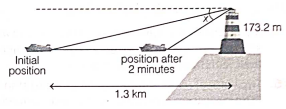
(Note The figure is not to scale.)
Find the angle of depression x of the top of the lighthouse from the ship after the ship had been moving for 2 min. Show your steps and give reasons.
[take (√3 =1.732)]
2.
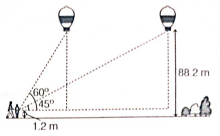
A 1.2 m tall girls pots a balloon moving with the wind in a horizontal linc at a height 88.2 m from the ground. The angle of elevation of the balloon from the eyes of the girlat any instant is 60°. After sometime, the angle of clevation reduces 45°. Find the distance travelled by the balloon during the interval.
3.
An observer 1.75m tall is at a distance of 24 m from a wall 25.75 m high. Find the angle of elevation of the top of the wall at the observer's eye
4.
If it possible to determine the dimensions of a room whose length is 3 m more than its breadth, if the area of the room is 70 sq. m.
5.
The angles of elevation and depression of the top and bottom of a light - house from the top of a 60 m high building are 30o and 60o respectively. Find
(i) the difference between the heights of the light - house and the building.
(ii) the distance between the light - house and the building.
6.
A statue 1.46 m tall stand on the top of a pedestal. From a point on the ground, the angle of elevation of the top of the statue is 60o and from the same point, the angle of elevation of the top of the pedestal is 45o . Find the height of the pedestal. \((\sqrt { 3 } =1.73)\) .
7.
Solve the equation \({4\over3}-3={5\over2x+3}; x\ne0,-{3\over2}\), for x.
8.
Find the positive value of k, for which the equations x2+kx+64=0 and x2-8x+k=0 will both have real roots.
9.
A speed of a boat in still water is 11km/hour. It can go 12km upstream and return downstream to the original point in 2 hours 45 minutes. Find the speed of the stream.
10.
Using quadratic formula, solve the following quadratic equation for x:
p2x2+(p2-q2)x-q2=0
11.
The sum of squares of two consecutive even numbers is 340. Find the numbers.
12.
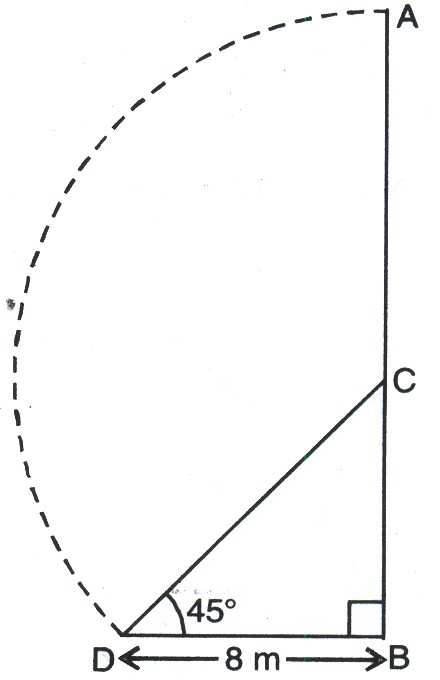
A tree breaks due to storm and the broken part bends so that the top of the tree touches the ground making an angle 45o with it. The distance between the foot of the tree to the point where the top touches the ground is 8 m. Find the height of the tree.
13.
The speed of a boat in still water is 11 km\h. It can go 12 km upstream and return downstream to the original point in 2 hours and 45 minutes. Find the speed of the stream.
14.
The hypotenuse of right-angled triangle is \(3\sqrt{10} \ \ cm\). If the smaller side is the tripled and the longer side is doubled, the new hypotenuse will be \(9\sqrt {5} \ \ cm\) , find the length of each sides.
15.
The difference between the ages of Sohrab and his father is 30 years. The difference of the squares of their ages is 1560. Find the age of soharb and his father.
16.
The angle of elevation of an aeroplane from a point A on the ground is 60o . After a flight of 30 seconds, the angle of elevation changes to 30o . If the plane is flying at a constant height of \(3600\sqrt { 3 } \) m, find the speed in km/hr of the plane.
17.
The angle of elevation of a cloud from a point 60 m above a lake is 30o and the angle of depression of the reflection of the cloud in the lake is 60o . Find the height of the cloud from the surface of the lake.
18.
The perimeter of a right-angled triangle is 70 units and its hypotenuse is 29 units. Find the lengths of the other sides.
19.
Solve for x: \(2({2x-1\over x+3})-3({x+3\over 2x-1})=5\); given that \(x\ne-3,x\ne{1\over 2}\)
20.
A graph of quadratic polynomial is given below
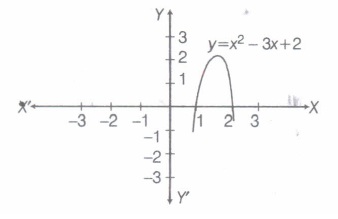
If we rotate the axes at an angle of 90° in anti-clockwise direction, the figure remains at the same position. Find the equation of the graph.
y2 + 3y + 2
y2 -3y + 2
y2 + 2y + 3
y2 - 2y + 3
21.
Value(s) of k for which the quadratic equation 2x2 - kx + k = 0 has equal roots is/are
0
4
8
0,8
22.
The same value of x satisfies the equations 4x + 5 = 0 and 4x2 + (5 + 3p)x + 3p2=0, then p is
0 or 5/4
¼ or ½
0 or ¼
0 or ½
23.
The condition for equation ax2 + bx + c = 0 to be quadratic is
a ≠ 0
a > 0
a ≠ 0, b ≠ 0
a < 0
24.
If x = -2 is a root of equation x2 – 4x + K = 0 then value of K is
-8
8
-12
12
25.
If 1/2 is a root of the equation x2 + kx-5/4 = 0 then the other root of the quadratic equation is
1/4
-5/2
-2
1/2
26.
The nature of the roots of following quadratic equation 3x2-4√3x+4=0 is
Unequal
Equal
No real roots
None of above
27.
The length of shadow of a tower on the plane ground is √3 times the height of the tower. The angle of elevation of sun is :
90o
60o
30o
45o
28.
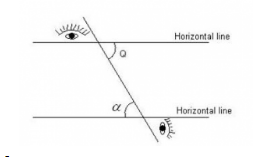
In the above fig Q and α respectively are
Angle of Depression and Angle of Depression
Angle of Elevation and Angle of depression
Angle of Elevation and Angle of Elevation
Angle of depression and Angle of Elevation
29.
A tree casts a shadow 4 m long on the ground, when the angle of elevation of the sun is 450. The height of the tree is:
4.5 m
3 m
5.2 m
4 m
1.
Speed of ship \(=36 \mathrm{~km} / \mathrm{h}\)
Time taken \(=2 \mathrm{~min}\)
Therefore Distance covered by ship in \(2 \mathrm{~min}=36 \times \frac{2}{60}=1.2 \mathrm{~km}\)
Distance of ship from foot of lighthouse =1.3-1.2
\(=0.1 \mathrm{~km} =100 \mathrm{~m}\)
Let angle of elevation of the ship to the top of the lighthouse \(=y^{\circ}\)
Then, \(\tan y=\frac{173.2}{100}=1.732\)
\(\Rightarrow \quad \tan y=\sqrt{3} {[\because 1.732=\sqrt{3}]} \)
\( \Rightarrow \quad y=60^{\circ} \)
\({\left[\because \tan \sqrt{3}=\tan 60^{\circ}\right]}\)
Now, \(y=x^{\circ} \quad[\because\) alternate interior angles are equal ]
Thus, \(x^{\circ}=60^{\circ}\)
2.
Trigonometric ratio involving AB, BC, OD, OA and angles is tanθ. [Refer AB, BC, OA and OD from the figure.]
Distance travelled by the balloon OB = AB - OA
From the figure, OD = BC, and it can be calculated as
88.2 m - 1.2 m = 87 m --- (1)
In ΔAOD,
tan 60° = OD/OA
√3 = 87/OA
OA = 87 / √3
= 87 × √3 / √3 × √3
= (87 × √3) / 3
= 29√3 m
3.
45°
4.
Yes, 7 m and 10 m
5.
Let AB is the building
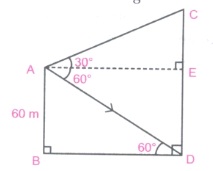
∴ AB=60 m and CD is the light house.
ㄥEAC=30o
and ㄥEAD=60o
∴ ㄥADB=60o
∴ AE||BD
In right ΔABD,
\(\frac { BD }{ AB } \)=cot 600⇒ \(\frac { BD }{ 60 } =\frac { 1 }{ \sqrt { 3 } } \)
⇒ BD=\(\frac { 60 }{ \sqrt { 3 } } \) m=20\(\sqrt { 3 } \) m.
∵ BD=AE
∴ AE=20\(\sqrt { 3 } \) m
Now in right ΔCEA, tan 300=\(\frac { CE }{ AE } \)
⇒ \(\frac { 1 }{ \sqrt { 3 } } =\frac { CE }{ 20\sqrt { 3 } } \)⇒ CE=20 m
(i) Difference between the heights of the light house and the building=CE=20 m
(ii) The distance between the light house and the building =BD=20\(\sqrt { 3 } \) m
6.
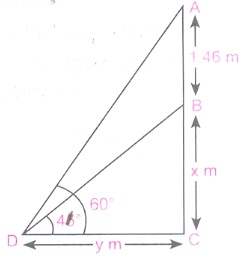
Let AB is statue, BC is pedestal and BC=x m, CD=y m.
In right ΔBCD, ΔBCD, \(\frac { BC }{ CD } \)=tan 45o
⇒, \(\frac { x }{ y } \)=1 ⇒ x=y .....(i)
In right ΔACD, \(\frac { AC }{ CD } \)=tan 600
⇒ \(\frac { x+1.46 }{ y } =\sqrt { 3 } \)
⇒ \(\frac { x+1.46 }{ x } \)=1.73 [Using (i)]
⇒ x+1.46=1.73x ⇒ 0.73x=1.46 ⇒ x=2
7.
Consider the equation
\(\frac { 4 }{ x } -3=\frac { 5 }{ 2x+3 } ,x\neq 0,-\frac { 3 }{ 2 } \)
\(\Rightarrow \frac { 4-3x }{ x } =\frac { 5 }{ 2x+3 } \)
\(\Rightarrow (4-3x)(2x+3)=5x\)
\(\Rightarrow 8x+12-6x^{ 2 }-9x=5x\)
\(\Rightarrow 6x^{ 2 }+6x-12=0\)
\(\Rightarrow 6(x^{ 2 }+x-2)=0\)
\(\Rightarrow x^{ 2 }+x-2=0\)
\(\Rightarrow x^{ 2 }+2x-x-2=0\)
\(\Rightarrow x(x+2)-1(x+2)=0\)
\(\Rightarrow (x+2)(x-1)=0\)
\(\Rightarrow \) Either x+2=0 or x-1=0
\(\Rightarrow \) x=-2,1
8.
If the equation x2+kx+64=0 has real roots,then D \(\ge 0\)
\(\Rightarrow k^{ 2 }-4\times 64\ge 0\quad \Rightarrow k^{ 2 }\ge 256\Rightarrow k^{ 2 }\ge (16)^{ 2 }\)
\(\Rightarrow k\ge 16\) \(\left[ \therefore k>0 \right] \) ...(i)
If the equation x2 - 8x+k=0 has real roots then D \(\ge \) 0 \(\Rightarrow 64-4k\ge 0\Rightarrow 4k\le 64\) ...(ii)
From (i) and (ii) we get k=16
9.
Let speed of the stream be x km/h
Speed of the boat in still water = I I km/h
\(\therefore \) Upstream speed be (11-x) km/h and downstream speed be (11+x) km/h
Distance = 12 km
Time taken for downstream direction = \(\frac { 12 }{ 11+x } \) hours
Time taken for upstream direction = \(\frac { 12 }{ 11-x } \) hours
ATQ \(\frac { 12 }{ 11+x } +\frac { 12 }{ 11-x } =2\frac { 3 }{ 4 } \Rightarrow \frac { 12(11-x)+12(11+x) }{ (11+x)(11-x) } =\frac { 11 }{ 4 } \)
\(\Rightarrow \frac { 132+132 }{ 121-x^{ 2 } } =\frac { 11 }{ 4 } \Rightarrow 4\times 264=11(121-x^{ 2 })\)
\(\Rightarrow \frac { 4\times 264 }{ 11 } =121-x^{ 2 }\Rightarrow 4\times 24=121-x^{ 2 }\)
\(\Rightarrow x^{ 2 }=25\Rightarrow x=\pm 5\)
Hence speed of the stream is x=5 km/h
10.
\(p^{ 2 }+x^{ 2 }+(p^{ 2 }-q^{ 2 })x-q^{ 2 }=0\)
Here a=p2,b=(p2-q2),x= c=q2
D= b2-4ac=(p2-q2)2-4Xp2-4Xp2X(-q2) = (62+q2)2
Now x= \(x=\frac { -b\pm \sqrt { D } }{ 2a } ,\frac { -b-\sqrt { D } }{ 2a } \)
\(\Rightarrow x=\frac { -(p^{ 2 }-q^{ 2 })+\sqrt { (p^{ 2 }+q^{ 2 })^{ 2 } } }{ 2\times p^{ 2 } } ;x=\frac { (-p^{ 2 }-q^{ 2 })-\sqrt { (p^{ 2 }-q^{ 2 })^{ 2 } } }{ 2\times p^{ 2 } } \)
\(\Rightarrow x=\frac { q^{ 2 } }{ p^{ 2 } } ,-1\)
11.
Let the numbers be x, x + 2
(x)2+(x+2)2=340
x2+x2+4+4x=340
\(\Rightarrow 2x^{ 2 }+4x-3369=0\)
On dividing by 2, we get
x2+2x-168=0
\(\Rightarrow (x+14)(x-12)=0\)
\(\Rightarrow x=12\)
The numbers are, 12, (12 + 2) i.e., 12, 14
12.
Let AB=h m be height of the tree and AC is the part of the broken tree. As ㄥCDB=450 and BD=8 m
Consider rt . angled ΔCBD, we have
tan45o=\(\frac { CB }{ DB } \)
1=\(\frac { CB }{ 8 } \)
⇒ CB=8 m
Also, cos450=\(\frac { DB }{ DC } \)
\(\frac { 1 }{ \sqrt { 2 } } =\frac { 8 }{ DC } \)
⇒ Dc=8\(\sqrt { 2 } \)
Total height of the tree AB=AC+CB
=CD+CB
=8\(\sqrt { 2 } \)m+8m
=8(\(\sqrt { 2 } \) +1)m
13.
5 Km/h
14.
3 cm, 9 cm
15.
41 years, 11 years
16.
Let AC = x m and CE = y m
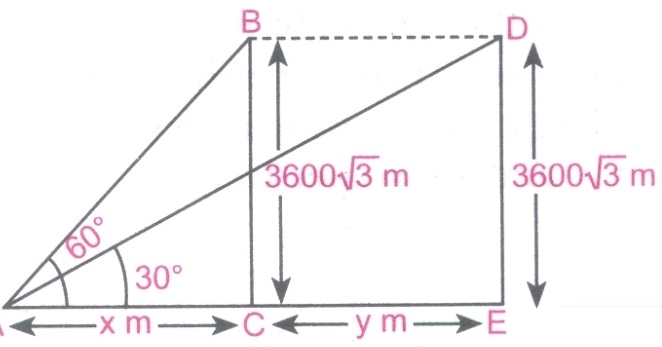
In rt.ΔACB, tan60o =\(\frac { BC }{ AC } \)
\(\sqrt { 3 } =\frac { 3600\sqrt { 3 } }{ x } \)
x = 3600 m
Now, In right ΔAED,
tan300 = \(\frac { DE }{ AE } \)
\(\frac { 1 }{ \sqrt { 3 } } =\frac { 3600\sqrt { 3 } }{ 3600+y } \)
3600 + y = 10800
y = 7200 m
BD = CE
∴ BD = 7200 m
∴ Distance covered in 30 seconds
= 7200 m
So, Speed = \(\frac { 720 }{ 30 } \) = 240 m/s
=\(240\times \frac { 18 }{ 5 } \) = 864 km/hr
17.
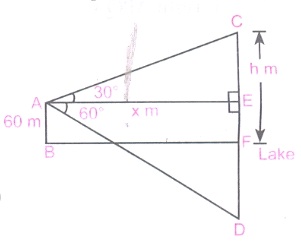
Let height of the cloud C from lake be h m . A is position of the point 60 m above the lake. D is the reflection of the cloud in lake .
Let AE=x m, CF=h m, CE=(h-60)m
DE=(60+h)m.
In right angled triangle AEC
\(\frac { AE }{ EC } \)=cot 300
AE=(h-60)\(\sqrt { 3 } \) .........(i)
In right angled triangle AED,
\(\frac { AE }{ ED } =cot60^{ 0 }\quad \Rightarrow \quad AE=\frac { h+60 }{ \sqrt { 3 } } \) .............(ii)
From (i) and (ii), we get
\((h-60)\sqrt { 3 } =\frac { h+60 }{ \sqrt { 3 } } \)
⇒ 3h-180=h+60 ⇒ 2h=240 ⇒ h=120 m.
∴ Height of the cloud above the lake is 120 m.
18.
Let ABC is the right-angled triangle.
Let BC=x units and AB=y units.
Also AC Hypotenuse=29 units
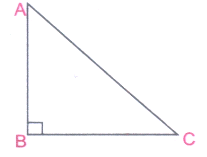
Now Perimeter=70 units
\(\Rightarrow\) x+y+29=70
\(\Rightarrow\) x+y=41
\(\Rightarrow\) y=41-x ....(i)
Also, AC2=AB2+BC2
\(\Rightarrow\) (29)2=(y)2+x2
\(\Rightarrow\) 841=(41-x)2+x2 [Using (i)]
\(\Rightarrow\) 841=1681+x2-82x+x2
\(\Rightarrow\) 2x2-82x+840=0
\(\Rightarrow\) x2-41x+420=0
\(\Rightarrow\) (x-20)(x-21)=0
\(\Rightarrow\) x=20 or x=21
Wnen x=20, y=41-x=21 and when x=21, y=41-21=20
\(\therefore\) Length of other sides are 20 units and 21 units.
19.
\(2\left( \frac { 2x-1 }{ x+3 } \right) -3\left( \frac { x+3 }{ 2x-1 } \right) =5\)
Let \(\frac { 2x-1 }{ x+3 } =y\)
Given equation becomes \(2y-3\times \frac { 1 }{ y } =5\Rightarrow 2{ y }^{ 2 }-3=5y\Rightarrow 2{ y }^{ 2 }-5y-3=0\)
\(\Rightarrow 2{ y }^{ 2 }-6y+y+3=0\Rightarrow 2y(y-3)+1(y-3)=0\)
\(\Rightarrow \left( y-3 \right) (2y+1)=0\Rightarrow y=3,y=-\frac { 1 }{ 2 } \)
\(\Rightarrow \frac { 2x-1 }{ x+3 } =3\Rightarrow \frac { 2x-1 }{ x+3 } =-\frac { 1 }{ 2 } \Rightarrow 2x-1=3x+9or4x-2=-x-3\)
\(\Rightarrow \) -x = 10 or 5x = -1 \(\Rightarrow \) x = -10 or \(x=\frac { -1 }{ 5 } \)
\(\Rightarrow \) x = -10,\(\frac { -1 }{ 5 } \)
20.
(a)
y2 + 3y + 2
21.
(d)
0,8
22.
(a)
0 or 5/4
23.
(a)
a ≠ 0
24.
(c)
-12
25.
(b)
-5/2
26.
(b)
Equal
27.
(c)
30o
28.
(d)
Angle of depression and Angle of Elevation
29.
(d)
4 m

10th Standard CBSE Syllabus & Materials
10th Standard CBSE
CBSE 10th Social Science PS - Federalism - New Model Questions Papers Study Material - QB365 Set A
NEW10th Standard CBSE
CBSE 10th Social Science PS - Power Sharing - New Model Questions Papers Study Material - QB365 Set A
NEW10th Standard CBSE
CBSE 10th Social Science GEO - Manufacturing Industries - New Model Questions Papers Study Material - QB365 Set A
NEW10th Standard CBSE
CBSE 10th Social Science GEO - Minerals and Energy Resources - New Model Questions Papers Study Material - QB365 Set A



NCERT Books

Syllabus

Exam Pattern

Sample Question Papers

Previous year Question Papers

Important Notes

MCQ Practice test

NCERT Exemplers

Case study Questions

Image Based Questions

Passage based Questions

HOT Questions

Value Based Questions

Model Questions Papers
NCERT ( Book Back ) Questions

Assertion and Reason
Important Questions And Answers

CBSE 10th Standard CBSE Subjects
CBSE Standards



